REVIEW 3 major objections 4 minor 20 references
Regular Bouncing Solutions, Energy Conditions and the Brans-Dicke Theory
T0 review · 3 major / 4 minor · reviewed 2026-08-14 · deepseek-v4-flash
Pith's one-line read This paper claims that regular, nonsingular bounces arise in Brans-Dicke theory with standard radiation, without phantom fields or energy-condition violations.
desk verdict A correct but modest re-analysis of known Gurevich solutions: the no-phantom bounce window holds as background algebra, but the physical status of the phi->0 boundary is unproven and the perturbation spectrum is already ruled out. read the letter →
The pith
A machine-rendered reading of the paper's core claim, the machinery that carries it, and where it could break.
The reading
What carries the argument
The mechanism is the non-minimal coupling between the Brans-Dicke scalar $\phi$ and the Ricci scalar, combined with the exact Gurevich et al solutions for a flat FLRW universe filled with a perfect fluid $p = \alpha\rho$. The scale factor and scalar are power laws in conformal time; demanding that the cosmic time integral be finite and the scale factor have a minimum imposes inequalities on the exponents, fixing $-3/2 \leq \omega \leq -4/3$ for $1/4 \leq \alpha < 1$. The lower-sign branch of Eqs. (19)-(20) is the one that realizes the bounce, and the conformal transformation to the Einstein frame with $b = \phi^{1/2}a$ shows the same history as a singular cosmology, which the paper interprets as a conformal continuation: the bounce is an effect of the frame geometry and the non-minimal coupling.
What would settle it
A numerical integration of the Brans-Dicke equations on a Bianchi I background starting from the contracting branch with a small initial shear would settle the claim: if the shear or curvature invariant diverges before the scale factor reaches its minimum, the regular bounce does not survive.
Extended reading notes
Core claim
The central discovery is that Brans-Dicke theory with a fluid obeying $p = \alpha\rho$ admits regular bounces for $1/4 \leq \alpha < 1$ when the Brans-Dicke parameter lies in $-3/2 \leq \omega \leq -4/3$, and for radiation ($\alpha = 1/3$) this happens while the fluid satisfies the energy conditions and the scalar field has positive kinetic energy in the Einstein frame. The solutions chosen are the lower-sign Gurevich et al expressions for the scale factor and scalar field; in that branch the universe contracts from infinite size, reaches a minimum scale factor, and re-expands, with cosmic time running from $-\infty$ to $+\infty$ and no curvature singularity. The scalar field $\phi$ tends to zero at the asymptotic ends, making the effective gravitational coupling diverge there, but only where the scale factor is also infinite. The paper presents this as evidence that non-minimal coupling, not phantom matter, can be the origin of the regular bounce.
Load-bearing premise
The load-bearing assumption is that it is acceptable for the scalar field $\phi$ to approach zero at infinite cosmic time, making the effective gravitational coupling diverge precisely when the universe is infinitely large; the paper relies on a footnote expectation, not a calculation, that anisotropies stay suppressed.
Editorial extensions
If this is right
- The result removes the automatic implication that a classical bounce needs ghosts: within this parameter window, radiation alone can do it while satisfying the standard energy conditions.
- The interval $-3/2 \leq \omega \leq -4/3$, though excluded by Solar System tests today, becomes a plausible early-universe regime if $\omega$ varies with time, as suggested by Horndeski extensions and by string effective actions with $\omega = -1$.
- Because the background is exactly solvable, the model offers a controlled analytic setting for studying perturbation propagation through a nonsingular bounce in scalar-tensor gravity.
- The paper's own perturbation analysis shows that a single radiation fluid gives a spectrum in clear disagreement with observations, so the bounce window is best read as an ingredient for richer models rather than a complete cosmology.
- Since the bounce condition holds for any $1/4 \leq \alpha < 1$, the mechanism is generic to a family of barotropic fluids, not a special accident of radiation.
Reading between the lines
- If the regularity survives the inclusion of anisotropies, then singularity avoidance in scalar-tensor gravity may be generic for a wide band of negative couplings, and the usual theorem linking bounces to energy-condition violations would need to be stated with the non-minimal coupling explicitly excluded.
- A concrete next computation suggested by the paper's footnote 2 is a Bianchi I treatment of the lower-sign solutions; the paper only expects anisotropic instabilities to die out because the scale factor grows, so an explicit shear perturbation would either confirm or overturn the regularity claim.
- The singular Einstein-frame dual points toward a broader rule: a nonsingular Jordan-frame bounce with $\phi \to 0$ at infinity maps to a singular Einstein-frame cosmology, reversing the usual intuition that physical predictions should be frame-independent.
- Because the pure-radiation power spectrum is blue and scale-dependent, one could testably add a dust-like contraction phase or a second field to see whether the observed near-scale-invariant spectrum can be recovered while keeping the bounce intact.
Signed reviews
Editorial analysis
A structured set of objections, weighed in public.
Referee Report
Summary. The paper analyzes flat FLRW Brans-Dicke cosmologies with a perfect fluid obeying p = αρ, focusing on the radiative case α = 1/3. Using the Gurevich et al. solutions, it identifies a parameter window, approximately -3/2 < ω ≤ -4/3 with the lower-sign branch of Eqs. (19)-(20), in which the Jordan-frame scale factor bounces regularly between two asymptotic states with a → ∞ while the scalar field φ tends to zero at one of the boundaries. The authors argue that in this window the scalar field has positive kinetic energy in the Einstein frame (no phantom/ghost), the fluid obeys the energy conditions, and the singularity is avoided by the non-minimal coupling rather than by exotic matter. They also present a perturbation analysis for the radiative model and report a spectral index in disagreement with observations.
Significance. If the main claim is correct, the paper would be a useful counterexample to the folklore that bouncing solutions require phantom fields or energy-condition violations: it shows, using closed-form Gurevich et al. solutions, that a simple Brans-Dicke theory with ordinary radiation can produce a non-singular Jordan-frame bounce. The analysis has genuine strengths: it is based on explicit analytical solutions, the exponent algebra leading to the bounce window is checkable, and the no-ghost statement follows directly from the sign of the kinetic term in Eq. (24) rather than from fitting parameters to a desired outcome. The perturbation section is also honest in reporting that the radiative model's spectrum is not compatible with observations. The significance is, however, conditional on the physical admissibility of the φ → 0 boundary and on clarifying the energy-condition statements, which the paper does not fully establish.
major comments (3)
- [3, especially after Eq. (30) and footnote 2] The central existence claim rests on accepting that φ → 0 at infinite cosmic time, which makes the gravitational coupling G = 1/φ diverge. In the lower-sign radiative solution for -3/2 < ω ≤ -4/3, φ ∝ (η - η_+)^r (η - η_-)^{-r} tends to zero as η → η_+ while the scale factor diverges, and the conformal transformation to the Einstein frame is singular there. The only justification given is footnote 2, which says one 'can expect' anisotropic instabilities not to develop because the scale factor grows. This is an assumption, not a stability analysis. Since the regular-bounce claim is load-bearing on this boundary, the authors should either provide a concrete analysis of anisotropic or scalar perturbations through the asymptotic regime (e.g., a Bianchi I treatment) or explicitly state that the result is conditional on the admissibility of a divergent G. Without this, the solution may be only a formal regular geometry rather than a physically realizable bounce.
- [4, around Eqs. (24), (33)-(34)] The sentence 'It is easy to verify that both energy conditions are satisfied as far as ω < −3/2' appears to contradict Eq. (24), where for ω < −3/2 the coefficient (ω + 3/2) is negative and the Einstein-frame scalar field is phantom, so it violates both the null and strong energy conditions. The following sentence, 'This is consistent with the fact that in the Einstein frame the cosmological scenarios are singular unless ω < −3/2,' also reads backwards: for ω < −3/2 the Einstein-frame solutions (21)-(22) are non-singular, which is what one expects when energy conditions are violated. The subsequent discussion of 'effective' energy conditions using the left-hand sides of Eqs. (33)-(34) needs a precise definition of which stress-energy tensor is being evaluated and in which frame. This ambiguity directly affects the paper's central claim that energy conditions are preserved, so it must be corrected and clarified.
- [5, first paragraph; Section 3, dual solution] The abstract and Section 5 state that regular bounce solutions exist 'without any phantom field, even in the Einstein frame,' but the Einstein-frame geometry for the window -3/2 < ω ≤ -4/3 is not regular: the dual scale factor b = φ^{1/2}a is proportional to (η - η_+)^{1/2}(η - η_-)^{1/2} and vanishes at both endpoints, i.e., it is the singular big-bang/crunch geometry of a closed radiation-filled universe, as the authors themselves note. Thus 'regular' applies only to the Jordan frame; the Einstein frame contains a curvature singularity. The paper should either remove the 'even in the Einstein frame' claim or explain in what precise sense energy conditions are preserved there despite the singular geometry. As written, this overstates the frame-invariance of the regularity result.
minor comments (4)
- [5, Discussion] The interval is stated inconsistently: Section 3 uses -3/2 < ω ≤ -4/3, Section 5 uses -3/2 ≤ ω ≤ -4/3, and the Discussion contains '−3/2 < ω ≤ 4/3', which should clearly be '-4/3'. Since r = 1/sqrt(1 + 2ω/3) diverges at ω = -3/2, the endpoint should be excluded or discussed explicitly.
- [4, after Eq. (38)] The definition 'h = kkk/a^2' appears to be a typesetting artifact; please define h and the other perturbation variables unambiguously, for instance in terms of the synchronous metric perturbation and the scalar field perturbation.
- [4, Eq. (43)] The definition 'Δ = k^3 δ_k^2 = k^{n_s - 1}' is not the standard dimensionless power spectrum; please clarify the normalization and the relationship between δ_k and the density contrast.
- [3, footnote 2] The caveat about the divergent gravitational coupling is relegated to a footnote; given its importance, it should be promoted to the main text and stated as a condition on the validity of the regular-bounce claim.
Circularity Check
No significant circularity: the regular-bounce interval is derived from external Gurevich et al. solutions via explicit inequalities, with no fitted parameters masquerading as predictions.
full rationale
The paper's central claim is that Brans-Dicke theory with a radiative fluid satisfying p = alpha rho admits regular bouncing solutions for 1/4 <= alpha < 1 and -3/2 <= omega <= -4/3. This is not obtained by fitting any parameter to the desired bounce. The starting point is the external Gurevich et al. solution set quoted in Eqs. (10)-(14) and (19)-(23), and the bounce interval is derived from the stated inequalities r+ < 0, r+ + r- > 0, and 3*alpha*r+ + 1 < 0. No equation is defined in terms of the conclusion. The no-ghost statement follows directly from the sign of the kinetic term (omega + 3/2)(nabla phi)^2/phi^2 in the Einstein-frame action (Eq. 24); it is an evaluation, not a fitted prediction. The one same-author citation used in the parameter discussion, Ref. [7] for 'The case alpha = 1 is quite peculiar, and contains no bounce,' is non-load-bearing because the paper's own inequalities already exclude alpha = 1: their condition requires omega*(1-alpha) < -1, which cannot hold when alpha = 1. Footnote 2 explicitly flags a limitation: 'One can expect that instabilities (due to the anisotropic perturbations) do not develop since, in this situation, anisotropies are suppressed as they decay fast when the scale factor increases.' This is an unproven physical-admissibility assumption about the phi -> 0 boundary, and it is a legitimate correctness risk, but it does not make the derivation circular: the stated solution and its regularity properties do not reduce to the conclusion. The perturbation analysis is also self-contained and even reports disagreement with observations rather than tuning to a target spectrum. Overall, the derivation chain is independent of its own output, so the circularity score is 0.
Assumptions & free parameters
free parameters (1)
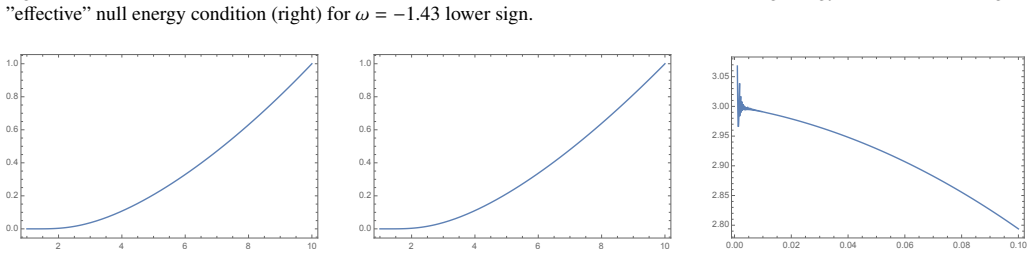
- Brans-Dicke parameter omega in perturbation figures =
-1.43
assumptions (4)
- domain assumption The Gurevich et al solutions, Eqs. (10)-(18), are the general flat FLRW Brans-Dicke solutions for a perfect fluid with equation of state p = alpha rho.
- domain assumption The background is a spatially flat, homogeneous and isotropic FLRW universe, Eq. (5).
- domain assumption The conformal transformation g_mu_nu = phi^{-1} g_tilde_mu_nu to the Einstein frame is valid, and the radiative fluid is conformally invariant.
- ad hoc to paper A divergent gravitational coupling at infinite cosmic time, phi to 0, is physically acceptable and not destabilized by anisotropic perturbations.
Cite this review
Pith. "Pith review of Regular Bouncing Solutions, Energy Conditions and the Brans-Dicke Theory." pith.science (2026). https://pith.science/paper/HMTVQOOJ
@misc{pith2026190804258,
  author       = {Pith},
  title        = {Pith review of: Regular Bouncing Solutions, Energy Conditions and the Brans-Dicke Theory},
  year         = {2026},
  howpublished = {\url{https://pith.science/paper/HMTVQOOJ}},
  note         = {Machine review of arXiv:1908.04258}
}
read the original abstract
In general, to avoid a singularity in cosmological models involves the introduction of exotic kind of matter fields, for example, a scalar field with negative energy density. In order to have a bouncing solution in classical General Relativity, violation of the energy conditions is required. In this work, we discuss a case of the bouncing solution in the Brans-Dicke theory with radiative fluid that obeys the energy conditions, and with no ghosts.
Figures

Reference graph
Works this paper leans on
-
[1]
L. E. Gurevich, A. M. Finkelstein, V . A. Ruban, Astro- phys. Spc. Sci. 22, 231 (1973)
work page 1973
-
[2]
J. D. Barrow, P. Parsons, Phys.Rev. D 55, 1906-1936 (1997)
work page 1997
- [3]
-
[4]
J. P. Mimoso, D. Wands, Phys. Rev. D 52, 5612 (1995)
work page 1995
- [5]
- [6]
-
[7]
Stiff Matter Solution in Brans-Dicke Theory and The General Relativity Limit
G. Brando, J. C. Fabris, F. T. Falciano, O. Galkina, arXiv:1810.07860 [gr-qc] (2018)
work page Pith review arXiv 2018
- [8]
Show all 20 references
-
[9]
Paliathanasis, M
A. Paliathanasis, M. Tsamparlis, S. Basilakos, John D. Barrow, Phys.Rev. D93 (2016)
2016
-
[10]
D. A. Tretyakova, B. N. Latosh and S. O. Alexeyev, Class. Quantum Grav. 32, 185002 (2015)
2015
- [11]
-
[12]
Frion and C
E. Frion and C. R. Almeida, Phys. Rev. D 99,023524 (2019)
2019
-
[13]
Kobayashi, Rept
T. Kobayashi, Rept. Prog. Phys. 82, 086901 (2019)
2019
-
[14]
C. M. Will, Theory and experiment in gravitational physics, 2 ed., Cambridge University Press, (2018)
2018
-
[15]
M. J. Du ff, Ramzi R. Khuri, J. X. Lu, Phys.Rept. 259, 213-326 (1995)
1995
-
[16]
K. A. Bronnikov, J. Math. Phys. 43, 6096-6115 (2002)
2002
-
[17]
A. A. Starobinsky, Sov. Astron. Lett. 7, 36-38 (1981)
1981
-
[18]
J. P. Baptista, J. C. Fabris and S.V .B. Gonc ¸alves, Astro- phys.Space Sci. 246, 315 (1996)
1996
-
[19]
A. B. Batista, J. C. Fabris and J. P. Baptista, Comptes R. Acad. Scie. 309, 791 (1989)
1989
-
[20]
Sandro D. P. Vitenti and Nelson Pinto-Neto, Phys. Rev. D 85, 023524 (2012). 5
2012
Reviewed August 14, 2026 · model on record in the stance chip above.
Discussion (0). Continue with ORCID to comment.