REVIEW 3 major objections 3 minor 27 references
The range of geometrical frustration in lattice spin models
T0 review · 3 major / 3 minor · reviewed 2026-08-14 · deepseek-v4-flash
Pith's one-line read The central claim is that geometrical frustration, quantified by the gauge-invariant functional $f_z$, is finite-range for every two-dimensional binary spin system studied, including the triangular-lattice antiferromagnetic Ising model.
desk verdict A genuinely new gauge-invariant measure of frustration; the central result holds, but Eq. 11 needs a fuller proof and the numerics need reproducibility. read the letter →
The pith
A machine-rendered reading of the paper's core claim, the machinery that carries it, and where it could break.
The reading
What carries the argument
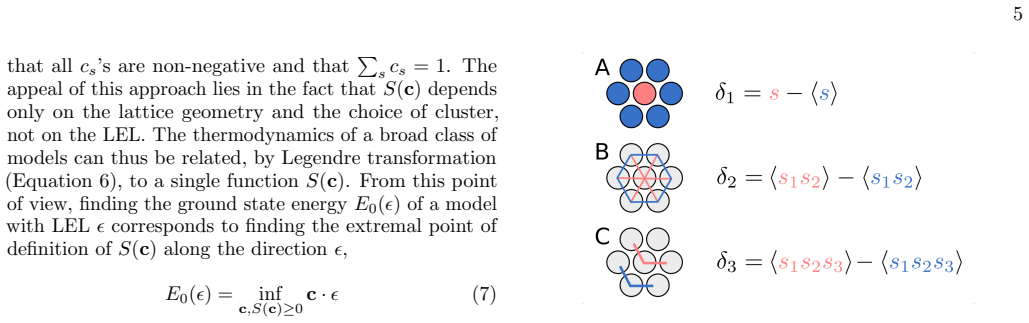
The central object is the local energy landscape (LEL), which assigns an energy $\epsilon_s$ to each possible local structure $s$ on a cluster of $z$ sites. The gauge group of energy displacements—vectors $\delta$ such that $\delta \cdot c = 0$ for every realizable structural composition $c$—is identified with $\Delta = \operatorname{Ker}(C) \cap \operatorname{Perp}(c_\infty)$, where $C$ is the infinite-temperature covariance matrix of structure counts and $c_\infty$ is the random-spin composition. Frustration at scale $z$ is then defined by $f_z(\epsilon) = E_0(\epsilon) - \max_{\delta \in \Delta} \min_s (\epsilon_s + \delta_s)$. The optimization is concave and piecewise-linear, so it has a unique maximum and can be performed numerically; when $f_z=0$, the chosen landscape admits locally preferred structures that tile the lattice exactly, giving a constructive proof of the ground-state energy.
What would settle it
Search for a structural composition vector that satisfies every covariance null-space constraint yet cannot be realized by any spin configuration; finding such a vector would show the gauge group $\Delta$ is overestimated and would invalidate the computed $f_z$ values. Alternatively, exhibit a binary spin model on a lattice for which the paper's method gives strictly positive $f_z$ for every finite cluster size, which would disprove the conjecture that all such systems have finite-range frustration.
Extended reading notes
Core claim
The paper's central claim is that geometrical frustration, defined as the gap between the energy of the locally preferred structure and the true ground-state energy, is not an intrinsic property of a Hamiltonian: it depends on how the Hamiltonian is decomposed into local energies. The authors characterize the gauge group of energy displacements—local rewritings that change the local-energy landscape but not the total Hamiltonian—as the intersection $\Delta = \operatorname{Ker}(C) \cap \operatorname{Perp}(c_\infty)$ of the covariance null space with the hyperplane orthogonal to the infinite-temperature composition. They define $f_z$ as the ground-state energy minus the maximum, over this gauge group, of the minimal local energy at scale $z$. Using this measure, they show that the antiferromagnetic Ising model on the triangular lattice has $f_3=0$, and that all thirteen Favoured Local Structures models on the triangular-lattice coordination shell have finite-range frustration, with $z^*$ at most 13. The conclusion is that apparent frustration is often an artifact of an unlucky local-energy representation, and that no binary spin system studied so far exhibits genuinely long-range frustration.
Load-bearing premise
The load-bearing premise is that a linear, infinite-temperature analysis of the structure-counting entropy captures every possible local-energy rewrite that leaves the Hamiltonian unchanged; if nonlinear constraints on which local structures can coexist are missed, the gauge group is too large and the frustration values are wrong.
Editorial extensions
If this is right
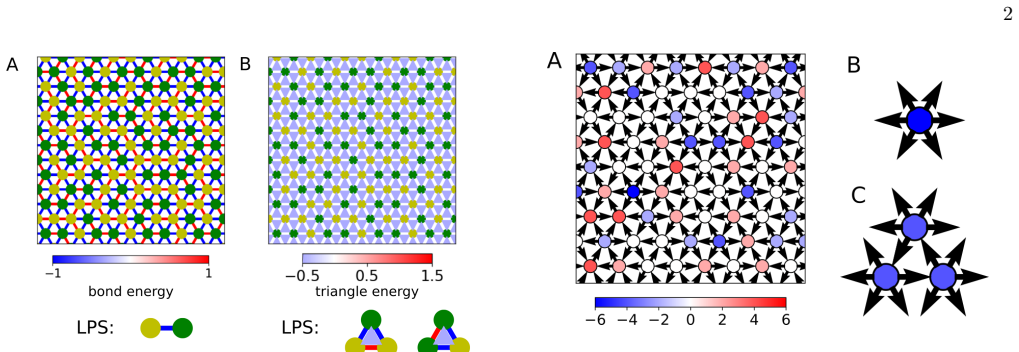
- For the antiferromagnetic Ising model on the triangular lattice, $f_3=0$, meaning the Hamiltonian can be rewritten on triangular plaquettes so that the locally preferred order tiles the lattice without defects.
- Nine of the twelve nontrivial Favoured Local Structures models have $f_7=0$, and the remaining three have $z^*=10$ or $z^*=13$, so every studied binary spin system on this lattice has finite-range frustration.
- When $f_z=0$, the system can be exactly coarse-grained into a frustration-free local-energy landscape, so geometrical incompatibilities are localized below the scale $z^*$.
- The maximal locally preferred energy $E^*_z$ provides a rigorous lower bound on the ground-state energy; when it matches a constructed crystalline state, that state is proven to be a ground state.
- A system with genuinely long-range frustration, if one exists, would have non-local geometrical constraints and would fall outside this provability method, suggesting a distinct complexity class for ground-state certification.
Reading between the lines
- The absence of long-range frustration among all studied two-dimensional binary spin models hints that long-range frustration may require more than two spin values, longer-ranged interactions, or three-dimensional lattices; a natural next test is to apply the same gauge-invariant calculation to such systems.
- The energy-displacement ambiguity implies that any experimental inference of local-structure energies from observed structure statistics is inherently gauge-ambiguous; this framework offers a way to define an observable, representation-independent frustration.
- The method connects geometrical frustration to proof complexity: finite-range frustration gives a constructive certification of ground states, so finding a long-range frustrated model would simultaneously identify a class of short-range spin Hamiltonians whose ground-state energies resist this type of proof.
- A testable extension would be to search for a spin model where $f_z$ is strictly positive for every $z$ by enumerating cluster sizes hierarchically and applying the paper's optimization to candidate Hamiltonians that favor mutually incompatible local structures.
Signed reviews
Editorial analysis
A structured set of objections, weighed in public.
Referee Report
Summary. The manuscript introduces 'Local Energy Landscapes' (LEL) for translation-invariant binary spin lattice models, associating an energy to each local spin environment (structure). It defines a gauge group of 'energy displacements'—local redefinitions of the LEL that leave the total Hamiltonian unchanged—and proposes a scale-dependent frustration measure f_z(ϵ) = E0(ϵ) − max_{δ∈Δ} min_s (ϵ_s+δ_s), where Δ is the space of energy displacements at cluster scale z. The main claims are: (i) f_z is gauge invariant and therefore depends only on the Hamiltonian and the chosen scale; (ii) for the antiferromagnetic Ising model on the triangular lattice and for all Favoured Local Structure (FLS) models considered, frustration is finite-range, meaning f_z=0 at some finite cluster size z* (z*=3 for AF Ising, z*≤13 for all FLS models); (iii) when f_z*=0, the framework yields rigorous lower bounds that prove the ground-state energies found by enumerative search. The paper also discusses a 'Frustrated Non-Model' whose apparent frustration is purely a gauge artifact, motivating the gauge-invariant construction.
Significance. If the central construction is sound, this is a valuable conceptual contribution: it offers a quantitative, gauge-invariant notion of geometrical frustration and distinguishes finite-range from long-range frustration, with concrete consequences for ground-state proofs. The AF Ising example is explicit and convincing, and the use of the method to certify ground states in Section II F is an elegant practical application. The paper is also commendably candid about the current limitations (no proven example of long-range frustration, exponential growth of the number of structures, and the impossibility of scaling analysis at present). However, the validity of the framework rests on the characterization of the gauge group in Eq. (11), which is asserted rather than proved, and the numerical results in Table II are not documented to a reproducible standard. These issues are localizable and fixable, so the paper merits revision rather than rejection.
major comments (3)
- [Section II C, Eq. (11)] The characterization of the gauge group as Δ = Ker(C) ∩ Perp(c∞) is load-bearing for all values of f_z, but it rests on the unproved assertion that 'a linear analysis of the entropy functional S(c) around the infinite-temperature limit is sufficient to fully characterize this vector space.' Equation (9) is only a local quadratic expansion with an O[(c−c∞)^3] remainder, and the text does not rule out the existence of hard (S=−∞) constraints that make the affine span of realizable compositions smaller than c∞ + (Ker C)^⊥. If such constraints exist, the true energy-displacement space is larger than Eq. (11), the maximization in Eq. (12) is over too small a set, and the reported values of f_7 for FLS models 6, 9 and 11 are overestimates (zeros would remain zero, but the gauge-invariance claim would fail). Please provide a proof, or a precise reference, that the affine hull of {c : S(c) ≥ 0} is exactly c∞ + (Ker C)^⊥, including a discussion of the pseudo-inverse in Eq. (9).
- [Table II and Section II D] The numerical values of f_7, f_10, f_13 are obtained with the SciPy Nelder-Mead implementation, but the manuscript gives no convergence criteria, number of restarts, or error estimates. Because the central classification (e.g., the exact rational values 1/12, 2/117, 1/22 and the zeros) depends on these optimizations, the protocol should be documented in enough detail for independent reproduction. The authors could also exploit the piecewise-linear structure of the objective to solve the problem exactly via linear programming and report the resulting exact values.
- [Section II E and Table I] The definition of the range z* is tied to a specific hierarchical cluster sequence (sizes 2, 3, 4, 7, 10, 13, 19 and chosen shapes). While f_z is non-increasing for this hierarchical family, the paper does not show that a different cluster shape with the same number of sites would give the same f_z. Consequently, the statement that 'all 2D binary spin systems studied by the authors have z* ≤ 13' is a statement about this particular sequence, not a property of the Hamiltonian alone. If the range is intended as an intrinsic quantity, the definition must be made independent of the cluster-shape choice (e.g., by minimizing over all clusters of a given size), or the paper should explicitly frame z* as convention-dependent.
minor comments (3)
- [Section II C, Eq. (9)] Equation (9) uses C^{-1} although C is stated to have a non-trivial null space; please specify that a pseudo-inverse is intended and define the quadratic form on the orthogonal complement of Ker C.
- [Section II D, Eq. (12)] The paper states that the maximization is 'non-ambiguous' because the objective is concave, but it does not explicitly prove that the maximum is finite and attained; since Δ is unbounded, a short argument (e.g., using c∞·δ=0 and ϵ_s+δ_s ≥ t) would reassure the reader.
- [Section I B, last paragraph] The text contains a typo: 'aFrustrated Non-Model' should read 'a Frustrated Non-Model'. Additionally, the sentence describing the model's 'peculiar properties' could be clarified to emphasize that these properties are trivial because the total Hamiltonian is identically zero.
Circularity Check
No circularity: the frustration measure and finite-range claims are computed from the Hamiltonian and covariance data, not fitted or self-citational in their target content.
full rationale
The derivation is self-contained relative to its stated inputs. The frustration functional f_z (Eq. 12) is defined directly from the Hamiltonian's local energy landscape epsilon, the ground-state energy E0(epsilon), and the gauge space Delta. The values reported in Table II are outputs of a numerical optimization over Delta, not inputs fitted to the target conclusion. The antiferromagnetic Ising model's finite-range frustration at z*=3 follows from the explicit exact rewriting in Eq. 2, which is a genuine gauge transformation rather than a result imported from the conclusion. The FLS results are nontrivial: for each structure, E0 is obtained by a systematic search and f_z by maximizing the concave LPS energy, so the reported zeros and nonzero values are computed, not assumed. The main conceptual reliance is the identification Delta = Ker(C) ∩ Perp(c_inf) in Eq. 11, which rests on the entropy expansion Eq. 9 cited to prior work [13-15]. That expansion is a parameter-free structural covariance statement, not the frustration result itself, so the citation is background evidence rather than circularity. The unproved step is whether the affine span of acceptable compositions is fully captured by range(C); that is a correctness risk, not a circular reduction. The paper also openly flags the absence of long-range frustration examples and the exponential growth of n as limitations, which further indicates the claims are not being forced by definition. Overall, no equation is equivalent by construction to the paper's main findings, and no fitted parameter is renamed as a prediction.
Assumptions & free parameters
free parameters (1)
- Cluster hierarchy (sizes z = 2, 3, 4, 7, 10, 13, 19 and shapes) =
z* = 3 for AF Ising; z* = 7, 10, or 13 for FLS models
assumptions (3)
- domain assumption The entropy functional S(c) has a quadratic expansion around infinite temperature (Eq. 9), and the null space of the covariance matrix C exactly characterizes the set of forbidden compositions; hence Delta = Ker(C) ∩ Perp(c_inf) (Eq. 11).
- domain assumption The set of local structures on a chosen cluster, with rotational variants identified, is a complete description of the energy of any configuration (Eq. 5).
- ad hoc to paper The hierarchical cluster sequence in Table I provides a meaningful notion of scale for the frustration function f_z, so that z* defines the range of frustration independently of cluster shape.
invented entities (3)
-
Local Energy Landscape (LEL)
-
Energy displacement (gauge class Delta)
-
Finite-range vs long-range frustration classes
Cite this review
Pith. "Pith review of The range of geometrical frustration in lattice spin models." pith.science (2026). https://pith.science/paper/O6QAYA5D
@misc{pith2026190804285,
  author       = {Pith},
  title        = {Pith review of: The range of geometrical frustration in lattice spin models},
  year         = {2026},
  howpublished = {\url{https://pith.science/paper/O6QAYA5D}},
  note         = {Machine review of arXiv:1908.04285}
}
read the original abstract
The concept of geometrical frustration in condensed matter physics refers to the fact that a system has a locally preferred structure with an energy density lower than the infinite ground state. This notion is however often used in a qualitative sense only. In this article, we discuss a quantitative definition of geometrical frustration in the context of lattice models of binary spins. To this aim, we introduce the framework of local energy landscapes, within which frustration can be quantified as the discrepancy between the energy of locally preferred structures and the ground state. Our definition is scale-dependent and involves an optimization over a gauge class of equivalent local energy landscapes, related to one another by local energy displacements. This ensures that frustration depends only on the physical Hamiltonian and its range, and not on unphysical choices in how it is written. Our framework shows that a number of popular frustrated models, including the antiferromagnetic Ising model on a triangular lattice, only have finite-range frustration: geometrical incompatibilities are local and can be eliminated by an exact coarse-graining of the local energies.
Figures

Figures from the paper (1 more)

Reference graph
Works this paper leans on
-
[1]
The set of energy displacements thus corresponds to vectors δ that are both orthogonal to c∞ and to all (c− c∞) for acceptable compositions c. Mathematically, we thus have: ∆ = Ker(C)∩ Perp(c∞) (11) with Perp(c∞) the hyperplane orthogonal to the vector c∞, and Ker(C) the null space of C. The exact values of both the covariance matrixC and the infinite-temp...
-
[2]
Toulouse, Theory of the frustration effect in spin glasses, Communications on Physics 2 115 (1977)
G. Toulouse, Theory of the frustration effect in spin glasses, Communications on Physics 2 115 (1977)
work page 1977
-
[3]
P. W. Anderson, The concept of frustration in spin glasses, Journal of the Less Common Metals 62, 291 (1978)
work page 1978
- [4]
-
[5]
J.-F. Sadoc and R. Mosseri, Geometrical Frustration (Cambridge University Press, 2006)
work page 2006
-
[6]
B. Charbonneau, P. Charbonneau, and G. Tarjus, Geo- metrical frustration and static correlations in hard-sphere glass formers, The Journal of Chemical Physics 138, 12A515 (2013)
work page 2013
- [7]
-
[8]
Diep, Frustrated spin systems, 2nd edition (World Scientific, 2013)
H. Diep, Frustrated spin systems, 2nd edition (World Scientific, 2013)
work page 2013
Show all 27 references
-
[9]
Toulouse, The frustration model, in Modern Trends in the Theory of Condensed Matter, Lecture Notes in Physics, edited by A
G. Toulouse, The frustration model, in Modern Trends in the Theory of Condensed Matter, Lecture Notes in Physics, edited by A. Pekalski and J. A. Przystawa (Springer Berlin Heidelberg, 1980) pp. 195–203
1980
-
[10]
a non-zero entropy at zero temperature – is sometimes considered to be the definition of frustration, rather than one of its effects
Note that an extensively degenerate ground state – i.e. a non-zero entropy at zero temperature – is sometimes considered to be the definition of frustration, rather than one of its effects. We will not take that point of view here
-
[11]
F. C. Frank, Supercooling of Liquids, Proceedings of the Royal Society of London. Series A, Mathematical and Physical Sciences 215, 43 (1952)
1952
-
[12]
C. P. Royall and S. R. Williams, The role of local structure in dynamical arrest, Physics Reports The role of local structure in dynamical arrest, 560, 1 (2015)
2015
-
[13]
Taffs and C
J. Taffs and C. Patrick Royall, The role of fivefold symme- try in suppressing crystallization, Nature Communications 7, 10.1038/ncomms13225 (2016)
2016 doi
-
[14]
Ronceray and P
P. Ronceray and P. Harrowell, From liquid structure to configurational entropy: introducing structural covariance, Journal of Statistical Mechanics: Theory and Experiment 2016, 084002 (2016)
2016
-
[15]
Ronceray and P
P. Ronceray and P. Harrowell, Geometry and the entropic cost of locally favoured structures in a liquid, The Journal of chemical physics 136, 134504 (2012)
2012
-
[16]
Ronceray and P
P. Ronceray and P. Harrowell, Influence of liquid structure on the thermodynamics of freezing, Physical Review E 87, 052313 (2013)
2013
-
[17]
This makes the problem numerically tractable
Importantly, symmetries of the original LEL ϵ (for in- stance a discrete rotation or spin-flip symmetry) cannot be spontaneously broken when optimizing this concave function, so it is enough to consider energy displacements that preserve all symmetries. This makes the problem n...
-
[18]
Ronceray and P
P. Ronceray and P. Harrowell, Favoured local structures in liquids and solids: a 3d lattice model, Soft matter 11, 3322 (2015)
2015
-
[19]
Gao and L
F. Gao and L. Han, Implementing the Nelder-Mead sim- plex algorithm with adaptive parameters, Computational Optimization and Applications 51, 259 (2012)
2012
-
[20]
Ronceray and P
P. Ronceray and P. Harrowell, The variety of ordering transitions in liquids characterized by a locally favoured structure, EPL (Europhysics Letters) 96, 36005 (2011)
2011
-
[21]
Ronceray and P
P. Ronceray and P. Harrowell, Multiple ordering transi- tions in a liquid stabilized by low symmetry structures, Physical review letters 112, 017801 (2014)
2014
-
[22]
[17, 19], the local cluster considered are empty coordination shells, where the spin value at the central site is indifferent
In Refs. [17, 19], the local cluster considered are empty coordination shells, where the spin value at the central site is indifferent. This choice was made to limit the number of possible structures. However, in view of the results presented in this article, including the cent...
-
[23]
One type of energy displacement δ is to average the en- ergy over clusters in a ball of radius R (with z ∼ Rd sites). The resulting LEL ϵ +δ on the ball cannot admit a configuration with energy less than E0 −O(1/R), oth- erwise replacing the region of the ground state by that c...
-
[24]
G. L. W. Hart and R. W. Forcade, Algorithm for generat- ing derivative structures, Physical Review B 77, 224115 (2008)
2008
-
[25]
Malins, S
A. Malins, S. R. Williams, J. Eggers, and C. P. Royall, Identification of structure in condensed matter with the topological cluster classification, The Journal of Chemical Physics 139, 234506 (2013)
2013
-
[26]
G. M. Grason, Perspective: Geometrically frustrated as- semblies, The Journal of Chemical Physics 145, 110901 (2016)
2016
-
[27]
Lenz and T
M. Lenz and T. A. Witten, Geometrical frustration yields fibre formation in self-assembly, Nature Physics 13, 1100 (2017)
2017
Reviewed August 14, 2026 · model on record in the stance chip above.
Discussion (0). Continue with ORCID to comment.