REVIEW 2 major objections 5 minor 39 references
Local Supports Global: Deep Camera Relocalization with Sequence Enhancement
T0 review · 2 major / 5 minor · reviewed 2026-08-14 · deepseek-v4-flash
Pith's one-line read The paper claims that global camera relocalization becomes more accurate when a deep network exploits short image sequences—augmenting each frame's features with co-visible content from a learned local map and refining poses through…
desk verdict A plausible sequence-based relocalization system whose main novelty is under-specified by a dimensionally wrong attention equation; worth refereeing if the authors can fix Eq. (2) and release code. read the letter →
The pith
A machine-rendered reading of the paper's core claim, the machinery that carries it, and where it could break.
The reading
What carries the argument
The mechanism that carries the argument has two parts. Content augmentation: for each frame, the raw feature map $X_t$ is used as a query to reweight every hidden state $H_i$ of the convolutional LSTM in both channel and temporal dimensions (Eq. 2), producing an augmented feature $X'_t$ that fuses co-visible content from the whole local sequence. Motion-based refinement: global poses are nodes and learned relative poses $P^{vo}_{t,t-1}$ are edges of a pose graph; a joint loss enforces consistency during training, and standard pose graph optimization refines the nodes at test time with edges fixed. The convolutional LSTM hidden states are the local maps that carry the sequence information.
What would settle it
Take a model trained on day sequences and run it on night sequences from the same route, comparing global pose accuracy with content augmentation enabled versus disabled; if augmented predictions are no better than the network's own single-image baseline under this appearance shift, the co-visibility attention has failed to transfer.
Extended reading notes
Core claim
The central claim is that local sequence information can support global pose estimation in an end-to-end deep network. Instead of regressing a pose from one image, the network builds a local map inside a convolutional LSTM's hidden states while estimating relative motion, then augments each frame's raw features by softly attending to co-visible content across those hidden states; the augmented features are used to regress global poses, and the predicted relative poses are added as edges in a pose graph that jointly constrains global poses during training and optimizes them at test time. The paper reports that this two-part design lowers translation and rotation errors on both benchmark datasets relative to the compared methods, and that the improvement is largest exactly where single images are most ambiguous—repetitive textures, textureless regions, similar appearances, and over-exposure.
Load-bearing premise
The load-bearing premise is that the soft attention's learned feature-space correlations, called co-visibility, generalize to unseen sequences and appearance conditions; if those correlations do not transfer, content augmentation stops helping—and the night-sequence results show all methods degrade sharply in that regime.
Editorial extensions
If this is right
- Sequence-aware pose regressors should expect lower errors in textureless and repetitive scenes than single-image regressors, since ambiguity is resolved by co-visible content across frames.
- A learned visual-odometry stream can supply test-time motion constraints without external GPS, SLAM, or ground-truth relative poses, which removes a practical barrier for pose-graph refinement in deep relocalization.
- Orientation errors, which are typically the weakest part of single-image pose regression, are reduced most by the motion constraints on the long outdoor routes.
- Attention maps trained with content augmentation shift focus away from dynamic objects and toward stable structures, implying that the method suppresses exactly the features that cause outliers.
Reading between the lines
- If the learned co-visibility attention transfers across scenes, the same sequence-augmentation idea could be applied to other localization tasks such as place recognition or map-based retrieval, where nearby frames from any source could enrich a query feature.
- The night-sequence failures (FULL7 and FULL8) suggest a boundary: content augmentation helps when appearance shift is moderate but cannot overcome extreme photometric domain shift; an appearance-invariant feature space or target-condition fine-tuning would be the natural next test.
- Sequence length is fixed at seven frames; a scaling experiment varying clip length could show whether longer local maps continue to help or saturate, and where the recurrent memory starts to hurt.
- Because the test-time motion consistency comes from the same network rather than an external system, the method is a candidate drop-in module for monocular relocalization pipelines that already run a learned visual odometry.
Signed reviews
Editorial analysis
A structured set of objections, weighed in public.
Referee Report
Summary. The manuscript proposes a sequence-based deep camera relocalization method that couples a global pose regressor with a learned visual odometry branch. Raw ResNet features are augmented by a soft-attention mechanism over the hidden states of a convolutional LSTM used for VO, and the predicted global poses are then refined in a pose graph using relative poses from the VO branch. The model is trained with a combined global-pose loss, VO loss, and motion-consistency loss. Experiments on 7-Scenes and Oxford RobotCar report lower translation and rotation errors than several published single-image and sequence-based baselines, and the supplementary ablation attributes the gains to content augmentation and motion-based refinement.
Significance. If the technical description is corrected and the comparison protocol clarified, the paper would make a useful empirical contribution: reusing the hidden states of a learned VO component as local maps for global relocalization is a plausible idea, and the supplementary ablation in Table 5 shows a clear error progression (64.58m to 41.46m to 25.84m average translation on RobotCar). The paper is also honest about failure cases at night, and the attention visualizations in Fig. 16 go beyond simple accuracy tables. However, the central content-augmentation equation as printed is dimensionally inconsistent, and the RobotCar comparison against MapNet is not fully documented, so the claimed superiority is not yet substantiated as written. No code is released and no error bars are given, which further limits verification.
major comments (2)
- [Section 3.2, Eq. (2)] The printed content-augmentation operation is dimensionally inconsistent. With X_t and H_i both 3D tensors of shape H×W×C, each H^j_i is an H×W map and A_S is described as a scalar cosine similarity between the j-th channels; the inner sum over j therefore produces a single H×W map, and the outer sum over i with the scalar A_T preserves that shape. The equation cannot yield the asserted X'_t ∈ R^{H×W×C} that is subsequently fed to two convolutional layers. In addition, A_T is never defined and A_S is only referenced to GFS-VO without its formula. Please give the channel-indexed, shape-correct form (for example, X'^j_t = Σ_i A_T(X_t,H_i) A_S(X_t^j,H_i^j) H_i^j) and specify how the temporal and spatial attention compose; as written, Eq. (2) does not specify the network that produced Tables 1–3.
- [Table 3 and Section 3.3] The RobotCar comparison against MapNet may not be apples-to-apples. Section 3.3 states that MapNet's test-time pose graph optimization requires extra computation with known relative poses of testing images obtained from ground truth or from another VO/SLAM system, whereas the proposed method is self-contained. The MapNet numbers in Table 3 are quoted from [4] without stating whether the reported evaluation used such extra relative poses. Please clarify the exact protocol behind the published MapNet results, or re-run MapNet under the same input and supervision conditions, before claiming a consistent improvement over MapNet on the LOOP and FULL routes.
minor comments (5)
- [Section 4, Implementation Details] The value of the balance weight α in Eq. (4) is not reported anywhere in the paper or the supplementary material, so the test-time pose graph refinement step cannot be exactly reproduced from the text.
- [Section 3.4, Eq. (6)] The index range in the VO loss appears to be off by one: for a sequence of N frames, the relative poses are defined for consecutive pairs (t, t-1) with t = 2..N, so the sum should run to N or the subscripts should be rewritten accordingly; as printed, the term with i=N refers to a nonexistent P^vo_{N+1,N}.
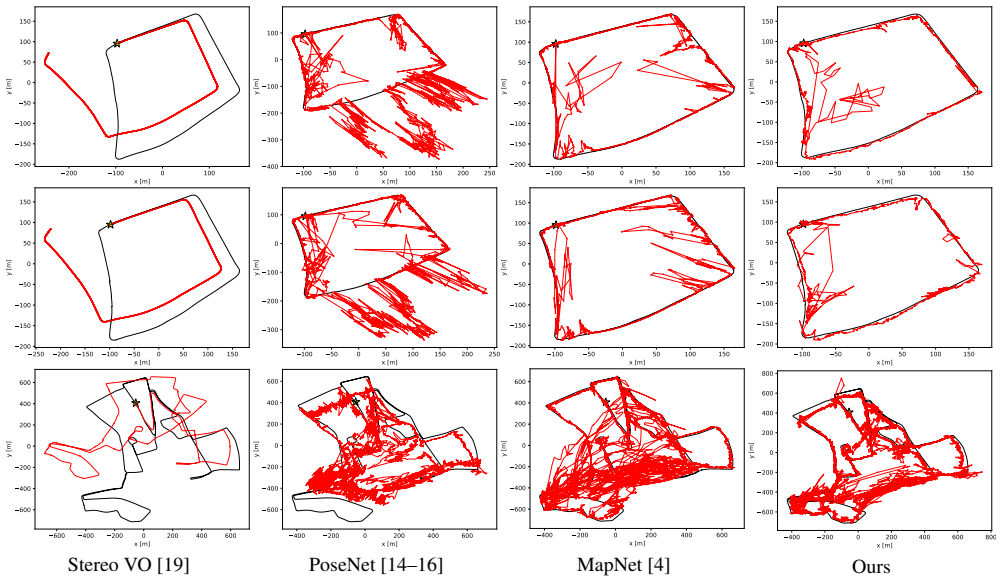
- [Supplementary Table 6 and Section 5.1] The text in Section 5.1 says that 'our method gives better performance' on the night sequences, but in FULL8 the reported mean translation error for Ours (430.54m) is slightly worse than for MapNet (430.49m); the statement should be qualified.
- [All quantitative tables] No repeated runs or error bars are reported, and several comparisons are very close (for example, Chess in Table 2: Ours 0.09m versus MapNet 0.08m), so it is not clear whether the reported differences are stable under random initialization; the number of runs averaged should be stated.
- [General] No code or trained models are released, and the underspecified Eq. (2) plus the missing value of α make the results difficult to verify independently; a public release or at least detailed tensor-shape documentation would materially improve reproducibility.
Circularity Check
No circularity: benchmark claims rest on external data; self-citations are design-motivating only; the Eq. (2) issue is a correctness concern, not circularity.
full rationale
The central claims of this paper are empirical: it reports translation and rotation errors on the public 7-Scenes and Oxford RobotCar benchmarks and compares them with externally reported or released baselines (PoseNet, VidLoc, MapNet, DSO). The content-augmentation module in Eq. (2) and the motion-based pose-graph refinement in Eq. (4) are trainable components optimized with supervised losses (Eqs. 5-8) against ground-truth global and relative poses; no parameter is fitted to the test error and then reported as a prediction. The test-time pose graph minimizes a weighted sum of deviations from the network's own predicted global poses and its predicted relative-pose constraints; this is an inference-time smoothing step whose output is not forced by construction to match the benchmark metric. The authors' self-citations to GFS-VO [35] and Beyond Tracking [36] motivate the choice of cosine-similarity attention and recurrent VO design, but the headline comparisons do not reduce to those citations; the improvement is evaluated on external test sequences against external baselines. The dimensional inconsistency of Eq. (2) noted in review is a genuine correctness and underspecification issue, but it is not a circular reduction: the equation is not equivalent by construction to the reported evaluation numbers. No circular step is exhibited.
Assumptions & free parameters
free parameters (2)
- alpha (pose graph balance weight)
- Input sequence length =
7
assumptions (5)
- domain assumption ResNet34 pretrained on ImageNet provides useful feature maps for both global relocalization and VO.
- domain assumption The hidden states of a convolutional LSTM capture a local map that is useful for relocalization.
- domain assumption The soft attention in Eq. (2) selects co-visible content that generalizes across sequences and conditions.
- domain assumption Ground truth poses in 7-Scenes (KinectFusion) and Oxford RobotCar (INS interpolation) are accurate enough to serve as supervision and evaluation.
- standard math The pose graph optimization from Calafiore et al. [5] converges to a better pose estimate when edges are fixed.
Cite this review
Pith. "Pith review of Local Supports Global: Deep Camera Relocalization with Sequence Enhancement." pith.science (2026). https://pith.science/paper/473RBOPN
@misc{pith2026190804391,
  author       = {Pith},
  title        = {Pith review of: Local Supports Global: Deep Camera Relocalization with Sequence Enhancement},
  year         = {2026},
  howpublished = {\url{https://pith.science/paper/473RBOPN}},
  note         = {Machine review of arXiv:1908.04391}
}
read the original abstract
We propose to leverage the local information in image sequences to support global camera relocalization. In contrast to previous methods that regress global poses from single images, we exploit the spatial-temporal consistency in sequential images to alleviate uncertainty due to visual ambiguities by incorporating a visual odometry (VO) component. Specifically, we introduce two effective steps called content-augmented pose estimation and motion-based refinement. The content-augmentation step focuses on alleviating the uncertainty of pose estimation by augmenting the observation based on the co-visibility in local maps built by the VO stream. Besides, the motion-based refinement is formulated as a pose graph, where the camera poses are further optimized by adopting relative poses provided by the VO component as additional motion constraints. Thus, the global consistency can be guaranteed. Experiments on the public indoor 7-Scenes and outdoor Oxford RobotCar benchmark datasets demonstrate that benefited from local information inherent in the sequence, our approach outperforms state-of-the-art methods, especially in some challenging cases, e.g., insufficient texture, highly repetitive textures, similar appearances, and over-exposure.
Figures


Figures from the paper (12 more)




Reference graph
Works this paper leans on
-
[4]
S. Brahmbhatt, J. Gu, K. Kim, J. Hays, and J. Kautz. Map- Net: Geometry-aware Learning of Maps for Camera Local- ization. In CVPR, 2018
work page 2018
-
[1]
V . Balntas, S. Li, and V . Prisacariu. RelocNet: Continu- ous Metric Learning Relocalisation Using Neural Nets. In ECCV, 2018
work page 2018
-
[2]
E. Brachmann, A. Krull, S. Nowozin, J. Shotton, F. Michel, S. Gumhold, and C. Rother. DSAC-differentiable RANSAC for Camera Localization. In CVPR, 2017
work page 2017
-
[3]
E. Brachmann and C. Rother. Learning Less Is More - 6D Camera Localization via 3D Surface Regression. In CVPR, 2018
work page 2018
-
[5]
G. Calafiore, L. Carlone, and F. Dellaert. Pose Graph Opti- mization in the Complex Domain: Lagrangian Duality, Con- ditions for Zero Duality Gap, and Optimal Solutions. T-RO, 2016
work page 2016
-
[6]
F. Camposeco, T. Sattler, A. Cohen, A. Geiger, and M. Polle- feys. Toroidal Constraints for Two-point Localization under High Outlier Ratios. In CVPR, 2017
work page 2017
- [7]
- [8]
Show all 39 references
-
[9]
Engel, T
J. Engel, T. Sch ¨ops, and D. Cremers. LSD-SLAM: Large- scale Direct Monocular SLAM. In ECCV, 2014
2014
-
[10]
K. He, X. Zhang, S. Ren, and J. Sun. Delving Deep into Rec- tifiers: Surpassing Human-level Performance on Imagenet Classification. In ICCV, 2015
2015
-
[11]
K. He, X. Zhang, S. Ren, and J. Sun. Deep Residual Learning for Image Recognition. In CVPR, 2016
2016
-
[12]
Hochreiter and J
S. Hochreiter and J. Schmidhuber. Long Short-term Mem- ory. Neural Computation, 1997
1997
-
[13]
J ´egou, M
H. J ´egou, M. Douze, C. Schmid, and P. P ´erez. Aggregating Local Descriptors into a Compact Image Representation. In CVPR, 2010
2010
-
[14]
Kendall and R
A. Kendall and R. Cipolla. Modelling Uncertainty in Deep Learning for Camera Relocalization. In ICRA, 2016
2016
-
[15]
Kendall and R
A. Kendall and R. Cipolla. Geometric Loss Functions for Camera Pose Regression with Deep Learning. In CVPR, 2017
2017
-
[16]
Kendall, M
A. Kendall, M. Grimes, and R. Cipolla. PoseNet: A Convo- lutional Network for Real-time 6-DoF Camera Relocaliza- tion. In ICCV, 2015
2015
-
[17]
D. P. Kingma and J. Ba. Adam: A Method for Stochastic Optimization. In ICLR, 2015
2015
-
[18]
L. Liu, H. Li, and Y . Dai. Efficient Global 2D-3D Matching for Camera Localization in a Large-scale 3D Map. In ICCV, 2017
2017
-
[19]
Maddern, G
W. Maddern, G. Pascoe, C. Linegar, and P. Newman. 1 Year, 1000km: The Oxford RobotCar Dataset. IJRR, 2017
2017
-
[20]
Melekhov, J
I. Melekhov, J. Ylioinas, J. Kannala, and E. Rahtu. Image- based Localization Using Hourglass Networks. In ICCV Workshops, 2017
2017
-
[21]
Mur-Artal and J
R. Mur-Artal and J. D. Tard ´os. ORB-SLAM2: An Open- source SLAM System for Monocular, Stereo, and RGB-D Cameras. T-RO, 2017
2017
-
[22]
Paszke, S
A. Paszke, S. Gross, S. Chintala, and G. Chanan. Pytorch. https://github.com/pytorch/pytorch, 2017
2017
-
[23]
Sattler, M
T. Sattler, M. Havlena, K. Schindler, and M. Pollefeys. Large-scale Location Recognition and the Geometric Bursti- ness Problem. In CVPR, 2016
2016
-
[24]
Sattler, B
T. Sattler, B. Leibe, and L. Kobbelt. Efficient & Effective Prioritized Matching for Large-scale Image-based Localiza- tion. TPAMI, 2017
2017
-
[25]
Sattler, W
T. Sattler, W. Maddern, C. Toft, A. Torii, L. Hammarstrand, E. Stenborg, D. Safari, M. Okutomi, M. Pollefeys, J. Sivic, F. Kahl, and T. Pajdla. Benchmarking 6-DoF Outdoor Visual Localization in Changing Conditions. In CVPR, 2018
2018
-
[26]
J. L. Schonberger and J. M. Frahm. Structure-from-motion Revisited. In CVPR, 2016
2016
-
[27]
X. Shi, Z. Chen, H. Wang, D. Yeung, W. Wong, and W. Woo. Convolutional LSTM Network: A Machine Learning Ap- proach for Precipitation Nowcasting. In NIPS, 2015
2015
-
[28]
Shotton, B
J. Shotton, B. Glocker, C. Zach, S. Izadi, A. Criminisi, and A. Fitzgibbon. Scene Coordinate Regression Forests for Camera Relocalization in RGB-D Images. In CVPR, 2013
2013
-
[29]
Sukhbaatar, A
S. Sukhbaatar, A. Szlam, J. Weston, and R. Fergus. End-to- end Memory Networks. In NIPS, 2015
2015
-
[30]
Taira, M
H. Taira, M. Okutomi, T. Sattler, M. Cimpoi, M. Pollefeys, J. Sivic, T. Pajdla, and A. Torii. InLoc: Indoor Visual Local- ization with Dense Matching and View Synthesis. In CVPR, 2018
2018
-
[31]
C. Toft, E. Stenborg, L. Hammarstrand, L. Brynte, M. Polle- feys, T. Sattler, and F. Kahl. Semantic Match Consistency for Long-term Visual Localization. In ECCV, 2018
2018
-
[32]
Ummenhofer, H
B. Ummenhofer, H. Zhou, J. Uhrig, N. Mayer, E. Ilg, A. Dosovitskiy, and T. Brox. DeMoN: Depth and Motion Network for Learning Monocular Stereo. In CVPR, 2017
2017
-
[33]
Walch, C
F. Walch, C. Hazirbas, L. Leal-Taixe, T. Sattler, S. Hilsen- beck, and D. Cremers. Image-based Localization Using LSTMs for Structured Feature Correlation. In ICCV, 2017
2017
-
[34]
S. Wang, R. Clark, H. Wen, and N. Trigoni. DeepVO: Towards End-to-end Visual Odometry with Deep Recurrent Convolutional Neural Networks. In ICRA, 2017
2017
-
[35]
F. Xue, Q. Wang, X. Wang, W. Dong, J. Wang, and H. Zha. Guided Feature Selection for Deep Visual Odometry. In ACCV, 2018
2018
-
[36]
F. Xue, X. Wang, S. Li, Q. Wang, J. Wang, and H. Zha. Be- yond Tracking: Selecting Memory and Refining Poses for Deep Visual Odometry. In CVPR, 2019
2019
-
[37]
Yin and J
Z. Yin and J. Shi. GeoNet: Unsupervised Learning of Dense Depth, Optical Flow and Camera Pose. In CVPR, 2018
2018
-
[38]
H. Zhou, B. Ummenhofer, and T. Brox. DeepTAM: Deep Tracking and Mapping. In ECCV, 2018
2018
-
[39]
T. Zhou, M. Brown, N. Snavely, and D. G. Lowe. Unsu- pervised Learning of Depth and Ego-motion from Video. In CVPR, 2017. 9 Abstract In the supplementary material, we first introduce the training and testing sequences adopted on the Oxford RobotCar dataset [19] in Table 4. The ...
2017
Reviewed August 14, 2026 · model on record in the stance chip above.
Discussion (0). Continue with ORCID to comment.