REVIEW 3 major objections 4 minor 1 cited by
Landauer's Principle in a Quantum Szilard Engine Without Maxwell's Demon
T0 review · 3 major / 4 minor · reviewed 2026-08-14 · deepseek-v4-flash
Pith's one-line read A quantum Szilard engine without a demon still pays kT ln2 at the measurement step.
desk verdict The cycle bookkeeping is careful, but the "superposition" is a thermal mixture, so the claim that measurement localization carries Landauer's cost rests on a conflation. read the letter →
The pith
A machine-rendered reading of the paper's core claim, the machinery that carries it, and where it could break.
The reading
What carries the argument
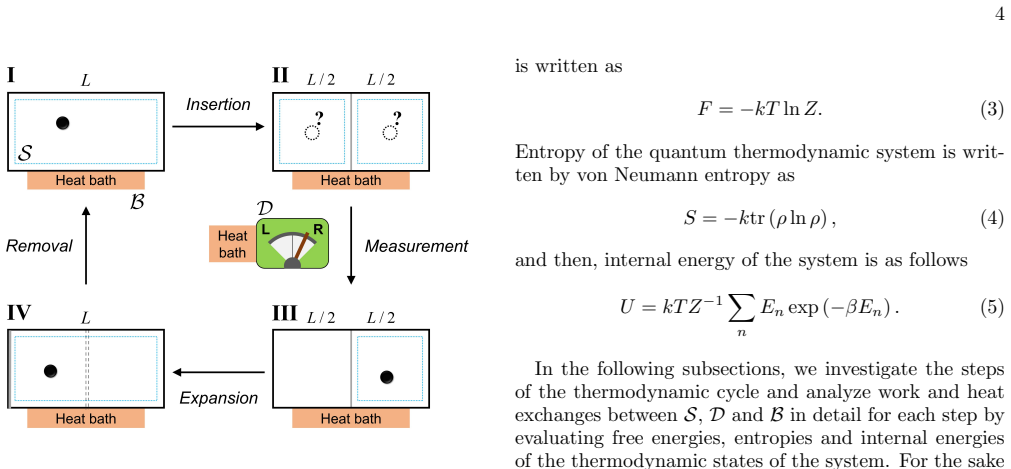
The central object is the pair of states connected by quantum measurement: the post-insertion superposition of the particle being in both compartments, described by partition function $2Z(L/2)$ and entropy $S(L/2)+k\ln 2$, and the post-measurement localized state, described by $Z(L/2)$ and $S(L/2)$. The identity that carries the argument is the equality between the free-energy change $\Delta F = kT\ln 2$ and the Landauer cost, with the measuring device acting as the heat bath that absorbs the dissipated heat. The quantum boundary layer $\delta$ supplies analytical approximations for the confinement corrections, but the $kT\ln 2$ terms are independent of confinement and carry the argument.
What would settle it
Compute or measure the von Neumann entropy of the post-insertion state. If the partition insertion genuinely produces the pure superposition $|\psi\rangle=(|L\rangle+|R\rangle)/\sqrt{2}$, its entropy is not $S(L/2)+k\ln 2$ and the predicted $kT\ln 2$ measurement dissipation disappears; if it produces the incoherent mixture $\rho=(|L\rangle\langle L|+|R\rangle\langle R|)/2$, the cost is real. Experimentally, perform the localization with a calorimetric detector in a single-particle double well and look for a $kT\ln 2$ heat pulse.
Extended reading notes
Core claim
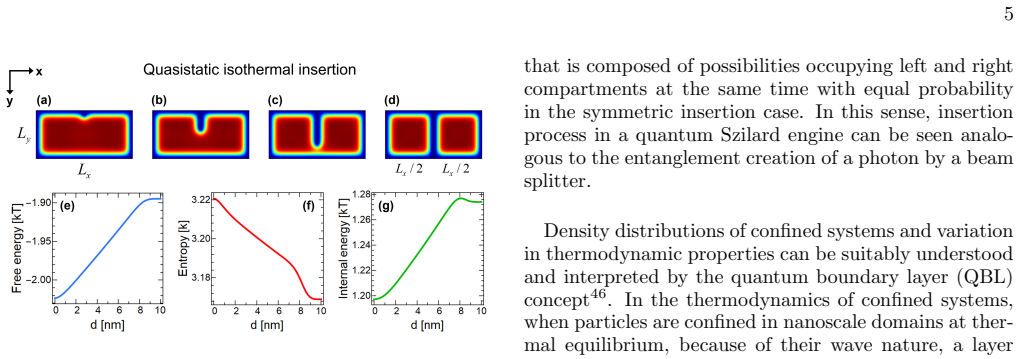
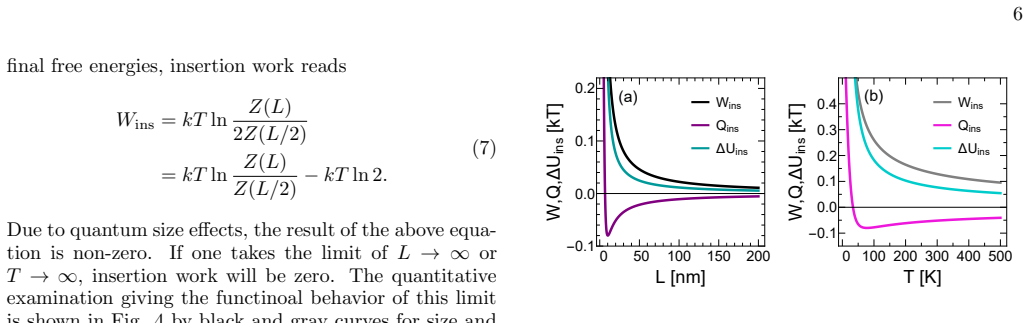
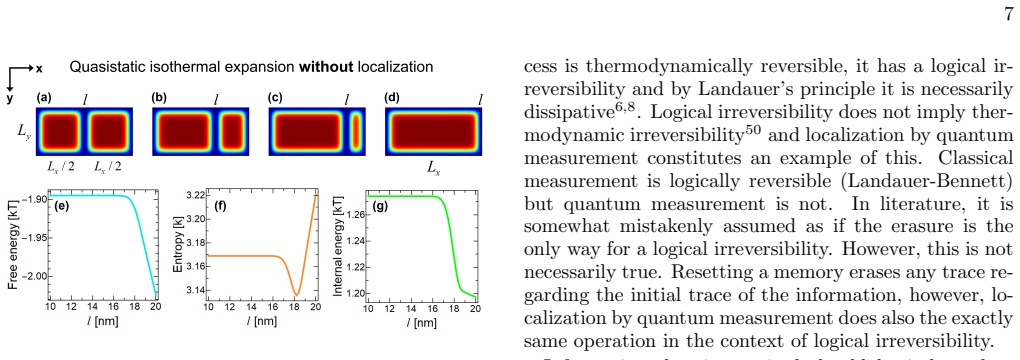
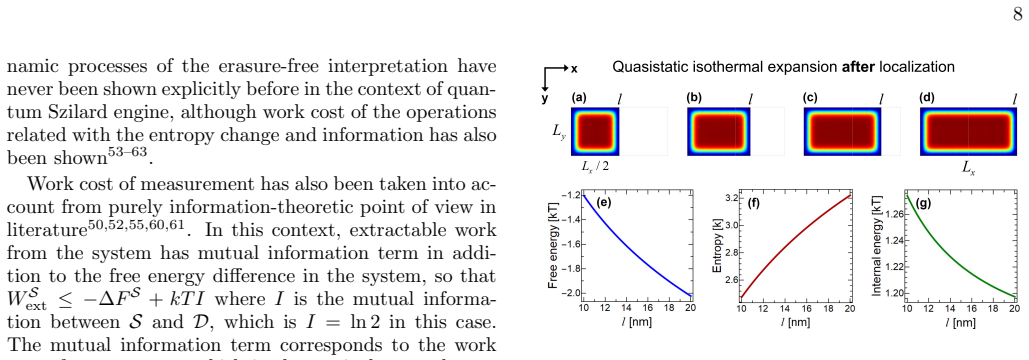
On the paper's own terms, the central discovery is that quantum measurement localizing a delocalized particle is a logically irreversible operation, and therefore carries the same thermodynamic price as information erasure: a heat dissipation of at least $kT\ln 2$ and a corresponding work input of $kT\ln 2$. In the proposed demonless quantum Szilard engine, inserting the partition creates a superposition described by the partition function $2Z(L/2)$ and entropy $S(L/2)+k\ln 2$; localization projects the particle to one compartment with partition function $Z(L/2)$ and entropy $S(L/2)$. This makes the system's free energy rise by $kT\ln 2$, supplied as work by the measuring device, while heat $-kT\ln 2$ is dissipated to the bath. The expansion step returns the insertion work plus $kT\ln 2$, but the measurement cost wipes out that gain, leaving zero net work for the full cycle. The paper also gives accurate analytical expressions, via the quantum boundary layer thickness $\delta = \lambda_{\rm th}/4$, for the confinement corrections to work and heat in the insertion and expansion steps.
Load-bearing premise
The whole cost hinges on the claim that inserting the partition leaves the particle in a state that already carries one bit of entropy; if it were a clean superposition with no extra mixedness, localizing it would not need to dissipate heat.
Editorial extensions
If this is right
- A demonless quantum Szilard engine extracts zero net work per cycle: the $kT\ln 2$ gained in expansion is exactly consumed by the measurement that localizes the particle.
- Acquiring and using which-side information is not what makes a Szilard engine costly; the projective act of localization is itself the logically irreversible step.
- Landauer's principle extends beyond memory erasure to any operation that collapses a superposition onto an outcome basis, including quantum measurement.
- The measurement process is internally reversible in the thermodynamic bookkeeping but externally irreversible, so the second law is preserved without invoking a demon's memory.
- Quantum confinement changes insertion work and heat quantitatively but does not alter the $kT\ln 2$ measurement cost or the zero net-work conclusion.
Reading between the lines
- If correct, the same logic applies to any engine whose working medium is prepared in a coherent spatial superposition: projective measurement of the particle's position should show up as a $kT\ln 2$ heat pulse absorbed by the detector, independent of whether the outcome is recorded.
- A direct experimental signature would be to run the cycle twice, once with localization and once without; the difference in heat flow to the bath should be exactly $kT\ln 2$, offering a clean test of the claimed measurement cost.
- The argument suggests that 'rectification' of two-way motion into one-way work is the classical shadow of this quantum logical irreversibility, so any demonless engine, electrical or mechanical, should exhibit the same unavoidable dissipation.
- One open direction the paper leaves implicit is that for pure versus mixed preparations of the post-insertion state, the predicted cost differs by $kT\ln 2$, so measurements on engineered superpositions could distinguish this account from the standard memory-erasure explanation.
Signed reviews
Editorial analysis
A structured set of objections, weighed in public.
Referee Report
Summary. The paper proposes a quantum Szilard engine without an explicit Maxwell's demon. It claims that inserting the partition creates a quantum superposition/entangled position state of the particle being in both compartments; that work can be extracted only after a quantum measurement localizes the particle; and that this localization is a logically irreversible operation which, by Landauer's principle, dissipates at least kT ln 2 per cycle. The authors compute free-energy, entropy and internal-energy changes for the four steps of the cycle, include quantum confinement corrections via the quantum boundary layer, and give analytical expressions for work/heat exchanges. They conclude that the net extractable work is zero and the second law is preserved without invoking a demon's memory erasure.
Significance. If correct, the result would extend Landauer's principle from information erasure to quantum measurement/localization and would provide a demonless resolution of the Szilard paradox. The manuscript has strengths: it presents explicit cycle bookkeeping in Table I, analytic QBL-based expressions with claimed accuracy below 10^-6, and numerical simulations. However, the central claim depends on identifying the post-insertion state as a superposition while assigning it the entropy of a mixture; the kT ln 2 measurement cost is thereby assumed rather than derived. Since this is the load-bearing point of the paper, the significance of the result as stated is not established by the present derivation.
major comments (3)
- [Sec. III A, Eqs. (7)-(8)] Equations (7)-(8) assign to the post-insertion state the partition function 2Z(L/2) and entropy S(L/2)+k ln 2, which are the quantities for an equiprobable mixture of the two one-compartment Gibbs states. The accompanying text in Sec. III A and Fig. 3d instead describes the state as 'a quantum superposition state of being both left and right sides at the same time' and as an 'entangled position-state'. These are inconsistent: a coherent delocalized state would possess off-diagonal coherences and would not have the von Neumann entropy S(L/2)+k ln 2; a pure superposition would have zero entropy. Under the paper's own quasistatic isothermal assumption, the final state is the Gibbs state for the divided box, which is diagonal in the left/right basis. The k ln 2 term in Eq. (8) is therefore classical which-side uncertainty, not a quantum superposition effect. Because Eqs. (10)-(11) merely take the difference between this assumed entropy and the one-compartment entropy, the claimed kT ln 2 dissipation of the measurement is an input assumption rather than a derived consequence.
- [Sec. III B, Eqs. (10)-(11)] The logical-irreversibility argument for localization is asserted rather than demonstrated. For a pre-existing mixture of the two compartments, an ideal projective measurement that reveals the side leaves the unconditional system state unchanged; the measurement can be modelled by a unitary coupling to an apparatus, and no heat need be dissipated by the system itself. The free-energy difference F_III - F_II = kT ln 2 is the work value of the acquired which-side information, as the manuscript itself acknowledges in the mutual-information paragraph of Sec. III B. It is not an independent heat dissipation caused by measurement. The conclusion that 'localization by quantum measurement ... has to be accompanied by a corresponding heat dissipation' therefore does not follow from the presented calculation without an explicit model of how localization is implemented and why that implementation is dissipative.
- [Table I and Sec. III B] The measuring device D is assigned nonzero changes only in step II: ΔF_D = -W_msr and ΔS_D = +Q_msr (with Q_msr = -kT ln 2), but no states, Hamiltonian, or measurement interaction for D are specified. If D records the outcome, its entropy should first increase by k ln 2 and later require erasure; if it does not record the outcome, it is unclear why D has any free-energy or entropy change. Table I therefore cannot close the cycle for D and does not substantiate the claim that the heat Q_msr is dissipated in the measurement step. This is load-bearing because the paper's central claim relies on the separation between S and D.
minor comments (4)
- [Sec. III A] The word 'functinoal' should be 'functional'.
- [Fig. 4 caption] The caption lists color assignments for (a)/(b) as black/gray, teal/turquoise and purple/pink; the text refers to 'gray curves', 'turquoise curves' and so on. The pairing should be clarified, especially for readers in print.
- [Sec. III A] The phrase 'entangled position-state' for a single particle is nonstandard; entanglement requires at least two subsystems. Consider 'coherent superposition of position states' or provide a bipartite formulation.
- [Sec. III A] The statement that 'in an isothermal process internal energy change is zero' is only true for an ideal gas; as stated it is too broad, though the subsequent caveat about quantum confinement partially addresses this.
Circularity Check
The kT ln2 'measurement dissipation' is put in by assuming Z_II = 2Z(L/2); Eq. (11) is an accounting identity, so the central claim reduces to its input assumption.
-
self definitional
[Sec. III A (Eqs. 7-8) and Sec. III B (Eqs. 10-11)]
"Since insertion divides the system into entangled states occupying two compartments, the partition function of the final system after the insertion is the sum of two partition functions of left and right compartments. Hence, free energy after insertion is FII = −kT ln[2Z(L/2)] = −kT ln[Z(L/2)] − kT ln 2. ... It can be seen that kT ln 2 term naturally arises inside the free energy expression FII. ... Before the localization, the particle was in both boxes at once and hence the total partition function ... is 2Z(L/2)."
The paper 'finds' Qmsr = −kT ln2 by subtracting SIII = −k tr[rho(L/2) ln rho(L/2)] from SII = −k tr[rho(L/2) ln rho(L/2)] + k ln2. That k ln2 was already inserted by the definition FII = −kT ln[2Z(L/2)], so Eq. (11) is exactly the assumed entropy difference read backwards as a heat cost. The claim that the k ln2 term is a consequence of 'quantum entanglement' is not supported by the density matrix: the Gibbs state in the two-compartment Hilbert space is diagonal in the left/right basis, i.e., an equal classical mixture, not a coherent superposition. A coherent superposition would have off-diagonal terms and a different entropy; the k ln2 is classical which-side uncertainty.
full rationale
The paper's formal bookkeeping is self-consistent, and the QBL-based analytic expressions (Appendix) are checked against numerics; the self-citations (Refs. 46-47) are used for confinement corrections and are not load-bearing for the measurement-cost claim. There are no fitted parameters and no external benchmark is needed for the algebraic steps. However, the headline result—that localization by quantum measurement dissipates exactly kT ln2—is not derived from an independent dynamical or information-theoretic argument. It is the same k ln2 term that the paper puts into the post-insertion state by choosing Z_II = 2Z(L/2). The state described by that partition function is an incoherent mixture, not a superposition, so the measurement step merely cancels the classical uncertainty that was assumed in the previous step. This makes the central claim partially circular: one 'prediction' reduces by construction to the chosen input state.
Assumptions & free parameters
assumptions (5)
- standard math Canonical Gibbs state and von Neumann entropy (Eqs. 1-5) describe the equilibrium particle at every step.
- domain assumption Landauer's principle: logically irreversible operations dissipate at least kT ln2 of heat.
- ad hoc to paper Symmetric insertion produces a state with partition function 2Z(L/2) and entropy S(L/2)+k ln2.
- domain assumption Quasistatic isothermal processes and an impenetrable zero-thickness partition.
- domain assumption Quantum boundary layer thickness delta = h/(4 sqrt(2 pi m k T)) (Eq. A.1).
Cite this review
Pith. "Pith review of Landauer's Principle in a Quantum Szilard Engine Without Maxwell's Demon." pith.science (2026). https://pith.science/paper/YAI24DFR
@misc{pith2026190804400,
  author       = {Pith},
  title        = {Pith review of: Landauer's Principle in a Quantum Szilard Engine Without Maxwell's Demon},
  year         = {2026},
  howpublished = {\url{https://pith.science/paper/YAI24DFR}},
  note         = {Machine review of arXiv:1908.04400}
}
read the original abstract
Quantum Szilard engine constitutes an adequate interplay of thermodynamics, information theory and quantum mechanics. Szilard engines are in general operated by a Maxwell's Demon where Landauer's principle resolves the apparent paradoxes. Here we propose a Szilard engine setup without featuring an explicit Maxwell's demon. In a demonless Szilard engine, the acquisition of which-side information is not required, but erasure and the related heat dissipation still take place implicitly by the very nature of the work extraction process. We see that the insertion of the partition in a quantum Szilard engine does not localize the particle to one side, instead it creates a superposition state of the particle being in both sides. To be able to extract work from the system, particle has to be localized at one side. The localization occurs as a result of quantum measurement on the particle, which shows the importance of the measurement process regardless of whether one uses the acquired information or not. In accordance with the Landauer's principle, localization by quantum measurement corresponds to a logically irreversible operation and for this reason it has to be accompanied by the corresponding heat dissipation. This shows the validity of the Landauer's principle even in quantum Szilard engines without Maxwell's demon. Furthermore, we take quantum confinement effects fully into account to analyze the Szilard cycle in the quantum regime thoroughly and obtain highly accurate analytical expressions for work and heat exchanges. Our results show that Landauer's principle holds the key role to understand the thermodynamics of the localization of the particle by quantum measurement, which explicitly saves the second law in demonless engines and shows that quantum-mechanical considerations are essential to reconcile thermodynamics and information theory.
Figures

Figures from the paper (3 more)
Forward citations
Cited by 1 Pith paper
-
Maxwell's lesser demon: a quantum engine driven by pointer measurements
A measurement-driven quantum engine using a damped oscillator as the demon's pointer can simultaneously reach high power and efficiency and operates beyond the Otto window when the pointer states are distinguishable.
Reference graph
Works this paper leans on
- [1]
-
[2]
J. C. Maxwell. Theory of Heat . Longmans, London, 1871
-
[3]
M. Smoluchowski. Experimentell nachweisbare, der \" u blichen thermodynamik widersprechende molekularphanomene. Phys. Z. , 13:1069, 1912
work page 1912
-
[4]
L. Szilard. \" U ber die entropieverminderung in einem thermodynamischen system bei eingriffen intelligenter wesen. Z. Phys. , 53:840, 1929
work page 1929
-
[5]
O. Maroney. Information processing and thermodynamic entropy. In Edward N. Zalta, editor, The Stanford Encyclopedia of Philosophy . 2009
work page 2009
- [6]
-
[7]
O. Penrose. Foundations of Statistical Mechanics . Oxford: Pergamon Press, 1970
work page 1970
-
[8]
C. H. Bennett. The thermodynamics of computation-a review. Int. J. Theor. Phys. , 21:905, 1982
work page 1982
Show all 64 references
-
[9]
Piechocinska
B. Piechocinska. Information erasure. Phys. Rev. A , 61:062314, 2000
2000
-
[10]
Maruyama, F
K. Maruyama, F. Nori, and V. Vedral. Colloquium: The physics of maxwell’s demon and information. Rev. Mod. Phys. , 81:1, 2009
2009
-
[11]
W. H. Zurek. Maxwell's demon, szilard's engine and quantum measurements. In G.T. Moore and M.O. Scully, editors, Frontiers of Nonequilibrium Statistical Physics . New York: Plenum Press, 1986
1986
-
[12]
W. H. Zurek. Eliminating ensembles from equilibrium statistical physics: Maxwell’s demon, szilard’s engine, and thermodynamics via entanglement. Phys. Rep. , 755:1, 2018
2018
-
[13]
L. C. Biedenharn and J. C. Solem. A quantum-mechanical treatment of szilard's engine: Implications for the entropy of information. Found. Phys. , 25:1221, 1995
1995
-
[14]
C. M. Bender, D. C. Brody, and B. K. Meister. Unusual quantum states: non-locality, entropy, maxwell’s demon and fractals. Proc. R. Soc. A , 461:733, 2005
2005
-
[15]
J. M. R. Parrondo. The szilard engine revisited: Entropy, macroscopic randomness, and symmetry breaking phase transitions. Chaos , 11:725, 2001
2001
-
[16]
J. M. R. Parrondo. Universal features in the energetics of symmetry breaking. Nat. Phys. , 10:457, 2014
2014
-
[17]
Alicki and M
R. Alicki and M. Horodecki. Information-thermodynamics link revisited. J. Phys. A: Math. Theor. , 52:204001, 2019
2019
-
[18]
S. Lloyd. Quantum-mechanical maxwell’s demon. Phys. Rev. A , 56:3374, 1997
1997
-
[19]
Quantum szilard engine
Sang Wook Kim, Takahiro Sagawa, Simone De Liberato, and Masahito Ueda. Quantum szilard engine. Phys. Rev. Lett. , 106:070401, 2011
2011
-
[20]
Plesch, O
M. Plesch, O. Dahlsten, J. Goold, and V. Vedral. Maxwell's daemon: Information versus particle statistics. Sci. Rep. , 4:6995, 2014
2014
-
[21]
Bengtsson, M
J. Bengtsson, M. Nilsson Tengstrand, A. Wacker, P. Samuelsson, M. Ueda, H. Linke, and S. M. Reimann. Quantum szilard engine with attractively interacting bosons. Phys. Rev. Lett. , 120:100601, 2018
2018
-
[22]
H. Dong, D. Z. Xu, C. Y. Cai, and C. P. Sun. Quantum maxwell's demon in thermodynamic cycles. Phys. Rev. E , 83:061108, 2011
2011
-
[23]
H. Li, J. Zou, J. G. Li, and L. A. Wu B. Shao. Revisiting the quantum szilard engine with fully quantum considerations. Ann. Phys. , 327:2955, 2012
2012
-
[24]
C. Y. Cai, H. Dong, and C. P. Sun. Multiparticle quantum szilard engine with optimal cycles assisted by a maxwell's demon. Phys. Rev. E , 85:031114, 2012
2012
-
[25]
Naghiloo, J
M. Naghiloo, J. J. Alonso, A. Romito, E. Lutz, and K. W. Murch. Information gain and loss for a quantum maxwell's demon. Phys. Rev. Lett. , 121:030604, 2018
2018
-
[26]
M. H. Mohammady and J. Anders. A quantum szilard engine without heat from a thermal reservoir. New J. Phys. , 19:113026, 2017
2017
-
[27]
Toyabe, T
S. Toyabe, T. Sagawa, M. Ueda, E. Muneyuki, and M. Sano. Experimental demonstration of information-to-energy conversion and validation of the generalized jarzynski equality. Nat. Phys. , 6:988, 2010
2010
-
[28]
Berut, A
A. Berut, A. Arakelyan, A. Petrosyan, S. Ciliberto, R. Dillenschneider, and E. Lutz. Experimental verification of landauer’s principle linking information and thermodynamics. Nature , 483:187, 2012
2012
-
[29]
J. V. Koski, V. F. Maisi, J. P. Pekola, and D. V. Averin. Experimental realization of a szilard engine with a single electron. PNAS , 111:13786, 2014
2014
-
[30]
J. V. Koski, A. Kutvonen, I. M. Khaymovich, T. Ala-Nissila, and J. P. Pekola. On-chip maxwell's demon as an information-powered refrigerator. Phys. Rev. Lett. , 115:260602, 2015
2015
-
[31]
M. D. Vidrighin, O. Dahlsten, M. Barbieri, M. S. Kim, V. Vedral, and I. A. Walmsley. Photonic maxwell’s demon. Phys. Rev. Lett. , 116:050401, 2016
2016
-
[32]
Cottet et al
N. Cottet et al. Observing a quantum maxwell demon at work. PNAS , 114:7561, 2017
2017
-
[33]
L. L. Yan, T. P. Xiong, K. Rehan, F. Zhou, D. F. Liang, L. Chen, J. Q. Zhang, W. L. Yang, Z. H. Ma, and M. Feng. Single-atom demonstration of the quantum landauer principle. Phys. Rev. Lett. , 120:210601, 2018
2018
-
[34]
M. B. Plenio and V. Vitelli. The physics of forgetting: Landauer’s erasure principle and information theory. Contemp. Phys. , 42:25, 2001
2001
-
[35]
Jauch and J.G
J.M. Jauch and J.G. Baron. Entropy, information, and szilard’s paradox. Helv. Phys. Acta , 45:220, 1972
1972
-
[36]
Hemmo and O
M. Hemmo and O. R. Shenker. The Road to Maxwell’s Demon . Cambridge University Press, New York, 2012
2012
-
[37]
J. D. Norton. All shook up: Fluctuations, maxwell’s demon and the thermodynamics of computation. Entropy , 15:4432, 2013
2013
-
[38]
Earman and J.D
J. Earman and J.D. Norton. Exorcist xiv: The wrath of maxwell's demon. part i. from maxwell to szilard. Studies in the History and Philosophy of Modern Physics , 29:435, 1998
1998
-
[39]
Earman and J.D
J. Earman and J.D. Norton. Exorcist xiv: The wrath of maxwell's demon. part ii. from szilard to landauer. Studies in the History and Philosophy of Modern Physics , 30:1, 1999
1999
-
[40]
L. B. Kish and C. G. Granqvist. Electrical maxwell demon and szilard engine utilizing johnson noise, measurement, logic and control. PLoS ONE , 7:e46800, 2012
2012
-
[41]
M. O. Magnasco. Szilard's heat engine. EPL , 33:583, 1996
1996
-
[42]
H. S. Leff and A. F. Rex. Maxwell's Demon: Entropy, Information, Computing . Princeton, New Jersey: Princeton University Press, 1990
1990
-
[43]
H. S. Leff and A. F. Rex. Maxwell's Demon 2: Entropy, Classical and Quantum Information, Computing . Philadelphia, Pennsylvania: Institute of Physics Publishing, 2003
2003
-
[44]
J. Berger. Szilard's demon revisited. Int. J. Theor. Phys. , 29:985, 1990
1990
-
[45]
All numerical simulations are implemented in COMSOL M ultiphysics software
-
[46]
Sisman, Z.F
A. Sisman, Z.F. Ozturk, and C. Firat. Quantum boundary layer: a non-uniform density distribution of an ideal gas in thermodynamic equilibrium. Phys. Lett. A , 362:16--20, 2007
2007
-
[47]
Aydin and A
A. Aydin and A. Sisman. Quantum shape effects and novel thermodynamic behaviors at nanoscale. Phys. Lett. A , 383:655, 2019
2019
-
[48]
Firat and A
C. Firat and A. Sisman. Quantum forces of a gas confined in nano structures. Phys. Scr. , 87:045008, 2013
2013
-
[49]
Sisman and I
A. Sisman and I. Muller. The casimir-like size effects in ideal gases. Phys. Lett. A , 320:360, 2004
2004
-
[50]
J. M. Horowitz J. M. R. Parrondo and T. Sagawa. Thermodynamics of information. Nat. Phys. , 11:131, 2015
2015
-
[51]
Second law of thermodynamics and quantum feedback control: Maxwell's demon with weak measurements
Kurt Jacobs. Second law of thermodynamics and quantum feedback control: Maxwell's demon with weak measurements. Phys. Rev. A , 80:012322, 2009
2009
-
[52]
Quantum measurement and the first law of thermodynamics: The energy cost of measurement is the work value of the acquired information
Kurt Jacobs. Quantum measurement and the first law of thermodynamics: The energy cost of measurement is the work value of the acquired information. Phys. Rev. E , 86:040106, 2012
2012
-
[53]
S. Turgut. Relations between entropies produced in nondeterministic thermodynamic processes. Phys. Rev. E , 79:041102, 2009
2009
-
[54]
Minimal energy cost for thermodynamic information processing: Measurement and information erasure
Takahiro Sagawa and Masahito Ueda. Minimal energy cost for thermodynamic information processing: Measurement and information erasure. Phys. Rev. Lett. , 102:250602, Jun 2009
2009
-
[55]
Thermodynamic cost of measurements
L\'eo Granger and Holger Kantz. Thermodynamic cost of measurements. Phys. Rev. E , 84:061110, 2011
2011
-
[56]
Dupuis, J
Philippe Faist, F. Dupuis, J. Oppenheim, and R. Renner. The minimal work cost of information processing. Nat. Commun. , 6:7669, 2015
2015
-
[57]
Hovhannisyan, and Marcus Huber
David Edward Bruschi, Mart\' Perarnau-Llobet, Nicolai Friis, Karen V. Hovhannisyan, and Marcus Huber. Thermodynamics of creating correlations: Limitations and optimal protocols. Phys. Rev. E , 91:032118, 2015
2015
-
[58]
Information processing and the second law of thermodynamics: An inclusive, hamiltonian approach
Sebastian Deffner and Christopher Jarzynski. Information processing and the second law of thermodynamics: An inclusive, hamiltonian approach. Phys. Rev. X , 3:041003, 2013
2013
-
[59]
Huber et al
M. Huber et al. Thermodynamic cost of creating correlations. New J. Phys. , 17:065008, 2015
2015
-
[60]
Heat engine driven by purely quantum information
Jung Jun Park, Kang-Hwan Kim, Takahiro Sagawa, and Sang Wook Kim. Heat engine driven by purely quantum information. Phys. Rev. Lett. , 111:230402, 2013
2013
-
[61]
Sebastian Deffner, Juan Pablo Paz, and Wojciech H. Zurek. Quantum work and the thermodynamic cost of quantum measurements. Phys. Rev. E , 94:010103, 2016
2016
-
[62]
Zhang, Y
J. Zhang, Y. Liu, R. B. Wu, K. Jacobs, and F. Nori. Quantum feedback: Theory, experiments, and applications. Phys. Rep. , 679:1, 2017
2017
-
[63]
Fundamental work cost of quantum processes
Philippe Faist and Renato Renner. Fundamental work cost of quantum processes. Phys. Rev. X , 8:021011, 2018
2018
-
[64]
Thermodynamic work gain from entanglement
Ken Funo, Yu Watanabe, and Masahito Ueda. Thermodynamic work gain from entanglement. Phys. Rev. A , 88:052319, 2013
2013
Reviewed August 14, 2026 · model on record in the stance chip above.
Discussion (0). Continue with ORCID to comment.