REVIEW 3 major objections 4 minor 12 references
Dynamical Quantum Phase Transition of the Quantum $N$-state Potts Chain with Quenched Disorder
T0 review · 3 major / 4 minor · reviewed 2026-08-14 · deepseek-v4-flash
Pith's one-line read The paper proves that the quench-averaged Loschmidt rate function of a random-bond $N$-state Potts chain remains nonanalytic at definite critical times, with a linear cusp for typical continuous disorder and a logarithmic divergence for…
desk verdict The N=2 result is exact and numerically supported; the general-N extension is an interesting conjecture resting on an unproved algebraic zero-product property, so treat the paper's headline claim as conditional. read the letter →
The pith
A machine-rendered reading of the paper's core claim, the machinery that carries it, and where it could break.
The reading
What carries the argument
The central object is the set of noncritical fixed-point transfer matrices of the pure Potts chain, together with an exact real-space decimation RG that multiplies neighboring transfer matrices and normalizes by the first nonzero entry. Within one noncritical phase the RG is regular, but multiplying fixed-point matrices from different phases gives the zero matrix, so a disordered chain must be split into phase blocks that are renormalized independently and then joined. Because of commutativity, the spatial order of the blocks does not matter, and the final singular term is controlled by the deviations $\epsilon_\alpha$ from the fixed-point matrices. The load-bearing identity is the min formula $[l_s(t)]=\min_\alpha l_\alpha(t)$; whether the transition is a linear cusp or a logarithmic divergence follows from whether the competing curves cross with nonzero or vanishing $\epsilon$'s.
What would settle it
Compute the pairwise products of the noncritical fixed-point transfer matrices for $N=6$ or any larger $N$: if any pair is nonzero, the min formula and the sharp-transition proof fail for that $N$. Alternatively, for a chain with the fine-tuned binary bonds of Eq. 20, check numerically whether the peak of $[l_s(t)]$ near $t_c$ grows as $\log|t-t_c|$ with the predicted prefactor as $L$ increases; a non-diverging peak would disprove the claim.
Extended reading notes
Core claim
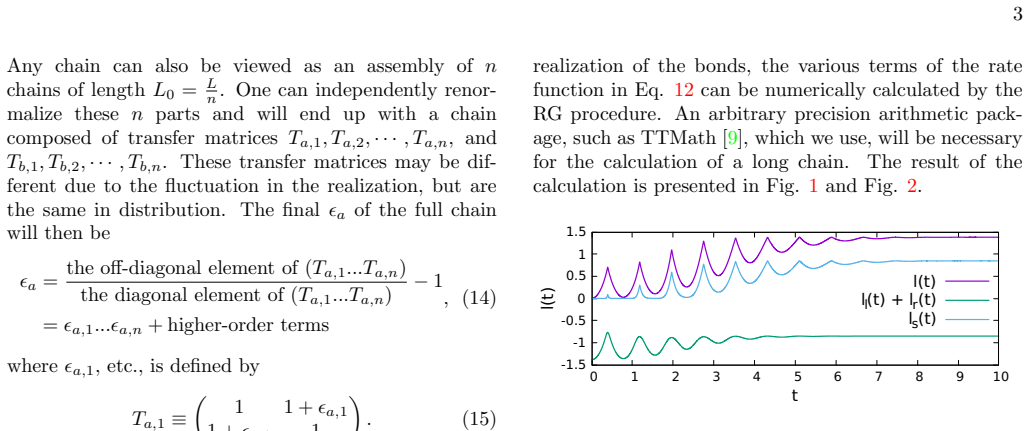
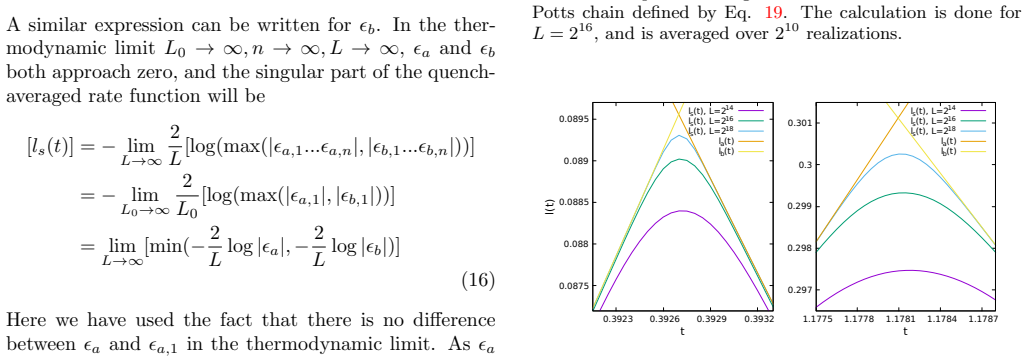
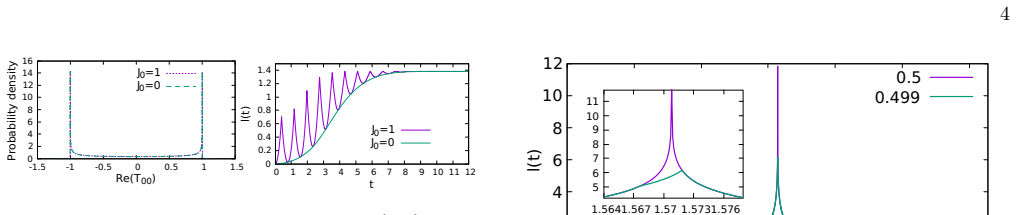
For the extreme quench of the $N$-state Potts chain, the Loschmidt amplitude is exactly a classical partition function built from transfer matrices $T^{[i]}_{m_i m_{i+1}}=\exp(i t J_i\,2\cos(2\pi m/N))$. Because the normalized transfer matrices commute, every chain can be reorganized into blocks that sit near one of the noncritical fixed points of the pure model; only the interface between blocks carries the singular time dependence. The quench-averaged singular rate function is therefore the minimum of smooth phase contributions, $[l_s(t)]=\min_\alpha l_\alpha(t)$, where $l_\alpha(t)=-\lim_{L\to\infty}(2/L)[\log|\epsilon_\alpha(t)|]$ and $\epsilon_\alpha$ measures how far the renormalized block is from its fixed-point matrix. When two such curves cross with nonzero $\epsilon$'s, the rate function has a linear cusp; when fine-tuned discrete bonds make both $\epsilon_a(t_c)$ and $\epsilon_b(t_c)$ vanish exactly, the rate function diverges as $\propto-\log|t-t_c|$. For $N>2$ the same argument is carried over, with the minimum taken over all noncritical phases, under the fixed-point product-zero property.
Load-bearing premise
The proof for general $N$ assumes that the noncritical fixed-point transfer matrices of the pure Potts chain multiply to the zero matrix in pairs; only $N=3,4,5$ are checked in the companion work, and the general-$N$ statement is asserted without proof here.
Editorial extensions
If this is right
- Even arbitrarily strong bond disorder leaves the dynamical phase transition sharp in the thermodynamic limit, so the singular times remain well-defined observables.
- For most continuous bond distributions the singularity has the same linear-cusp form as the pure model, meaning the cusp shape does not by itself reveal the disorder strength.
- Fine-tuned discrete bond distributions produce a logarithmic divergence in the rate function, a disorder-induced singular feature absent from the pure model.
- At large times the rate function forgets the bond distribution: every continuous distribution converges to the same universal plateau value.
- Because the mechanism is governed by noncritical fixed points rather than a critical fixed point, the usual equilibrium criterion for when weak disorder changes critical behavior does not apply to this transition.
Reading between the lines
- Beyond the paper: if the zero-product property holds for all $N$, the min formula predicts new multicritical crossover behavior where three noncritical phases compete, which the paper does not develop.
- Beyond the paper: the block-decomposition trick relies only on commutativity and pairwise annihilation of fixed-point matrices, so the same sharpness result may carry over to other one-dimensional transfer-matrix quenches beyond the Potts chain.
- Beyond the paper: the universal large-time plateau is a crisp experimental signature; comparing two continuous bond distributions in a simulator and finding identical late-time rate functions would support the prediction.
Signed reviews
Editorial analysis
A structured set of objections, weighed in public.
Referee Report
Summary. The paper studies the Loschmidt amplitude and the associated rate function for the quantum N-state Potts chain with random nearest-neighbor bonds, under a quench from the paramagnetic product state to the ferromagnetic Hamiltonian. It maps the Loschmidt amplitude to a classical partition function and applies a real-space decimation RG to the transfer matrices. For N=2, the paper identifies two non-critical fixed points, groups the transfer matrices in the two basins, and derives the singular part of the quench-averaged rate function as [ls(t)] = min(la(t), lb(t)) (Eq. 17). It then argues that this gives a linear-cusp DQPT for generic continuous bond distributions and a logarithmic divergence for a fine-tuned binary distribution (Eqs. 20-22). The final section extends the result to general N, giving [ls(t)] = min over phases (Eq. 23). Numerical finite-size calculations for N=2 are presented in support of the cusp and logarithmic behaviors, and a universal large-time plateau is argued for continuous distributions.
Significance. If the general-N claim is correct, this is a valuable exact analytical result on dynamical quantum phase transitions in disordered systems: it shows that disorder can leave the DQPT sharp, identifies the mechanism as competition between non-critical RG fixed points, and sharply contrasts with the Harris-criterion intuition from equilibrium. The N=2 part is coherent and the finite-size scaling in Figs. 2 and 4 is consistent with the claimed linear cusps and logarithmic divergence. The universal large-time plateau for continuous distributions is an interesting and falsifiable prediction. The main limitation is that the central general-N theorem depends on an algebraic zero-product property of fixed-point transfer matrices that is verified only for N=3,4,5 and asserted for all other N, with no proof supplied in this manuscript.
major comments (3)
- [Generalization to other Ns (final section), Eq. (23)] The general-N result rests on the assertion that distinct non-critical RG fixed-point transfer matrices annihilate each other, T*_alpha T*_beta = 0 for every pair. The text verifies this explicitly only for N=3,4,5, with the N=5 case displayed, and then states that the argument follows identically. Since these matrices are circulant, the zero-product property is equivalent to a disjoint-support condition on their Fourier transforms; it is a special algebraic fact and does not follow from commutativity. If any pair has a nonzero product for some N, the cross-block couplings survive the grouping step and the reduction to min(la, lb, lc, ...) in Eq. (23) is not justified. Please provide a proof of the zero-product property for all N, or explicitly restrict the theorem to N=2,3,4,5 and present the general-N statement as a conjecture.
- [Equations (14)-(17), self-averaging and higher-order terms] The derivation of [ls(t)] = min(la(t), lb(t)) in Eqs. (14)-(17) drops 'higher-order terms' in the product of the epsilon parameters and then exchanges the disorder average with the logarithm and the minimum, citing self-averaging of la(t) and lb(t). These steps are load-bearing: the singular part is defined through the L→∞ limit of logarithms of products, so uncontrolled higher-order corrections could in principle contribute to the rate function. Please provide a bound on the neglected terms or a proof of self-averaging for the N=2 case, and state clearly which of these ingredients remain unproven for general N.
- [Generalization, basin-of-attraction structure] Even if the zero-product property holds, the RG rearrangement used for the disordered chain requires that every realized transfer matrix be assigned, after finitely many RG iterations, to one of the non-critical fixed-point basins. For N=2 the basins are simply E=(1,x) with x>0 and x<0, but for N>5 no basin characterization is supplied in this paper or, according to the text, in the cited companion paper [5] beyond N=5. Without this assignment, the decomposition leading to Eq. (23) cannot be applied to a generic realization of the disorder. Please state the basin structure for general N or restrict the claim accordingly.
minor comments (4)
- [Eq. (6), step 2] The normalization step says 'E'_s,tmp is the first nonzero E'_m,tmp'; it should also specify what happens when all E'_m,tmp vanish, since that is precisely the singular situation discussed later in the paper.
- [Fig. 2 caption] The caption for Fig. 2 reports [ls(t)], [la(t)], and [lb(t)] but does not explain how the regular parts [ll(t)] and [lr(t)] are subtracted numerically; stating this would improve reproducibility.
- [Eq. (20) and Fig. 4] For the random binary bond distribution with p=1/2, the statement that the chain 'can be made homogeneous by alternatingly putting 1 and 0.5' relies on the law of large numbers for the density of each bond value; this should be stated explicitly, since an actual realization has random proportions of the two bond values.
- [Eq. (14) and the sentence after Eq. (16)] The phrase 'there is no difference between epsilon_a and epsilon_a,1 in the thermodynamic limit' should be made precise as equality in distribution rather than literal equality of random variables.
Circularity Check
No circular reduction: core N=2 derivation is self-contained; general-N claim depends on an unproved zero-product lemma from the author's prior work, an evidentiary gap rather than circularity.
full rationale
The N=2 derivation is self-contained: the transfer-matrix RG (Eq. 6), commutativity (Eq. 10), grouping into basins (Eq. 11), the product form of epsilon (Eq. 14), and the min formula [ls]=min(la,lb) (Eqs. 16-17) follow from the paper's own equations, with no fitted parameter and no target quantity inserted as input; the numerics in Figs. 1-4 are checks, not inputs. The only reliance on the author's prior paper [5] is the pure-chain classification of non-critical fixed points and the zero-product property T*_a T*_b = ... = 0, quoted for N=3,4,5. That is parameter-free algebraic evidence, not a redefinition of the rate function, so citing it is not circular. The text's step from N=3,4,5 to 'the arguments ... follow identically' (preceding Eq. 23) is an unproved algebraic lemma; if any pair of fixed-point matrices had nonzero product for some N>5, the min formula and the claimed sharp transition for that N would fail. This is a completeness/correctness gap, not a circular reduction: the conclusion is conditional on an external lemma, not identical to an input. Score 2 reflects the general-N self-citation dependence while the core mechanism remains independently derived.
Assumptions & free parameters
assumptions (6)
- domain assumption The non-equilibrium RG fixed points and the RG equation (Eq. 6) of the pure Potts chain from Wu 1906.07945 are correct and complete.
- domain assumption The non-critical fixed-point transfer matrices of the pure Potts chain multiply to zero in pairs for all N, not only for N=3,4,5 checked in [5].
- domain assumption la(t) and lb(t) self-average, so the order of quench averaging and min can be swapped in Eq. 17.
- domain assumption For sufficiently long chains, |eps_a| and |eps_b| are much smaller than 1, and eps_a equals the product of eps_a,i up to higher-order terms (Eq. 14).
- domain assumption For continuous bond distributions, the phases 2 t J_i modulo 2 pi become uniform at large t.
- domain assumption The thermodynamic limit L to infinity of the rate function exists, and the RG decimation preserves G(t) exactly in that limit.
Cite this review
Pith. "Pith review of Dynamical Quantum Phase Transition of the Quantum $N$-state Potts Chain with Quenched Disorder." pith.science (2026). https://pith.science/paper/4UKOWCHG
@misc{pith2026190804476,
  author       = {Pith},
  title        = {Pith review of: Dynamical Quantum Phase Transition of the Quantum $N$-state Potts Chain with Quenched Disorder},
  year         = {2026},
  howpublished = {\url{https://pith.science/paper/4UKOWCHG}},
  note         = {Machine review of arXiv:1908.04476}
}
abstract
We present an exact renormalization group analysis of the Loschmidt amplitude of the quantum $N$-state Potts chain with random quench-disordered nearest neighbor bonds, under the extreme dynamical quantum quench. We prove that the phase transition of the Loschmidt rate function remains sharp in general. For typical bond distributions, the phase transition is found to be a linear-cusp, as in the pure model. For some special discrete bond distributions, however, the rate function exhibits logarithmic divergences. These singularities are due to the competition between the non-critical dynamical phases of the pure model, which is very different from how disorder affects equilibrium phase transitions. In addition, due to the periodicity of the complex exponential function, all continuous bond distributions result in rate functions which converge to a universal value at large time.
Figures
Reference graph
Works this paper leans on
-
[5]
A. A. Zvyagin, Low Temperature Physics 42, 971 (2016)
work page 2016
-
[1]
Heyl, Reports on Progress in Physics 81, 054001 (2018)
M. Heyl, Reports on Progress in Physics 81, 054001 (2018)
2018
-
[2]
Dynamical Quantum Phase Transition of the Quantum $N$-state Potts Chain with Quenched Disorder
that the quantum dynamics of the transverse field Ising chain can exhibit singular dependence on time in the thermodynamic limit. Subsequently the DQPT has been studied in many other examples [1, 3]. The central quantity in DQPT that hosts this singular behavior is called the Loschmidt amplitude G(t): G(t) =⟨ψ0|e−iHt|ψ0⟩ (1) where|ψ0⟩ is a quantum state ev...
work page Pith review arXiv 1908
-
[3]
Here, because of the com- mutativity of the transfer matrices, the chain can be made homogeneous by alternatingly putting 1 and 0 .5 (0.499) one after another along the chain. The calculation can thus be done for L = ∞ by computing the leading eigenvalue of the transfer matrix of the homogeneous chain. one can check,T∗ aT∗ b =T∗ bT∗ c =T∗ cT∗ a = 0. Then,...
-
[4]
M. Heyl, A. Polkovnikov, and S. Kehrein, Phys. Rev. Lett. 110, 135704 (2013)
2013
-
[6]
Cardy, Scaling and Renormalization in Statistical Physics (1996)
J. Cardy, Scaling and Renormalization in Statistical Physics (1996)
work page 1996
-
[7]
Y. Wu, arXiv e-prints arXiv:1906.07945 (2019), 1906.07945
work page Pith review arXiv 2019
-
[8]
Heyl, Phys
M. Heyl, Phys. Rev. Lett. 115, 140602 (2015)
2015
Show all 12 references
-
[9]
Karrasch and D
C. Karrasch and D. Schuricht, Phys. Rev. B 95, 075143 (2017)
2017
-
[10]
A. B. Harris and T. C. Lubensky, Phys. Rev. Lett. 33, 1540 (1974)
1974
-
[11]
Sowa and C
T. Sowa and C. Kaiser, www.ttmath.org
-
[12]
A. B. Harris, Journal of Physics C: Solid State Physics 7, 1671 (1974)
1974
Reviewed August 14, 2026 · model on record in the stance chip above.
Discussion (0). Continue with ORCID to comment.