REVIEW 3 major objections 6 minor 6 references
Reinforcement Learning based Interconnection Routing for Adaptive Traffic Optimization
T0 review · 3 major / 6 minor · reviewed 2026-08-14 · deepseek-v4-flash
Pith's one-line read Reinforcement learning can choose among four routing algorithms on a network-on-chip and match the best fixed option as traffic changes.
desk verdict Useful short paper with a real artifact, but 'near-optimal' is asserted rather than measured. read the letter →
The pith
A machine-rendered reading of the paper's core claim, the machinery that carries it, and where it could break.
The reading
What carries the argument
The load-bearing mechanism is the RL control loop built on a Markov decision process. At each step the agent observes a state consisting of the simulator's current injected flits, received flits, and average latency; chooses one action from a four-algorithm set; receives a reward defined as throughput (packets received divided by execution cycles); and updates an action-value estimate using Q-learning, SARSA, or Expected-SARSA. The policy $\pi(a|s)$ maps states to routing-algorithm choices, and the utility $U_1 = \text{Throughput}$ is the objective being maximized. The simulation wrapper (called icr-gym) exposes the NoC simulator as an RL environment, which is what allows the three algorithms to be trained and evaluated directly.
What would settle it
Run the trained Q-learning agent on a traffic pattern not present in the training set—for example, a shuffle or bit-complement pattern—and compare its throughput with always using the best fixed routing algorithm for that pattern. If the RL agent does not at least match that fixed algorithm, the near-optimal generalization claim fails. Alternatively, compare the distribution of observed states under the learned policy with the distribution under a fixed policy; a large divergence indicates the state is strongly action-dependent and the Markov assumption is unsupported.
Extended reading notes
Core claim
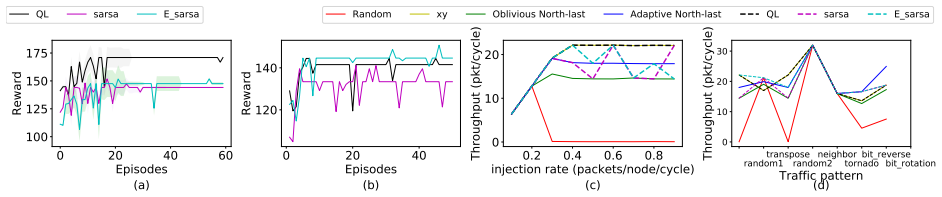
The central claim is that a tabular RL agent, trained on throughput feedback, can learn the mapping from observed network statistics to the best of four routing algorithms (random, xy, oblivious North-last, and adaptive North-last) and thereby achieve near-optimal throughput as traffic conditions change. In Case 1, where injection rate rises from 0.1 to 0.9, the Q-learning agent is reported to always make the optimal choice among the four algorithms, choosing adaptive North-last at low rates and oblivious North-last at higher rates. In Case 2, where seven synthetic traffic patterns replace one another, all three RL methods deliver near-optimal choices across all states. The paper interprets this as demonstrating that a continuously learning agent can configure NoC routing decisions better than any single fixed routing algorithm.
Load-bearing premise
The load-bearing premise is that the observed network statistics (injected flits, received flits, average latency) form a sufficient and reliable state from which the best next routing algorithm can be inferred, even though those statistics are produced by whatever routing algorithm was just selected.
Editorial extensions
If this is right
- If the learned selection policy is correct, a NoC can automatically switch routing algorithms in response to changing workload without human retuning, improving throughput over any static choice.
- Because the action space is only four algorithms, classical tabular RL suffices, avoiding the memory footprint of deep RL in real-time controllers.
- The same reward formulation can be adapted to other objectives, such as average latency, and other topologies, because the action-value learning loop is agnostic to those details.
- The convergence of all three algorithms in under about forty episodes suggests the state space is small enough for the learned Q-table to be transferred to a hardware controller with modest storage.
Reading between the lines
- Editorial inference: Because the observed state (flit counts and latency) is produced by the currently selected routing algorithm, the Markov assumption is action-dependent; a useful test is to check whether a policy trained on one traffic-pattern sequence generalizes to a held-out sequence of patterns, and whether adding a short history of past states improves decisions.
- Editorial inference: The four actions are coarse; the same framework could be extended to per-packet or per-router routing choices, but then the state space grows, and tabular Q-learning would likely need to be replaced by function approximation.
- Editorial inference: A lightweight baseline—always choose the routing algorithm with the highest throughput in the previous observation window—might perform comparably, and comparing against it would isolate the value of the learned Q-values rather than the simple act of switching.
- Editorial inference: The paper's two cases both assume the environment changes on a timescale slower than the RL training loop; a stress test with rapid switching (every few cycles) would reveal whether the learning rate and discount factor are tuned for stable or turbulent traffic.
Signed reviews
Editorial analysis
A structured set of objections, weighed in public.
Referee Report
Summary. The paper presents a reinforcement learning (RL) framework for adaptive routing on Networks-on-Chip (NoCs). The authors propose three temporal-difference RL algorithms (Q-learning, SARSA, and Expected-SARSA) that choose among four fixed routing algorithms (random, xy, oblivious North-last, and adaptive North-last) based on gem5 statistics. The environment is packaged as an OpenAI Gym extension, icr-gym, with code made publicly available. Two case studies are reported: one with gradually increasing injection rate and one with switching among seven synthetic traffic patterns. The central claim is that the RL agents learn a near-optimal routing choice across environment states, as evidenced by throughput curves comparing the RL-selected routing against the fixed baselines.
Significance. If the central claim were fully substantiated, the paper would provide a useful proof-of-concept that classical RL can act as a runtime decision agent for NoC routing, with the explicit strength of releasing reproducible code and a new Gym environment. The comparison of three RL algorithms against four fixed routing baselines in a realistic gem5/Garnet2.0 simulator is a reasonable empirical setup, and the convergence of the reward curves in Fig. 2(a)-(b) supports the claim that the RL algorithms learn something nontrivial. However, the headline claim of 'near-optimal' performance is not directly established by the presented evidence, which substantially limits the current significance of the paper.
major comments (3)
- [Section 4, Fig. 2(c)-(d)] The claim that the RL agents learn a 'near-optimal solution' is not supported because the paper never defines or computes the optimal routing choice per state. An appropriate oracle would be, for each state, the maximum throughput among the four available routing algorithms; the paper should plot this upper envelope alongside the RL curves and report the gap. Without such an oracle, a curve that lies above some baselines does not establish near-optimality, since the best baseline may vary by state and the RL policy could be systematically below the best available action. The sentence in Section 4 that 'the QL always makes the optimal choice out of four routing algorithms' is also asserted without a per-state action table or a quantitative comparison to the oracle.
- [Section 3, State bullet] The observation fed to the RL agent consists of gem5 statistics (injected flits, received flits, and average latency) that are outputs of the network under the currently selected routing algorithm. This makes the state action-dependent, so the Markov property assumed for Q-learning, SARSA, and Expected-SARSA may not hold: the learned state mapping can be confounded by the agent's own previous action. The paper should explicitly discuss this limitation and ideally mitigate it, for example by including the current action in the state, by using statistics collected under a fixed probe routing, or by demonstrating that the learned policy generalizes across seeds and unseen traffic conditions. This concern does not automatically falsify the empirical results, but it is load-bearing for the theoretical justification of the RL formulation.
- [Section 4, Fig. 2(c)-(d) and text] The throughput comparison in Fig. 2(c)-(d) is presented without any indication of variance or number of seeds, even though the reward curves in Fig. 2(a)-(b) do show standard deviation. Since the main empirical claim is that RL-selected throughput tracks the better baselines, the throughput curves need error bars or confidence intervals across multiple independent training runs. In addition, the text states that 'the results under different injection rates can all converge and follow the same trend' without showing those results; a representative plot or a supplementary table for at least one additional injection rate is needed to support this generalization.
minor comments (6)
- [Section 3, first paragraph] The environment name is rendered inconsistently and with unusual characters: 'interconnet -routinд-дym' and 'icr -дym' appear to contain Cyrillic characters and spacing errors; please use a consistent ASCII name such as 'icr-gym' throughout.
- [Section 4, first paragraph] The capitalization of 'Sarsa' is inconsistent; 'SARSA' is used in Section 2 and 'Sarsa' in Section 4, so please standardize.
- [Section 2, 'RL Algorithms'] The phrase 'temporal differential approaches' should be 'temporal difference approaches'.
- [Section 3, Experimental Methodology] Several important hyperparameters are not reported: the discount factor gamma, the learning rate, the exploration schedule, and the state discretization thresholds used to convert continuous gem5 statistics into the discrete state representation. These details are necessary for reproducibility even with the provided code.
- [Section 3, 'Info' bullet] The bullet describing 'Info' as 'Boolean format for thresholding at desired reward' is unclear; please explain what this information field represents and how it is used.
- [Figure 2] The figure caption and labels are difficult to read, particularly the legend in Fig. 2(d); please reformat the figure so that the baseline names and RL algorithm names are legible.
Circularity Check
No significant circularity: the RL evaluation is an empirical benchmark against fixed routing baselines, not a derivation from fitted inputs.
full rationale
The paper claims that its RL agents learn a near-optimal routing choice, and it supports this by comparing learned-agent throughput against fixed routing algorithms in Fig. 2(c)-(d). This is an empirical comparison, not a derivation that reduces to its inputs by construction. The reward function in Eq. (1) is the same throughput measure used in the baselines, but that is the intended objective, not a circularity. The state includes gem5 statistics that depend on the previously chosen routing action, which weakens the MDP justification and could hinder generalization, but this is a modeling limitation rather than a self-definitional or fitted-input circularity. The paper's 'near-optimal' claim is under-supported because no oracle or per-state optimal action table is provided, and the statement that 'QL always makes the optimal choice out of four routing algorithms' is asserted without direct evidence. However, under the evaluation rules, an unsupported empirical claim or missing oracle comparison is a correctness or evidence concern, not a circularity: the result is not forced by construction, and no fitted parameter is renamed as a prediction. The paper cites only external prior work and does not invoke any self-citation or uniqueness theorem as load-bearing. Therefore the appropriate circularity score is 0.
Assumptions & free parameters
free parameters (3)
- discount factor γ =
not reported
- state discretization thresholds =
not reported
- learning rate and exploration schedule =
not reported
assumptions (3)
- domain assumption gem5 with Garnet2.0 is a faithful model of NoC behavior.
- domain assumption The set of four routing algorithms contains the optimal choice for each traffic state.
- domain assumption The observed gem5 statistics form a Markov state for the routing decision.
Cite this review
Pith. "Pith review of Reinforcement Learning based Interconnection Routing for Adaptive Traffic Optimization." pith.science (2026). https://pith.science/paper/LTRESBWW
@misc{pith2026190804484,
  author       = {Pith},
  title        = {Pith review of: Reinforcement Learning based Interconnection Routing for Adaptive Traffic Optimization},
  year         = {2026},
  howpublished = {\url{https://pith.science/paper/LTRESBWW}},
  note         = {Machine review of arXiv:1908.04484}
}
read the original abstract
Applying Machine Learning (ML) techniques to design and optimize computer architectures is a promising research direction. Optimizing the runtime performance of a Network-on-Chip (NoC) necessitates a continuous learning framework. In this work, we demonstrate the promise of applying reinforcement learning (RL) to optimize NoC runtime performance. We present three RL-based methods for learning optimal routing algorithms. The experimental results show the algorithms can successfully learn a near-optimal solution across different environment states. Reproducible Code: github.com/huckiyang/interconnect-routing-gym
Figures

Reference graph
Works this paper leans on
-
[1]
Device placement optimization with reinforcement learning
Azalia Mirhoseini et al. Device placement optimization with reinforcement learning. In Proceedings of the 34th International Conference on Machine Learning-V olume 70, pages 2430–2439, 2017
work page 2017
-
[2]
Reinforcement learning: An introduction
Richard S Sutton et al. Reinforcement learning: An introduction. MIT press, 1998
work page 1998
- [3]
-
[4]
Improving tcp congestion control with machine intelli- gence
Yiming Kong et al. Improving tcp congestion control with machine intelli- gence. In ACM NetAI, pages 60–66, 2018
work page 2018
-
[5]
Nathan Binkert et al. The gem5 simulator. ACM SIGARCH Computer Architecture News, 39(2):1–7, 2011
work page 2011
-
[6]
Garnet: A detailed on-chip network model inside a full- system simulator
Niket Agarwal et al. Garnet: A detailed on-chip network model inside a full- system simulator. In 2009 IEEE international symposium on performance analysis of systems and software , pages 33–42. IEEE, 2009. 2
work page 2009
Reviewed August 14, 2026 · model on record in the stance chip above.
Discussion (0). Continue with ORCID to comment.