REVIEW 2 major objections 5 minor 11 references
Symmetry reduction of the 3-body problem in $\mathbb{R}^4$
T0 review · 2 major / 5 minor · reviewed 2026-08-14 · deepseek-v4-flash
Pith's one-line read This paper claims that the Newtonian three-body problem in four-dimensional space has Lyapunov-stable relative equilibria for small second angular momentum, so an open full-dimensional set of initial conditions never escapes to infinity.
desk verdict A carefully worked symplectic reduction that proves stable relative equilibria in the 3-body problem in R^4; the main result looks solid, with only minor caveats about local coordinates and the meaning of 'full dimension'. read the letter →
The pith
A machine-rendered reading of the paper's core claim, the machinery that carries it, and where it could break.
The reading
What carries the argument
The carrying object is a symplectic coordinate chart that performs the $\mathrm{SO}(4)$ analogue of Jacobi's elimination of nodes. A rotation matrix $M = \exp(B_{12}\theta_1)\exp(B_{34}\theta_2)\exp(B_{13}\psi_1)\exp(B_{24}\psi_2)$ aligns the two configuration vectors with the $(q_1,q_2)$- and $(q_3,q_4)$-planes, making $\theta_1,\theta_2$ cyclic with conjugate momenta fixed at $\mu_1,\mu_2$. The remaining rotational variables are removed by restricting to the invariant set $I$ defined by $p_{\psi_1} = p_{\psi_2} = 0$ and $L_3 = \Sigma\cos\delta = \Delta\cos\sigma$, which Theorem 1 shows is a symplectic submanifold carrying the reduced flow. On $I$ the reduced Hamiltonian is $H = \frac{1}{2\nu_1}(p_1^2+p_2^2+f(q_3,q_4)) + \frac{1}{2\nu_2}(p_3^2+p_4^2+f(q_1,q_2)) + V$, with $f$ built from the oriented area $A = \tfrac12(q_1q_4-q_2q_3)$ and from $L_d^2 = (\mu_1-\mu_2)^2 - L_3^2$, $L_s^2 = (\mu_1+\mu_2)^2 - L_3^2$. The effective-potential machinery then reduces the search for relative equilibria to a finite-dimensional minimization problem for $V_{\mathrm{eff}}$ with moments of inertia $I_1 = \nu_2 q_4^2 + \nu_1 q_2^2$ and $I_2 = \nu_1 q_1^2 + \nu_2 q_3^2$.
What would settle it
Take concrete masses such as $m_1=2$, $m_2=m_3=1$, fix $\mu_1=1$ and $\mu_2=0.01$, compute the equilibrium from Lemma 11, and evaluate the Hessian of the reduced Hamiltonian; a negative eigenvalue for any parameter in the claimed stable range, or a numerical integration of the original unreduced equations from a nearby initial condition that escapes to infinity, would settle the central claim false.
Extended reading notes
Core claim
On the paper's own terms, the central discovery is that the fully reduced three-body Hamiltonian in $\mathbb{R}^4$ has explicit relative equilibria that are strict local minima, not merely saddle points. For two equal masses the equilibrium is an isosceles configuration with $q_2 = q_3 = 0$ and zero momenta, whose coordinates solve two algebraic equations relating $q_1, q_4$ to $\mu_1, \mu_2$; for general masses it is a near-isosceles configuration given by power series in a small quantity $u$, with $q_1 = O(u^2)$, $q_2 = O(u^{10})$, $q_3 = O(u^{12})$, and $q_4 = O(1)$. The proof locates these configurations as critical points of the effective potential $V_{\mathrm{eff}} = \tfrac12(\mu_1^2 I_1^{-1} + \mu_2^2 I_2^{-1}) + V$, then verifies that both the Hessian of $V_{\mathrm{eff}}$ and the reduced kinetic form $K_{\mathrm{eff}}$ are positive definite for sufficiently small $\mu_2$. From these checks the paper concludes that the reduced Hamiltonian itself has a minimum at the equilibrium and hence that the corresponding relative equilibrium of the full problem is Lyapunov stable, so a full-dimensional set of initial conditions remains bounded.
Load-bearing premise
The load-bearing premise is that a minimum of the 8-dimensional reduced Hamiltonian automatically gives Lyapunov stability of the corresponding relative equilibrium in the original 24-dimensional flow; the paper invokes this as standard rather than proving the lifting, and if the momentum-level fibers contributed neutral directions or noncompact effects, the full-dimensional bounded-orbit conclusion would not follow.
Editorial extensions
If this is right
- For dimension four, the set of negative-energy initial conditions is not densely populated by escaping orbits: there exist open full-dimensional balls in which every orbit remains bounded for all time.
- The three families of balanced relative equilibria obtained by permuting the masses are all Lyapunov stable when $\mu_2$ is small, and their two rotational frequencies are generically incommensurate, making them quasiperiodic relative equilibria whose leading-order frequencies satisfy Kepler's third law.
- As $\mu_2 \to 0$, the stable equilibria tend to a collision configuration, and in rescaled variables the limit matches the known bifurcation values of the energy surface at infinity, connecting the $\mathbb{R}^4$ construction to the three-dimensional escape problem.
- Because the reduction itself is valid for any potential depending only on mutual distances, the same 8-dimensional Hamiltonian and stability criterion apply to other central interactions, although the minimum claim is proved here for the Newtonian potential.
Reading between the lines
- A natural but unproved extension is that the same effective-potential minimization could yield Lyapunov-stable balanced configurations for four or more bodies in $\mathbb{R}^4$; the paper only treats the three-body case.
- The paper proves existence of the stable ball but does not estimate its radius; one could numerically or analytically bound how the size of the non-escaping neighborhood scales with $\mu_2$ and $\mu_1$.
- The explicit reduced Hamiltonian invites a numerical continuation of the stable family from small $\mu_2$ toward $\mu_2 = \mu_1$, where the kinetic form ceases to be positive definite, potentially revealing a sharp stability boundary.
- The coordinate chart loses validity where $A = 0$, so a global description of the reduced space might uncover additional relative equilibria, stable or unstable, that are invisible to the present local analysis.
Signed reviews
Editorial analysis
A structured set of objections, weighed in public.
Referee Report
Summary. The manuscript develops a symplectic reduction of the Newtonian three-body problem in R^4. After translation reduction to a 16-dimensional phase space and a rotation reduction adapted to the two angular-momentum eigenvalues ±iμ1, ±iμ2, the authors obtain a local 8-dimensional reduced Hamiltonian (Theorem 2, Eq. (6)). They then identify relative equilibria: an isosceles family for two equal masses (Theorem 3) and a near-collision binary family for general masses in the small-μ2 limit (Theorem 4). The central claims are that these equilibria are local minima of the reduced Hamiltonian for sufficiently small μ2, hence Lyapunov stable, and that this yields full-dimensional open sets of initial conditions with no unbounded orbits, giving a negative answer to Herman's question in d=4.
Significance. If the result holds, this is a substantial contribution: it provides the first complete local symplectic reduction of the 3-body problem in R^4, exhibits new relative equilibria that are Lyapunov stable, and disproves the density of unbounded orbits at negative energy in this setting. The paper is commendably concrete: the reduction chain is explicit, the Hessian blocks are written out, the eigenvalue expansions are given in closed form, and the limiting Keplerian frequencies are stated. The general reduction theorem in Section 4 is a useful tool in its own right. The main caveat is that the local-minimum argument is performed on the reduced space, while the advertised Lyapunov stability in the full system is asserted rather than proved in detail.
major comments (2)
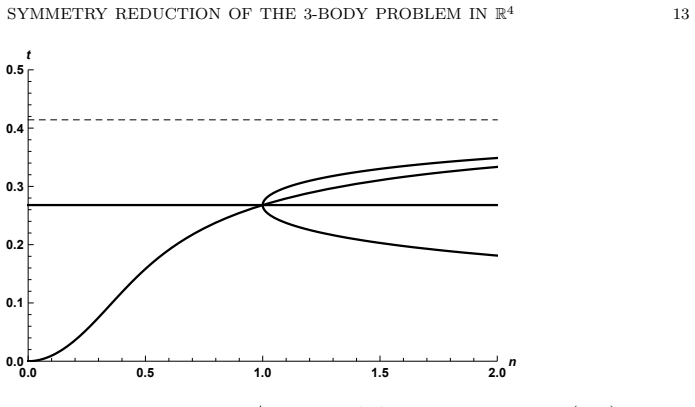
- [§6, Lemma 9 and Figure 2] The positivity condition for the (q2,q3)-block is stated as (μ1^2−μ2^2)P1(n,t)>0, with P1 defined two lines below. For t→0, P1 = 32t^3(3n+2+O(t^2)) − (1+t^2)^5, which is negative for all n>0 and all sufficiently small t. Lemma 8, however, proves that all eigenvalues of this block are positive in exactly that limit, and the text identifies the region adjacent to the n-axis as stable. Thus the inequality in Lemma 9 has the wrong sign, or P1 is defined with the opposite sign. Since the proof of Theorem 3 refers to Lemmas 8 and 9, this internal contradiction must be fixed; the small-μ2 conclusion itself can be recovered from Lemma 8 by continuity, but the global statement of Lemma 9 and the interpretation of Figure 2 are not supported as printed.
- [Abstract, §1, and §6-7] The inference 'local minimum of the reduced Hamiltonian ⇒ Lyapunov stability of the relative equilibrium in the full system' is load-bearing for the advertised boundedness result, but no proof or reference is supplied. The equilibrium in question is quasiperiodic with two incommensurate frequencies, so the invariant object is a compact torus, not a fixed point. To justify the conclusion one needs a Dirichlet-type argument on the fixed momentum level, or a cited theorem on stability of relative equilibria under symplectic reduction, together with an explanation of why nearby orbits in the unreduced phase space remain close to the torus. Please add this argument or a precise reference.
minor comments (5)
- [Abstract] The phrase 'balls of initial conditions of full dimension' is ambiguous. The proof gives an open set in the reduced space, which lifts to a full-dimensional neighbourhood in the fixed-momentum, translation-reduced phase space, not in the original 24-dimensional phase space with arbitrary linear momentum, where the centre of mass drifts. Please state precisely in which phase space the ball lives and what 'full dimension' means there.
- [§4, determinant of A] The determinant formula for the matrix A is stated without derivation, and the reduction to Δ^2Σ^2 on the invariant set is only asserted. A short computation or a reference would make the regularity check easier to verify.
- [§6, Lemma 8] The eigenvalue expansions in Lemma 8 mix leading terms of different orders in t; it would help to state explicitly which block each eigenvalue belongs to and to confirm that all displayed leading terms are positive in the stated limit.
- [§7, Lemma 12] The statement 'with an overall scaling factor of m2m3/q4^3 removed' is somewhat unclear; please specify the scaling convention for q4 and the mass factors so the reader can reproduce the eigenvalue expansions.
- [§6, Theorem 3] The theorem states that an isosceles relative equilibrium exists for any μ1>μ2>0, but the proof focuses on the minimum property for small μ2. A brief existence argument for all admissible momenta, or a precise domain statement, would strengthen the theorem.
Circularity Check
No significant circularity: the reduction and local-minimum proof are self-contained, and the cited preprint is context, not load-bearing.
full rationale
The paper derives the 8-dimensional reduced Hamiltonian by an explicit symplectic coordinate transformation (Lemma 1), checks the invariant set via the momentum map (Lemmas 3–4), proves that restriction to the invariant set yields the reduced dynamics (Theorem 1), and then computes the reduced Hamiltonian explicitly (Theorem 2 and Lemma 5). The relative equilibria are not fitted or assumed: they are found by solving the equilibrium equations of the effective potential (Theorem 3 and Lemma 11), and stability is established by explicit positive-definiteness of the Hessian in the q- and p-directions (Lemmas 7–9 and Lemma 12). The step from a local minimum of the reduced Hamiltonian to Lyapunov stability of the relative equilibrium is the standard argument that the full Hamiltonian is constant on the compact isotropy torus and that a strict reduced minimum gives an open set of nearby bounded orbits. The self-cited preprint [AD19] is mentioned only as prior discussion and context, and the paper explicitly distinguishes its own contribution: proving that the three families of relative equilibria are minima in the limit close to the three-dimensional case. No parameter is fitted to a quantity that is later called a prediction, and no uniqueness theorem is imported from the authors' prior work. The only interpretive caveat is that 'full dimension' must mean full dimension in the translation-reduced, fixed-angular-momentum phase space, since the centre of mass drift prevents an open ball in the original unrestricted phase space; this is a wording point, not circularity.
Assumptions & free parameters
assumptions (5)
- standard math Marsden-Weinstein symplectic reduction theorem is valid for the SO(4) action and the fixed momentum level
- domain assumption A local minimum of the reduced Hamiltonian implies Lyapunov stability of the corresponding relative equilibrium in the full phase space
- standard math The equilibrium branch for general masses exists for all sufficiently small μ2 via the implicit function theorem
- domain assumption Non-degeneracy conditions hold near the equilibrium: A ≠ 0, cos2ψ1 ≠ cos2ψ2, and μ1 ≠ μ2
- domain assumption Newtonian potential is smooth away from collisions
Cite this review
Pith. "Pith review of Symmetry reduction of the 3-body problem in $\mathbb{R}^4$." pith.science (2026). https://pith.science/paper/AUMZLWBS
@misc{pith2026190804496,
  author       = {Pith},
  title        = {Pith review of: Symmetry reduction of the 3-body problem in $\mathbbR^4$},
  year         = {2026},
  howpublished = {\url{https://pith.science/paper/AUMZLWBS}},
  note         = {Machine review of arXiv:1908.04496}
}
abstract
The 3-body problem in $\mathbb{R}^4$ has 24 dimensions and is invariant under translations and rotations. We do the full symplectic symmetry reduction and obtain a reduced Hamiltonian in local symplectic coordinates on a reduced phase space with 8 dimensions. The Hamiltonian depends on two parameters $\mu_1 > \mu_2 \ge 0$, related to the conserved angular momentum. The limit $\mu_2 \to 0$ corresponds to the 3-dimensional limit. We show that the reduced Hamiltonian has relative equilibria that are local minima and hence Lyapunov stable when $\mu_2$ is sufficiently small. This proves the existence of balls of initial conditions of full dimension that do not contain any orbits that are unbounded.
Figures

Reference graph
Works this paper leans on
-
[1]
Alain Albouy and Alain Chenciner, Le probl\`eme des n corps et les distances mutuelles , Invent. Math. 131 (1998), no. 1, 151--184. 1489897 (98m:70017)
work page 1998
-
[2]
Dullin, Relative equilibra of the 3-body problem in R^4 , preprint (2019)
Alain Albouy and Holger R. Dullin, Relative equilibra of the 3-body problem in R^4 , preprint (2019)
work page 2019
-
[3]
Alain Albouy, Integral manifolds of the N -body problem , Invent. Math. 114 (1993), 463--488
work page 1993
-
[4]
Alain Chenciner, The angular momentum of a relative equilibrium, Discrete & Continuous Dynamical Systems - A 33 (2013), 1033--1047
work page 2013
-
[5]
Michael Herman, Some open problems in dynamical systems, Proceedings of the International Congress of Mathematicians (Bielefeld), Documenta Mathematica, vol. 2, DMV, 1998, pp. 797--808
work page 1998
-
[6]
C. G. J. Jacobi, Sur l' \'e limination des noeuds dans le probl \`e me des trois corps , Astronomische Nachrichten 20 (1843), no. 6, 81--98
-
[7]
132, Springer Grundlehren, 2013
Tosio Kato, Perturbation theory for linear operators, vol. 132, Springer Grundlehren, 2013
work page 2013
-
[8]
J. E. Marsden and A. Weinstein, Reduction of symplectic manifolds with symmetry, Rep. on Math. Phys. 5 (1974), 121--130
work page 1974
Show all 11 references
-
[9]
Steven Smale, Topology and mechanics I+II , Inv. Math. 10+11 (1970), 305--331\ + \ 45--64
1970
-
[10]
Tanya Schmah and Cristina Stoica, On the n-body problem in R^4 , arXiv:1907.08746 (2019)
2019 arXiv
-
[11]
E. T. Whittaker, A treatise on the analytical dynamics of particles and rigid bodies, 4 ed., Cambridge University Press, Cambridge, 1937
1937
Reviewed August 14, 2026 · model on record in the stance chip above.
Discussion (0). Continue with ORCID to comment.