REVIEW 3 major objections 4 minor 1 cited by
Mapping the twist angle and unconventional Landau levels in magic angle graphene
T0 review · 3 major / 4 minor · reviewed 2026-08-14 · deepseek-v4-flash
Pith's one-line read This paper maps the local twist angle across magic-angle twisted bilayer graphene devices and shows that even the cleanest devices, including a superconducting one, carry roughly 0.1° of twist-angle disorder that reshapes the quantum Hall…
desk verdict Impressive first maps of local twist angle in real MATBG devices, but the θ extraction likely absorbs strain/relaxation effects and the quantitative gradients should be treated with caution. read the letter →
The pith
A machine-rendered reading of the paper's core claim, the machinery that carries it, and where it could break.
The reading
What carries the argument
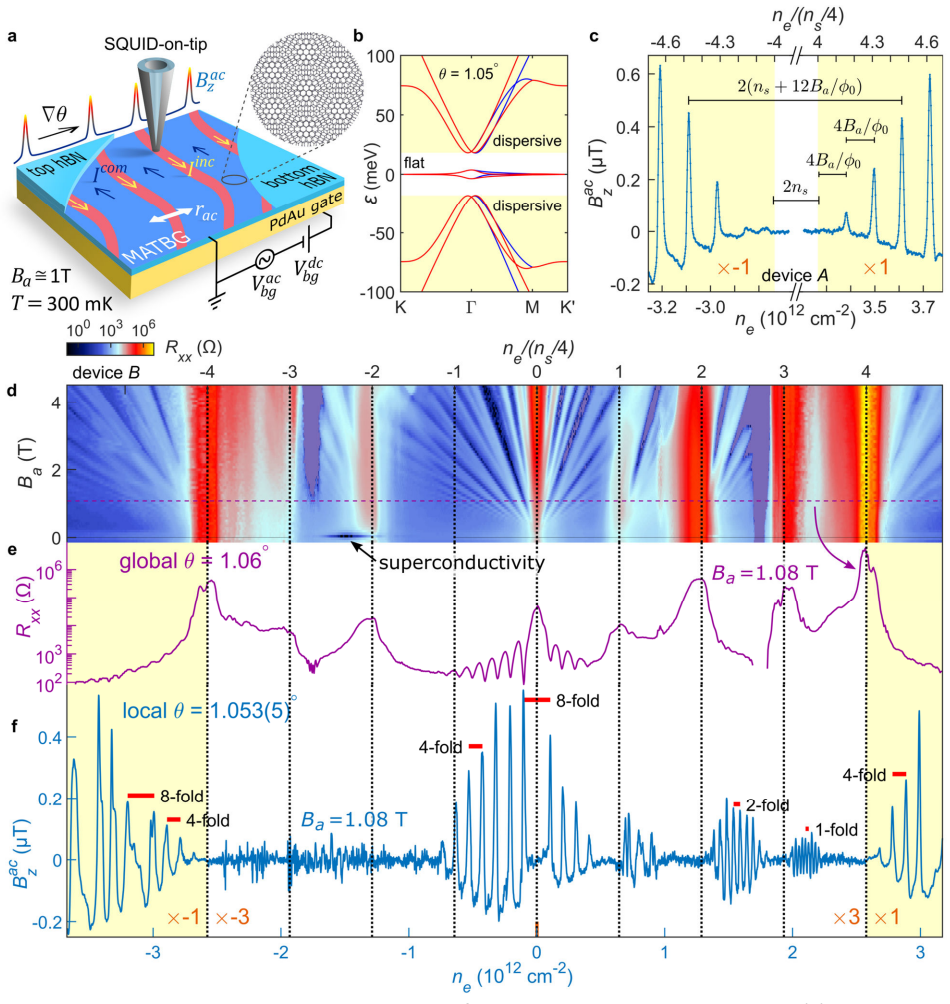
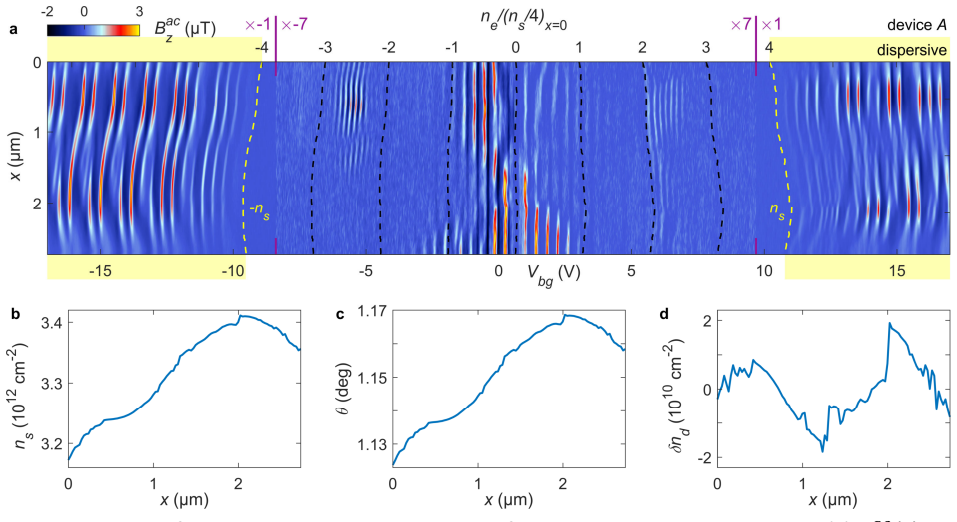
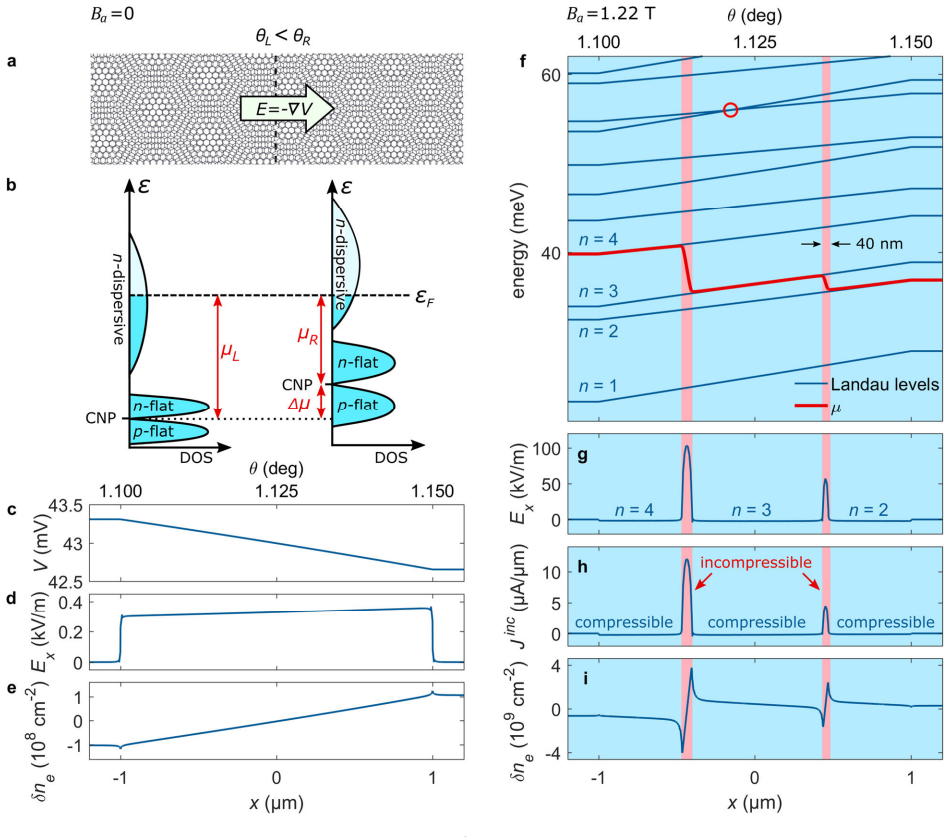
The central object is the nanoSQUID-on-tip (SOT), a superconducting quantum interference device at the apex of a sharp pipette that can image the tiny magnetic fields of equilibrium currents flowing in incompressible quantum Hall strips. With backgate modulation, the SOT records sharp peaks whenever an incompressible strip passes beneath the tip, and the gate voltages of these peaks give the local density of full Landau levels, from which the local flat-band density and thus the local twist angle are extracted through the rigid-twist relation $n_{s2} = 8\theta^2/(\sqrt{3}\,a^2)$, where $a$ is graphene's lattice constant. A separate self-consistent electrostatic and band-structure calculation converts the measured $\theta(\mathbf{r})$ maps into chemical-potential, electric-field, and persistent-current maps that explain the observed bulk quantum Hall strips.
What would settle it
Measure the same device region with an atomic-resolution technique such as STM or TEM and compare the local moiré period with the SOT-derived $\theta(\mathbf{r})$; if the local band structure or reconstruction shifts the relation between $n_{s2}$ and $theta$ by more than the claimed 0.002° relative precision, the inferred angle maps and gradients would change. Alternatively, a calculation showing that heterostrain or lattice relaxation changes $n_{s2}(\theta)$ by a comparable amount would falsify the angle calibration.
Extended reading notes
Core claim
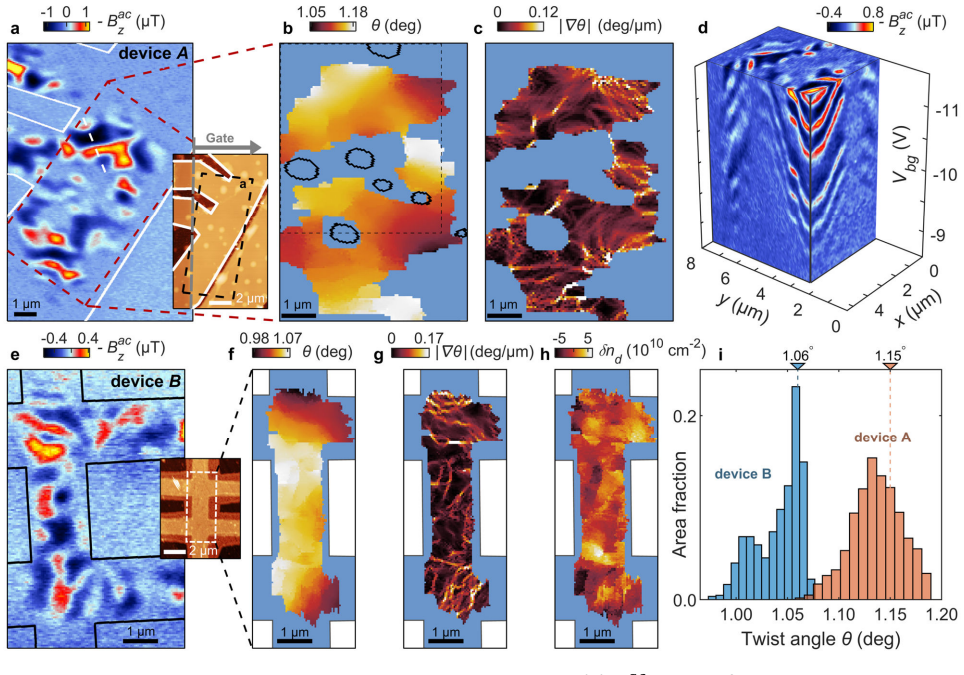
By imaging the equilibrium currents carried by incompressible quantum Hall strips with a nanoSQUID-on-tip, the authors obtain tomographic maps of the local Landau levels and, from the spacing between p- and n-band peaks, maps of the local flat-band density $n_{s2}(\mathbf{r})$ and hence the local twist angle $\theta(\mathbf{r})$ with relative precision better than 0.002° and spatial resolution of a few moiré periods. They find twist-angle spans of 0.13° and 0.10° in two devices, with gradients around 0.05°/µm and networks of ~0.01° jumps, and they show that these gradients produce electric fields up to ~$10^{5}$ V/m inside narrow incompressible strips and move quantum Hall edge states into the bulk. The central claim is that twist-angle disorder is a dominant, distinct disorder type in MATBG, one that changes the local band structure and substantially affects the correlated insulator and superconducting phases.
Load-bearing premise
The maps assume that the local density needed to fill the flat bands, $n_{s2}(\mathbf{r})$, is tied to the local twist angle by the rigid-rotation formula $n_{s2} = 8\theta^2/(\sqrt{3}\,a^2)$ and that the midpoint of the p- and n-band Landau-level peaks gives $n_{s2}(\mathbf{r})$ exactly, with negligible bias from lattice relaxation, heterostrain, charge disorder, or local variations of the backgate capacitance.
Editorial extensions
If this is right
- Even devices that show superconductivity can contain substantial non-magic-angle regions; global MATBG behavior can be carried by percolating paths of favorable local twist angle.
- Twist-angle gradients create unscreened in-plane electric fields that move quantum Hall edge states into the bulk, forming narrow (~50 nm) incompressible strips carrying persistent currents.
- The observed $\theta(\mathbf{r})$ gradients and associated electric fields should affect the stability of correlated insulators, superconductivity, and magnetism in MATBG.
- The usual absence of full conductance quantization in MATBG transport follows naturally from the coexistence of several different Landau levels crossing the Fermi level in the bulk.
- At high enough magnetic field, when the Landau-level degeneracy exceeds the local $n_{s2}$ variation, conventional quantum Hall quantization should be restored.
Reading between the lines
- If twist-angle disorder is the dominant disorder in MATBG, then improving only the global alignment accuracy will not fix device quality; controlling local gradients or relaxation-induced jumps may matter more than the average angle.
- The same nanoSQUID-based tomographic method could be applied to other moiré systems to test whether the observed ~0.01° jumps correspond to stacking-fault networks seen in transmission electron microscopy.
- The gate-tunable built-in planar electric fields produced by twist-angle gradients could be deliberately engineered for band-structure tuning, photovoltaic, or thermoelectric applications—an extension the paper mentions as a direction but does not itself demonstrate.
- A direct comparison between the SOT-derived $\theta(\mathbf{r})$ maps and atomic-resolution measurements on the same device would test whether the inferred angle gradients are intrinsic to the lattice or partly an artifact of the rigid-twist density relation.
Signed reviews
Editorial analysis
A structured set of objections, weighed in public.
Referee Report
Summary. The paper presents scanning nanoSQUID-on-tip imaging of Landau levels in two hBN-encapsulated magic-angle twisted bilayer graphene devices. From the spacing between p-type and n-type dispersive-band Landau level peaks, the authors extract maps of the local twist angle θ(r) via the rigid-twist relation between the flat-band density n_s2 and θ. They report that even transport-quality devices with correlated insulators and superconductivity contain local twist-angle variations spanning up to about 0.1°, networks of abrupt jumps, and mean gradients of order 0.05°/µm. They further argue that these gradients create unscreened in-plane electric fields, produce compressible/incompressible strip patterns and bulk quantum Hall edge states, and may influence correlated and superconducting phases. The claims are supported by line scans, tomographic movies, two-device consistency, and self-consistent electrostatic and Landau level calculations.
Significance. If the central interpretation holds, the work constitutes an important advance: it directly images local twist-angle disorder in realistic MATBG devices, provides a quantitative link between local θ(r) and quantum Hall structure, and proposes a concrete mechanism—twist-angle-gradient-induced built-in electric fields—that could affect transport and the correlated phase diagram. The experimental methodology is original and carefully executed, with long-duration tomographic acquisitions, spatial resolution near 50 nm, and machine-readable movies. The error analysis in SI6 is a real strength, and the paper is honest about regions where no MATBG physics is observed. The percolation interpretation of global transport in devices with large non-MA areas is falsifiable and already consistent with the contrasting device A/B behavior. The main reservation is not circularity—the θ extraction does not fit the theoretical model—but model bias in the conversion from measured LL spacings to local twist angle.
major comments (3)
- [SI6, twist-angle conversion] The entire θ(r) map rests on the relation n_s2 = 8θ²/(√3a²), which is the rigid uniform-twist result, and on the assumption that the midpoint of the p and n dispersive LL peaks directly gives n_s2(r). The manuscript itself notes in the introduction that in-plane relaxation within a supercell significantly modifies the band structure (refs 12,13) and that heterostrain has strong predicted effects (refs 14,15), yet no correction or calibration for either is applied. Because the paper's central physical consequences—unscreened electric fields, bulk QH edge states, and percolation—are driven by gradients of θ(r), any strain- or relaxation-induced shift of the apparent local n_s2 would transfer directly into the reported θ spans and gradients. I ask for a quantitative estimate of this systematic error: for example, a relaxed-band or heterostrained LL calculation showing how much the p/n midpoint moves relative to the geometric moiré density, or an independent local measurement of the moiré period in the same devices.
- [Fig. 2a and SI6] The midpoint extraction assumes that the p and n dispersive LL fans are symmetric around the charge neutrality point and that all symmetry-breaking effects can be absorbed into a common midpoint shift. However, Fig. 2a displays a pronounced p-n asymmetry and position-dependent toggling between 4-fold and 8-fold LL degeneracies, which indicates that the single-particle band structure is not rigidly symmetric at the local level. The authors should justify explicitly why the lower LL midpoint remains an unbiased estimator of n_s2(r). A concrete test would be to compare θ(r) extracted from two different LL indices, or to compute the p/n LL midpoint in the SI11 model with a finite heterostrain included, and show that the difference is negligible relative to the 0.1° span claimed.
- [SI2 and Fig. 3] The conversion from gate voltage to density uses a single global backgate capacitance C_bg determined from transport, while the θ(r) maps cover areas near bubbles and over a device with spatial topography. Local variations in hBN thickness or gate geometry—most plausibly in the vicinity of the bubbles explicitly excluded from the maps—would change the local C_bg and could appear as apparent θ(r) variations. The paper does not provide a spatial calibration of C_bg or an estimate of its maximum variation over the mapped regions. Please add an upper bound on ΔC_bg/C_bg and show that it contributes negligibly to the reported θ span and to the gradient maps in Figs. 3c and 3g.
minor comments (4)
- [Main text and SI6] The quoted accuracies are inconsistent across the manuscript: the main text states relative accuracy between locations of ±0.0002° and map accuracy better than ±0.001°, while SI6 quotes ±0.002° for the movie-derived maps and also mentions ±0.001°; these numbers should be harmonized with a clear statement of which uncertainty refers to line scans, which to maps, and which is statistical versus systematic.
- [Fig. S10 caption] The caption labels all three band structure panels as (c); the panels should be labeled (c), (d), and (e) or the caption text should be corrected.
- [General typesetting] Many inline equations and Greek symbols are rendered as garbled escape sequences in the submitted text, particularly in the derivations of θ(r) and in SI6; the final typeset version must be carefully checked for legibility.
- [Abstract] The abstract says 'relative precision better than 0.002°' while the main text emphasizes 'absolute accuracy of ±0.005° and relative accuracy of ±0.0002°'; please clarify precision versus accuracy in the abstract to avoid misleading readers who do not consult SI6.
Circularity Check
Twist-angle map is a direct geometric extraction from measured LL spacings; the QH/field simulations use published parameters and are forward models, not fits to the target result, so no circular reduction is present.
full rationale
The derivation chain is self-contained at the level of the paper's central claims. The local twist angle θ(r) is obtained from measured positions of the p- and n-dispersive-band Landau-level peaks via the rigid geometric relation n_s2 = 8θ²/(√3 a²) (main text and SI6); no parameter of the tight-binding/continuum band-structure model is fitted to the θ maps or to the observed quantum-Hall phenomenology. The Fig. 4 simulations use a representative linear gradient, 0.025°/µm, and published interlayer couplings w = 0.0797 eV and w' = 0.0975 eV from Ref. [49] to forward-model the unscreened electric fields and bulk incompressible strips; the comparison with the measured B_z^ac images is a consistency check rather than a fit. The flat-band degeneracy and LL-crossing discussion also uses an independent LL calculation, not a parameter extracted from the same data. The only self-references (Ref. 28 for QH current imaging from the same group, and Ref. 49 for interlayer parameters by a co-author) are methodological or parameter-source citations; neither is invoked as a uniqueness theorem or as an ansatz that carries the θ(r) claim. The assumption that the p/n LL midpoint equals n_s2 and that n_s2 follows the rigid uniform-twist formula is a calibration assumption; if lattice relaxation or heterostrain biased the midpoint, the reported θ spans and gradients would change, but that is a model-accuracy/correctness concern, not circularity.
Assumptions & free parameters
free parameters (2)
- Backgate capacitance C_bg =
Device A: 3.07e11 cm^-2 V^-1; Device B: 2.31e11 cm^-2 V^-1
- hBN relative permittivity epsilon_r =
4
assumptions (4)
- domain assumption Continuum model of twisted bilayer graphene with interlayer couplings w = 0.0797 eV and w' = 0.0975 eV from prior literature.
- domain assumption Local rigid twisted bilayer approximation: electronic structure at each point is that of a uniform twist angle theta(r) with n_s2 = 8*theta^2/(sqrt(3)*a^2).
- standard math Quantum Hall filling relation |n| = g*nu*B/phi_0 with LL degeneracy g = 4 or 8.
- domain assumption Equilibrium condition of uniform chemical potential and electrostatic boundary conditions in the COMSOL simulation.
Cite this review
Pith. "Pith review of Mapping the twist angle and unconventional Landau levels in magic angle graphene." pith.science (2026). https://pith.science/paper/RCHP7VLU
@misc{pith2026190804595,
  author       = {Pith},
  title        = {Pith review of: Mapping the twist angle and unconventional Landau levels in magic angle graphene},
  year         = {2026},
  howpublished = {\url{https://pith.science/paper/RCHP7VLU}},
  note         = {Machine review of arXiv:1908.04595}
}
abstract
The emergence of flat electronic bands and of the recently discovered strongly correlated and superconducting phases in twisted bilayer graphene crucially depends on the interlayer twist angle upon approaching the magic angle $\theta_M \approx 1.1\deg$. Although advanced fabrication methods allow alignment of graphene layers with global twist angle control of about 0.1$\deg$, little information is currently available on the distribution of the local twist angles in actual magic angle twisted bilayer graphene (MATBG) transport devices. Here we map the local $\theta$ variations in hBN encapsulated devices with relative precision better than 0.002$\deg$ and spatial resolution of a few moir$\'e$ periods. Utilizing a scanning nanoSQUID-on-tip, we attain tomographic imaging of the Landau levels in the quantum Hall state in MATBG, which provides a highly sensitive probe of the charge disorder and of the local band structure determined by the local $\theta$. We find that even state-of-the-art devices, exhibiting high-quality global MATBG features including superconductivity, display significant variations in the local $\theta$ with a span close to 0.1$\deg$. Devices may even have substantial areas where no local MATBG behavior is detected, yet still display global MATBG characteristics in transport, highlighting the importance of percolation physics. The derived $\theta$ maps reveal substantial gradients and a network of jumps. We show that the twist angle gradients generate large unscreened electric fields that drastically change the quantum Hall state by forming edge states in the bulk of the sample, and may also significantly affect the phase diagram of correlated and superconducting states. The findings call for exploration of band structure engineering utilizing twist-angle gradients and gate-tunable built-in planar electric fields for novel correlated phenomena and applications.
Figures
Figures from the paper (2 more)
Forward citations
Cited by 1 Pith paper
-
General continuum model for twisted bilayer graphene and arbitrary smooth deformations
A real-space derivation yields a general continuum Hamiltonian for bilayer graphene under arbitrary small-gradient deformations, reducing to the Bistritzer-MacDonald model for rigid twists.
Reference graph
Works this paper leans on
-
[1]
Y. Cao, V. Fatemi, A. Demir, S. Fang, S. L. Toma rken, J. Y. Luo, J. D. Sanchez-Yamagishi, K. Watanabe, T. Taniguchi, E. Kaxiras, R. C. Ashoori, and P. Jarillo-Herrero, ''Correlated insulator behaviour at half-filling in magic-angle graphene superlattices'', Nature 556 , 80 (2018)
work page 2018
-
[2]
Y. Cao, V. Fatemi, S. Fang, K. Watanabe, T. Tani guchi, E. Kaxiras, and P. Jarillo-Herrero, ''Unconventional superconductivity in magic-angle graphene superlattices'', Nature 556 , 43 (2018)
work page 2018
-
[3]
M. Yankowitz, S. Chen, H. Polshyn, Y. Zhang, K. W atanabe, T. Taniguchi, D. Graf, A. F. Young, and C. R. Dean, ''Tuning superconductivity in twisted bilayer graphene'', Science 363 , 1059 (2019)
work page 2019
-
[4]
A. L. Sharpe, E. J. Fox, A. W. Barnard, J. Finne y, K. Watanabe, T. Taniguchi, M. A. Kastner, and D. Goldhaber-Gordon, ''Emergent ferromagnetism near three-quarters filling in twisted bilayer graphene'', arXiv:1901.03520 (2019)
arXiv 2019
-
[5]
X. Lu, P. Stepanov, W. Yang, M. Xie, M. A. Aamir , I. Das, C. Urgell, K. Watanabe, T. Taniguchi, G. Zhang, A. Bachtold, A. H. MacDonald, and D. K. Efetov, ''Superconductors, Orbital Magnets, and 11 Correlated States in Magic Angle Bilayer Graphene'', arXiv:1903.06513 (2019)
arXiv 2019
-
[6]
S. L. Tomarken, Y. Cao, A. Demir, K. Watanabe, T . Taniguchi, P. Jarillo-Herrero, and R. C. Ashoori, ''Electronic compressibility of magic angle graphene superlattices'', arXiv:1903.10492 (2019)
work page Pith review arXiv 2019
- [7]
-
[8]
E. Suárez Morell, J. D. Correa, P. Vargas, M. Pa checo, and Z. Barticevic, ''Flat bands in slightly twisted bilayer graphene: Tight-binding calculations'', Phys. Rev. B 82 , 121407 (2010)
work page 2010
Show all 53 references
-
[9]
Bistritzer and A
R. Bistritzer and A. H. MacDonald, ''Moiré bands in twisted double-layer graphene'', Proc. Natl. Acad. Sci. 108 , 12233 (2011)
2011
-
[10]
J. M. B. Lopes dos Santos, N. M. R. Peres, and A. H. Castro Neto, ''Continuum model of the twisted graphene bilayer'', Phys. Rev. B 86 , 155449 (2012)
2012
-
[11]
Moon and M
P. Moon and M. Koshino, ''Optical absorption in twisted bilayer graphene'', Phys. Rev. B 87 , 205404 (2013)
2013
-
[12]
N. N. T. Nam and M. Koshino, ''Lattice relaxati on and energy band modulation in twisted bilayer graphene'', Phys. Rev. B 96 , 075311 (2017)
2017
-
[13]
H. Yoo, R. Engelke, S. Carr, S. Fang, K. Zhang, P. Cazeaux, S. H. Sung, R. Hovden, A. W. Tsen, T. Taniguchi, K. Watanabe, G.-C. Yi, M. Kim, M. Luskin, E. B. Tadmor, E. Kaxiras, and P. Kim, ''Atomic and electronic reconstruction at the van der Waals interface in twisted bilayer...
2019
-
[14]
Huder, A
L. Huder, A. Artaud, T. Le Quang, G. T. de Lais sardière, A. G. M. Jansen, G. Lapertot, C. Chapelier, and V. T. Renard, ''Electronic Spectrum of Twisted Graphene Layers under Heterostrain'', Phys. Rev. Lett. 120 , 156405 (2018)
2018
-
[15]
Z. Bi, N. F. Q. Yuan, and L. Fu, ''Designing Fla t Band by Strain'', arXiv:1902.10146 (2019)
2019 arXiv
-
[16]
G. Li, A. Luican, J. M. B. Lopes dos Santos, A. H. Castro Neto, A. Reina, J. Kong, and E. Y. Andrei, ''Observation of Van Hove singularities in twisted graphene layers'', Nat. Phys. 6, 109 (2010)
2010
-
[17]
Brihuega, P
I. Brihuega, P. Mallet, H. González-Herrero, G. Trambly de Laissardière, M. M. Ugeda, L. Magaud, J. M. Gómez-Rodríguez, F. Ynduráin, and J.-Y. Veuillen, ''Unraveling the Intrinsic and Robust Nature of van Hove Singularities in Twisted Bilayer Graphene by Scanning Tunneling Mic...
2012
-
[18]
D. Wong, Y. Wang, J. Jung, S. Pezzini, A. M. Da Silva, H.-Z. Tsai, H. S. Jung, R. Khajeh, Y. Kim, J. Lee, S. Kahn, S. Tollabimazraehno, H. Rasool, K. Watanabe, T. Taniguchi, A. Zettl, S. Adam, A. H. MacDonald, and M. F. Crommie, ''Local spectroscopy of moiré-induced electronic...
2015
-
[19]
Kerelsky, L
A. Kerelsky, L. McGilly, D. M. Kennes, L. Xian, M. Yankowitz, S. Chen, K. Watanabe, T. Taniguchi, J. Hone, C. Dean, A. Rubio, and A. N. Pasupathy, ''Magic Angle Spectroscopy'', arXiv:1812.08776 (2018)
2018 arXiv
-
[20]
Y. Choi, J. Kemmer, Y. Peng, A. Thomson, H. Aro ra, R. Polski, Y. Zhang, H. Ren, J. Alicea, G. Refael, F. von Oppen, K. Watanabe, T. Taniguchi, and S. Nadj-Perge, ''Imaging Electronic Correlations in Twisted Bilayer Graphene near the Magic Angle'', arXiv:1901.02997 (2019)
2019 arXiv
-
[21]
Jiang, J
Y. Jiang, J. Mao, X. Lai, K. Watanabe, T. Tanig uchi, K. Haule, and E. Y. Andrei, ''Evidence of charge- 12 ordering and broken rotational symmetry in magic angle twisted bilayer graphene'', arXiv:1904.10153 (2019)
2019 arXiv
-
[22]
Y. Xie, B. Lian, B. Jäck, X. Liu, C.-L. Chiu, K . Watanabe, T. Taniguchi, B. A. Bernevig, and A. Yazdani, ''Spectroscopic signatures of many-body correlations in magic angle twisted bilayer graphene'', arXiv:1906.09274 (2019)
2019 arXiv
-
[23]
J. S. Alden, A. W. Tsen, P. Y. Huang, R. Hovden , L. Brown, J. Park, D. A. Muller, and P. L. McEuen, ''Strain solitons and topological defects in bilayer graphene'', Proc. Natl. Acad. Sci. 110 , 11256 (2013)
2013
-
[24]
J. Lin, W. Fang, W. Zhou, A. R. Lupini, J. C. Id robo, J. Kong, S. J. Pennycook, and S. T. Pantelides, ''AC/AB Stacking Boundaries in Bilayer Graphene'', Nano Lett. 13 , 3262 (2013)
2013
-
[25]
B. Butz, C. Dolle, F. Niekiel, K. Weber, D. Wal dmann, H. B. Weber, B. Meyer, and E. Spiecker, ''Dislocations in bilayer graphene'', Nature 505 , 533 (2014)
2014
-
[26]
Y. Cao, J. Y. Luo, V. Fatemi, S. Fang, J. D. Sa nchez-Yamagishi, K. Watanabe, T. Taniguchi, E. Kaxiras, and P. Jarillo-Herrero, ''Superlattice-Induced Insulating States and Valley-Protected Orbits in Twisted Bilayer Graphene'', Phys. Rev. Lett. 117 , 116804 (2016)
2016
-
[27]
K. Kim, M. Yankowitz, B. Fallahazad, S. Kang, H . C. P. Movva, S. Huang, S. Larentis, C. M. Corbet, T. Taniguchi, K. Watanabe, S. K. Banerjee, B. J. LeRoy, and E. Tutuc, ''van der Waals Heterostructures with High Accuracy Rotational Alignment'', Nano Lett. 16 , 1989 (2016)
2016
-
[28]
A. Uri, Y. Kim, K. Bagani, C. K. Lewandowski, S . Grover, N. Auerbach, E. O. Lachman, Y. Myasoedov, T. Taniguchi, K. Watanabe, J. Smet, and E. Zeldov, ''Nanoscale imaging of equilibrium quantum Hall edge currents and of the magnetic monopole response in graphene'', arXiv:1908....
2019 arXiv
-
[29]
Vasyukov, Y
D. Vasyukov, Y. Anahory, L. Embon, D. Halbertal , J. Cuppens, L. Neeman, A. Finkler, Y. Segev, Y. Myasoedov, M. L. Rappaport, M. E. Huber, and E. Zeldov, ''A scanning superconducting quantum interference device with single electron spin sensitivity'', Nat. Nanotechnol. 8, 639 (2013)
2013
-
[30]
''www.weizmann.ac.il/condmat/superc/software/ma tbg'', (2019)
2019
-
[31]
C. R. Dean, A. F. Young, I. Meric, C. Lee, L. W ang, S. Sorgenfrei, K. Watanabe, T. Taniguchi, P. Kim, K. L. Shepard, and J. Hone, ''Boron nitride substrates for high-quality graphene electronics'', Nat. Nanotechnol. 5, 722 (2010)
2010
-
[32]
Martin, N
J. Martin, N. Akerman, G. Ulbricht, T. Lohmann, J. H. Smet, K. von Klitzing, and A. Yacoby, ''Observation of electron–hole puddles in graphene using a scanning single-electron transistor'', Nat. Phys. 4, 144 (2008)
2008
-
[33]
Hejazi, C
K. Hejazi, C. Liu, and L. Balents, ''Landau lev els in twisted bilayer graphene and semiclassical orbits'', arXiv:1903.11563 (2019)
2019 arXiv
-
[34]
Zhang, H
Y.-H. Zhang, H. C. Po, and T. Senthil, ''Landau Level Degeneracy in Twisted Bilayer Graphene: Role of Symmetry Breaking'', arXiv:1904.10452 (2019)
2019 arXiv
-
[35]
K. Kim, A. DaSilva, S. Huang, B. Fallahazad, S. Larentis, T. Taniguchi, K. Watanabe, B. J. LeRoy, A. H. MacDonald, and E. Tutuc, ''Tunable moiré bands and strong correlations in small-twist-angle bilayer graphene'', Proc. Natl. Acad. Sci. 114 , 3364 (2017)
2017
-
[36]
L. Wang, I. Meric, P. Y. Huang, Q. Gao, Y. Gao, H. Tran, T. Taniguchi, K. Watanabe, L. M. Campos, D. A. Muller, J. Guo, P. Kim, J. Hone, K. L. Shepard, and C. R. Dean, ''One-Dimensional Electrical Contact to a Two-Dimensional Material'', Science 342 , 614 (2013). 13
2013
-
[37]
Halbertal, J
D. Halbertal, J. Cuppens, M. B. Shalom, L. Embo n, N. Shadmi, Y. Anahory, H. R. Naren, J. Sarkar, A. Uri, Y. Ronen, Y. Myasoedov, L. S. Levitov, E. Joselevich, A. K. Geim, and E. Zeldov, ''Nanoscale thermal imaging of dissipation in quantum systems'', Nature 539 , (2016)
2016
-
[38]
M. E. Huber, P. A. Neil, R. G. Benson, D. A. Bu rns, A. M. Corey, C. S. Flynn, Y. Kitaygorodskaya, O. Massihzadeh, J. M. Martinis, and G. C. Hilton, ''DC SQUID series array amplifiers with 120 MHz bandwidth'', IEEE Trans. Appiled Supercond. 11 , 1251 (2001)
2001
-
[39]
Finkler, D
A. Finkler, D. Vasyukov, Y. Segev, L. Ne’eman, E. O. Lachman, M. L. Rappaport, Y. Myasoedov, E. Zeldov, and M. E. Huber, ''Scanning superconducting quantum interference device on a tip for magnetic imaging of nanoscale phenomena'', Rev. Sci. Instrum. 83 , 073702 (2012)
2012
-
[40]
Finkler, Y
A. Finkler, Y. Segev, Y. Myasoedov, M. L. Rappa port, L. Ne’eman, D. Vasyukov, E. Zeldov, M. E. Huber, J. Martin, and A. Yacoby, ''Self-Aligned Nanoscale SQUID on a Tip'', Nano Lett. 10 , 1046 (2010)
2010
-
[41]
E. O. Lachman, A. F. Young, A. Richardella, J. Cuppens, H. R. Naren, Y. Anahory, A. Y. Meltzer, A. Kandala, S. Kempinger, Y. Myasoedov, M. E. Huber, N. Samarth, and E. Zeldov, ''Visualization of superparamagnetic dynamics in magnetic topological insulators'', Sci. Adv. 1, e150...
2015
-
[42]
Halbertal, J
D. Halbertal, J. Cuppens, M. Ben Shalom, L. Emb on, N. Shadmi, Y. Anahory, H. R. Naren, J. Sarkar, A. Uri, Y. Ronen, Y. Myasoedov, L. S. Levitov, E. Joselevich, A. K. Geim, and E. Zeldov, ''Nanoscale thermal imaging of dissipation in quantum systems'', Nature 539 , 407 (2016)
2016
-
[43]
Kleinbaum and G
E. Kleinbaum and G. A. Csáthy, ''Note: A transi mpedance amplifier for remotely located quartz tuning forks'', Rev. Sci. Instrum. 83 , 126101 (2012)
2012
-
[44]
M. R. Geller and G. Vignale, ''Currents in the compressible and incompressible regions of the two- dimensional electron gas'', Phys. Rev. B 50 , 11714 (1994)
1994
-
[45]
Kim, ''Graphene and Relativistic Quantum Phy sics'', in Duplantier B., Rivasseau V., Fuchs JN
P. Kim, ''Graphene and Relativistic Quantum Phy sics'', in Duplantier B., Rivasseau V., Fuchs JN. (eds) Dirac Matter. Progress in Mathematical Physics, vol 71. Birkhäuser, Cham , 2017, 1
2017
-
[46]
J. M. B. Lopes dos Santos, N. M. R. Peres, and A. H. Castro Neto, ''Graphene Bilayer with a Twist: Electronic Structure'', Phys. Rev. Lett. 99 , 256802 (2007)
2007
-
[47]
Kindermann and P
M. Kindermann and P. N. First, ''Local sublatti ce-symmetry breaking in rotationally faulted multilayer graphene'', Phys. Rev. B 83 , 045425 (2011)
2011
-
[48]
Koshino and P
M. Koshino and P. Moon, ''Electronic Properties of Incommensurate Atomic Layers'', J. Phys. Soc. Japan 84 , 121001 (2015)
2015
-
[49]
Koshino, N
M. Koshino, N. F. Q. Yuan, T. Koretsune, M. Och i, K. Kuroki, and L. Fu, ''Maximally Localized Wannier Orbitals and the Extended Hubbard Model for Twisted Bilayer Graphene'', Phys. Rev. X 8, 031087 (2018)
2018
-
[50]
Xiao, M.-C
D. Xiao, M.-C. Chang, and Q. Niu, ''Berry phase effects on electronic properties'', Rev. Mod. Phys. 82 , 1959 (2010)
2010
-
[51]
Bistritzer and A
R. Bistritzer and A. H. MacDonald, ''Moiré butt erflies in twisted bilayer graphene'', Phys. Rev. B 84 , 035440 (2011)
2011
-
[52]
Moon and M
P. Moon and M. Koshino, ''Energy spectrum and q uantum Hall effect in twisted bilayer graphene'', Phys. Rev. B 85 , 195458 (2012)
2012
-
[53]
magnetic
F. Mireles and J. Schliemann, ''Energy spectrum and Landau levels in bilayer graphene with spin– orbit interaction'', New J. Phys. 14 , 093026 (2012). 14 Supplementary Information SI1. Device fabrication The MATBG devices were fabricated using previously reported 'tear & stack...
2012
Reviewed August 14, 2026 · model on record in the stance chip above.
Discussion (0). Continue with ORCID to comment.