REVIEW 3 major objections 6 minor 33 references
Semi-Supervised Learning using Differentiable Reasoning
T0 review · 3 major / 6 minor · reviewed 2026-08-14 · deepseek-v4-flash
Pith's one-line read Adding a differentiable logic-satisfaction loss on unlabeled images significantly improves a simple classifier's semantic image interpretation, the authors claim.
desk verdict A useful empirical study of MP/MT imbalance in a Real Logic loss, but the normalization's claimed mechanism is unverified because Equation 18, as written, does not detach its theta-dependent weights. read the letter →
The pith
A machine-rendered reading of the paper's core claim, the machinery that carries it, and where it could break.
The reading
What carries the argument
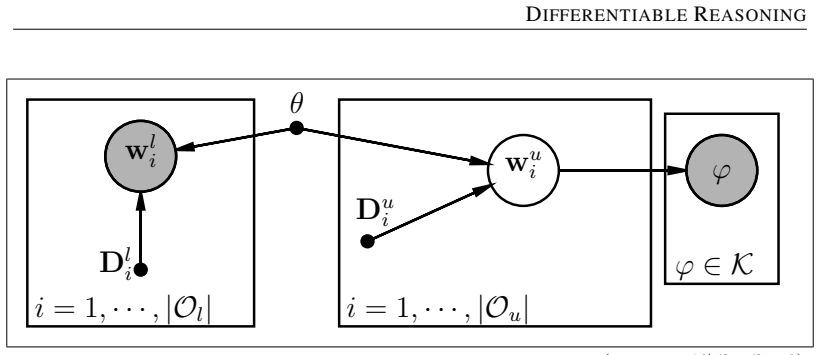
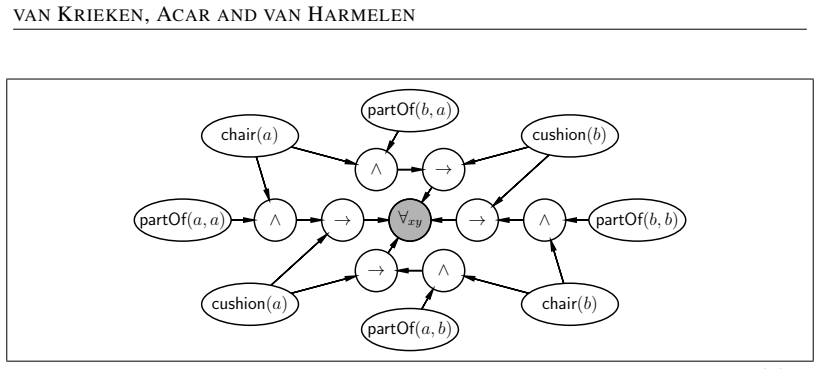
The machinery is the Differentiable Reasoning (DR) loss, a special case of Real Logic that the authors call Product Real Logic: each ground atom $P(o)$ has truth value $f^\theta_P(o) \in [0,1]$ from a parameterized model, conjunction is multiplication, negation is $1 - p$, and implication $\varphi\rightarrow\psi$ is the Reichenbach implication $1 - p(\varphi)(1 - p(\psi))$. The loss for a rule $\forall x\, \varphi$ is the negative sum of log-valuations over all instantiations of $x$ across all unlabeled images. This keeps the computation polynomial in the number of objects per image rather than exponential in the Herbrand base, at the cost of exactness: Appendix A shows equality with the true marginal likelihood $p(K|O_u,\theta)$ only under disjointness assumptions (Equations 22-23) that the actual rule set does not satisfy. The second piece of machinery is the normalized loss of Equation 18, which separates the Modus Ponens and Modus Tollens gradient contributions and reweights them with a hyperparameter $\mu$; this is what converts the dominant contrapositive signal into a tunable resource.
What would settle it
Take a tiny unlabeled domain and a knowledge base that violates the disjointness assumptions (e.g., two rules sharing the predicate $partOf$), enumerate all worlds to compute the exact $p(K|O_u,\theta)$, and compare it with the DR loss's value during training; any divergence shows the loss is an estimate, not the declared marginal, and quantifies the error the approximation introduces.
Extended reading notes
Core claim
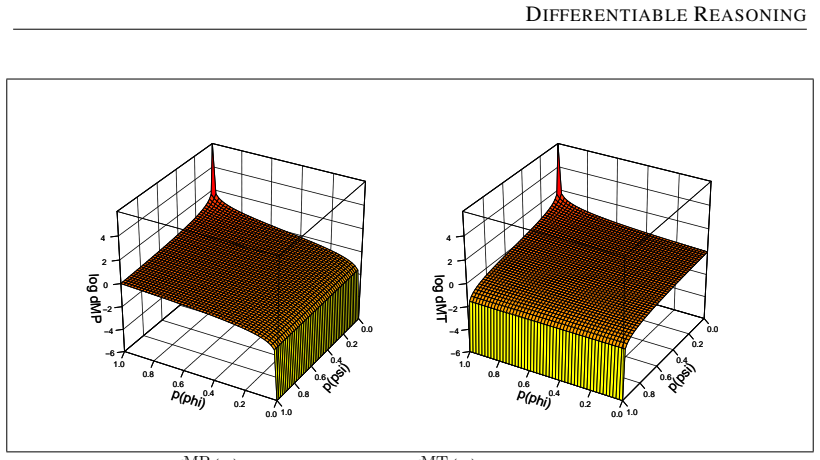
The central claim is that a simple supervised classifier for semantic image interpretation can be significantly improved by adding a 'differentiable reasoning' loss term that evaluates the degree to which a first-order logic knowledge base is satisfied by the model's predictions on unlabeled images. The loss is the negative log of a product-real-logic valuation of each rule, computed by grounding the universally quantified formulas over objects in each image and treating connectives with the product t-norm and the Reichenbach implication. Under the paper's construction, optimizing the supervised loss plus this unsupervised term approximates maximizing the joint likelihood of the labeled worlds and the knowledge base given the unlabeled domains. The paper further claims that the gradient of the implication rule decomposes into a Modus Ponens part (pushing up the consequent when the antecedent is likely) and a Modus Tollens part (pushing down the antecedent when the consequent is unlikely), that these are strongly imbalanced in practice, and that renormalizing their relative contribution, controlled by a hyperparameter $\mu$, produces the largest empirical gains (precision $0.517$ at $\mu=0.25$ versus $0.440$ supervised-only).
Load-bearing premise
The whole training signal rests on treating the unlabeled loss as the probability that the knowledge base holds, but the paper's own appendix proves that equality only when no ground atom is shared between rules or subformulas, which the actual rules violate.
Editorial extensions
If this is right
- Semi-supervised gains on sparse relational tasks can be obtained from generic background knowledge without hand-labeling the unlabeled set; the DR loss turns every rule into a training signal on every image.
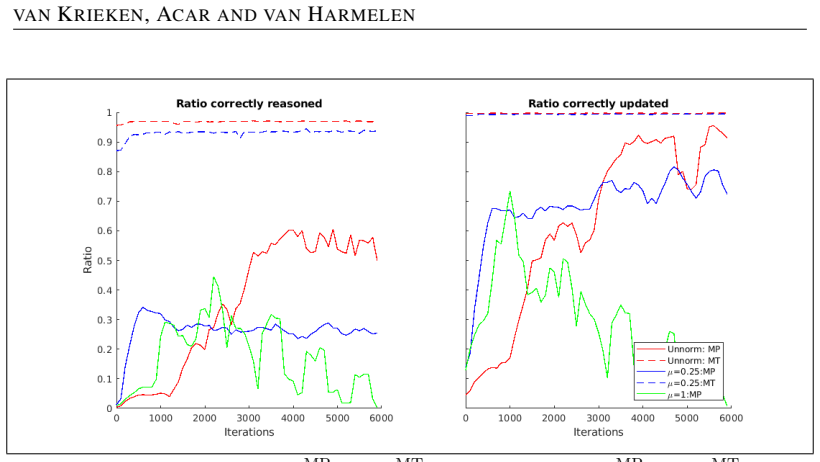
- The Raven Paradox is not a philosophical curiosity but a measurable engineering phenomenon: here Modus Tollens updates are roughly 100 times larger than Modus Ponens updates, so any neural-symbolic loss built on material implication inherits a strong contrapositive bias.
- Renormalizing MP and MT contributions introduces a single hyperparameter $\mu$ that controls the inductive bias; the paper's results suggest intermediate values ($\mu \approx 0.25$) beat both pure MP and the unnormalized baseline.
- Contrapositive reasoning is not merely noise: disabling MT entirely ($\mu=1$) destabilizes training and lowers accuracy, so the normalization should rebalance rather than eliminate either update type.
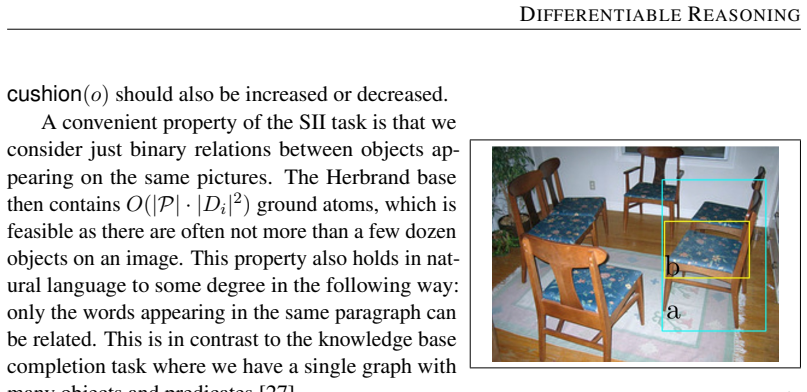
- The approach scales to images with a few dozen objects because the Herbrand base is $O(|P| \cdot |D_i|^2)$, making full grounding feasible for semantic image interpretation and similar structured domains.
Reading between the lines
- Because the paper's Appendix A shows exactness only under disjointness assumptions that the used rules violate (a predicate like $partOf$ appears in multiple formulas), the DR loss is best read as an approximation to $p(K|O_u,\theta)$; a natural testable extension is to measure, on tiny domains, how far the product-real-logic valuation drifts from the exact world-sum when those assumptions fail.
- The MP/MT imbalance likely transfers to any fuzzy-logic loss built on the material implication, including semantic loss variants and logic tensor networks; reweighting schemes analogous to Equation 18 could be applied there without changing the underlying model.
- One could test the Raven-Paradox explanation directly by constructing a synthetic dataset in which the class balance of antecedents is controlled; the paper's account predicts that the optimal $\mu$ tracks the prior rate of positive antecedents rather than being task-specific.
- A practical extension the authors leave implicit: the same loss could regularize natural-language semantic parsing, where objects in a sentence play the role of objects in an image and relational rules (e.g., thematic role constraints) supply the knowledge base.
Signed reviews
Editorial analysis
A structured set of objections, weighed in public.
Referee Report
Summary. The paper proposes Differentiable Reasoning (DR), a semi-supervised learning objective that augments a supervised cross-entropy loss with a differentiable term L_DR (Eqs. 6-12) measuring satisfaction of a first-order logic knowledge base over unlabeled domains, using product real logic with the Reichenbach material implication. The framework is applied to semantic image interpretation on PASCAL-Part, with 7 labeled and 2128 unlabeled images over 20 random splits. The authors report that adding the unlabeled DR loss improves type-classification precision over a supervised baseline, and that the gradient contributions from Modus Ponens and Modus Tollens are highly imbalanced, which they attribute to the Raven Paradox. They propose a normalized loss (Eq. 18) with hyperparameter mu to reweight MP and MT contributions, obtaining further improvements (best at mu=0.25). An appendix proves that Product Real Logic equals the marginal likelihood p(K|D,theta) under a disjointness assumption on ground atom occurrences.
Significance. If the conclusions hold, the paper makes two contributions: a simple, general recipe for injecting relational background knowledge into neural training via an unlabeled-data loss, and an analysis of implication behavior showing that contrapositive (MT) updates can dominate training. Strengths include the explicit loss and gradient equations, the transparent experimental protocol with 20 splits and confidence intervals, and the honest appendix that states the exactness conditions for the probabilistic interpretation. The empirical improvement over the supervised baseline is plausible and the paper identifies a real bias in material-implication losses. However, two technical points currently limit the significance: the exact objective optimized in the 'Normalized' variant is not fully specified (the theta-dependence of the normalization weights), and the claimed probabilistic interpretation of L_DR is not valid for the actual knowledge base used. The comparison only against a supervised baseline also leaves the semi-supervised claim under-supported.
major comments (3)
- [Section 2.5, Eq. (18)] Equation (18) is written as a loss, but the surrounding text and Section 4 treat it as a direct reweighting of MP and MT gradient contributions. Because the coefficients dMP_phi(o) and dMT_phi(o) (Eqs. 15-16) and the normalization sums depend on the current parameters theta, differentiating Eq. (18) with respect to theta generates additional terms proportional to the partial derivative of dMP_phi(o)/sum dMP (and symmetrically for MT) with respect to theta. The paper neither derives these extra terms nor states that the weights are detached (stop-gradient). Without this information, the 'Normalized' rows in Table 1 cannot be attributed to the advertised control of Modus Ponens versus Modus Tollens reasoning; they may be the result of an unanalyzed objective. Please report the exact gradient used, including any detach operations, or provide a full derivation of the objective minimized.
- [Section 2.2 and Appendix A] The transition from the probabilistic objective (Eqs. 3-5) to the practical loss (Eqs. 6-12) is not derived in the main text, and Appendix A shows equality only under the disjointness assumptions in Eqs. (22)-(23). These assumptions are violated by the knowledge base used in Section 3: partOf appears in multiple rules (e.g., forall x not partOf(x,x), forall x,y partOf(x,y) -> not partOf(y,x), and inside the antecedent of the chair/cushion rule), and formulas also share other predicates. Hence L_DR is not the marginal likelihood p(K|Ou,theta) for the actual experiments. The paper should explicitly acknowledge this, provide a justification for the approximation (for instance by benchmarking against the exact semantic loss on a small problem), or temper the claim that the loss 'computes the correct probability' (end of Section 2.2). This is load-bearing because the empirical results are obtained with the approximate loss.
- [Section 3, Table 1] The paper introduces DR as a semi-supervised learning technique, yet Table 1 compares only against a fully supervised baseline. An improvement over supervised training shows that the unlabeled data carry useful signal, but it does not show that logical reasoning is the cause; a simple pseudo-labeling, entropy-minimization, or consistency regularizer on unlabeled images could yield similar gains. Adding at least one generic semi-supervised baseline (or a DR variant without the knowledge-base rules) would materially strengthen the central claim that background knowledge, rather than unlabeled data per se, drives the improvement.
minor comments (6)
- [Section 2.4, Eq. (15)] The denominator contains an unbalanced parenthesis; it should be 1 - p_hat(phi|o,theta) * (1 - p_hat(psi|o,theta)), without the extra closing parenthesis after the equality.
- [Appendix A, Eq. (22)] As written, union of A_phi over phi in K equals the empty set is impossible when formulas contain ground atoms; the intended condition is that the sets A_phi are pairwise disjoint (A_phi intersect A_psi = empty set for distinct phi, psi).
- [Section 3] The experimental setup should specify how the test set for Table 1 is defined separately from the 'held-out validation set of 200 images' and the test set <Ot,Wt> used in Section 4, including the number of images in each.
- [Section 3, Table 1] The statement 'All results are significant' should state the exact paired test used and whether any multiple-comparison correction was applied, given that seven values of mu are compared.
- [Section 4, Figure 6] The claim that 'the unnormalized method seems to be best at reasoning correctly' is based on visual inspection of a single training run; report the variance over the 20 splits or provide quantitative support.
- [Section 2.4 and Section 4.1] The imbalance between dMP and dMT is a mathematical consequence of the chosen Reichenbach implication and the predicted probabilities, as shown in Eqs. (15)-(16); the empirical contribution is the magnitude of the effect during training, and the narrative should distinguish these two aspects.
Circularity Check
No circularity: the core DR loss is an independently evaluated semi-supervised objective, and the flagged MP/MT and Appendix A issues are correctness concerns rather than derivation-by-construction.
full rationale
I walked the claimed derivation chain and found no step where a prediction is forced by its inputs by construction. The primary claim is empirical: adding the differentiable reasoning loss L_DR (Eqs. 6-12) to the supervised cross-entropy loss improves type and partOf prediction on PASCAL-PART, measured on a held-out validation set. The loss is defined directly from the knowledge base and the model probabilities, not from the reported accuracies, so the improvement is not an identity. The Appendix A proof that Product Real Logic equals p(K|D,theta) is explicitly conditional on disjointness assumptions (Eqs. 22-23) that the paper does not claim hold in general; that is a soundness/approximation limitation, not circularity. The MP/MT imbalance is indeed derived mathematically in Eqs. 15-16 from the chosen Reichenbach implication, but the paper does not use that derivation as evidence of an empirical prediction; it is an analysis of the method, and the experimental section then evaluates the proposed normalization on external data. Eq. 18 reweights MP and MT contributions using theta-dependent coefficients, and a careful reader may question whether the actual gradient matches the advertised normalized MP/MT updates, but this is an unverified correctness point about the objective, not a case of fitted parameters being renamed as predictions. The paper also does not rely on load-bearing self-citations: the cited Real Logic and LTN work is external, and the background knowledge is taken from Donadello et al. rather than from the authors' own prior results. Overall, the central contribution is self-contained and benchmarked externally, so the circularity score is 0.
Assumptions & free parameters
free parameters (1)
- mu =
0.25
assumptions (3)
- domain assumption Background knowledge rules (e.g., chair(x) and partOf(y,x) implies cushion(y) or armRest(y)) are true in the target domain.
- domain assumption Product Real Logic with Reichenbach implication is an acceptable fuzzy semantics for the knowledge base.
- ad hoc to paper Ground atom occurrences across formulas and subformulas are disjoint (Eq. 22-23).
Cite this review
Pith. "Pith review of Semi-Supervised Learning using Differentiable Reasoning." pith.science (2026). https://pith.science/paper/5CSGM457
@misc{pith2026190804700,
  author       = {Pith},
  title        = {Pith review of: Semi-Supervised Learning using Differentiable Reasoning},
  year         = {2026},
  howpublished = {\url{https://pith.science/paper/5CSGM457}},
  note         = {Machine review of arXiv:1908.04700}
}
read the original abstract
We introduce Differentiable Reasoning (DR), a novel semi-supervised learning technique which uses relational background knowledge to benefit from unlabeled data. We apply it to the Semantic Image Interpretation (SII) task and show that background knowledge provides significant improvement. We find that there is a strong but interesting imbalance between the contributions of updates from Modus Ponens (MP) and its logical equivalent Modus Tollens (MT) to the learning process, suggesting that our approach is very sensitive to a phenomenon called the Raven Paradox. We propose a solution to overcome this situation.
Figures
Figures from the paper (3 more)

Reference graph
Works this paper leans on
-
[1]
An introduction to many-valued and fuzzy logic: semantics, algebras, and derivation systems
Merrie Bergmann. An introduction to many-valued and fuzzy logic: semantics, algebras, and derivation systems. Cambridge University Press, 2008
work page 2008
-
[2]
Olivier Chapelle, Bernhard Scholkopf, and Alexander Zien. Semi-supervised learning. 2006
work page 2006
-
[3]
Detect what you can: Detecting and representing objects using holistic models and body parts
Xianjie Chen, Roozbeh Mottaghi, Xiaobai Liu, Sanja Fidler, Raquel Urtasun, and Alan Yuille. Detect what you can: Detecting and representing objects using holistic models and body parts. In Proceedings of the IEEE Conference on Computer Vision and Pattern Recognition, pages 1971–1978, 2014
work page 1971
-
[4]
SDD: A new canonical representation of propositional knowledge bases
Adnan Darwiche. SDD: A new canonical representation of propositional knowledge bases. IJCAI International Joint Conference on Artificial Intelligence, pages 819–826, 2011
work page 2011
-
[5]
Lifted rule injection for relation embeddings
Thomas Demeester, Tim Rocktäschel, and Sebastian Riedel. Lifted rule injection for relation embeddings. In Proceedings of the 2016 Conference on Empirical Methods in Natural Language Processing, pages 1389–1399. Association for Computational Linguistics, 2016
work page 2016
-
[6]
Regularizing relation representa- tions by first-order implications
Thomas Demeester, Tim Rocktäschel, and Sebastian Riedel. Regularizing relation representa- tions by first-order implications. In AKBC2016, the Workshop on Automated Base Construction, pages 1–6, 2016
work page 2016
-
[7]
Ivan Donadello, Luciano Serafini, and Artur S. d’Avila Garcez. Logic tensor networks for semantic image interpretation. In IJCAI, pages 1596–1602. ijcai.org, 2017
work page 2017
-
[8]
Dorothy Edgington. Indicative conditionals. In Edward N. Zalta, editor, The Stanford Ency- clopedia of Philosophy. Metaphysics Research Lab, Stanford University, winter 2014 edition, 2014
work page 2014
Show all 33 references
-
[9]
Fast r-cnn
Ross Girshick. Fast r-cnn. International Conference on Computer Vision, pages 1440–1448, 2015
2015
-
[10]
Studies in the logic of confirmation (i.)
Carl G Hempel. Studies in the logic of confirmation (i.). Mind, 54(213):1–26, 1945
1945
-
[11]
Harnessing deep neural networks with logic rules
Zhiting Hu, Xuezhe Ma, Zhengzhong Liu, Eduard Hovy, and Eric Xing. Harnessing deep neural networks with logic rules. In Proceedings of the 54th Annual Meeting of the Association for Computational Linguistics (Volume 1: Long Papers), pages 2410–2420. Association for Computation...
2016
-
[12]
Fuzzy Implications, volume 231
Balasubramaniam Jayaram and Michal Baczynski. Fuzzy Implications, volume 231. 2008
2008
-
[13]
Image retrieval using scene graphs
Justin Johnson, Ranjay Krishna, Michael Stark, Li-Jia Li, David Shamma, Michael Bernstein, and Li Fei-Fei. Image retrieval using scene graphs. In Proceedings of the IEEE conference on computer vision and pattern recognition, pages 3668–3678, 2015
2015
-
[14]
Semi-supervised classification with graph convolutional networks
Thomas N Kipf and Max Welling. Semi-supervised classification with graph convolutional networks. 2016
2016
-
[15]
Visual genome: Connecting 14 DIFFERENTIABLE REASONING language and vision using crowdsourced dense image annotations
Ranjay Krishna, Yuke Zhu, Oliver Groth, Justin Johnson, Kenji Hata, Joshua Kravitz, Stephanie Chen, Yannis Kalantidis, Li-Jia Li, David A Shamma, et al. Visual genome: Connecting 14 DIFFERENTIABLE REASONING language and vision using crowdsourced dense image annotations. Intern...
2017
-
[16]
Pseudo-label: The simple and efficient semi-supervised learning method for deep neural networks
Dong-Hyun Lee. Pseudo-label: The simple and efficient semi-supervised learning method for deep neural networks. 2013
2013
-
[17]
Deepproblog: Neural probabilistic logic programming
Robin Manhaeve, Sebastijan Duman ˇci´c, Angelika Kimmig, Thomas Demeester, and Luc De Raedt. Deepproblog: Neural probabilistic logic programming. arXiv preprint arXiv:1805.10872, 2018
2018 arXiv
-
[18]
Kevin Murphy, Yair Weiss, and Michael I. Jordan. Loopy Belief Propagation for Approximate Inference: An Empirical Study. pages 467–476, 2013
2013
-
[19]
Cubuk, and Ian J
Avital Oliver, Augustus Odena, Colin Raffel, Ekin D. Cubuk, and Ian J. Goodfellow. Realistic evaluation of semi-supervised learning algorithms. 2018
2018
-
[20]
Combining representation learning with logic for language processing
Tim Rocktäschel. Combining representation learning with logic for language processing. CoRR, abs/1712.09687, 2017
2017 arXiv
-
[21]
End-to-end differentiable proving
Tim Rocktäschel and Sebastian Riedel. End-to-end differentiable proving. In Advances in Neural Information Processing Systems, pages 3791–3803, 2017
2017
-
[22]
Injecting logical background knowl- edge into embeddings for relation extraction
Tim Rocktäschel, Sameer Singh, and Sebastian Riedel. Injecting logical background knowl- edge into embeddings for relation extraction. In Proceedings of the 2015 Conference of the North American Chapter of the Association for Computational Linguistics: Human Language Technolog...
2015
-
[23]
On the hardness of approximate reasoning
Dan Roth. On the hardness of approximate reasoning. Artificial Intelligence, 82(1-2):273–302, 1996
1996
-
[24]
Berg, and Li Fei-Fei
Olga Russakovsky, Jia Deng, Hao Su, Jonathan Krause, Sanjeev Satheesh, Sean Ma, Zhiheng Huang, Andrej Karpathy, Aditya Khosla, Michael Bernstein, Alexander C. Berg, and Li Fei-Fei. ImageNet Large Scale Visual Recognition Challenge. International Journal of Computer Vision (IJC...
2015
-
[25]
Modeling Relational Data with Graph Convolutional Networks
Michael Schlichtkrull, Thomas N Kipf, Peter Bloem, Rianne van den Berg, Ivan Titov, and Max Welling. Modeling Relational Data with Graph Convolutional Networks. In Aldo Gangemi, Roberto Navigli, Maria-Esther Vidal, Pascal Hitzler, Raphaël Troncy, Laura Hollink, Anna Tordai, an...
2018
-
[26]
Logic tensor networks: Deep learning and logical reasoning from data and knowledge
Luciano Serafini and Artur d’Avila Garcez. Logic tensor networks: Deep learning and logical reasoning from data and knowledge. 2016
2016
-
[27]
Reasoning with neural tensor networks for knowledge base completion
Richard Socher, Danqi Chen, Christopher D Manning, and Andrew Ng. Reasoning with neural tensor networks for knowledge base completion. In Advances in neural information processing systems, pages 926–934, 2013
2013
-
[28]
Logic and structure
Dirk Van Dalen. Logic and structure. Springer, 2004
2004
-
[29]
Peter B.M. Vranas. Hempel’s raven paradox: A lacuna in the standard Bayesian solution.British Journal for the Philosophy of Science, 55(3):545–560, 2004
2004
-
[30]
The effect of class distribution on classifier learning: an empirical study
Gm Weiss and Foster Provost. The effect of class distribution on classifier learning: an empirical study. Rutgers University, (September 2001), 2001
2001
-
[31]
A semantic 15 VAN KRIEKEN , ACAR AND VAN HARMELEN loss function for deep learning with symbolic knowledge
Jingyi Xu, Zilu Zhang, Tal Friedman, Yitao Liang, and Guy Van den Broeck. A semantic 15 VAN KRIEKEN , ACAR AND VAN HARMELEN loss function for deep learning with symbolic knowledge. In Jennifer Dy and Andreas Krause, editors, Proceedings of the 35th International Conference on ...
2018
-
[32]
Cohen, and Ruslan Salakhutdinov
Zhilin Yang, William W. Cohen, and Ruslan Salakhutdinov. Revisiting semi-supervised learning with graph embeddings. In Proceedings of the 33rd International Conference on International Conference on Machine Learning - Volume 48, ICML’16, pages 40–48. JMLR.org, 2016
2016
-
[33]
Semi-supervised learning using gaussian fields and harmonic functions
Xiaojin Zhu, Zoubin Ghahramani, and John D Lafferty. Semi-supervised learning using gaussian fields and harmonic functions. In Proceedings of the 20th International conference on Machine learning (ICML-03), pages 912–919, 2003. Appendices A Conditional Optimality of Product Rea...
2003
Reviewed August 14, 2026 · model on record in the stance chip above.
Discussion (0). Continue with ORCID to comment.