REVIEW 5 major objections 4 minor 38 references
Exploiting Parallelism Opportunities with Deep Learning Frameworks
T0 review · 5 major / 4 minor · reviewed 2026-08-14 · deepseek-v4-flash
Pith's one-line read The average width of a deep learning model's graph determines the optimal CPU thread-pool setting, matching exhaustive search.
desk verdict A genuinely useful root-cause analysis of TF parallelism with a novel but under-specified width heuristic; the central speedup claim is plausible on Intel but not yet reproducible as written. read the letter →
The pith
A machine-rendered reading of the paper's core claim, the machinery that carries it, and where it could break.
The reading
What carries the argument
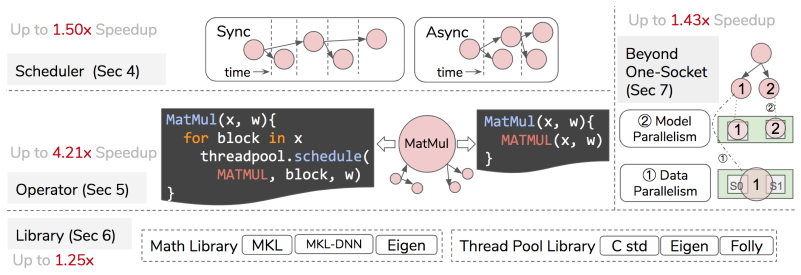
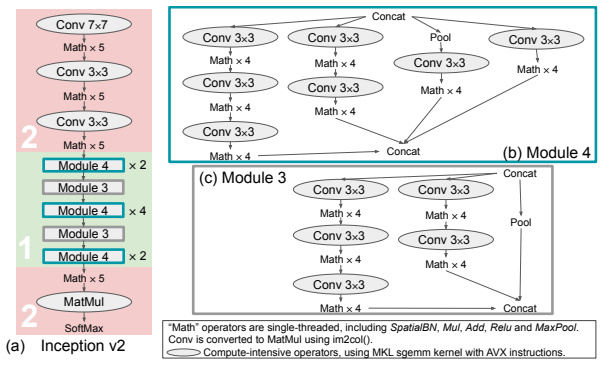
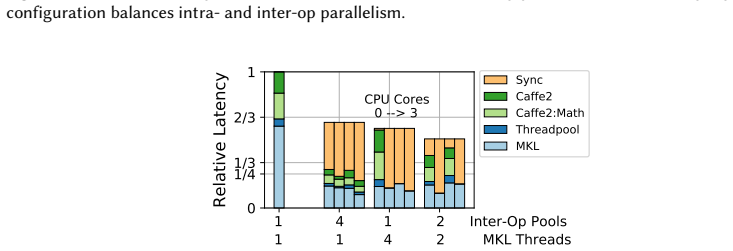
The load-bearing object is the average model width, a graph-level statistic defined as $\lfloor \text{total heavy operators} / \text{maximum layers} \rfloor$, where a heavy operator is a compute-intensive or embedding operator. This single number sets the number of inter-operator thread pools; the guideline then splits the system's physical cores evenly among those pools, giving the MKL threads and the framework's intra-op threads the same count so that one of each can share a physical core, one using FMA units and the other using other execution units. The machinery works by converting a five-dimensional tuning problem (scheduler, operator implementation, math library, thread pool library, parallelism mechanism) into a one-dimensional choice, justified by the observed balance between intra- and inter-operator parallelism.
What would settle it
Take a model whose graph has, say, three long independent branches but whose average width computes to 2, run an exhaustive sweep of pool counts and thread splits on a standard multicore CPU, and check whether the heuristic's choice is more than 5% slower than the sweep's optimum; such a case would refute the claimed match to the global optimum.
Extended reading notes
Core claim
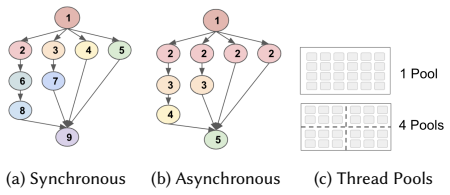
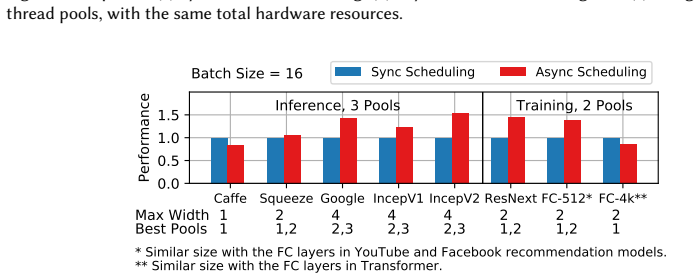
The central discovery is that framework overhead in deep learning on CPUs--the so-called programmability tax--is dominated by how operators are scheduled and how their data is prepared, and that both can be controlled by one number: the number of inter-operator thread pools. From profiling traces, the paper shows that asynchronous scheduling helps only when a model's graph has branches that can run in parallel, and that the best pool count never exceeds the graph's maximum width. It then defines the average model width as $\lfloor \text{total heavy operators} / \text{maximum layers} \rfloor$ and claims that setting the pool count to this number, with MKL and intra-op threads each set to total physical cores divided by the pool count, achieves the same average performance as the global optimum found by exhaustive search over hundreds of thousands of configurations. The claim is supported on inference and training workloads, including recommendation and translation models, on a dual-socket server.
Load-bearing premise
The whole speedup rests on the average-model-width heuristic--$\lfloor \text{total heavy operators} / \text{maximum layers} \rfloor$--correctly predicting the best number of inter-op pools for models and CPUs it was not tuned on.
Editorial extensions
If this is right
- Setting inter-op pools to the average model width instead of socket count yields 1.29x over Intel's and 1.34x over TensorFlow's recommended settings across the evaluated models.
- The chosen setting matches globally optimal performance on average and stays within 95% of it in the worst case (Inception inference and SqueezeNet training).
- Framework users running a single model per session should at least set inter-op pools to one rather than using TensorFlow's default of logical cores.
- The same analysis applies to training as well as inference, since the training graph's extra gradient and sum-weight operators just change the effective width.
Reading between the lines
- If the average-width rule transfers across architectures and framework versions as the paper suggests, the same heuristic could be packaged as a compiler or runtime pass that reads the graph and sets thread counts automatically, eliminating the plugin step.
- Because the workload imbalance that motivates the rule is structural (branches of unequal size), dynamic thread-pool sizing that lets the scheduler assign threads per operator, which the paper notes as an opportunity, could beat any fixed split on graphs whose branch sizes vary widely.
- The programmability tax numbers (1.3% to 63%) suggest that framework overhead will dominate as kernels get faster on CPUs and accelerators, so the scheduling lessons here are likely to matter more, not less, for future hardware.
- One testable extension: compute the average width for large language models and compare against their observed optimal pool counts; if the rule holds there, the heuristic's scope extends well beyond the vision and recommendation models evaluated.
Signed reviews
Editorial analysis
A structured set of objections, weighed in public.
Referee Report
Summary. The paper is a measurement study of parallelism-related configuration knobs in CPU deep learning frameworks, focusing on TensorFlow v1.13 with MKL-DNN. It characterizes four design dimensions—operator scheduling (number of inter-op thread pools), operator implementation (intra-op threads), math/thread-pool libraries, and multi-socket placement—on Intel Skylake platforms. From these observations it distills a tuning guideline: set the number of inter-op pools p to the model's 'average width' (floor(total heavy operators / maximum layers)), and set intra-op and MKL threads to total physical cores divided by p. The authors integrate the rule into a TensorFlow plugin and evaluate it on a two-socket AWS instance, comparing against Intel and TensorFlow recommended settings and against an exhaustive search of 884,736 configurations. They report average speedups of 1.29x and 1.34x over the Intel and TensorFlow settings, respectively, and average performance equal to the global optimum, with a worst-case gap of 5%.
Significance. The practical contribution is strong if the result holds: the paper reduces an enormous configuration space to a single interpretable model-graph statistic, and it provides the strongest available evidence by evaluating on a platform and on recommendation/translation workloads not used in the guideline-development analysis, while also comparing to the global optimum via exhaustive search. The profiling methodology (top-down analysis, per-core traces, UPI bandwidth measurements) is careful, and the manuscript states that the code is open source, which aids reproducibility. The main caveats are that the average-width heuristic is not operationally defined in the manuscript, all performance numbers are point estimates, and the cross-architecture generalization is asserted rather than measured. If these are addressed, the paper would be a solid, useful systems contribution.
major comments (5)
- [§8 Definitions; Table 2] Section 8 defines average model width as floor(total heavy operators / maximum layers), but neither term is operationally defined. 'Heavy operator' is only exemplified as compute-intensive or embedding, and 'maximum layers' is ambiguous for graphs with branches, residuals, or embedding tables. Table 2 gives p values for seven models without per-model operator counts or graph-parsing rules, so an independent user cannot reproduce DenseNet=1, Wide&Deep=3, or Transformer=4 from the stated rule. Since the central speedup claim rests entirely on this quantity, the manuscript should specify the counting algorithm, the operator taxonomy, the parsed counts for all evaluated models, and ideally a script that computes p directly from a serialized graph.
- [§8 Evaluation; Figure 18] All reported speedups and the 'same performance as the global optimum' conclusion are based on point estimates. No error bars, number of repetitions, or variance statistics are reported for Figure 18 or the earlier scaling studies. On AWS bare-metal instances, run-to-run and neighbor interference can be non-negligible; the 1.29x/1.34x margins and the 95%-of-optimum worst case could change under variability. Please report means, standard deviations (or min/max), and repetition counts for at least the headline comparisons.
- [§8 Guidelines (first paragraph)] The statement that the guidelines are 'architecture-irrelevant' and 'can be applied to CPUs with different architectures including Intel, AMD and OpenPOWER' is not supported by the data. All experiments use Intel Skylake microarchitectures (i7-6700k and Platinum 8175M, one- and two-socket). The claim should be removed, restricted to a clearly labeled hypothesis, or tested on at least one non-Intel platform.
- [§3 vs §8; Figure 18] The paper states that non-vision models were held out for Section 8, but Figure 18 also includes the vision models DenseNet, ResNet, SqueezeNet, and InceptionV3. Please specify explicitly which models were used to derive the average-width rule and which were first evaluated at test time, and clarify whether the Table 2 p values for any model were chosen after seeing the exhaustive-search optimum on the evaluation platform. This distinction is necessary to assess how much of the reported 'match to global optimum' comes from the rule rather than from post hoc selection.
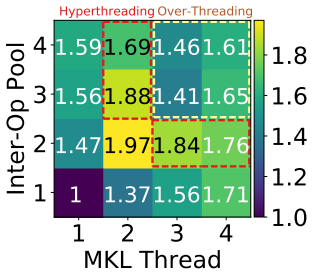
- [§4.1 vs §8] Section 4.1 identifies maximum graph width as the relevant inter-op parallelism bound and shows that the best pool count depends on batch size and on training versus inference, yet Section 8 switches to average width without derivation or sensitivity analysis. The paper should explain why average width is the right statistic, show how the predicted p changes with batch size and training/inference for the Table 2 models, and report how sensitive the final speedups are to p-1 and p+1.
minor comments (4)
- [Figure 1] The percentage labels on the stacked bars do not appear to sum to 100, and the legend makes it unclear which bar each percentage belongs to; please redraw with explicit axes and totals.
- [Section 1] The phrase 'another 25 ×' appears to be a typo (likely 2.5x), since the surrounding sentence says the whole-model improvement is 2.4x.
- [Section 8] The paper first attributes to TensorFlow the recommendation 'inter-op pools to the socket count' and later says 'TensorFlow naively sets all parameters...to the number of logical cores'; please reconcile the default TensorFlow behavior with the recommended setting from the cited performance guide.
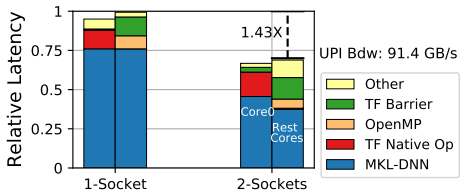
- [Table 1] Table 1 omits memory capacity and logical-thread counts, which are useful for reproducing the hyperthreading analyses in Sections 5.2 and 8.
Circularity Check
No significant circularity: the tuning guideline is an empirically validated heuristic, not a derivation that reduces to its inputs.
full rationale
The central claim is an empirical performance result, not a mathematical derivation. Section 8 defines the rule p = floor(total heavy operators / maximum number of layers) independently of the measured optima, applies it to the models in Table 2, and then compares the resulting setting against a global optimum obtained by exhaustive search. The paper explicitly evaluates on held-out non-vision workloads (NCF, Transformer, Wide&Deep) and on the large.2 platform, which was not used in the analysis sections, so the comparison is not against the data used to form the rule. No equation in the paper equates the guideline's output to the measured optimum, and no fitted parameter is renamed as a prediction. The average-width metric is under-specified ('heavy operator' and 'maximum number of layers' lack an operational parser-level definition), which is a reproducibility/correctness concern rather than circularity; the same applies to the unsupported claim that the guidelines are architecture-irrelevant across AMD/OpenPOWER. There is no load-bearing self-citation or imported uniqueness theorem. Therefore no circular step can be exhibited from the text, and the appropriate finding is no significant circularity.
Assumptions & free parameters
assumptions (3)
- ad hoc to paper The optimal number of inter-op thread pools equals the average model width, defined as floor(total heavy operators / maximum layers).
- domain assumption Guidelines that work on Intel Skylake CPUs apply to other architectures (AMD, OpenPOWER) without modification.
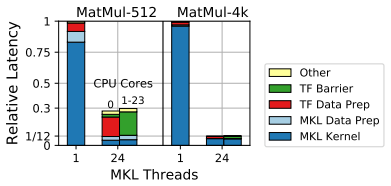
- domain assumption The non-MKL fraction of execution time is a 'programmability tax' that can be largely optimized away with high-performance implementations.
Cite this review
Pith. "Pith review of Exploiting Parallelism Opportunities with Deep Learning Frameworks." pith.science (2026). https://pith.science/paper/SCRLFMOL
@misc{pith2026190804705,
  author       = {Pith},
  title        = {Pith review of: Exploiting Parallelism Opportunities with Deep Learning Frameworks},
  year         = {2026},
  howpublished = {\url{https://pith.science/paper/SCRLFMOL}},
  note         = {Machine review of arXiv:1908.04705}
}
read the original abstract
State-of-the-art machine learning frameworks support a wide variety of design features to enable a flexible machine learning programming interface and to ease the programmability burden on machine learning developers. Identifying and using a performance-optimal setting in feature-rich frameworks, however, involves a non-trivial amount of performance profiling efforts and often relies on domain-specific knowledge. This paper takes a deep dive into analyzing the performance impact of key design features in a machine learning framework and quantifies the role of parallelism. The observations and insights distill into a simple set of guidelines that one can use to achieve much higher training and inference speedup. Across a diverse set of real-world deep learning models, the evaluation results show that the proposed performance tuning guidelines outperform the Intel and TensorFlow recommended settings by 1.29x and 1.34x, respectively.
Figures

Figures from the paper (15 more)






Reference graph
Works this paper leans on
-
[1]
Folly: Facebook Open-source Library
2019. Folly: Facebook Open-source Library. https://github.com/facebook/folly
work page 2019
-
[2]
Martín Abadi, Paul Barham, Jianmin Chen, Zhifeng Chen, Andy Davis, Jeffrey Dean, Matthieu Devin, Sanjay Ghemawat, Geoffrey Irving, Michael Isard, et al. 2016. TensorFlow: A System for Large-Scale Machine Learning. In OSDI, V ol. 16. 265–283. 19
work page 2016
-
[3]
P Anju. 2018. Tips to Improve Performance for Popular Deep Learning Frameworks on CPUs. Intel Developer Zone (2018)
work page 2018
-
[4]
Soheil Bahrampour, Naveen Ramakrishnan, Lukas Schott, and Mohak Shah. 2016. Comparative Study of Caffe, Neon, Theano, and Torch for Deep Learning. (2016)
work page 2016
-
[5]
Jeff Bezanson, Alan Edelman, Stefan Karpinski, and Viral B Shah. 2017. Julia: A Fresh Approach to Numerical Computing. SIAM review 59, 1 (2017), 65–98
work page 2017
-
[6]
Ashraf Bhuiyan, Mahmoud Abuzaina, Niranjan Hasabnis, Niroop Ammbashankar, Faijul Amin, Sheng Fu, and Bhavani Subramanian. [n.d.]. Improving TensorFlow Inference Performance on Intel Xeon Processors. Intel AI Blog ([n. d.])
-
[7]
Google AI Blog. 2019. Introducing GPipe, an Open Source Library for Efficiently Training Large-scale Neural Network Models. https:// ai.googleblog.com/ 2019/ 03/ introducing-gpipe-open-source-library.html(2019)
work page 2019
-
[8]
Tianqi Chen, Mu Li, Yutian Li, Min Lin, Naiyan Wang, Minjie Wang, Tianjun Xiao, Bing Xu, Chiyuan Zhang, and Zheng Zhang. 2015. MXNet: A Flexible and Efficient Machine Learning Library for Heterogeneous Distributed Systems. arXiv preprint arXiv:1512.01274 (2015)
arXiv 2015
Show all 38 references
-
[9]
Tianqi Chen, Thierry Moreau, Ziheng Jiang, Lianmin Zheng, Eddie Yan, Haichen Shen, Meghan Cowan, Leyuan Wang, Yuwei Hu, Luis Ceze, et al. 2018. {TVM}: An Automated end-to-end optimizing compiler for deep learning. In 13th {USENIX} Symposium on Operating Systems Design and Impl...
2018
-
[10]
Heng-Tze Cheng. [n.d.]. Wide and Deep Learning: Better Together with TensorFlow. Google AI Blog ([n. d.]). https://ai.googleblog.com/2016/06/wide-deep-learning-better-together-with.html
2016
-
[11]
Paul Covington, Jay Adams, and Emre Sargin. 2016. Deep Neural Networks for YouTube Recommendations. In Proceedings of the 10th ACM conference on recommender systems . ACM, 191–198
2016
-
[12]
Eigen. 2019. Eigen Thread Pool. (2019). https://bitbucket.org/eigen/eigen/src/default/unsupported/Eigen/CXX11/src/ ThreadPool/
2019
-
[13]
Assaf Eisenman, Maxim Naumov, Darryl Gardner, Misha Smelyanskiy, Sergey Pupyrev, Kim Hazelwood, Asaf Cidon, and Sachin Katti. 2018. Bandana: Using Non-V olatile Memory for Storing Deep Learning Models. arXiv preprint arXiv:1811.05922 (2018)
2018 arXiv
-
[14]
Google. 2019. TensorFlow Performance Guide. https://docs.w3cub.com/tensorflow~guide/performance/performance_ guide/#general_best_practices. TensorFlow Documentation
2019
-
[15]
Udit Gupta, Xiaodong Wang, Maxim Naumov, Carole-Jean Wu, Brandon Reagen, David Brooks, Bradford Cottel, Kim Hazelwood, Bill Jia, Hsien-Hsin S Lee, Andrey Malevich, Dheevatsa Mudigere, Mikhail Smelyanskiy, Liang Xiong, and Xuan Zhang. 2019. The Architectural Implications of Fac...
2019 arXiv
-
[16]
Niranjan Hasabnis. 2018. Auto-Tuning TensorFlow Threading Model for CPU Backend. arXiv preprint arXiv:1812.01665 (2018)
2018 arXiv
-
[17]
Kim Hazelwood, Sarah Bird, David Brooks, Soumith Chintala, Utku Diril, Dmytro Dzhulgakov, Mohamed Fawzy, Bill Jia, Yangqing Jia, Aditya Kalro, et al. 2018. Applied Machine Learning at Facebook: A Datacenter Infrastructure Perspective. In High Performance Computer Architecture ...
2018
-
[18]
Kaiming He, Xiangyu Zhang, Shaoqing Ren, and Jian Sun. 2016. Deep Residual Learning for Image Recognition. In Proceedings of the IEEE conference on Computer Vision and Pattern Recognition . 770–778
2016
-
[19]
Xiangnan He, Lizi Liao, Hanwang Zhang, Liqiang Nie, Xia Hu, and Tat-Seng Chua. 2017. Neural Collaborative Filtering. In Proceedings of the 26th international conference on world wide web . International World Wide Web Conferences Steering Committee, 173–182
2017
-
[20]
Gao Huang, Zhuang Liu, Laurens Van Der Maaten, and Kilian Q Weinberger. 2017. Densely Connected Convolutional Networks. In Proceedings of the IEEE conference on Computer Vision and Pattern Recognition . 4700–4708
2017
-
[21]
Forrest N Iandola, Song Han, Matthew W Moskewicz, Khalid Ashraf, William J Dally, and Kurt Keutzer. 2016. SqueezeNet: AlexNet-Level Accuracy with 50x Fewer Parameters and <0.5 MB Model Size. arXiv preprint arXiv:1602.07360 (2016)
2016 arXiv
-
[22]
Arpan Jain, Ammar Ahmad Awan, Quentin Anthony, Hari Subramoni, and Dhableswar K DK Panda. 2019. Performance characterization of dnn training using tensorflow and pytorch on modern clusters. In2019 IEEE International Conference on Cluster Computing (CLUSTER) . IEEE, 1–11
2019
-
[23]
Yangqing Jia, Evan Shelhamer, Jeff Donahue, Sergey Karayev, Jonathan Long, Ross Girshick, Sergio Guadarrama, and Trevor Darrell. 2014. Caffe: Convolutional architecture for fast feature embedding. In Proceedings of the 22nd ACM international conference on Multimedia. ACM, 675–678
2014
-
[24]
Nikhil Ketkar. 2017. Introduction to PyTorch. In Deep Learning with Python . Springer, 195–208
2017
-
[25]
Primate Labs. 2019. GeekBench v4. https://www.geekbench.com/
2019
-
[26]
Chris Lomont. 2011. Introduction to Intel Advanced Vector Extensions. Intel White Paper (2011), 1–21. 20
2011
-
[27]
Mattson, V
P. Mattson, V . J. Reddi, C. Cheng, C. Coleman, G. Diamos, D. Kanter, P. Micikevicius, D. Patterson, G. Schmuelling, H. Tang, G. Wei, and Carole-Jean Wu. 2020. MLPerf: An Industry Standard Benchmark Suite for Machine Learning Performance. IEEE Micro 40, 2 (2020), 8–16
2020
-
[28]
Maxim Naumov, Dheevatsa Mudigere, Hao-Jun Michael Shi, Jianyu Huang, Narayanan Sundaraman, Jongsoo Park, Xiaodong Wang, Udit Gupta, Carole-Jean Wu, Alisson G Azzolini, Dmytro Dzhulgakov, Andrey Mallevich, Ilia Cherniavskii, Yinghai Lu, Raghuraman Krishnamoorthi, Ansha Yu, V ol...
2019 arXiv
-
[29]
Vijay Janapa Reddi, Christine Cheng, David Kanter, Peter Mattson, Guenther Schmuelling, Carole-Jean Wu, Brian Anderson, Maximilien Breughe, Mark Charlebois, William Chou, et al. 2019. MLPerf inference benchmark. arXiv preprint arXiv:1911.02549 (2019)
2019 arXiv
-
[30]
Shaohuai Shi, Qiang Wang, Pengfei Xu, and Xiaowen Chu. 2016. Benchmarking state-of-the-art deep learning software tools. In 2016 7th International Conference on Cloud Computing and Big Data (CCBD) . IEEE, 99–104
2016
-
[31]
Akshitha Sriraman, Abhishek Dhanotia, and Thomas F Wenisch. 2019. SoftSKU: Optimizing Server Architectures for Microservice Diversity at Scale. In Proceedings of the 46th International Symposium on Computer Architecture . ACM, 513–526
2019
-
[32]
Christian Szegedy, Wei Liu, Yangqing Jia, Pierre Sermanet, Scott Reed, Dragomir Anguelov, Dumitru Erhan, Vincent Vanhoucke, and Andrew Rabinovich. 2015. Going Deeper with Convolutions. In Proceedings of the IEEE conference on Computer Vision and Pattern Recognition. 1–9
2015
-
[33]
Christian Szegedy, Vincent Vanhoucke, Sergey Ioffe, Jon Shlens, and Zbigniew Wojna. 2016. Rethinking the Inception Architecture for Computer Vision. In Proceedings of the IEEE conference on Computer Vision and Pattern Recognition . 2818–2826
2016
-
[34]
Nicolas Vasilache, Oleksandr Zinenko, Theodoros Theodoridis, Priya Goyal, Zachary DeVito, William S Moses, Sven Verdoolaege, Andrew Adams, and Albert Cohen. 2018. Tensor Comprehensions: Framework-Agnostic High-Performance Machine Learning Abstractions. arXiv preprint arXiv:180...
2018 arXiv
-
[35]
Ashish Vaswani, Noam Shazeer, Niki Parmar, Jakob Uszkoreit, Llion Jones, Aidan N Gomez, Łukasz Kaiser, and Illia Polosukhin. 2017. Attention Is All You Need. In Advances in Neural Information Processing Systems . 5998–6008
2017
-
[36]
Carole-Jean Wu, David Brooks, Kevin Chen, Douglas Chen, Sy Choudhury, Marat Dukhan, Kim Hazelwood, Eldad Isaac, Yangqing Jia, Bill Jia, et al. 2019. Machine Learning at Facebook: Understanding Inference at the Edge. In 2019 IEEE International Symposium on High Performance Comp...
2019
-
[37]
Saining Xie, Ross Girshick, Piotr Dollár, Zhuowen Tu, and Kaiming He. 2017. Aggregated Residual Transformations for Deep Neural Networks. In Proceedings of the IEEE conference on Computer Vision and Pattern Recognition . 1492–1500
2017
-
[38]
Ahmad Yasin. 2014. A Top-Down Method for Performance Analysis and Counters Architecture. In 2014 IEEE International Symposium on Performance Analysis of Systems and Software (ISPASS) . IEEE, 35–44. 21
2014
Reviewed August 14, 2026 · model on record in the stance chip above.
Discussion (0). Continue with ORCID to comment.