REVIEW 4 major objections 5 minor 45 references
A Deep Evolutionary Approach to Bioinspired Classifier Optimisation for Brain-Machine Interaction
T0 review · 4 major / 5 minor · reviewed 2026-08-14 · deepseek-v4-flash
Pith's one-line read An evolutionary EEG pipeline matches a deep LSTM on mental states, beats it on digit guessing, and trains in a tenth of the time.
desk verdict Useful integration of evolutionary feature selection and MLP topology search for EEG, but the evaluation leaks test information into model selection, so the headline accuracies are optimistic. read the letter →
The pith
A machine-rendered reading of the paper's core claim, the machinery that carries it, and where it could break.
The reading
What carries the argument
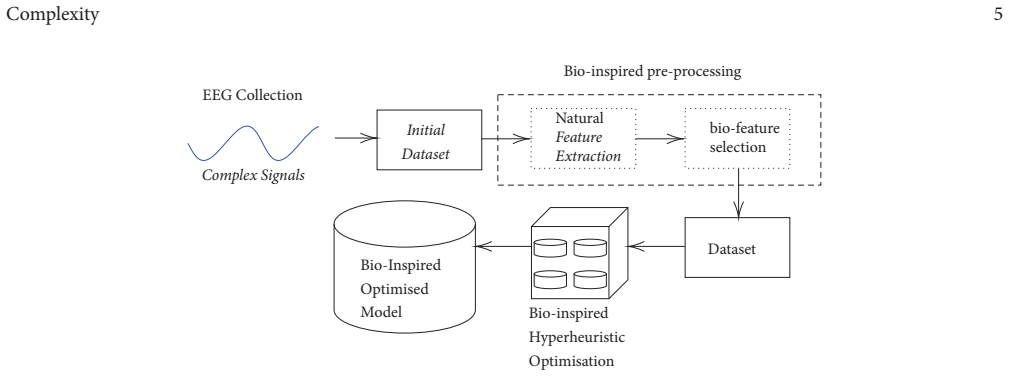
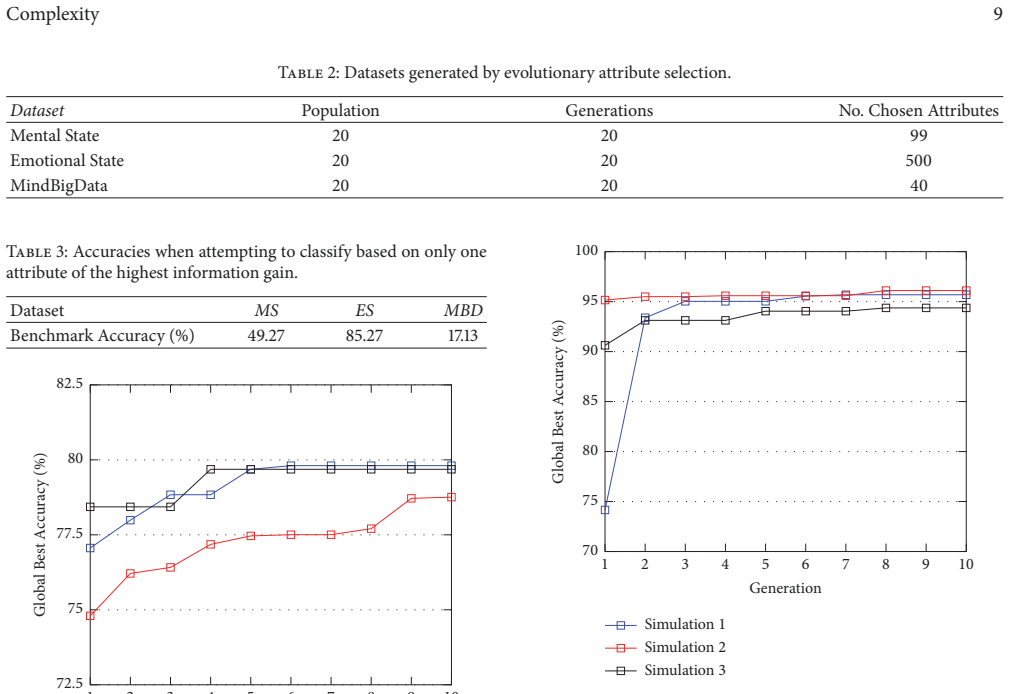
The load-bearing mechanism is the DEvo pipeline: first, an evolutionary algorithm (population 20, 20 generations, tournament breeding) searches subsets of 2550 statistical EEG features, using information gain as fitness; this cuts the datasets to 99 features for attention, 500 for emotion, and 40 for imagined digits. Second, a second evolutionary search optimises the MLP topology, searching up to three hidden layers and up to 100 neurons per layer, with 10-fold cross-validated accuracy as fitness and a speciation scheme—three species, mating restricted within a species, and a 5% chance an offspring changes species—to prevent premature convergence. The LSTM comparator is manually tuned over 25 to 125 units, and AdaBoost is applied to both model types.
What would settle it
Re-run the three experiments with feature selection nested inside the cross-validation loop—selecting features anew on the training folds only—and compare the final accuracies with Table 8; if the digit-task accuracy drops from 31.35% toward the 10% chance level, the selection step was carrying the result.
Extended reading notes
Core claim
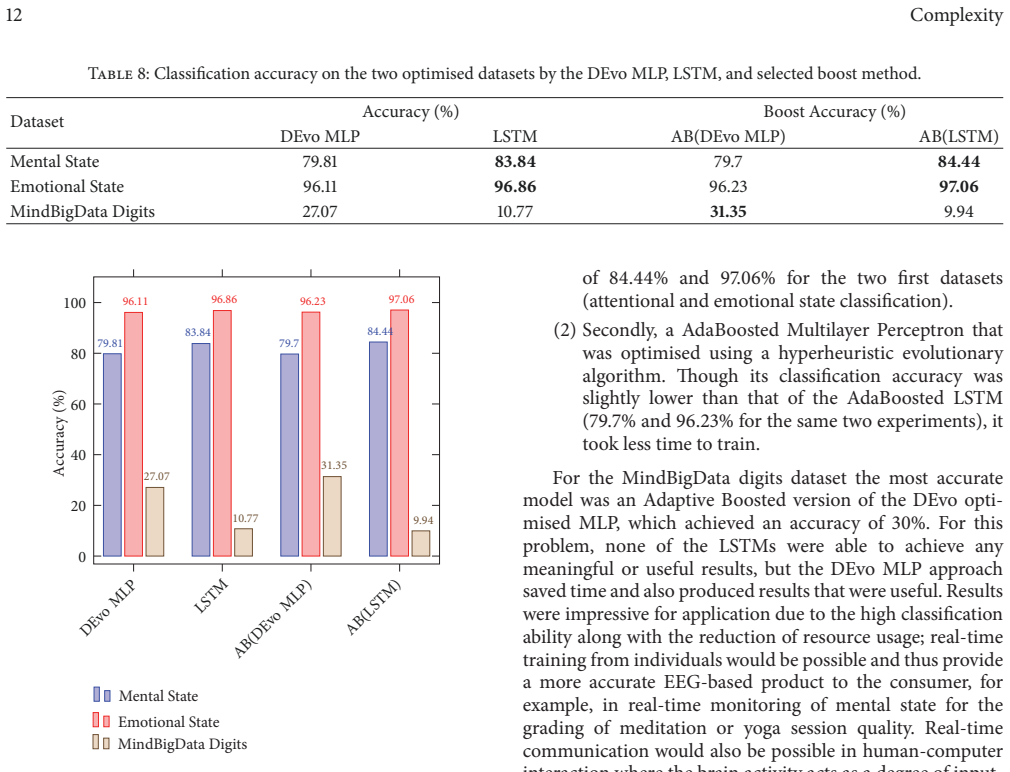
The paper's central claim is that a fully bioinspired pipeline—evolutionary selection of EEG features followed by evolutionary search over multilayer perceptron (MLP) topologies, optionally boosted with AdaBoost—can match or beat a manually tuned LSTM on brain-signal classification while training in roughly a tenth of the time. In the final benchmark, the AdaBoosted LSTM is the most accurate model on the attention and emotion datasets (84.44% and 97.06%), but the plain evolved MLP is close (79.81% and 96.11%), and on the ten-class imagined-digit dataset the AdaBoosted evolved MLP reaches 31.35% while the AdaBoosted LSTM reaches only 9.94%. The authors interpret this as evidence that the expensive deep model is not needed once feature selection and network topology are themselves optimised by evolution; the topology search repeatedly converged on a single hidden layer, mirroring the manual LSTM finding that depth one worked best. The evolved MLP trains in seconds to tens of seconds on the datasets used, which the authors connect to real-time brain-machine interaction.
Load-bearing premise
The results rest on the assumption that the evolutionary feature selection of Section 4.1, which computes information gain on the whole dataset before the 10-fold cross-validation described in Section 3.3, does not leak test-fold information into the selected features; if it does, every reported accuracy is optimistic.
Editorial extensions
If this is right
- The reported accuracies imply that a four-electrode EEG headband can support three-class mental-state and emotion classification with a shallow optimised MLP, since the evolutionary search repeatedly converged on a single hidden layer.
- Because the DEvo MLP trains in seconds to tens of seconds while the LSTM takes minutes, per-user retraining in real time becomes practical, which the authors connect to applications such as grading meditation sessions or hands-free interaction.
- The results imply that AdaBoost is not uniformly helpful: it lifted the DEvo MLP on the ten-class digit task (from 27.07% to 31.35%) but left the already-strong LSTM accuracy essentially unchanged or slightly lower, so boosting decisions should be made per model and per task.
- The evolutionary feature selector's chosen subset sizes (99, 500, and 40 from 2550 features) imply that the amount of useful statistical structure varies sharply across EEG tasks, and that dataset-specific selection matters more than a fixed feature set.
Reading between the lines
- The same two-stage recipe—evolve a feature subset, then evolve a shallow network topology—could be transferred to other high-dimensional biosignals such as EMG or ECG, where windowed statistical features are the standard representation.
- For brain-machine interaction, the sub-minute training times suggest adaptive per-user retraining, where the classifier is re-evolved as the user's signal distribution drifts; the paper mentions real-time training but does not develop this adaptive loop.
- If the 31.35% digit-guessing accuracy survives replication across many subjects, it would indicate that imagined numerals are partially decodable from four frontal and temporal electrodes; the paper itself cautions that its single-subject digit data makes transfer learning unlikely, so multi-subject replication is the decisive next experiment.
- The strong performance of single-hidden-layer networks across both the evolved MLP and the manually tuned LSTM suggests that for windowed statistical features, feature quality matters more than network depth, a hypothesis that could be tested directly by fixing the evolved features and varying depth.
Signed reviews
Editorial analysis
A structured set of objections, weighed in public.
Referee Report
Summary. The manuscript proposes a 'Deep Evolutionary' (DEvo) pipeline for EEG classification: an evolutionary algorithm selects discriminative features from an initial set of 2550 statistical EEG features, and a second evolutionary search optimises the topology of a Multilayer Perceptron. The authors compare the resulting MLP with a manually tuned LSTM and with AdaBoosted versions of both, on three datasets: a mental-state (attention) dataset from four subjects, an emotional-state dataset from two subjects, and the MindBigData digit-guessing dataset from one subject. Reported results are that an AdaBoosted LSTM achieves 84.44%, 97.06%, and 9.94% accuracy on the three problems, while the DEvo-optimised MLP achieves 79.81%, 96.11%, and 27.07%, and an AdaBoosted DEvo MLP achieves 31.35% on the digit task, with substantially lower training times.
Significance. The empirical question addressed—whether evolutionary feature and architecture search can make a lightweight MLP competitive with a deep recurrent model on small EEG datasets—is of genuine interest, and the authors are to be credited for making their datasets publicly available and for repeating each evolutionary run three times. The speciation mechanism to avoid premature convergence is a useful practical detail. However, the current evaluation protocol does not establish the claimed result: feature selection and topology selection are carried out before the reported cross-validation, so the headline accuracies are likely optimistically biased. The significance of the contribution is therefore conditional on a corrected nested evaluation; if the advantage of the DEvo MLP survives that correction, the paper would be a solid empirical contribution.
major comments (4)
- [3.3, 4.1, Table 8] Feature selection is performed on the full dataset before the reported 10-fold cross-validation. Section 4.1 states that the evolutionary attribute search uses information gain computed on the entire dataset and that the resulting attribute subset is taken forward while the original datasets are discarded; Section 3.3 describes the MLP as evaluated with 10-fold cross-validation, but no step places feature selection inside the cross-validation loop. Consequently, the held-out folds have already influenced which features are used, so the Table 8 accuracies are not unbiased estimates of generalization. The DEvo-versus-LSTM comparison should be re-run with feature selection nested inside each training fold, or with an outer cross-validation loop that performs selection and topology search on the training part only.
- [Tables 4–6 vs Table 8] The final 'global best accuracy' values in Tables 4–6 are identical to the DEvo MLP entries in Table 8 (79.81%, 96.11%, and 27.07%). This exact correspondence indicates that the number reported as the final result is the same accuracy that was used as the evolutionary fitness for model selection. Even if the fitness accuracy itself came from a 10-fold CV on the selected feature sets, using those same fold accuracies to choose the topology and then reporting them as the final accuracy incurs selection bias. The authors should either report a fresh evaluation on folds untouched by the evolutionary search or implement nested CV for the topology search.
- [3.2, 3.3] The evaluation also ignores the temporal structure of the EEG windows. Section 3.2 creates sliding windows with 0.5s overlap, and Section 3.3 describes 10-fold CV without saying that folds are grouped by subject or by non-overlapping segments. A random split of overlapping windows places near-duplicate time segments in both training and test folds, and for the first two datasets the same subjects also appear in both parts; both effects inflate the measured accuracies. The CV protocol should be based on subject-independent, non-overlapping folds.
- [3.1, 4.4, Abstract] With only four, two, and one subjects in the three experiments, the paper reports no standard deviations, confidence intervals, or significance tests for the Table 8 accuracies. The abstract's 'significantly higher' and 'significantly quicker' are therefore unsupported by the evidence as presented. Per-fold results, variance over the three evolutionary runs, and appropriate statistical comparisons are needed to support the central claims.
minor comments (5)
- [3.2, Eq. (10)] The arithmetic mean formula is missing the 1/N factor and is typeset incorrectly; it should be μ = (1/N) Σᵢ xᵢ.
- [2.4.2, Eq. (4)] The left-hand side of Eq. (4) should be iₜ, not oₜ, to match the input gate and its use in Eq. (6).
- [Table 8 caption] The caption reads 'on the two optimised datasets', but the table contains three datasets; the caption should be corrected.
- [Throughout] The paper uses 'Adaptive Boosted', 'Adaptive Boosting', and 'AdaBoosted' interchangeably; a single consistent term should be used.
- [3.2, 4.1] Section 3.2 reports 2147 features per measure, while the abstract and Section 4.1 say 2550; these counts should be reconciled.
Circularity Check
Reported accuracies are the same values used to fit features and topologies, so the DEvo-versus-LSTM comparison is partly circular.
-
fitted input called prediction
[Section 4.2 (Evolutionary Optimisation of MLP), Tables 4-6; Section 4.4, Table 8]
"The evolutionary optimisation of MLP topology was set to run for a set 10 generations, tested for scientific benchmark accuracy three times ... Tables 4, 5, and 6 detail the accuracy values measured at each generation along with detail of the network topology."
The fitness used to evolve the MLP topology is classification accuracy, and the final generation's 'global best accuracy' in Tables 4-6 is 79.8061%, 96.1069%, and 27.0718% for the three datasets. Table 8 reports the DEvo MLP final accuracies as 79.81%, 96.11%, and 27.07% - the same numbers, rounded. Thus the reported result is the value of the selection objective itself, not an independent evaluation on data held out from the topology search. The DEvo MLP side of the comparison with the LSTM is therefore the fitted value returned by the optimiser.
-
fitted input called prediction
[Section 3.3 (Evolutionary Optimisation and Machine Learning); Section 4.1 (Evolutionary Attribute Selection)]
"An initial population of 20 attribute subsets were generated and simulated for 20 generations with tournament breeding selection [53] ... The evolutionary search considered the information gain (Kullback-Leibler Divergence) of the attributes and thus their classification ability as a fitness metric ... The datasets generated by this algorithm are taken forward in the DEvo process, and the original datasets are thus discarded. Further experiments are performed with this data only."
The feature subset is selected by information gain computed on the entire dataset, and the same full dataset is then carried into the 10-fold cross-validation and final accuracy reporting. No step is described that moves feature selection inside the cross-validation folds. Consequently the selected features are fitted to the same instances that later produce the reported accuracies, so the Table 8 numbers are in-sample for the feature-selection stage rather than out-of-sample generalization estimates. This selection bias inflates the DEvo MLP results that drive the central comparison.
1 more flagged steps
-
fitted input called prediction
[Section 4.3 (Manual LSTM Tuning), Table 7; Section 4.4, Table 8]
"LSTM units within this layer would be tested from 25 to 125 at steps of 25 units. Using a vector of the time sequence statistical data as an input in batches of 50 data points, an LSTM was trained for 50 epochs to predict class for each number of units on a layer, and thus a manually optimised topology was derived."
The LSTM topology is chosen by comparing classification accuracies for different unit counts in Table 7, and Table 8 then reports the same Table 7 values for the selected architectures (83.84%, 96.86%, and 10.77%) as the LSTM results. No separate test set is introduced after the manual tuning. The reported LSTM accuracies are therefore the same values used to select the hyperparameters, making the comparison baseline itself a fitted input rather than an independent prediction.
full rationale
This is an empirical paper with no equation-level derivation, so there is no algebraic tautology in the numerical results themselves. The circularity is evaluational rather than formal: the final accuracies are the same quantities used as the fitness or selection criterion on the same full datasets. Section 4.2 uses classification accuracy as the evolutionary fitness, and Tables 4-6 record the best fitness at generation 10; Table 8 then reports those identical values as the DEvo MLP accuracy. Similarly, Section 4.1 selects features by information gain on the entire dataset, and Section 4.3 chooses LSTM unit counts from accuracies that are repeated in Table 8. In neither case is a nested cross-validation loop described that would keep feature selection and model selection inside the training folds, so the reported numbers are optimistically biased estimates of generalization, not independent predictions. The claimed DEvo-versus-LSTM comparison therefore rests on fitted values on both sides. The paper still contains independent empirical content - the datasets, the manual LSTM experiments, and the timing measurements - and no load-bearing self-citation chain was found, so this is partial circularity (score 6) rather than a fully definitional derivation.
Assumptions & free parameters
free parameters (13)
- MLP learning rate =
0.3
- MLP momentum =
0.2
- MLP training epochs =
500
- max hidden layers for MLP search =
3
- max neurons per layer for MLP search =
100
- evolution generations for feature selection =
20
- evolution population for feature selection =
20
- evolution generations for MLP optimisation =
10
- speciation mutation chance =
5%
- LSTM hidden units =
100 for MS, 25 for ES, 100 for MBD
- LSTM epochs =
50
- LSTM batch size =
50
- Adam decay =
0.9
assumptions (5)
- domain assumption EEG signals from the four-electrode Muse headband, after statistical feature extraction, contain sufficient class-discriminative information for attention and emotion classification.
- domain assumption Information gain is a valid fitness criterion for selecting discriminative EEG features.
- domain assumption Self-reported or task-induced states provide reliable ground-truth labels for the attention and emotion datasets.
- domain assumption The small subject samples (4, 2, and 1 subjects) are sufficient to support the comparative accuracy claims.
- domain assumption Feature selection performed before cross-validation does not bias the accuracy estimates.
Cite this review
Pith. "Pith review of A Deep Evolutionary Approach to Bioinspired Classifier Optimisation for Brain-Machine Interaction." pith.science (2026). https://pith.science/paper/T4RHIZOH
@misc{pith2026190804784,
  author       = {Pith},
  title        = {Pith review of: A Deep Evolutionary Approach to Bioinspired Classifier Optimisation for Brain-Machine Interaction},
  year         = {2026},
  howpublished = {\url{https://pith.science/paper/T4RHIZOH}},
  note         = {Machine review of arXiv:1908.04784}
}
read the original abstract
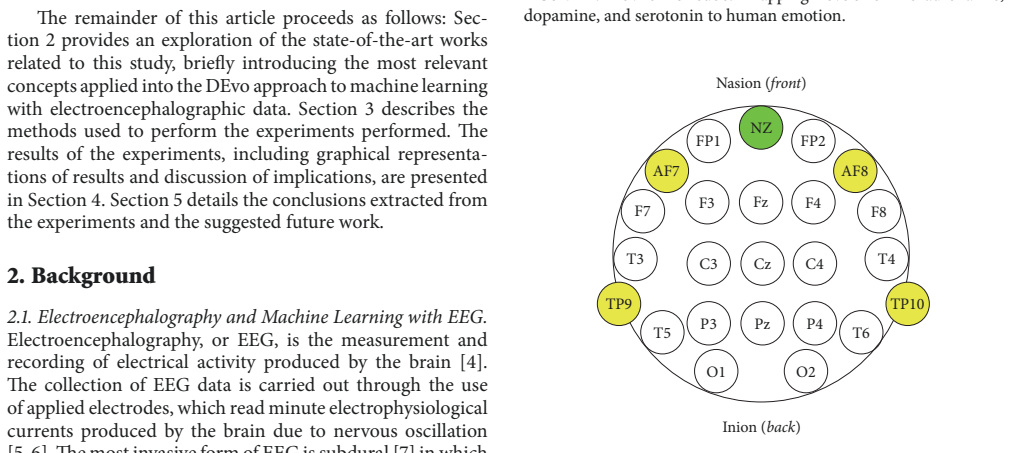
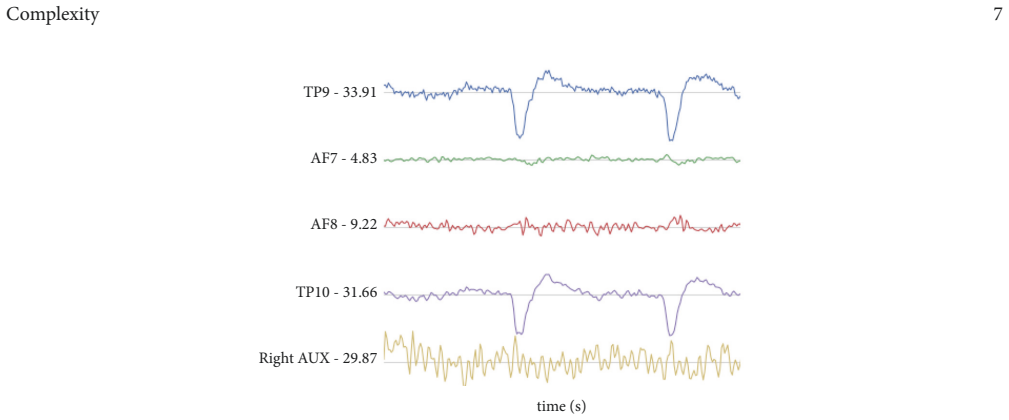
This study suggests a new approach to EEG data classification by exploring the idea of using evolutionary computation to both select useful discriminative EEG features and optimise the topology of Artificial Neural Networks. An evolutionary algorithm is applied to select the most informative features from an initial set of 2550 EEG statistical features. Optimisation of a Multilayer Perceptron (MLP) is performed with an evolutionary approach before classification to estimate the best hyperparameters of the network. Deep learning and tuning with Long Short-Term Memory (LSTM) are also explored, and Adaptive Boosting of the two types of models is tested for each problem. Three experiments are provided for comparison using different classifiers: one for attention state classification, one for emotional sentiment classification, and a third experiment in which the goal is to guess the number a subject is thinking of. The obtained results show that an Adaptive Boosted LSTM can achieve an accuracy of 84.44%, 97.06%, and 9.94% on the attentional, emotional, and number datasets, respectively. An evolutionary-optimised MLP achieves results close to the Adaptive Boosted LSTM for the two first experiments and significantly higher for the number-guessing experiment with an Adaptive Boosted DEvo MLP reaching 31.35%, while being significantly quicker to train and classify. In particular, the accuracy of the nonboosted DEvo MLP was of 79.81%, 96.11%, and 27.07% in the same benchmarks. Two datasets for the experiments were gathered using a Muse EEG headband with four electrodes corresponding to TP9, AF7, AF8, and TP10 locations of the international EEG placement standard. The EEG MindBigData digits dataset was gathered from the TP9, FP1, FP2, and TP10 locations.
Figures


Figures from the paper (7 more)



Reference graph
Works this paper leans on
-
[1]
The ten-twenty electrode system of the interna- tionalfederation,
H. H. Jasper, “The ten-twenty electrode system of the interna- tionalfederation,”ClinicalNeurophysiology,vol.10,pp.370–375, 1958. [ 2 ]K .G r e ff ,R .K .S r i v a s t a v a ,J .K o u t n k ,B .R .S t e u n e b r i n k ,a n dJ . Schmidhuber, “LSTM: a search space odyssey,”IEEE Transac- tions on Neural Networks and Learning Systems,v o l .2 8 ,n o .1 0 , p...
work page 1958
-
[4]
E.NiedermeyerandF .L.daSilva,Electroencephalography:Basic Principles, Clinical Applications, and Related Fields,L i p p i n c o t t Williams&Wilkins,2005
work page 2005
-
[5]
Adolf beck: a forgotten pioneer in electroencephalography,
A. Coenen, E. Fine, and O. Zayachkivska, “Adolf beck: a forgotten pioneer in electroencephalography,”Journal of the History of the Neurosciences,vol.23,no .3,p p .27 6–286,201 4
-
[6]
The advantages of digital over analog recording techniques,
B. E. Swartz, “The advantages of digital over analog recording techniques,”Electroencephalography and Clinical Neurophysiol- ogy,vol.106,no .2,p p .113–117 ,1998. [ 7 ]A .K .S h a ha n dS .M i t t a l ,“ I n v a s i v ee l e c t r o e n c e p h a l o g r a p h y monitoring: Indications and presurgical planning,”Annals of IndianAcademyofNeurology ,vol.17,n...
work page 1998
-
[8]
A dry electrode for EEG recording,
B. A. Taheri, R. T. Knight, and R. L. Smith, “A dry electrode for EEG recording,”E l e c t r o e n c e p h a l o g r a p h ya n dC l i n i c a lN e u - rophysiology,vol.90,no .5,p p .37 6–38 3,1 994
-
[9]
Anewthree-dimensionalmodelforemotionsand monoamineneurotransmitters,
H.L¨ovheim,“Anewthree-dimensionalmodelforemotionsand monoamineneurotransmitters,”MedicalHypotheses,vol.78,no. 2,pp.341–348,2012. [10]K.OatleyandJ .M.Jenkins,Understanding Emotions ,Blackwell Publishing,1996
work page 2012
-
[11]
J. Gruzelier, “A theory of alpha/theta neurofeedback, creative performanceenhancement,longdistancefunctionalconnectiv- ity and psychological integration,”Cognitive Processing,v o l .1 0 , no.1,pp.101–109,2009
work page 2009
-
[12]
E.-R. Symeonidou, A. D. Nordin, W. D. Hairston, and D. P. Ferris, “Effects of cable sway, electrode surface area, and electrodemassonelectroencepha lographysignalqualityduring motion,”Sensors,vol.18,no .4,p .107 3,2018
work page 2018
Show all 45 references
-
[13]
Induction and separation of motion artifacts in EEG data using a mobile phantom head device,
A. S. Oliveira, B. R. Schlink, W. D. Hairston, P. K¨onig, and D. P. Ferris, “Induction and separation of motion artifacts in EEG data using a mobile phantom head device,”Journal of Neural Engineering,vol.13,no .3,p .03601 4,2016
2016
-
[14]
Brain-EE:BrainenjoymentevaluationusingcommercialEEG headband,
M. Abujelala, A. Sharma, C. Abellanoza, and F. Makedon, “Brain-EE:BrainenjoymentevaluationusingcommercialEEG headband,”in Proceedingsofthe9thACMInternationalConfer- enceonPervasiveTechnologiesRelatedtoAssistiveEnvironments, PETRA 2016,p.33,ACM,Greece,July2016. [15]A.Plotnikov ...
2016
-
[16]
ChoosingMUSE:Validationofalow-cost,portable EEGsystemforERPresearch,
O.E.Krigolson,C.C.Williams,A.Norton,C.D.Hassall,andF. L.Colino,“ChoosingMUSE:Validationofalow-cost,portable EEGsystemforERPresearch,” FrontiersinNeuroscience,vol.11, p. 109, 2017. [ 1 7 ]J .J .B i r d ,L .J .M a n s o ,E .P .R i b i e r o ,A .E k a r t ,a n dD .R . Faria, “A s...
2017
-
[18]
Applying probabilisticMixtureModelstosemanticplaceclassificationin mobile robotics,
C.Premebida,D.R.Faria,F.A.Souza,andU.Nunes,“Applying probabilisticMixtureModelstosemanticplaceclassificationin mobile robotics,” inProceedings of the IEEE/RSJ International Conference on Intelligent Robots and Systems, IROS 2015,p p. 42 65–4270,Germany,October2015
2015
-
[19]
Dynamic Bayesian network for semantic place classification in mobile robotics,
C. Premebida, D. R. Faria, and U. Nunes, “Dynamic Bayesian network for semantic place classification in mobile robotics,” Autonomous Robots,vol.41,no .5,p p .1161 –117 2,2017
2017
-
[20]
Classificationof human emotions from eeg signals using statistical features and neuralnetwork,
T.Y.Chai,S.S.Woo,M.Rizon,andC.S.Tan,“Classificationof human emotions from eeg signals using statistical features and neuralnetwork,” InternationalJournalofIntegratedEngineering (PenerbitUTHM),vol.1,p p .1 –6,2010. [ 2 1 ]H .T a n a k a ,M .H a y a s h i ,a n dT .H o r i ,“ S t...
2010
-
[22]
EEG-based emotion classification using deep belief networks,
W. Zheng, J. Zhu, Y. Peng, and B. Lu, “EEG-based emotion classification using deep belief networks,” inProceedings of the 2014 IEEE International Conference on Multimedia and Expo (ICME),pp.1–6,Chengdu,China,July2014
2014
-
[23]
Emergency EEG and continuous EEG monitor- ing in acute ischemic stroke,
K. G. Jordan, “Emergency EEG and continuous EEG monitor- ing in acute ischemic stroke,”Journal of Clinical Neurophysiol- ogy,vol.21,no .5,p p .341 –35 2,2004
2004
-
[24]
Clinical study of neurorehabilitation in stroke using EEG-based motor imagery brain-computerinterfacewithroboticfeedback,
K. K. Ang, C. Guan, K. S. G. Chua et al., “Clinical study of neurorehabilitation in stroke using EEG-based motor imagery brain-computerinterfacewithroboticfeedback,”in Proceedings of the 2010 32nd Annual International Conference of the IEEE Engineering in Medicine and Biology ...
2010
-
[25]
Epileptic seizuredetectioninEEGsusingtime-frequencyanalysis,
A. T. Tzallas, M. G. Tsipouras, and D. I. Fotiadis, “Epileptic seizuredetectioninEEGsusingtime-frequencyanalysis,” IEEE Transactions on Information Technology in Biomedicine,v o l .1 3 , no .5,p p .703–710,2009 . [ 2 6 ]A .A a r a b i ,R .G r e b e ,a n dF .W a l l o i s ,“ Am...
2009
-
[27]
Auto- mated sleep scoring in rats and mice using the naive Bayes classifier,
K.-M. Rytk¨onen, J. Zitting, and T. Porkka-Heiskanen, “Auto- mated sleep scoring in rats and mice using the naive Bayes classifier,”Journal of Neuroscience Methods,v o l .2 0 2 ,n o .1 ,p p . 60–64,2011
2011
-
[28]
Automated sleep stage identification system based ontime-frequencyanalysisofasingleEEGchannelandrandom forestclassifier,
L. Fraiwan, K. Lweesy, N. Khasawneh, H. Wenz, and H. Dickhaus, “Automated sleep stage identification system based ontime-frequencyanalysisofasingleEEGchannelandrandom forestclassifier,”ComputerMethods&ProgramsinBiomedicine , vol.108,no .1,p p .10–19 ,2012
2012
-
[29]
Immune clonal algorithm based feature selection for epileptic EEG signal classification,
Y. Peng and B.-L. Lu, “Immune clonal algorithm based feature selection for epileptic EEG signal classification,” inProceedings ofthe201211thInternationalConferenceonInformationScience, Signal Processing and their Applications, ISSPA 2012,p p .8 4 8 – 853,Canada,July2012
2012
-
[30]
Affectivefacialexpressionsrecognitionforhuman-robotinter- action,
D. R. Faria, M. Vieira, F. C. C. Faria, and C. Premebida, “Affectivefacialexpressionsrecognitionforhuman-robotinter- action,”inProceedingsofthe26thIEEEInternationalSymposium on Robot and Human Interactive Communication, RO-MAN 2017,pp.805–810,Portugal,September2017
2017
-
[31]
High resolution sentiment analysis by ensemble classification,
J. J. Bird, A. Ekart, and D. R. Faria, “High resolution sentiment analysis by ensemble classification,” inProceedings of the SAI ComputingConference,SAI,2019 ,201 9
2019
-
[32]
Social activity recognition based on probabilistic merging of skeleton 14 Complexity features with proximity priors from RGB-D data,
C. Coppola, D. R. Faria, U. Nunes, and N. Bellotto, “Social activity recognition based on probabilistic merging of skeleton 14 Complexity features with proximity priors from RGB-D data,” inProceed- ingsofthe2016IEEE/RSJInternationalConferenceonIntelligent Robots and Systems, I...
2016
-
[33]
Human activitiestransferlearningforassistiverobotics,
D. A. Adama, A. Lotfi, C. Langensiepen, and K. Lee, “Human activitiestransferlearningforassistiverobotics,”in Proceedings oftheUKWorkshoponComputationalIntelligence ,pp.253–264, Springer, 2017
2017
-
[34]
Anomaly detec- tion in activities of daily living using one-class support vector machine,
S. W. Yahaya, C. Langensiepen, and A. Lotfi, “Anomaly detec- tion in activities of daily living using one-class support vector machine,”inProceedingsoftheUKWorkshoponComputational Intelligence,p p .36 2–371,S p ringer ,2018
2018
-
[35]
A multi-level refinement approach towards the classification of quotidian activities using accelerometer data,
D. Ortega-Anderez, A. Lotfi, C. Langensiepen, and K. Appiah, “A multi-level refinement approach towards the classification of quotidian activities using accelerometer data,”Journal of AmbientIntelligenceandHumanizedComputing ,pp .1 –12,2018
2018
-
[36]
Learning from inter- action: An intelligent networked-based human-bot and bot- bot chatbot system,
J. J. Bird, A. Ek´art, and D. R. Faria, “Learning from inter- action: An intelligent networked-based human-bot and bot- bot chatbot system,” inProceedings of the UK Workshop on Computational Intelligence,pp.179–190,Springer,2018
2018
-
[37]
Evolutionary algorithms: a critical review and its future prospects,
P. A. Vikhar, “Evolutionary algorithms: a critical review and its future prospects,” inProceedings of the 2016 International Conference on Global Trends in Signal Processing, Information ComputingandCommunication,ICGTSPICC2016 ,pp.261–265, India,December2016
2016
-
[38]
C.Darwin, Ontheoriginofspecies,1859 ,Ro u tledge,2004
2004
-
[39]
Evolutionary optimisation of fully connected artificial neural network topology,
J. J. Bird, A. Ekart, and D. R. Faria, “Evolutionary optimisation of fully connected artificial neural network topology,” inPro- ceedings of the SAI Computing Conference, SAI, 2019,2019
2019
-
[40]
Nofreelunchtheoremsfor optimization,
D.H.WolpertandW.G.Macready,“Nofreelunchtheoremsfor optimization,”IEEETransactionsonEvolutionaryComputation , vol.1,no.1,pp.67–82,1997
1997
-
[41]
Postscript about NP-hard problems,
D. E. Knuth, “Postscript about NP-hard problems,” ACM SIGACTNews,vol.6,no .2,p p .15-16,197 4
-
[42]
Deep learning,
Y. Bengio, I. J. Goodfellow, and A. Courville, “Deep learning,” Nature,vol.5 21,no .7 55 3,p p .436–444,2015
2015
-
[43]
Oninformationandsufficiency,
S.KullbackandR.A.Leibler,“Oninformationandsufficiency,” Annals of Mathematical Statistics,vol.22,no .1,p p .79–86,1951
1951
-
[44]
DENSER: deep evolutionary network structured representa- tion,
F. Assunc¸˜ao, N. Lourenc¸ o ,P .M a c h a d o ,a n dB .R i b e i r o , “DENSER: deep evolutionary network structured representa- tion,”Genetic Programming and Evolvable Machines,p p .1 – 3 1 , 2018
2018
-
[45]
EvoDeep: a new evolutionary approach for automatic deep neural networks parametrisation,
A. Mart´ın, R. Lara-Cabrera, F. Fuentes-Hurtado, V. Naranjo, and D. Camacho, “EvoDeep: a new evolutionary approach for automatic deep neural networks parametrisation,”Journal of Parallel and Distributed Computing,vol.117 ,p p .180–1 91,2018
2018
-
[46]
Discriminativeextremelearningmachine with supervised sparsity preserving for image classification,
Y.PengandB.-L.Lu,“Discriminativeextremelearningmachine with supervised sparsity preserving for image classification,” Neurocomputing,vol.261,p p .2 42–25 2,2017
2017
-
[47]
Hybrid speech recognition with deep bidirectional LSTM,
A. Graves, N. Jaitly, and A.-R. Mohamed, “Hybrid speech recognition with deep bidirectional LSTM,” in Proceedings of the 2013 IEEE Workshop on Automatic Speech Recognition and Understanding, ASRU 2013, pp. 273–278, Czech Republic, December2013. [ 4 8 ]P .R .D a v i d s o n ,R ...
2013
-
[49]
A decision-theoretic generaliza- tionofon-linelearningandanapplicationtoboosting,
Y. Freund and R. E. Schapire, “A decision-theoretic generaliza- tionofon-linelearningandanapplicationtoboosting,” Journal of Computer and System Sciences,v o l .5 5 ,n o .1 ,p a r t2 ,p p .1 1 9 – 139,1997
1997
-
[50]
Adaboost and the super bowl of classifiers a tutorial introductiontoadaptiveboosting,
R. Rojas, “Adaboost and the super bowl of classifiers a tutorial introductiontoadaptiveboosting,”Tech.Rep.,FreieUniversity, Berlin, Germany,2009
2009
-
[51]
The matrix- logarithmic covariance model,
T. Y. M. Chiu, T. Leonard, and K.-W. Tsui, “The matrix- logarithmic covariance model,”Journal of the American Statis- ticalAssociation,vol.91,no.433,pp.198–210,1996
1996
-
[52]
C. van Loan,Computational Frameworks for the Fast Fourier Transform,v o l .1 0o fFrontiers in Applied Mathematics,S o c i e t y for Industrial and Applied Mathematics (SIAM), Philadelphia, P a,USA,1 99 2
-
[53]
T.Back, Evolutionary Algorithms in Theory and Practice: Evolu- tion Strategies, Evolutionary Programming, Genetic Algorithms, Oxford UniversityPress,1996
1996
-
[54]
A study on cnn transfer learning for image classification,
M. Hussain, J. J. Bird, and D. R. Faria, “A study on cnn transfer learning for image classification,” inProceedings of the UK Workshop on Computational Intelligence,p p .1 9 1 – 2 0 2 ,S p r i n g e r , 2018. Hindawi www.hindawi.com Volume 2018 Mathematics Journal of Hindawi w...
2018
Reviewed August 14, 2026 · model on record in the stance chip above.
Discussion (0). Continue with ORCID to comment.