REVIEW 3 major objections 4 minor 1 cited by
Ultralight dark matter detection with mechanical quantum sensors
T0 review · 3 major / 4 minor · reviewed 2026-08-14 · deepseek-v4-flash
Pith's one-line read A milligram-scale force sensor at the standard quantum limit could detect ultralight dark matter that couples to ordinary matter, and arrays of such sensors would extend the reach.
desk verdict A clean, well-scoped sensitivity study applying standard optomechanical force sensing to ultralight DM; the assumptions are stated and the reach curves are transparent, so it deserves serious refereeing. read the letter →
The pith
A machine-rendered reading of the paper's core claim, the machinery that carries it, and where it could break.
The reading
What carries the argument
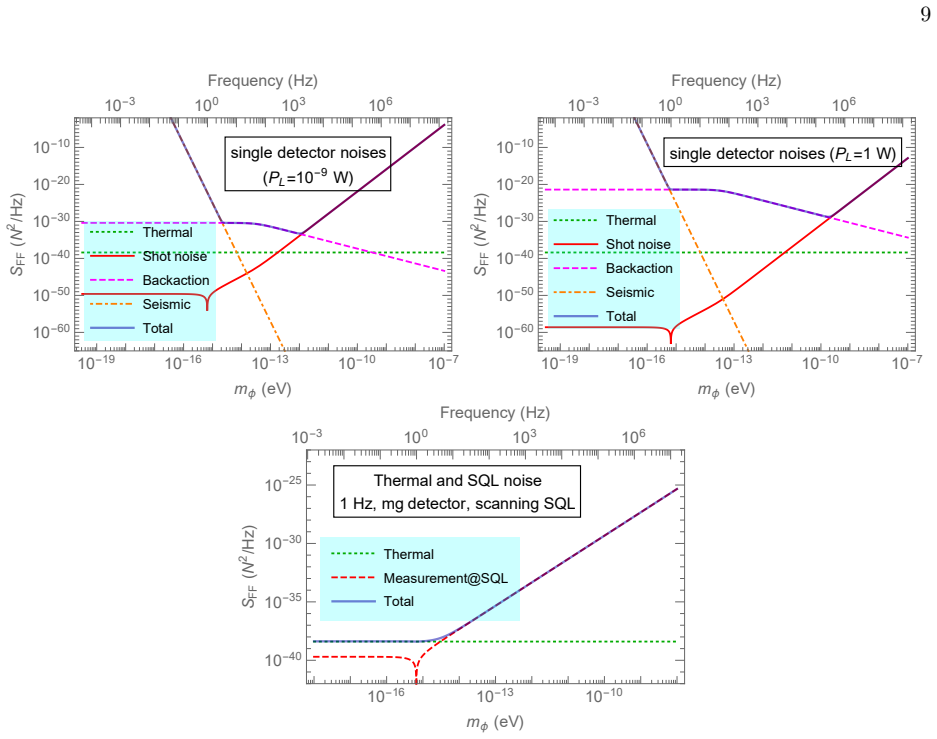
The load-bearing object is the optomechanical force sensor: a high-finesse cavity whose movable mirror is a mechanical oscillator of mass $m_s$, frequency $\omega_s$, and damping $\gamma$, monitored by laser light. The paper reduces its sensitivity to a closed-form noise power spectral density $S_{FF} = 4\gamma m_s kT + S_{FF}^{\rm M, SQL}(\omega_\varphi)$ at the standard quantum limit, with $S_{FF}^{\rm M, SQL}(\omega_\varphi)=2m_s\sqrt{(\omega_\varphi^2-\omega_s^2)^2+\gamma^2\omega_s^2}$, obtained by balancing shot noise against backaction at the target frequency. The dark-matter signal is modeled as a sinusoidal force $F(t)=gN_g F_0\sin(\omega_\varphi t)$ with $F_0\simeq 10^{-15}$ N and $N_g$ the number of coupled charges in the sensor; equating this signal to the noise floor yields the coupling reach. The array generalization uses the correlated signal across sensors to average down uncorrelated thermal and measurement noise, and the material-dependent coupling enables differential measurements that cancel common-mode backgrounds.
What would settle it
Measure the force noise of a 1 mg, 1 Hz pendulum in a 10 mK dilution refrigerator, with a silicon mirror referenced against an iron mirror, and compare the differential noise spectrum with the paper's thermal-plus-SQL floor: if the seismic or other correlated background stays above roughly $10^{-20}$ N/$\sqrt{\rm Hz}$ near 1 Hz, the claimed exclusion reach at low $m_\varphi$ is not achievable with that sensor. A null test for the dark-matter signal itself would be a long integration showing no coherent peak at the expected frequency with amplitude above the quoted sensitivity.
Extended reading notes
Core claim
The paper's central claim is that a mechanical sensor with mass around or below 1 mg, mechanical frequency near 1 Hz, damping near $10^{-6}$ Hz, and temperature near 10 mK, operated with the readout laser tuned to reach the standard quantum limit at each target frequency, could detect or exclude vector $B-L$ and scalar–neutron ultralight dark matter for masses below about $10^{-8}$ eV, corresponding to signal frequencies in the kHz range and below. Using equations (20) and (21), the smallest detectable coupling scales as $g \sim \sqrt{S_{FF}}/(N_g F_0 \sqrt{N_{\rm det} T_{\rm tot}})$; because the signal force grows with sensor mass, the sensitivity improves roughly as the inverse square root of total mass. The paper further claims that making the sensor and its reference from different materials turns the dark-matter signal into a differential, equivalence-principle-violating acceleration that can be distinguished from common-mode seismic noise, and that an array of $N_{\rm det}$ sensors improves the coupling reach by at least $\sqrt{N_{\rm det}}$.
Load-bearing premise
The results assume that correlated technical noise—above all seismic vibration—can be cancelled well enough by differential measurements between different materials that only thermal and quantum measurement noise remain; if that cancellation falls short, the low-frequency reach is overstated.
Editorial extensions
If this is right
- A single 1 mg sensor at the SQL can reach unexplored values of the $B-L$ and scalar–neutron couplings for $m_\varphi \lesssim 10^{-8}$ eV, as shown in Fig. 4.
- An array of $N_{\rm det}$ independently read sensors improves the coupling reach by at least $\sqrt{N_{\rm det}}$; a single coherent readout can approach the $N_{\rm det}$ Heisenberg scaling.
- The natural search band is kHz–MHz signal frequencies, complementing torsion balances and atom interferometers at sub-kHz frequencies.
- Resonant operation, $\omega_s = \omega_\varphi$, gives the best sensitivity, and dynamical stiffening is one route to scan the mechanical frequency.
- Post-SQL techniques such as squeezed light or backaction evasion would extend the reach beyond the curves plotted here, especially at frequencies above $kT \sim 1$ GHz.
Reading between the lines
- If the differential-material noise cancellation works as assumed, the same array could be repurposed as a broadband equivalence-principle test, since the technique is essentially an equivalence-principle-violating force search with a variable source frequency.
- A two-site or multi-site version of the array with sensors made of different materials could exploit the predicted Earth-size coherence length for $m_\varphi \lesssim 10^{-9}$ eV to reject local noise and confirm a common signal.
- This points to a concrete near-term engineering target: demonstrate that a cryogenic mg-scale pendulum pair with silicon and iron mirrors achieves a differential noise floor below $10^{-20}$ N/$\sqrt{\rm Hz}$ near 1 Hz, which is the decisive step for the proposed reach.
Signed reviews
Editorial analysis
A structured set of objections, weighed in public.
Referee Report
Summary. The paper proposes using quantum-limited optomechanical and electromechanical force sensors to search for ultralight dark matter candidates that couple coherently to standard-model charges, specifically vector B-L and scalar-neutron couplings. It derives the force sensitivity of a single-sided cavity optomechanical sensor from first principles in Appendix B, obtains the standard quantum limit (SQL) noise PSD, and uses it to project detection reach for three search strategies: fixed laser power, SQL scanning at fixed mechanical frequency, and resonant SQL scanning. The central claim is that milligram-scale sensors operating near the SQL, possibly arranged in arrays, could probe new coupling regimes for dark matter masses below about 10^-8 eV, complementing torsion-balance and atom-interferometer experiments. The paper also discusses how arrays of sensors with different materials enable differential measurements to suppress correlated technical noise such as seismic vibrations.
Significance. If the projections are correct, this is a valuable contribution to the ultralight dark matter detection program. It provides a clean, first-principles derivation of the SQL-limited force sensitivity in the appendices, and it makes explicit, falsifiable predictions with clearly stated experimental parameters (mass, mechanical frequency, damping, temperature, laser power). The paper does not fit any quantities to data; the sensitivity curves follow from standard quantum noise formulas. The array-scaling discussion is a useful addition to the prior accelerometer-based proposals. However, as detailed below, the quantitative reach curves contain a significant error in the treatment of the differential measurement and a smaller inconsistency in the thermal noise floor, so the headline numbers need correction before the claimed reach can be taken at face value.
major comments (3)
- [§IV, Eqs. (18)–(20), and Fig. 4] The reach formula omits the differential acceleration coefficient Δ defined in Eq. (4). The paper explicitly states that the detection method relies on a differential measurement between two materials (see Fig. 1 and the Fig. 4 caption, which fixes Δ≈0.03 for an iron/silicon pair). For such a measurement, the signal force is proportional to the difference in charge numbers, i.e., approximately 2Δ N_g g F0, not N_g g F0. Consequently, the denominators in Eqs. (18) and (20) should contain (2Δ N_g)^2, and the sensitivity curves in Fig. 4 are optimistic by roughly 1/(2Δ)≈15 in coupling. Relatedly, Eq. (4) as written is dimensionally inconsistent: a_s is called a differential acceleration, but F0 has dimensions of force, so a correct expression must involve an additional factor of 1/m_n (or an equivalent definition of F0). This issue is load-bearing for every quantitative projection in the paper and must be corrected and re-plotted.
- [§III A, Eq. (14), and Appendix B, Eq. (B22)] The main-text formula for thermal force noise, S_FF^T = γ m_s kT, disagrees with the derivation in Appendix B, Eq. (B22), which gives S_FF^T = 4γ m_s kT (the standard fluctuation-dissipation result for the two-sided spectral density used in the paper). Equation (20) inherits the smaller value, understating the thermal floor by a factor of 4 in PSD and a factor of 2 in coupling reach in the thermal-dominated regime. The authors should reconcile Eq. (14) with Eq. (B22) and update the figures accordingly.
- [§III C and Fig. 4] The projections assume that correlated technical noise, especially seismic noise, is fully suppressed: the text states, 'we assume that these correlated noise sources have been sufficiently controlled so that thermal and measurement-added noise are dominant.' This assumption is load-bearing for the low-frequency part of Fig. 4, where the plotted seismic PSD is many orders of magnitude above the thermal and SQL floors. The manuscript does not provide a quantitative estimate of the required common-mode rejection (in dB) or a concrete experimental scheme demonstrating that such rejection is achievable with existing isolation and differential techniques. If this cannot be established, the reach curves below roughly 10^-13 eV should be omitted or explicitly labeled as contingent on unproven technical noise suppression.
minor comments (4)
- [Eq. (B18)] The mechanical susceptibility is written with a damping term -i γ ω_s, whereas the time-domain equation (B9) contains -γ p, which yields -i γ ω in the Fourier domain. The discrepancy is negligible exactly on resonance but can matter for off-resonant scans; please either use the exact expression or state the high-Q approximation explicitly.
- [§II] The text says 'due to the viral theorem'; this should be 'virial theorem'.
- [Throughout] There are several typographical errors, including 'persisent' in the Introduction, 'Fundamanetal' in the affiliation, and 'intergration' near Eq. (18). These should be corrected in a revised version.
- [Eq. (19)] The definition of Ttot uses a piecewise expression with Tint<Tcoh and Tint>Tcoh. The text explains the scaling, but it would help to state explicitly that the second line arises from incoherently combining N_bins=Tint/Tcoh independent coherent segments, which is a standard but nontrivial statistical step.
Circularity Check
No significant circularity: the detection reach curves follow from standard optomechanical noise formulas with explicitly stated sensor parameters and an externally sourced dark matter signal model.
full rationale
The paper's derivation chain is self-contained in the relevant sense. The dark matter force signal is taken from the standard ultralight dark matter formalism and prior work [11], which is not authored by the present authors; the force parametrization in Eqs. (3)-(4) is a model input, not a prediction derived from the sensitivity analysis. The sensitivity curves are obtained from the quantum optomechanical noise calculation in Appendix B, where the standard quantum limit result (16) follows algebraically from the Heisenberg-Langevin equations with vacuum input noise and a thermal force noise obeying the fluctuation-dissipation theorem. The detection reach formula (18) then combines this noise PSD with the assumed integration time and number of sensors. No parameter appearing in Fig. 4 is fitted to dark matter data or to the quantity being predicted; the sensor parameters (m_s = 1 mg, ω_s = 1 Hz, γ = 10^-6 Hz, T = 10 mK, laser power) are stated inputs based on demonstrated systems such as [19]. The paper explicitly identifies its main caveat as an assumption rather than hiding it: it states that correlated technical noise sources are assumed to be sufficiently controlled so that thermal and measurement-added noise dominate. That is an experimental assumption, not a circular argument. The self-citations present in the paper, [13] and [31], are not load-bearing for the central claim: [13] is cited only for details of the standard random-phase simulation of the dark matter waveform in Appendix A, and [31] is mentioned as a long-term gravitational detection goal in the introduction and outlook. The comparison to Eot-Wash bounds is an external benchmark, not a fit input. Therefore no step in the derivation reduces by construction to its own inputs, and the circularity score is zero.
Assumptions & free parameters
free parameters (8)
- Sensor mass m_s =
1 mg
- Mechanical frequency ω_s =
1 Hz
- Mechanical damping rate γ =
10^-6 Hz
- Temperature T =
10 mK
- Maximum laser power P_L =
1 W
- Integration time per bin T_int =
1 hour
- Differential acceleration coefficient Δ =
0.03
- Sensor array size N_det =
1 (baseline); variable in array scaling
assumptions (6)
- domain assumption The ultralight DM is a single bosonic field in the mass range 10^-22 eV to 0.1 eV, virialized in the galaxy with local density 0.3 GeV/cm^3 and velocity v ~ 10^5 m/s, so it behaves as a classical wave.
- domain assumption The DM-SM coupling generates a coherent force proportional to the number of neutrons (or nucleons) in the sensor, with a material-dependent differential acceleration Δ between different materials.
- standard math The mechanical and optical baths are Markovian and in equilibrium, so the fluctuation-dissipation theorem gives a thermal force noise PSD S_FF^T = 4γ m_s kT.
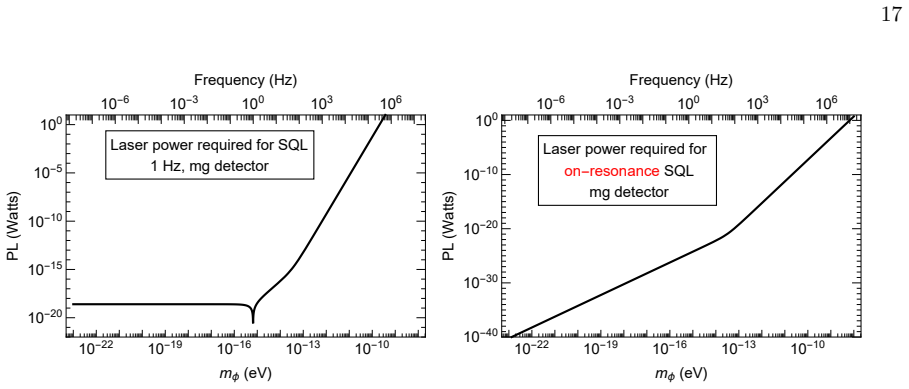
- domain assumption The SQL force noise formula S_FF^{M,SQL}(ω_φ) = 2 m_s sqrt((ω_φ^2 - ω_s^2)^2 + γ^2 ω_s^2) applies at the chosen signal frequency after tuning laser power.
- domain assumption Correlated technical noise sources (seismic, vibrational, gravitational) can be made subdominant to thermal and measurement noise by using differential measurements between sensors of different materials.
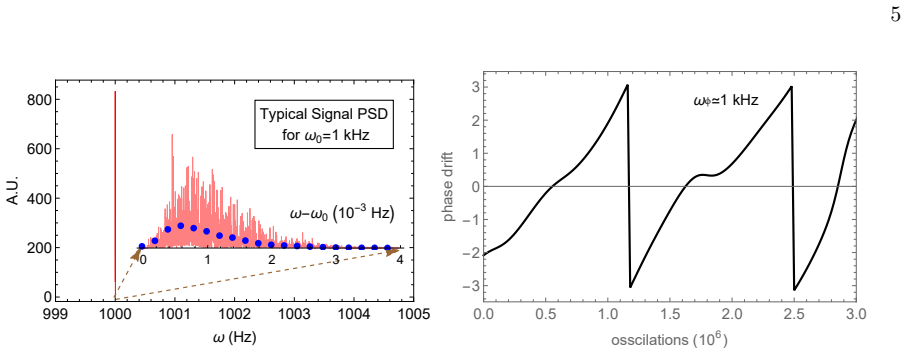
- domain assumption The DM signal remains coherent for T_coh = 10^6/ω_φ, and over longer observations the signal can be binned into N_bins independent realizations, giving an effective integration time T_tot = sqrt(T_int T_coh) for T_int > T_coh.
Cite this review
Pith. "Pith review of Ultralight dark matter detection with mechanical quantum sensors." pith.science (2026). https://pith.science/paper/6BED6RN4
@misc{pith2026190804797,
  author       = {Pith},
  title        = {Pith review of: Ultralight dark matter detection with mechanical quantum sensors},
  year         = {2026},
  howpublished = {\url{https://pith.science/paper/6BED6RN4}},
  note         = {Machine review of arXiv:1908.04797}
}
read the original abstract
We consider the use of quantum-limited mechanical force sensors to detect ultralight (sub-meV) dark matter candidates which are weakly coupled to the standard model. We show that mechanical sensors with masses around or below the milligram scale, operating around the standard quantum limit, would enable novel searches for dark matter with natural frequencies around the kHz scale. This would complement existing strategies based on torsion balances, atom interferometers, and atomic clock systems.
Figures

Figures from the paper (2 more)

Forward citations
Cited by 1 Pith paper
-
Searching for Ultralight Dark Matter with MOLeQuTE: a Massive Optically Levitated Quantum Tabletop Experiment
A proposed optically levitated milligram-scale plate sensor could reach the standard quantum limit and probe new parameter space for ultralight B-L vector dark matter.
Reference graph
Works this paper leans on
-
[31]
Superconducting gravity gradiometer for sensitive gravity measurements. i. theory,
H. Chan and H. Paik, “Superconducting gravity gradiometer for sensitive gravity measurements. i. theory,” Physical Review D 35 no. 12, (1987) 3551
work page 1987
-
[1]
Single-sided optomechanical cavity 15
-
[2]
Inferring force from position measurement 17 References 19 I. INTRODUCTION There is overwhelming astrophysical and cosmological evidence for the existence of cold dark matter (DM) [1–4]. However, the detailed properties of the DM, in particular its mass, are highly unconstrained [5]. The possibility that the dark sector could contain or even consist prima...
arXiv 1908
-
[3]
We write the total Hamiltonian H =Hsys +Hbath
Single-sided optomechanical cavity Consider a high-reflectivity mirror suspended as a mechanical resonator of mechanical frequency ωs and massms forming a moveable end of an optical cavity with a single port. We write the total Hamiltonian H =Hsys +Hbath. (B1) The system term here consists of a mechanical resonator (the sensor) and the fundamental elec- tr...
-
[4]
Inferring force from position measurement The standard paradigm for force sensing is continuously monitor some resonator variable like x(t) and try to infer a force acting on the device. Note that x(t) is imprinted onto the light Y quadrature through the optomechanical coupling; what one actually does is to make an interfero- metric measurement of this qu...
-
[5]
Rotation curves of spiral galaxies,
Y. Sofue and V. Rubin, “Rotation curves of spiral galaxies,” Ann. Rev. Astron. Astrophys. 39 (2001) 137–174, arXiv:astro-ph/0010594 [astro-ph]
arXiv 2001
-
[6]
The dark matter of gravitational lensing,
R. Massey, T. Kitching, and J. Richard, “The dark matter of gravitational lensing,” Rept. Prog. Phys. 73 (2010) 086901, arXiv:1001.1739 [astro-ph.CO]
arXiv 2010
-
[7]
Planck 2018 results. VI. Cosmological parameters,
Planck Collaboration, N. Aghanim et al., “Planck 2018 results. VI. Cosmological parameters,” arXiv:1807.06209 [astro-ph.CO]
arXiv 2018
Show all 62 references
-
[8]
Cosmological Structure Formation,
J. R. Primack, “Cosmological Structure Formation,” in The Philosophy of Cosmology , pp. 136–160
-
[9]
Torsion balance experiments: A low-energy frontier of particle physics,
E. Adelberger, J. Gundlach, B. Heckel, S. Hoedl, and S. Schlamminger, “Torsion balance experiments: A low-energy frontier of particle physics,” Progress in Particle and Nuclear Physics 62 no. 1, (2009) 102–134
2009
-
[10]
Review of Particle Physics,
Particle Data Group Collaboration, M. Tanabashi et al., “Review of Particle Physics,” Phys. Rev. D98 no. 3, (2018) 030001
2018
-
[11]
Working Group Report: New Light Weakly Coupled Particles,
R. Essig et al., “Working Group Report: New Light Weakly Coupled Particles,” in Proceedings, 2013 Community Summer Study on the Future of U.S. Particle Physics: Snowmass on the Mississippi (CSS2013): Minneapolis, MN, USA, July 29-August 6, 2013 . 2013. arXiv:1311.0029 [hep-ph]...
2013 arXiv
-
[12]
Ultralight scalars as cosmological dark matter,
L. Hui, J. P. Ostriker, S. Tremaine, and E. Witten, “Ultralight scalars as cosmological dark matter,” Phys. Rev. D95 no. 4, (2017) 043541, arXiv:1610.08297 [astro-ph.CO] . 20
2017 arXiv
-
[13]
New experimental approaches in the search for axion-like particles,
I. G. Irastorza and J. Redondo, “New experimental approaches in the search for axion-like particles,” Prog. Part. Nucl. Phys. 102 (2018) 89–159, arXiv:1801.08127 [hep-ph]
2018 arXiv
-
[14]
Matter-wave Atomic Gradiometer InterferometricSensor (MAGIS-100) at Fermilab,
MAGIS-100 Collaboration, J. Coleman, “Matter-wave Atomic Gradiometer InterferometricSensor (MAGIS-100) at Fermilab,” PoS ICHEP2018 (2019) 021, arXiv:1812.00482 [physics.ins-det]
2019 arXiv
-
[15]
Torsion-balance tests of the weak equivalence principle,
T. A. Wagner, S. Schlamminger, J. Gundlach, and E. G. Adelberger, “Torsion-balance tests of the weak equivalence principle,” Classical and Quantum Gravity 29 no. 18, (2012) 184002
2012
-
[16]
Dark matter direct detection with accelerometers,
P. W. Graham, D. E. Kaplan, J. Mardon, S. Rajendran, and W. A. Terrano, “Dark matter direct detection with accelerometers,” Physical Review D 93 no. 7, (2016) 075029
2016
-
[17]
Searching for dark photon dark matter with gravitational-wave detectors,
A. Pierce, K. Riles, and Y. Zhao, “Searching for dark photon dark matter with gravitational-wave detectors,” Physical review letters 121 no. 6, (2018) 061102
2018
-
[18]
Searching for Dark Photon Dark Matter in LIGO O1 Data,
H.-K. Guo, K. Riles, F.-W. Yang, and Y. Zhao, “Searching for Dark Photon Dark Matter in LIGO O1 Data,” arXiv:1905.04316 [hep-ph]
1905 arXiv
-
[19]
Demonstration of displacement sensing of a mg-scale pendulum for mm-and mg-scale gravity measurements,
N. Matsumoto, S. B. Cata˜ no-Lopez, M. Sugawara, S. Suzuki, N. Abe, K. Komori, Y. Michimura, Y. Aso, and K. Edamatsu, “Demonstration of displacement sensing of a mg-scale pendulum for mm-and mg-scale gravity measurements,” Physical review letters 122 no. 7, (2019) 071101
2019
-
[20]
Search for invisible axion dark matter with the axion dark matter experiment,
N. Du, N. Force, R. Khatiwada, E. Lentz, R. Ottens, L. Rosenberg, G. Rybka, G. Carosi, N. Woollett, D. Bowring, et al., “Search for invisible axion dark matter with the axion dark matter experiment,” Physical review letters 120 no. 15, (2018) 151301
2018
-
[21]
Results from phase 1 of the haystac microwave cavity axion experiment,
L. Zhong, S. Al Kenany, K. Backes, B. Brubaker, S. Cahn, G. Carosi, Y. Gurevich, W. Kindel, S. Lamoreaux, K. Lehnert, et al., “Results from phase 1 of the haystac microwave cavity axion experiment,” Physical Review D 97 no. 9, (2018) 092001
2018
-
[22]
Advanced LIGO,
LIGO Scientific Collaboration, J. Aasi et al., “Advanced LIGO,” Class. Quant. Grav. 32 (2015)
2015
-
[23]
5-mg suspended mirror driven by measurement-induced backaction,
N. Matsumoto, K. Komori, Y. Michimura, G. Hayase, Y. Aso, and K. Tsubono, “5-mg suspended mirror driven by measurement-induced backaction,” Physical Review A 92 no. 3, (2015) 033825
2015
-
[24]
Force sensing with an optically levitated charged nanoparticle,
D. Hempston, J. Vovrosh, M. Toroˇ s, G. Winstone, M. Rashid, and H. Ulbricht, “Force sensing with an optically levitated charged nanoparticle,” Applied Physics Letters 111 no. 13, (2017) 133111
2017
-
[25]
Ultralow-noise sin trampoline resonators for sensing and optomechanics,
C. Reinhardt, T. M¨ uller, A. Bourassa, and J. C. Sankey, “Ultralow-noise sin trampoline resonators for sensing and optomechanics,” Physical Review X 6 no. 2, (2016) 021001
2016
-
[26]
Ultracoherent nanomechanical resonators via soft clamping and dissipation dilution,
Y. Tsaturyan, A. Barg, E. S. Polzik, and A. Schliesser, “Ultracoherent nanomechanical resonators via soft clamping and dissipation dilution,” Nature nanotechnology 12 no. 8, (2017) 776
2017
-
[27]
Optomechanics of levitated dielectric particles,
Z.-Q. Yin, A. A. Geraci, and T. Li, “Optomechanics of levitated dielectric particles,” International Journal of Modern Physics B 27 no. 26, (2013) 1330018
2013
-
[28]
Cavity opto-mechanics using an optically levitated nanosphere,
D. E. Chang, C. Regal, S. Papp, D. Wilson, J. Ye, O. Painter, H. J. Kimble, and P. Zoller, “Cavity opto-mechanics using an optically levitated nanosphere,” Proceedings of the National Academy of Sciences 107 no. 3, (2010) 1005–1010
2010
-
[29]
Cavity optomechanics in a levitated helium drop,
L. Childress, M. Schmidt, A. Kashkanova, C. Brown, G. Harris, A. Aiello, F. Marquardt, and J. Harris, “Cavity optomechanics in a levitated helium drop,” Physical Review A 96 no. 6, (2017) 063842
2017
-
[30]
Optical levitation of 10-ng spheres with nano-g acceleration sensitivity,
F. Monteiro, S. Ghosh, A. G. Fine, and D. C. Moore, “Optical levitation of 10-ng spheres with nano-g acceleration sensitivity,” Physical Review A 96 no. 6, (2017) 063841
2017
-
[32]
Superconducting gravity gradiometer for sensitive gravity measurements. ii. experiment,
H. Chan, M. Moody, and H. Paik, “Superconducting gravity gradiometer for sensitive gravity measurements. ii. experiment,” Physical Review D 35 no. 12, (1987) 3572
1987
-
[33]
Ultrasensitive inertial and force sensors with diamagnetically levitated magnets,
J. Prat-Camps, C. Teo, C. Rusconi, W. Wieczorek, and O. Romero-Isart, “Ultrasensitive inertial and force sensors with diamagnetically levitated magnets,” Physical Review Applied 8 no. 3, (2017) 034002
2017
-
[34]
Constraining the mass of light bosonic dark matter using SDSS Lyman- α forest,
E. Armengaud, N. Palanque-Delabrouille, C. Y` eche, D. J. E. Marsh, and J. Baur, “Constraining the mass of light bosonic dark matter using SDSS Lyman- α forest,” Mon. Not. Roy. Astron. Soc. 471 no. 4, (2017) 4606–4614, arXiv:1703.09126 [astro-ph.CO]
2017 arXiv
-
[35]
Advances in quantum metrology,
V. Giovannetti, S. Lloyd, and L. Maccone, “Advances in quantum metrology,” Nature photonics 5 no. 4, (2011) 222
2011
-
[36]
Gravitational Direct Detection of Dark Matter,
D. Carney, S. Ghosh, G. Krnjaic, and J. M. Taylor, “Gravitational Direct Detection of Dark Matter,” arXiv:1903.00492 [hep-ph]
1903 arXiv
-
[37]
Lectures on Dark Matter Physics,
M. Lisanti, “Lectures on Dark Matter Physics,” in Proceedings, Theoretical Advanced Study Institute in Elementary Particle Physics: New Frontiers in Fields and Strings (TASI 2015): Boulder, CO, USA, June 1-26, 2015 , pp. 399–446. 2017. arXiv:1603.03797 [hep-ph]
2015 arXiv
-
[38]
WISPy Cold Dark Matter,
P. Arias, D. Cadamuro, M. Goodsell, J. Jaeckel, J. Redondo, and A. Ringwald, “WISPy Cold Dark Matter,” JCAP 1206 (2012) 013, arXiv:1201.5902 [hep-ph] . 21
2012 arXiv
-
[39]
Dynamical Role of Light Neutral Leptons in Cosmology,
S. Tremaine and J. E. Gunn, “Dynamical Role of Light Neutral Leptons in Cosmology,” Phys. Rev. Lett. 42 (1979) 407–410. [,66(1979)]
1979
-
[40]
Strong Constraints on Fuzzy Dark Matter from Ultrafaint Dwarf Galaxy Eridanus II,
D. J. E. Marsh and J. C. Niemeyer, “Strong Constraints on Fuzzy Dark Matter from Ultrafaint Dwarf Galaxy Eridanus II,” arXiv:1810.08543 [astro-ph.CO]
-
[41]
Ultralight dark matter in disk galaxies,
N. Bar, K. Blum, J. Eby, and R. Sato, “Ultralight dark matter in disk galaxies,” Phys. Rev. D99 no. 10, (2019) 103020, arXiv:1903.03402 [astro-ph.CO]
2019 arXiv
-
[42]
Galactic rotation curves versus ultralight dark matter: Implications of the soliton-host halo relation,
N. Bar, D. Blas, K. Blum, and S. Sibiryakov, “Galactic rotation curves versus ultralight dark matter: Implications of the soliton-host halo relation,” Phys. Rev. D98 no. 8, (2018) 083027, arXiv:1805.00122 [astro-ph.CO]
2018 arXiv
-
[43]
Ultra-light Dark Matter is Incompatible with the Milky Way’s Dwarf Satellites,
M. Safarzadeh and D. N. Spergel, “Ultra-light Dark Matter is Incompatible with the Milky Way’s Dwarf Satellites,” arXiv:1906.11848 [astro-ph.CO]
1906 arXiv
-
[44]
Introduction to quantum noise, measurement, and amplification,
A. A. Clerk, M. H. Devoret, S. M. Girvin, F. Marquardt, and R. J. Schoelkopf, “Introduction to quantum noise, measurement, and amplification,” Reviews of Modern Physics 82 no. 2, (2010) 1155
2010
-
[45]
Zeptonewton force sensing with nanospheres in an optical lattice,
G. Ranjit, M. Cunningham, K. Casey, and A. A. Geraci, “Zeptonewton force sensing with nanospheres in an optical lattice,” Physical Review A 93 no. 5, (2016) 053801
2016
-
[46]
Halo substructure in the sdss–gaia catalogue: streams and clumps,
G. Myeong, N. Evans, V. Belokurov, N. Amorisco, and S. Koposov, “Halo substructure in the sdss–gaia catalogue: streams and clumps,” Monthly Notices of the Royal Astronomical Society 475 no. 2, (2017) 1537–1548
2017
-
[47]
Dark matter hurricane: Measuring the s1 stream with dark matter detectors,
C. A. O’Hare, C. McCabe, N. W. Evans, G. Myeong, and V. Belokurov, “Dark matter hurricane: Measuring the s1 stream with dark matter detectors,” Physical Review D 98 no. 10, (2018) 103006
2018
-
[48]
Under the firelight: Stellar tracers of the local dark matter velocity distribution in the milky way,
L. Necib, M. Lisanti, S. Garrison-Kimmel, A. Wetzel, R. Sanderson, P. F. Hopkins, C.-A. Faucher-Gigu` ere, and D. Kereˇ s, “Under the firelight: Stellar tracers of the local dark matter velocity distribution in the milky way,” arXiv:1810.12301
-
[49]
Enhanced sensitivity of the ligo gravitational wave detector by using squeezed states of light,
J. Aasi, J. Abadie, B. Abbott, R. Abbott, T. Abbott, M. Abernathy, C. Adams, T. Adams, P. Addesso, R. Adhikari, et al., “Enhanced sensitivity of the ligo gravitational wave detector by using squeezed states of light,” Nature Photonics 7 no. 8, (2013) 613
2013
-
[50]
Quantum electromechanical systems,
M. Blencowe, “Quantum electromechanical systems,” Physics Reports 395 no. 3, (2004) 159–222
2004
-
[51]
Cavity optomechanics,
M. Aspelmeyer, T. J. Kippenberg, and F. Marquardt, “Cavity optomechanics,” Reviews of Modern Physics 86 no. 4, (2014) 1391
2014
-
[52]
Observation and characterization of an optical spring,
B. S. Sheard, M. B. Gray, C. M. Mow-Lowry, D. E. McClelland, and S. E. Whitcomb, “Observation and characterization of an optical spring,” Physical Review A 69 no. 5, (2004) 051801
2004
-
[53]
Quantum-mechanical noise in an interferometer,
C. M. Caves, “Quantum-mechanical noise in an interferometer,” Physical Review D 23 no. 8, (1981) 1693
1981
-
[54]
Back-action evasion and squeezing of a mechanical resonator using a cavity detector,
A. Clerk, F. Marquardt, and K. Jacobs, “Back-action evasion and squeezing of a mechanical resonator using a cavity detector,” New Journal of Physics 10 no. 9, (2008) 095010
2008
-
[55]
Strong optomechanical squeezing of light,
T. P. Purdy, P.-L. Yu, R. W. Peterson, N. S. Kampel, and C. A. Regal, “Strong optomechanical squeezing of light,” Physical Review X 3 no. 3, (2013) 031012
2013
-
[56]
Sideband cooling beyond the quantum backaction limit with squeezed light,
J. B. Clark, F. Lecocq, R. W. Simmonds, J. Aumentado, and J. D. Teufel, “Sideband cooling beyond the quantum backaction limit with squeezed light,” Nature 541 no. 7636, (2017) 191
2017
-
[57]
Quantum nondemolition measurements,
V. B. Braginsky, Y. I. Vorontsov, and K. S. Thorne, “Quantum nondemolition measurements,” Science 209 no. 4456, (1980) 547–557
1980
-
[58]
Gravitational wave antenna with qnd speed meter,
V. Braginsky and F. Khalili, “Gravitational wave antenna with qnd speed meter,” Physics Letters A 147 no. 5, (1990) 251 – 256
1990
-
[60]
Back-action-evading measurements of nanomechanical motion,
J. Hertzberg, T. Rocheleau, T. Ndukum, M. Savva, A. Clerk, and K. Schwab, “Back-action-evading measurements of nanomechanical motion,” Nature Physics 6 no. 3, (2010) 213
2010
-
[61]
Quantum optomechanics beyond the quantum coherent oscillation regime,
K. E. Khosla, G. A. Brawley, M. R. Vanner, and W. P. Bowen, “Quantum optomechanics beyond the quantum coherent oscillation regime,” Optica 4 no. 11, (2017) 1382–1387
2017
-
[62]
A new quantum speed-meter interferometer: measuring speed to search for intermediate mass black holes,
S. L. Danilishin, E. Knyazev, N. V. Voronchev, F. Y. Khalili, C. Gr¨ af, S. Steinlechner, J.-S. Hennig, and S. Hild, “A new quantum speed-meter interferometer: measuring speed to search for intermediate mass black holes,” Light: Science & Applications 7 no. 1, (2018) 11
2018
-
[2015]
arXiv:1505.02821 [astro-ph.GA]
Reviewed August 14, 2026 · model on record in the stance chip above.
Discussion (0). Continue with ORCID to comment.