REVIEW 2 major objections 4 minor 26 references
Detecting non-unitary multiorbital superconductivity with Dirac points at finite energies
T0 review · 2 major / 4 minor · reviewed 2026-08-14 · deepseek-v4-flash
Pith's one-line read This paper shows that a Dirac crossing away from the Fermi energy that develops a gap upon entering the superconducting state is a direct signature of non-unitary multiorbital pairing, with the gap size controlled by the non-unitarity…
desk verdict A clean, useful two-band criterion for detecting orbital-selective pairing via remote Dirac gaps, with an overbroad abstract and a real isolated-crossing caveat. read the letter →
The pith
A machine-rendered reading of the paper's core claim, the machinery that carries it, and where it could break.
The reading
What carries the argument
The object that carries the argument is the non-unitarity parameter $\Upsilon = \mathrm{Tr}[\tau_z \Delta\Delta^\dagger]$ for the $2\times2$ superconducting gap matrix $\Delta$ in orbital space. It appears as the coefficient of the $\tau_z$ Pauli matrix in the effective Dirac Hamiltonian obtained by a Schrieffer-Wolff / second-order perturbation treatment of the pairing at the Dirac momentum, giving the mass term $\gamma_z = \Upsilon/(4\Lambda)$. This identity maps the orbital structure of the order parameter directly onto the existence and size of a spectral gap at a remote Dirac crossing: $\Upsilon\neq0$ opens the gap, $\Upsilon=0$ does not. The same parameter also fixes the topological response of the gapped Dirac cone through the Chern number $C=\frac12\,\mathrm{sign}(\Upsilon)\mathrm{sign}(\Lambda)$, which predicts chiral states at interfaces between domains with opposite non-unitary order.
What would settle it
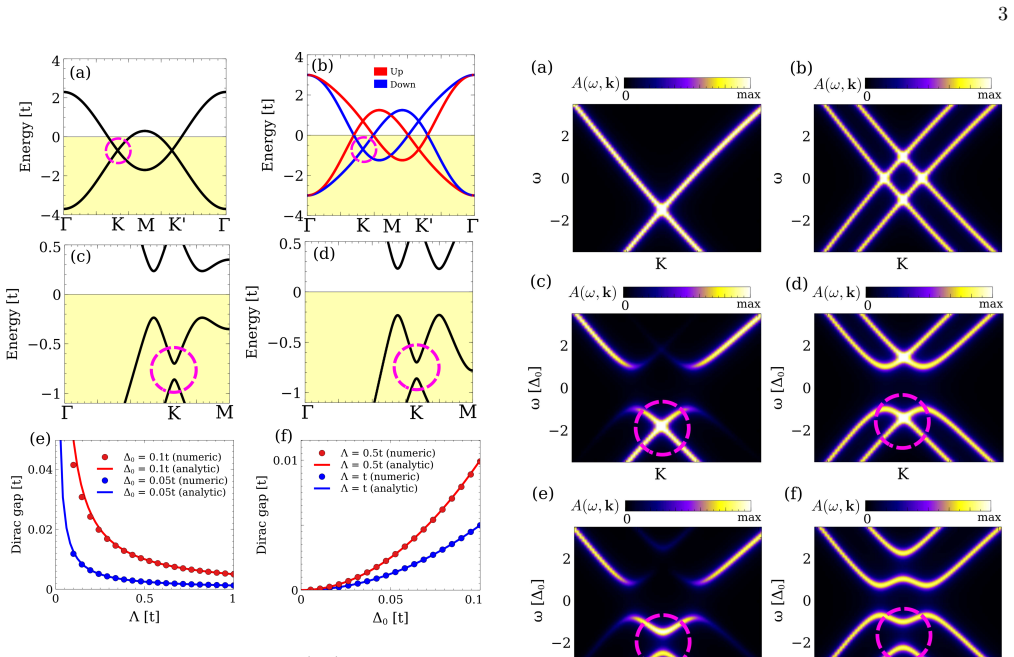
Measure the gap at a remote Dirac crossing in a superconductor as a function of the energy distance $\Lambda$ (for example by doping or by tuning spin-orbit splitting): the paper predicts $\gamma_z=\Upsilon/(4\Lambda)$, so the gap should shrink as $1/\Lambda$ and vanish when $\Upsilon=0$. A remote Dirac gap that does not scale inversely with $\Lambda$, or that appears in a material whose gap matrix is independently known to be unitary, would falsify the diagnosis.
Extended reading notes
Core claim
The paper's central claim, stated on its own terms, is that non-unitarity in orbital space is the controlling quantity for Dirac crossings away from the Fermi level in a superconductor. Starting from a minimal two-orbital $k\cdot p$ Dirac Hamiltonian $H_0^{\mathrm{DP}}(k)=-\Lambda\tau_0+\tau_x k_x+\tau_y k_y$ and coupling it to a $2\times2$ gap matrix $\Delta$, a Schrieffer-Wolff reduction gives the effective correction $\Delta\Delta^\dagger/2\Lambda$. Decomposing this correction into Pauli components, the coefficient $\gamma_z = \Upsilon/(4\Lambda)$ of $\tau_z$ acts as a mass term, opening a gap at the Dirac point precisely when the non-unitarity parameter $\Upsilon=\mathrm{Tr}[\tau_z\Delta\Delta^\dagger]$ is nonzero. Unitary pairing ($\Upsilon=0$) leaves the Dirac point gapless; non-unitary pairing such as pairing on only one orbital ($\Delta=\Delta_0(\tau_0+\tau_z)/2$) opens it. The claim is verified in a honeycomb-lattice model, including the predicted $1/\Lambda$ scaling, and extended to domain walls where the gapped Dirac points carry half-integer Chern numbers and produce chiral interface excitations.
Load-bearing premise
The load-bearing premise is that the Dirac point is an isolated two-band crossing whose energy separation from the Fermi level is much larger than the pairing energy, so the pairing acts as a weak perturbation; if other bands or a competing order such as a charge-density wave or magnetism also live at that crossing, the measured gap can no longer be attributed uniquely to non-unitary pairing.
Editorial extensions
If this is right
- An ARPES scan of the superconducting state that shows a gap at a Dirac point well below the Fermi energy is direct evidence of non-unitary multiorbital pairing, even if the low-energy gap looks conventional.
- The remote Dirac gap should scale as $\Upsilon/(4\Lambda)$, so sweeping the chemical potential or spin-orbit splitting changes the gap in a predictable way.
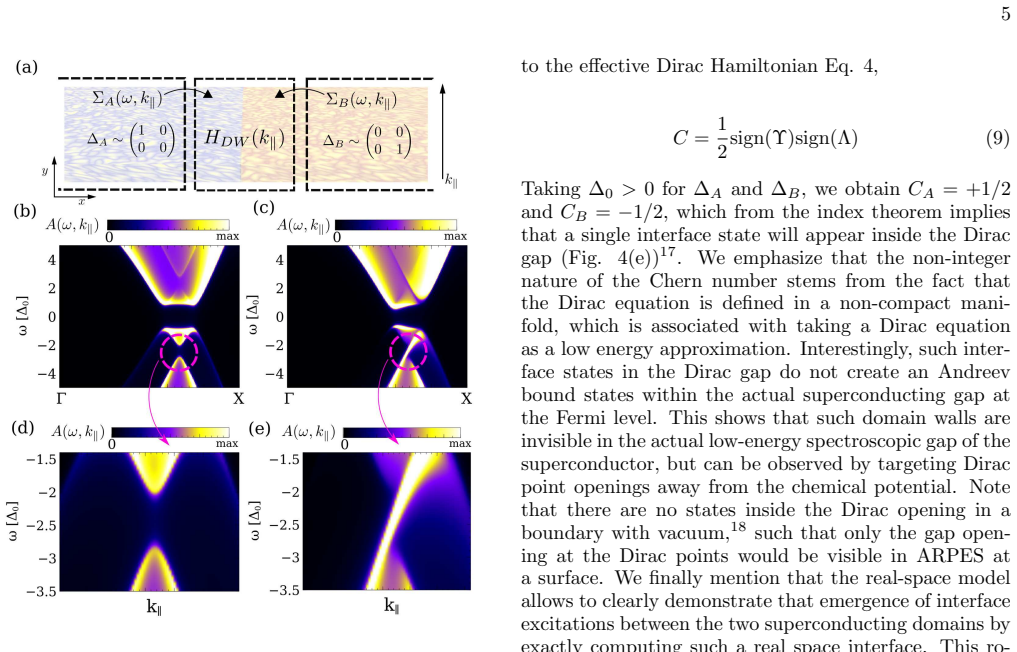
- Domain walls between two degenerate non-unitary orders produce a chiral state inside the remote Dirac gap, while leaving the Fermi-level superconducting gap unchanged.
- The criterion is independent of the momentum structure of the pairing, so it applies to $s$-wave, $d$-wave, or other pairing channels on equal footing.
- In three-dimensional Dirac semimetals the mechanism changes character: a $2\times2$ Dirac cone cannot open a gap, only shift, so the diagnostic is dimension-specific.
Reading between the lines
- Beyond the paper, the $\Upsilon/(4\Lambda)$ scaling suggests a quantitative route: once the normal-state Dirac position is known from ARPES, the measured remote gap size could be converted into an estimate of the orbital-selectivity strength $\Upsilon$, something the paper does not attempt.
- Beyond the paper, the diagnosis is safest in compounds where charge-density-wave, magnetic, or lattice-symmetry-breaking orders are absent, since any competing order that gaps the same crossing would mimic the non-unitary signature; the paper notes the pair-density-wave example itself carries a sublattice charge imbalance.
- Beyond the paper, the half-integer Chern number per gapped Dirac cone implies that a network of non-unitary domains could act as a chiral conductor at remote energies, decoupled from the low-energy superconducting condensate; the paper discusses a single interface but not such networks.
Signed reviews
Editorial analysis
A structured set of objections, weighed in public.
Referee Report
Summary. The paper proposes a spectroscopic diagnostic for non-unitary multiorbital superconductivity. Starting from a two-orbital k·p model with a Dirac point at energy -Λ away from the Fermi level, the authors include superconductivity in a BdG Hamiltonian and perform a Schrieffer-Wolff / second-order perturbative reduction. The effective correction is Δ(K)Δ(K)†/(2Λ); its τ_z component is controlled by Υ = Tr[τ_z ΔΔ†], Eq. (6), so that for Υ ≠ 0 the Dirac point acquires a mass γ_z = Υ/(4Λ) and opens a gap, while for unitary pairing (ΔΔ† ∝ I) it remains gapless. The mechanism is validated with a two-band honeycomb lattice model and spectral-function calculations. The paper further shows that a domain wall between two non-unitary regions hosts a chiral state inside the gap, and concludes that ARPES observations of remote Dirac-point gaps can identify non-unitary multiorbital pairing, with iron chalcogenides and twisted bilayer graphene mentioned as targets.
Significance. If the correspondence is taken in the two-band subspace for which it is derived, the paper gives a clean and potentially useful result: a finite-energy spectral feature whose gap is controlled by an orbital non-unitarity parameter rather than by the Fermi-surface gap. The derivation is explicit, the lattice calculation supports the analytic formula in the stated limit, and the ARPES spectral-function prediction is falsifiable. The topological interface statement is also a concrete additional consequence. The main limitation is that the diagnostic is established only for an isolated two-band crossing; whether it survives in the multiband environment of the cited materials is not addressed, which tempers the significance of the broader claim.
major comments (2)
- [Sec. II, Eq. (4); Sec. III] The signature is derived under an isolated two-band assumption that the paper does not establish for the materials it names. The Schrieffer-Wolff reduction in Eq. (4) projects onto the two crossing orbitals and treats all other bands as irrelevant; the lattice check in Sec. III is itself a two-band honeycomb model, so it cannot detect a third band at the same energy. If a third band at the Dirac energy is coupled to the crossing orbitals by an otherwise unitary pairing, downfolding that band produces a second-order self-energy in the A/B subspace whose ΔΔ† is not proportional to the identity; the τ_z part of that self-energy would open the Dirac gap even though the full pairing is unitary. The abstract and conclusion claim that a gap opening is a signature of non-unitary multiorbital order is therefore too strong unless the paper adds an explicit argument that such third-band processes are absent for the iron-chalcogenide or twisted-bilayer cases, or restricts the claim to a strictly isolated two-band crossing.
- [Sec. III, Fig. 2] The text states that the numerical Dirac gap agrees with Υ/(2Λ) only when |Λ| ≫ |Δ0|, but the parameters listed for Fig. 2(c,d) use Δ0 = 0.71Λ, which is not in that regime. The comparison panels in Fig. 2(e,f) should state the parameter range and show the condition explicitly, so the reader can see where the analytic result is expected to hold; as written, the agreement for the strong-pairing panels is outside the stated validity domain and does not by itself validate the asymptotic formula.
minor comments (4)
- [Throughout] There are several typographical errors: "gneral" in the introduction, "onsite" where "onset" is meant, "thorugh" and "frecuency" in Sec. IV, and "spectra function" for "spectral function" in Sec. III.
- [Sec. II, after Eq. (5)] The phrase "γx = γy = γz = 0 defines a unitary pairing state" should be phrased as "ΔΔ† proportional to the identity" to avoid ambiguity about whether Δ itself is unitary as a matrix.
- [Sec. III, Fig. 2 caption] The caption should clarify that Δ0 = 0.71Λ applies only to panels (c,d), and that panels (e,f) scan parameters with the condition |Λ| ≫ |Δ0| enforced where the analytic formula is claimed.
- [Sec. V] The sentence in the conclusions about an incipient charge density wave should be clarified, because a CDW-induced gap at the same Dirac point would be a false positive for the non-unitarity diagnostic unless the spectral function is compared above and below the superconducting transition.
Circularity Check
No significant circularity: the Dirac-gap criterion is derived from a stated two-band BdG Hamiltonian, and the ARPES prediction is an independent falsifiable consequence.
full rationale
The paper's central derivation is self-contained. It starts from a specified two-orbital Dirac Hamiltonian (Eq. 1) and a BdG extension with a general gap matrix (Eq. 3), then obtains the effective correction ΔΔ†/(2Λ) by a Schrieffer-Wolff transformation (Eq. 4). The result γz = Υ/(4Λ) (Eq. 6) follows algebraically from decomposing ΔΔ†/(2Λ) into Pauli matrices, with Υ defined as Tr[τz ΔΔ†]. This is a derived relation, not an input assumed to prove the conclusion. Unitary pairing gives Υ = 0 and therefore no gap, while non-unitary pairing can give Υ ≠ 0 and a gap; the paper's examples and the real-space honeycomb lattice model independently validate the formula. No experimental data are used to fit the criterion, and the claim that ARPES can detect such gaps is a falsifiable prediction. The isolated-two-band assumption noted by the skeptic bears on the applicability of the model to specific materials, not on whether the derivation is circular. There is no load-bearing self-citation chain, and the cited experimental works are external inputs rather than the proof of the central result.
Assumptions & free parameters
free parameters (3)
- Λ (Dirac point energy offset)
- Δ0 (pairing amplitude)
- Λ1, Λ2 (chemical potential and spin-orbit coupling in real-space model)
assumptions (4)
- domain assumption The normal-state band structure near a Dirac point is described by the 2x2 k·p Hamiltonian H0 = -Λτ0 + τx kx + τy ky (Eq. 1).
- domain assumption Pairing occurs between time-reversal Kramers partners and is described by a 2x2 gap matrix Δ(k) (Eq. 2).
- domain assumption The weak-pairing limit |Λ| ≫ max(|Δ|) justifies second-order perturbation theory (Eq. 4).
- standard math Schrieffer-Wolff / second-order perturbation theory yields H_eff = H0 + ΔΔ†/(2Λ).
Cite this review
Pith. "Pith review of Detecting non-unitary multiorbital superconductivity with Dirac points at finite energies." pith.science (2026). https://pith.science/paper/JQNFKWUB
@misc{pith2026190804820,
  author       = {Pith},
  title        = {Pith review of: Detecting non-unitary multiorbital superconductivity with Dirac points at finite energies},
  year         = {2026},
  howpublished = {\url{https://pith.science/paper/JQNFKWUB}},
  note         = {Machine review of arXiv:1908.04820}
}
read the original abstract
Determining the symmetry of the order parameter of unconventional superconductors remains a recurrent topic and non-trivial task in the field of strongly correlated electron systems. Here we show that the behavior of Dirac points away from the Fermi energy is a potential tool to unveil the orbital structure of a superconducting state. In particular, we show that gap openings in such Dirac crossings are a signature of non-unitary multiorbital superconducting order. Consequently, also spectral features at higher energy can help us to identify broken symmetries of superconducting phases and the orbital structure of non-unitary states. Our results show how angle-resolved photo-emission spectroscopy measurements can be used to detect non-unitary multiorbital superconductivity.
Figures

Reference graph
Works this paper leans on
-
[1]
author author A. J. \ Leggett ,\ 10.1103/RevModPhys.47.331 journal journal Rev. Mod. Phys. \ volume 47 ,\ pages 331 ( year 1975 ) NoStop
-
[2]
author author M. Sigrist \ and\ author K. Ueda ,\ 10.1103/RevModPhys.63.239 journal journal Rev. Mod. Phys. \ volume 63 ,\ pages 239 ( year 1991 ) NoStop
-
[3]
author author M. Sato \ and\ author Y. Ando ,\ 10.1088/1361-6633/aa6ac7 journal journal Reports on Progress in Physics \ volume 80 ,\ pages 076501 ( year 2017 ) NoStop
-
[4]
Pfleiderer ,\ 10.1103/RevModPhys.81.1551 journal journal Rev
author author C. Pfleiderer ,\ 10.1103/RevModPhys.81.1551 journal journal Rev. Mod. Phys. \ volume 81 ,\ pages 1551 ( year 2009 ) NoStop
-
[5]
author author D. J. \ Scalapino ,\ 10.1103/RevModPhys.84.1383 journal journal Rev. Mod. Phys. \ volume 84 ,\ pages 1383 ( year 2012 ) NoStop
-
[6]
author author G. R. \ Stewart ,\ 10.1103/RevModPhys.83.1589 journal journal Rev. Mod. Phys. \ volume 83 ,\ pages 1589 ( year 2011 ) NoStop
-
[7]
author author P. O. \ Sprau , author A. Kostin , author A. Kreisel , author A. E. \ B\" o hmer , author V. Taufour , author P. C. \ Canfield , author S. Mukherjee , author P. J. \ Hirschfeld , author B. M. \ Andersen , \ and\ author J. C. S. \ Davis ,\ 10.1126/science.aal1575 journal journal Science \ volume 357 ,\ pages 75 ( year 2017 ) NoStop
-
[8]
Time Reversal Symmetry Breaking in the Fe-Chalcogenide Superconductors
author author N. Zaki , author G. Gu , author A. M. \ Tsvelik , author C. Wu , \ and\ author P. D. \ Johnson ,\ @noop journal journal arXiv e-prints \ ,\ eid arXiv:1907.11602 ( year 2019 ) ,\ http://arxiv.org/abs/1907.11602 arXiv:1907.11602 [cond-mat.supr-con] NoStop
work page Pith review arXiv 1907
Show all 26 references
-
[9]
\ Hu , author P
author author L.-H. \ Hu , author P. D. \ Johnson , \ and\ author C. Wu ,\ @noop journal journal arXiv e-prints \ ,\ eid arXiv:1906.01754 ( year 2019 ) ,\ http://arxiv.org/abs/1906.01754 arXiv:1906.01754 [cond-mat.supr-con] NoStop
1906 arXiv
-
[10]
Komendov\'a , author A
author author L. Komendov\'a , author A. V. \ Balatsky , \ and\ author A. M. \ Black-Schaffer ,\ 10.1103/PhysRevB.92.094517 journal journal Phys. Rev. B \ volume 92 ,\ pages 094517 ( year 2015 ) NoStop
2015 doi
-
[11]
Wehling , author A
author author T. Wehling , author A. Black-Schaffer , \ and\ author A. Balatsky ,\ 10.1080/00018732.2014.927109 journal journal Advances in Physics \ volume 63 ,\ pages 1 ( year 2014 ) NoStop
2014
-
[12]
author author F. D. M. \ Haldane ,\ 10.1103/PhysRevLett.61.2015 journal journal Phys. Rev. Lett. \ volume 61 ,\ pages 2015 ( year 1988 ) NoStop
2015 doi
-
[13]
author author C. L. \ Kane \ and\ author E. J. \ Mele ,\ 10.1103/PhysRevLett.95.226801 journal journal Phys. Rev. Lett. \ volume 95 ,\ pages 226801 ( year 2005 ) NoStop
2005 doi
-
[14]
author author P. M. R. \ Brydon , author D. S. L. \ Abergel , author D. F. \ Agterberg , \ and\ author V. M. \ Yakovenko ,\ 10.1103/PhysRevX.9.031025 journal journal Phys. Rev. X \ volume 9 ,\ pages 031025 ( year 2019 ) NoStop
2019 doi
-
[15]
author author P. M. R. \ Brydon , author D. F. \ Agterberg , author H. Menke , \ and\ author C. Timm ,\ 10.1103/PhysRevB.98.224509 journal journal Phys. Rev. B \ volume 98 ,\ pages 224509 ( year 2018 ) NoStop
2018 doi
-
[16]
author author M. P. L. \ Sancho , author J. M. L. \ Sancho , author J. M. L. \ Sancho , \ and\ author J. Rubio ,\ 10.1088/0305-4608/15/4/009 journal journal Journal of Physics F: Metal Physics \ volume 15 ,\ pages 851 ( year 1985 ) NoStop
-
[17]
Jackiw \ and\ author C
author author R. Jackiw \ and\ author C. Rebbi ,\ 10.1103/PhysRevD.13.3398 journal journal Phys. Rev. D \ volume 13 ,\ pages 3398 ( year 1976 ) NoStop
1976 doi
-
[18]
note A zigzag interface with vacuum will show a flat band of zigzag boundary modes, yet without crossing the gap NoStop
-
[19]
author author S. Y. \ Tan , author Y. Fang , author D. H. \ Xie , author W. Feng , author C. H. P. \ Wen , author Q. Song , author Q. Y. \ Chen , author W. Zhang , author Y. Zhang , author L. Z. \ Luo , author B. P. \ Xie , author X. C. \ Lai , \ and\ author D. L. \ Feng ,\ 10...
-
[20]
Cao , author V
author author Y. Cao , author V. Fatemi , author S. Fang , author K. Watanabe , author T. Taniguchi , author E. Kaxiras , \ and\ author P. Jarillo-Herrero ,\ 10.1038/nature26160 journal journal Nature \ volume 556 ,\ pages 43 ( year 2018 ) NoStop
-
[21]
Yankowitz , author S
author author M. Yankowitz , author S. Chen , author H. Polshyn , author Y. Zhang , author K. Watanabe , author T. Taniguchi , author D. Graf , author A. F. \ Young , \ and\ author C. R. \ Dean ,\ 10.1126/science.aav1910 journal journal Science \ volume 363 ,\ pages 1059 ( yea...
-
[22]
Lu , author P
author author X. Lu , author P. Stepanov , author W. Yang , author M. Xie , author M. A. \ Aamir , author I. Das , author C. Urgell , author K. Watanabe , author T. Taniguchi , author G. Zhang , author A. Bachtold , author A. H. \ MacDonald , \ and\ author D. K. \ Efetov ,\ 10...
-
[23]
Su\'arez Morell , author J
author author E. Su\'arez Morell , author J. D. \ Correa , author P. Vargas , author M. Pacheco , \ and\ author Z. Barticevic ,\ 10.1103/PhysRevB.82.121407 journal journal Phys. Rev. B \ volume 82 ,\ pages 121407 ( year 2010 ) NoStop
2010 doi
-
[24]
author author J. M. B. \ Lopes dos Santos , author N. M. R. \ Peres , \ and\ author A. H. \ Castro Neto ,\ 10.1103/PhysRevLett.99.256802 journal journal Phys. Rev. Lett. \ volume 99 ,\ pages 256802 ( year 2007 ) NoStop
2007 doi
-
[25]
Bistritzer \ and\ author A
author author R. Bistritzer \ and\ author A. H. \ MacDonald ,\ 10.1073/pnas.1108174108 journal journal Proceedings of the National Academy of Sciences \ volume 108 ,\ pages 12233 ( year 2011 ) NoStop
2011 doi
-
[26]
author author S. L. \ Tomarken , author Y. Cao , author A. Demir , author K. Watanabe , author T. Taniguchi , author P. Jarillo-Herrero , \ and\ author R. C. \ Ashoori ,\ 10.1103/PhysRevLett.123.046601 journal journal Phys. Rev. Lett. \ volume 123 ,\ pages 046601 ( year 2019 ) NoStop
Reviewed August 14, 2026 · model on record in the stance chip above.
Discussion (0). Continue with ORCID to comment.