REVIEW 2 major objections 3 minor 31 references
Cylindrically symmetric static $n$-dimensional (un)charged (anti-)de Sitter black holes in generic $f(T)$ gravity
T0 review · 2 major / 3 minor · reviewed 2026-08-14 · deepseek-v4-flash
Pith's one-line read Generic f(T) gravity admits closed-form static cylindrical AdS/dS black holes in every dimension.
desk verdict Useful and mostly sound generic f(T) exact-solutions paper whose 'most general' claim needs a vielbein-gauge caveat. read the letter →
The pith
A machine-rendered reading of the paper's core claim, the machinery that carries it, and where it could break.
The reading
What carries the argument
The load-bearing identity is the algebraic torsion condition $2T f_T - 2\Lambda - f = 0$, where $f_T$ is the derivative of $f$ with respect to $T$; it forces $T$ to be constant in vacuum. Once all $T'$ terms vanish, the first-order equations imply $G = F$ (so $A$ can be rescaled to equal $B$) and reduce the system to the master equation $r^2 F' + (n-4) r F + r^2 F^2 + 6 - 2n = 0$, whose direct integration produces the closed metric (20). In the charged case the analogous identity is $G = F - 2(\ln f_T)'$, which ties $B$ to $A$ through $f_T(T(r))$, and Maxwell's equation fixes $V' = -\frac{(n-3)q\, f_T(T(r))}{f_T(T_0)\, r^{n-2}}$. This mechanism is what converts a complicated nonlinear $f$ into a single fixed effective cosmological constant.
What would settle it
Compute the vacuum field equations for the metric (5) using a Lorentz-rotated, non-diagonal vielbein (frame field) for a concrete model such as $f(T)=T+\alpha T^2$ and look for a solution with $A\neq B$ or with $r$-dependent torsion. Any such counterexample would show that the diagonal ansatz was not exhaustive and that (20) is not the most general generic solution; equivalently, the universal claim fails if the rotated-frame equations do not force $G=F$.
Extended reading notes
Core claim
The central discovery is that in vacuum the torsion is not dynamical: equation (8), $2T f_T - 2\Lambda - f = 0$, fixes $T$ to a constant depending only on $\Lambda$ and the parameters of $f$. All $T'$ terms then drop out, and the remaining field equations reduce to $G = F$ and the master equation $r^2 F' + (n-4) r F + r^2 F^2 + 6 - 2n = 0$, whose integration gives $A = B = \frac{T}{(n-2)(n-1)}r^2 - \frac{m}{r^{n-3}}$. Thus every $f(T)$ model, within this diagonal frame-field (vielbein) ansatz, admits the same two-parameter family of static cylindrical black holes (or regular/wormhole solutions when $A$ has no zero), with the constant torsion acting as an effective cosmological constant. For the charged case $T$ is no longer constant, but the paper reduces the field equations to a five-step procedure: solve (8) for $T_0$ at infinity, solve (44) for $T(r)$, integrate (45) for $A(r)$, obtain $B(r)$ from (40), and obtain $V(r)$ from (48). The same $T_0$ sets the effective cosmological constant in the charged and uncharged solutions, and the generic multipole expansion shows the first non-Coulomb correction to $V$ is proportional to $1/r^5$.
Load-bearing premise
The load-bearing premise is that the diagonal choice of frame field used in Eq. (4) is not missing any static cylindrically symmetric solutions; because $f(T)$ gravity changes its form under frame rotations, the paper does not prove that every solution of a given $f(T)$ can be represented this way.
Editorial extensions
If this is right
- Any nonlinear $f(T)$ with bare $\Lambda = 0$ can still generate a non-zero effective cosmological constant through a non-trivial constant torsion root, so the trivial $T = 0$ vacuum is not the only possibility.
- The de Sitter or anti-de Sitter character of a solution is decided by the sign of the constant torsion $T$, not by the sign of the bare cosmological constant, and the same $f(T)$ can yield both end behaviors in different parameter ranges.
- Charged solutions inherit the same effective cosmological constant as the uncharged solution, fixed by $T_0$ at infinity, and their first non-Coulomb electric correction is generically order $1/r^5$.
- In the limit where the nonlinear parameters vanish, the quadratic and cubic solutions reduce to the general-relativity result $T = 2\Lambda$, with $\Lambda_{\rm eff} = \Lambda$ in four dimensions, giving a controlled GR limit.
Reading between the lines
- Editorial inference: because $f(T)$ gravity is not invariant under local Lorentz rotations of the frame, the diagonal-tetrad solution (20) is best read as a tetrad-gauge statement; a non-diagonal frame could in principle support additional static cylindrical solutions outside this family.
- Editorial inference: the same constant-torsion mechanism that produces $\Lambda_{\rm eff}$ here might work in spherical or planar symmetric $f(T)$ solutions, so observational constraints on $f(T)$ models may need to account for an induced cosmological constant even when the bare $\Lambda$ vanishes.
- Editorial inference: for $f(T) = T + \alpha T^2$ with $\Lambda = 0$ and $\alpha < 0$, the paper's branch analysis predicts an anti-de Sitter end state; following this branch in a numerical time evolution of the same symmetry would test whether the algebraic-root classification survives outside the original static ansatz.
Signed reviews
Editorial analysis
A structured set of objections, weighed in public.
Referee Report
Summary. The paper constructs static cylindrically symmetric solutions of n-dimensional f(T) gravity. In the uncharged case, the field equations for a diagonal vielbein imply that the torsion scalar is constant, equal to a root T of the algebraic equation 2T f_T - 2Λ - f = 0 (Eq. 8); the resulting metric is A = B = T/((n-2)(n-1)) r^2 - m/r^{n-3} (Eq. 20). The charged case is treated by an algorithm that reduces the field equations to an algebraic equation for T(r), a first-order equation for A(r), and quadratures for A, B, and the electrostatic potential V; the quadratic model f(T)=T+αT^2 is worked out explicitly, including large-r series. A generic multipole expansion for the electric potential is stated in Section IV, and the paper discusses applications to quadratic and cubic models, including the generation of an effective cosmological constant from a nonvanishing torsion root.
Significance. If the derivation is taken at face value, Eq. (20) is a valuable exact result: it provides, for every f(T) admitting a real root of Eq. (8), a closed-form uncharged cylindrical solution with an effective cosmological constant determined by that root, with no fitted parameters. The charged algorithm is coherent and the quadratic example is checked against the consistency equation (49). The paper also makes the interesting observation that the effective cosmological constant can have a sign opposite to the explicit Λ, and that f(T) can generate an effective cosmological constant even when Λ=0. These features are worth publishing, provided the scope of the claims is made precise with respect to the vielbein ansatz and the asserted generic expansion is supported by the derivation.
major comments (2)
- [Introduction, Eq. (4), Eqs. (8)-(10), Eq. (20)] The claim of the 'most general solution in closed form for all f(T)' is not established. The derivation starts from the diagonal vielbein ansatz (4), and the field equations (8)-(10) are obtained from that specific tetrad. Since f(T) gravity is not invariant under local Lorentz transformations of the vielbein, one cannot assume without argument that every static cylindrically symmetric solution admits this diagonal tetrad, nor that a non-diagonal or rotated tetrad would not lead to additional solutions for the same f(T). Thus Eq. (20) is rigorously a solution in the chosen tetrad gauge, but the paper overstates the exhaustiveness of this family. Please either prove that the diagonal vielbein captures all static cylindrically symmetric solutions in generic f(T) gravity, or explicitly reformulate the claims as applying to the diagonal-vielbein sector.
- [Section IV, Eq. (59)] The generic multipole expansion is introduced with 'Skipping the calculations'. Equation (59) is the basis of the Section IV conclusion that the first nonvanishing higher-order moment is generically of order 1/r^5 and that the shape of f(T) does not affect the order of that term. As written, the only evidence offered for the generic expansion is its consistency with the quadratic example, which is insufficient to establish a generic statement about arbitrary f(T). The derivation should be included, or the claim should be downgraded to a conjecture supported by the quadratic example.
minor comments (3)
- [Eqs. (21)-(22)] The terminology 'anti-de Sitter' for a positive effective cosmological constant and 'de Sitter' for a negative one is opposite to the most common convention in general relativity; please add an explicit sentence fixing the sign convention used in the paper.
- [Eq. (42)] The object denoted F_{tr} in Eq. (42) appears to be the contravariant component F^{tr} rather than the covariant component F_{tr} = -V'; please correct the index placement or the definition to avoid confusion in the integration leading to Eq. (43).
- [Abstract and Section III] The abstract mentions wormholes as part of the solution family, but the paper only notes that a wormhole may occur for certain parameter ranges and does not construct or analyze an explicit wormhole solution; please adjust the wording to match the actual content.
Circularity Check
No circularity: the vacuum and charged solutions are derived from the field equations; the only concerns are gauge-completeness and an omitted calculation, not circularity.
full rationale
The derivation is self-contained. In the vacuum case, the paper starts from the field equations (8)-(10), observes that Eq. (8) forces T to be a constant root of the algebraic equation 2T f_T - 2Λ - f = 0, sets all T' terms to zero, and then eliminates T/B to obtain Eq. (14), Eq. (15), and finally the integrated solution (18). The constants are fixed by Eq. (11), yielding Eq. (20): A = B = T(Λ,...)/((n-2)(n-1)) r^2 - m/r^(n-3). The effective cosmological constant Λ_eff = 3T/[(n-2)(n-1)] is read off from this already-determined T, not used as an input. The charged section is an explicit five-step construction algorithm, followed by a consistency check against Eq. (49); it does not fit any parameter to a target quantity. The self-citations [19,20] are used only for solving Weierstrass polynomials and elliptic integrals, so they are not load-bearing. The diagonal vielbein ansatz (4) is an imposed restriction and f(T) gravity is not locally Lorentz invariant, which may limit the claim that the solutions are the 'most general' ones for a generic f(T); however, this is a gauge/completeness concern, not circularity, and the paper never represents the ansatz as being derived from the solution. Similarly, 'Skipping the calculations' before Eq. (59) flags a derivation gap, but Eq. (59) is checked against the quadratic case and is not a renamed input. Therefore no circular reduction by the paper's own equations or by self-citation is present.
Assumptions & free parameters
assumptions (3)
- domain assumption The f(T) field equations, Eqs (8)-(10), derived from the diagonal vielbein (4), are the correct equations of motion for the theory.
- ad hoc to paper The diagonal vielbein (4) is sufficient to represent static cylindrically symmetric solutions.
- domain assumption f_T and f_TT are such that divisions by f_T and f_TT are valid.
Cite this review
Pith. "Pith review of Cylindrically symmetric static $n$-dimensional (un)charged (anti-)de Sitter black holes in generic $f(T)$ gravity." pith.science (2026). https://pith.science/paper/HWASHDEJ
@misc{pith2026190804995,
  author       = {Pith},
  title        = {Pith review of: Cylindrically symmetric static $n$-dimensional (un)charged (anti-)de Sitter black holes in generic $f(T)$ gravity},
  year         = {2026},
  howpublished = {\url{https://pith.science/paper/HWASHDEJ}},
  note         = {Machine review of arXiv:1908.04995}
}
abstract
Given a generic function $f(T)$ we construct in closed forms cylindrically symmetric static $n$-dimensional uncharged and charged de Sitter and anti-de Sitter solutions (including black holes, wormholes and possibly other regular solutions) in $f(T)$ gravity. Applications to some known models are considered.
Figures

Reference graph
Works this paper leans on
-
[1]
(27) This constraint is always satisfied if α and Λ have the same sign
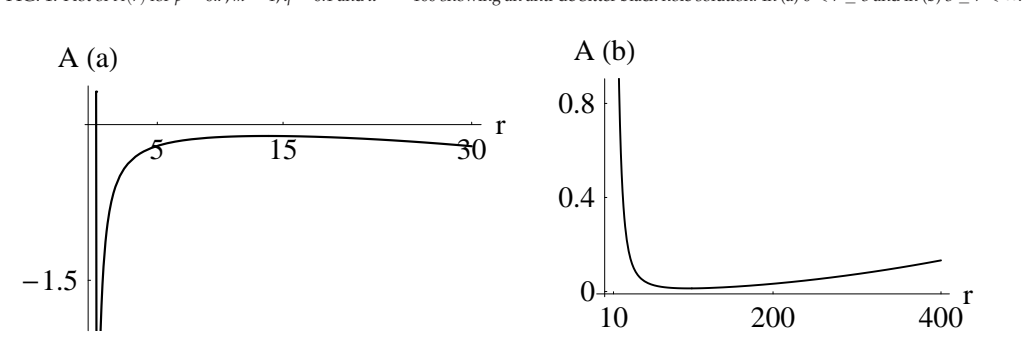
f (T) = T + αT2 For f (T) including a quadratic torsion term f (T) = T + αT2, α ∈ R, (24) we obtain solving (8), which takes the form 3αT2 + T − 2Λ = 0, (25) two real solutions T± = − 1 ± √ 1 + 24αΛ 6α , (26) provided 24αΛ ≥ −1. (27) This constraint is always satisfied if α and Λ have the same sign. Thus, α > 0, Λ > 0 : { T+ < 0, T = T+ ⇒ de Sitter T− > 0,...
-
[2]
f (T) = T + αT2 + βT3 This case is more involved and we will not consider it in full detail. Equation (8) reduces to 5βT3 + 3αT2 + T − 2Λ = 0, (29) then to the W eierstrass polynomial on eliminating the quadratic term 4z3 − g2z − g3 = 0, T = z − α 5β , (30) g2 = 4(3α2 − 5β) 25β2 , g3 = 4(50β2Λ + 5αβ − 2α3) 125β3 . A complete description on how to determin...
-
[3]
For g2 > 0 and ∆ > 0 there are three distinct real roots; for g2 > 0 and ∆ = 0 there are two distinct real roots; and for ∆ < 0 there is one real root. As we noticed earlier even in the case Λ ≡ 0, the f (T) theory generates a non vanishing effective cosmological constant. Let us examine this case which is much easier than the generic case (29). Solutions...
-
[4]
Solve (8) for T0. Insert (40) and (43) into (34) to obtain 2T fT(r) − 2Λ − f + 2(n − 3)2q2 r2(n−2) = 0, (44) Solve this algebraic equation for T(r) and write T(r) as T(r) = T0 + T (r) with limr→∞ T (r) = 0
-
[5]
Insert (40) into (7) to obtain, T(r) = [ fT(T0) fT(T(r)) ] 2 [ (n − 2) r A′ + (n − 2)(n − 3) r2 A ] , (45) and solve this first order differential equation for A(r) or A(r) where A(r) = A0(r) + A(r), (46) with limr→∞ A(r) = 0 and A0(r) is the uncharged solution (20). W e draw the following interesting conclusion: Since lim r→∞ A(r) = 0, the only term conta...
-
[6]
Obtain B(r) from (40) B(r) = A0(r) + [ fT(T0)2 fT(T(r))2 − 1 ] A0(r) + [ fT(T0)2 fT(T(r))2 ] A(r); (47)
-
[7]
Obtain V(r) from (43) V = q rn−3 − (n − 3)q ∫ r [ fT(T(r)) fT(T0) − 1 ] dr rn−2 ; (48)
-
[8]
Use (36) for checking consistency of the results. The latter is brought to the following form once we eliminate T, Λ and G using (7), (34) and(39) r2F′ + (n − 4)rF + r2 F2 + 6 − 2n = 4r2V′2 fT(T(r)) A . (49) Compare with(16). Since lim r→∞ A(r) = limr→∞ B(r) = A0(r), the classi- fication of the solutions (de Sitter or anti-de Sitter) fol- lows that of the ...
Show all 31 references
-
[9]
[2], so we will not consider it here
This very special case has been treated in Ref. [2], so we will not consider it here. Our purpose in this section is to tackle the most general case for f (T) = T + αT2. In this section we assume p ⁄= 0. Looking for a solution A(r) = ( T0/6)r2 − m/r + A(r) we find that A satisfi...
-
[10]
Nashed and E.N
G.G.L. Nashed and E.N. Saridakis, Class. Quantum Grav. 36 (2019) 135005
2019
-
[11]
A.M. Awad, S. Capozziello and G.G.L. Nashed, JHEP 07 (2017) 136
2017
-
[12]
Capozziello, P .A
S. Capozziello, P .A. Gonz´ alez, E.N. Saridakis and Y . V´ asquezJHEP 02 (2013) 039
2013
-
[13]
Gonz´ alez, E.N
P .A. Gonz´ alez, E.N. Saridakis and Y . V´ asquez JHEP 07 (2012) 053
2012
-
[14]
Bengochea and R
G.R. Bengochea and R. Ferraro, Phys. Rev. D 79 (2009) 124019
2009
-
[15]
Ferraro and F
R. Ferraro and F. Fiorini, Phys. Rev. D 75 (2007) 084031
2007
-
[16]
Hohmann, L
M. Hohmann, L. J¨ arv , M. Krˇ sˇ s´ ak, and C. Pfeifer,Phys. Rev. D 100 (2019) 084002
2019
-
[17]
Maluf, Ann
J.W. Maluf, Ann. Phys. (Berlin) 525 (2013) 339
2013
-
[18]
Hayashi and T
K. Hayashi and T. Shirafuji, Phys. Rev. D 19 (1979), 3524 [Addendum ibid. D 24 (1982) 3312]
1979
-
[19]
Capozziello and G.G.L
S. Capozziello and G.G.L. Nashed, Eur. Phys. J. C 79 (2019) 911
2019
-
[20]
Garecki, arXiv:1010.2654v3 [gr-qc]
J. Garecki, arXiv:1010.2654v3 [gr-qc]. Lecture given at the (Hyper)Complex and Randers-Ingarden Structures in Mathe- matics and Physics conference, 17-24 July 2010, Bedlewo, Poland
2010 arXiv
-
[21]
Weitzenb ¨ ock, Invarianten Theorie , Nordhoff, Gronin- gen, The Netherlands (1923)
R. Weitzenb ¨ ock, Invarianten Theorie , Nordhoff, Gronin- gen, The Netherlands (1923)
1923
-
[22]
Lemos and V .T
J.P .S. Lemos and V .T. Zanchin, Phys.Rev . D54 (1996) 3840
1996
-
[23]
Aldrovandi and J.G
R. Aldrovandi and J.G. Pereira, T eleparallel Gravity: An In- troduction, Springer Dordrecht (2013)
2013
-
[24]
Xie, X.-M
Y . Xie, X.-M. Deng, MNRAS 433 (2013) 3584
2013
-
[25]
Nesseris, S
S. Nesseris, S. Basilakos, E.N. Saridakis, L. Perivola ropou- los, Phys.Rev . D88 (2013) 103010
2013
-
[26]
Nunes, S
R.C. Nunes, S. Pan, E.N. Saridakis, JCAP 2016 (2016) 011
2016
-
[27]
Basilakos, S
S. Basilakos, S. Nesseris, F.K. Anagnostopoulos, E.N. Sari- dakis, JCAP 2018 (2018) 008
2018
-
[28]
Azreg-A¨ ınou,Phys
M. Azreg-A¨ ınou,Phys. Rev. D 87 (2013), 024012
2013
-
[29]
Ahmed, M
A.K. Ahmed, M. Azreg-A¨ ınou, M. Faizal, M. Jamil, Eur. Phys. J. C 76 (2016), 280
2016
-
[30]
Junior, M.E
E.L.B. Junior, M.E. Rodrigues, M.J.S. Houndjo, JCAP 2015 (2015) 060
2015
-
[31]
http://functions.wolfram.com/EllipticIntegrals/EllipticF/introductions/IncompleteEllipticIntegrals/
Reviewed August 14, 2026 · model on record in the stance chip above.
Discussion (0). Continue with ORCID to comment.