REVIEW 2 major objections 4 minor 2 cited by
Numerical convergence of hydrodynamical simulations of galaxy formation: the abundance and internal structure of galaxies and their cold dark matter haloes
T0 review · 2 major / 4 minor · reviewed 2026-08-14 · deepseek-v4-flash
Pith's one-line read Hydrodynamical galaxy simulations are far more sensitive to the gravitational softening length than dark-matter-only runs are, and this paper derives analytic thresholds that tell when a chosen softening will distort the results.
desk verdict A strong, useful convergence study whose headline feedback criterion (eq. 13) is off by a factor of about two — the qualitative message survives, the quantitative recommendation does not. read the letter →
The pith
A machine-rendered reading of the paper's core claim, the machinery that carries it, and where it could break.
The reading
What carries the argument
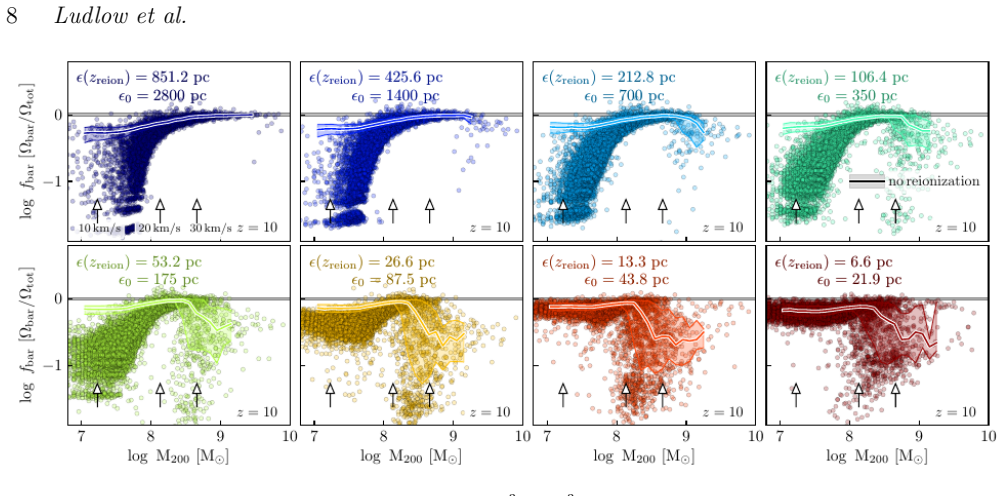
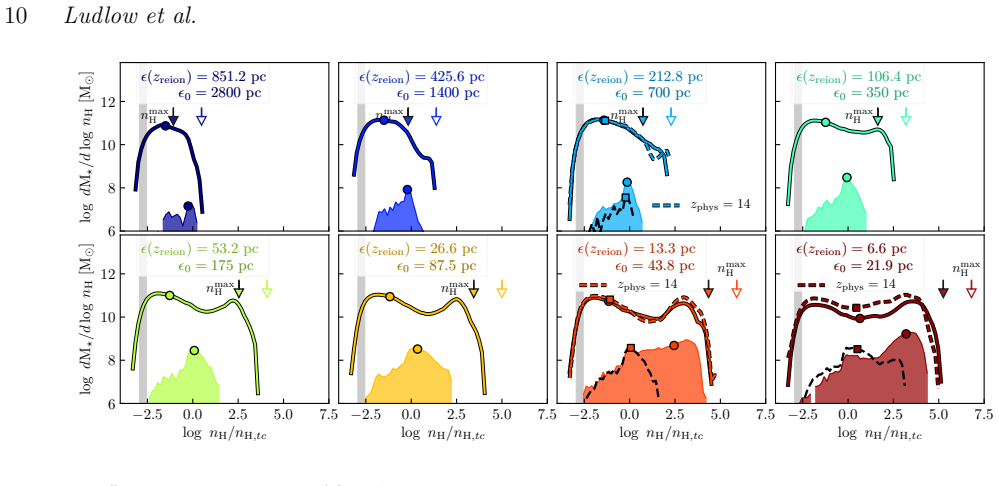
The central machinery is a pair of analytic thresholds written in terms of the Plummer-equivalent softening $\epsilon$ and gas particle mass $m_g$: the minimum resolved escape speed $v_\epsilon = \sqrt{2G m_g/\epsilon}$ (Eq. 8) and the feedback-efficiency softening $\epsilon_{\rm eFB}$ that keeps the maximum resolved gas density, $n_{\rm H}^{\rm max}\propto \epsilon^{-3}$, below the critical density $n_{\rm H,tc}$ required for thermal feedback to act before cooling (Eq. 13). These thresholds connect force resolution to gas physics, and the paper verifies them against two distinct diagnostics: the baryon fractions of low-mass haloes at $z=10$ and the distribution of gas densities at the moment stars are born.
What would settle it
Keep particle masses and subgrid physics fixed and rerun one cosmological volume with present-day softening below $19\,{\rm pc}$ and above $156\,{\rm pc}$, the paper's $v_\epsilon$ bounds for its high-resolution case: if the median baryon fraction of $\sim10^8\,\mathrm{M}_\odot$ haloes at $z=10$ does not jump from near the cosmic mean to a small fraction of it, the minimum-resolved-escape-speed mechanism fails. The same experiment should also show a high-redshift star-formation peak and late-time suppression for the small softening; their absence would falsify the over-cooling story.
Extended reading notes
Core claim
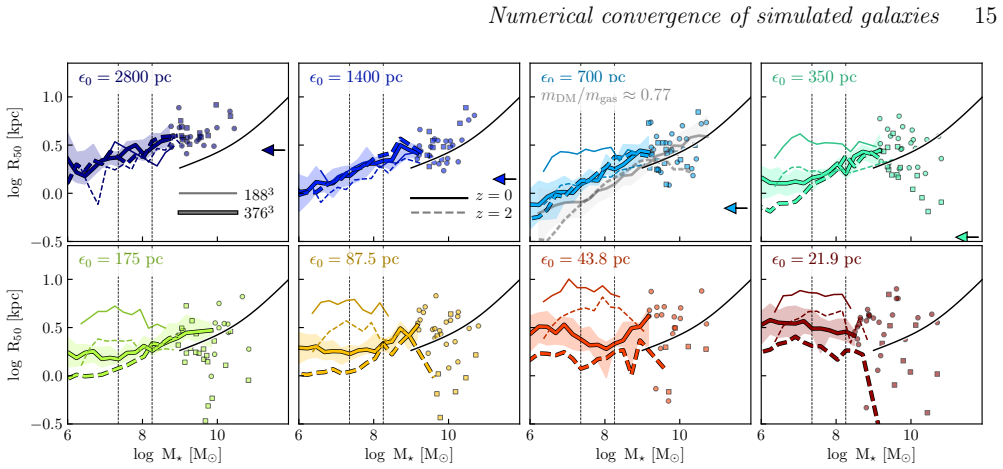
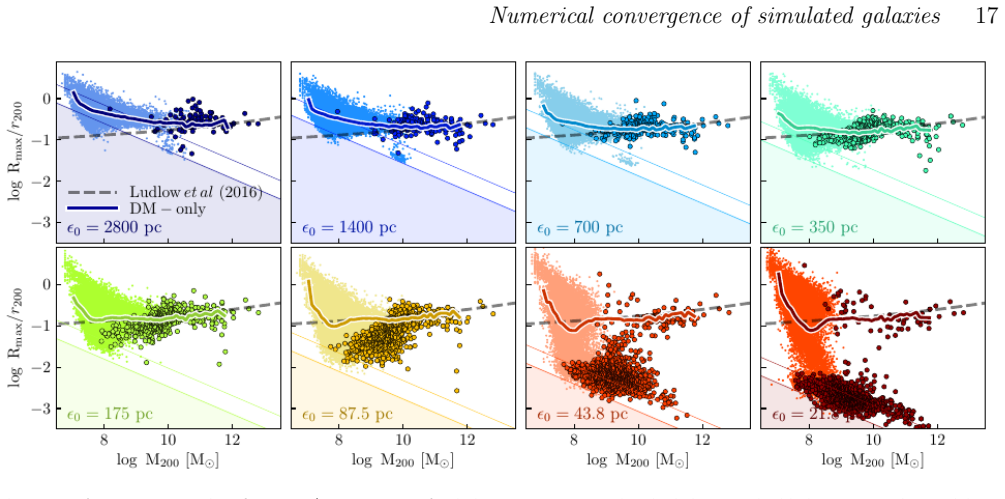
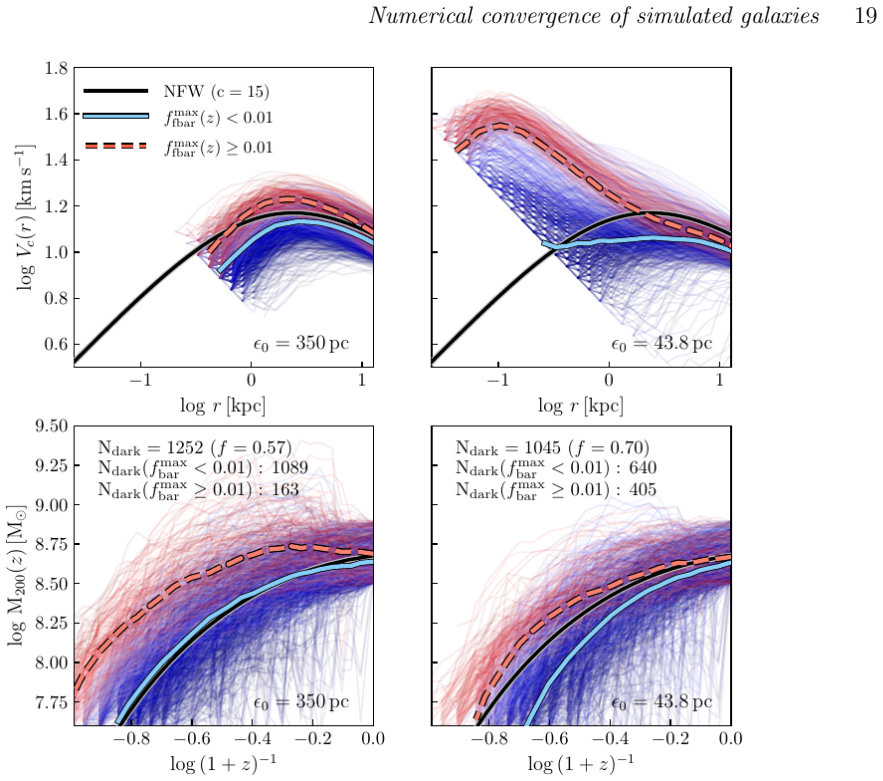
On its own terms, the paper claims that hydrodynamical simulations of galaxy formation are far more sensitive to gravitational softening than dark-matter-only simulations, and that the sensitivity is predictable. Softening sets a minimum resolved escape speed $v_\epsilon = \sqrt{2 G m_g / \epsilon}$ for gas particles; once $v_\epsilon$ exceeds roughly $10\,{\rm km\,s^{-1}}$, the photo-heating associated with reionization is suppressed, low-mass haloes retain baryons, and stars form in systems that should have been quenched. Softening also caps the maximum resolved gas density roughly as $n_{\rm H}^{\rm max}\propto \epsilon^{-3}$; when that cap pushes gas past the critical density $n_{\rm H,tc}$ for efficient thermal feedback, a large share of star-forming gas radiates away feedback energy before it can act. In addition, because dark-matter particles are more massive than star particles, small softening accelerates two-body mass segregation, which inflates galaxy sizes and contracts dark-matter haloes even after the baryons responsible for the contraction have been scattered away. The paper's recommended softening---about $0.05$ times the mean inter-particle spacing in comoving units at early times and $0.022$ times that spacing in physical units at late times---keeps circular velocity profiles converged to roughly 10 per cent outside the dark-matter convergence radius.
Load-bearing premise
The quantitative thresholds are derived and tested for smoothed-particle-hydrodynamics runs with a single calibrated subgrid model, equal numbers of dark-matter and gas particles, and identical softening for all particle species; other numerical setups may shift the numbers or weaken the effects.
Editorial extensions
If this is right
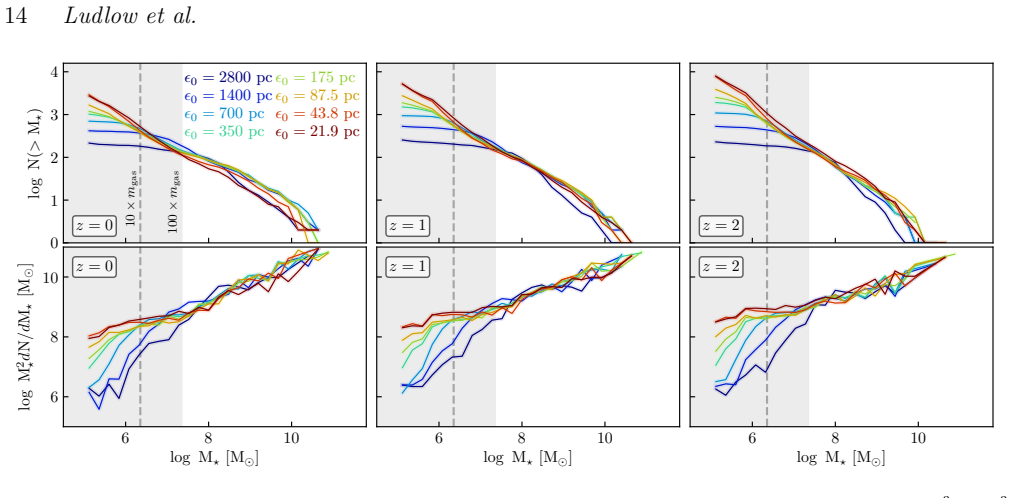
- Runs with softening below the $v_\epsilon$ threshold overproduce stars in small haloes after reionization, so their low-mass galaxy stellar mass functions become too steep.
- Runs with softening below $\epsilon_{\rm eFB}$ convert a large part of star formation into numerically over-cooled events with weak feedback, producing galaxies that are initially too compact.
- Runs with softening too large suppress dwarf-galaxy formation because the maximum resolved gas density falls below the star-formation threshold.
- At the recommended optimal softening, cosmic star formation histories and stellar mass functions converge across two mass resolutions, and dark-matter circular velocity profiles agree to within about 10 per cent outside the dark-matter convergence radius.
- Small softening also alters dark-matter structure: haloes that are baryon-free at $z=0$ can still contain steep central cusps left by baryons that were later scattered away, so dark-matter-only convergence criteria do not carry over to hydrodynamical runs.
Reading between the lines
- The same two thresholds should apply, at least approximately, to any subgrid feedback model that heats gas to roughly $10^{7.5}\,\mathrm{K}$, because the over-cooling criterion depends only on particle mass, softening, and post-heating temperature.
- A testable extension of the mass-segregation result: runs with equal-mass dark-matter and star particles should show much weaker softening-driven size inflation, since the paper ties the effect to the mass ratio $\mu = m_{\rm DM}/m_{\rm gas}$.
- The softening-dependent star-formation peak near $z_{\rm reion}$ implies that high-redshift star formation rates from simulations with very small softening deserve suspicion even when their $z=0$ galaxy populations look reasonable.
- If these criteria generalize to moving-mesh or adaptive-mesh codes, simulators would gain a common vocabulary for choosing force resolution across methods; the paper does not test this, but the criteria are phrased in resolution-element terms that carry over.
Signed reviews
Editorial analysis
A structured set of objections, weighed in public.
Referee Report
Summary. This paper uses a suite of cosmological SPH simulations with EAGLE-like subgrid physics, run in a 12.5 cMpc box at two mass resolutions (Np = 188 and 376 per side), to study how the gravitational softening length affects galaxy formation and dark matter halo structure. Softening is varied by factors of two around the fiducial EAGLE values, and the runs include both non-radiative and full-physics cases. The authors derive analytic criteria for choosing the softening: an upper limit from resolving low-mass haloes, a lower limit from two-body collisional heating of gas, a minimum resolved escape velocity (Eq. 8), and a feedback-efficiency threshold (Eqs. 12-13) that prevents numerical over-cooling of supernova-heated gas. They then test these criteria against baryon fractions, cosmic star formation histories, galaxy stellar mass functions, galaxy sizes, and DM circular velocity profiles. The central qualitative conclusion is that hydrodynamical simulations are far more sensitive to softening than dark-matter-only simulations, with too-small softening suppressing photo-heating, promoting over-cooling, and exacerbating mass segregation, sometimes causing galaxy sizes to increase as softening decreases.
Significance. If the quantitative criteria are correct, this is an important contribution: it provides simple, physically motivated rules of thumb for a community that routinely adopts softening lengths without such tests, and it demonstrates the non-trivial coupling between numerical force resolution and subgrid feedback. The study is strengthened by the systematic factor-of-two coverage of softening, by the use of two mass resolutions, and by direct diagnostics such as baryon fractions and stellar birth densities that make the claimed effects falsifiable. The qualitative results, especially the v_epsilon criterion and the identification of mass segregation as a softening-dependent effect, are valuable and likely robust. However, the central feedback-efficiency threshold contains an arithmetic error of a factor of about 1.9, which directly affects the paper's quantitative statements and its recommended 'optimal' softening. The paper therefore requires a major revision before the practical guidance can be accepted.
major comments (2)
- [Section 3.3, Eqs. (10)-(13)] The coefficient in Eq. (12) does not follow from equating Eqs. (10) and (11). With the stated normalizations, n_H,tc = n_max^H implies epsilon_eFB = 350 pc x (180/26)^(1/3) x (Nngb/58)^(1/3) x (X/0.75)^(1/3) x (f/0.1)^(-1) x (T/10^7.5 K)^(-1/2) x (mg/10^5 Msun)^(1/2), approximately 667 pc x (mg/10^5 Msun)^(1/2). The missing factor (180/26)^(1/3) is about 1.9 and is not a convention effect: Eq. (10) already refers to the Plummer-equivalent softening, with the eps_sp = 2.8 eps conversion folded into the 180 cm^-3 calibration. Consequently, the values quoted in Section 3.3 (epsilon_eFB about 0.5 kpc and 1.5 kpc for the Np = 376 and Np = 188 runs) should be about 1.0 kpc and 2.8 kpc. This is not a cosmetic issue: Sections 5.1(iii) and 5.2 use these values to state that EAGLE's high-resolution run falls short of epsilon_eFB by only a factor of 1.4 and that the recommended softening 'ensure[s] that feedback will be maximally efficient.' Under the corrected criterion, 700 pc is below epsilon_eFB, and the shortfall is about 2.9, not 1.4. Please recompute the threshold, revise the numerical statements throughout, and reassess the practical recommendations.
- [Section 5.2, optimal softening recommendation] The recommendation epsilon_opt about 0.022 L/Np (approximately 700 pc for Np = 376 and 1400 pc for Np = 188) is presented as ensuring efficient feedback, but with the corrected epsilon_eFB from the previous comment it falls below the paper's own feedback-efficiency threshold for both resolutions. The statement in Section 5.2 that 'these criteria ensure that feedback will be maximally efficient' is therefore not supported by the corrected algebra. Because epsilon_eFB and the DM-only convergence radius rconv about 0.055 L/Np (about 1.8 kpc for Np = 376) are both constraints, the paper should discuss the resulting allowed window (roughly 1.0-1.8 kpc for the high-resolution runs) and explain whether any of the simulated configurations actually satisfies both requirements, rather than simply doubling the fiducial softening.
minor comments (4)
- [Section 4.1.3, first paragraph] The text quotes 'about 27 per cent for epsilon = 700 pc' for stars formed at z above about 11.5 and then, in the same paragraph, quotes 'only about 9 per cent of all stars' for the same run; please state explicitly that these refer to different stellar populations (pre-reionization versus all epochs) to avoid an apparent contradiction.
- [Figure 7 caption] The phrase 'the upper middle-right panel' is ambiguous; please specify the panel corresponding to epsilon0 = 700 pc.
- [Section 2.2 and Acknowledgements] There are minor language errors: 'effected' should be 'affected' in Section 2.2, and 'we also with to acknowledge' should be 'we also wish to acknowledge' in the Acknowledgements.
- [Section 3.3] The derivation of n_H,tc in Eq. (11) is quoted from Dalla Vecchia & Schaye (2012), but the text would benefit from a brief statement of the adopted cooling function and the kernel-volume normalization, since the coefficient 26 cm^-3 enters directly into the corrected feedback threshold.
Circularity Check
No circularity: analytic softening thresholds are derived from independent physical estimates and validated by the simulations, not fitted from them.
full rationale
The derivation chain in Section 3 is not circular. Equations (4), (7), (8), (10), and (11)-(13) are obtained from independent physical estimates: virial scaling, two-body encounter heating, the self-binding energy of a particle pair, SPH kernel normalization, and the cooling-time versus sound-crossing-time comparison imported from Dalla Vecchia & Schaye (2012). None of these formulas is fitted to the EAGLE simulation outputs that later confirm them (Figures 1-3); the simulations are used as validation, not as the source of the coefficients. The EAGLE subgrid parameters are acknowledged prior calibrations (Section 2.2), and the paper's softening tests hold that calibration fixed while varying only epsilon, so the measured softening sensitivity is not a renamed fit. Self-citations to Ludlow et al. (2019) (Paper I) supply the DM-only convergence radius rconv and mass-segregation physics from independent collisionless simulations; the present paper also shows its own mu = 1 comparison and its own Vc(r) convergence tests, so the argument does not reduce to those citations. The recommended 'optimal' softening is explicitly empirical ('At present we lack a detailed analytic framework that can guide our choices, but the results shown in Figure 7 suggest ...'), anchored to observed size-mass data rather than presented as a derived first-principles prediction. A genuine internal consistency problem does exist in the quoted numbers: substituting the stated normalizations into eqs. (10) and (11) gives epsilon_eFB = 350 pc x (180/26)^(1/3) x (mg/10^5 Msun)^(1/2) ~ 667 pc x (mg/10^5 Msun)^(1/2), roughly 1.9 times larger than the 350 pc coefficient quoted in eq. (12). Consequently, the quoted thresholds (0.5 kpc and 1.5 kpc) and the 'optimal' 700 pc recommendation are not self-consistent with the paper's own equations. This is a correctness defect, not circularity, because the qualitative over-cooling conclusion is independently evidenced by the simulated birth-density distributions in Figure 3 and the surrounding analysis.
Assumptions & free parameters
free parameters (2)
- epsilon_opt (optimal physical softening) =
~0.022 x (L/Np) at z=0, ~0.05 x (L/Np) in comoving units
- f, minimum smoothing length factor =
0.1
assumptions (4)
- domain assumption The EAGLE subgrid model (stochastic thermal feedback with Delta T = 10^7.5 K, pressure-based star formation, AGN feedback) adequately represents unresolved physics.
- domain assumption The cooling-time criterion of Dalla Vecchia & Schaye (2012) (eq. 11) characterizes numerically efficient thermal feedback.
- domain assumption Two-body scattering and energy equipartition between DM and stellar particles cause the observed mass segregation.
- domain assumption Statistics from a single 12.5 Mpc box per parameter set are representative despite chaotic galaxy-by-galaxy divergence.
Cite this review
Pith. "Pith review of Numerical convergence of hydrodynamical simulations of galaxy formation: the abundance and internal structure of galaxies and their cold dark matter haloes." pith.science (2026). https://pith.science/paper/553BPOJZ
@misc{pith2026190805019,
  author       = {Pith},
  title        = {Pith review of: Numerical convergence of hydrodynamical simulations of galaxy formation: the abundance and internal structure of galaxies and their cold dark matter haloes},
  year         = {2026},
  howpublished = {\url{https://pith.science/paper/553BPOJZ}},
  note         = {Machine review of arXiv:1908.05019}
}
abstract
We address the issue of numerical convergence in cosmological smoothed particle hydrodynamics simulations using a suite of runs drawn from the EAGLE project. Our simulations adopt subgrid models that produce realistic galaxy populations at a fiducial mass and force resolution, but systematically vary the latter in order to study their impact on galaxy properties. We provide several analytic criteria that help guide the selection of gravitational softening for hydrodynamical simulations, and present results from runs that both adhere to and deviate from them. Unlike dark matter-only simulations, hydrodynamical simulations exhibit a strong sensitivity to gravitational softening, and care must be taken when selecting numerical parameters. Our results--which focus mainly on star formation histories, galaxy stellar mass functions and sizes--illuminate three main considerations. First, softening imposes a minimum resolved escape speed, $v_\epsilon$, due to the binding energy between gas particles. Runs that adopt such small softening lengths that $v_\epsilon \gt 10\,{\rm km s^{-1}}$ (the sound speed in ionised $\sim 10^4\,{\rm K}$ gas) suffer from reduced effects of photo-heating. Second, feedback from stars or active galactic nuclei may suffer from numerical over-cooling if the gravitational softening length is chosen below a critical value, $\epsilon_{\rm eFB}$. Third, we note that small softening lengths exacerbate the segregation of stars and dark matter particles in halo centres, often leading to the counter-intuitive result that galaxy sizes {\em increase} as softening is reduced. The structure of dark matter haloes in hydrodynamical runs respond to softening in a way that reflects the sensitivity of their galaxy populations to numerical parameters.
Figures

Figures from the paper (11 more)






Forward citations
Cited by 2 Pith papers
-
The complex stellar system M 22: constraining the chemical enrichment from AGB stars using magnesium isotope ratios
First Mg isotope measurements at [Fe/H]≈-2 in a globular cluster show no difference tied to s-process enrichment, favoring ~2.75 M_sun AGB polluters and a 280–480 Myr age gap.
-
The complex stellar system M 22: confirming abundance variations with high precision differential measurements
High-precision differential abundances confirm M 22 hosts a >0.24 dex iron spread and ~0.65 dex s-process spread, and reveal new internal abundance variations within each population.
Reference graph
Works this paper leans on
-
[1]
write newline
" write newline "" before.all 'output.state := FUNCTION fin.entry write newline FUNCTION new.block output.state before.all = 'skip after.block 'output.state := if FUNCTION new.sentence output.state after.block = 'skip output.state before.all = 'skip after.sentence 'output.state := if if FUNCTION not #0 #1 if FUNCTION and 'skip pop #0 if FUNCTION or pop #1...
-
[2]
@esa ( ) , n @biblabelnum##1 ##1
\@ifclassloaded aguplus natbib The aguplus class already includes natbib coding, so you should not add it explicitly Type <Return> for now, but then later remove the command natbib from the document \@ifclassloaded nlinproc natbib The nlinproc class already includes natbib coding, so you should not add it explicitly Type <Return> for now, but then later r...
-
[3]
@stdbsttrue NAT@ctr \@lbibitem[ NAT@ctr ] \@lbibitem[#1]#2 \@ifundefined b@#2\@extra@b@citeb @num @parse #2 [ @natanchorstart #2 \@biblabel @num @natanchorend] @ifcmd#1()()\@nil #2 \@ifpackageloaded showkeys @lbibitem\@lbibitem \@lbibitem[#1]#2 @lbibitem[#1] #2 @ @@label #2 @stdbst @stdbstfalse @stdbst @filesw \@auxout @numberstrue [2] \@ifundefined b@#1\...
-
[4]
@open @close @open @close and [1] URL: ##1 \@ifundefined chapter * \@mkboth \@ifundefined NAT@sectionbib * \@mkboth * \@mkboth\@gobbletwo \@ifclassloaded amsart * \@ifclassloaded amsbook * \@ifundefined bib@heading @heading NAT@ctr thebibliography [1] @ \@biblabel NAT@ctr \@bibsetup #1 NAT@ctr 0 @openbib .11em \@plus.33em \@minus.07em 4000 4000 `\.=1000 \...
-
[5]
V., Leitner S
Agertz O., Kravtsov A. V., Leitner S. N., Gnedin N. Y., 2013, , 770, 25
2013
-
[6]
Agertz, et al 2007, , 380, 963
2007
-
[7]
M., Barnes D
Bah \'e Y. M., Barnes D. J., Dalla Vecchia C., Kay S. T., White S. D. M., McCarthy I. G., Schaye J., Bower R. G., Crain R. A., Theuns T., Jenkins A., McGee S. L., Schaller M., Thomas P. A., Trayford J. W., 2017, , 470, 4186
2017
-
[8]
S., Ludlow A
Ben \' tez-Llambay A., Frenk C. S., Ludlow A. D., Navarro J. F., 2019, , 488, 2387
2019
Show all 104 references
-
[9]
Binney J., Knebe A., 2002, , 333, 378
2002
-
[10]
Princeton, NJ, Princeton University Press, 1987, 747 p
Binney J., Tremaine S., 1987, Galactic dynamics . Princeton, NJ, Princeton University Press, 1987, 747 p
1987
-
[11]
R., Faber S
Blumenthal G. R., Faber S. M., Flores R., Primack J. R., 1986, , 301, 27
1986
-
[12]
M., Schaye J., 2009, , 398, 53
Booth C. M., Schaye J., 2009, , 398, 53
2009
-
[13]
B., Stinson G., Gibson B
Brook C. B., Stinson G., Gibson B. K., Ro s kar R., Wadsley J., Quinn T., 2012, , 419, 771
2012
-
[14]
B., Stinson G., Gibson B
Brook C. B., Stinson G., Gibson B. K., Wadsley J., Quinn T., 2012, , 424, 1275
2012
-
[15]
E., Kay S
Bryan S. E., Kay S. T., Duffy A. R., Schaye J., Dalla Vecchia C., Booth C. M., 2013, , 429, 3316
2013
-
[16]
et al 2014, , 211, 19
Bryan, G. et al 2014, , 211, 19
2014
-
[17]
V., Dutton A
Buck T., Macci \`o A. V., Dutton A. A., Obreja A., Frings J., 2019, , 483, 1314
2019
-
[18]
Chabrier G., 2003, , 115, 763
2003
-
[19]
A., Schaye J., Bower R
Crain R. A., Schaye J., Bower R. G., Furlong M., Schaller M., Theuns T., Dalla Vecchia C., Frenk C. S., McCarthy I. G., Helly J. C., Jenkins A., Rosas-Guevara Y. M., White S. D. M., Trayford J. W., 2015, , 450, 1937
2015
-
[20]
Cui et al 2018, , 480, 2898
2018
-
[21]
Dalla Vecchia C., Schaye J., 2012, , 426, 140
2012
-
[22]
H., Appleby S., 2019, , 486, 2827
Dav \'e R., Angl \'e s-Alc \'a zar D., Narayanan D., Li Q., Rafieferantsoa M. H., Appleby S., 2019, , 486, 2827
2019
-
[23]
Dolag K., Borgani S., Murante G., Springel V., 2009, , 399, 497
2009
-
[24]
Dolag K., Komatsu E., Sunyaev R., 2016, , 463, 1797
2016
-
[25]
R., Schaye J., Kay S
Duffy A. R., Schaye J., Kay S. T., Dalla Vecchia C., Battye R. A., Booth C. M., 2010, , 405, 2161
2010
-
[26]
A., Macci \`o A
Dutton A. A., Macci \`o A. V., Buck T., Dixon K. L., Blank M., Obreja A., 2019, , 486, 655
2019
-
[27]
S., White S
Efstathiou G., Frenk C. S., White S. D. M., Davis M., 1988, , 235, 715
1988
-
[28]
A., Everitt M
El-Zant A. A., Everitt M. J., Kassem S. M., 2019, , 484, 1456
2019
-
[29]
J., Korista K
Ferland G. J., Korista K. T., Verner D. A., Ferguson J. W., Kingdon J. B., Verner E. M., 1998, , 110, 761
1998
-
[30]
Gaburov E., Nitadori K., 2011, , 414, 129
2011
-
[31]
L., Springel V., Hernquist L., Nelson D., Pillepich A., Weinberger R., Pakmor R., Marinacci F., Vogelsberger M., 2019, , 871, 21
Genel S., Bryan G. L., Springel V., Hernquist L., Nelson D., Pillepich A., Weinberger R., Pakmor R., Marinacci F., Vogelsberger M., 2019, , 871, 21
2019
-
[32]
A., Monaghan J
Gingold R. A., Monaghan J. J., 1977, , 181, 375
1977
-
[33]
Governato F., Brook C., Mayer L., Brooks A., Rhee G., Wadsley J., Jonsson P., Willman B., Stinson G., Quinn T., Madau P., 2010, , 463, 203
2010
-
[34]
M., Tran J
Haardt F., Madau P., 2001, in Neumann D. M., Tran J. T. V., eds, Clusters of Galaxies and the High Redshift Universe Observed in X-rays Modelling the UV/X-ray cosmic background with CUBA . p. 64
2001
-
[35]
R., Schaye J., Booth C
Haas M. R., Schaye J., Booth C. M., Dalla Vecchia C., Springel V., Theuns T., Wiersma R. P. C., 2013a, , 435, 2931
-
[36]
R., Schaye J., Booth C
Haas M. R., Schaye J., Booth C. M., Dalla Vecchia C., Springel V., Theuns T., Wiersma R. P. C., 2013b, , 435, 2955
-
[37]
F., 2015, , 450, 53
Hopkins P. F., 2015, , 450, 53
2015
-
[38]
Hopkins et al 2018, , 480, 800
2018
-
[39]
A., Falle S
Hubber D. A., Falle S. A. E. G., Goodwin S. P., 2013, , 432, 711
2013
-
[40]
D., 2007, Computing In Science & Engineering, 9, 90
Hunter J. D., 2007, Computing In Science & Engineering, 9, 90
2007
-
[41]
S., White S
Jenkins A., Frenk C. S., White S. D. M., Colberg J. M., Cole S., Evrard A. E., Couchman H. M. P., Yoshida N., 2001, , 321, 372
2001
-
[42]
C., Cole S., Frenk C
Jiang L., Helly J. C., Cole S., Frenk C. S., 2014, , 440, 2115
2014
-
[43]
Jones E., Oliphant T., Peterson P., et al.,, 2001, SciPy : Open source scientific tools for Python
2001
-
[44]
H., Hernquist L., 1996, , 105, 19
Katz N., Weinberg D. H., Hernquist L., 1996, , 105, 19
1996
-
[45]
W., Wadsley J
Keller B. W., Wadsley J. W., Wang L., Kruijssen J. M. D., 2019, , 482, 2244
2019
-
[46]
Kennicutt Jr. R. C., 1989, , 344, 685
1989
-
[47]
Knebe A., Green A., Binney J., 2001, , 325, 845
2001
-
[48]
V., 1999, PhD thesis, NEW MEXICO STATE UNIVERSITY
Kravtsov A. V., 1999, PhD thesis, NEW MEXICO STATE UNIVERSITY
1999
-
[49]
I., Yepes G., Knebe A., Gottl \"o ber S., Hoffman Y., Knollmann S
Libeskind N. I., Yepes G., Knebe A., Gottl \"o ber S., Hoffman Y., Knollmann S. R., 2010, , 401, 1889
2010
-
[50]
D., Bose S., Angulo R
Ludlow A. D., Bose S., Angulo R. E., Wang L., Hellwing W. A., Navarro J. F., Cole S., Frenk C. S., 2016, , 460, 1214
2016
-
[51]
D., Navarro J
Ludlow A. D., Navarro J. F., Angulo R. E., Boylan-Kolchin M., Springel V., Frenk C., White S. D. M., 2014, , 441, 378
2014
-
[52]
D., Schaye J., Bower R., 2019, , 488, 3663
Ludlow A. D., Schaye J., Bower R., 2019, , 488, 3663
2019
-
[53]
D., Schaye J., Schaller M., Richings J., 2019, , 488, L123
Ludlow A. D., Schaye J., Schaller M., Richings J., 2019, , 488, L123
2019
-
[54]
V., Stinson G., Brook C
Macci \`o A. V., Stinson G., Brook C. B., Wadsley J., Couchman H. M. P., Shen S., Gibson B. K., Quinn T., 2012, , 744, L9
2012
-
[55]
Madau P., Dickinson M., 2014, , 52, 415
2014
-
[56]
J., 1992, , 30, 543
Monaghan J. J., 1992, , 30, 543
1992
-
[57]
F., Eke V
Navarro J. F., Eke V. R., Frenk C. S., 1996, , 283, L72
1996
-
[58]
F., Ludlow A., Springel V., Wang J., Vogelsberger M., White S
Navarro J. F., Ludlow A., Springel V., Wang J., Vogelsberger M., White S. D. M., Jenkins A., Frenk C. S., Helmi A., 2010, , 402, 21
2010
-
[59]
Ogiya G., Mori M., 2014, , 793, 46
2014
-
[60]
W., Nagamine K., Springel V., Hernquist L., Norman M
O'Shea B. W., Nagamine K., Springel V., Hernquist L., Norman M. L., 2005, , 160, 1
2005
-
[61]
E., 2007, Computing in Science and Engineering, 9, 21
P\'erez F., Granger B. E., 2007, Computing in Science and Engineering, 9, 21
2007
-
[62]
P., Marinacci F., Vogelsberger M., 2018, , 475, 648
Pillepich A., Nelson D., Hernquist L., Springel V., Pakmor R., Torrey P., Weinberger R., Genel S., Naiman J. P., Marinacci F., Vogelsberger M., 2018, , 475, 648
2018
-
[63]
Planck Collaboration Ade P. A. R., Aghanim N., Alves M. I. R., Armitage-Caplan C., Arnaud M., Ashdown M., Atrio-Barandela F., Aumont J., Aussel H., et al. 2014, , 571, A1
2014
-
[64]
Pontzen A., Governato F., 2012, , 421, 3464
2012
-
[65]
F., Jenkins A., Frenk C
Power C., Navarro J. F., Jenkins A., Frenk C. S., White S. D. M., Springel V., Stadel J., Quinn T., 2003, , 338, 14
2003
-
[66]
J., Monaghan J
Price D. J., Monaghan J. J., 2007, , 374, 1347
2007
-
[67]
M., Bower R
Rosas-Guevara Y. M., Bower R. G., Schaye J., Furlong M., Frenk C. S., Booth C. M., Crain R. A., Dalla Vecchia C., Schaller M., Theuns T., 2015, , 454, 1038
2015
-
[68]
S., Fattahi A., Navarro J
Sawala T., Frenk C. S., Fattahi A., Navarro J. F., Bower R. G., Crain R. A., Dalla Vecchia C., Furlong M., Helly J. C., Jenkins A., Oman K. A., Schaller M., Schaye J., Theuns T., Trayford J., White S. D. M., 2016, , 457, 1931
2016
-
[69]
B., White S
Scannapieco C., Tissera P. B., White S. D. M., Springel V., 2008, , 389, 1137
2008
-
[70]
Scannapieco et al 2012, , 423, 1726
2012
-
[71]
G., Theuns T., Crain R
Schaller M., Dalla Vecchia C., Schaye J., Bower R. G., Theuns T., Crain R. A., Furlong M., McCarthy I. G., 2015, , 454, 2277
2015
-
[72]
S., Bower R
Schaller M., Frenk C. S., Bower R. G., Theuns T., Jenkins A., Schaye J., Crain R. A., Furlong M., Dalla Vecchia C., McCarthy I. G., 2015, , 451, 1247
2015
-
[73]
Schaye J., 2004, , 609, 667
2004
-
[74]
Schaye J., Dalla Vecchia C., 2008, , 383, 1210
2008
-
[75]
Schaye et al 2015, , 446, 521
2015
-
[76]
A., Debattista V
Sellwood J. A., Debattista V. P., 2009, , 398, 1279
2009
-
[77]
Sembolini et al 2016, , 459, 2973
2016
-
[78]
J., White S
Shen S., Mo H. J., White S. D. M., Blanton M. R., Kauffmann G., Voges W., Brinkmann J., Csabai I., 2003, , 343, 978
2003
-
[79]
S., Dav \'e R., 2015, , 53, 51
Somerville R. S., Dav \'e R., 2015, , 53, 51
2015
-
[80]
Springel V., 2000, , 312, 859
2000
-
[81]
Springel V., 2005, , 364, 1105
2005
-
[82]
Springel V., 2010, , 401, 791
2010
-
[83]
Springel V., Di Matteo T., Hernquist L., 2005, , 361, 776
2005
-
[84]
Springel V., Hernquist L., 2003, , 339, 289
2003
-
[85]
F., Frenk C
Springel V., Wang J., Vogelsberger M., Ludlow A., Jenkins A., Helmi A., Navarro J. F., Frenk C. S., White S. D. M., 2008, , 391, 1685
2008
-
[86]
Springel V., White S. D. M., Tormen G., Kauffmann G., 2001, , 328, 726
2001
-
[87]
Stadel J., Potter D., Moore B., Diemand J., Madau P., Zemp M., Kuhlen M., Quilis V., 2009, , 398, L21
2009
-
[88]
Stevens A. R. H., Martig M., Croton D. J., Feng Y., 2014, , 445, 239
2014
-
[89]
Stinson G., Seth A., Katz N., Wadsley J., Governato F., Quinn T., 2006, , 373, 1074
2006
-
[90]
J., Brunino R., Mitchell N
Tasker E. J., Brunino R., Mitchell N. L., Michielsen D., Hopton S., Pearce F. R., Bryan G. L., Theuns T., 2008, , 390, 1267
2008
-
[91]
Teyssier R., 2002, , 385, 337
2002
-
[92]
I., 2013, , 429, 3068
Teyssier R., Pontzen A., Dubois Y., Read J. I., 2013, , 429, 3068
2013
-
[93]
J., Couchman H
Thacker R. J., Couchman H. M. P., 2001, , 555, L17
2001
-
[94]
Thi \'e baut J., Pichon C., Sousbie T., Prunet S., Pogosyan D., 2008, , 387, 397
2008
-
[95]
V., Klypin A., Abazajian K
Tinker J., Kravtsov A. V., Klypin A., Abazajian K. a., 2008, , 688, 709
2008
-
[96]
C., Ogiya G., 2018, , 475, 4066
van den Bosch F. C., Ogiya G., 2018, , 475, 4066
2018
-
[97]
C., Varoquaux G., 2011, CoRR, abs/1102.1523
van der Walt S., Colbert S. C., Varoquaux G., 2011, CoRR, abs/1102.1523
2011 arXiv
-
[98]
Vandenbroucke B., De Rijcke S., 2016, Astronomy and Computing, 16, 109
2016
-
[99]
A., Sales L
Vera-Ciro C. A., Sales L. V., Helmi A., Frenk C. S., Navarro J. F., Springel V., Vogelsberger M., White S. D. M., 2011, , 416, 1377
2011
-
[100]
A., Stinson G
Wang L., Dutton A. A., Stinson G. S., Macci \`o A. V., Penzo C., Kang X., Keller B. W., Wadsley J., 2015, , 454, 83
2015
-
[101]
R., Hopkins P
Wetzel A. R., Hopkins P. F., Kim J.-h., Faucher-Gigu \`e re C.-A., Kere s D., Quataert E., 2016, , 827, L23
2016
-
[102]
Wiersma R. P. C., Schaye J., Smith B. D., 2009, , 393, 99
2009
-
[103]
Wiersma R. P. C., Schaye J., Theuns T., Dalla Vecchia C., Tornatore L., 2009, , 399, 574
2009
-
[104]
Yepes G., Kates R., Khokhlov A., Klypin A., 1997, , 284, 235
1997
Reviewed August 14, 2026 · model on record in the stance chip above.
Discussion (0). Continue with ORCID to comment.