REVIEW 4 major objections 5 minor 75 references
Comparison of aluminum oxide empirical potentials from cluster to nanoparticle
T0 review · 4 major / 5 minor · reviewed 2026-08-14 · deepseek-v4-flash
Pith's one-line read The Alvarez potential, a simple Coulomb-plus-steric model, is the only one of four empirical potentials tested that reproduces both alumina nanoparticle phase transitions, at 41 Å and 95 Å.
desk verdict Useful empirical-potential benchmark for alumina that gives a clear practical ranking; the phase-transition sizes are estimates, not thermodynamic crossovers. read the letter →
The pith
A machine-rendered reading of the paper's core claim, the machinery that carries it, and where it could break.
The reading
What carries the argument
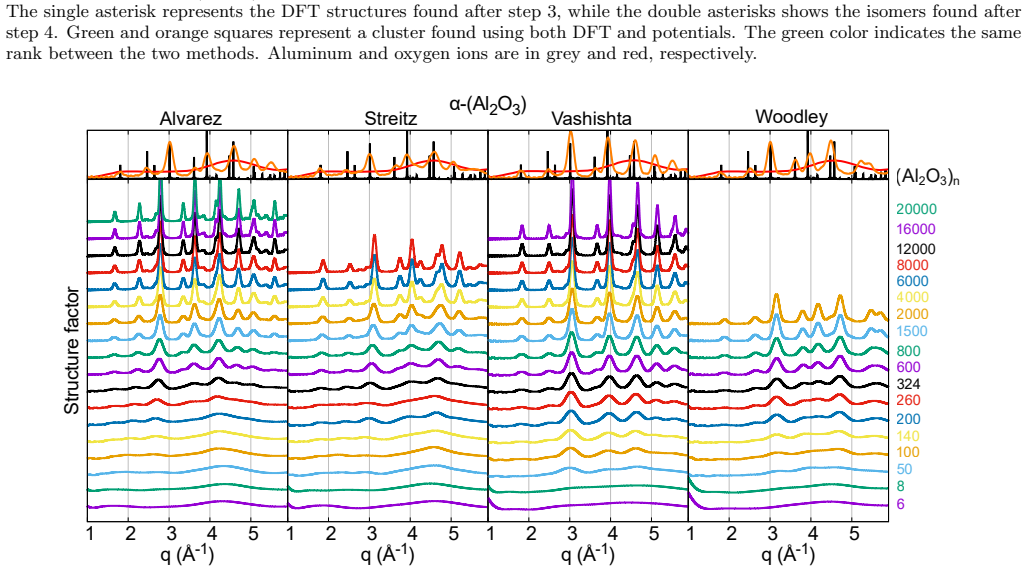
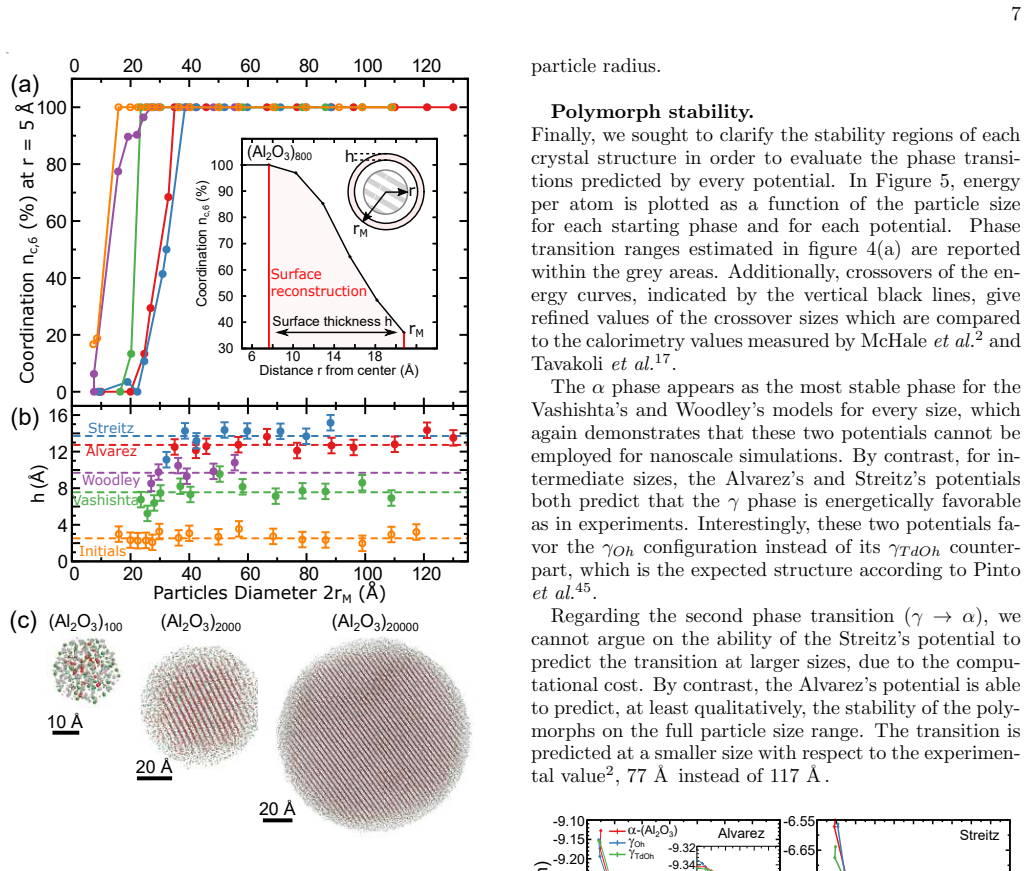
The argument is carried by a size-scanning protocol rather than by a single identity. Nanoparticles with n = 50 to 20,000 formula units (diameters up to about 12 nm) are cut from bulk alpha, gamma_Oh, and gamma_TdOh crystals, then relaxed with each of the four potentials; the Alvarez potential is additionally run through 10 ps of molecular dynamics at 300 K. The load-bearing objects are the energy-per-atom versus diameter curves for the three starting structures, whose crossings define the predicted polymorph-stability regions, and the structure factor plus the percentage of six-coordinated aluminum cations, which locate the amorphous-to-crystal transition. The key comparison is against calorimetric transition sizes from the literature. A secondary mechanism is the constant amorphous surface shell, whose thickness (about 7.5 to 13.8 Å depending on potential) explains why small particles are amorphous regardless of the starting crystal structure.
What would settle it
Run the same size scan with the Alvarez potential but compute free energies, for example via thermodynamic integration at 300 K, for alpha, gamma_Oh, and gamma_TdOh nanoparticles between 3 and 12 nm in diameter; if the gamma phase is not the lowest-free-energy structure between about 41 Å and 95 Å, the central claim of reproduced phase transitions fails. Alternatively, a size-resolved calorimetry or electron-diffraction study of alumina nanoparticles with diameters between 3 and 12 nm that found the amorphous-to-gamma transition far from 41 Å would contradict the paper's central quantitative result.
Extended reading notes
Core claim
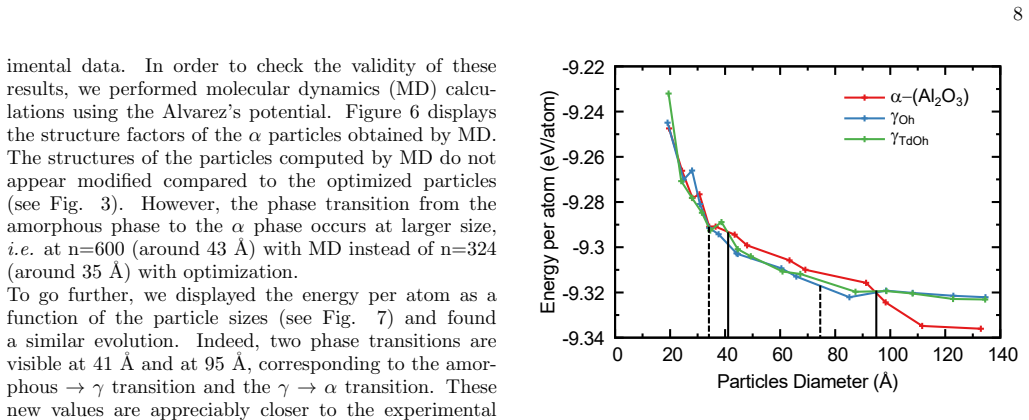
The central claim is that empirical-potential reliability for alumina must be judged over the whole size spectrum, and that by that test most existing potentials fail. Comparing energy per atom of nanoparticles cut from alpha, gamma with octahedral vacancies, and gamma with mixed vacancies, the paper finds that only the Alvarez and Streitz–Mintmire potentials give the experimentally observed order: amorphous solid at small sizes, cubic gamma at intermediate sizes, and hexagonal alpha (corundum) at the largest sizes. The Vashishta and Woodley potentials predict alpha to be most stable at every size and trigger crystallization at diameters far below experiment. The Alvarez potential, despite being only a Coulomb term plus a steric repulsion, locates the amorphous-to-gamma crossover at 41 Å and the gamma-to-alpha crossover at 95 Å when 10 ps of 300 K molecular dynamics are used, against calorimetric values of 41 Å and 117 Å. The paper also shows the amorphous-to-crystal transition has a geometric origin: every relaxed particle carries an amorphous surface shell of roughly constant thickness, so a particle is amorphous when its radius is smaller than that shell.
Load-bearing premise
The load-bearing premise is that energy minimization of nanoparticles cut from bulk alpha and gamma crystals, plus 10 ps of molecular dynamics for the Alvarez potential, explores enough configuration space that the energy-per-atom crossovers represent the equilibrium phase transitions measured by calorimetry.
Editorial extensions
If this is right
- Large-scale molecular dynamics of alumina nanoparticle growth can be run with the Alvarez potential with some confidence that polymorph stability is qualitatively correct.
- The Streitz–Mintmire potential, though not tested at the largest sizes, is the other viable candidate for nanoscale alumina simulations.
- Simulations using the Vashishta or Woodley potentials to study alumina nanoparticles may misplace crystallization sizes and phase stability, and such published results would need re-examination.
- The amorphous shell of nearly constant thickness gives a simple geometric criterion for when a particle becomes crystalline: when its radius exceeds the shell thickness.
- Parameterizing a potential on cluster geometries obtained from DFT can be more important for transferability than adding functional complexity.
Reading between the lines
- A testable extension would be to repeat the same size scan with the Alvarez potential but with free-energy methods, such as thermodynamic integration at several temperatures; if the gamma-stability window narrows or shifts with temperature, the reported crossover diameters are energy-driven, not full Gibbs free-energy crossovers.
- The same cluster-to-nanoparticle benchmark could be applied to other oxides with known size-dependent polymorph transitions, such as TiO2, ZrO2, or Fe2O3, using a simple potential trained on small DFT clusters.
- The preference for octahedral-vacancy gamma over mixed-vacancy gamma is a prediction about vacancy ordering that could be checked by solid-state NMR or diffraction on well-sized nanoparticles.
- The 10 ps MD runs sample only local relaxation from a chosen starting crystal; growth simulations that nucleate from the gas phase could test whether the same polymorph sequence emerges without a crystalline seed.
Signed reviews
Editorial analysis
A structured set of objections, weighed in public.
Referee Report
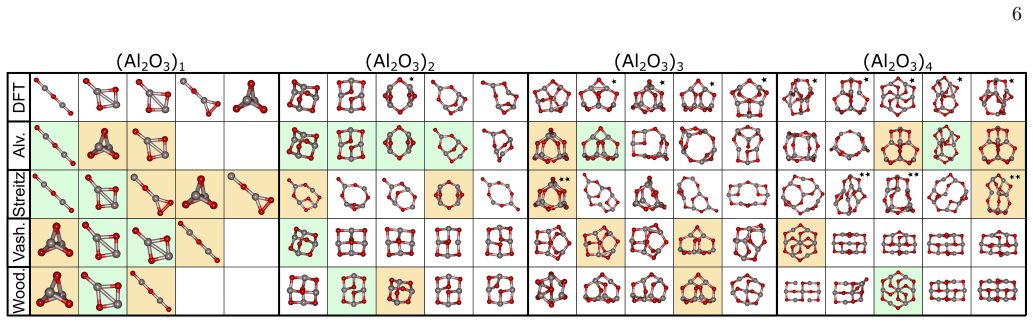
Summary. This paper benchmarks four empirical potentials for aluminum oxide (Alvarez, Vashishta, Woodley, Streitz) across length scales from (Al2O3)n clusters (n=1-8) to nanoparticles up to about 12 nm. For small clusters, low-energy isomers from extensive conformation searches are compared with B3LYP DFT results. For nanoparticles, particles are cut from bulk alpha, gammaOh, and gammaTdOh crystals, relaxed with each potential, and characterized by structure factor and Al coordination; energy per atom versus size is used to infer polymorph stability. The authors report that only the Alvarez and Streitz potentials reproduce the DFT cluster energetics, and that these two also predict the experimentally observed amorphous-to-gamma and gamma-to-alpha transitions, with Alvarez MD giving transition sizes of 41 and 95 Å compared to experimental 41 and 117 Å.
Significance. If the nanoscale phase-transition claims were fully supported, this would be a valuable benchmark: it would identify a computationally cheap potential (Alvarez) that works from clusters to nanoparticles and would warn against the use of more complex potentials (Vashishta, Woodley) for nanoscale alumina. The cluster-level comparison is systematic and the conclusion that a simple potential outperforms more elaborate ones is valuable and testable. The authors provide optimized geometries in the Supplemental Material, supporting reproducibility. However, the thermodynamic interpretation of the nanoparticle energy crossovers is not established, so the central quantitative claim is not yet convincing.
major comments (4)
- [Section III.B, Figures 5 and 7] The central claim that the Alvarez and Streitz potentials reproduce the amorphous-to-gamma and gamma-to-alpha transitions rests on energy-per-atom curves for particles relaxed from bulk alpha, gammaOh, and gammaTdOh crystal cuts, with no independently prepared amorphous reference state. Small particles are classified as amorphous only after losing crystallinity during relaxation; this does not sample the equilibrium amorphous phase. To support the claimed transition sizes, the authors should include melt-quenched or explicitly amorphous starting configurations and compute free energies, or at least demonstrate that the phase boundaries are independent of the relaxation protocol.
- [Section II.D and Figures 6-7] The MD validation for the Alvarez potential consists of 1 ps heating, 1 ps equilibration, and 10 ps production at 300 K. This is far too short to equilibrate a nanoparticle or to observe spontaneous phase transitions; the reported crossover at 41 Å and 95 Å may reflect kinetic relaxation rather than thermodynamic stability. The authors should provide convergence tests (e.g., longer runs, multiple independent seeds, heating/cooling hysteresis) or soften the wording that MD "confirms" the optimization results.
- [Section III.B, Figures 3-5] The transition sizes are read from qualitative structure-factor and coordination curves without error estimates or sensitivity analysis. For instance, the "amorphous to crystal" transition is identified by visual appearance of peaks in S(q) and by the increase in nc,6, and the crossover sizes in Figure 5 are obtained by interpolation between a small number of discrete sizes (e.g., n=324 and n=600). The claimed values 41 Å and 95 Å have no stated uncertainty. The authors should quantify uncertainties, for example by fitting order parameters with smooth functions and reporting confidence intervals, and by testing sensitivity to the coordination cutoffs and to the specific set of particle sizes.
- [Section II.A and Figure 3] The "homothety correction" used to align the simulated structure factors with experimental peak positions is not defined in the text; it appears to be a per-potential rescaling of q. Since this correction is a free parameter that influences the comparison to experimental diffraction data, its definition, magnitude, and effect on the determined transition sizes should be reported and justified.
minor comments (5)
- [Section II.A] The sentence introducing the Woodley potential says it "was also developed by Gutiérrez et al."; this is ambiguous because the functional form is attributed to Woodley while the parameterization may come from later work. Please clarify the exact provenance of the parameters used here.
- [Section II.E] The coordination cutoff radii satisfy Rmax(Al-Al)=3.10 Å > Rmax(Al-O)=2.43 Å > Rmax(O-O)=1.76 Å; a brief physical justification for this ordering would help the reader assess the coordination analysis.
- [Section III.A] The text contains a typo, "By constrast", which should read "By contrast".
- [Figure 2 caption] The caption states "the double asterisks shows the isomers found after step 4"; "shows" should be "show".
- [Section IV] The sentence "this work is a first step towards the understanding of the phase transition occurring during the synthesis of nano-Al2O3" overstates the connection to synthesis; the study addresses static stability, not nucleation or growth kinetics. Consider revising to reflect the scope.
Circularity Check
No circularity: the potentials are pre-existing, no parameters are fitted, and the nanoscale transitions are emergent outputs benchmarked against independent DFT and calorimetry data.
full rationale
The paper benchmarks four published empirical potentials (Alvarez, Vashishta, Woodley, Streitz) against two external references: B3LYP/6-311+G* DFT conformer searches for (Al2O3)n clusters and experimental calorimetry for the amorphous/γ/α transition sizes. No potential parameter is fitted or refitted in this work; each potential's functional form and parameters are taken from the original references. The cluster-level ranking is obtained by generating random geometries, optimizing with each potential, recalculating the low-energy candidates with DFT, and then checking which potential recovers the lowest DFT isomers; the comparison is therefore with independent first-principles data. The nanoscale phase-transition sizes are read from energy-per-atom crossovers of relaxed nanoparticles cut from bulk α, γOh, and γTdOh crystals, and, for Alvarez, from short 300 K MD. These crossovers are outputs of the potentials, not inputs. The only calibrating element is the homothety correction applied to the x-axis of the structure factors (Section III.B and Fig. 3), which aligns calculated peak positions to the experimental α pattern at one particle size; it is explicitly a presentation correction, it is not used to locate the flat-to-peak crossover, and it does not enter the energy-per-atom crossover analysis that determines the claimed transition sizes. The self-citations (refs. 21, 32, 75, 76) concern prior cluster calculations, experimental synthesis contexts, or software, and none is used as the justificatory premise for the benchmark conclusions. Thus the central claims are self-contained against external data, and no step reduces by construction to its own input.
Assumptions & free parameters
free parameters (2)
- homothety correction factor =
not reported
- coordination cutoff radii =
Rmax(Al-Al)=3.10 Å, Rmax(Al-O)=2.43 Å, Rmax(O-O)=1.76 Å
assumptions (6)
- domain assumption DFT (B3LYP/6-311+G*) cluster geometries and relative energies are a valid reference for ranking empirical potentials.
- domain assumption Gamma-alumina can be represented by an ideal spinel with aluminum vacancies placed on octahedral sites or randomly, following Pinto et al.
- domain assumption Geometry optimization from bulk-cut starting structures, or short MD for Alvarez, sufficiently samples the relevant nanoparticle states.
- domain assumption Structure factor and coordination-number criteria correctly identify amorphous-to-crystal transitions.
- domain assumption Experimental calorimetry transition sizes (McHale 1997, Tavakoli 2013) are appropriate benchmarks for simulated relaxed-particle crossovers.
- ad hoc to paper The homothety correction preserves the structure factor peak positions when comparing simulation to experiment.
Cite this review
Pith. "Pith review of Comparison of aluminum oxide empirical potentials from cluster to nanoparticle." pith.science (2026). https://pith.science/paper/VBCVCMJD
@misc{pith2026190805046,
  author       = {Pith},
  title        = {Pith review of: Comparison of aluminum oxide empirical potentials from cluster to nanoparticle},
  year         = {2026},
  howpublished = {\url{https://pith.science/paper/VBCVCMJD}},
  note         = {Machine review of arXiv:1908.05046}
}
read the original abstract
Aluminum oxide nanoparticles are increasingly sought in numerous technological applications. However, as the nanoparticles grow during the synthesis, two phase transitions occur. At the nanoscale, numerical simulation of the stability of the alumina phases requires the use of empirical potentials that are reliable over a large range of system sizes going from a few atoms to several hundred thousand atoms. In this work, we confronted four different empirical potentials that are currently employed for bulk alumina. We found that only two of them are correct at the molecular level when compared to DFT calculations. Furthermore, the two potentials remain the best at the nanoscale as they reproduce one or two phase transitions that were observed experimentally: from amorphous solid to cubic crystal ({\gamma}) and from cubic to hexagonal ({\alpha}, i.e. corundum) crystal.
Figures

Figures from the paper (5 more)



Reference graph
Works this paper leans on
-
[1]
Navrotsky ,\ 10.1186/1467-4866-4-34 journal journal Geochem
author author A. Navrotsky ,\ 10.1186/1467-4866-4-34 journal journal Geochem. Trans. \ volume 4 ,\ pages 34 ( year 2003 ) NoStop
-
[2]
author author J. M. \ Mc H ale , author A. Auroux , author A. J. \ Perrotta , \ and\ author A. Navrotsky ,\ 10.1126/science.277.5327.788 journal journal Science \ volume 277 ,\ pages 788 ( year 1997 ) NoStop
-
[3]
author author H. Zhang \ and\ author J. Banfield ,\ 10.1039/a802619j journal journal J. Mater. Chem. \ volume 8 ,\ pages 2073 ( year 1998 ) NoStop
-
[4]
author author H. Zhang \ and\ author J. Banfield ,\ 10.1021/jp000499j journal journal J. Phys. Chem. B \ volume 104 ,\ pages 3481 ( year 2000 ) NoStop
-
[5]
author author K. Zhu , author M. Zhang , author J. Hong , \ and\ author Z. Yin ,\ 10.1016/j.msea.2005.04.029 journal journal Mater. Sci. Eng. A-Struct. Mater. Prop. Microstruct. Process. \ volume 403 ,\ pages 87 ( year 2005 ) NoStop
-
[6]
author author M. Ranade , author A. Navrotsky , author H. Zhang , author J. Banfield , author S. Elder , author A. Zaban , author P. Borse , author S. Kulkarni , author G. Doran , \ and\ author H. Whitfield ,\ 10.1073/pnas.251534898 journal journal Proc. Natl. Acad. Sci. U. S. A. \ volume 99 ,\ pages 6476 ( year 2002 ) NoStop
-
[7]
author author R. C. \ Garvie ,\ 10.1021/j100888a024 journal journal J. Phys. Chem. \ volume 69 ,\ pages 1238 ( year 1965 ) NoStop
-
[8]
author author L. Chen , author T. Mashimo , author E. Omurzak , author H. Okudera , author C. Iwamoto , \ and\ author A. Yoshiasa ,\ 10.1021/jp111367k journal journal J. Phys. Chem. C \ volume 115 ,\ pages 9370 ( year 2011 ) NoStop
Show all 75 references
-
[9]
Schimanke \ and\ author M
author author G. Schimanke \ and\ author M. Martin ,\ 10.1016/S0167-2738(00)00593-2 journal journal Solid State Ion. \ volume 136 ,\ pages 1235 ( year 2000 ) NoStop
2000 doi
-
[10]
Bomati-Miguel , author L
author author O. Bomati-Miguel , author L. Mazeina , author A. Navrotsky , \ and\ author S. Veintemillas-Verdaguer ,\ 10.1021/cm071178o journal journal Chem. Mat. \ volume 20 ,\ pages 591 ( year 2008 ) NoStop
2008 doi
-
[11]
Nicolas , author B
author author D. Nicolas , author B. Masenelli , author P. Melinon , author E. Bernstein , author C. Dujardin , author G. Ledoux , \ and\ author C. Esnouf ,\ 10.1063/1.2390693 journal journal J. Chem. Phys. \ volume 125 ,\ pages 171104 ( year 2006 ) NoStop
-
[12]
author author M. A. \ Caldwell , author S. Raoux , author R. Y. \ Wang , author H. S. P. \ Wong , \ and\ author D. J. \ Milliron ,\ 10.1039/b917024c journal journal J. Mater. Chem. \ volume 20 ,\ pages 1285 ( year 2010 ) NoStop
2010 doi
-
[13]
author author W. S. \ Brey \ and\ author K. Krieger ,\ @noop journal journal J. Am. Chem. Soc. \ volume 71 ,\ pages 3637 ( year 1949 ) NoStop
1949
-
[14]
Ernst , author F
author author M. Ernst , author F. Lurot , \ and\ author J.-C. \ Schrotter ,\ 10.1016/S0926-3373(03)00290-X journal journal Appl. Catal., B \ volume 47 ,\ pages 15 ( year 2004 ) NoStop
2004 doi
-
[15]
author author E. S. \ Lukin , author S. V. \ Tarasova , \ and\ author A. V. \ Korolev ,\ 10.1023/A:1010999432041 journal journal Glass Ceram. \ volume 58 ,\ pages 105 ( year 2001 ) NoStop
2001 doi
-
[16]
Schembri \ and\ author B
author author V. Schembri \ and\ author B. J. M. \ Heijmen ,\ 10.1118/1.2737160 journal journal Med. Phys. \ volume 34 ,\ pages 2113 ( year 2007 ) NoStop
2007 doi
-
[17]
author author A. H. \ Tavakoli , author P. S. \ Maram , author S. J. \ Widgeon , author J. Rufner , author K. van Benthem , author S. Ushakov , author S. Sen , \ and\ author A. Navrotsky ,\ 10.1021/jp405820g journal journal J. Phys. Chem. C \ volume 117 ,\ pages 17123 ( year 2...
-
[18]
author author I. L. \ Liu , author P. Shen , \ and\ author S. Y. \ Chen ,\ 10.1021/jp1002325 journal journal J. Phys. Chem. C \ volume 114 ,\ pages 7751 ( year 2010 ) NoStop
2010 doi
-
[19]
author author I. L. \ Liu , author B. C. \ Lin , author S. Y. \ Chen , \ and\ author P. Shen ,\ 10.1021/jp107030h journal journal J. Phys. Chem. C \ volume 115 ,\ pages 4994 ( year 2011 ) NoStop
2011 doi
-
[20]
Piriyawong , author V
author author V. Piriyawong , author V. Thongpool , author P. Asanithi , \ and\ author P. Limsuwan ,\ 10.1155/2012/819403 journal journal J. Nanomater \ volume 2012 ,\ pages 819403 ( year 2012 ) NoStop
2012 doi
-
[21]
Lam , author D
author author J. Lam , author D. Amans , author F. Chaput , author M. Diouf , author G. Ledoux , author N. Mary , author K. Masenelli-Varlot , author V. Motto-Ros , \ and\ author C. Dujardin ,\ 10.1039/c3cp53748j journal journal Phys. Chem. Chem. Phys. \ volume 16 ,\ pages 963...
-
[22]
Ishizuka , author Y
author author S. Ishizuka , author Y. Kimura , author J. Kawano , author R. Escribano , author T. Yamazaki , author T. Hama , \ and\ author R. Sato ,\ 10.1021/acs.jpcc.8b08355 journal journal J. Phys. Chem. C \ volume 122 ,\ pages 25092 ( year 2018 ) NoStop
-
[23]
Ishizuka , author Y
author author S. Ishizuka , author Y. Kimura , author T. Yamazaki , author T. Hama , author N. Watanabe , \ and\ author A. Kouchi ,\ 10.1021/acs.chemmater.6b04061 journal journal Chem. Mat. \ volume 28 ,\ pages 8732 ( year 2016 ) NoStop
-
[24]
author author J. M. \ Mc H ale , author A. Navrotsky , \ and\ author A. J. \ Perrotta ,\ 10.1021/jp9627584 journal journal J. Phys. Chem. B \ volume 101 ,\ pages 603 ( year 1997 ) NoStop
1997 doi
-
[25]
Ruberto , author Y
author author C. Ruberto , author Y. Yourdshahyan , \ and\ author B. I. \ Lundqvist ,\ 10.1103/PhysRevB.67.195412 journal journal Phys. Rev. B \ volume 67 ,\ pages 195412 ( year 2003 ) NoStop
2003 doi
-
[26]
Manassidis , author A
author author I. Manassidis , author A. D. \ Vita , \ and\ author M. J. \ Gillan ,\ 10.1016/0039-6028(93)90423-H journal journal Surf. Sci. Lett. \ volume 285 ,\ pages 517 ( year 1993 ) NoStop
1993 doi
-
[27]
Manassidis \ and\ author M
author author I. Manassidis \ and\ author M. J. \ Gillan ,\ 10.1111/j.1151-2916.1994.tb07000.x journal journal J. Am. Ceram. Soc. \ volume 77 ,\ pages 335 ( year 1994 ) NoStop
1994
-
[28]
Marmier \ and\ author S
author author A. Marmier \ and\ author S. C. \ Parker ,\ 10.1103/PhysRevB.69.115409 journal journal Phys. Rev. B \ volume 69 ,\ pages 115409 ( year 2004 ) NoStop
2004 doi
-
[29]
author author A. S. \ Sharipov , author B. I. \ Loukhovitski , \ and\ author A. M. \ Starik ,\ 10.1088/0031-8949/88/05/058307 journal journal Phys. Scr. \ volume 88 ,\ pages 058307 ( year 2013 ) NoStop
2013 doi
-
[30]
Li \ and\ author L
author author R. Li \ and\ author L. Cheng ,\ 10.1016/j.comptc.2012.07.027 journal journal Comput. Theor. Chem. \ volume 996 ,\ pages 125 ( year 2012 ) NoStop
2012 doi
-
[31]
Rahane , author M
author author A. Rahane , author M. Deshpande , \ and\ author V. Kumar ,\ 10.1021/jp2050614 journal journal J. Phys. Chem. C \ volume 115 ,\ pages 18111 ( year 2011 ) NoStop
2011 doi
-
[32]
Lam , author D
author author J. Lam , author D. Amans , author C. Dujardin , author G. Ledoux , \ and\ author A.-R. \ Allouche ,\ 10.1021/acs.jpca.5b05829 journal journal J. Phys. Chem. A \ volume 119 ,\ pages 8944 ( year 2015 ) NoStop
2015 doi
-
[33]
Gu , author N
author author Y. Gu , author N. Xu , author M. Lin , \ and\ author K. Tan ,\ 10.1016/j.comptc.2015.03.027 journal journal Comput. Theor. Chem. \ volume 1063 ,\ pages 29 ( year 2015 ) NoStop
2015 doi
-
[34]
author author W. C. \ Mackrodt , author R. J. \ Davey , \ and\ author S. N. \ Black ,\ 10.1016/0022-0248(87)90093-5 journal journal J. Cryst. Growth \ volume 80 ,\ pages 441 ( year 1987 ) NoStop
1987 doi
-
[35]
author author W. C. \ Mackrodt ,\ 10.1039/f29898500541 journal journal J. Chem. Soc., Faraday Trans. 2 \ volume 85 ,\ pages 541 ( year 1989 ) NoStop
1989 doi
-
[36]
Hartman ,\ 10.1016/0022-0248(89)90065-1 journal journal J
author author P. Hartman ,\ 10.1016/0022-0248(89)90065-1 journal journal J. Cryst. Growth \ volume 96 ,\ pages 667 ( year 1989 ) NoStop
1989 doi
-
[37]
Salles , author O
author author N. Salles , author O. Politano , author E. Amzallag , \ and\ author R. T\'etot ,\ 10.1016/j.commatsci.2015.09.017 journal journal Comput. Mater. Sci. \ volume 111 ,\ pages 181 ( year 2016 ) NoStop
2015 doi
-
[38]
Sun , author T
author author J. Sun , author T. Stirner , author W. Hagston , author A. Leyland , \ and\ author A. Matthews ,\ 10.1016/j.jcrysgro.2005.12.076 journal journal J. Cryst. Growth \ volume 290 ,\ pages 235 ( year 2006 ) NoStop
2005 doi
-
[39]
author author S. P. \ Adiga , author P. Zapol , \ and\ author L. A. \ Curtiss ,\ 10.1103/PhysRevB.74.064204 journal journal Phys. Rev. B \ volume 74 ,\ pages 064204 ( year 2006 ) NoStop
2006 doi
-
[40]
Blonski \ and\ author S
author author S. Blonski \ and\ author S. H. \ Garofalini ,\ 10.1016/0039-6028(93)90202-U journal journal Surf. Sci. \ volume 295 ,\ pages 263 ( year 1993 ) NoStop
1993 doi
-
[41]
Liz\'arraga , author E
author author R. Liz\'arraga , author E. Holmstr\"om , author S. C. \ Parker , \ and\ author C. Arrouvel ,\ 10.1103/PhysRevB.83.094201 journal journal Phys. Rev. B \ volume 83 ,\ pages 094201 ( year 2011 ) NoStop
2011 doi
-
[42]
Krokidis , author P
author author X. Krokidis , author P. Raybaud , author A.-E. \ Gobichon , author B. Rebours , author P. Euzen , \ and\ author H. Toulhoat ,\ 10.1021/jp0038310 journal journal J. Phys. Chem. B \ volume 105 ,\ pages 5121 ( year 2001 ) NoStop
-
[43]
Alvarez , author L
author author L. Alvarez , author L. Le\'on , author J. Sanz , author M. Capit\'an , \ and\ author J. Odriozola ,\ 10.1103/PhysRevB.50.2561 journal journal Phys. Rev. B \ volume 50 ,\ pages 2561 ( year 1994 ) NoStop
1994 doi
-
[44]
Alvarez , author L
author author L. Alvarez , author L. Le\'on , author J. Sanz , author M. Capit\'an , \ and\ author J. Odriozola ,\ 10.1021/j100051a011 journal journal J. Phys. Chem. \ volume 99 ,\ pages 17872 ( year 1995 ) NoStop
1995 doi
-
[45]
Pinto , author R
author author H. Pinto , author R. M. \ Nieminen , \ and\ author S. D. \ Elliott ,\ 10.1103/PhysRevB.70.125402 journal journal Phys. Rev. B \ volume 70 ,\ pages 125402 ( year 2004 ) NoStop
2004 doi
-
[46]
Guti\'errez \ and\ author B
author author G. Guti\'errez \ and\ author B. Johansson ,\ 10.1103/PhysRevB.65.104202 journal journal Phys. Rev. B \ volume 65 ,\ pages 104202 ( year 2002 ) NoStop
2002 doi
-
[48]
Vashishta , author R
author author P. Vashishta , author R. Kalia , author A. Nakano , \ and\ author J. Rino ,\ 10.1063/1.2901171 journal journal J. App. Sci. \ volume 103 ,\ pages 083504 ( year 2008 ) NoStop
2008 doi
-
[49]
Van Hoang \ and\ author S
author author V. Van Hoang \ and\ author S. Kun Oh ,\ 10.1016/j.physb.2004.06.057 journal journal Physica B: Condensed Matter \ volume 352 ,\ pages 73 ( year 2004 ) NoStop
2004 doi
-
[50]
author author G. T. \ Nguyen , author T. T. \ Nguyen , author T. T. \ Nguyen , \ and\ author V. V. \ Le ,\ 10.1016/j.jnoncrysol.2016.07.018 journal journal J. Non-Cryst. Solids. \ volume 449 ,\ pages 100 ( year 2016 ) NoStop
2016 doi
-
[51]
Ahuja , author A
author author R. Ahuja , author A. Belonoshko , \ and\ author B. Johansson ,\ 10.1103/PhysRevE.57.1673 journal journal Phys. Rev. E \ volume 57 ,\ pages 1673 ( year 1998 ) NoStop
1998 doi
-
[52]
Ansell , author S
author author S. Ansell , author S. Krishnan , author J. K. R. \ Weber , author J. J. \ Felten , author P. C. \ Nordine , author M. A. \ Beno , author D. L. \ Price , \ and\ author M.-L. \ Saboungi ,\ 10.1103/PhysRevLett.78.464 journal journal Phys. Rev. Lett. \ volume 78 ,\ p...
-
[53]
Erlebach , author H.-D
author author A. Erlebach , author H.-D. \ Kurland , author J. Grabow , author F. A. \ M\"uller , \ and\ author M. Sierka ,\ 10.1039/C4NR06989G journal journal Nanoscale \ volume 7 ,\ pages 2960 ( year 2015 ) NoStop
2015 doi
-
[54]
Vashishta , author R
author author P. Vashishta , author R. Kalia , author J. Rino , \ and\ author I. Ebbsj\"o ,\ 10.1103/PhysRevB.41.12197 journal journal Phys. Rev. B \ volume 41 ,\ pages 12197 ( year 1990 ) NoStop
1990 doi
-
[55]
Woodley ,\ 10.1098/rspa.2011.0009 journal journal Proc
author author S. Woodley ,\ 10.1098/rspa.2011.0009 journal journal Proc. R. Soc. A \ volume 467 ,\ pages 2020 ( year 2011 ) NoStop
2011
-
[56]
Streitz \ and\ author J
author author F. Streitz \ and\ author J. Mintmire ,\ @noop journal journal Phys. Rev. B \ volume 50 ,\ pages 11996 ( year 1994 ) NoStop
1994
-
[57]
Guti\'errez , author A
author author G. Guti\'errez , author A. Belonoshko , author R. Ahuja , \ and\ author B. Johansson ,\ 10.1088/0953-8984/23/49/495401 journal journal Phys. Rev. E \ volume 61 ,\ pages 2723 ( year 2000 ) NoStop
-
[58]
Gobrecht , author L
author author D. Gobrecht , author L. Decin , author S. Cristallo , \ and\ author S. T. \ Bromley ,\ https://doi.org/10.1016/j.cplett.2018.09.018 journal journal Chem. Phys. Lett. \ volume 711 ,\ pages 138 ( year 2018 ) NoStop
2018 doi
-
[59]
author author H. F. \ J. Lewis , D. Schwarzenbach ,\ @noop journal journal Acta Cryst. \ volume A38 ,\ pages 733 ( year 1982 ) NoStop
1982
-
[60]
Guse \ and\ author H
author author W. Guse \ and\ author H. Saalfeld ,\ @noop journal journal Neues Jahrb. Mineral., Monatsh. \ volume 217 ,\ pages 733 ( year 1990 ) NoStop
1990
-
[61]
Bussi , author D
author author G. Bussi , author D. Donadio , \ and\ author M. Parrinello ,\ 10.1063/1.2408420 journal journal J. Chem. Phys. \ volume 126 ,\ pages 014101 ( year 2007 ) NoStop
2007 doi
-
[62]
author author R. S. \ Zhou \ and\ author R. L. \ Snyder ,\ 10.1107/S0108768191002719 journal journal Acta Crystallogr. Sect. B \ volume 47 ,\ pages 617 ( year 1991 ) NoStop
1991 doi
-
[63]
Samain , author A
author author L. Samain , author A. Jaworski , author M. Eden , author D. M. \ Ladd , author D.-K. \ Seo , author F. Javier Garcia-Garcia , \ and\ author U. Haussermann ,\ 10.1016/j.jssc.2014.05.004 journal journal J. Solid State Chem. \ volume 217 ,\ pages 1 ( year 2014 ) NoStop
2014 doi
-
[64]
author author E. N. \ Maslen , author V. A. \ Streltsov , author N. R. \ Streltsova , author N. Ishizawa , \ and\ author Y. Satow ,\ 10.1107/S0108768193006901 journal journal Acta Crystallogr. B Struct. Sci. \ volume 49 ,\ pages 973 ( year 1993 ) NoStop
-
[65]
Lamparter \ and\ author R
author author P. Lamparter \ and\ author R. Kniep ,\ doi.org/10.1016/S0921-4526(96)01044-7 journal journal Physica B: Condens. Matter \ volume 234--236 ,\ pages 405 ( year 1997 ) NoStop
1997 doi
-
[66]
author author X. W. \ Zhou , author H. N. G. \ Wadley , author J.-S. \ Filhol , \ and\ author M. N. \ Neurock ,\ 10.1103/PhysRevB.69.035402 journal journal Phys. Rev. B \ volume 69 ,\ pages 035402 ( year 2004 ) NoStop
2004 doi
-
[67]
Zhang \ and\ author L
author author Q. Zhang \ and\ author L. Cheng ,\ 10.1021/acs.jcim.5b00069 journal journal J. Chem. Inf. and Model. \ volume 55 ,\ pages 1012 ( year 2015 ) NoStop
2015 doi
-
[68]
Maci\`a Escatllar , author A
author author A. Maci\`a Escatllar , author A. Morales-Garc\'ia , author F. Illas , \ and\ author S. T. \ Bromley ,\ 10.1063/1.5095071 journal journal J. Chem. Phys. \ volume 150 ,\ pages 214305 ( year 2019 ) NoStop
2019 doi
-
[69]
Calvo \ and\ author C
author author F. Calvo \ and\ author C. Mottet ,\ 10.1103/PhysRevB.84.035409 journal journal Phys. Rev. B \ volume 84 ,\ pages 035409 ( year 2011 ) NoStop
2011 doi
-
[70]
Pavan , author K
author author L. Pavan , author K. Rossi , \ and\ author F. Baletto ,\ 10.1063/1.4935272 journal journal J. Chem. Phys. \ volume 143 ,\ pages 184304 ( year 2015 ) NoStop
2015 doi
-
[71]
Bechelli , author B
author author S. Bechelli , author B. Gonzalez , author V. Piquet , author I. Essafri , author C. Desgranges , \ and\ author J. Delhommelle ,\ 10.1021/acs.jpcb.7b06028 journal journal J. Phys. Chem. B \ volume 121 ,\ pages 8558 ( year 2017 ) NoStop
-
[72]
Singh , author C
author author V. Singh , author C. Cassidy , author P. Grammatikopoulos , author F. Djurabekova , author K. Nordlund , \ and\ author M. Sowwan ,\ 10.1021/jp500684y journal journal J. Phys. Chem. C \ volume 118 ,\ pages 13869 ( year 2014 ) NoStop
-
[73]
Zhao , author V
author author J. Zhao , author V. Singh , author P. Grammatikopoulos , author C. Cassidy , author K. Aranishi , author M. Sowwan , author K. Nordlund , \ and\ author F. Djurabekova ,\ 10.1103/PhysRevB.91.035419 journal journal Phys. Rev. B \ volume 91 ,\ pages 035419 ( year 20...
-
[74]
Akbarzadeh , author F
author author H. Akbarzadeh , author F. Taherkhani , author E. Mehrjouei , \ and\ author A. Masoumi ,\ 10.1016/j.molliq.2017.05.106 journal journal J. Mol. Liq. \ volume 240 ,\ pages 468 ( year 2017 ) NoStop
2017 doi
-
[75]
author author G. D. \ F o \" o rster , author M. Benoit , \ and\ author J. Lam ,\ 10.1039/C9CP04231H journal journal Phys. Chem. Chem. Phys. \ ( year 2019 ),\ 10.1039/C9CP04231H NoStop
2019 doi
-
[76]
\ Allouche ,\ 10.1002/jcc.21600 journal journal J
author author A.-R. \ Allouche ,\ 10.1002/jcc.21600 journal journal J. Comput. Chem. \ volume 32 ,\ pages 174 ( year 2011 ) NoStop
2011 doi
Reviewed August 14, 2026 · model on record in the stance chip above.
Discussion (0). Continue with ORCID to comment.