REVIEW 3 major objections 4 minor 27 references
Radiative Decay of Bound Electron Pairs in Two-Dimensional Topological Insulators
T0 review · 3 major / 4 minor · reviewed 2026-08-14 · deepseek-v4-flash
Pith's one-line read The paper calculates that bound electron pairs in two-dimensional topological insulators radiatively decay in about a nanosecond—not femtoseconds—and that the lifetime is longest in the topological phase with nearly flat band dispersion.
desk verdict First golden-rule calculation of BEP radiative decay in the BHZ model, but the empty-crystal approximation leaves the headline 1 ns HgTe estimate unsupported. read the letter →
The pith
A machine-rendered reading of the paper's core claim, the machinery that carries it, and where it could break.
The reading
What carries the argument
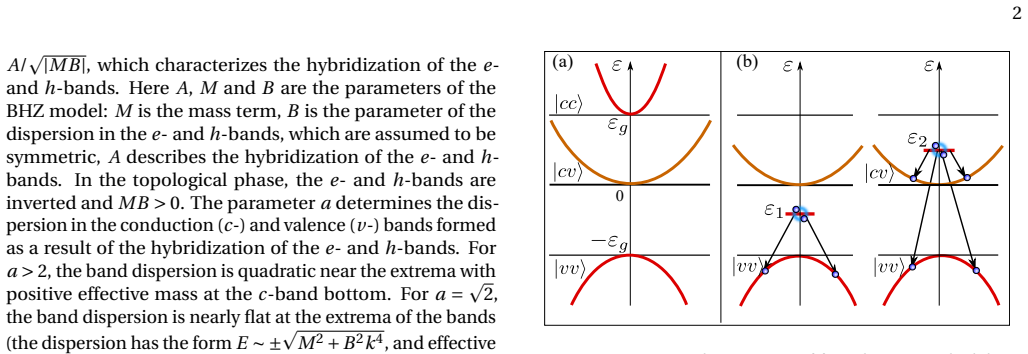
The central object is the two-particle light-matter Hamiltonian obtained by making the substitution $k \to k + (e/\hbar c)A$ in the BHZ Hamiltonian, written as $H'(1,2) = 4A\cdot k\,M_0 + A_+(M_+\otimes I + I\otimes M_+) + A_-(M_-\otimes I + I\otimes M_-)$, where $M_0$ and $M_\pm$ are numerical matrices and $A_\pm = A_x \pm i A_y$. This Hamiltonian contains both the usual dipole term and hybridization terms that couple electron and hole bands. The decay rate is computed with Fermi's Golden Rule, using BEP initial states represented by 16-rank spinors (with four independent spatial components, $\psi_3,\psi_4,\psi_7,\psi_8$) and free two-electron final states; the photon wave vector is treated as small, which strongly restricts the allowed phase space.
What would settle it
Measure the time-resolved photoluminescence or pump-probe signal of a HgTe/CdHgTe quantum well in the topological phase after resonant excitation of a bound pair; a radiative decay component with lifetime of order 1 ns at the predicted photon energy would support the claim, while its absence or a lifetime orders of magnitude shorter at that energy would refute it.
Extended reading notes
Core claim
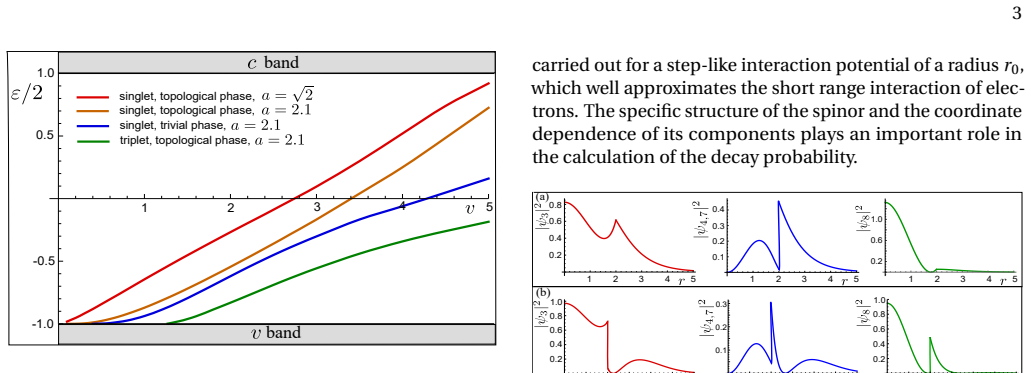
The paper's central claim is that BEPs in the BHZ model decay radiatively on a nanosecond timescale rather than on the femtosecond timescale typical of excitons, and that this lifetime is controlled by the topological phase and the band dispersion. For HgTe/CdHgTe parameters, $\tau \sim 10^{-9}$ s, with $\tau_N \approx 2 \times 10^{-14}$ s as the natural scale. In the topological phase the decay time is substantially longer than in the trivial phase, and the longest decay time of all is found in the topological phase with nearly flat dispersion at the band extrema ($a = \sqrt{2}$), which also has the largest binding energy. The dominant decay channel is the $vv$ channel, in which both electrons end up in the valence band; triplet-state decay through this channel is nonvanishing but suppressed by a factor of order $q^2|B/M|$.
Load-bearing premise
The calculation depends on the two-electron wave functions obtained from a simplified step-like interaction potential in Ref. [7] being accurate for real HgTe/CdHgTe samples; if those wave functions or the light-matter coupling in Eq. (8) are not, the predicted nanosecond lifetime can shift.
Editorial extensions
If this is right
- In HgTe/CdHgTe quantum wells, BEPs created by light should survive about a nanosecond, long enough to be manipulated or to contribute to transport before radiative decay.
- Because the empty-crystal calculation is an upper bound on the decay rate, actual band filling should make the lifetime even longer.
- The topological phase is the stable regime: at equal parameters the decay time in the topological phase exceeds that in the trivial phase, so BEP stability tracks the topological phase.
- Near-flat dispersion at $a=\sqrt{2}$ gives the most stable pairs: they combine the largest binding energy with the longest radiative lifetime.
- Triplet BEPs are also radiatively long-lived through the $vv$ channel, with decay suppressed by $q^2|B/M|$, so spin-polarized pairs may survive appreciably.
Reading between the lines
- Not drawn by the authors: if the radiative channel really is as slow as 1 ns, phonon-assisted and disorder-assisted decay will likely set the actual lifetime in most samples; a temperature-dependent lifetime measurement would separate the channels.
- A design rule follows from their parameter scan: pushing a BHZ-type system toward the flat-dispersion point should increase both binding and stability, and this could be tested in other inverted-band quantum wells.
- The same Fermi's Golden Rule machinery could be adapted to compute phonon decay of BEPs by replacing the photon coupling with an electron-phonon coupling, giving a direct test of whether radiative or nonradiative decay dominates.
Signed reviews
Editorial analysis
A structured set of objections, weighed in public.
Referee Report
Summary. The paper investigates the radiative decay of two-electron bound states (BEPs) in two-dimensional topological insulators described by the BHZ model. The authors derive a two-particle electron-photon interaction Hamiltonian, compute the decay rate using Fermi's golden rule, and identify the decay channel in which both electrons end up in the valence band as dominant. They report that the radiative lifetime is much longer in the topological phase than in the trivial phase and estimate it as ~1 ns for HgTe/CdHgTe heterostructures, with the longest lifetime occurring for nearly flat band dispersion at a = sqrt(2).
Significance. If the estimate is reliable, the paper provides a useful first step toward assessing the stability of bound electron pairs in two-dimensional topological insulators, which is relevant for proposals involving charge and spin transport by these composite bosons. The strength of the paper is that the golden-rule framework is standard, the calculation is a genuine function of the model inputs rather than a rearrangement of the target quantity, and the authors explicitly identify the phase-space and spinor-structure reasons why the decay is slower than exciton decay. The significance is conditional, however, because the quantitative claim for HgTe/CdHgTe rests on an empty-crystal calculation and on bound-state wavefunctions imported without independent verification.
major comments (3)
- [§III, Eq. (11) and the following paragraph] The decay rate is computed for an empty crystal, with final states Phi_{v,k1;v,k2} describing two free electrons in the valence band. In a real HgTe/CdHgTe heterostructure the valence band is occupied, so the physically relevant final state for BEP recombination contains holes, and the matrix element is different from the empty-crystal matrix element. The statement that band filling reduces the rate 'approximately as f^-2' is not derived and is not a controlled estimate; for full filling the vv channel is Pauli-blocked, and the cv channel also requires an unoccupied valence-band state. The 1 ns estimate for HgTe should either be rederived in a filled-band formalism with explicit hole final states, or the claim should be explicitly restricted to doped or otherwise empty-band systems with the HgTe estimate removed or substantially qualified.
- [§II.B, Eq. (6) and Fig. 3] The decay rate depends sensitively on the structure of the two-particle bound-state spinor, but this wavefunction is taken from Ref. [7] without derivation or independent check. The wavefunction was computed for a step-like interaction potential of radius r0, and no sensitivity analysis with respect to the interaction shape, r0, or the band asymmetry delta is provided. Since the matrix element involves cancellations between spinor components of different signs, the numerical rates, including the 1 ns estimate, inherit an unquantified uncertainty. The authors should re-derive the key wavefunctions in an appendix or add a robustness study over the model parameters.
- [§III, Eq. (8)] The derivation of the two-particle light-matter Hamiltonian from minimal coupling is only sketched, and the displayed Hamiltonian is said to be 'simplified ... adapted to pairs with small total momentum'. It is not explained which terms are dropped in this simplification, so the reader cannot judge whether the vv- and cv-channel matrix elements are complete to the order in q retained later. A fuller derivation, including the treatment of the photon spatial phase e^{-iq*r} in the matrix element, is needed to support the quantitative rates.
minor comments (4)
- [Abstract and Introduction] There are typos: 'band extema' in the abstract should be 'band extrema', and 'nontrival' in the Introduction should be 'nontrivial'.
- [Fig. 2 caption] The legend of Fig. 2 is garbled, with phrases such as 'band band' and repeated 'singlet, topological phase,' labels; the caption should be rewritten so that each curve is clearly identified.
- [§III, Eq. (7)] The normalization of the vector potential should specify the unit system and the convention for the dielectric constant kappa; currently the prefactor with e^2/epsilon_q is introduced without stating whether cgs units and a specific photon normalization volume are assumed.
- [§III, Eq. (8)] The ordering of the 16-component basis should be stated explicitly before Eq. (8), since the sign structure of M0 and the resulting cancellations are a central physical point in the paper.
Circularity Check
No significant circularity: the 1 ns BEP radiative lifetime is a computed consequence of model inputs, not a rearrangement of the target quantity.
full rationale
The paper's derivation chain is a genuine forward calculation. The two-particle bound-state wavefunctions, quoted in Eq. (6), are taken from Ref. [7] by the same first author, but that cited work is an independent solution of the two-electron bound-state problem in the BHZ model with a stated step-like interaction potential; its assumptions do not include the radiative decay rate. The present paper then constructs the light-matter Hamiltonian, Eq. (8), by minimal substitution from the BHZ Hamiltonian, and evaluates the Fermi golden rule rate in Eq. (11) by numerical integration over final electron and photon states. No parameter is fitted to the radiative decay time, and the decay time does not appear as an input to any fitting procedure. The HgTe/CdHgTe estimate uses independent material parameters (A, M, B, kappa) to fix the normalization tau_N and the hybridization parameter a. The statement that band filling reduces the rate 'approximately as f^-2' is an acknowledged approximation and limitation, not a device for importing the answer; the empty-crystal final-state assumption is explicitly flagged, and many-body effects are stated to be beyond the paper's scope. Those are correctness or applicability risks, not circularity. Thus no circular step can be exhibited from the paper's own equations, and the most honest finding is no significant circularity.
Assumptions & free parameters
free parameters (4)
- hybridization parameter a =
a ≈ 4 for HgTe/CdHgTe estimate; varied in figures; special value a = sqrt(2)
- interaction potential amplitude v =
v = 2.0 in the figures
- interaction radius r0 =
r0 = 2.0 in the figures
- band asymmetry parameter delta =
0
assumptions (6)
- domain assumption The Bernevig-Hughes-Zhang Hamiltonian describes the electronic structure of the 2D topological insulator in both topological and trivial phases.
- domain assumption The light-matter interaction is obtained by minimal substitution k -> k + (e/hbar c)A in the two-particle BHZ Hamiltonian, retaining only electric-dipole terms.
- domain assumption The two-electron bound-state wavefunctions from Ref. [7], computed with a step-like interaction potential of radius r0, are correct and applicable.
- standard math Fermi's golden rule is valid for the transition rate.
- domain assumption The v-band is empty, so the calculated decay rate is an upper estimate.
- domain assumption Only radiative decay through the vv and cv channels is considered; phonon and many-particle decay are neglected.
Cite this review
Pith. "Pith review of Radiative Decay of Bound Electron Pairs in Two-Dimensional Topological Insulators." pith.science (2026). https://pith.science/paper/B45MBZM6
@misc{pith2026190805148,
  author       = {Pith},
  title        = {Pith review of: Radiative Decay of Bound Electron Pairs in Two-Dimensional Topological Insulators},
  year         = {2026},
  howpublished = {\url{https://pith.science/paper/B45MBZM6}},
  note         = {Machine review of arXiv:1908.05148}
}
abstract
Bound electron pairs (BEPs) with energy in the band gap are interesting because they can participate in charge and spin transport in modern topologically nontrivial materials. We address the problem of their stability and study the radiative decay of the BEPs formed due to the negative reduced effective mass in two-dimensional topological insulators. The decay time is found to be rather large on the scale of the characteristic relaxation times of the electron system and significantly dependent on the topological properties and dispersion of the band states. In topological phase the decay time is much longer than in the trivial one, and is estimated as $\sim$1~ns for the HgTe/CdHgTe heterostructures. However, the longest decay time is in the topological phase with nearly flat dispersion in the band extema.
Figures

Reference graph
Works this paper leans on
-
[7]
C. A. Downing and M. E. Portnoi, Phys. Status Solidi (b) , 1800584 (2019)
work page 2019
-
[1]
M. Combescot and S.-Y. Shiau, Excitons and Cooper pairs: two composite bosons in many-body physics (Oxford University Press, Oxford, 2015)
work page 2015
-
[2]
The spinor components are seen to have very differ- ent and unusual spatial distribution. The calculations were carried out for a step-like interaction potential of a radius r0, which well approximates the short range interaction of elec- trons. The specific structure of the spinor and the coordinate dependence of its components plays an important role in ...
-
[3]
In this case the longest decay time of the BEPs is reached. Given the fact that in this case the BEPs has the largest binding energy, one can expect that this type of the BEPs is the most stable one. Of course, the final conclusion about the decay time of the BEPs requires further study of other mechanisms of nonra- diative decay and many-particle effects,...
-
[4]
M. Y. Kagan, Modern trends in superconductivity and superflu- idity, Lecture Notes in Physics, Vol. 874 (Springer, Dordrecht, 2013)
work page 2013
-
[5]
Micnas, J
R. Micnas, J. Ranninger, and S. Robaszkiewicz, Rev. Mod. Phys. 62, 113 (1990)
1990
-
[6]
Rachel, Reports on Progress in Physics 81, 116501 (2018)
S. Rachel, Reports on Progress in Physics 81, 116501 (2018)
2018
-
[8]
L. L. Marnham and A. V . Shytov, Phys. Rev. B92, 085409 (2015)
work page 2015
Show all 27 references
-
[9]
V . A. Sablikov, Phys. Rev. B95, 085417 (2017)
2017
-
[10]
Gindikin and V
Y. Gindikin and V . A. Sablikov, Phys. Rev. B98, 115137 (2018)
2018
-
[11]
Gross, V
E. Gross, V . Perel’ , and R. Shekhmamet’ev, Sov. JETP Lett.13, 229 (1971)
1971
-
[12]
S. M. Mahajan and A. Thyagaraja, J. Phys. A: Math. Gen. 39, L667 (2006)
2006
-
[13]
Souza and F
D. Souza and F . Claro, Phys. Rev. B82, 205437 (2010)
2010
-
[14]
Hai and L
G.-Q. Hai and L. K. Castelano, Journal of Physics: Condensed Matter 26, 115502 (2014)
2014
-
[15]
Downing and M
C. Downing and M. Portnoi, Nature communications 8, 897 (2017)
2017
-
[16]
V . I. Belyavskii, V . V . Kapaev, and Y. V . Kopaev, Journal of Exper- imental and Theoretical Physics 91, 817 (2000)
2000
-
[17]
Winkler, G
K. Winkler, G. Thalhammer, F . Lang, R. Grimm, J. H. Denschlag, A. J. Daley, A. Kantian, H. P . Büchler, and P . Zoller, Nature441, 853 (2006)
2006
-
[18]
S. Zhou, Y. Wang, and Z. Wang, Phys. Rev. B 89, 195119 (2014)
2014
-
[19]
X.-J. Han, Y. Liu, Z.-Y. Liu, X. Li, J. Chen, H.-J. Liao, Z.-Y. Xie, B. Normand, and T . Xiang, New Journal of Physics18, 103004 (2016)
2016
-
[20]
Strohmaier, D
N. Strohmaier, D. Greif, R. Jördens, L. Tarruell, H. Moritz, T . Esslinger, R. Sensarma, D. Pekker, E. Altman, and E. Demler, Phys. Rev. Lett.104, 080401 (2010)
2010
-
[21]
Hofmann and M
F . Hofmann and M. Potthoff, Phys. Rev. B85, 205127 (2012)
2012
-
[22]
Bello, G
M. Bello, G. Platero, and S. Kohler, Phys. Rev. B 96, 045408 (2017)
2017
-
[23]
Hanamura, Phys
E. Hanamura, Phys. Rev. B 38, 1228 (1988)
1988
-
[24]
L. C. Andreani, F . Tassone, and F . Bassani, Solid State Commu- nications 77, 641 (1991)
1991
-
[25]
Robert, D
C. Robert, D. Lagarde, F . Cadiz, G. Wang, B. Lassagne, T . Amand, A. Balocchi, P . Renucci, S. Tongay, B. Urbaszek, and X. Marie, Phys. Rev. B93, 205423 (2016)
2016
-
[26]
G. Wang, A. Chernikov, M. M. Glazov, T . F . Heinz, X. Marie, T . Amand, and B. Urbaszek, Rev. Mod. Phys.90, 021001 (2018)
2018
-
[27]
B. A. Bernevig, T . L. Hughes, and S.-C. Zhang, Science 314, 1757 (2006)
2006
Reviewed August 14, 2026 · model on record in the stance chip above.
Discussion (0). Continue with ORCID to comment.