REVIEW 4 major objections 4 minor 37 references
Single-Energy Partial Wave Analysis for $\pi^0$ Photoproduction on Proton with Fixed-$t$ Analyticity Imposed
T0 review · 4 major / 4 minor · reviewed 2026-08-14 · deepseek-v4-flash
Pith's one-line read By iteratively enforcing fixed-$t$ analyticity, this paper extracts $\pi^0$ photoproduction multipoles whose dependence on the starting reaction model is minimal below $W = 1.7$ GeV.
desk verdict Honest, useful application of fixed-t analyticity to pi0 photoproduction with real convergence evidence below 1.7 GeV, but the abstract overreaches and the phase-pinning premise remains unproven. read the letter →
The pith
A machine-rendered reading of the paper's core claim, the machinery that carries it, and where it could break.
The reading
What carries the argument
The load-bearing object is the fixed-$t$ Pietarinen expansion: each helicity amplitude at a fixed value of $t$ is written as a convergent expansion in powers of a conformal variable that maps the cut $t$-plane onto the unit circle, so the amplitude automatically carries the analytic structure dictated by crossing symmetry and unitarity cuts. Two analyses are coupled in a loop: a fixed-$t$ fit of the binned observables to these expansions, and a single-energy fit of each energy bin to Legendre moments through multipoles, with penalty terms pulling each fit toward the other. The adjustable weight $q_{\mathrm{cons}}$ controls how strongly the constraint acts; after three or four iterations the solution stabilizes and is continuous in energy.
What would settle it
Generate pseudo-data from a known multipole solution, then run the full iterative procedure starting from several phase-rotated versions of the seed models. If the recovered multipoles fall outside the quoted convergence band, the band reflects the constraint pulling the starts together rather than the data pinning the amplitudes; if they remain inside, the claimed model independence is substantiated.
Extended reading notes
Core claim
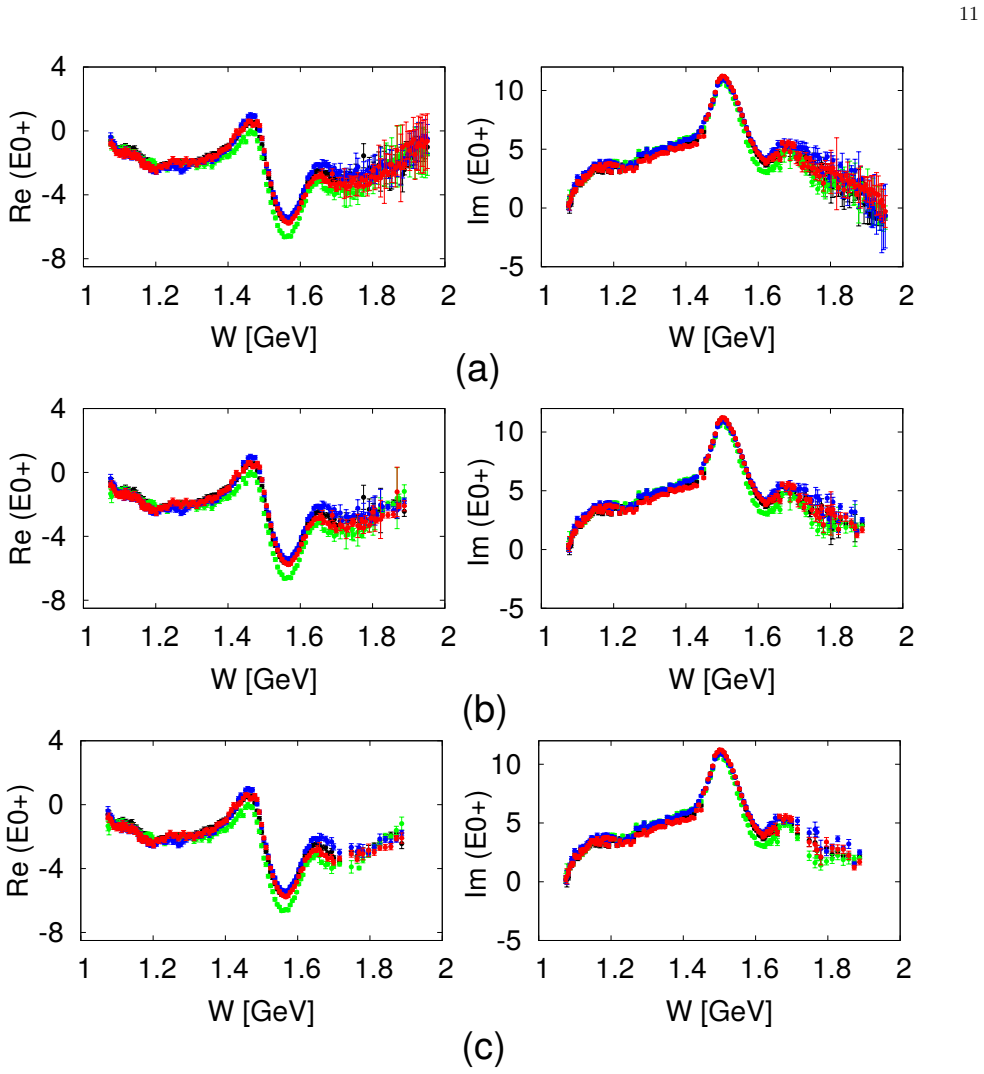
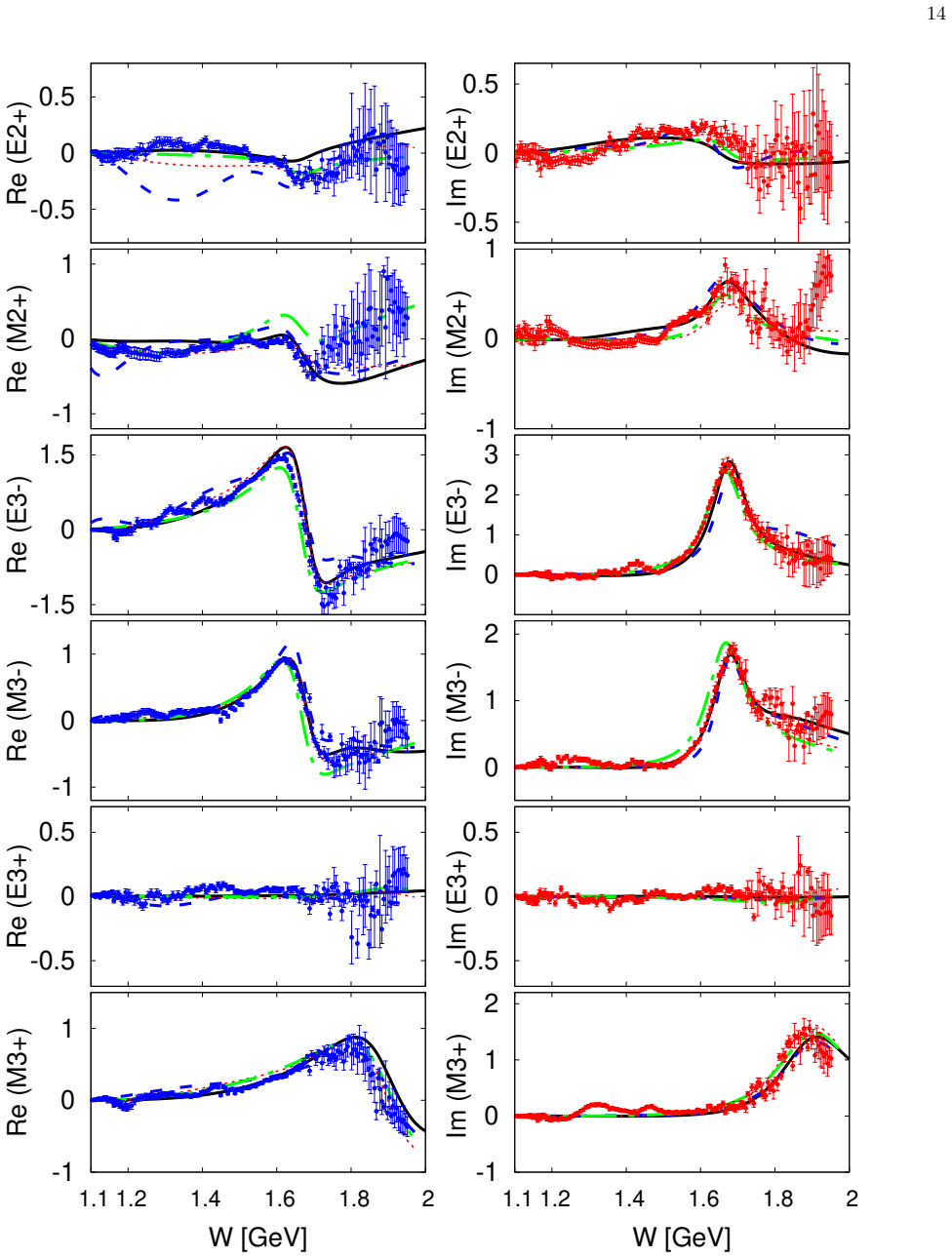
The central discovery is that an iterated two-step procedure\u2014fixed-$t$ amplitude analysis using Pietarinen expansions, coupled to single-energy partial-wave fits constrained by the result\u2014produces an energy-continuous set of $\pi^0$ photoproduction multipoles from the world data set. Starting from four independent energy-dependent solutions and randomizing them by 30\%, the four final single-energy solutions nearly coincide below $W = 1.7$ GeV despite large differences between the starting models in some multipoles. The averaged solution agrees with the energy-dependent models where those agree and interpolates between them where they differ. Above 1.7 GeV the solutions spread again, and the paper attributes this to the reduced set of measured observables and to weaker fixed-$t$ constraints at larger $-t$, not to a failure of the method.
Load-bearing premise
The load-bearing premise is that imposing analyticity on a fixed momentum-transfer grid fixes the overall energy- and angle-dependent phase that ordinary single-energy fits leave free; the paper states this has not been proven and is supported mainly by extensive experience in elastic pion-nucleon scattering.
Editorial extensions
If this is right
- Below $W = 1.7$ GeV, the converged band gives a data-anchored multipole set that can serve as a reference for energy-dependent analyses without endorsing any one model.
- Resonance parameters extracted from these multipoles would inherit the reduced model dependence, tightening the nucleon spectrum in a region where independent analyses still disagree.
- At higher energies the procedure identifies which observables are missing: the spread of predictions for $T$, $P$, and recoil observables marks where new measurements would most improve uniqueness.
- The same iterative fixed-$t$ scheme can be applied to other meson photoproduction channels and, as the paper notes, to a full isospin-coupled analysis, extending the method beyond the single $\pi^0 p$ channel.
Reading between the lines
- An extension the paper leaves implicit: the width of the four-solution band below 1.7 GeV can be read as an empirical, data-driven upper bound on the continuum ambiguity\u2014the band acts as an uncertainty estimate for the multipoles themselves.
- A sharper test of \u201cminimal model dependence\u201d would be a pseudo-data experiment: generate synthetic observables from one known amplitude, run the iterative procedure from several deliberately phase-rotated seeds, and check whether all solutions land in the quoted band. This would separate what the data determine from what the constraint imposes.
- Because the constraint is implemented through truncated expansions with an adjustable weight, the method\u2019s model independence is relative to that parametrization; comparing against an alternative conformal-mapping basis would reveal any residual basis dependence.
- The sharp predictions for unmeasured recoil observables at $W \approx 1.2$ and $1.5$ GeV suggest that a single dedicated double-polarization measurement could nearly complete the amplitude reconstruction at those energies.
Signed reviews
Editorial analysis
A structured set of objections, weighed in public.
Referee Report
Summary. The paper presents a single-energy partial wave analysis (SE PWA) of the γp→π0p reaction from threshold to W = 2 GeV, imposing point-to-point continuity in energy through an iterative fixed-t analyticity constraint based on Pietarinen expansions. Four energy-dependent models (BnGa, JüBo, SAID, MAID) are used only as starting points in the first iteration. The authors report that the resulting multipoles form a narrow band below W = 1.7 GeV, which they interpret as minimal dependence on the initial model assumptions, while above 1.7 GeV the solutions diverge due to sparse data. They also compare predictions for unmeasured observables at several energies and recommend specific measurements to improve the uniqueness of future analyses.
Significance. If the claimed model independence is valid, the method offers a data-driven extraction of multipoles in the baryon resonance region, with a quantitative systematic band, which would be a valuable addition to hadron spectroscopy. The paper is unusually transparent about its limitations, explicitly noting in Section II that the phase-pinning property of fixed-t analyticity has not been proven for this reaction. The empirical convergence of four seeds is a useful sanity check, and the predictions for future measurements are constructive. However, the central claim rests on an unproven premise, and several analysis choices (correlated interpolated data, unreported strength of the penalty term) make the current evidence insufficient to fully support the claim.
major comments (4)
- [II] The central claim of minimal model dependence requires that the fixed-t analyticity constraint uniquely fixes the overall phase of the amplitudes, i.e., that it resolves the continuum ambiguity. The paper states in Section II that this has 'not been proven' and is only 'extensively tested in piN elastic' scattering. The four-seed convergence in Figs. 3-4 does not close this gap, because the penalty terms in Eqs. (2) and (4) pull each solution toward the previous iteration; a sufficiently large q_cons would force any seeds to converge. The value of q_cons is never reported, nor are the final χ^2 values or the relative sizes of the data and constraint terms. I recommend adding a Monte Carlo closure test: take one seed solution, apply random energy- and angle-dependent phase rotations φ(W,θ) as in Ref. [9], and run the iterative procedure to verify that all rotated inputs converge to the same band. Without such a test, the claimed model independence is not established.
- [III.A] The interpolated data are fitted as independent measurements, yet the text in Section III.A explicitly notes that 'the individual errors are not independent.' This inconsistency means the χ^2 values and the uncertainties on the extracted multipoles are likely underestimated, and the agreement among the four SE solutions may be artificially good. The authors should either propagate the interpolation covariance (e.g., through a covariance matrix from the spline smoothing) or demonstrate that the correlations have a negligible effect on the convergence band. This is needed for the quoted errors in Figs. 3-4 to be physically meaningful.
- [IV] The description of the seed generation is incomplete: 'We randomly scatter them with 30% uncertainty' (Section IV) is not a well-defined procedure. A random scatter of the model multipoles does not sample the continuum ambiguity, which is the relevant source of model dependence; it only probes the stability of the fit around a particular phase class. The authors should specify exactly how the randomization is performed and, ideally, include seeds that differ by the overall phase φ(W,θ) (for example, by rotating one of the models by a nontrivial angle) to test whether the fixed-t constraint actively removes such differences. As written, the four starting points are not independent draws over the allowed phase ambiguity.
- [II, Eqs. (2) and (4)] The penalty terms in Eqs. (2) and (4) use ε_Re = ε_Im = 1, but the helicity amplitudes H_k have physical dimensions. The absolute scale of χ^2_cons therefore depends on the units chosen for H, and the reported value of q_cons is necessary for reproducibility. The authors should specify the units of the helicity amplitudes and report the numerical value of q_cons used in the fits, together with a breakdown of χ^2_data versus χ^2_cons. Without this information, a reader cannot judge whether the constraint is a gentle guide or an overwhelming force that trivially pulls the solutions together.
minor comments (4)
- [Fig. 10] The caption of Fig. 10 states 'E = 1.0 MeV'; this should be 'E = 1.0 GeV'.
- [Appendix A] In Appendix A, the text says 'center-of-mass (c.c.) system'; this should be 'center-of-mass (c.m.) system'.
- [Figs. 6 and 7 captions] The figure captions contain the typo 'avarage' instead of 'average'.
- [Section IV] In Section IV, the sentence 'some of them (Bonn-Gatchina for instance) has very different E0+ and M1− multipoles' contains a subject-verb agreement error: 'has' should be 'have'.
Circularity Check
No circular reduction: the iterative FT/SE loop is a data-constrained fixed-point search, and the flagged phase-pinning issue is an unproven assumption, not a constructional identity.
full rationale
The paper's claimed derivation chain is a two-step constrained fit: the fixed-t amplitude analysis minimizes chi^2_FTdata plus a penalty toward the current single-energy solution (Eqs. 1-2), and the single-energy PWA minimizes chi^2_SEdata plus a penalty toward the fixed-t amplitudes (Eqs. 3-4), iterating to convergence. The final multipoles therefore are not defined as the seed amplitudes; the data chi^2 terms enter at every iteration, and the claimed minimal model dependence is supported empirically by comparing four different ED-model seeds, not by any equation that sets the output equal to an input. The one genuinely load-bearing weakness is the passage in Sec. II: "It has not been proven, but it is extensively tested in piN elastic, fixed-t constrained SE PWA [20], and since then recommended for other processes." This is an explicit admission that the phase-pinning power of fixed-t analyticity is assumed rather than proved; if that assumption fails, the convergence of the four seeds would not certify a unique amplitude. That is a correctness risk or a missing proof, not a circularity: no prediction or first-principles result in the paper reduces by construction to its inputs, and the use of Ref. [18] for the method is ordinary method transfer rather than a self-citation loop. The paper is therefore self-consistent and the main claim has independent content, so the circularity score is 0.
Assumptions & free parameters
free parameters (4)
- q_cons (constraint weight) =
not stated
- Partial wave truncation L_max =
l = 3 (F waves)
- Fixed-t grid =
20 equidistant t values in [-1.00, -0.005] GeV^2
- Constraint error scale epsilon =
1 (dimensionless)
assumptions (5)
- domain assumption Mandelstam analyticity: the four invariant amplitudes are analytic in s and t with only s- and u-channel cuts and nucleon poles, representable by convergent Pietarinen expansions at fixed t.
- domain assumption The truncated partial wave basis (l up to 3) is sufficient for the considered energies and observables.
- domain assumption Fixed-t analyticity plus energy continuity fully resolves the continuum (overall phase) ambiguity.
- ad hoc to paper Interpolated data points behave statistically as independent measurements with nearest-neighbor errors.
- domain assumption Isospin can be ignored: pi0 photoproduction is treated as a single-channel problem with the pi0 as a 'light eta meson'.
Cite this review
Pith. "Pith review of Single-Energy Partial Wave Analysis for $\pi^0$ Photoproduction on Proton with Fixed-$t$ Analyticity Imposed." pith.science (2026). https://pith.science/paper/XMKHZ4YJ
@misc{pith2026190805167,
  author       = {Pith},
  title        = {Pith review of: Single-Energy Partial Wave Analysis for $\pi^0$ Photoproduction on Proton with Fixed-$t$ Analyticity Imposed},
  year         = {2026},
  howpublished = {\url{https://pith.science/paper/XMKHZ4YJ}},
  note         = {Machine review of arXiv:1908.05167}
}
abstract
High precision data of the $\gamma p \to \pi^0 p$ reaction from its threshold up to $W=2$~GeV have been used in order to perform a single-energy partial wave analysis with minimal model dependence. Continuity in energy was achieved by imposing constraints from fixed-$t$ analyticity in an iterative procedure. Reaction models were only used as starting point in the very first iteration. We demonstrate that with this procedure partial wave amplitudes can be obtained which show only a minimal dependence on the initial model assumptions.
Figures


Figures from the paper (6 more)




Reference graph
Works this paper leans on
- [9]
-
[1]
A. V. Anisovich et al., Phys. Rev. C 96, 055202 (2017), and references therein; and http://pwa.hiskp.uni-bonn.de/
work page 2017
-
[2]
D. R¨ onchen, M. D¨ oring, H. Haberzettl, J. Haidenbauer, U. -G. Meißner and K. Nakayama Eur. Phys. J. A51, 70 (2015), and references therein; and http://collaborations.fz-juelich.de/ikp/meson-baryon/main
work page 2015
-
[3]
R. L. Workman, R. A. Arndt, W. J. Briscoe, M. W. Paris, and I. I. Strakovsky, Phys. Rev. C 86 , 035202 (2012); and http://gwdac.phys.gwu.edu/
work page 2012
-
[4]
D. Drechsel, S. S. Kamalov and L. Tiator, Eur. Phys. J. A 34 (2007) 69; and https://maid.kph.uni-mainz.de/
work page 2007
-
[5]
A. V. Anisovich et al., Eur. Phys. J. A 52, no. 9, 284 (2016)
work page 2016
-
[6]
A. S. Omelaenko, Yad. Fiz. 34, 730 (1981)
work page 1981
-
[7]
Y. Wunderlich, A. varc, R. L. Workman, L. Tiator and R. Beck, Phys. Rev. C 96, no. 6, 065202 (2017)
work page 2017
Show all 37 references
-
[8]
R. L. Workman, L. Tiator, Y. Wunderlich, M. Dring and H. Haberzettl, Phys. Rev. C 95, no. 1, 015206 (2017)
2017
-
[10]
K. M. Watson, Phys. Rev. 95, 228 (1954)
1954
-
[11]
Beck et al., Phys
R. Beck et al., Phys. Rev. C 61, 035204 (2000)
2000
-
[12]
Hornidge et al
D. Hornidge et al. [A2 and CB-TAPS Collaborations], Phys. Rev. Lett. 111, no. 6, 062004 (2013)
2013
-
[13]
Schumann et al
S. Schumann et al. [A2 Collaboration at MAMI], Phys. Lett. B 750, 252 (2015)
2015
-
[14]
Markou, E
L. Markou, E. Stiliaris and C. N. Papanicolas, Eur. Phys. J. A 54, no. 7, 115 (2018)
2018
-
[15]
G. Y. Chen, S. S. Kamalov, S. N. Yang, D. Drechsel, and L. Tiator, Phys. Rev. C 76 , 035206 (2007); L. Tiator, S. S. Kamalov, S. Ceci, Guan Yeu Chen, D. Drechsel, A. Svarc, and Shin Nan Yang, Phys. Rev. C 82 , 055203 (2010)
2007
-
[16]
R. A. Arndt, W. J. Briscoe, I. I. Strakovsky, and R. L. Workman, Phys. Rev. C 74 , 045205 (2006); R. L. Workman, R. A. Arndt, W. J. Briscoe, M. W. Paris, and I. I. Strakovsky, Phys. Rev. C 86 , 035202 (2012)
2006
-
[17]
B. C. Hunt and D. M. Manley, Phys. Rev. C 99, 055203 (2019) and Phys. Rev. C 99, 055205 (2019)
2019
-
[18]
Osmanovi´ c, M
H. Osmanovi´ c, M. Hadˇ zimehmedovi´ c, R. Omerovi´ c, J. Stahov, V. Kashevarov, K. Nikonov, M. Ostrick, L. Tiator, and A. ˇSvarc, Phys. Rev. C 97 , 015207 (2018)
2018
-
[19]
Hamilton, J
J. Hamilton, J. L. Petersen, New development in Dispersion Theory , Vol. 1. Nordita, Copenhagen, 1973
1973
-
[20]
H¨ ohler,Pion Nucleon Scattering , Part 2, Landolt-B¨ ornstein: Elastic and Charge Exchange Scattering of Elementary Particles, Vol
G. H¨ ohler,Pion Nucleon Scattering , Part 2, Landolt-B¨ ornstein: Elastic and Charge Exchange Scattering of Elementary Particles, Vol. 9b (Springer-Verlag, Berlin, 1983)
1983
-
[21]
Pietarinen, Nuovo Cimento Soc
E. Pietarinen, Nuovo Cimento Soc. Ital. Fis. 12A, 522 (1972)
1972
-
[22]
Adlarson et al
P. Adlarson et al. [A2 Collaboration at MAMI], Phys. Rev. C 92, 024617 (2015)
2015
-
[23]
Leukel, PhD thesis (2001) Mainz University
R. Leukel, PhD thesis (2001) Mainz University
2001
-
[24]
J. R. M. Annand et al. [A2 Collaboration at MAMI] Phys. Rev. C 93, 055209 (2016)
2016
-
[25]
Otte, PhD thesis (2015) Mainz University
P. Otte, PhD thesis (2015) Mainz University
2015
-
[26]
Preobrajenski, PhD thesis (2001), Mainz University
I. Preobrajenski, PhD thesis (2001), Mainz University
2001
-
[27]
Linturi, PhD thesis (2015) Mainz University
J. Linturi, PhD thesis (2015) Mainz University
2015
-
[28]
Ahrens et al
J. Ahrens et al. Eur. Phys. J. A 26, 135 (2005)
2005
-
[29]
Hartmann et al
J. Hartmann et al. [CBELSA/TAPS Collaboration] Phys. Rev. Lett. 113, 062001 (2014)
2014
-
[30]
Gottschall et al
M. Gottschall et al. [CBELSA/TAPS Collaboration] Phys. Rev. Lett. 112, 012003 (2014)
2014
-
[31]
Thiel et al
A. Thiel et al. [CBELSA/TAPS Collaboration] Phys. Rev. Lett. 109, 102001 (2012)
2012
-
[32]
Bartalini at
O. Bartalini at. al. Eur. Phys. J. A 26, 399 (2005)
2005
-
[33]
de Boor, A Practical Guide to Splines , Springer-Verlag, Heidelberg, 1978, revised 2001
C. de Boor, A Practical Guide to Splines , Springer-Verlag, Heidelberg, 1978, revised 2001
1978
-
[34]
I. G. Aznauryan, Phys. Rev. C 67, 015209 (2003)
2003
-
[35]
Pasquini, D
B. Pasquini, D. Drechsel, and L. Tiator, Eur. Phys. J. A 27, 231 (2006)
2006
-
[36]
I. S. Barker, A. Donnachie, J. K. Storrow, Nucl. Phys. B 95, 347 (1975)
1975
-
[37]
R. L. Walker, Phys. Rev. 182, 1729 (1969)
1969
Reviewed August 14, 2026 · model on record in the stance chip above.
Discussion (0). Continue with ORCID to comment.