REVIEW 3 major objections 5 minor 47 references
Substrate effects on charged defects in two-dimensional materials
T0 review · 3 major / 5 minor · reviewed 2026-08-14 · deepseek-v4-flash
Pith's one-line read A calibrated continuum dielectric profile reproduces explicit-substrate charged-defect energies in 2D materials to within 0.16 eV.
desk verdict A pragmatic continuum-solvation extension that passes its own benchmarks, but the single-Gaussian calibration makes the blanket generality claim thinner than the abstract suggests. read the letter →
The pith
A machine-rendered reading of the paper's core claim, the machinery that carries it, and where it could break.
The reading
What carries the argument
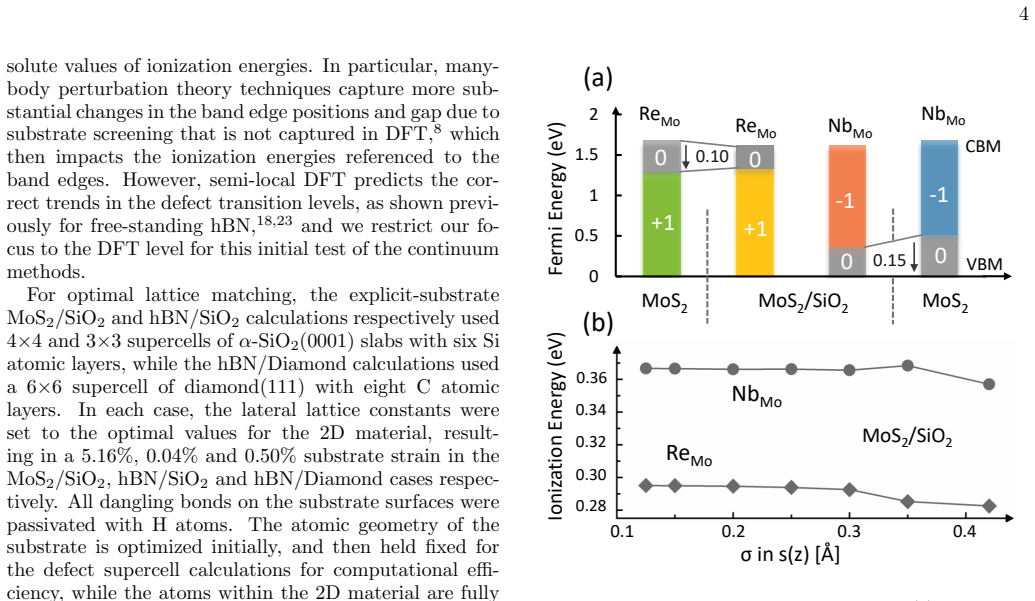
The load-bearing object is the dielectric shape function $s(z) = \frac{1}{2}\mathrm{erfc}\left(\frac{z_0 - z}{\sigma \sqrt{2}}\right)$ and the associated modified Poisson equation solved in cylindrical coordinates within the DFT self-consistency loop; it converts the substrate's many atoms into a smooth dielectric slab whose bound surface charge screens the defect. Its boundary position $z_0$ is calibrated from one Gaussian test charge, and $\sigma$ is fixed at 0.2 Å with results insensitive below 0.3 Å. A secondary mechanism, Eq. 7, uses the isolated self-energy of the same Gaussian model charge in the 2D-only versus 2D-plus-substrate dielectric environments, plus band-edge offsets, to give a defect-independent estimate of the ionization-energy shift.
What would settle it
Compute, with explicit substrate DFT, a charged defect whose charge density is strongly delocalized or shaped very differently from a Gaussian (for example, a shallow donor with a diffuse orbital, or a defect whose wavefunction hybridizes with the substrate), and compare its ionization energy to the continuum-model prediction. A disagreement larger than the 0.05–0.16 eV band found for the localized defects studied here would show that a single Gaussian test charge does not calibrate the substrate for all defects.
Extended reading notes
Core claim
The central claim is that a continuum model of the substrate, given by a dielectric profile $\epsilon(z) = 1 + (\epsilon_b - 1)s(z)$ with $s(z) = \frac{1}{2}\mathrm{erfc}\left(\frac{z_0 - z}{\sigma \sqrt{2}}\right)$, contains the decisive electrostatic physics of charged defects in 2D materials on substrates. The boundary position $z_0$ is not guessed; it is fixed by requiring the interaction energy of a Gaussian test charge at the monolayer center with the continuum substrate to equal the corresponding DFT interaction energy of the explicit substrate. Once calibrated, the modified Poisson equation replaces the Hartree term in the DFT calculation, yielding charged-defect total energies whose ionization energies agree with explicit substrate calculations. For band edges, an additional explicit calculation of the perfect 2D material on the substrate supplies the non-electrostatic VBM/CBM offsets, which are small relative to the roughly 0.94–1.00 eV rigid electrostatic shift. The paper also shows the ionization-energy reduction is nearly identical across defects, so a single Gaussian self-energy shift (Eq. 7) converts all free-standing defect levels to substrate values within about 0.02 eV.
Load-bearing premise
The load-bearing premise is that one dielectric profile, fitted to the response of the bare substrate to a single Gaussian test charge at the monolayer center, stays accurate for every defect's charge distribution, position, and orbital character, and also for the band-edge shifts.
Editorial extensions
If this is right
- Charged-defect transition levels in 2D materials on realistic substrates can be computed from free-standing DFT plus a calibrated dielectric environment, at 40–200x lower cost than explicit substrate calculations.
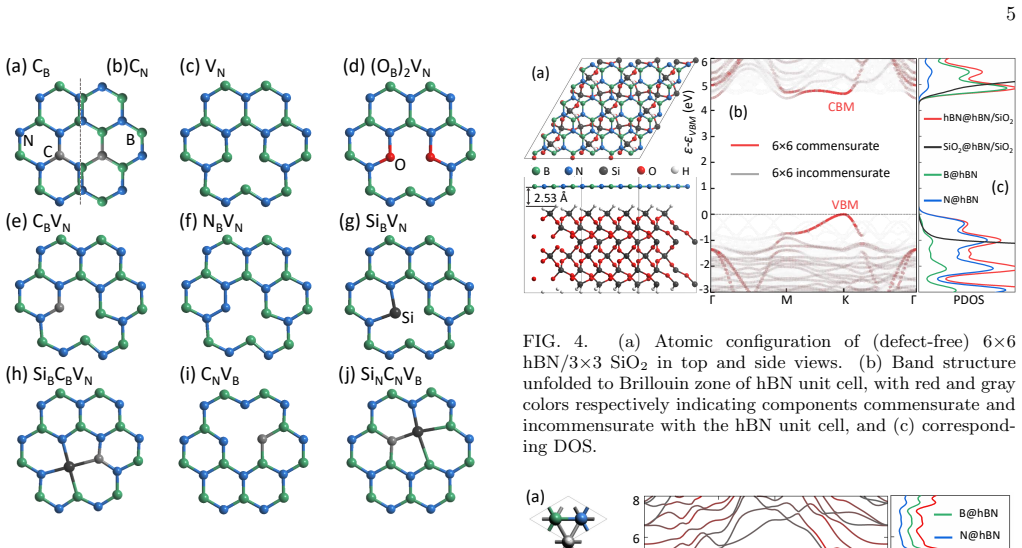
- Substrate screening lowers donor and acceptor ionization energies: by 0.10–0.15 eV for ReMo and NbMo in MoS2/SiO2, by 0.27–0.33 eV for hBN defects on SiO2, and by 0.47–0.64 eV on diamond.
- All ten hBN defects studied remain deep on SiO2 and diamond even after substrate screening, so they are expected to retain the long excited-state lifetimes needed for quantum applications.
- Because the ionization-energy reduction is nearly independent of the defect, a single Gaussian-charge shift computed once per material/substrate pair can update every free-standing defect level with about 0.02 eV accuracy.
- The continuum construction applies to arbitrary combinations of defects, 2D materials, and substrates, enabling screening of both defect candidates and material–substrate pairs for targeted properties.
Reading between the lines
- One testable extension: because the shift is nearly defect-independent for localized defects, the method's range could be mapped by testing delocalized or substrate-hybridized charge states, where the single-Gaussian calibration is likely to be least accurate.
- The paper leaves implicit that the same dielectric-profile construction applies to encapsulated multilayers and heterostructures by superposing profiles for each interface; the calibration cost would be paid once per material pair, not per defect.
- A direct prediction the benchmarks do not test: replacing the optical dielectric constant with the low-frequency value should reproduce explicit calculations in which substrate atoms relax, a comparison that would validate the model's treatment of substrate degrees of freedom.
- The explicit band-edge offset calculation remains a one-time DFT run per (2D material, substrate) pair, so the 40–200x speedup applies to the per-defect screening loop rather than the whole pipeline; the economics favor many defects sharing one substrate.
Signed reviews
Editorial analysis
A structured set of objections, weighed in public.
Referee Report
Summary. The paper presents a continuum dielectric model for including substrate effects in DFT calculations of charged defects in 2D materials. The substrate is represented by a smooth dielectric profile with parameters sigma and z0; z0 is calibrated against the DFT interaction energy of a Gaussian test charge with the explicit substrate. Defect ionization energies are then computed in the free-standing 2D material with the continuum substrate, plus band-edge shifts from an explicit perfect-layer/substrate calculation. The method is benchmarked against explicit substrate DFT for ReMo/NbMo in MoS2/SiO2 and for selected hBN defects on SiO2 and diamond, with reported agreement of 0.05 eV and 0.10-0.16 eV, respectively. The paper also introduces Eq. 7, a defect-independent estimate of the ionization-energy shift, and applies the method to predict substrate effects on ten hBN defects.
Significance. The work addresses a real bottleneck: charged-defect supercells with explicit substrates are costly. If the method holds, it enables high-throughput screening of defects in 2D materials on substrates at 40-200x reduction in defect-supercell cost. Strengths: benchmarks against explicit DFT for two material/substrate combinations; the sigma independence is demonstrated; Eq. 7 is a simple, falsifiable prediction; calculations use open-source software. Main limitation: the calibration and defect-independence assumptions are tested only on in-plane, fairly localized defects, leaving transferability to general defects unproven.
major comments (3)
- [II.B, Eq. 6] The calibration condition E_int^s(z0) = E_int^DFT fits z0 to the total DFT interaction energy of one Gaussian test charge. That energy includes the electrostatic interaction of the test charge with the bare substrate's potential, not just the dielectric image-charge response. A dielectric-only continuum model cannot distinguish these contributions, so z0 can absorb a substrate-potential term that may not transfer to defects with different charge centroids or orbital character. The current benchmarks are all in-plane localized defects, so they mainly probe the same monopole-like response used for calibration. To support the general claim, the authors should test z0 transferability, for example by calibrating with test charges at different positions or with a dipole/quadrupole charge distribution, and by benchmarking one defect with significant out-of-plane charge density.
- [III.C, Eq. 7 and Table I] The claim that Eq. 7 estimates ΔIE with ~0.02 eV accuracy is supported only by comparison with the continuum model's own self-consistent calculations. Both columns in Table I derive from the same Gaussian self-energy in the same dielectric profile, so agreement is partially by construction. The authors should compare Eq. 7 directly with the explicit DFT ΔIE values (e.g., for ReMo/NbMo in MoS2/SiO2 and the explicit hBN cases) or clearly state that Eq. 7 is a fast approximation within the continuum model whose accuracy relative to explicit DFT has not been separately benchmarked.
- [Abstract and Section III.B] The claim of "computational expediency of calculating defects in free-standing 2D materials" should be qualified, because the method still requires one explicit DFT calculation of the perfect 2D material on the substrate to determine ΔεVBM and ΔεCBM (Fig. 1(d), Section III.B). The 40-200x speedup applies only to the defect-containing supercells; the required substrate-plus-perfect-layer calculation remains an explicit, nontrivial cost. This should be stated clearly so readers can assess the true computational savings.
minor comments (5)
- [II.B] The notation for the continuum interaction energy is inconsistent; "Es(z)int" should be defined (e.g., E_int^s(z)) and distinguished from E_int^DFT.
- [Table I] Headers "Self-consistent" and "Continuum Model" in the two sub-tables are inconsistent; use the same labels for the same quantity.
- [III.A] The comparison for MoS2/SiO2 is against previous explicit calculations (Ref. 40), not new explicit calculations; this should be stated explicitly in the text.
- [III.B] The sentence "The defects are all deep in hBN with ionization energies in the range of 2.14-4.01 eV" appears to refer to both donors and acceptors; specify which panel and whether this range includes both.
- [II.B] The text says "we select the cavity parameters such that E_int^s(z)=E_int^DFT" and then mentions two parameters but fixes sigma; please clarify that only z0 is fitted.
Circularity Check
No significant circularity: the continuum substrate model is calibrated to a DFT test-charge response and its predictions are benchmarked against independent explicit-substrate DFT calculations.
full rationale
The paper's central parameter z0 is fit to E_DFT_int, the interaction of a Gaussian test charge with the explicit DFT substrate (Eq. 6), which is not a defect ionization energy. The claimed predictions (ionization-energy reductions) are then compared with explicit substrate DFT: previously published MoS2/SiO2 calculations (Ref. 40) and the authors' own explicit DFT for selected hBN defects. Thus the headline agreement is not forced by the fitting target. The continuum correction scheme is taken from prior published work (Refs. 17, 18, including the second author), but this is supporting methodology, not the novel substrate model, and it is not the source of the benchmark agreement. Eq. 7 reuses the Gaussian self-energy to estimate ionization-energy shifts and agrees with the self-consistent continuum model, but that agreement is a model-internal consistency check, while the self-consistent model itself is validated externally. No equation reduces to the calibration input by construction.
Assumptions & free parameters
free parameters (2)
- z0 (substrate dielectric transition center) =
Not reported in main text; listed in Table S1
- sigma (shape function width) =
0.2 Å recommended
assumptions (5)
- domain assumption Substrate electrostatic response can be represented by a local dielectric function varying only along z, with an erfc shape function s(z).
- domain assumption A dielectric profile calibrated against one Gaussian test charge at the monolayer center transfers to all defect charge distributions.
- domain assumption Substrate-induced band edge shifts are rigid shifts determined by core-level alignment, with no other electronic structure changes.
- domain assumption Using the optical dielectric constant of the substrate is adequate because substrate atoms are held fixed.
- domain assumption Semi-local DFT predicts correct trends in defect transition levels.
Cite this review
Pith. "Pith review of Substrate effects on charged defects in two-dimensional materials." pith.science (2026). https://pith.science/paper/J4VORRRL
@misc{pith2026190805208,
  author       = {Pith},
  title        = {Pith review of: Substrate effects on charged defects in two-dimensional materials},
  year         = {2026},
  howpublished = {\url{https://pith.science/paper/J4VORRRL}},
  note         = {Machine review of arXiv:1908.05208}
}
abstract
Two-dimensional (2D) materials are strongly affected by the dielectric environment including substrates, making it an important factor in designing materials for quantum and electronic technologies. Yet, first-principles evaluation of charged defect energetics in 2D materials typically do not include substrates due to the high computational cost. We present a general continuum model approach to incorporate substrate effects directly in density-functional theory calculations of charged defects in the 2D material alone. We show that this technique accurately predicts charge defect energies compared to much more expensive explicit substrate calculations, but with the computational expediency of calculating defects in free-standing 2D materials. Using this technique, we rapidly predict the substantial modification of charge transition levels of two defects in MoS$_2$ and ten defects promising for quantum technologies in hBN, due to SiO$_2$ and diamond substrates. This establishes a foundation for high-throughput computational screening of new quantum defects in 2D materials that critically accounts for substrate effects.
Figures

Figures from the paper (2 more)


Reference graph
Works this paper leans on
-
[1]
author author M. Toth \ and\ author I. Aharonovich ,\ @noop journal journal Ann. Rev. Phys. Chem. \ volume 70 ,\ pages 123 ( year 2019 ) NoStop
work page 2019
-
[2]
author author Z. Lin , author B. R. \ Carvalho , author E. Kahn , author R. Lv , author R. Rao , author H. Terrones , author M. A. \ Pimenta , \ and\ author M. Terrones ,\ @noop journal journal 2D Mater. \ volume 3 ,\ pages 022002 ( year 2016 ) NoStop
work page 2016
-
[3]
author author D. Wang , author X.-B. \ Li , author D. Han , author W. Q. \ Tian , \ and\ author H.-B. \ Sun ,\ 10.1016/j.nantod.2017.07.001 journal journal Nano Today \ volume 16 ,\ pages 30 ( year 2017 a ) NoStop
-
[4]
author author H. I. \ Rasool , author C. Ophus , \ and\ author A. Zettl ,\ @noop journal journal Adv. Mater. \ volume 27 ,\ pages 5771 ( year 2015 ) NoStop
work page 2015
-
[5]
author author J. Hong , author C. Jin , author J. Yuan , \ and\ author Z. Zhang ,\ @noop journal journal Adv. Mater. \ volume 29 ,\ pages 1606434 ( year 2017 ) NoStop
work page 2017
-
[6]
author author A. Alkauskas , author M. D. \ McCluskey , \ and\ author C. G. \ Van de Walle ,\ @noop journal journal J. Appl. Phys. \ volume 119 ,\ pages 181101 ( year 2016 ) NoStop
work page 2016
-
[7]
Zhang ,\ @noop journal journal J
author author S. Zhang ,\ @noop journal journal J. Phys.: Cond. Matt. \ volume 14 ,\ pages R881 ( year 2002 ) NoStop
work page 2002
-
[8]
author author M. H. \ Naik \ and\ author M. Jain ,\ @noop journal journal Phys. Rev. Mater. \ volume 2 ,\ pages 084002 ( year 2018 a ) NoStop
work page 2018
Show all 47 references
-
[9]
Singh , author A
author author A. Singh , author A. Manjanath , \ and\ author A. K. \ Singh ,\ 10.1021/acs.jpcc.8b08082 journal journal J. Phys. Chem. C \ volume 122 ,\ pages 24475 ( year 2018 ) NoStop
2018 doi
-
[10]
author author S. A. \ Tawfik , author S. Ali , author M. Fronzi , author M. Kianinia , author T. T. \ Tran , author C. Stampfl , author I. Aharonovich , author M. Toth , \ and\ author M. J. \ Ford ,\ 10.1039/C7NR04270A journal journal Nanoscale \ volume 9 ,\ pages 13575 ( year...
-
[11]
Sajid , author J
author author A. Sajid , author J. R. \ Reimers , \ and\ author M. J. \ Ford ,\ @noop journal journal Phys. Rev. B \ volume 97 ,\ pages 064101 ( year 2018 ) NoStop
2018
-
[12]
Gupta , author J.-H
author author S. Gupta , author J.-H. \ Yang , \ and\ author B. I. \ Yakobson ,\ 10.1021/acs.nanolett.8b04159 journal journal Nano Lett. \ volume 19 ,\ pages 408 ( year 2019 ) NoStop
2019 doi
-
[13]
Grosso , author H
author author G. Grosso , author H. Moon , author B. Lienhard , author S. Ali , author D. K. \ Efetov , author M. M. \ Furchi , author P. Jarillo-Herrero , author M. J. \ Ford , author I. Aharonovich , \ and\ author D. Englund ,\ @noop journal journal Nature Commun. \ volume 8...
2017
-
[14]
author author T. T. \ Tran , author C. Elbadawi , author D. Totonjian , author C. J. \ Lobo , author G. Grosso , author H. Moon , author D. R. \ Englund , author M. J. \ Ford , author I. Aharonovich , \ and\ author M. Toth ,\ 10.1021/acsnano.6b03602 journal journal ACS Nano \ ...
-
[15]
\ Komsa \ and\ author A
author author H.-P. \ Komsa \ and\ author A. Pasquarello ,\ @noop journal journal Phys. Rev. Lett. \ volume 110 ,\ pages 095505 ( year 2013 ) NoStop
2013
-
[16]
Wang , author D
author author D. Wang , author D. Han , author X.-B. \ Li , author S.-Y. \ Xie , author N.-K. \ Chen , author W. Q. \ Tian , author D. West , author H.-B. \ Sun , \ and\ author S. Zhang ,\ @noop journal journal Phys. Rev. Lett. \ volume 114 ,\ pages 196801 ( year 2015 ) NoStop
2015
-
[17]
Sundararaman \ and\ author Y
author author R. Sundararaman \ and\ author Y. Ping ,\ 10.1063/1.4978238 journal journal J. Chem. Phys. \ volume 146 ,\ pages 104109 ( year 2017 ) NoStop
2017 doi
-
[18]
Wu , author A
author author F. Wu , author A. Galatas , author R. Sundararaman , author D. Rocca , \ and\ author Y. Ping ,\ @noop journal journal Phys. Rev. Mater. \ volume 1 ,\ pages 071001 ( year 2017 ) NoStop
2017
-
[19]
Wang , author D
author author D. Wang , author D. Han , author X.-B. \ Li , author N.-K. \ Chen , author D. West , author V. Meunier , author S. Zhang , \ and\ author H.-B. \ Sun ,\ @noop journal journal Phys. Rev. B \ volume 96 ,\ pages 155424 ( year 2017 b ) NoStop
2017
-
[20]
Freysoldt \ and\ author J
author author C. Freysoldt \ and\ author J. Neugebauer ,\ @noop journal journal Phys. Rev. B \ volume 97 ,\ pages 205425 ( year 2018 ) NoStop
2018
-
[21]
Wang , author X.-B
author author D. Wang , author X.-B. \ Li , \ and\ author H.-B. \ Sun ,\ 10.1039/C7NR03389C journal journal Nanoscale \ volume 9 ,\ pages 11619 ( year 2017 c ) NoStop
2017 doi
-
[22]
author author M. H. \ Naik \ and\ author M. Jain ,\ @noop journal journal Comput. Phys. Comm. \ volume 226 ,\ pages 114 ( year 2018 b ) NoStop
2018
-
[23]
author author T. J. \ Smart , author F. Wu , author M. Govoni , \ and\ author Y. Ping ,\ @noop journal journal Phys. Rev. Mater. \ volume 2 ,\ pages 124002 ( year 2018 ) NoStop
2018
-
[24]
Wang , author D
author author D. Wang , author D. Han , author D. West , author N.-K. \ Chen , author S.-Y. \ Xie , author W. Q. \ Tian , author V. Meunier , author S. Zhang , \ and\ author X.-B. \ Li ,\ @noop journal journal npj Comput. Mater. \ volume 5 ,\ pages 8 ( year 2019 ) NoStop
2019
-
[25]
Tomasi , author B
author author J. Tomasi , author B. Mennucci , \ and\ author R. Cammi ,\ @noop journal journal Chem. Rev. \ volume 105 ,\ pages 2999 ( year 2005 ) NoStop
2005
-
[26]
author author A. V. \ Marenich , author C. J. \ Cramer , \ and\ author D. G. \ Truhlar ,\ @noop journal journal J. Phys. Chem. B \ volume 113 ,\ pages 6378 ( year 2009 ) NoStop
2009
-
[27]
Andreussi , author I
author author O. Andreussi , author I. Dabo , \ and\ author N. Marzari ,\ @noop journal journal J. Chem. Phys \ volume 136 ,\ pages 064102 ( year 2012 ) NoStop
2012
-
[28]
Xiao , author T
author author H. Xiao , author T. Cheng , author W. A. \ Goddard III , \ and\ author R. Sundararaman ,\ @noop journal journal J. Am. Chem. Soc. \ volume 138 ,\ pages 483 ( year 2016 ) NoStop
2016
-
[29]
author author A. T. B. \ Jason D. Goodpaster \ and\ author M. Head-Gordon ,\ @noop journal journal J. Phys. Chem. Lett. \ volume 7 ,\ pages 1471 ( year 2016 ) NoStop
2016
-
[30]
Sundararaman , author K
author author R. Sundararaman , author K. Letchworth-Weaver , \ and\ author K. A. \ Schwarz ,\ 10.1063/1.5024219 journal journal J. Chem. Phys. \ volume 148 ,\ pages 144105 ( year 2018 ) NoStop
2018 doi
-
[31]
Sundararaman , author D
author author R. Sundararaman , author D. Gunceler , \ and\ author T. A. \ Arias ,\ 10.1063/1.4896827 journal journal J. Chem. Phys. \ volume 141 ,\ pages 134105 ( year 2014 ) NoStop
2014 doi
-
[32]
Gunceler , author K
author author D. Gunceler , author K. Letchworth-Weaver , author R. Sundararaman , author K. A. \ Schwarz , \ and\ author T. A. \ Arias ,\ 10.1088/0965-0393/21/7/074005 journal journal Model. Simul. Mater. Sci. Engi. \ volume 21 ,\ pages 074005 ( year 2013 ) NoStop
-
[33]
Sundararaman , author K
author author R. Sundararaman , author K. A. \ Schwarz , author K. Letchworth-Weaver , \ and\ author T. A. \ Arias ,\ 10.1063/1.4906828 journal journal J. Chem. Phys. \ volume 142 ,\ pages 054102 ( year 2015 ) NoStop
2015 doi
-
[34]
Sundararaman \ and\ author W
author author R. Sundararaman \ and\ author W. A. \ Goddard ,\ 10.1063/1.4907731 journal journal J. Chem. Phys. \ volume 142 ,\ pages 064107 ( year 2015 ) NoStop
2015 doi
-
[35]
Zhang \ and\ author J
author author S. Zhang \ and\ author J. Northrup ,\ 10.1103/PhysRevLett.67.2339 journal journal Phys. Rev. Lett. \ volume 67 ,\ pages 2339 ( year 1991 ) NoStop
1991 doi
-
[36]
Han , author Y
author author D. Han , author Y. Y. \ Sun , author J. Bang , author Y. Y. \ Zhang , author H.-B. \ Sun , author X.-B. \ Li , \ and\ author S. B. \ Zhang ,\ @noop journal journal Phys. Rev. B \ volume 87 ,\ pages 155206 ( year 2013 ) NoStop
2013
-
[37]
Sundararaman , author K
author author R. Sundararaman , author K. Letchworth-Weaver , author K. A. \ Schwarz , author D. Gunceler , author Y. Ozhabes , \ and\ author T. Arias ,\ 10.1016/j.softx.2017.10.006 journal journal SoftwareX \ volume 6 ,\ pages 278 ( year 2017 ) NoStop
2017 doi
-
[38]
author author K. F. \ Garrity , author J. W. \ Bennett , author K. M. \ Rabe , \ and\ author D. Vanderbilt ,\ @noop journal journal Comput. Mater. Sci. \ volume 81 ,\ pages 446 ( year 2014 ) NoStop
2014
-
[39]
Sundararaman \ and\ author T
author author R. Sundararaman \ and\ author T. Arias ,\ @noop journal journal Phys. Rev. B \ volume 87 ,\ pages 165122 ( year 2013 ) NoStop
2013
-
[40]
\ Noh , author H
author author J.-Y. \ Noh , author H. Kim , author M. Park , \ and\ author Y.-S. \ Kim ,\ 10.1103/PhysRevB.92.115431 journal journal Phys. Rev. B \ volume 92 ,\ pages 115431 ( year 2015 ) NoStop
2015 doi
-
[41]
author author J. P. \ Perdew , author K. Burke , \ and\ author M. Ernzerhof ,\ @noop journal journal Phys. Rev. Lett. \ volume 77 ,\ pages 3865 ( year 1996 ) NoStop
1996
-
[42]
Grimme ,\ @noop journal journal J
author author S. Grimme ,\ @noop journal journal J. Comput. Chem \ volume 27 ,\ pages 1787 ( year 2006 ) NoStop
2006
-
[43]
Freysoldt , author P
author author C. Freysoldt , author P. Rinke , \ and\ author M. Scheffler ,\ @noop journal journal Phys. Rev. Lett. \ volume 103 ,\ pages 056803 ( year 2009 ) NoStop
2009
-
[44]
H \"u ser , author T
author author F. H \"u ser , author T. Olsen , \ and\ author K. S. \ Thygesen ,\ @noop journal journal Phys. Rev. B \ volume 87 ,\ pages 235132 ( year 2013 ) NoStop
2013
-
[45]
Abdi , author J.-P
author author M. Abdi , author J.-P. \ Chou , author A. Gali , \ and\ author M. B. \ Plenio ,\ @noop journal journal ACS Photonics \ volume 5 ,\ pages 1967 ( year 2018 ) NoStop
1967
-
[46]
author author J. R. \ Reimers , author A. Sajid , author R. Kobayashi , \ and\ author M. J. \ Ford ,\ @noop journal journal J. Chem. Theory Comput. \ volume 14 ,\ pages 1602 ( year 2018 ) NoStop
2018
-
[47]
Popescu \ and\ author A
author author V. Popescu \ and\ author A. Zunger ,\ @noop journal journal Phys. Rev. B \ volume 85 ,\ pages 085201 ( year 2012 ) NoStop
2012
Reviewed August 14, 2026 · model on record in the stance chip above.
Discussion (0). Continue with ORCID to comment.