REVIEW 3 major objections 4 minor 38 references
UAV Surveillance Under Visibility and Dwell-Time Constraints: A Sampling-Based Approach
T0 review · 3 major / 4 minor · reviewed 2026-08-14 · deepseek-v4-flash
Pith's one-line read Sampling the UAV flight space turns surveillance routing with viewing and dwell-time requirements into a generalized traveling salesperson problem, and provably approaches the continuous optimum as sampling is refined.
desk verdict A genuinely useful sampling-based framework for UAV surveillance with visibility and dwell-time constraints, but Theorem 3's resolution-completeness guarantee has a gap that goes beyond the exact-GTSP caveat. read the letter →
The pith
A machine-rendered reading of the paper's core claim, the machinery that carries it, and where it could break.
The reading
What carries the argument
The central object is a weighted directed graph $G=(V\cup\{v_0\},E,W)$ built from sampled UAV configurations, where each node is a configuration (position and heading) paired with a feasible dwell-time loop at a particular target, and each edge weight is the duration of the dwell loop at the source node plus the optimal Dubins path time from the source to the destination configuration. The named identity doing the work is the augmented Dubins distance; because the Dubins distance satisfies a triangle inequality, the graph weights inherit it, which permits the reduction to a GTSP. The equivalence theorem (Theorem 2) and the resolution completeness theorem (Theorem 3) rest on the structure of the set $\text{INL}_\epsilon$ of configurations reachable from the start within the allowed initial time, together with the continuity of the closed-tour length function away from a finite set of degenerate surfaces.
What would settle it
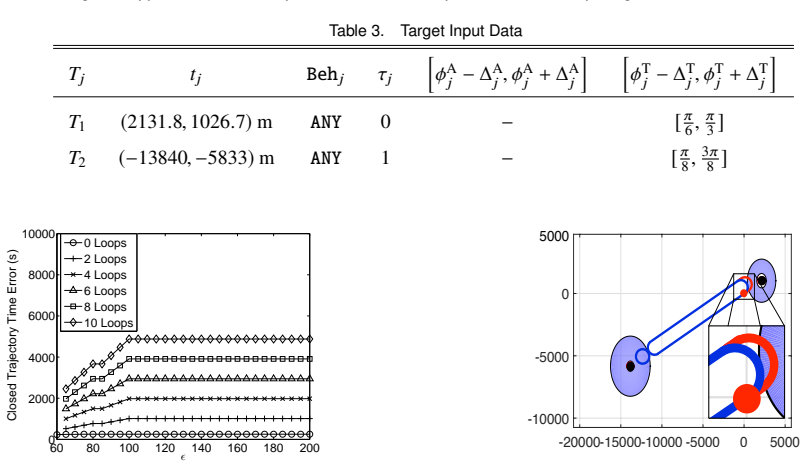
Run the two-target example of Section 6.3 with the initial-time bound set to 16.26 s, the value at which the reachable set collapses to a single configuration: any sampling grid that omits that exact configuration makes the discrete problem infeasible, so no sequence of tours exists and the claimed resolution completeness fails.
Extended reading notes
Core claim
The central claim is that the continuous, multi-objective UAV tour problem with visibility and dwell-time constraints can be approximated to arbitrary accuracy by a discrete graph problem. By sampling configurations that are each the start and end point of a feasible dwell-time maneuver, and by weighting edges with the sum of the dwell time at the source and the optimal Dubins travel time to the destination, the authors obtain a finite graph whose optimal tours approximate those of the continuous problem. The approximation is exact in a well-defined sense: whenever the set of configurations reachable within the allowed initial time is nested either inside or around the dwell-time set of a single target (Theorem 2), optimal solutions of the corresponding GTSP map to optimal solutions of the discrete problem. The resolution completeness theorem (Theorem 3) then shows that, for non-degenerate instances, the length of tours produced by the full Algorithm 5 converges to the continuous optimum as the number of samples per target grows, provided the GTSP is solved exactly at each step.
Load-bearing premise
The convergence theorem assumes that the generalized traveling salesperson problem on the sampled graph is solved to global optimality at every sampling density, but exact solvers are not generally available and the numerical implementation uses a heuristic solver, so the proven guarantee does not apply to the implemented algorithm.
Editorial extensions
If this is right
- When target spacing is large, the condition for Theorem 2 is typically satisfied, so optimal GTSP solutions translate directly into optimal solutions of the discrete approximation, and hence into near-optimal continuous tours.
- Varying the epsilon bound produces a family of routes that trace an approximate Pareto front trading initial response time against total tour duration, which can be computed with existing GTSP and asymmetric TSP solvers.
- The framework reduces to the polygon-visiting Dubins traveling salesperson problem when all dwell-times are zero and epsilon is unconstrained, showing it is a genuine generalization of prior work.
- The resolution completeness result guarantees that the discrete approximation faithfully reflects the continuous problem in the limit; any residual suboptimality in practice comes from the finiteness of the sampling grid and from the heuristic rather than exact GTSP solving.
- As dwell-time requirements increase, the advantage of the GTSP-based heuristic over greedy nearest-target planning grows, since greedy choices can strand the vehicle far from targets that require multiple loops.
Reading between the lines
- Because the proven convergence requires an exact GTSP solver, a testable extension is to compute exact solutions via branch-and-bound for small target counts and compare the observed convergence rate with the resolution-completeness prediction.
- The nesting condition on the reachable set is likely to hold when the initial position is much closer to one target than to any other; in cluttered or symmetric layouts where the condition fails, the heuristic has no such equivalence guarantee, and degraded performance is plausible.
- The same sampling-plus-GTSP machinery extends naturally to multiple vehicles or to targets with time windows, but the equivalence theorems would need to be re-derived, since the initial-maneuver constraint would couple vehicles.
Signed reviews
Editorial analysis
A structured set of objections, weighed in public.
Referee Report
Summary. The paper proposes a sampling-based framework for planning a fixed-wing UAV surveillance tour under per-target visibility and dwell-time constraints. A bi-objective formulation (closed-tour time and initial-maneuver time) is scalarized via an epsilon-constraint method, then discretized by sampling the UAV configuration space at configurations that support feasible dwell maneuvers. The resulting discrete problem (Problem 2) is solved by a heuristic reduction to a Generalized Traveling Salesperson Problem (GTSP) via Algorithm 4. Theorems 1 and 2 state, respectively, that Algorithm 4 always returns a feasible solution and that, under structural conditions on the initially reachable node set, optimal GTSP solutions map to optimal solutions of Problem 2. Theorem 3 claims resolution completeness of the full construction under non-degeneracy, dense sampling, and exact GTSP solving. The paper closes with numerical examples illustrating Pareto-front behavior, comparisons against a greedy baseline, and a hand-constructed convergence example.
Significance. If the advertised convergence property held for the implemented algorithm, the paper would be a useful extension of the prior Polygon-Visiting Dubins TSP sampling framework to dwell-time behaviors and a second objective. The problem formulation is careful and the modular reduction to GTSP is practically appealing; Theorem 2's equivalence result is clean and the numerical study is transparent about the solvers used. However, the central resolution-completeness claim is substantially weaker than the abstract suggests: Theorem 3 requires an exact GTSP oracle that the implementation does not provide, and its denseness argument has a gap for feasible sets of empty relative interior. The paper therefore needs either a repaired theorem or a reframed set of claims before it can be accepted.
major comments (3)
- [Appendix, Theorem 3 proof] The step "Since the sampling procedure is dense, for some N, there will be a discrete node placed inside of the set U" is not justified. Dense sampling is defined on each DWL_j, but the first component of the required discrete node must lie in DWL_j∩INL_epsilon. If INL_epsilon∩DWL_j has empty relative interior—for example if epsilon equals the minimum of DIST(v0,·) over a positive-dimensional continuum in DWL_j—then a dense sequence in DWL_j can be chosen that avoids this set entirely. In that case Algorithm 4 returns "Problem 2 Infeasible" for every N, contradicting the claimed feasibility of each INL_MNVRN. Definition 4 only excludes a first component that is isolated in INL_epsilon; it does not exclude a non-isolated point lying on a positive-codimension reachable set. The theorem needs an additional relative-interior assumption around the optimal first component, or the conclusion must be weakened to approximate feasibility with an initial-maneuver slack that tends to zero.
- [Theorem 3 and Section 6 (experimental setup)] The statement of Theorem 3 explicitly assumes "(iii) an optimal GTSP solution is found (Algorithm 4, line 5)", but the numerical implementation in Section 6 solves GTSPs through a Noon-Bean transformation followed by the Lin-Kernighan heuristic (LKH). The Appendix itself concedes that "it is not generally possible to find optimal solutions to GTSPs" and that the theorem's utility is mainly to provide intuition. Consequently, the proven result applies to an idealized algorithm with an exact GTSP oracle, not to the Algorithm 5 as implemented. The abstract's claim that the heuristic "is shown to have resolution completeness properties" should be qualified accordingly, or a separate convergence statement for the heuristic should be supplied.
- [Section 6.3 and Definition 4] The authors' own example at epsilon=16.26 s shows that when the feasible initial set is a single configuration, Algorithm 5 is not resolution complete, and they argue this is a degenerate case. This is an isolated-point degeneracy, which Definition 4 does exclude. However, it does not address the non-isolated lower-dimensional case in the first major comment, where no point is isolated in INL_epsilon but the intersection DWL_j∩INL_epsilon still has empty relative interior. The numerical evidence in Figure 9 is limited to one hand-constructed nondegenerate instance, so it provides only weak support for the claim that the theorem's conditions are typically satisfied in practice.
minor comments (4)
- [Abstract and Section 5.1] The phrase "in many cases, this approximation is equivalent to a generalized traveling salesperson problem" is imprecise: the discrete problem is solved by a heuristic reduction to a GTSP, and equivalence to Problem 2 holds only under the conditions of Theorem 2. Please adjust the wording to avoid overstating the scope of the equivalence.
- [Remark 8] The notation "ÐM j=1[ϵ_j, ϵ_j]" appears to be a rendering artifact; it should presumably be a union of intervals, e.g., ∪_{j=1}^{M}[ϵ_j, ϵ_j].
- [Figure 7] The y-axis label "Closed Trajectory Time Error (s)" in Figure 7 is misleading: the plotted quantity is the difference between the greedy method and Algorithm 5, not an error with respect to an optimal solution. Consider renaming it "Difference in closed trajectory time" or "Improvement over greedy."
- [Algorithm 4, line 3] It would clarify the procedure to state explicitly that the subset INL*_epsilon is chosen nonempty; otherwise the GTSP instance constructed in line 5 may have an empty node set for the selected target.
Circularity Check
No significant circularity found; the derivation is self-contained and the noted proof gaps are correctness concerns, not input-output equivalences.
full rationale
The derivation chain is self-contained: Problem 1 is a continuous Dubins routing optimization, Problem 2 is an independent discretization with sampled nodes and Dubins-distance edge weights, and Theorem 2 establishes an equivalence between Problem 2 and a GTSP under structural conditions on the reachable set rather than defining the two problems to be identical. Theorem 3's resolution-completeness proof uses a standard density-and-continuity argument and does not fit or rename any parameter. The appendix explicitly limits Theorem 3 to the idealized case where an optimal GTSP solution is available and concedes that 'it is not generally possible to find optimal solutions to GTSPs'; this is an honest limitation, not a circular prediction. The skeptical concern that dense sampling in DWL_j may miss a lower-dimensional INL_epsilon is a potential gap in the proof of Theorem 3, but a proof gap is not circularity: no equation is identified with its own input, and no fitted parameter is renamed as a prediction. Self-citations (e.g., [15], [24]) appear only in the literature review and are not load-bearing. The dependence on the external prior work [7] for continuity of LGTH is a citation of independent, non-author prior work used as a lemma, not as the theorem's conclusion. Score 0.
Assumptions & free parameters
free parameters (2)
- epsilon (initial maneuver time bound) =
varied from about 16 to 205 seconds in the examples
- sampling density parameters (N, or grid spacings delta_r, delta_theta, delta_alpha) =
N not fixed in examples; spacing conditions 1 through 7 use delta_r from 1000 m to 125 m and angles from pi to pi/8
assumptions (7)
- domain assumption The UAV is modeled as a Dubins vehicle moving in a plane at fixed altitude and speed with a minimum turning radius r.
- domain assumption Imaging parameters are chosen so that at least one feasible dwell-time maneuver exists at each target inside its visibility region.
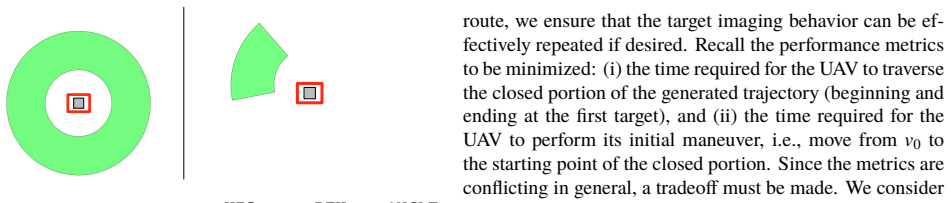
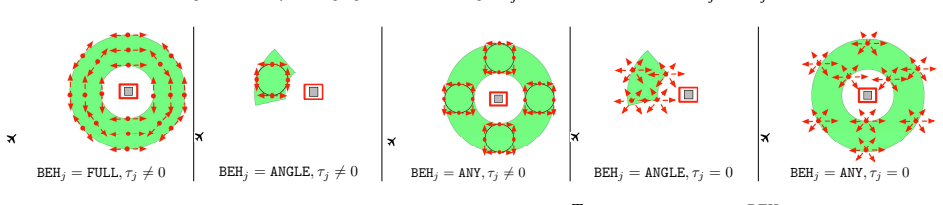
- domain assumption Nontrivial dwell-time imaging is performed by flying complete circles of radius r around a pivot point inside the visibility region, or around the target for FULL behavior, with the entire loop inside the visibility region.
- standard math The tour-length function LGTH is continuous except on a finite set of (3M-1)-dimensional smooth surfaces, with one-sided continuity up to each surface.
- standard math The optimal Dubins path length satisfies a triangle inequality.
- ad hoc to paper Algorithm 4, line 5, returns a globally optimal GTSP solution at every sampling density N.
- ad hoc to paper The Problem 1 instance is non-degenerate in the sense of Definition 4.
Cite this review
Pith. "Pith review of UAV Surveillance Under Visibility and Dwell-Time Constraints: A Sampling-Based Approach." pith.science (2026). https://pith.science/paper/5JA7SYEZ
@misc{pith2026190805347,
  author       = {Pith},
  title        = {Pith review of: UAV Surveillance Under Visibility and Dwell-Time Constraints: A Sampling-Based Approach},
  year         = {2026},
  howpublished = {\url{https://pith.science/paper/5JA7SYEZ}},
  note         = {Machine review of arXiv:1908.05347}
}
read the original abstract
A framework is introduced for planning unmanned aerial vehicle flight paths for visual surveillance of ground targets, each having particular viewing requirements. Specifically, each target is associated with a set of imaging parameters, including a desired (i) tilt angle, (ii) azimuth, with the option of a 360-degree view, and (iii) dwell-time. Tours are sought to image the targets, while minimizing both the total mission time and the time required to reach the initial target. An epsilon-constraint scalarization is used to pose the multi-objective problem as a constrained optimization, which, through careful discretization, can be approximated as a discrete graph-search. It is shown that, in many cases, this approximation is equivalent to a generalized traveling salesperson problem. A heuristic procedure for solving the discrete approximation and recovering solutions to the full routing problem is presented, and is shown to have resolution completeness properties. Algorithms are illustrated through numerical studies.
Figures


Figures from the paper (5 more)



Reference graph
Works this paper leans on
-
[7]
Sampling-based path planning for a visual reconnais- sance UAV
Obermeyer, K. J., Oberlin, P., and Darbha, S., 2012. “Sampling-based path planning for a visual reconnais- sance UAV”.AIAA Journal of Guidance, Control, and Dynamics, 35(2), pp. 619–631
work page 2012
-
[1]
Special issue on uninhabited aerial vehicles
Roberts, J., 2006. “Special issue on uninhabited aerial vehicles”.Journal of Field Robotics,23(3–4)
work page 2006
-
[2]
P., 2008.Advances in Unmanned Aerial Vehicles: State Of The Art And the Road To Autonomy
Valavanis, K. P., 2008.Advances in Unmanned Aerial Vehicles: State Of The Art And the Road To Autonomy. Springer
work page 2008
-
[3]
Report on technology hori- zons, a vision for Air Force Science And Technol- ogy during 2010–2030
US Air Force, 2010. Report on technology hori- zons, a vision for Air Force Science And Technol- ogy during 2010–2030. Tech. rep., AF/ST-TR-10- 01-PR, United States Air Force. Retrieved from http://www.defenseinnovationmarketplace.mil/ resources/AF_TechnologyHorizons2010-2030.pdf on Feb. 8, 2016
work page 2010
-
[4]
USOfficeoftheSecretaryofDefense,2005.Unmanned aircraft systems (UAS) roadmap, 2005-2030
work page 2005
-
[5]
Attack reconnaissance heli- copter operations
Army, U., 2007. Attack reconnaissance heli- copter operations. Tech. Rep. FM 3-04.126, De- partment of the Army (US), Feb. Retrieved from http://usacac.army.mil/sites/default/files/misc/doctrine/ CDG/fms.html on Dec. 5, 2016
work page 2007
-
[6]
Nonlinear Multiobjective Opti- mization
Miettinen, K., 1998. Nonlinear Multiobjective Opti- mization. Springer
work page 1998
-
[8]
A resourceallocationalgorithmformulti-vehiclesystems with non holonomic constraints
Rathinam, S., Sengupta, R., and Darbha, S., 2007. “A resourceallocationalgorithmformulti-vehiclesystems with non holonomic constraints”.IEEE Transactions onAutomationSciencesandEngineering, 4(1),pp.98– 104
work page 2007
Show all 38 references
-
[9]
Decentralized perimeter surveillance using a team of UAVs
Kingston, D. B., Beard, R. W., and Holt, R. S., 2008. “Decentralized perimeter surveillance using a team of UAVs”. IEEE Transactions on Robotics, 24(6), pp. 1394–1404
2008
-
[10]
Cooperative surveillance and pursuit using unmanned aerial vehicles and unattended ground sensors
Las Fargeas, J., Kabamba, P., and Girard, A., 2015. “Cooperative surveillance and pursuit using unmanned aerial vehicles and unattended ground sensors”.Sen- sors,15(1), pp. 1365–1388
2015
-
[11]
Trackingmultiple groundtargetsinurbanenvironmentsusingcooperating unmanned aerial vehicles
Shaferman,V.,andShima,T.,2015. “Trackingmultiple groundtargetsinurbanenvironmentsusingcooperating unmanned aerial vehicles”.Journal of Dynamic Sys- tems, Measurement, and Control,137(5), pp. 051010– 051010–11
2015
-
[12]
Guest editorial introduction to the special issue on multivehicle systems cooperative control with applica- tion
Rabbath, C. A., Su, C. Y., and Tsourdos, A., 2007. “Guest editorial introduction to the special issue on multivehicle systems cooperative control with applica- tion”.IEEE Transactions on Control Systems Technol- ogy,15(4), pp. 599–600
2007
-
[13]
Tools and techniques for mobile sensor network con- trol
Hedrick, J., Basso, B., Love, J., and Lavis, B., 2011. “Tools and techniques for mobile sensor network con- trol”.Journal of Dynamic Systems, Measurement, and Control,133(2), pp. 024001–024001–7
2011
-
[14]
P., 2007
Gutin, G., and Punnen, A. P., 2007. The Traveling Salesman Problem and Its Variations. Springer
2007
-
[15]
Traveling Salesperson Problems for the Dubins vehicle
Savla, K., Frazzoli, E., and Bullo, F., 2008. “Traveling Salesperson Problems for the Dubins vehicle”.IEEE Transactions on Automatic Control,53(6), pp. 1378– 1391
2008
-
[16]
J., Savla, K., Frazzoli, E., and Bullo, F.,
Enright, J. J., Savla, K., Frazzoli, E., and Bullo, F.,
-
[17]
An approximation algorithm for a symmetric generalized multiple depot, multiple travelling salesman problem
Malik, W., Rathinam, S., and Darbha, S., 2007. “An approximation algorithm for a symmetric generalized multiple depot, multiple travelling salesman problem”. Operations Research Letters,35(6), pp. 747–753
2007
-
[18]
Stability of solutions to classes of traveling salesman problems
Niendorf, M., Kabamba, P. T., and Girard, A. R., 2016. “Stability of solutions to classes of traveling salesman problems”.IEEE Transactions on Cybernetics,46(4)
2016
-
[19]
A robust ap- proach to the UAV task assignment problem
Alighanbari, M., and How, J. P., 2008. “A robust ap- proach to the UAV task assignment problem”.Interna- tionalJournalonRobustandNonlinearControl, 18(2), pp. 118–134
2008
-
[20]
An effective implementation of theLin–Kernighantravelingsalesmanheuristic
Helsgaun, K., 2000. “An effective implementation of theLin–Kernighantravelingsalesmanheuristic”.Euro- peanJournalofOperationalResearch, 126(1),pp.106– 130
2000
-
[21]
Stochastic surveillance strategies for spatial quickest detection
Srivastava, V., Pasqualetti, F., and Bullo, F., 2013. “Stochastic surveillance strategies for spatial quickest detection”.InternationalJournalofRoboticsResearch, 32(12), pp. 1438–1458
2013
-
[22]
Robotic surveillanceandMarkovchainswithminimalweighted Kemeny constant
Patel, R., Agharkar, P., and Bullo, F., 2015. “Robotic surveillanceandMarkovchainswithminimalweighted Kemeny constant”.IEEE Transactions on Automatic Control,60(12), pp. 3156–3167
2015
-
[23]
Strategiesandtech- niques for node placement in wireless sensor networks: A survey
Younis,M.,andAkkaya,K.,2008.“Strategiesandtech- niques for node placement in wireless sensor networks: A survey”.Ad Hoc Networks,6(4), pp. 621–655
2008
-
[24]
Dynamic vehicle routing for robotic sys- tems
Bullo,F.,Frazzoli,E.,Pavone,M.,Savla,K.,andSmith, S. L., 2011. “Dynamic vehicle routing for robotic sys- tems”.ProceedingsoftheIEEE, 99(9),pp.1482–1504
2011
-
[25]
Multirobot rendezvous planning for recharging in per- sistent tasks
Mathew, N., Smith, S. L., and Waslander, S. L., 2015. “Multirobot rendezvous planning for recharging in per- sistent tasks”.IEEE Transactions on Robotics,31(1), pp. 128–142
2015
-
[26]
Gossip cov- erage control for robotic networks: Dynamical systems on the space of partitions
Bullo, F., Carli, R., and Frasca, P., 2012. “Gossip cov- erage control for robotic networks: Dynamical systems on the space of partitions”.SIAM Journal on Control and Optimization,50(1), pp. 419–447
2012
-
[27]
Dividing a territory among several vehicles
Carlsson, J. G., 2012. “Dividing a territory among several vehicles”.INFORMS Journal on Computing, 24(4), pp. 565–577
2012
-
[28]
Pathplanningforauavperform- ingreconnaissanceofstaticgroundtargetsinterrain
Obermeyer,K.,2009. “Pathplanningforauavperform- ingreconnaissanceofstaticgroundtargetsinterrain”.In AIAA Guidance, Navigation, and Control Conference, pp. 10–13
2009
-
[29]
Dubins traveling salesman problem with neighborhoods: A graph-based approach
Isaacs, J., and Hespanha, J. P., 2013. “Dubins traveling salesman problem with neighborhoods: A graph-based approach”.Algorithms,6(1), pp. 84–99
2013
-
[30]
PlanningAlgorithms
LaValle,S.M.,2006. PlanningAlgorithms. Cambridge University Press
2006
-
[31]
A transformation for a heterogeneous, multiple depot, multiple traveling salesmen problem
Oberlin, P., Rathinam, S., and Darbha, S., 2009. “A transformation for a heterogeneous, multiple depot, multiple traveling salesmen problem”. In American Control Conference, pp. 1292–1297
2009
-
[32]
A Lagrangian based approach for the asymmetric generalized travel- ing salesman problem
Noon, C. E., and Bean, J. C., 1991. “A Lagrangian based approach for the asymmetric generalized travel- ing salesman problem”.Operations Research,39(4), pp. 623–632
1991
-
[33]
Arandom-key geneticalgorithmforthegeneralizedtravelingsalesman problem
Snyder,L.V.,andDaskin,M.S.,2006. “Arandom-key geneticalgorithmforthegeneralizedtravelingsalesman problem”.European Journal of Operational Research, 174(1), pp. 38–53
2006
-
[34]
Survey of multi-objectiveoptimizationmethodsforengineering
Marler, R. T., and Arora, J. S., 2004. “Survey of multi-objectiveoptimizationmethodsforengineering”. Structural and multidisciplinary optimization, 26(6), pp. 369–395
2004
-
[35]
Many-objective optimization: An engineering design perspective
Fleming,P.J.,Purshouse,R.C.,andLygoe,R.J.,2005. “Many-objective optimization: An engineering design perspective”. In Evolutionary Multi-Criterion Opti- mization,C.A.C.Coello,A.H.Aguirre,andE.Zitzler, eds. Springer, pp. 14–32
2005
-
[36]
Formulation and solution of the target visitation problem
Grundel, D., and Jeffcoat, D., 2004. “Formulation and solution of the target visitation problem”. In Proceed- ingsoftheAIAA1stIntelligentSystemsTechnicalCon- ference. AIAA 2004-6212
2004
-
[37]
Oncurvesofminimallengthwith a constraint on average curvature and with prescribed initial and terminal positions and tangents
Dubins,L.E.,1957. “Oncurvesofminimallengthwith a constraint on average curvature and with prescribed initial and terminal positions and tangents”.American Journal of Mathematics,79, pp. 497–516
1957
-
[2009]
Stochastic and dynamic routing problems for multiple UAVs
“Stochastic and dynamic routing problems for multiple UAVs”.AIAA Journal of Guidance, Control, and Dynamics,34(4), pp. 1152–1166
Reviewed August 14, 2026 · model on record in the stance chip above.
Discussion (0). Continue with ORCID to comment.