REVIEW 4 major objections 6 minor 40 references
Sex Trafficking Detection with Ordinal Regression Neural Networks
T0 review · 4 major / 6 minor · reviewed 2026-08-14 · deepseek-v4-flash
Pith's one-line read An ordinal regression neural network that reads only escort-ad text outperforms the previous image-plus-text detector on Trafficking-10K, with mean absolute error 0.769 and binary accuracy 0.818.
desk verdict Solid applied paper with a modest ordinal-regression penalty; the state-of-the-art claim rests on an uncontrolled comparison and needs to be fixed or dropped. read the letter →
The pith
A machine-rendered reading of the paper's core claim, the machinery that carries it, and where it could break.
The reading
What carries the argument
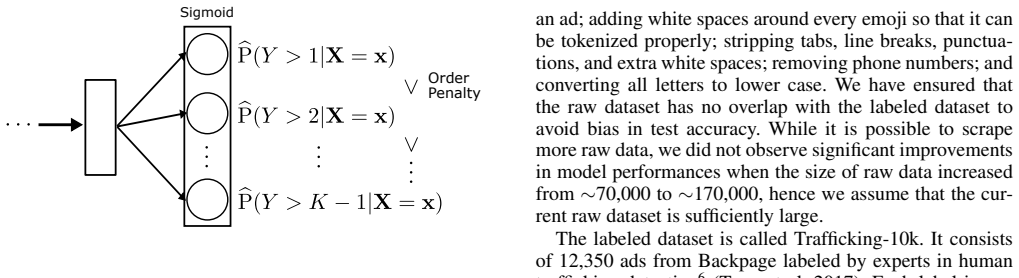
The central object is the ordinal regression neural network (ORNN): a gated-feedback recurrent network fed with skip-gram word embeddings, capped by a multi-labeled logistic regression layer that estimates the cumulative probabilities $\hat f_i(X) = \hat P(Y > i \mid X)$ for $i=1,\dots,k-1$. The load-bearing novelty is the order penalty, a term added to the training loss that charges the model whenever an estimated probability violates the required ordering $\hat f_i(X) \ge \hat f_{i+1}(X)$. This makes the ordinal predictions monotone and interpretable while also acting as a regularizer, and it is computationally cheap enough to train despite earlier concerns that enforcing monotonicity was too costly.
What would settle it
Run the trained ORNN on a fresh, expert-labeled sample of escort ads from a website other than Backpage; if its binary accuracy or mean absolute error on that sample is close to chance or far worse than the reported 0.818 and 0.769, the central claim fails. A second check would re-annotate a random subset of Trafficking-10K with independent experts and measure label agreement, since low agreement would undermine the benchmark itself.
Extended reading notes
Core claim
The central claim is that ordinal regression on text-only representations of escort ads yields the best published detector on Trafficking-10K. The model replaces the softmax classifier of a deep network with a multi-labeled logistic regression layer: for seven ordered labels it estimates six probabilities $p_i = P(Y > i)$, predicts $\hat Y = 1 + \sum_i \mathrm{Round}(p_i)$, and adds an order-penalty term $\lambda \sum_i \max\{\hat f_{i+1}(X) - \hat f_i(X), 0\}$ to the loss. This penalty addresses the monotonicity violation noted since the original ordinal regression network, reducing conflicting binary predictions from 5.2% to 1.4% in the ablation study. The same architecture, with skip-gram embeddings and a gated-feedback recurrent network, achieves a binary accuracy of 0.818 on Trafficking-10K, improving on the multimodal Human Trafficking Deep Network's 0.800 even though ORNN never sees images.
Load-bearing premise
The load-bearing premise is that the expert labels in Trafficking-10K are trustworthy and that a model trained on Backpage ads will keep its accuracy on escort ads from other websites and from later time periods.
Editorial extensions
If this is right
- A text-only model can beat a multimodal baseline on Trafficking-10K, suggesting images are not necessary for first-pass filtering of escort ads.
- Treating the seven expert labels as ordered rather than categorical lowers mean absolute error; the ablation's classification variant scores 0.785 versus ORNN's 0.769.
- The order penalty cuts conflicting binary predictions from 5.2% to 1.4%, making the model's probability outputs more interpretable for non-expert stakeholders.
- Word embeddings trained on unlabeled escort ads, visualized with t-SNE, can propose new emoji flags for underage-victim indicators such as the porcelain doll, grape, and strawberry emojis.
- The open-sourced code and trained model give law-enforcement agencies a deployable screening tool at no cost.
Reading between the lines
- Because the benchmark labels come from a single website (Backpage), the reported gains depend on the assumption that escort ads on other sites resemble Backpage ads; expert-labeled data from a second site would test this directly.
- The order penalty is a generic remedy for ordinal neural networks and could transfer to other ordinal tasks, such as age estimation or severity scoring, wherever non-monotone probability estimates arise.
- The qualitative signals the model latches onto—multiple names per ad, travel phrases, and third-to-first person shifts—could be turned into explicit features or rules to complement the learned representation.
- Since traffickers adapt their vocabulary, the emoji-map update loop implies the lexicon expansion must be re-run periodically; the paper does not measure how quickly accuracy decays as ads drift.
Signed reviews
Editorial analysis
A structured set of objections, weighed in public.
Referee Report
Summary. The paper proposes an ordinal regression neural network (ORNN) for detecting sex-trafficking-related escort ads from text. The architecture combines skip-gram word embeddings pre-trained on scraped escort ads, a gated-feedback recurrent neural network with dropout, residual connections and batch normalization, and a multi-labeled logistic regression layer that predicts the probability that an ad exceeds each of six ordered thresholds. A penalty term is added to the loss to discourage non-monotonic threshold probabilities. The authors evaluate on Trafficking-10K using 10-fold cross-validation, compare with four ordinal/multiclass baselines and the previously published Human Trafficking Deep Network (HTDN), run an ablation study, present a qualitative analysis of predictions on unlabeled TNABoard ads, and use t-SNE on emoji embeddings to propose expansions of a trafficking-flags lexicon. The main claimed contributions are state-of-the-art performance on Trafficking-10K, a computationally cheap monotonicity penalty for ordinal regression, and a data-driven approach to lexicon expansion.
Significance. If the empirical claims are fully supported, the paper would provide a useful, open-source text-only model for a socially important screening task, together with a simple penalty that removes most monotonicity violations in neural ordinal regression at negligible computational cost. The ablation study and the emoji/lexicon analysis are constructive and, in the case of code release, reproducible. However, the headline state-of-the-art claim rests on a comparison with HTDN that is not controlled, and no significance tests are reported for any pairwise difference; as a result, the magnitude and even the existence of an improvement over the prior neural model are not yet established. The internal comparisons among models evaluated under identical cross-validation splits are more informative and are a genuine strength of the paper.
major comments (4)
- [Section 4.2, Table 2] The central claim that ORNN achieves state-of-the-art performance on Trafficking-10K is not supported by a controlled comparison with HTDN. The HTDN row is read from Tong et al. (2017), where the model was trained on binary labels, used both text and images, and was evaluated on a single train/validation/test split, whereas ORNN and the other baselines are trained on ordinal labels, use text only, and are evaluated with 10-fold cross-validation. Differences in label encoding, input modalities, and test-set composition can account for the reported 1.8-point accuracy gap (0.818 vs 0.800), and no standard error or test-set size is given for HTDN. To sustain the state-of-the-art claim in Section 5, the authors should re-implement HTDN under the same 10-fold CV protocol, or at minimum evaluate a text-only binary-label variant under the same splits; otherwise the claim should be restricted to 'best among the models evaluated under the same protocol.'
- [Section 4.2, Tables 2 and 3] No significance tests are reported for any pairwise model comparison, and the reported naive standard errors overlap for key comparisons. For example, ORNN has MAE 0.769 (SE 0.009) versus AT 0.778 (SE 0.009), and binary accuracy 0.818 (SE 0.003) versus 0.813 (SE 0.003); the 0.005 accuracy gap is well within the naive standard error. The abstract and Section 5 use the word 'significantly,' but the evidence for statistical significance is absent. The authors should provide paired tests across folds (e.g., paired t-tests or Wilcoxon tests) or confidence intervals adjusted for the cross-validated structure, and should soften the wording if the differences are not significant.
- [Section 4.4] The qualitative analysis of 44,105 unlabeled TNABoard ads does not provide quantitative evidence for cross-site generalization. Three anecdotal examples and a footnote asserting that escort ads are similar across websites are not sufficient to support the claim, made in Section 4.1 and in the discussion, that the Backpage-trained model transfers to other escort websites. Without labeled TNABoard data or a manual evaluation protocol with measured agreement, the generalization claim is unsupported. The authors should either add a small labeled evaluation set from another website, report precision at a chosen threshold from expert review, or explicitly characterize Section 4.4 as exploratory pattern identification rather than evidence of transfer.
- [Section 4.3, Table 3] The ablation in rows 0 and 7 shows that removing the order penalty leaves MAE, macro-MAE, accuracy, and weighted accuracy essentially unchanged (MAE 0.769 in both cases; accuracy 0.818 in both cases). The paper's contribution list and Section 3.3 state that the penalty is proposed to 'mitigate the monotonicity violation and improve the interpretability,' which is supported by the reduction in conflicting predictions from 5.2% to 1.4%. However, the abstract's wording that the modified cost function is used to 'improve prediction accuracy' is not supported by the ablation. The authors should revise the abstract and contributions to distinguish interpretability/consistency gains from predictive-accuracy gains, or provide evidence that the penalty improves accuracy under other settings.
minor comments (6)
- [Title page] The affiliation line contains a typographical error: '1Alexa AI, Amazon, 23Department of Statistics' should be '1Alexa AI, Amazon; 2,3Department of Statistics' or the like.
- [Table 2] The caption says the best and second best results are highlighted, but the formatting does not survive in the text version; please ensure the highlighting is visible or replace it with explicit markers in the table.
- [Section 4.2] The phrase 'same (w.r.t. data shuffle and split) 10-fold cross-validation' is unclear because HTDN is excluded; please clarify that the splits are shared among the newly evaluated models only.
- [Section 4.5] The emoji analysis is qualitative and relies on visual proximity in a t-SNE projection; the paper would benefit from a quantitative measure (e.g., nearest-neighbor precision against the known lexicon) or at least an explicit caveat that t-SNE distances are not directly interpretable.
- [Section 3.3] The order-penalty hyperparameter lambda is listed in the appendix as 0.5, but there is no sensitivity analysis with respect to lambda; a sentence describing how lambda was chosen (e.g., grid search on the validation set) would strengthen the reproducibility of the method.
- [Section 5] The discussion of BERT and future multi-modal models is reasonable, but the sentence claiming that the ordinal-regression contributions are 'not dependent on a particular choice of language representation model' is slightly too strong: the experiments only test skip-gram plus GF-RNN, so the claim should be framed as a design principle rather than an empirically verified property.
Circularity Check
No significant circularity: the ordinal regression target is an explicit re-encoding of the labels, and the reported gains are evaluated under held-out cross-validation.
full rationale
The paper's derivation chain is self-contained: the ordinal regression layer re-encodes each ordinal label y as a vector of k-1 binary indicators (1_{y>1}, ..., 1_{y>k-1}), trains sigmoid outputs against this re-encoding with MSE, and reconstructs the predicted rank as 1 + sum_i Round(f_i(x)). This is a standard transformation of the label, not a fitted target smuggled in as a prediction. The order penalty is a regularizer added to the loss, and the ablation shows that removing it leaves MAE and accuracy essentially unchanged, so the main reported performance is not an artifact of that penalty. All baseline comparisons except HTDN use the same 10-fold CV splits; HTDN's result is read from the original paper, which is an uncontrolled benchmark comparison rather than a circular derivation, since no equation in the paper reduces HTDN's reported accuracy to an input of ORNN. The qualitative analysis in Section 4.4 is explicitly exploratory and labeled as offering patterns for experts to confirm, and the emoji lexicon expansion in Section 4.5 is driven by unsupervised word embeddings and an externally supplied lexicon, not by the model's own predictions used as ground truth. There is no load-bearing self-citation, no imported uniqueness theorem, and no fitted parameter renamed as a prediction. Accordingly, no circularity step meeting the evidentiary bar is present.
Assumptions & free parameters
free parameters (9)
- Order penalty lambda =
0.5
- Embedding dimension =
128
- GF-RNN hidden size =
128
- Dropout rate =
0.2
- L2 penalty =
0.00001
- Learning rate decay factor =
2.0
- Early stop patience =
9
- Batch size =
200
- Max input length =
120
assumptions (4)
- domain assumption The expert ordinal labels in Trafficking-10K are correct and reflect ground-truth trafficking likelihood.
- domain assumption Unlabeled ads from Backpage and TNABoard are representative of escort ads in deployment.
- ad hoc to paper The order-penalty form with lambda=0.5 sufficiently enforces monotonicity.
- standard math Standard deep learning training assumptions (SGD, backpropagation, batch normalization, dropout) behave as expected here.
Cite this review
Pith. "Pith review of Sex Trafficking Detection with Ordinal Regression Neural Networks." pith.science (2026). https://pith.science/paper/A5SV2MQ6
@misc{pith2026190805434,
  author       = {Pith},
  title        = {Pith review of: Sex Trafficking Detection with Ordinal Regression Neural Networks},
  year         = {2026},
  howpublished = {\url{https://pith.science/paper/A5SV2MQ6}},
  note         = {Machine review of arXiv:1908.05434}
}
read the original abstract
Sex trafficking is a global epidemic. Escort websites are a primary vehicle for selling the services of such trafficking victims and thus a major driver of trafficker revenue. Many law enforcement agencies do not have the resources to manually identify leads from the millions of escort ads posted across dozens of public websites. We propose an ordinal regression neural network to identify escort ads that are likely linked to sex trafficking. Our model uses a modified cost function to mitigate inconsistencies in predictions often associated with nonparametric ordinal regression and leverages recent advancements in deep learning to improve prediction accuracy. The proposed method significantly improves on the previous state-of-the-art on Trafficking-10K, an expert-annotated dataset of escort ads. Additionally, because traffickers use acronyms, deliberate typographical errors, and emojis to replace explicit keywords, we demonstrate how to expand the lexicon of trafficking flags through word embeddings and t-SNE.
Figures


Reference graph
Works this paper leans on
-
[1]
Amin, S. 2010. A step towards modeling and destabilizing human trafficking networks using machine learning methods. Conference: Artificial intelligence for development, papers from the 2010 AAAI Spring Symposium, Techinical Report SS10-01 (pp. 2-7), Stanford
work page 2010
-
[2]
Baccianella, S.; Esuli, A.; and Sebastiani, F. 2009. Evaluation measures for ordinal regression. 9th International Conference on Intelligent Systems Design and Applications
work page 2009
-
[3]
Beel, J.; Gipp, B.; Langer, S.; and Breitinger, C. 2016. Research-paper recommender systems: a literature survey. International Journal on Digital Libraries 17(4):305--338
work page 2016
-
[4]
Bengio, Y., and Grandvalet, Y. 2004. No unbiased estimator of the variance of k-fold cross-validation. Journal of Machine Learning Research 5:1089--1105
work page 2004
-
[5]
Bloomfield, P., and Steiger, W. 1980. Least absolute deviations curve-fitting. SIAM Journal on Scientific and Statistical Computing 1(2):290--301
work page 1980
-
[6]
Cheng, J.; Wang, Z.; and Pollastri, G. 2008. A neural network approach to ordinal regression. 2008 IEEE International Joint Conference on Neural Networks (IEEE World Congress on Computational Intelligence) 1279--1284
work page 2008
-
[7]
Chung, J.; Gulcehre, C.; Cho, K.; and Bengio, Y. 2015. Gated feedback recurrent neural networks. ICML-15
work page 2015
-
[8]
Devlin, J.; Chang, M.-W.; Lee, K.; and Toutanova, K. 2018. Bert: Pre-training of deep bidirectional transformers for language understanding. CoRR abs/1810.04805
arXiv 2018
Show all 40 references
-
[9]
Dumais, S. 2004. Latent semantic analysis. Annual Review of Information Science and Technology 38(1):188--230
2004
-
[10]
Fan, R.; Chang, K.; Hsieh, C.; Wang, X.; and Lin, C. 2008. Liblinear: A library for large linear classification. The Journal of Machine Learning Research 9:1871--1874
2008
-
[11]
Frank, E., and Hall, M. 2001. A simple approach to ordinal classification. Lecture Notes in Artificial Intelligence 145--156
2001
-
[12]
Goodfellow, I.; Bengio, Y.; and Courville, A. 2016. Deep Learning . MIT Press
2016
-
[13]
Graves, A.; Fern\'andez, S.; and Schmidhuber, J. 2005. Bidirectional lstm networks for improved phoneme classification and recognition. Proc. Int'l Conf. Artificial Neural Networks 799--804
2005
-
[14]
He, K.; Zhang, X.; Ren, S.; and Sun, J. 2016. Deep residual learning for image recognition. CVPR
2016
-
[15]
Ho, C., and Lin, C. 2012. Large-scale linear support vector regression. The Journal of Machine Learning Research 13(1):3323--3348
2012
-
[16]
International Labour Organization ; Walk Free Foundation ; and International Organization for Migration . 2017. Global estimates of modern slavery: forced labour and forced marriage . Geneva: International Labour Organization. ISBN: 978-92-2-130131-8
2017
-
[17]
Ioffe, S., and Szegedy, C. 2015. Batch normalization: Accelerating deep network training by reducing internal covariate shift. ICML
2015
-
[18]
Irsoy, O., and Cardie, C. 2015. Modeling compositionality with multiplicative recurrent neural networks. ICLR
2015
-
[19]
Kim, Y. 2014. Convolutional neural networks for sentence classification. In Proceedings of the 2014 Conference on Empirical Methods in Natural Language Processing (EMNLP) , 1746--1751
2014
-
[20]
LeCun, Y.; Bengio, Y.; and Hinton, G. 2015. Deep learning. Nature 521:436--444
2015
-
[21]
Li, L., and Lin, H. 2006. Ordinal regression by extended binary classification. NIPS 865--872
2006
-
[22]
Manning, C.; Raghavan, P.; and Sch \"u tze, H. 2009. An Introduction to Information Retrieval . Cambridge University Press
2009
-
[23]
Mikolov, T.; Chen, K.; Corrado, G.; and Dean, J. 2013a. Efficient estimation of word representations in vector space. ICLR Workshop Papers
-
[24]
Mikolov, T.; Sutskever, I.; Chen, K.; Corrado, G.; and Dean, J. 2013b. Distributed representations of words and phrases and their compositionality. NIPS 3111--3119
-
[25]
Narula, S., and Wellington, J. 1982. The minimum sum of absolute errors regression: A state of the art survey. International Statistical Review 317--326
1982
-
[26]
Niu, Z.; Zhou, M.; Wang, L.; Gao, X.; and Hua, G. 2016. Ordinal regression with multiple output cnn for age estimation. In Proceedings of the IEEE Conference on Computer Vision and Pattern Recognition , 4920--4928
2016
-
[27]
Pedregosa, F.; Varoquaux, G.; Gramfort, A.; Michel, V.; Thirion, B.; Grisel, O.; Blondel, M.; Prettenhofer, P.; Weiss, R.; Dubourg, V.; Vanderplas, J.; Passos, A.; Cournapeau, D.; Brucher, M.; Perrot, M.; and Duchesnay, E. 2011. Scikit-learn: Machine learning in P ython. Journ...
2011
-
[28]
Pedregosa-Izquierdo, F. 2015. Feature extraction and supervised learning on fMRI: from practice to theory . Ph.D. Dissertation, Universit\'e Pierre et Marie Curie, Paris VI
2015
-
[29]
Ren, S.; He, K.; Girshick, R.; and Sun, J. 2015. Faster r-cnn: Towards real-time object detection with region proposal networks. NIPS
2015
-
[30]
Rennie, J., and Srebro, N. 2005. Loss functions for preference levels: Regression with discrete ordered labels. In Proc. Int'l Joint Conf. Artificial Intelligence Multidisciplinary Workshop Advances in Preference Handling
2005
-
[31]
Rosenthal, S.; Farra, N.; and Nakov, P. 2017. Semeval-2017 task 4: Sentiment analysis in twitter. In Proceedings of the 11th International Workshop on Semantic Evaluation , volume 3 of 4 , 502--518
2017
-
[32]
Ruder, S.; Ghaffari, P.; and Breslin, J. 2016. Insight-1 at semeval-2016 task 4: Convolutional neural networks for sentiment classification and quantification. In Proceedings of the 10th International Workshop on Semantic Evaluation (SemEval 2016)
2016
-
[33]
Schuller, B.; Mousa, A.; and Vryniotis, V. 2015. Sentiment analysis and opinion mining: on optimal parameters and performances. WIREs Data Mining Knowl. Discov. 5:255--263
2015
-
[34]
Socher, R.; Perelygin, A.; Wu, J.; Chuang, J.; Manning, C.; Ng, A.; and Potts, C. 2013. Recursive deep models for semantic compositionality over a sentiment treebank. In Proceedings of EMNLP
2013
-
[35]
Srivastava, N.; Hinton, G.; Krizhevsky, A.; Sutskever, I.; and Salakhutdinov, R. 2014. Dropout: A simple way to prevent neural networks from overfitting. Journal of Machine Learning Research 15:1929--1958
2014
-
[36]
Tarinelli, R. 2018. Online sex ads rebound, months after shutdown of backpage. The Associated Press
2018
-
[37]
THORN, and Bouch\'e, V. 2018. Survivor insights: The role of technology in domestic minor sex trafficking . THORN
2018
-
[38]
Tong, E.; Zadeh, A.; Jones, C.; and Morency, L. 2017. Combating human trafficking with deep multimodal models. Association for Computational Linguistics
2017
-
[39]
van der Maaten, L., and Hinton, G. 2008. Visualizing data using t-sne. Journal of Machine Learning Research 9:2431--2456
2008
-
[40]
write newline
" write newline "" before.all 'output.state := FUNCTION fin.entry add.period write newline FUNCTION new.block output.state before.all = 'skip after.block 'output.state := if FUNCTION new.sentence output.state after.block = 'skip output.state before.all = 'skip after.sentence '...
Reviewed August 14, 2026 · model on record in the stance chip above.
Discussion (0). Continue with ORCID to comment.