REVIEW 3 major objections 5 minor 33 references
Accelerated CNN Training Through Gradient Approximation
T0 review · 3 major / 5 minor · reviewed 2026-08-14 · deepseek-v4-flash
Pith's one-line read Selectively approximating filter gradients—keeping one scaled entry per output channel—can speed up CNN training in wall-clock time while keeping validation accuracy nearly unchanged.
desk verdict A real GPU-kernel contribution with a small, plausible speedup, but the reporting is sloppy: no error bars, an abstract/body speedup inconsistency, and an unbiasedness claim that is mathematically wrong but blessedly not load-bearing. read the letter →
The pith
A machine-rendered reading of the paper's core claim, the machinery that carries it, and where it could break.
The reading
What carries the argument
The load-bearing object is the max-gradient approximation: for each output channel and each batch element, keep only the largest-magnitude entry of the $H\times W$ output-gradient map, scale it by the sum of all entries in that map, and zero everything else, so the filter gradient becomes a sum of $K\times K$ input patches weighted by those scaled scalars. The argument wraps this in an 'approximation schedule'—a per-layer, per-batch choice of which approximation to apply—which lets the method touch only a quarter of filter-gradient computations. The CUDA kernel that interprets the sparse convolution as patch extraction is what converts the algorithmic saving into actual wall-clock speed.
What would settle it
Compare, over many random input/backprop pairs at an untrained layer, the average approximated filter gradient with the average full filter gradient; a persistent nonzero difference would show the estimate is biased and that convergence is driven by something other than unbiased gradient estimation.
Extended reading notes
Core claim
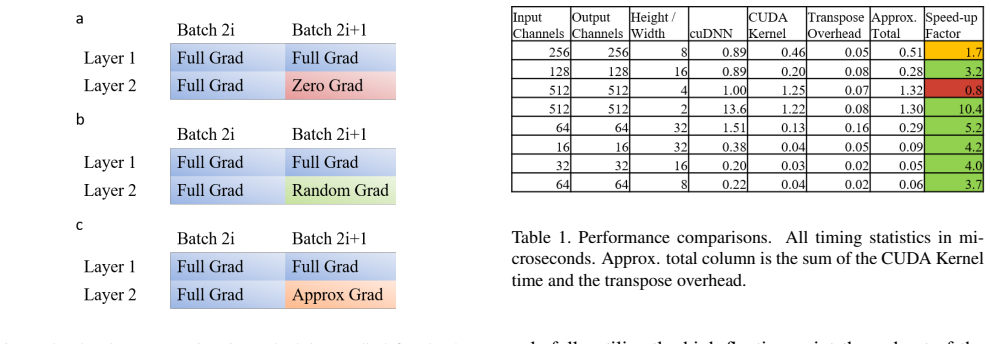
The central claim, stated as the authors would state it: training deep CNNs does not require exact dense filter gradients at every layer and every batch. On a schedule that approximates a quarter of the filter-gradient computations (on every fourth convolutional layer, every batch, starting from the second layer), keeping only the single largest-magnitude value in each output channel's gradient map—scaled by that map's total sum and all other values zeroed—is enough to train ResNet-20 and VGG-19 to validation accuracy within a small margin of full-gradient training. Implemented as a CUDA patch-extraction kernel, this approximation is faster than cuDNN's dense gradient convolution in the tested cases, and the measured wall-clock speedups range from 3.5% for ResNet-20 up to over 7% for the two networks, with accuracy loss as low as 0.1 percentage point under some schedules.
Load-bearing premise
The load-bearing premise is that the scaled top-1 approximation produces an unbiased estimate of the true filter gradient; if that premise fails—and deterministic retention of the largest element does not by itself make each position unbiased—the theoretical justification collapses even though the training curves may still converge.
Editorial extensions
If this is right
- Approximating one quarter of the filter-gradient computations gives a theoretical speedup ceiling of roughly 8 percent, and measured wall-clock speedups on CIFAR-10 range from 3.5 percent on ResNet-20 to over 7 percent across the two networks.
- The approximated-gradient method keeps validation accuracy within about 0.1 percentage point of full-gradient training under at least one schedule, making the accuracy loss smaller than the loss from substituting a smaller ResNet-14 baseline.
- The approximation methods require no network structure changes or explicit sparsity inputs, so they can be dropped into standard VGG and ResNet training pipelines.
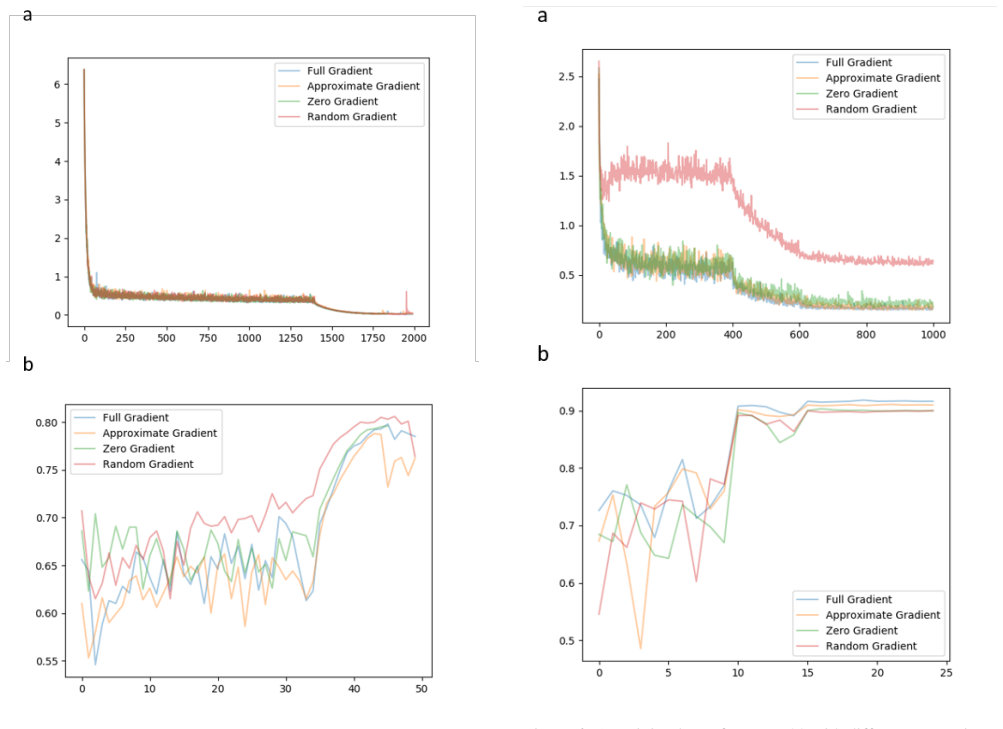
- Using approximations early in training and switching to full gradients later is a promising schedule direction for VGG-like networks, since full-gradient training overtakes the approximations only at the end.
Reading between the lines
- Editorial inference: The deterministic top-1 selection scaled by channel sum is not unbiased per-position, so if the method trains well, the explanation likely lies in SGD optimization dynamics rather than in unbiasedness; averaging over many layers and batches may hide systematic bias.
- Editorial inference: The success of freshly regenerated random gradients on some architectures, with no fixed alignment, suggests a testable hypothesis that stochastic gradient noise itself, not directional alignment, keeps the network trainable.
- Editorial inference: Fusing the input transposes into the CUDA kernel could remove more than half the reported overhead, indicating that larger speedups are available without changing the approximation itself.
- Editorial inference: The same approximation could be applied to activation gradients in deeper layers, but error propagation to shallower layers would need to be controlled; the paper's own reason for avoiding that direction sets a boundary for future work.
Editorial analysis
A structured set of objections, weighed in public.
Referee Report
Summary. The paper proposes three gradient approximation methods for CNN training — zero gradient, random gradient, and a top-1 approximated gradient — and introduces the notion of approximation schedules that specify when each approximation is applied per layer and per training batch. A custom CUDA kernel implements the approximated gradient, and the paper reports wall-clock training speedups on CIFAR-10 for ResNet-20 and VGG-19, claiming speedups 'upwards of 7%' with minimal validation accuracy loss. The evaluation includes kernel timing comparisons against cuDNN, convergence curves for three network architectures, and robustness checks across three approximation schedules for ResNet-20.
Significance. If the reported speedups and accuracy results are reproducible, the paper makes a modest but useful systems contribution: a GPU-friendly sparse gradient approximation that can reduce training time for standard deep CNNs without significant accuracy loss. The paper's strengths include a nontrivial CUDA kernel implementation, explicit accounting for overheads such as data transposes, and transparent reporting of negative results (e.g., the slowdown on a small 2-layer CNN). The approximation-schedule abstraction is also a useful conceptual contribution. However, the central empirical claim is not yet convincing because the reported speedups are small, the experiments appear to be single runs without error bars, and the abstract's headline speedup is not reconciled with the body.
major comments (3)
- [Section 2.3, Algorithm 1] The claim that the approximated gradient estimate is unbiased is mathematically incorrect. The retained element is selected deterministically as the largest-magnitude gradient, and scaling by the channel sum preserves only the total sum, not the per-coordinate expectations. For an unbiased estimator, the selection would need to be randomized with an appropriate inverse-probability rescaling, as in standard gradient sparsification methods. This error undermines the theoretical justification for the approximated gradient method, even though the empirical convergence curves might still be valid; the authors should either provide a correct unbiasedness argument, characterize the bias, or remove the claim.
- [Abstract and Section 3.3] The abstract's headline claim of wall-clock speedup 'upwards of 7%' is not supported by the body: the only explicitly reported speedup in the text is 3.5% for ResNet-20 with the approximated gradient, and no VGG-19 speedup is stated in prose or referenced to a table. Moreover, Tables 1–5 are referenced but their contents are not present in the manuscript, so the underlying timing and accuracy numbers cannot be checked. The authors must include the actual table data and reconcile the abstract with the reported results.
- [Section 3 (Evaluation)] All experiments appear to be single runs with no error bars, standard deviations, or confidence intervals. Since the reported speedups are only a few percent, they are within the typical run-to-run variation of GPU training time. In addition, validation accuracy is recorded only every ten epochs, so the 'best validation accuracy' is a coarse sample. The authors should run multiple seeds for each configuration and report the mean and variance (or at least the observed range) for both wall-clock time and validation accuracy. Without this, the central empirical claim is not established.
minor comments (5)
- [Section 2.2] 'tf.py func' should be written as 'tf.py_func'.
- [Section 3.4] The phrase 'in now line with its poor loss curve' appears to be a typo; it should likely be 'in line with' or 'no longer in line with'.
- [Section 4] 'its performance serious lags other methods' should be 'its performance seriously lags other methods'.
- [Section 3] The training setup does not specify key hyperparameters such as batch size, initial learning rate, learning rate decay schedule, weight decay, or the exact number of training steps; providing these details would improve reproducibility.
- [Section 2.4] The notation for the filter tensor dimension 'KKC iCo' is unclear without explicit multiplication signs or subscripts; please define the dimensions unambiguously.
Circularity Check
No significant circularity: the speedup and convergence claims are benchmarked against external baselines, and no prediction reduces to a fitted input or self-citation.
full rationale
The paper's derivation chain is self-contained and does not reduce to its inputs by construction. The central speedup claim is measured against NVIDIA cuDNN v7.4.2, an external baseline, using wall-clock timing on a Titan-Xp GPU, so the headline result is not equivalent to a fitted parameter or a self-citation. The gradient approximation methods (zero, random, and top-k approximated gradients) are defined algorithmically, and the scale factor 1/128 and the 25% approximation schedules are hand-chosen and openly stated rather than fitted to the final validation accuracy or speedup. The paper contains no load-bearing self-citation: the cited works on sparsified backpropagation and meProp are prior external work, not the authors' own uniqueness claim. The Section 2.3 assertion that channel-sum scaling makes the top-k gradient estimate unbiased is a mathematical claim that may be incorrect, but incorrectness is a correctness risk, not circularity, because the claim is not derived from the target result and the experiments do not depend on it for their empirical comparison. The discrepancy between the abstract's 'upwards of 7%' and the body's 3.5% ResNet-20 speedup, and the absence of multiple seeds or error bars, are evidence-quality concerns, not circular construction. Therefore the appropriate circularity score is 0.
Assumptions & free parameters
free parameters (3)
- Gradient scaling factor =
1/128
- Approximation schedule =
every fourth conv layer starting from second, all batches (schedule 1); other schedules in Section 3.4
- Training epochs =
500/250/200 for the three networks
assumptions (3)
- domain assumption Approximating weight gradients is safe because errors remain local and do not propagate to other layers.
- ad hoc to paper The top-1 selection with channel-sum scaling yields an unbiased gradient estimate.
- domain assumption cuDNN v7.4.2 is a representative baseline for full gradient computation.
Cite this review
Pith. "Pith review of Accelerated CNN Training Through Gradient Approximation." pith.science (2026). https://pith.science/paper/MKNUG7SU
@misc{pith2026190805460,
  author       = {Pith},
  title        = {Pith review of: Accelerated CNN Training Through Gradient Approximation},
  year         = {2026},
  howpublished = {\url{https://pith.science/paper/MKNUG7SU}},
  note         = {Machine review of arXiv:1908.05460}
}
read the original abstract
Training deep convolutional neural networks such as VGG and ResNet by gradient descent is an expensive exercise requiring specialized hardware such as GPUs. Recent works have examined the possibility of approximating the gradient computation while maintaining the same convergence properties. While promising, the approximations only work on relatively small datasets such as MNIST. They also fail to achieve real wall-clock speedups due to lack of efficient GPU implementations of the proposed approximation methods. In this work, we explore three alternative methods to approximate gradients, with an efficient GPU kernel implementation for one of them. We achieve wall-clock speedup with ResNet-20 and VGG-19 on the CIFAR-10 dataset upwards of 7%, with a minimal loss in validation accuracy.
Figures


Figures from the paper (3 more)


Reference graph
Works this paper leans on
-
[1]
Tensorflow: A system for large-scale machine learning
Mart ´ın Abadi, Paul Barham, Jianmin Chen, Zhifeng Chen, Andy Davis, Jeffrey Dean, Matthieu Devin, Sanjay Ghe- mawat, Geoffrey Irving, Michael Isard, et al. Tensorflow: A system for large-scale machine learning. In 12th {USENIX} Symposium on Operating Systems Design and Implementa- tion ({OSDI} 16), pages 265–283, 2016
2016
-
[2]
Faster Neural Network Training with Approximate Tensor Operations
Menachem Adelman and Mark Silberstein. Faster neural network training with approximate tensor operations. arXiv preprint arXiv:1805.08079, 2018
work page Pith review arXiv 2018
-
[3]
Ex- tremely large minibatch sgd: Training resnet-50 on imagenet in 15 minutes
Takuya Akiba, Shuji Suzuki, and Keisuke Fukuda. Ex- tremely large minibatch sgd: Training resnet-50 on imagenet in 15 minutes. arXiv preprint arXiv:1711.04325, 2017
arXiv 2017
-
[4]
Assessing the scalability of biologically-motivated deep learning algo- rithms and architectures
Sergey Bartunov, Adam Santoro, Blake Richards, Luke Mar- ris, Geoffrey E Hinton, and Timothy Lillicrap. Assessing the scalability of biologically-motivated deep learning algo- rithms and architectures. In Advances in Neural Information Processing Systems, pages 9368–9378, 2018
work page 2018
-
[5]
Escort: Efficient sparse convolutional neural networks on gpus
Xuhao Chen. Escort: Efficient sparse convolutional neural networks on gpus. arXiv preprint arXiv:1802.10280, 2018
arXiv 2018
-
[6]
cudnn: Efficient primitives for deep learning
Sharan Chetlur, Cliff Woolley, Philippe Vandermersch, Jonathan Cohen, John Tran, Bryan Catanzaro, and Evan Shelhamer. cudnn: Efficient primitives for deep learning. arXiv preprint arXiv:1410.0759, 2014
arXiv 2014
-
[7]
Drop- back: Continuous pruning during training
Maximilian Golub, Guy Lemieux, and Mieszko Lis. Drop- back: Continuous pruning during training. arXiv preprint arXiv:1806.06949, 2018
arXiv 2018
-
[8]
Sub- manifold sparse convolutional networks
Benjamin Graham and Laurens van der Maaten. Sub- manifold sparse convolutional networks. arXiv preprint arXiv:1706.01307, 2017
arXiv 2017
Show all 33 references
-
[9]
Gpu kernels for block-sparse weights
Scott Gray, Alec Radford, and Diederik P Kingma. Gpu kernels for block-sparse weights. arXiv preprint arXiv:1711.09224, 2017
2017 arXiv
-
[10]
Efficient convolutional neural network training with direct feedback alignment
Donghyeon Han and Hoi-jun Yoo. Efficient convolutional neural network training with direct feedback alignment. arXiv preprint arXiv:1901.01986, 2019
1901 arXiv
-
[11]
Deep com- pression: Compressing deep neural networks with pruning, trained quantization and huffman coding
Song Han, Huizi Mao, and William J Dally. Deep com- pression: Compressing deep neural networks with pruning, trained quantization and huffman coding. arXiv preprint arXiv:1510.00149, 2015
2015 arXiv
-
[12]
Deep residual learning for image recognition
Kaiming He, Xiangyu Zhang, Shaoqing Ren, and Jian Sun. Deep residual learning for image recognition. In Proceed- ings of the IEEE conference on computer vision and pattern recognition, pages 770–778, 2016
2016
-
[13]
Batch normalization: Accelerating deep network training by reducing internal co- variate shift
Sergey Ioffe and Christian Szegedy. Batch normalization: Accelerating deep network training by reducing internal co- variate shift. arXiv preprint arXiv:1502.03167, 2015
2015 arXiv
-
[14]
Highly scalable deep learn- ing training system with mixed-precision: Training imagenet in four minutes
Xianyan Jia, Shutao Song, Wei He, Yangzihao Wang, Haidong Rong, Feihu Zhou, Liqiang Xie, Zhenyu Guo, Yuanzhou Yang, Liwei Yu, et al. Highly scalable deep learn- ing training system with mixed-precision: Training imagenet in four minutes. arXiv preprint arXiv:1807.11205, 2018
2018 arXiv
-
[15]
In-datacenter per- formance analysis of a tensor processing unit
Norman P Jouppi, Cliff Young, Nishant Patil, David Patter- son, Gaurav Agrawal, Raminder Bajwa, Sarah Bates, Suresh Bhatia, Nan Boden, Al Borchers, et al. In-datacenter per- formance analysis of a tensor processing unit. In 2017 ACM/IEEE 44th Annual International Symposium on ...
2017
-
[16]
Learning multiple layers of features from tiny images
Alex Krizhevsky and Geoffrey Hinton. Learning multiple layers of features from tiny images. Technical report, Cite- seer, 2009
2009
-
[17]
Random synaptic feedback weights support error backpropagation for deep learning
Timothy P Lillicrap, Daniel Cownden, Douglas B Tweed, and Colin J Akerman. Random synaptic feedback weights support error backpropagation for deep learning. Nature communications, 7:13276, 2016
2016
-
[18]
Effi- cient sparse-winograd convolutional neural networks
Xingyu Liu, Jeff Pool, Song Han, and William J Dally. Effi- cient sparse-winograd convolutional neural networks. arXiv preprint arXiv:1802.06367, 2018
2018 arXiv
-
[19]
Prunetrain: Gradual structured pruning from scratch for faster neural network training
Sangkug Lym, Esha Choukse, Siavash Zangeneh, Wei Wen, Mattan Erez, and Sujay Shanghavi. Prunetrain: Gradual structured pruning from scratch for faster neural network training. arXiv preprint arXiv:1901.09290, 2019
1901 arXiv
-
[20]
Nvidia tensor core pro- grammability, performance & precision
Stefano Markidis, Steven Wei Der Chien, Erwin Laure, Ivy Bo Peng, and Jeffrey S Vetter. Nvidia tensor core pro- grammability, performance & precision. In 2018 IEEE In- ternational Parallel and Distributed Processing Symposium Workshops (IPDPSW), pages 522–531. IEEE, 2018
2018
-
[21]
Mixed precision training
Paulius Micikevicius, Sharan Narang, Jonah Alben, Gregory Diamos, Erich Elsen, David Garcia, Boris Ginsburg, Michael Houston, Oleksii Kuchaiev, Ganesh Venkatesh, et al. Mixed precision training. arXiv preprint arXiv:1710.03740, 2017
-
[22]
Direct feedback alignment provides learning in deep neural networks
Arild Nøkland. Direct feedback alignment provides learning in deep neural networks. In Advances in neural information processing systems, pages 1037–1045, 2016
2016
-
[23]
Faster cnns with di- rect sparse convolutions and guided pruning
Jongsoo Park, Sheng Li, Wei Wen, Ping Tak Peter Tang, Hai Li, Yiran Chen, and Pradeep Dubey. Faster cnns with di- rect sparse convolutions and guided pruning. arXiv preprint arXiv:1608.01409, 2016. 8
2016 arXiv
-
[24]
Sbnet: Sparse blocks network for fast inference
Mengye Ren, Andrei Pokrovsky, Bin Yang, and Raquel Urta- sun. Sbnet: Sparse blocks network for fast inference. In Pro- ceedings of the IEEE Conference on Computer Vision and Pattern Recognition, pages 8711–8720, 2018
2018
-
[25]
Very deep convo- lutional networks for large-scale image recognition
Karen Simonyan and Andrew Zisserman. Very deep convo- lutional networks for large-scale image recognition. arXiv preprint arXiv:1409.1556, 2014
2014 arXiv
-
[26]
meprop: Sparsified back propagation for accelerated deep learning with reduced overfitting
Xu Sun, Xuancheng Ren, Shuming Ma, and Houfeng Wang. meprop: Sparsified back propagation for accelerated deep learning with reduced overfitting. In Proceedings of the 34th International Conference on Machine Learning-Volume 70 , pages 3299–3308. JMLR. org, 2017
2017
-
[27]
Training simplification and model simplification for deep learning: A minimal effort back propagation method.IEEE Transactions on Knowledge and Data Engineering, 2018
Xu Sun, Xuancheng Ren, Shuming Ma, Bingzhen Wei, Wei Li, Jingjing Xu, Houfeng Wang, and Yi Zhang. Training simplification and model simplification for deep learning: A minimal effort back propagation method.IEEE Transactions on Knowledge and Data Engineering, 2018
2018
-
[28]
Gra- dient sparsification for communication-efficient distributed optimization
Jianqiao Wangni, Jialei Wang, Ji Liu, and Tong Zhang. Gra- dient sparsification for communication-efficient distributed optimization. In Advances in Neural Information Processing Systems, pages 1306–1316, 2018
2018
-
[29]
Minimal effort back propagation for convolutional neural networks
Bingzhen Wei, Xu Sun, Xuancheng Ren, and Jingjing Xu. Minimal effort back propagation for convolutional neural networks. arXiv preprint arXiv:1709.05804, 2017
2017 arXiv
-
[30]
Terngrad: Ternary gradi- ents to reduce communication in distributed deep learning
Wei Wen, Cong Xu, Feng Yan, Chunpeng Wu, Yandan Wang, Yiran Chen, and Hai Li. Terngrad: Ternary gradi- ents to reduce communication in distributed deep learning. In Advances in neural information processing systems, pages 1509–1519, 2017
2017
-
[31]
Biologically-plausible learning algorithms can scale to large datasets
Will Xiao, Honglin Chen, Qianli Liao, and Tomaso Poggio. Biologically-plausible learning algorithms can scale to large datasets. arXiv preprint arXiv:1811.03567, 2018
2018 arXiv
-
[32]
Imagenet training in minutes
Yang You, Zhao Zhang, Cho-Jui Hsieh, James Demmel, and Kurt Keutzer. Imagenet training in minutes. In Proceedings of the 47th International Conference on Parallel Processing, page 1. ACM, 2018
2018
-
[33]
Structurally sparsified backward propagation for faster long short-term memory training
Maohua Zhu, Jason Clemons, Jeff Pool, Minsoo Rhu, Stephen W Keckler, and Yuan Xie. Structurally sparsified backward propagation for faster long short-term memory training. arXiv preprint arXiv:1806.00512, 2018. 9
2018 arXiv
Reviewed August 14, 2026 · model on record in the stance chip above.
Discussion (0). Continue with ORCID to comment.