REVIEW 4 major objections 5 minor 38 references
Impact of the initial fluctuations on the dissipative dynamics of interacting Fermi systems: A model case study
T0 review · 4 major / 5 minor · reviewed 2026-08-14 · deepseek-v4-flash
Pith's one-line read Replacing Gaussian initial noise with a two-point distribution in stochastic mean-field theory makes dissipative fermionic dynamics track the exact solution much longer.
desk verdict Two-point initial sampling beats Gaussian in SMF for a solvable Fermi model, with a clean fourth-moment argument; the kurtosis mechanism remains partly heuristic. read the letter →
The pith
A machine-rendered reading of the paper's core claim, the machinery that carries it, and where it could break.
The reading
What carries the argument
The load-bearing object is the kurtosis $\gamma = \overline{r_{ij}^4}/(\overline{r_{ij}^2})^2$ of the real part of a stochastic density-matrix element, with the imaginary part having the same kurtosis; this enters the mismatch function $F(\chi,\gamma)=2(\gamma-1)\chi^2-(\gamma-1)\chi+\gamma/4$. Here $\chi=\overline{r_{ij}^2}$ parametrizes how the fixed variance is split between the real and imaginary parts. The argument works by matching quantum central moments of one-body observables to ensemble moments of the stochastic density; the fourth-moment match is impossible for any positive probability distribution, so $F$ measures the minimal unavoidable error. Because $F$ decreases with $\gamma$, the optimal choice is the two-point distribution $P(x)=\frac{1}{2}\delta(x-\sigma)+\frac{1}{2}\delta(x+\sigma)$, the unique distribution with minimal kurtosis $\gamma=1$.
What would settle it
Run the same three initial distributions on an exactly solvable fermionic model where the initial stochastic matrix elements are drawn from a joint distribution that correlates real and imaginary parts while preserving $\overline{r_{ij}^2}+\overline{s_{ij}^2}=1/2$ for particle-hole pairs; if the correlated Gaussian or uniform ensemble then matches the exact dipole and entropy evolution as well as or better than the two-point ensemble, the kurtosis criterion is not the controlling factor.
Extended reading notes
Core claim
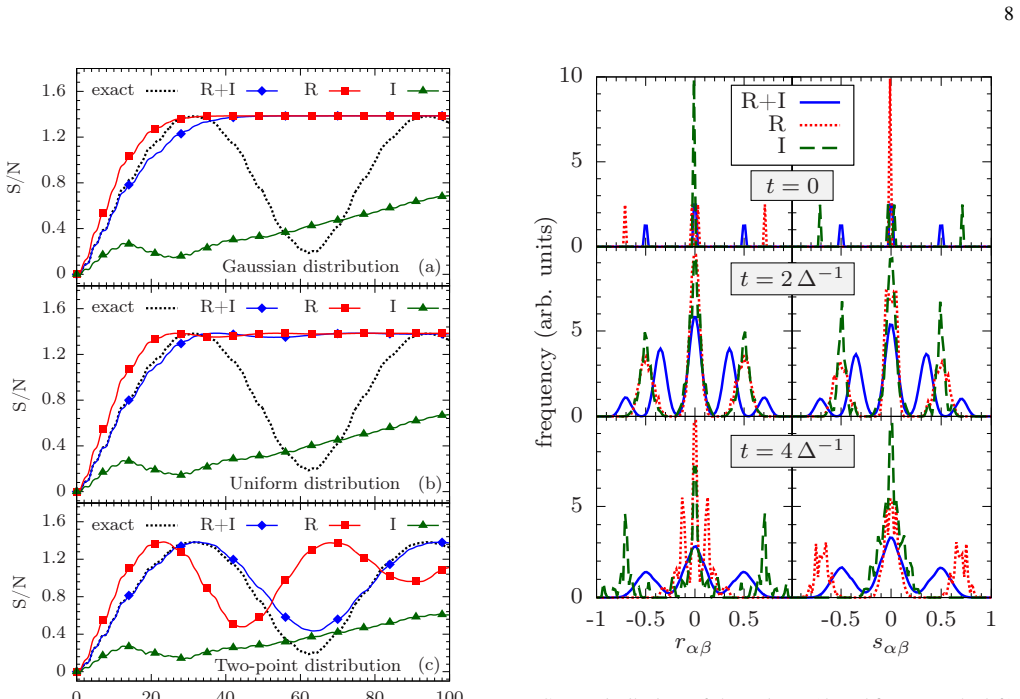
The central claim is that, among initial probability distributions with the same variance and with statistically independent matrix elements, the one with the smallest kurtosis gives the best SMF dynamics: for the three distributions tested, the two-point distribution is best, uniform is intermediate, and Gaussian is worst. The paper derives the quantum third and fourth central moments of a one-body observable for a Slater determinant and shows that matching them with a classical distribution is impossible, since the fourth-moment condition for particle-hole pairs would require a negative value. Under the independence assumption the mismatch reduces to $F(\chi,\gamma)=2(\gamma-1)\chi^2-(\gamma-1)\chi+\gamma/4$, which decreases as the kurtosis $\gamma$ decreases and is minimized for $\gamma=1$. In the modified Lipkin-Meshkov-Glick model, the Gaussian and uniform initial conditions over-dissipate the dipole oscillations and drive the one-body entropy to its maximum around $t=50\,\Delta^{-1}$, while the two-point initial condition follows the exact damping and entropy curve much further.
Load-bearing premise
The kurtosis ordering rests on treating every fluctuation in the initial density matrix as statistically independent, including the real and imaginary parts of the same entry; if those initial correlations matter physically, the two-point distribution may not remain optimal.
Editorial extensions
If this is right
- Swapping Gaussian initial draws for two-point draws in SMF should extend the time over which collective observables are predictive, at no extra computational cost.
- The ordering two-point better than uniform better than Gaussian should hold in other SMF applications whenever the matrix elements are initialized independently and the fourth-moment mismatch dominates.
- Equal weighting of real and imaginary parts ($\chi=1/4$) should be used; unequal weights cause fast drift of the one-body entropy regardless of the distribution.
- Because the two-point distribution yields discrete event observables that quickly Gaussianize, accurate ensemble averages may require fewer SMF events than Gaussian sampling.
- At strong coupling the initial distribution matters much less, since the validity time of mean-field-type dynamics shrinks inversely with the coupling strength.
Reading between the lines
- The independence assumption is the fragile part: if initialization correlations between matrix elements, or between real and imaginary parts, are dynamically important, the kurtosis ordering could reverse in other models; testing this would require a correlated sampling scheme, which the paper does not provide.
- The negative-fourth-moment obstruction has the same signature as Wigner-function negativity, so the two-point distribution may be acting as an effective quasiprobability; that view could guide noise construction in other semiclassical fermion methods.
- The discrete event distribution Gaussianizes faster for larger particle number, so the practical benefit of the two-point choice is likely largest in few-body and mesoscopic systems and may shrink for very large systems; this is an extrapolation from the paper's central-limit observation.
- A natural next step is to relax the independence assumption and try to match third and fourth moments jointly with a correlated distribution, which the paper's hierarchy argument suggests could further extend predictive time.
Signed reviews
Editorial analysis
A structured set of objections, weighed in public.
Referee Report
Summary. The paper studies the stochastic mean-field (SMF) approach for interacting fermions, where the initial one-body density matrix is sampled from a probability distribution. The authors derive the third- and fourth-moment conditions that such distributions should satisfy in order to match the quantum moments of one-body observables for an initial Slater determinant, and show that the exact quantum fourth central moment can be negative, which no classical probability distribution can reproduce. They then propose to choose initial distributions with small kurtosis, in particular the two-point distribution, and test Gaussian, uniform, and two-point distributions on a modified Lipkin-Meshkov-Glick model by comparing the SMF dynamics with the exact dynamics of the dipole operator and the one-body entropy. They report that the two-point distribution provides the best long-time agreement, while the Gaussian distribution gives the worst.
Significance. If the central claim is correct, the work offers a simple and practical improvement to the stochastic mean-field method: replacing Gaussian initial noise with a two-point distribution can substantially extend the predictive time scale for dissipative fermionic dynamics. The paper is self-contained, with a complete derivation of the moment conditions in Sec. II and the appendix, and the numerical benchmark is an independent exact solution of the same model with no parameter fitted to the exact dynamics. The figures are numerous and transparent. At the same time, the theoretical criterion is derived for individual stochastic matrix elements under an explicit independence assumption, whereas the headline result concerns a collective observable after nonlinear propagation; the quantitative support for the ranking is only visual, and one printed central equation is incorrect as written. These issues currently limit the strength of the conclusions.
major comments (4)
- [Sec. III.B, Eq. (38)] The printed mean-field equation contains two identical interaction sums, v0 Σ_{γ>0}(ρ_γα ρ_γβ - ρ_αγ ρ_βγ), with opposite signs; they cancel identically and leave only the non-interacting single-particle term. This cannot be the equation used in the simulations, since the SMF dynamics would then contain no interaction-dependent dissipation. Please correct the equation (and check the sign/index structure of the mean-field commutator) and state explicitly that the numerical code implements the corrected equation.
- [Sec. III.D, Figs. 3–5 and 10–11] The central ranking of the three distributions is supported only by visual comparison of curves. Provide a quantitative metric, e.g., time-integrated L1 or L2 errors of ⟨D⟩(t) and S(t) with respect to the exact solution, for each distribution and for both coupling strengths and both initial states. Without such numbers, the claim that the two-point distribution is 'much better' is not quantified, and the strong-coupling case (v0 = 0.5Δ), where the differences are described as 'almost negligible', needs a quantitative statement.
- [Sec. II, Eqs. (28)–(32); Fig. 8] The optimality argument based on F(χ,γ) is derived for a single stochastic matrix element under the independence assumption, but the headline result concerns the collective observable D after a basis rotation and nonlinear propagation. The paper does not report the fourth central moment of the ensemble of ⟨D⟩_λ at t = 0 or compare it with the exact quantum value for the three distributions; Fig. 8 shows only the shape of the distribution. Consequently, it is not demonstrated that the kurtosis criterion is the operative cause of the observed ordering, which could in principle be due to other features such as bounded support. Please add this diagnostic or explicitly weaken the causal claim.
- [Sec. III.D, Fig. 6] For the two-point distribution, F(χ,γ) is independent of χ (Eq. (30), Fig. 1), yet Fig. 6 shows a strong χ-dependence of the entropy evolution, with the equal-weight R+I case much closer to the exact result than the R or I cases. The authors invoke dynamical correlations built up by the MF equation, but this is a post-hoc argument and is not derived from the theory in Sec. II. This discrepancy limits the predictive content of the kurtosis criterion and should be discussed explicitly, including what it implies for the general applicability of the criterion.
minor comments (5)
- [Eq. (29)] The negative right-hand side is the crux of the impossibility argument; please make explicit that this target is unreachable for any probability distribution and that minimizing F is a heuristic rather than a variational principle.
- [Sec. III.C, Eq. (42)] The occupation numbers in Eq. (42) are written as a set; it would help to state explicitly that the remaining single-particle states are empty.
- [Figs. 3 and 4] The colors and line styles are described in the captions but it would aid accessibility to define them directly in the captions rather than relying on the (G), (U), (T) labels introduced in the main text.
- [Abstract] The abstract says 'generally leads to overdamping', but for the strong coupling case (v0 = 0.5Δ) the difference between the three distributions is small; please qualify the abstract accordingly.
- [Ref. [32]] The spelling 'Nicholson' in the reference title should be 'Nicolson' to match the standard name of the Crank–Nicolson method.
Circularity Check
Derivation is heuristic but benchmarked against independent exact mLMG dynamics; no parameter is fitted and no claim reduces to its input by construction.
full rationale
The paper's central claim is that a two-point initial distribution improves SMF dynamics compared with Gaussian or uniform noise. The theoretical motivation is heuristic: after deriving quantum third and fourth moments for a Slater determinant, the authors show that exact moment matching is impossible even with correlated matrix elements (Eqs. 24, 25), then assume uncorrelated elements and introduce F(χ,γ), Eq. (30), as a measure of the unattainable negative fourth-moment target. Smaller kurtosis lowers F, but F is not a fit parameter and is not the evidence for the conclusion. The substantive evidence is the independent comparison with the exact solution of the mLMG model, Figs. 3-5, 10-11, where Gaussian, uniform, and two-point ensembles share the same variances by construction and no parameter is adjusted to the exact dynamics. The observed ordering (two-point best, Gaussian worst) is therefore an external numerical result, not a restatement of the criterion. Self-citations appear in contextual roles: [6,7] define SMF, [8-18] give prior applications, and [35] is invoked only to explain why higher moments matter; none of these citations is load-bearing for the new numerical conclusion. Honest limitations are reported in the text: the independence assumption after Eq. (26), the impossibility of satisfying Eqs. (24)-(25), and the fact that F is only an anticipation rather than a proof. These are assumptions and correctness risks, not circularity. The paper does not rename a known result, smuggle an ansatz via citation, or import a uniqueness theorem from the authors' prior work. No circular step can be exhibited.
Assumptions & free parameters
free parameters (4)
- χ = r_ij^2: variance weight on real parts of stochastic matrix elements =
1/4 (equal weights); 0 (imaginary-only); 1/2 (real-only)
- Initial dipole boost μ =
0.8
- Interaction strength v0 =
0.05 Δ (weak) and 0.5 Δ (strong)
- Single-particle energy realization {εα} =
As listed in Eq. (43), with σε = 0.2 Δ
assumptions (4)
- domain assumption Each initial stochastic density is Hermitian, so the diagonal elements δρ_ii = 0 (Eq. 21).
- ad hoc to paper The stochastic matrix elements are statistically independent, and their real and imaginary parts are independent (Sec. II, after Eq. 26).
- domain assumption The initial many-body state is a Slater determinant with occupations n_i ∈ {0,1}, so n_i^2 = n_i in the Appendix.
- domain assumption The mLMG single-particle energies are quenched disorder, fixed once for the dynamics (Sec. III A).
Cite this review
Pith. "Pith review of Impact of the initial fluctuations on the dissipative dynamics of interacting Fermi systems: A model case study." pith.science (2026). https://pith.science/paper/TVMPGD2E
@misc{pith2026190805520,
  author       = {Pith},
  title        = {Pith review of: Impact of the initial fluctuations on the dissipative dynamics of interacting Fermi systems: A model case study},
  year         = {2026},
  howpublished = {\url{https://pith.science/paper/TVMPGD2E}},
  note         = {Machine review of arXiv:1908.05520}
}
read the original abstract
Standard methods used for computing the dynamics of a quantum many-body system are the mean-field (MF) approximations such as the time-dependent Hartree-Fock (TDHF) approach. Even though MF approaches are quite successful, they suffer some well-known shortcomings, one of which is insufficient dissipation of collective motion. The stochastic mean-field approach (SMF), where a set of MF trajectories with random initial conditions are considered, is a good candidate to include dissipative effects beyond mean field. In this approach, the one-body density matrix elements are treated initially as a set of stochastic Gaussian c numbers that are adjusted to reproduce first and second moments of collective one-body observables. It is shown that the predictive power of the SMF approach can be further improved by relaxing the Gaussian assumption for the initial probabilities. More precisely, using Gaussian or uniform distributions for the matrix elements generally leads to overdamping for long times, whereas distributions with smaller kurtosis lead to much better reproduction of the long time evolution.
Figures


Figures from the paper (5 more)




Reference graph
Works this paper leans on
-
[1]
+Tr12(ρ12A1A2) =∑ i j ni(1− n j)Ai jA ji +∑ i j nin jAiiA j j, (A.2) where ρ12 = ρ1ρ2(1− P12). Hence, the second central mo- ment is given by ⟨(A−⟨ A⟩)2⟩ =⟨A2⟩−⟨ A⟩2 =∑ i j ni(1− n j)A jiAi j =1 2 ∑ i j [ni(1− n j) +n j(1− ni)] A jiAi j. (A.3) 12 The third moment of A reads ⟨A3⟩ =Tr1(ρ1A3
-
[2]
+2Tr12(ρ12A2 1A2) +Tr12(ρ12A1A2 2) + Tr123(ρ123A1A2A3) =∑ i jk niAi jA jkAki + 2∑ i jk nin j ( AikAkiA j j− A jkAkiAi j ) +∑ i jk nin j ( AiiA jkAk j− A jiAikAk j ) +∑ i jk nin jnk(AiiA j jAkk− AiiA jkAk j − Ai jA jiAkk− AikA j jAki + Ai jA jkAki + A jiAk jAik) =∑ i jk niAi jA jkAki + 3∑ i jk nin j ( AikAkiA j j− A jkAkiAi j ) +∑ i jk nin jnk(AiiA j jAkk−...
-
[3]
+Tr12 [ ρ12(4A3 1A2 + 3A2 1A2 2) ] + 6Tr123(ρ123A2 1A2A3) + Tr1234(ρ1234A1A2A3A4) = ∑ i jkl niAi jA jkAkl Ali + 4 ∑ i jkl nin j ( AikAkl AliA j j− A jkAkl AliAi j ) + 3 ∑ i jkl nin j(AikAkiA jl Al j− A jkAkiAilAl j) + 6 ∑ i jkl nin jnk(AilAliA j jAkk− AilAliA jkAk j − Akl AliA j jAik− A jl AliAi jAkk + 2Ai jA jkAkl Ali) + ∑ i jkl nin jnknl(AiiA j jAkkAll−...
-
[4]
Comparisons of classical and quantum dynamics for initially localized states,
M. J. Davis and E. J. Heller, “Comparisons of classical and quantum dynamics for initially localized states,” J. Chem. Phys. 80, 5036 (1984)
work page 1984
-
[5]
C. W. Gardiner and P. Zoller, Quantum Noise: A Handbook of Markovian and Non-Markovian Quantum Stochastic Methods with Applications to Quantum Optics (Springer–Verlag, Berlin- Heidelberg, 2004)
work page 2004
-
[6]
The truncated Wigner method for Bose-condensed gases: limits of validity and applications,
Alice Sinatra, Carlos Lobo, and Yvan Castin, “The truncated Wigner method for Bose-condensed gases: limits of validity and applications,” J. Phys. B: At. Mol. Opt. Phys. 35, 3599– 3631 (2002)
work page 2002
-
[7]
Phase space representation of quantum dynamics,
Anatoli Polkovnikov, “Phase space representation of quantum dynamics,” Ann. Phys.325, 1790–1852 (2010)
work page 2010
-
[8]
Semiclassical approach to dynamics of interacting fermions,
Shainen M. Davidson, Dries Sels, and Anatoli Polkovnikov, “Semiclassical approach to dynamics of interacting fermions,” Ann. Phys. 384, 128–141 (2017)
work page 2017
Show all 38 references
-
[9]
A stochastic mean-field approach for nuclear dynam- ics,
S. Ayik, “A stochastic mean-field approach for nuclear dynam- ics,” Phys. Lett. B658, 174 (2008)
2008
-
[10]
Stochastic quantum dynamics beyond mean field,
Denis Lacroix and Sakir Ayik, “Stochastic quantum dynamics beyond mean field,” Eur. Phys. J. A50, 95 (2014)
2014
-
[11]
Symmetry breaking and fluctuations within stochastic mean-field dynam- ics: Importance of initial quantum fluctuations,
Denis Lacroix, Sakir Ayik, and Bulent Yilmaz, “Symmetry breaking and fluctuations within stochastic mean-field dynam- ics: Importance of initial quantum fluctuations,” Phys. Rev. C 85, 041602(R) (2012)
2012
-
[12]
Ul- trafast dynamics of finite Hubbard clusters:A stochastic mean- field approach,
D. Lacroix, S. Hermanns, C. M. Hinz, and M. Bonitz, “Ul- trafast dynamics of finite Hubbard clusters:A stochastic mean- field approach,” Phys. Rev. B90, 125112 (2014)
2014
-
[13]
Importance of realistic phase-space representations of initial quantum fluc- tuations using the stochastic mean-field approach for fermions,
Bulent Yilmaz, Denis Lacroix, and Resul Curebal, “Importance of realistic phase-space representations of initial quantum fluc- tuations using the stochastic mean-field approach for fermions,” Phys. Rev. C 90, 054617 (2014)
2014
-
[14]
Fluctuation and dis- sipation dynamics in fusion reactions from a stochastic mean- field approach,
S. Ayik, K. Washiyama, and D. Lacroix, “Fluctuation and dis- sipation dynamics in fusion reactions from a stochastic mean- field approach,” Phys. Rev. C79, 054606 (2009)
2009
-
[15]
Stochastic semi-classical description of fusion at near-barrier energies,
S. Ayik, B. Yilmaz, and D. Lacroix, “Stochastic semi-classical description of fusion at near-barrier energies,” Phys. Rev. C81, 034605 (2010)
2010
-
[16]
Nucleon exchange mechanism in heavy-ion collisions at near-barrier en- ergies,
B. Yilmaz, S. Ayik, D. Lacroix, and K. Washiyama, “Nucleon exchange mechanism in heavy-ion collisions at near-barrier en- ergies,” Phys. Rev. C83, 064615 (2011)
2011
-
[17]
Nucleon ex- change in heavy-ion collisions within a stochastic mean-field approach,
B. Yilmaz, S. Ayik, D. Lacroix, and O. Yilmaz, “Nucleon ex- change in heavy-ion collisions within a stochastic mean-field approach,” Phys. Rev. C90, 024613 (2014)
2014
-
[18]
Micro- scopic Phase–Space Exploration Modeling of 258Fm Sponta- neous Fission,
Yusuke Tanimura, Denis Lacroix, and Sakir Ayik, “Micro- scopic Phase–Space Exploration Modeling of 258Fm Sponta- neous Fission,” Phys. Rev. Lett.118, 152501 (2017)
2017
-
[19]
Multinucleon transfer in central collisions of 238U +238 U,
S. Ayik, B. Yilmaz, O. Yilmaz, A. S. Umar, and G. Turan, “Multinucleon transfer in central collisions of 238U +238 U,” Phys. Rev. C 96, 024611 (2017)
2017
-
[20]
Quantal dif- fusion description of multinucleon transfers in heavy–ion colli- sions,
S. Ayik, B. Yilmaz, O. Yilmaz, and A. S. Umar, “Quantal dif- fusion description of multinucleon transfers in heavy–ion colli- sions,” Phys. Rev. C97, 054618 (2018)
2018
-
[21]
Quantal diffu- sion approach for multinucleon transfers in Xe+Pb collisions,
S. Ayik, B. Yilmaz, O. Yilmaz, and A. S. Umar, “Quantal diffu- sion approach for multinucleon transfers in Xe+Pb collisions,” Phys. Rev. C 100, 014609 (2019)
2019
-
[22]
Quan- tal corrections to mean-field dynamics including pairing,
Denis Lacroix, Danilo Gambacurta, and Sakir Ayik, “Quan- tal corrections to mean-field dynamics including pairing,” Phys. Rev. C 87, 061302(R) (2013)
2013
-
[23]
Stochastic TDHF in exactly solvable model,
L. Lacombe, E. Suraud, P.-G. Reinhard, and P. M. Dinh, “Stochastic TDHF in exactly solvable model,” Ann. Phys.373, 216–229 (2016)
2016
-
[24]
On stochas- tic approaches of nuclear dynamics,
Y . Abe, S. Ayik, P.-G. Reinhard, and E. Suraud, “On stochas- tic approaches of nuclear dynamics,” Phys. Rep. 275, 49 – 196 (1996)
1996
-
[25]
Three-dimensional Langevin calculations of fission fragment mass-energy distribution from excited compound nuclei,
A. V . Karpov, P. N. Nadtochy, D. V . Vanin, and G. D. Adeev, “Three-dimensional Langevin calculations of fission fragment mass-energy distribution from excited compound nuclei,” Phys. Rev. C 63, 054610 (2001)
2001
-
[26]
Unified consideration of deep inelastic, quasi-fission and fusion-fission phenomena,
Valery Zagrebaev and Walter Greiner, “Unified consideration of deep inelastic, quasi-fission and fusion-fission phenomena,” J. Phys. G 31, 825 (2005)
2005
-
[27]
Analysis of dynamical processes using the mass distribution of fission fragments in heavy-ion reactions,
Y . Aritomo, “Analysis of dynamical processes using the mass distribution of fission fragments in heavy-ion reactions,” Phys. Rev. C 80, 064604 (2009)
2009
-
[28]
Non-Gaussian Fluctuations and Non-Markovian Effects in the Nuclear Fusion Process: Langevin Dynamics Emerging from Quantum Molecular Dy- 14 namics Simulations,
Kai Wen, Fumihiko Sakata, Zhu-Xia Li, Xi-Zhen Wu, Ying- Xun Zhang, and Shan-Gui Zhou, “Non-Gaussian Fluctuations and Non-Markovian Effects in the Nuclear Fusion Process: Langevin Dynamics Emerging from Quantum Molecular Dy- 14 namics Simulations,” Phys. Rev. Lett.111, 012501 (2013)
2013
-
[29]
Modeling near-barrier collisions of heavy ions based on a Langevin-type approach,
A. V . Karpov and V . V . Saiko, “Modeling near-barrier collisions of heavy ions based on a Langevin-type approach,” Phys. Rev. C 96, 024618 (2017)
2017
-
[30]
Time-dependent Hartree-Fock plus Langevin approach for hot fusion reactions to synthesize the Z = 120 superheavy element,
K. Sekizawa and K. Hagino, “Time-dependent Hartree-Fock plus Langevin approach for hot fusion reactions to synthesize the Z = 120 superheavy element,” Phys. Rev. C99, 051602(R) (2019)
2019
-
[31]
One-body Langevin dynam- ics in heavy-ion collisions at intermediate energies,
Hao Lin and Pawel Danielewicz, “One-body Langevin dynam- ics in heavy-ion collisions at intermediate energies,” Phys. Rev. C 99, 024612 (2019)
2019
-
[32]
Fourth moments reveal the negativity of the Wigner function,
Adam Bednorz and Wolfgang Belzig, “Fourth moments reveal the negativity of the Wigner function,” Phys. Rev. A83, 052113 (2011)
2011
-
[33]
A quantile alternative for kurtosis,
J. J. A. Moors, “A quantile alternative for kurtosis,” The Statis- tician 37, 25–32 (1988)
1988
-
[34]
Validity of many- body approximation methods for a solvable model. (I). Exact solutions and perturbation theory,
H. J. Lipkin, N. Meshkov, and A. J. Glick, “Validity of many- body approximation methods for a solvable model. (I). Exact solutions and perturbation theory,” Nucl. Phys. A 62, 188–198 (1965)
1965
-
[35]
Stability of the iterated Crank-Nicholson method in numerical relativity,
Saul A. Teukolsky, “Stability of the iterated Crank-Nicholson method in numerical relativity,” Phys. Rev. D 61, 087501 (2000)
2000
-
[36]
Stability conditions and nuclear rotations in the Hartree–Fock theory,
D. J. Thouless, “Stability conditions and nuclear rotations in the Hartree–Fock theory,” Nucl. Phys.21, 225–232 (1960)
1960
-
[37]
Quantum corrections to the dynamics of interacting bosons: Beyond the truncated Wigner approxima- tion,
Anatoli Polkovnikov, “Quantum corrections to the dynamics of interacting bosons: Beyond the truncated Wigner approxima- tion,” Phys. Rev. A68, 053604 (2003)
2003
-
[38]
A simpli- fied BBGKY hierarcy for correlated fermions from a stochastic mean-field approach,
D. Lacroix, Y . Tanimura, S. Ayik, and B. Yilmaz, “A simpli- fied BBGKY hierarcy for correlated fermions from a stochastic mean-field approach,” Eur. Phys. J. A52, 94 (2016)
2016
Reviewed August 14, 2026 · model on record in the stance chip above.
Discussion (0). Continue with ORCID to comment.