REVIEW 6 minor 65 references
Random surfaces and Liouville quantum gravity
T0 review · 0 major / 6 minor · reviewed 2026-08-14 · deepseek-v4-flash
Pith's one-line read Liouville quantum gravity surfaces are the canonical random two-dimensional geometries, the paper argues, and random planar maps converge to them in three distinct senses.
desk verdict A clear, honest survey of the LQG/random planar map convergence program; nothing new but a solid map of what is proven, worth a serious referee. read the letter →
The pith
A machine-rendered reading of the paper's core claim, the machinery that carries it, and where it could break.
The reading
What carries the argument
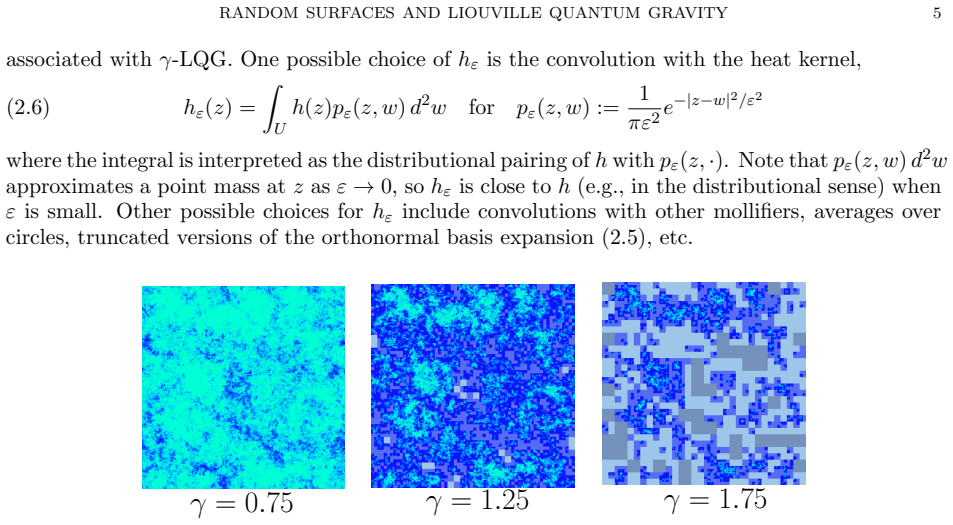
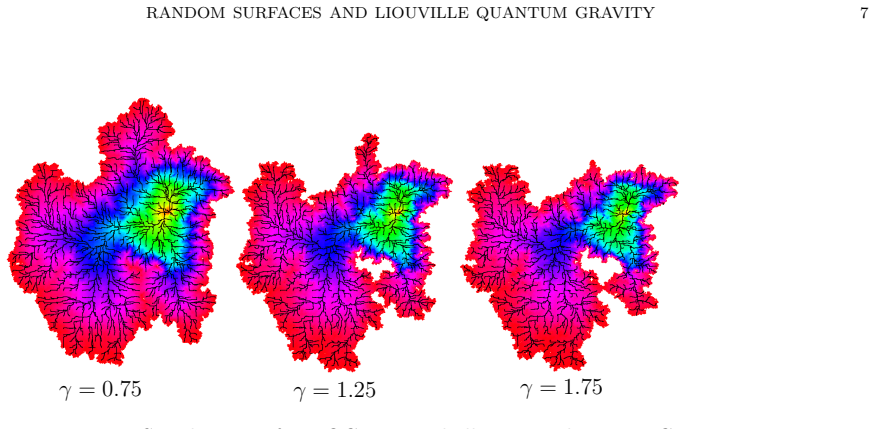
The load-bearing object is the $\gamma$-LQG surface, defined as a random distribution $h$ (the Gaussian free field) on a domain $U$, equipped with the formal Riemannian metric tensor $e^{\gamma h}(dx^2+dy^2)$. The area measure is obtained by regularization: $\varepsilon^{\gamma^2/2} e^{\gamma h_\varepsilon} d^2z$ converges to a Gaussian multiplicative chaos measure, and the metric is obtained by a much harder renormalized 'Liouville first passage percolation' procedure using the exponent $\gamma/d_\gamma$, whose limit was proved to exist and be unique for all $\gamma \in (0,2)$. The mating-of-trees bijections, which encode decorated planar maps by random walks converging to correlated Brownian motion, are the bridge that connects discrete maps to the continuum surface.
What would settle it
Run the renormalization construction for a fixed Gaussian free field and a fixed $\gamma \in (0,2)$ with two different mollifiers and check whether the rescaled metrics converge to the same limit; the uniqueness theorem says they must, so two distinct limits would refute the metric existence claim. Short of that, a precise simulation of the Hausdorff dimension for $\gamma=\sqrt{2}$ that lands outside the proven interval $3.550408$ to $3.63299$ would show the theory is internally inconsistent.
Extended reading notes
Core claim
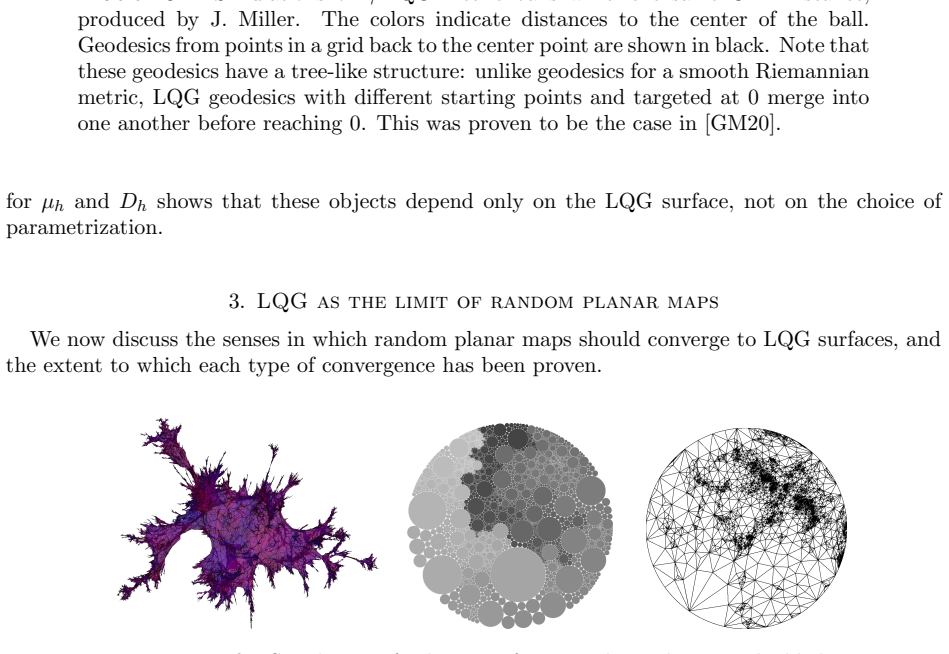
The central claim is that for every $\gamma \in (0,2)$, there is a unique random surface—the $\gamma$-LQG surface, built from the two-dimensional Gaussian free field $h$ via the formal metric tensor $e^{\gamma h}(dx^2+dy^2)$—that is the universal scaling limit of the associated family of random planar maps, in the same sense that Brownian motion is the universal scaling limit of random walks. The paper surveys the three proven modes of convergence: Gromov-Hausdorff convergence of uniform planar maps to the Brownian map, which is the $\sqrt{8/3}$-LQG quantum sphere; convergence of embedded maps toward the $\gamma$-LQG measure; and mating-of-trees convergence, in which a decorated planar map is encoded by a two-dimensional Brownian motion with correlation $-\cos(\pi \gamma^2/4)$ and the continuum surface is reconstructed from that motion by a continuum mating-of-trees bijection. It also records the main open problem, the value of the Hausdorff dimension $d_\gamma$ for $\gamma \neq \sqrt{8/3}$.
Load-bearing premise
The survey stands or falls with the correctness of the external theorems it cites, above all the existence and uniqueness of the random metric for every roughness parameter in (0,2), the identification of the uniform-map limit with the roughness $\sqrt{8/3}$ case, and the encoding of the continuum surfaces by correlated Brownian motion.
Editorial extensions
If this is right
- Uniform triangulations and quadrangulations, with graph distance rescaled by $n^{-1/4}$ and vertex masses by $1/n$, converge in the Gromov-Hausdorff-Prokhorov sense to the Brownian map, identified with the $\sqrt{8/3}$-LQG quantum sphere.
- For every $\gamma \in (0,2)$, mated-CRT maps embedded by the Tutte embedding have vertex counting measure converging to the $\gamma$-LQG measure; uniform triangulations embedded by the Cardy embedding converge to $\sqrt{8/3}$-LQG in all three senses simultaneously.
- The existence and uniqueness of the $\gamma$-LQG metric implies that $d_\gamma$—the Hausdorff dimension of the metric space—is a well-defined function of $\gamma$, equal to $4$ at $\gamma=\sqrt{8/3}$, and strictly increasing with known bounds such as $3.550408 \leq d_{\sqrt{2}} \leq 3.63299$.
- Mating-of-trees convergence holds for many weighted models (spanning trees, percolation, bipolar orientations, Fortuin-Kasteleyn), giving scaling limits of functionals and exponents, even where metric-space convergence is not yet available.
Reading between the lines
- If the universality claim is right, the three convergence modes should ultimately be compatible: the same $\gamma$-LQG surface should arise as the Gromov-Hausdorff limit, the embedding limit, and the peanosphere limit for the same model; Problem 2 asks for exactly this for weighted maps, but the paper does not conjecture that they coincide as metric measure spaces.
- A closed-form expression for $d_\gamma$ would likely propagate to many observables, including the spectral dimension of random walk on random planar maps and the scaling of graph distances, since the paper lists these as expressible in terms of $d_\gamma$.
- The metric construction is two-dimensional in an essential way: the paper notes the associated metric has only been constructed in dimension 2, so a higher-dimensional canonical random geometry would need a new idea, possibly along the lines of the proposed higher-dimensional Brownian map analog.
Signed reviews
Editorial analysis
A structured set of objections, weighed in public.
Referee Report
Summary. This expository article introduces random planar maps and Liouville quantum gravity (LQG) surfaces, explains how the latter arise as continuum limits of random planar maps, and surveys the state of the art. Sections 1 and 2 define planar maps and the Gaussian free field and describe the gamma-LQG area measure and metric. Section 3 distinguishes three modes of convergence (Gromov-Hausdorff, embedding, and mating-of-trees) and records which random map models have been proved to converge in each mode. Section 4 lists open problems, chiefly the value of the Hausdorff dimension d_gamma for gamma not equal to sqrt(8/3), and the convergence of weighted random planar maps for general gamma. The paper is aimed at readers with roughly second-year graduate-level background and does not prove new theorems.
Significance. The paper is a concise and generally reliable survey of a large and technical subject. Its main value is pedagogical: it isolates three genuinely different notions of convergence to LQG and carefully qualifies what is known for each, which is exactly the kind of precision an introductory text needs. The statements about the LQG measure, the LQG metric, and the Brownian map equivalence are consistent with the cited literature, and the open-problem section draws a clear line between established results and conjectures. The author is also careful to attribute results to original sources and to mark open problems as open. If the survey's account is accurate, it will be a useful entry point for graduate students and non-experts.
minor comments (6)
- [Section 2.2] In the paragraph containing equation (2.4), the Hilbert space H(U) is described as the completion of smooth compactly supported functions on D, but the domain under discussion is U; this should be corrected to 'functions on U'.
- [Section 2.4] The word 'estalbished' in the sentence about Duplantier and Sheffield should be 'established'.
- [Section 3.2] The term 'baycentric embedding' should be 'barycentric embedding'.
- [Section 2.1] The first fundamental form is conventionally written E dx^2 + 2F dx dy + G dy^2; as written with F dx dy, the factor of 2 is omitted. Since the cross term disappears in isothermal coordinates, this does not affect the main argument, but the notation should either follow the standard convention or explicitly note the convention being used.
- [Section 2.2] The phrase 'the standard Gaussian random variable on H(U)' could be misread as implying the existence of a Gaussian measure on an infinite-dimensional Hilbert space; the intended meaning is the random distribution defined by the orthonormal series (2.5), and this could be stated more explicitly.
- [Section 2.4] Equation (2.7) uses the heat-kernel regularization h_epsilon, but the text does not specify the normalization convention that makes epsilon^{gamma^2/2} the correct factor. A sentence noting that the normalization is chosen so that E[h_epsilon(z)^2] ~ log(1/epsilon) would help readers verify the formula.
Circularity Check
No circularity: the survey's claims rest on independent published theorems, not on self-referential fits or definitions.
full rationale
This is an expository survey by Ewain Gwynne; it presents no new derivation and fits no parameters. Its load-bearing statements are citations to published, peer-reviewed external results: Le Gall and Miermont for Brownian map scaling limits, Miller-Sheffield for the quantum sphere/Brownian map equivalence, Duplantier-Miller-Sheffield for mating of trees, and Gwynne-Miller for existence and uniqueness of the gamma-LQG metric. Although [GM21] is authored by the survey's author, it is an independent published theorem (Invent. Math. 223 (2021)) with its own proof, not an unverified premise imported solely by citation. The definitions in Section 2 (GFF, gamma-LQG measure, metric) are standard constructions, not definitions of the target convergence claims. Section 3 explicitly limits each convergence mode: Gromov-Hausdorff convergence only for uniform maps at gamma = sqrt(8/3), embedding convergence for specific models, and mating-of-trees convergence as a weaker topology; Section 4 lists open problems. No equation or claim reduces by construction to its input, and no fitted parameter is renamed as a prediction. Therefore no circularity step can be exhibited.
Assumptions & free parameters
assumptions (3)
- domain assumption The gamma-LQG metric exists and is unique for gamma in (0,2), as constructed in [GM21].
- domain assumption The Gaussian free field exists as a random distribution on H(U) and the gamma-LQG measure is the limit in (2.7) as established by [She07] and [DS11].
- domain assumption Uniform planar maps converge in the Gromov-Hausdorff-Prokhorov sense to the Brownian map, and the Brownian map is equivalent to sqrt(8/3)-LQG, per [Le13, Mie13, MS20].
Cite this review
Pith. "Pith review of Random surfaces and Liouville quantum gravity." pith.science (2026). https://pith.science/paper/7BQPHSNY
@misc{pith2026190805573,
  author       = {Pith},
  title        = {Pith review of: Random surfaces and Liouville quantum gravity},
  year         = {2026},
  howpublished = {\url{https://pith.science/paper/7BQPHSNY}},
  note         = {Machine review of arXiv:1908.05573}
}
read the original abstract
Liouville quantum gravity (LQG) surfaces are a family of random fractal surfaces which can be thought of as the canonical models of random two-dimensional Riemannian manifolds, in the same sense that Brownian motion is the canonical model of a random path. LQG surfaces are the continuum limits of discrete random surfaces called random planar maps. In this expository article, we discuss the definition of random planar maps and LQG, the sense in which random planar maps converge to LQG, and the motivations for studying these objects. We also mention several open problems. We do not assume any background knowledge beyond that of a second-year mathematics graduate student.
Figures

Figures from the paper (1 more)
Reference graph
Works this paper leans on
-
[1]
O. Angel. Growth and percolation on the uniform infinite planar triangulation. Geom. Funct. Anal. , 13(5):935--974, 2003, arXiv:0208123. 2024412
work page 2003
-
[2]
M. Ang. Comparison of discrete and continuum Liouville first passage percolation . ArXiv e-prints , Apr 2019, arXiv:1904.09285
arXiv 2019
-
[3]
J. Aru . Gaussian multiplicative chaos through the lens of the 2D Gaussian free field . ArXiv e-prints , Sep 2017, arXiv:1709.04355
work page Pith review arXiv 2017
-
[4]
Precision measurements of Hausdorff dimensions in two-dimensional quantum gravity
J. Barkley and T. Budd . Precision measurements of Hausdorff dimensions in two-dimensional quantum gravity . ArXiv e-prints , Aug 2019, arXiv:1908.09469
work page Pith review arXiv 2019
-
[5]
Planar maps as labeled mobiles
J. Bouttier, P. Di Francesco, and E. Guitter. Planar maps as labeled mobiles. Electron. J. Combin. , 11(1):Research Paper 69, 27, 2004, arXiv:math/0405099. 2097335 (2005i:05087)
work page Pith review arXiv 2004
-
[6]
N. Berestycki . I ntroduction to the G aussian F ree F ield and L iouville Q uantum G ravity. A vailable at https://homepage.univie.ac.at/nathanael.berestycki/articles.html
- [7]
-
[8]
Bijective counting of tree-rooted maps and shuffles of parenthesis systems
O. Bernardi. Bijective counting of tree-rooted maps and shuffles of parenthesis systems. Electron. J. Combin. , 14(1):Research Paper 9, 36 pp. (electronic), 2007, arXiv:math/0601684. 2285813 (2007m:05125)
work page Pith review arXiv 2007
Show all 65 references
-
[9]
Berestycki
N. Berestycki. An elementary approach to G aussian multiplicative chaos. Electron. Commun. Probab. , 22:Paper No. 27, 12, 2017, arXiv:1506.09113. 3652040
2017 arXiv
-
[10]
Bernardi , N
O. Bernardi , N. Holden , and X. Sun . Percolation on triangulations: a bijective path to Liouville quantum gravity . ArXiv e-prints , July 2018, arXiv:1807.01684
2018 arXiv
-
[11]
Barral, X
J. Barral, X. Jin, R. Rhodes, and V. Vargas. Gaussian multiplicative chaos and KPZ duality. Comm. Math. Phys. , 323(2):451--485, 2013, arXiv:1202.5296. 3096527
2013 arXiv
-
[12]
B erestycki and J
N. B erestycki and J. N orris. L ectures on S chramm- L oewner E volution. Available at http://www.statslab.cam.ac.uk/ james/Lectures/
-
[13]
S.-s. Chern. An elementary proof of the existence of isothermal parameters on a surface. Proc. Amer. Math. Soc. , 6:771--782, 1955. 0074856
1955
-
[14]
N. Curien. Peeling random planar maps. N otes du cours P eccot. Available at https://www.math.u-psud.fr/ curien/cours/peccot.pdf, 2016
2016
-
[15]
J. Ding, J. Dub \'e dat, A. Dunlap, and H. Falconet. Tightness of Liouville first passage percolation for (0,2) . ArXiv e-prints , Apr 2019, arXiv:1904.08021
2019 arXiv
-
[16]
Dub \'e dat, H
J. Dub \'e dat, H. Falconet, E. Gwynne, J. Pfeffer, and X. Sun. W eak LQG metrics and L iouville first passage percolation. ArXiv e-prints , May 2019, arXiv:1905.00380
2019 arXiv
-
[17]
Ding and S
J. Ding and S. Goswami . Upper bounds on Liouville first passage percolation and Watabiki's prediction . C ommunications in P ure and A pplied M athematics , to appear, 2016, arXiv:1610.09998
2016 arXiv
-
[18]
Ding and E
J. Ding and E. Gwynne . The fractal dimension of L iouville quantum gravity: universality, monotonicity, and bounds . C ommunications in M athematical P hysics , to appear, 2018, arXiv:1807.01072
2018 arXiv
-
[19]
David, A
F. David, A. Kupiainen, R. Rhodes, and V. Vargas. Liouville quantum gravity on the R iemann sphere. Comm. Math. Phys. , 342(3):869--907, 2016, arXiv:1410.7318. 3465434
2016 arXiv
-
[20]
Duplantier , J
B. Duplantier , J. Miller , and S. Sheffield . Liouville quantum gravity as a mating of trees . ArXiv e-prints , September 2014, arXiv:1409.7055
2014 arXiv
-
[21]
Duplantier , R
B. Duplantier , R. Rhodes , S. Sheffield , and V. Vargas . Log-correlated Gaussian fields: an overview . ArXiv e-prints , July 2014, arXiv:1407.5605
2014 arXiv
-
[22]
Duplantier, R
B. Duplantier, R. Rhodes, S. Sheffield, and V. Vargas. Critical G aussian multiplicative chaos: convergence of the derivative martingale. Ann. Probab. , 42(5):1769--1808, 2014, arXiv:1206.1671. 3262492
2014 arXiv
-
[23]
Duplantier, R
B. Duplantier, R. Rhodes, S. Sheffield, and V. Vargas. Renormalization of critical G aussian multiplicative chaos and KPZ relation. Comm. Math. Phys. , 330(1):283--330, 2014, arXiv:1212.0529. 3215583
2014 arXiv
-
[24]
Duplantier and S
B. Duplantier and S. Sheffield. Liouville quantum gravity and KPZ . Invent. Math. , 185(2):333--393, 2011, arXiv:1206.0212. 2819163 (2012f:81251)
2011 arXiv
-
[25]
Duplantier
B. Duplantier. A rigorous perspective on L iouville quantum gravity and the KPZ relation. In Exact methods in low-dimensional statistical physics and quantum computing , pages 529--561. Oxford Univ. Press, Oxford, 2010. 2668656
2010
-
[26]
Ding , O
J. Ding , O. Zeitouni , and F. Zhang . Heat kernel for Liouville Brownian motion and Liouville graph distance . C ommunications in M athematical P hysics , to appear, 2018, arXiv:1807.00422
2018 arXiv
-
[27]
Gwynne and T
E. Gwynne and T. Hutchcroft . Anomalous diffusion of random walk on random planar maps . ArXiv e-prints , July 2018, arXiv:1807.01512
2018 arXiv
-
[28]
Gwynne , N
E. Gwynne , N. Holden , and X. Sun . A mating-of-trees approach for graph distances in random planar maps . ArXiv e-prints , November 2017, arXiv:1711.00723
2017 arXiv
-
[29]
Gwynne, N
E. Gwynne, N. Holden, and X. Sun. M ating of trees for random planar maps and L iouville quantum gravity: a survey. In preparation, 2019
2019
-
[30]
Gwynne , N
E. Gwynne , N. Holden , and X. Sun . Joint scaling limit of site percolation on random triangulations in the metric and peanosphere sense . arXiv e-prints , page arXiv:1905.06757, May 2019, 1905.06757
1905 arXiv
-
[31]
Gwynne and J
E. Gwynne and J. Miller . Random walk on random planar maps: spectral dimension, resistance, and displacement . ArXiv e-prints , November 2017, arXiv:1711.00836
2017 arXiv
-
[32]
Gwynne and J
E. Gwynne and J. Miller. Confluence of geodesics in L iouville quantum gravity for (0,2) . ArXiv e-prints , May 2019, arXiv:1905.00381
2019 arXiv
-
[33]
Gwynne and J
E. Gwynne and J. Miller. Conformal covariance of the L iouville quantum gravity metric for (0,2) . ArXiv e-prints , May 2019, arXiv:1905.00384
2019 arXiv
-
[34]
Gwynne and J
E. Gwynne and J. Miller. Existence and uniqueness of the L iouville quantum gravity metric for (0,2) . ArXiv e-prints , May 2019, arXiv:1905.00383
2019 arXiv
-
[35]
Gwynne and J
E. Gwynne and J. Miller. Local metrics of the G aussian free field. ArXiv e-prints , May 2019, arXiv:1905.00379
2019 arXiv
-
[36]
Gwynne , J
E. Gwynne , J. Miller , and S. Sheffield . The Tutte embedding of the mated-CRT map converges to Liouville quantum gravity . ArXiv e-prints , May 2017, arXiv:1705.11161
2017 arXiv
-
[37]
Gwynne , J
E. Gwynne , J. Miller , and S. Sheffield . The Tutte embedding of the Poisson-Voronoi tessellation of the Brownian disk converges to 8/3 -Liouville quantum gravity . ArXiv e-prints , September 2018, arXiv:1809.02091
2018 arXiv
-
[38]
Gwynne and J
E. Gwynne and J. Pfeffer . Bounds for distances and geodesic dimension in Liouville first passage percolation . E lectronic C ommunications in P robability , 24:no. 56, 12, 2019, arXiv:1903.09561
2019 arXiv
-
[39]
Gwynne and J
E. Gwynne and J. Pfeffer . External diffusion limited aggregation on a spanning-tree-weighted random planar map . ArXiv e-prints , January 2019, arXiv:1901.06860
2019 arXiv
-
[40]
Gwynne and J
E. Gwynne and J. Pfeffer . KPZ formulas for the Liouville quantum gravity metric . ArXiv e-prints , May 2019, arXiv:1905.11790
2019 arXiv
-
[41]
X. Hu, J. Miller, and Y. Peres. Thick points of the G aussian free field. Ann. Probab. , 38(2):896--926, 2010, arXiv:0902.3842. 2642894 (2011c:60117)
2010 arXiv
-
[42]
Holden and X
N. Holden and X. Sun . Convergence of uniform triangulations under the Cardy embedding . ArXiv e-prints , May 2019, arXiv:1905.13207
2019 arXiv
-
[43]
J.-P. Kahane. Sur le chaos multiplicatif. Ann. Sci. Math. Qu\'ebec , 9(2):105--150, 1985. 829798 (88h:60099a)
1985
-
[44]
Kenyon, J
R. Kenyon, J. Miller, S. Sheffield, and D. B. Wilson. Bipolar orientations on planar maps and SLE _ 12 . Ann. Probab. , 47(3):1240--1269, 2019, arXiv:1511.04068. 3945746
2019 arXiv
-
[45]
Kupiainen , R
A. Kupiainen , R. Rhodes , and V. Vargas . Integrability of Liouville theory: proof of the DOZZ Formula . A nnals of M athematics , to appear, 2017, arXiv:1707.08785
2017 arXiv
-
[46]
G. F. Lawler. Conformally invariant processes in the plane , volume 114 of Mathematical Surveys and Monographs . American Mathematical Society, Providence, RI, 2005. 2129588 (2006i:60003)
2005
-
[47]
J.-F. Le Gall . Uniqueness and universality of the B rownian map. Ann. Probab. , 41(4):2880--2960, 2013, arXiv:1105.4842. 3112934
2013 arXiv
-
[48]
J.-F. Le Gall . Random geometry on the sphere . Proceedings of the ICM , 2014, arXiv:1403.7943
2014 arXiv
-
[49]
Lioni and J.-F
L. Lioni and J.-F. Marckert . Iterated foldings of discrete spaces and their limits: candidates for the role of Brownian map in higher dimensions . ArXiv e-prints , Aug 2019, arXiv:1908.02259
2019 arXiv
-
[50]
Miermont
G. Miermont. The B rownian map is the scaling limit of uniform random plane quadrangulations. Acta Math. , 210(2):319--401, 2013, arXiv:1104.1606. 3070569
2013 arXiv
-
[51]
Miller and S
J. Miller and S. Sheffield . Liouville quantum gravity and the Brownian map I: The QLE(8/3,0) metric . Inventiones Mathematicae , to appear, 2015, arXiv:1507.00719
2015 arXiv
-
[52]
Miller and S
J. Miller and S. Sheffield . Liouville quantum gravity and the Brownian map II: geodesics and continuity of the embedding . ArXiv e-prints , May 2016, arXiv:1605.03563
2016 arXiv
-
[53]
Miller and S
J. Miller and S. Sheffield . Liouville quantum gravity and the Brownian map III: the conformal structure is determined . ArXiv e-prints , August 2016, arXiv:1608.05391
2016 arXiv
-
[54]
R. C. Mullin. On the enumeration of tree-rooted maps. Canad. J. Math. , 19:174--183, 1967. 0205882 (34 \#5708)
1967
-
[55]
A. M. Polyakov. Quantum geometry of bosonic strings. Phys. Lett. B , 103(3):207--210, 1981. 623209 (84h:81093a)
1981
-
[56]
Rhodes and V
R. Rhodes and V. Vargas. Gaussian multiplicative chaos and applications: A review. Probab. Surv. , 11:315--392, 2014, arXiv:1305.6221. 3274356
2014 arXiv
-
[57]
Schaeffer
G. Schaeffer. Bijective census and random generation of E ulerian planar maps with prescribed vertex degrees. Electron. J. Combin. , 4(1):Research Paper 20, 14 pp.\ (electronic), 1997. 1465581 (98g:05074)
1997
-
[58]
O. Schramm. Scaling limits of loop-erased random walks and uniform spanning trees. Israel J. Math. , 118:221--288, 2000, arXiv:math/9904022. 1776084 (2001m:60227)
2000 arXiv
-
[59]
Sheffield
S. Sheffield. Gaussian free fields for mathematicians. Probab. Theory Related Fields , 139(3-4):521--541, 2007, arXiv:math/0312099. 2322706 (2008d:60120)
2007 arXiv
-
[60]
Sheffield
S. Sheffield. Conformal weldings of random surfaces: SLE and the quantum gravity zipper. Ann. Probab. , 44(5):3474--3545, 2016, arXiv:1012.4797. 3551203
2016 arXiv
-
[61]
Sheffield
S. Sheffield. Quantum gravity and inventory accumulation. Ann. Probab. , 44(6):3804--3848, 2016, arXiv:1108.2241. 3572324
2016 arXiv
-
[62]
V. Vargas . Lecture notes on Liouville theory and the DOZZ formula . ArXiv e-prints , Dec 2017, arXiv:1712.00829
2017 arXiv
-
[63]
Watabiki
Y. Watabiki. Analytic study of fractal structure of quantized surface in two-dimensional quantum gravity . Progr. Theor. Phys. Suppl. , (114):1--17, 1993. Quantum gravity (Kyoto, 1992)
1993
-
[64]
C. Webb. The characteristic polynomial of a random unitary matrix and G aussian multiplicative chaos---the L^2 -phase. Electron. J. Probab. , 20:no. 104, 21, 2015, arXiv:arXiv:1410.0939. 3407221
2015 arXiv
-
[65]
W. Werner. Random planar curves and S chramm- L oewner evolutions. In Lectures on probability theory and statistics , volume 1840 of Lecture Notes in Math. , pages 107--195. Springer, Berlin, 2004, arXiv:math/030335. 2079672 (2005m:60020)
2004
Reviewed August 14, 2026 · model on record in the stance chip above.
Discussion (0). Continue with ORCID to comment.