REVIEW 3 major objections 5 minor 1 cited by
Precision measurements of Hausdorff dimensions in two-dimensional quantum gravity
T0 review · 3 major / 5 minor · reviewed 2026-08-14 · deepseek-v4-flash
Pith's one-line read High-precision simulations of random planar maps and Liouville first-passage percolation rule out Watabiki's formula for the Hausdorff dimension of two-dimensional quantum gravity, favoring the Ding-Gwynne formula for $c\in[-12.5,0)$.
desk verdict Strong numerical evidence against Watabiki's formula for the Hausdorff dimension in 2D quantum gravity, but the abstract overreaches for the small-gamma DLFPP regime. read the letter →
The pith
A machine-rendered reading of the paper's core claim, the machinery that carries it, and where it could break.
The reading
What carries the argument
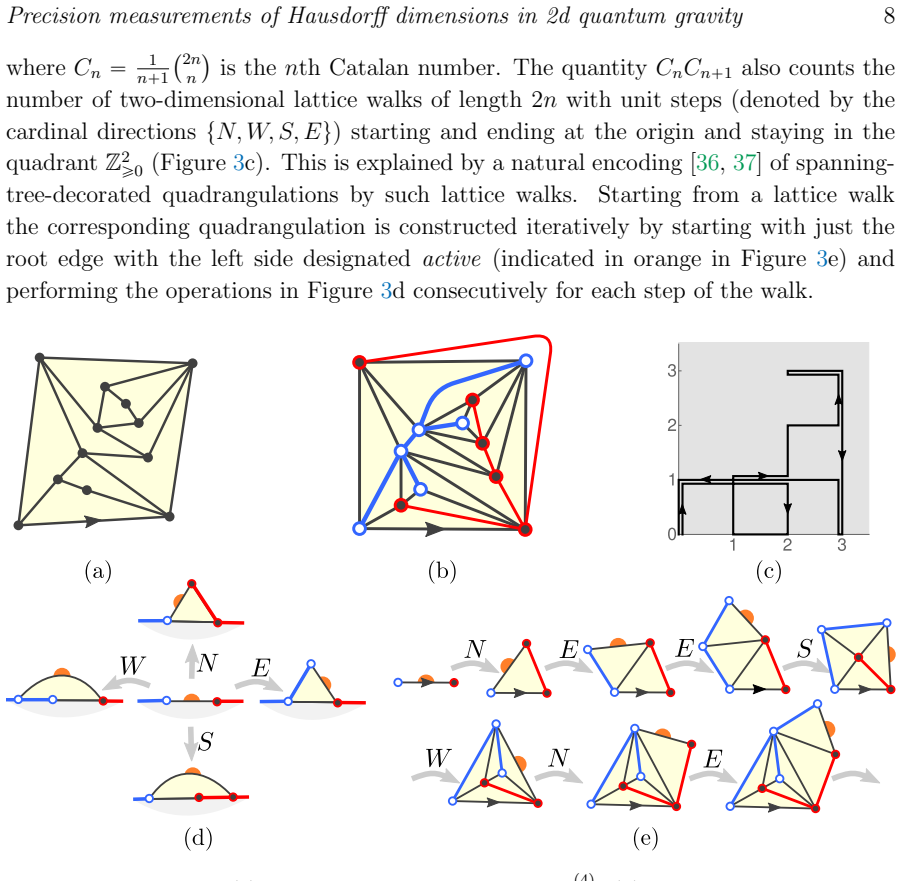
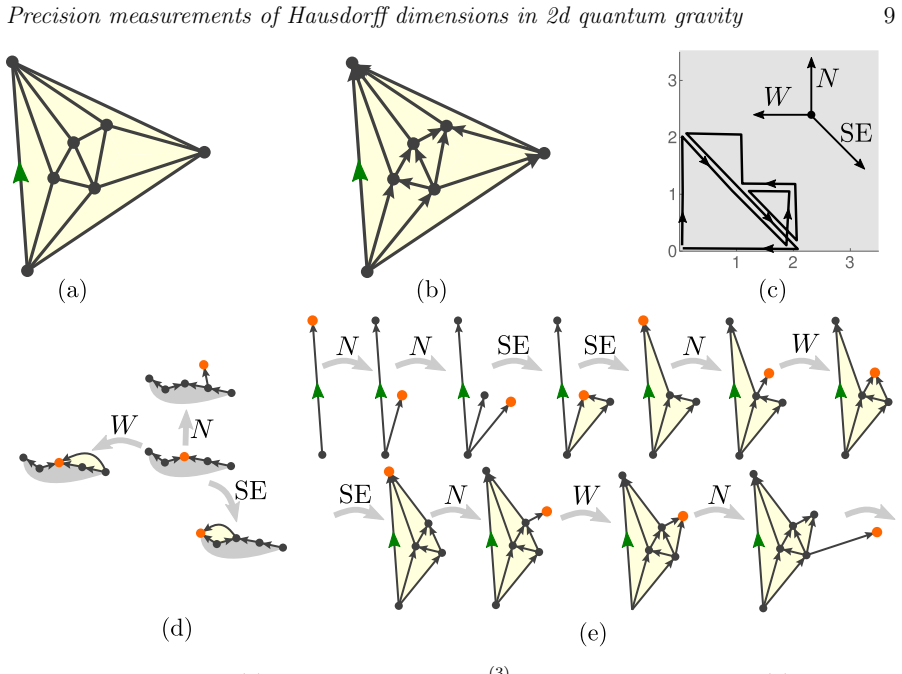
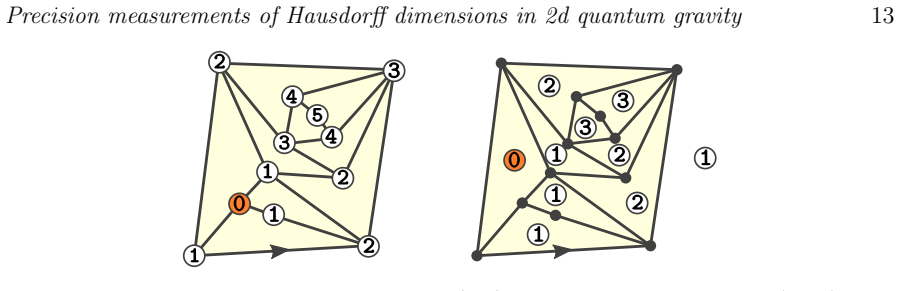
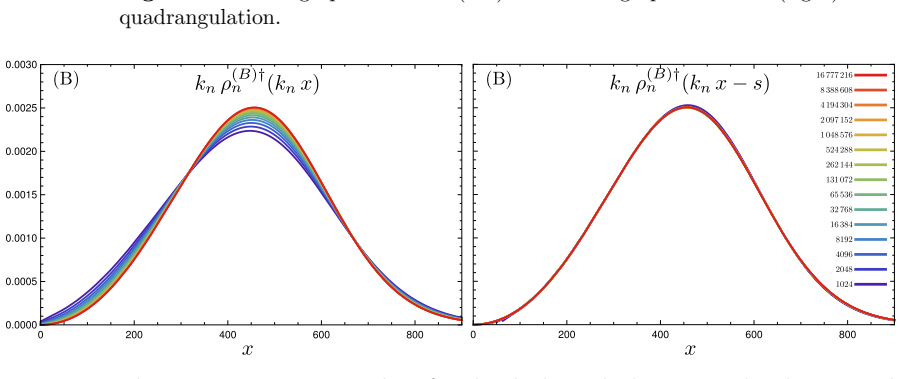
The workhorse is the finite-size scaling ansatz (19)--(22): for a model of size $n$, the rescaled distance density $n^{1/d}\rho_n(n^{1/d}x)$ is assumed to converge pointwise to a universal limit, with a constant shift $s$ and a power-law correction exponent $\delta$ absorbing the leading finite-size effects. Fitting the scaling factors $k_n$ to this ansatz produces the exponent $d$ from $k_n\sim (n/n_0)^{-1/d}$. The four planar-map models are sampled efficiently through bijections to walks in the quadrant, allowing ensembles with up to $2^{24}$ faces; the Liouville quantum gravity side uses discrete first passage percolation through the discrete Gaussian free field on $w\times w$ tori, with the same collapse ansatz yielding $\lambda(\xi)$, which is converted to $d_\gamma$ via $\xi=\gamma/d_\gamma$ and $\lambda=1-\xi Q$.
What would settle it
Run DLFPP at $\xi=0.1$ on lattices $w=2^{13}$ through $2^{16}$ with the same shift-and-correction fitting protocol: Watabiki predicts $\lambda=\xi^2=0.01$, Ding-Gwynne predicts $\lambda=\xi/\sqrt{6}\approx0.0408$, and the paper's current estimate is $0.0341\pm0.0006$. If the fitted $\lambda(w)$ moves toward $0.0408$ as $w$ grows, the paper's support for Ding-Gwynne is confirmed; if it levels off near $0.0341$ or falls toward $0.01$, the small-$\gamma$ conclusion collapses.
Extended reading notes
Core claim
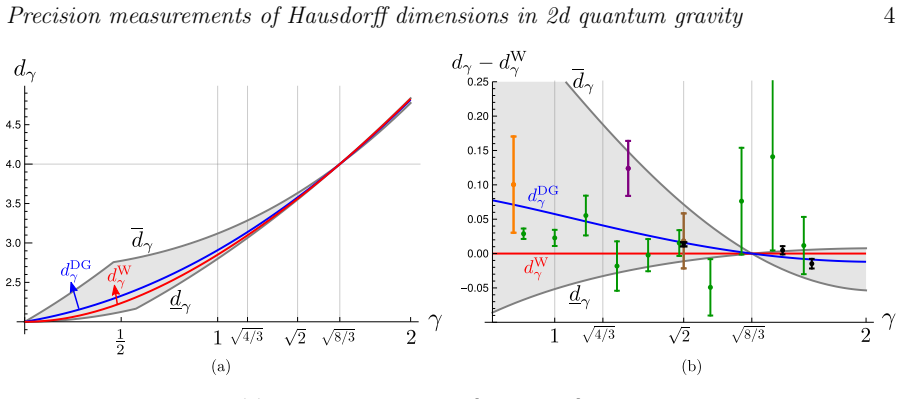
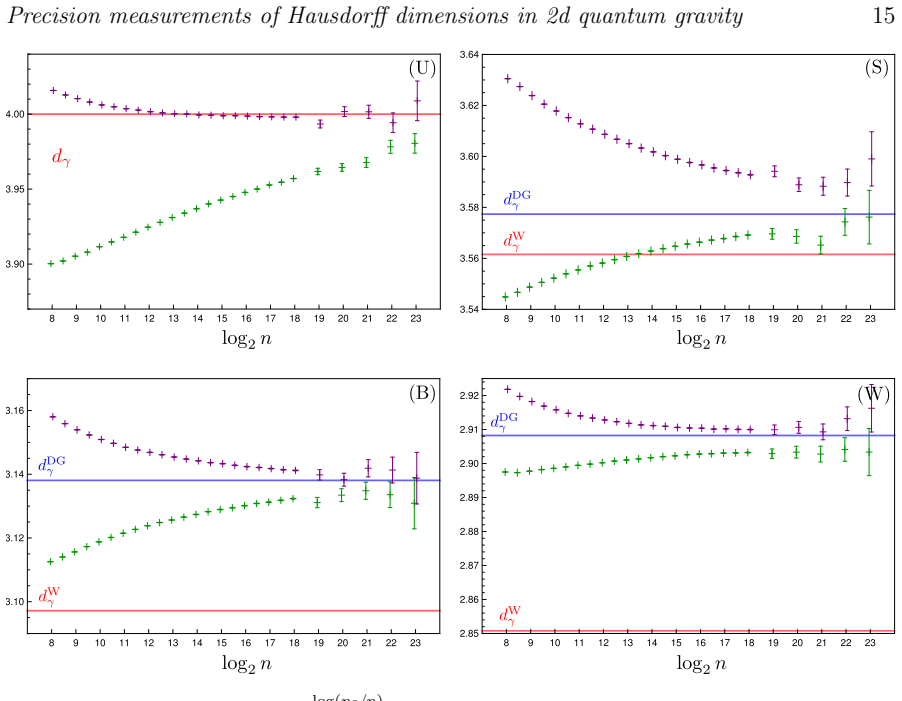
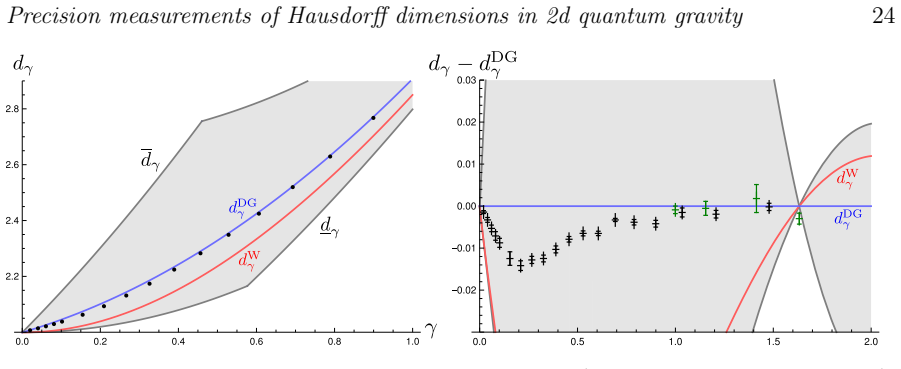
The central claim is that the Hausdorff dimension $d_\gamma$ of two-dimensional quantum gravity is not the Watabiki prediction $d^W_\gamma=1+\gamma^2/4+\sqrt{(1+\gamma^2/4)^2+\gamma^2}$ for the range $\gamma\in(0,2]$ that corresponds to $c<0$. In four random-planar-map models with $\gamma=\sqrt{8/3}$, $\sqrt{2}$, $\sqrt{4/3}$, and $1$, finite-size scaling of graph and dual-graph distances gives $d_{\sqrt{8/3}}=3.9970\pm0.0013$, $d_{\sqrt{2}}=3.5791\pm0.0033$, $d_{\sqrt{4/3}}=3.1375\pm0.0017$, and $d_1=2.9074\pm0.0009$. These numbers agree with $d^{DG}_\gamma=2+\gamma^2/2+\gamma/\sqrt{6}$ to within about $0.001$--$0.003$ in each case, whereas Watabiki's formula misses the last two models by $0.04$--$0.06$. The Liouville-quantum-gravity side, measured by discrete first passage percolation with $\xi\in[0.01,0.4]$ and converted via $\xi=\gamma/d_\gamma$ and $\lambda=1-\xi Q$ with $Q=2/\gamma+\gamma/2$, agrees with the Ding-Gwynne prediction $\lambda^{DG}=\xi/\sqrt{6}$ for $\xi=0.35,0.375,0.4$; at smaller $\xi$ the estimates deviate negatively, and the paper attributes this to markedly worse finite-size scaling rather than to a settled failure of the formula.
Load-bearing premise
The extraction assumes that the finite-size scaling ansatz (19)--(22) holds for these non-uniform planar maps and for the small-$\xi$ DLFPP data, namely that the rescaled distance density converges with a constant shift and a single power-law correction, and if that ansatz is misspecified, the fitted Hausdorff dimensions are biased.
Editorial extensions
If this is right
- Watabiki's formula is numerically excluded across the whole simulated range $c<0$; for instance the $\gamma=1$ planar-map estimate $2.9074\pm0.0009$ is many standard deviations above Watabiki's $2.8508$ but within error of Ding-Gwynne's $2.9083$.
- For $c\in[-12.5,0)$ the combined planar-map and DLFPP data are consistent with $d_\gamma=2+\gamma^2/2+\gamma/\sqrt{6}$, making this the best current description of the fractal dimension in that range.
- Because recent rigorous work has identified the Hausdorff dimension of Liouville quantum gravity with the scaling limits of these planar-map universality classes, the measured exponents transfer across all equivalent models in the same class.
- For $c<-12.5$ the negative deviation from Ding-Gwynne means the exact asymptotic formula at small $\gamma$ remains open; the rigorous lower bound $d_\gamma\ge 2+C\gamma^{4/3}/\log(\gamma^{-1})$ is compatible with either behavior, so this regime is the natural next target.
Reading between the lines
- If the small-$\xi$ negative deviation is real rather than a scaling artifact, the true $d_\gamma$ must cross from below Ding-Gwynne at small $\gamma$ to agreement near $\gamma=\sqrt{2}$, forcing an inflection near $\gamma\approx0.2$; such a shape is not present in either simple formula.
- The same collapse analysis applied to mated-CRT maps, which the paper names as a candidate for arbitrary $\gamma$, would provide a third independent route and would avoid the straight-segment contamination that limits DLFPP at small $\xi$.
- A sharper test of the paper's methodology is that graph and dual-graph distance estimates approach the same $d_\gamma$ from opposite sides; pushing both to larger map sizes should make the two correction signs converge, and any persistent gap would indicate the shift-correction ansatz is incomplete.
Signed reviews
Editorial analysis
A structured set of objections, weighed in public.
Referee Report
Summary. The paper presents new numerical estimates of the Hausdorff dimension $d_\gamma$ of two-dimensional Liouville quantum gravity for central charges $c<0$, using two complementary approaches: finite-size scaling of graph and dual graph distances in four exactly samplable models of random planar maps (uniform, spanning-tree-decorated, bipolar-oriented, and Schnyder-wood-decorated), and discrete Liouville first passage percolation (DLFPP) on the torus for $\xi\in[0.01,0.4]$. The planar-map data give estimates that lie close to the Ding--Gwynne formula $d_{\rm DG}=2+\gamma^2/2+\gamma/\sqrt{6}$ and many standard deviations away from Watabiki's formula for $\gamma=\sqrt{2},\sqrt{4/3},1$. The DLFPP data also favor $\lambda_{\rm DG}=\xi/\sqrt{6}$ for $\xi\gtrsim0.35$, with increasingly visible negative deviations at smaller $\xi$. The paper concludes that Watabiki's formula is contradicted for all simulated $c<0$, while the most reliable data in $c\in[-12.5,0)$ agree with the Ding--Gwynne formula.
Significance. If the planar-map estimates withstand scrutiny, this is an important result: it provides high-precision numerical evidence against a twenty-five-year-old empirical formula and supports a recent rigorous-motivated alternative. The paper's strengths include the use of exactly samplable decorated planar maps, the independent graph and dual graph distance observables, the very small statistical errors, and the public release of source code and data. The main weakness is the reliance on an assumed finite-size scaling ansatz with fitted shift and correction parameters, and the small-$\xi$ DLFPP regime, which carries the full weight of the $c<-12.5$ part of the claim, is explicitly acknowledged to have poor scaling. The core planar-map results are likely to be a lasting contribution even if the small-$\xi$ interpretation is later revised.
major comments (3)
- [Abstract and Section 6] The statement that the estimates are in clear contradiction with Watabiki's formula for all simulated values of $c\in(-\infty,0)$ is too strong for the range $c<-12.5$. In that regime the estimates come entirely from the DLFPP analysis in Table 6 with $\xi\lesssim0.25$, and Section 6 explicitly states that the finite-size scaling is markedly worse for small $\xi$ and that the authors are hesitant to rule out $\lambda_{\rm DG}=\xi/\sqrt{6}$ on the basis of current data. The systematic errors in Table 6 are obtained by varying the fit parameters $\nu$ and $s$ inside the fixed ansatz (37)--(38); they do not test whether that ansatz is correctly specified. The abstract should restrict the contradiction claim to the range $c\in[-12.5,0)$ supported by the planar-map data, and describe the $c<-12.5$ results as provisional or suggestive rather than conclusive.
- [Section 3 and Tables 4-5] The quoted errors on the planar-map estimates of $d_\gamma$ are statistical errors from fits to the assumed form (22), with the shift $s$ fixed by the data-dependent procedure described in Section 3. No systematic error is reported for the choice of $s$, for the correction exponent $\delta$, or for the correction form itself. This matters because the claimed agreement with Ding--Gwynne is at the $10^{-3}$ level (for example, $d=3.5791\pm0.0033$ versus $d_{\rm DG}=3.5774$ for model S), and a modest change in the shift or correction term could shift the fitted $d$ by more than the quoted statistical error. A robustness analysis should be added, for example varying $s$ over the values that still produce visually acceptable collapses, omitting the shift, or using an alternative correction functional form, and the discussion should state whether the separation from Watabiki remains many sigma under those variations.
- [Section 5 and Table 6] The conversion from the measured exponent $\lambda$ to $d_\gamma$ in Table 6 relies on the heuristic relation $\xi=\gamma/d_\gamma$ in Eq. (28) together with the scaling relation (31). For $\xi\lesssim0.25$, the negative deviation from $\lambda_{\rm DG}$ is therefore interpretable as a deviation in $d_\gamma$ only if both (28) and the pointwise convergence assumption (37) are correct. The paper should state this double dependence explicitly and should test the small-$\xi$ results against an alternative analysis, for example by attempting to model the Euclidean straight-segment contribution to DLFPP geodesics mentioned in Section 6, whose scaling exponent is close to $1-\lambda$ for small $\xi$ and could contaminate the finite-size estimate at the lattice sizes used.
minor comments (5)
- [Table 4] The rows for dual graph distance are indicated only by a colon after the model letter (for example, '(U):'); please relabel these rows explicitly as 'U (dual)' to avoid confusion.
- [Section 3, footnote] The footnote after Eq. (19) reads 'a limit in distribution as $n\to\infty$ followed by an almost sure limit as $n\to\infty$'; the second limit should presumably be as $r\to\infty$, and the sentence should be corrected.
- [Eq. (21) and Figure 9] The text does not explain how the error bars on the logarithmic ratios in Figure 9 are propagated from the fitted values of $k_n$; one sentence describing the error propagation would be helpful.
- [Table 6] The central charge value for $\xi=0.01$ is written as $-59.6k$; please use standard scientific notation such as $-5.96\times10^4$.
- [Abstract] The phrase 'for all simulated values of $c\in(-\infty,0)$' is informal because only finitely many values are simulated; please write 'for all simulated $c<0$' or specify the actual simulated range.
Circularity Check
No circularity: the measured Hausdorff dimensions are produced independently and then compared with external formulas.
full rationale
The paper's central results are numerical estimates of the Hausdorff dimension obtained by finite-size scaling of graph distances in four random planar map models and of the Liouville first passage percolation exponent lambda from discrete Gaussian free field simulations. In both cases the target quantities are extracted from the data via scaling collapses and the fitted ansatze (19)-(22) and (37)-(38); neither Watabiki's formula (1) nor the Ding-Gwynne formula (5) is used as an input to these fits. The shift parameters and correction exponents are fitted to improve the collapse and quantify finite-size effects, but the predicted value of d_gamma is not a fitted parameter of either ansatz. The conversion from lambda to d_gamma in Section 5 uses the rigorous relation (31) together with the scaling heuristic (28); this is a coordinate change, not an import of the formula being tested. The planar-map estimates for gamma = 1, sqrt(4/3), sqrt(2), sqrt(8/3) are compared with d_W and d_DG only after they have been determined, so the agreement with d_DG is an external comparison rather than a construction. The DLFPP estimates for very small xi are explicitly flagged by the authors as having poor scaling and larger systematic uncertainty, and the authors state that they are hesitant to rule out lambda_DG on the basis of current data; this candor addresses correctness risk, not circularity. The self-citations to prior work by one of the authors ([21], [23]) provide earlier numerical estimates for comparison and are not load-bearing for the new determination; the load-bearing mathematical identifications of the models with Liouville quantum gravity are citations to independent results by other authors. Thus the derivation chain is self-contained with respect to the claims it tests, and no step reduces by construction to its own inputs.
Assumptions & free parameters
free parameters (11)
- Shift parameter s for graph distance, uniform quadrangulations (U) =
0.940
- Shift parameter s for dual graph distance, uniform quadrangulations (U) =
4.608
- Shift parameter s for graph distance, spanning-tree-decorated quadrangulations (S) =
0.557
- Shift parameter s for dual graph distance, spanning-tree-decorated quadrangulations (S) =
3.019
- Shift parameter s for graph distance, bipolar-oriented triangulations (B) =
0.359
- Shift parameter s for dual graph distance, bipolar-oriented triangulations (B) =
2.941
- Shift parameter s for graph distance, Schnyder-wood-decorated triangulations (W) =
0.439
- Shift parameter s for dual graph distance, Schnyder-wood-decorated triangulations (W) =
2.629
- Correction exponent delta in ansatz (22) per model and distance =
0.16 to 0.57 (Table 4)
- Constants a and b in ansatz (22) per model and distance =
a approximately 0.98 to 1.00, b approximately -0.003 to 0.021 (Table 4)
- DLFPP analysis parameters nu and s =
nu in {0, 0.2, ..., 0.8}, s in {0, 2, 4}
assumptions (5)
- domain assumption Pointwise scaling limit (19) for distance distributions
- ad hoc to paper Finite-size correction ansatz (22) with fitted a, b, delta
- domain assumption Universality: each planar map model converges to Liouville quantum gravity with the stated gamma
- domain assumption Discrete LFPP distance approximates continuum LFPP (Eq 36)
- standard math KPZ relation c = 25 - 6(2/gamma + gamma/2)^2
Cite this review
Pith. "Pith review of Precision measurements of Hausdorff dimensions in two-dimensional quantum gravity." pith.science (2026). https://pith.science/paper/OIUJE4HF
@misc{pith2026190809469,
  author       = {Pith},
  title        = {Pith review of: Precision measurements of Hausdorff dimensions in two-dimensional quantum gravity},
  year         = {2026},
  howpublished = {\url{https://pith.science/paper/OIUJE4HF}},
  note         = {Machine review of arXiv:1908.09469}
}
abstract
Two-dimensional quantum gravity, defined either via scaling limits of random discrete surfaces or via Liouville quantum gravity, is known to possess a geometry that is genuinely fractal with a Hausdorff dimension equal to 4. Coupling gravity to a statistical system at criticality changes the fractal properties of the geometry in a way that depends on the central charge of the critical system. Establishing the dependence of the Hausdorff dimension on this central charge $c$ has been an important open problem in physics and mathematics in the past decades. All simulation data produced thus far has supported a formula put forward by Watabiki in the nineties. However, recent rigorous bounds on the Hausdorff dimension in Liouville quantum gravity show that Watabiki's formula cannot be correct when $c$ approaches $-\infty$. Based on simulations of discrete surfaces encoded by random planar maps and a numerical implementation of Liouville quantum gravity, we obtain new finite-size scaling estimates of the Hausdorff dimension that are in clear contradiction with Watabiki's formula for all simulated values of $c\in (-\infty,0)$. Instead, the most reliable data in the range $c\in [-12.5, 0)$ is in very good agreement with an alternative formula that was recently suggested by Ding and Gwynne. The estimates for $c\in(-\infty,-12.5)$ display a negative deviation from the latter formula, but the scaling is seen to be less accurate in this regime.
Figures

Figures from the paper (12 more)




Forward citations
Cited by 1 Pith paper
-
Random surfaces and Liouville quantum gravity
An expository overview of the definition of Liouville quantum gravity surfaces, the three senses in which random planar maps converge to them, and the major open problems.
Reference graph
Works this paper leans on
-
[1]
Ambjørn J, Jurkiewicz J and Loll R 2005 The spectral dimension of the universe is scale dependent Physical review letters 95 171301
work page 2005
-
[2]
Benedetti D 2009 Fractal properties of quantum spacetime Physical review letters 102 111303
work page 2009
-
[3]
Reuter M and Saueressig F 2011 Fractal space-times under the microscope: a renormalization group view on monte carlo data Journal of High Energy Physics 2011 12
work page 2011
-
[4]
Calcagni G, Oriti D and Th¨ urigen J 2015 Dimensional flow in discrete quantum geometriesPhysical Review D 91 084047
work page 2015
-
[5]
Carlip S 2017 Dimension and dimensional reduction in quantum gravity Classical and Quantum Gravity 34 193001
work page 2017
-
[6]
Knizhnik V G, Polyakov A M and Zamolodchikov A B 1988 Fractal structure of 2d-quantum gravity Modern Physics Letters A 3 819–826 Precision measurements of Hausdorff dimensions in 2d quantum gravity 25
work page 1988
-
[7]
Ambjørn J and Watabiki Y 1995 Scaling in quantum gravity Nuclear Physics B 445 129–142
work page 1995
-
[8]
Theory Related Fields 128 161–212
Chassaing P and Schaeffer G 2004 Random planar lattices and integrated superBrownian excursion Probab. Theory Related Fields 128 161–212
work page 2004
Show all 57 references
-
[9]
Angel O 2003 Growth and percolation on the uniform infinite planar triangulation Geom. Funct. Anal. 13 935–974
2003
-
[10]
Le Gall J F 2013 Uniqueness and universality of the Brownian map Ann. Probab. 41 2880–2960
2013
-
[11]
210 319–401
Miermont G 2013 The Brownian map is the scaling limit of uniform random plane quadrangulations Acta Math. 210 319–401
2013
-
[12]
Miller J and Sheffield S 2016 Liouville quantum gravity and the Brownian map II: geodesics and continuity of the embedding ( Preprint arXiv:1605.03563)
2016 arXiv
-
[13]
Ambjørn J, Nielsen J L, Rolf J, Boulatov D and Watabiki Y 1998 The spectral dimension of 2D quantum gravity Journal of High Energy Physics 1998 010
1998
-
[14]
Rhodes R and Vargas V 2014 Spectral dimension of Liouville quantum gravity Annales Henri Poincar´ evol 15 (Springer) pp 2281–2298
2014
-
[15]
Gwynne E and Miller J 2017 Random walk on random planar maps: spectral dimension, resistance, and displacement (Preprint arXiv:1711.00836)
2017 arXiv
-
[16]
Watabiki Y 1993 Analytic study of fractal structure of quantized surface in two-dimensional quantum gravity Progress of Theoretical Physics Supplement 114 1–17
1993
-
[17]
Ambjørn J, Jurkiewicz J and Watabiki Y 1995 On the fractal structure of two-dimensional quantum gravity Nuclear Physics B 454 313–342
1995
-
[18]
Kawamoto N, Kazakov V, Saeki Y and Watabiki Y 1992 Fractal structure of two-dimensional gravity coupled to c“´ 2 matter Physical review letters 68 2113
1992
-
[19]
Anagnostopoulos K, Bialas P and Thorleifsson G 1999 The ising model on a quenched ensemble of c“´ 5 gravity graphs Journal of statistical physics 94 321–345
1999
-
[20]
Kawamoto N and Yotsuji K 2002 Numerical study for the c-dependence of fractal dimension in two-dimensional quantum gravity Nuclear Physics B 644 533–567
2002
-
[21]
Ambjørn J and Budd T G 2012 Semi-classical dynamical triangulations Physics Letters B 718 200–204
2012
-
[22]
Ambjørn J and Budd T 2013 The toroidal Hausdorff dimension of 2d Euclidean quantum gravity Physics Letters B 724 328–332
2013
-
[23]
Ambjørn J and Budd T 2014 Geodesic distances in Liouville quantum gravity Nuclear Physics B 889 676 – 691
2014
-
[24]
on Pure and Applied Mathematics (Preprint arXiv:1610.09998)
Ding J and Goswami S 2018 Upper bounds on Liouville first-passage percolation and Watabiki’s prediction Commun. on Pure and Applied Mathematics (Preprint arXiv:1610.09998)
2018 arXiv
-
[25]
Ding J and Gwynne E 2018 The fractal dimension of Liouville quantum gravity: universality, monotonicity, and bounds Commun. Math. Phys. 1–58 (Preprint arXiv:1807.01072)
2018 arXiv
-
[26]
Dub´ edat J, Falconet H, Gwynne E, Pfeffer J and Sun X 2019 Weak LQG metrics and Liouville first passage percolation ( Preprint arXiv:1905.00380)
2019 arXiv
-
[27]
Gwynne E and Miller J 2019 Existence and uniqueness of the Liouville quantum gravity metric for γPp 0, 2q (Preprint arXiv:1905.00383)
2019 arXiv
-
[28]
Gwynne E and Pfeffer J 2019 Bounds for distances and geodesic dimension in Liouville first passage percolation (Preprint arXiv:1903.09561)
2019 arXiv
-
[29]
Ang M 2019 Comparison of discrete and continuum Liouville first passage percolation ( Preprint arXiv:1904.09285)
2019 arXiv
-
[30]
Kenyon R, Miller J, Sheffield S and Wilson D B 2015 Bipolar orientations on planar maps and SLE12 (Preprint arXiv:1511.04068)
2015 arXiv
-
[31]
Gwynne E and Pfeffer J 2019 External diffusion limited aggregation on a spanning-tree-weighted random planar map ( Preprint arXiv:1901.06860)
2019 arXiv
-
[32]
Li Y, Sun X and Watson S S 2017 Schnyder woods, SLE16, and Liouville quantum gravity (Preprint arXiv:1705.03573)
2017 arXiv
-
[33]
Tutte W T 1963 A census of planar maps Canadian J. Math. 15 249–271 Precision measurements of Hausdorff dimensions in 2d quantum gravity 26
1963
-
[34]
thesis Universit Bordeaux I
Schaeffer G 1998 Conjugation d’arbres et cartes combinatoires aleatoires Ph.D. thesis Universit Bordeaux I
1998
-
[35]
Miermont 2014 Aspects of Random Maps (Saint-Flour lecture notes)
2014
-
[36]
Mullin R C 1967 On the enumeration of tree-rooted maps Canadian J. Math. 19 174–183
1967
-
[37]
Sheffield S 2016 Quantum gravity and inventory accumulation Ann. Probab. 44 3804–3848
2016
-
[38]
Tutte W T 1973 Chromatic sums for rooted planar triangulations: the cases λ “ 1 and λ “ 2 Canadian J. Math. 25 426–447
1973
-
[39]
Bousquet-M´ elou M 2011 Counting planar maps, coloured or uncoloured Surveys in combinatorics 2011 (London Math. Soc. Lecture Note Ser. vol 392) (Cambridge Univ. Press, Cambridge) pp 1–49
2011
-
[40]
Gwynne E, Holden N and Sun X 2016 Joint scaling limit of a bipolar-oriented triangulation and its dual in the peanosphere sense ( Preprint arXiv:1603.01194)
2016
-
[41]
Bousquet-M´ elou M, Fusy´E and Raschel K 2019 Plane bipolar orientations and quadrant walks (Preprint arXiv:1905.04256)
2019 arXiv
-
[42]
Bousquet-M´ elou M and Mishna M 2010 Walks with small steps in the quarter plane Algorithmic probability and combinatorics (Contemp. Math. vol 520) (Amer. Math. Soc., Providence, RI) pp 1–39
2010
-
[43]
Schnyder W 1989 Planar graphs and poset dimension Order 5 323–343
1989
-
[44]
298 104–114
Bonichon N 2005 A bijection between realizers of maximal plane graphs and pairs of non-crossing Dyck paths Discrete Math. 298 104–114
2005
-
[45]
Bernardi O and Bonichon N 2009 Intervals in Catalan lattices and realizers of triangulations J. Combin. Theory Ser. A 116 55–75
2009
-
[46]
Fusy E, Poulalhon D and Schaeffer G 2009 Bijective counting of plane bipolar orientations and Schnyder woods European J. Combin. 30 1646–1658
2009
-
[47]
Bouttier J, Di Francesco P and Guitter E 2003 Geodesic distance in planar graphs Nuclear Physics B 663 535–567
2003
-
[48]
Ferrenberg A M and Landau D 1991 Critical behavior of the three-dimensional Ising model: A high-resolution Monte Carlo study Physical Review B 44 5081
1991
-
[49]
Ambjørn J, Anagnostopoulos K, Ichihara T, Jensen L, Kawamoto N, Watabiki Y and Yotsuji K 1998 The Quantum space-time of c = -2 gravity Nucl. Phys. B511 673–710 (Preprint hep- lat/9706009)
1998
-
[50]
Gwynne E, Miller J and Sheffield S 2017 The Tutte embedding of the mated-CRT map converges to Liouville quantum gravity ( Preprint arXiv:1705.11161)
2017 arXiv
-
[51]
David F 1988 Conformal field theories coupled to 2-d gravity in the conformal gauge Modern Physics Letters A 3 1651–1656
1988
-
[52]
Distler J and Kawai H 1989 Conformal field theory and 2d quantum gravity Nuclear physics B 321 509–527
1989
-
[53]
Theory Relat
Sheffield S 2007 Gaussian free fields for mathematicians Probab. Theory Relat. Fields 139 521–541
2007
-
[54]
Duplantier B and Sheffield S 2011 Liouville quantum gravity and KPZ Invent. Math. 185 333–393
2011
-
[55]
Ding J, Zeitouni O and Zhang F 2019 Heat kernel for Liouville Brownian motion and Liouville graph distance Communications in Mathematical Physics (Preprint arXiv:1807.00422)
2019 arXiv
-
[56]
Benjamini I 2010 Random planar metrics Proceedings of the International Congress of Mathematicians vol 4 (World Scientific Publishing Company) pp 2177–2187
2010
-
[57]
Barkley J and Budd T 2019 Simulation data and source code for Hausdorff dimension measurements in two-dimensional quantum gravity Zenodo doi:10.5281/zenodo.3375454
2019 doi
Reviewed August 14, 2026 · model on record in the stance chip above.
Discussion (0). Continue with ORCID to comment.