REVIEW 3 major objections 5 minor 92 references
Quantum preprocessing for information-theoretic security in two-party computation
T0 review · 3 major / 5 minor · reviewed 2026-08-14 · deepseek-v4-flash
Pith's one-line read The paper claims that two parties can replace a trusted initializer by running abort-checked quantum preprocessing protocols, so that the generated one-time tables leak asymptotically vanishing information about private inputs when at…
desk verdict A genuinely new protocol stack for replacing a trusted initializer with checked quantum preprocessing, but the central security claim rests on an asserted multi-copy tradeoff that needs a real proof before it is load-bearing. read the letter →
The pith
A machine-rendered reading of the paper's core claim, the machinery that carries it, and where it could break.
The reading
What carries the argument
The load-bearing object is the one-time table produced by Protocol 1: a two-message quantum procedure that takes random bits x and y and returns (x·y)⊕r to Alice and r to Bob, with the CNOT gate's basis-switching property ensuring the distributed AND. Around it, the checking Protocols 3, 4, and 6 impose verification: Bob (or both parties) randomly select instances, demand that the revealed inputs and outputs satisfy $a_j b_j = e_j \oplus f_j$, and abort when failures exceed a threshold. The security argument rests on information-tradeoff inequalities such as $I^M_y + I^M_r \le 1$ and $I^M_y + I^M_{y\oplus r} \le 1$, together with Holevo-bound versions $\chi_y + \max(\chi_r, \chi_{y\oplus r}) \le 1 + f(\epsilon)$, which say that a cheating Alice who must pass Bob's checks can learn almost nothing about y; analogous inequalities protect Alice in Protocol 4. This is 'forced security': useful tables exist only if the checks pass, so the data-independent preprocessing stage can abort safely without leaking meaningful data.
What would settle it
Search the space of Bob's received two-qubit states—modelled as pure states on four qubits via Schmidt decomposition—for a violation of the Holevo tradeoff $\chi_y + \max(\chi_r, \chi_{y\oplus r}) \le c$ with c near the claimed bound; any state with max near 1 while $\chi_y$ remains bounded away from 0 falsifies Theorem 1, and an experimental implementation of Protocol 1 where Bob's checks are passed with high probability while Alice's accessible information about y exceeds the predicted $\epsilon$-dependent bound would do the same.
Extended reading notes
Core claim
The central discovery is that the ideal resource of one-time tables—random bits x and y on the two sides together with (x·y)⊕r and r—need not be assumed from a trusted party: Protocols 1 and 11 realize the underlying nonlocal AND gate with partial privacy, and Protocols 3 through 6 verify those raw instances so that a cheating party who wants the generated tables to be correct and usable must give up almost all information about the other party's input. The security statements are asymptotic: Protocol 3 makes Bob's input asymptotically secure against a cheating Alice, Protocol 4 gives both parties asymptotic security when both sides check, Protocol 5 makes Alice's leakage exponentially small by combining tables, and Protocol 6 suppresses output error while keeping security comparable to Protocol 4. In the ideal noiseless case, the abort-based checks force the cheater's average cheating rate to be arbitrarily small, so with weak cooperation and a conservative checker, useful tables are generated with probability approaching one.
Load-bearing premise
The protocols' security collapses if no party is conservative: someone must actually run the prescribed checks and abort on failures, prizing their own privacy over the chance to learn the other's input, because the checks are what force a cheating counterpart to give up information.
Editorial extensions
If this is right
- Generic two-party boolean circuits with private inputs can be evaluated with asymptotically vanishing leakage in the noiseless case; the main computation needs about circuit-depth rounds and only XOR/AND decompositions.
- Interactive quantum homomorphic encryption becomes possible with quantum preprocessing: the number of one-time tables is O(n²+R²) for n input qubits and R T gates, giving almost-optimal information-theoretic data and circuit privacy.
- A constant-round QHE scheme exists at exponential cost, and interpolating between the two schemes trades rounds against table count.
- Check-based implementations of PR-box-type and more general no-signaling correlations can be built with inert classical communication, and 1-out-of-2 oblivious transfer and bit commitment follow under the conservative-party assumption.
- Physical noise makes leakage in Protocols 3 and 4 linear in the noise level, while Protocol 5 keeps Alice's privacy exponentially good at polynomial overhead; Protocol 6 reduces output error to polynomially small at polynomial cost.
Reading between the lines
- If the conservative-party assumption is acceptable in client-server settings, interactive quantum homomorphic encryption could be built with information-theoretic security and polynomial resources, avoiding the computational assumptions of standard fully homomorphic encryption.
- Because Protocol 5 makes one party's leakage almost noise-independent, a hybrid deployment could use Protocol 5 for high-sensitivity inputs and Protocol 6 for low-noise correctness, a trade-off the paper does not quantify.
- The check-based PR-box implementation with inert communication suggests an experimental route: certify no-signaling correlations by timing and message-content checks rather than spacelike separation; one could test whether the correlation parameter E can be device-independently estimated from the check statistics.
- The information-tradeoff inequalities likely generalize to qudits and multipartite tables; a concrete next step would be to derive the analogue of Eq. (5) for d-dimensional inputs and see whether the 1+f(ε) bound persists.
Signed reviews
Editorial analysis
A structured set of objections, weighed in public.
Referee Report
Summary. The paper proposes replacing a trusted initializer in two-party computation by bipartite quantum preprocessing with aborts. Protocol 1 implements a distributed AND gate with partial privacy, and Protocols 3-6 add checking and combining steps to generate one-time tables with claimed asymptotically vanishing leakage, under the assumptions that one party is "conservative" and the other is weakly cooperating. Applications are given to classical two-party computation, 1-out-of-2 oblivious transfer, bit commitment, interactive and constant-round quantum homomorphic encryption, and check-based implementations of no-signaling correlations. The security analysis is built on Propositions 1-2 and Theorems 1-2, with numerical support in Appendix B.
Significance. If the central security claims were established, the paper would be significant: it offers a concrete route to information-theoretic security in generic two-party computation without a trusted initializer, under assumptions weaker than full honesty, and it connects this primitive to quantum homomorphic encryption and no-signaling correlations. The paper is commendably explicit about its assumptions, including the conservative-party requirement, weak cooperation, and abort behavior, and it fully specifies the base protocol. The honest-but-curious analysis and the application sections are useful contributions in their own right. However, because the multi-copy tradeoff that carries the security proofs is asserted rather than proved, the significance is conditional on closing that gap.
major comments (3)
- [Sec. III, Theorem 1 proof, paragraph after Eq. (6)] The extension of the single-instance tradeoff Eq. (5) to correlated, jointly entangled cheating over m instances is asserted rather than proved. The text says that the generalization of Eq. (6) "should hold" and that other instances "serve as auxiliary systems," but accessible information is not subadditive, and a joint final measurement over m systems can in principle extract more than the one-copy Holevo tradeoff curve. The one-bit communication bound in Prop. 1 is a single-round bound on classical mutual information with a fixed measurement M, so it does not control the marginal Holevo quantities under joint attacks. The same gap appears in the corresponding step of Theorem 2. Since Protocols 3-6 and all applications inherit this step, the central claim of asymptotically vanishing leakage is not established.
- [Appendix B, Eq. (B3), and Eq. (5) in Theorem 1] The quantitative form of the tradeoff is not established analytically. Appendix B reports only that the Holevo sum is at most a constant c "somewhat larger than 1.388" that is "yet to be precisely determined," and gives numerical values f(0.1)≈0.3, f(0.01)≈0.06. Uniform continuity from the extreme point max=1 ⇒ χy=0 yields only existence of some f(ε) with f(0)=0; it does not yield the specific bound χy≤ε+f(ε) used in the proof. Moreover, the argument for the implication (6) invokes Prop. 1, but Prop. 1 bounds single-measurement mutual informations rather than Holevo quantities, so the step "the latter implies χy=0" requires a separate proof. Without Eq. (5), the claimed leakage rate is unsupported.
- [Protocol 3, Steps 2-4, and Theorem 1] The random-check sampling argument does not by itself bound leakage on the m−K unchecked tables that are actually used. From K checked instances Bob estimates an average cheating rate ε, and the proof transfers the bound ε+f(ε) to all remaining instances. This transfer presupposes a well-defined per-instance cheating rate and either independence or the unproved multi-copy tradeoff of the first major comment. A cheating Alice can keep checked instances statistically clean while placing information about y in unchecked instances, and the text explicitly acknowledges that Alice can choose different measurements on the remaining instances. The statement that the expected information about y in the remaining instances is arbitrarily small therefore requires a proof; the per-instance checking statistics alone do not imply it.
minor comments (5)
- [Protocol 1, Step 3] Bob's output bit is introduced as h = h1⊕h2, but the protocol specification and all later text use r; please use a single symbol throughout.
- [Appendix A, last paragraph] The sentence "The Protocol 2 is quite resistent to such attack" contains a typo: "resistent" should be "resistant".
- [Sec. III, after Protocol 4] The claim that it "suffices to assume either one of the parties is conservative" is argued informally; since applications depend on this assumption, a formal statement of which party must be conservative in each protocol and application would be helpful.
- [Sec. VII.3] Statements such as "the allowed circuit depth is a constant" are qualitative; please make them quantitative or asymptotic, since the noise model and the security parameter are not formally specified.
- [Protocol 11, Appendix A] The EPR-pair testing procedure is described only in prose; please specify the test and explain how its abort behavior composes with the checks used in Protocol 4.
Circularity Check
No construction-level circularity: the security analysis is derived from in-paper one-bit communication inequalities; the self-citation to [27] supplies the base protocol but is not load-bearing.
full rationale
The derivation chain is self-contained at the level where its security claims are argued. Proposition 1 is proved in-paper from the observation that the Bob-to-Alice communication in Protocol 1 is effectively one classical bit, and Proposition 2 is the corresponding statement for the reverse direction. Theorem 1 then builds on the in-paper Holevo tradeoff claim (Eq. (5)) and a sampling argument over Bob's checked instances; Theorem 2 is explicitly parallel. No security quantity is defined in terms of the security conclusion, and no fitted numerical value from Appendix B is fed into the proof: the appendix is supporting numerics, not an input. The base Protocol 1 is credited to the author's earlier work [27] but is fully specified in this paper, so that self-citation is attribution rather than a load-bearing uniqueness or ansatz claim. The one serious gap is the extension to correlated cheating in the proof of Theorem 1, where the paper states that the generalization of Eq. (5) 'should hold approximately' and that other instances 'serve as auxiliary systems'; this is an unproved assertion and a genuine rigor concern, but it is not a circular reduction, because the inequality is not assumed as the definition of security and the paper does not rename a fitted parameter as a prediction. Accordingly, no circular step meeting the quoted-evidence standard is established.
Assumptions & free parameters
free parameters (1)
- Holevo tradeoff constant c in Eq. (B3) =
approximately 1.388 (lower bound, undetermined)
assumptions (5)
- domain assumption At least one party is conservative: values the privacy of his/her own data higher than the possibility of learning the other party's data, and therefore performs the prescribed checks and aborts on failures.
- domain assumption The other party is weakly cooperating, i.e., does not cheat in some batch of instances of Protocol 1, so that some one-time tables pass the tests.
- ad hoc to paper The one-copy tradeoff inequality (5) and its extreme-point implication (6) extend to the case where Alice's operations are correlated across instances of Protocol 1.
- standard math The locking of classical correlations does not occur in Protocol 1, so the effective one-bit communication bound used in Props. 1 and 2 applies.
- standard math Holevo quantities are uniformly continuous on the relevant bounded-dimensional state space, so Eq. (5) follows from the extreme point (6) up to a continuous error f(epsilon).
Cite this review
Pith. "Pith review of Quantum preprocessing for information-theoretic security in two-party computation." pith.science (2026). https://pith.science/paper/IT52NSMM
@misc{pith2026190805584,
  author       = {Pith},
  title        = {Pith review of: Quantum preprocessing for information-theoretic security in two-party computation},
  year         = {2026},
  howpublished = {\url{https://pith.science/paper/IT52NSMM}},
  note         = {Machine review of arXiv:1908.05584}
}
abstract
In classical two-party computation, a trusted initializer who prepares certain initial correlations, known as one-time tables, can help make the inputs of both parties information-theoretically secure. We propose some bipartite quantum protocols with possible aborts for approximately generating such bipartite classical correlations with varying degrees of privacy, without introducing a third party. Under some weak requirements for the parties, the security level is nontrivial for use in bipartite computation. We show that the security is sometimes dependent on the noise level, but we propose a method for dealing with noise. The security is "forced security", which implies that the probability that some useful one-time tables are generated can approach $1$ in the noiseless case under quite weak assumptions about the parties, although the protocols allow aborts. We show how to use the generated one-time tables to achieve nontrivial information-theoretic security in generic two-party classical or quantum computation tasks, including (interactive) quantum homomorphic encryption. Our methods provide check-based implementations of some no-signaling correlations, including the PR-box type, with the help of communication which carry no information about the inputs in the generated correlations.
Figures

Reference graph
Works this paper leans on
-
[1]
Suppose m one-time tables were implemented
Alice and Bob perform many instances of Protocol 1 to generate some one-time tables, and exchange messages to agree on which instances were successfully implemented experimentally. Suppose m one-time tables were implemented. The one-time tables labeled by j has inputs aj and bj, and outputs ej and fj
-
[2]
He tells his choices to Alice
(The steps 2 to 4 can be done concurrently with the steps 5 to 7.) Bob randomly selects KB integers in {1,··· ,m}, which are labels for which one-time table. He tells his choices to Alice
-
[3]
Alice sends the bits aj and ej to Bob for all chosen labels j
-
[4]
If the total number of failures is larger than some preset number of Bob’s (e.g
For any chosen label j, Bob checks whether aj and ej satisfy that aj·bj = ej⊕fj. If the total number of failures is larger than some preset number of Bob’s (e.g. 0, or a small constant times m), he aborts the protocol, or asks Alice to restart the protocol to do testing on a new batch of instances of Protocol 1 if the two parties still want to perform som...
-
[5]
The chosen set of integers may overlap with the set chosen by Bob
Alice randomly chooses KA integers in{1,··· ,m}, and tells Bob her choices. The chosen set of integers may overlap with the set chosen by Bob
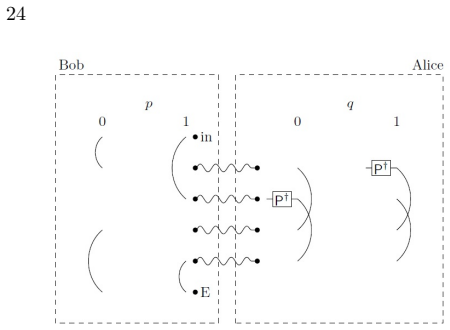
-
[6]
Bob sends the bits bj and fj to Alice for the chosen labels j
-
[7]
If the total number of failures is larger than some preset number of Alice’s, she aborts the protocol, or asks Bob to restart the protocol if needed
For any chosen label j, Alice checks whether aj·bj =ej⊕fj holds. If the total number of failures is larger than some preset number of Alice’s, she aborts the protocol, or asks Bob to restart the protocol if needed
-
[8]
restarts
The remaining one-time tables are regarded as having passed the checking and will be used later in the two-party computing task. They may repeat the steps above to prepare more one-time tables on demand. bounded by 1 bit. And since the bits x and x⊕r′ are independent, we have that the inequality (8) holds. The inequalities (7) and (8) together imply (9). ...
Show all 92 references
-
[9]
Suppose the instance labeled by j has inputs aj and bj, and outputs ej and fj
Alice and Bob perform Protocol 3 or Protocol 4 to obtain some one-time tables after checking. Suppose the instance labeled by j has inputs aj and bj, and outputs ej and fj
-
[10]
Each new instance corresponds to a set S of old instances which satisfy that Bob’s input bits are equal (denoted as b0)
Bob determines which remaining one-time tables are to be combined into one new instance of one-time table, and tells Alice his decision. Each new instance corresponds to a set S of old instances which satisfy that Bob’s input bits are equal (denoted as b0). A new instance has ...
-
[11]
Alice and Bob perform many instances of Protocol 1 to generate some one-time tables, and exchange messages to agree on which instances were successfully implemented experimentally
-
[12]
They use more instances and a higher ratio of checking by Bob, for better privacy of Bob
Alice and Bob uses the method in Protocol 4 to check the instances. They use more instances and a higher ratio of checking by Bob, for better privacy of Bob
-
[13]
auxiliary
Bob chooses a target instance of a one-time table with inputs a0 andb0 and outputse0 andf0. He also randomly chooses other q instances (called “auxiliary” one-time tables) for helping detecting errors in the following step
-
[14]
Bob asks Alice to send a0⊕aj ande0⊕ej to him
Suppose the auxiliary one-time table labeled by j has inputs aj andbj, and outputs ej andfj, for j = 1,...,q . Bob asks Alice to send a0⊕aj ande0⊕ej to him. For those j withbj =b0, Bob checks whether (a0⊕aj)·b0 =e0⊕ej⊕f0⊕fj. If there is an error, Bob rejects such target instan...
-
[15]
conservative
The one-time tables which passed the checking will be used later in the two-party computing task. Alice and Bob repeat the steps starting from Step 3 to prepare more one-time tables. bj are equal to redesign her attacks in Steps 1 or 2, since the choice of which of them are eq...
-
[16]
Alice and Bob perform Protocol 3 or 4 or 5 or 6 to obtain n one-time tables
-
[17]
II, with the output being distributed
For evaluating the linear polynomial z = (c + ∑n j=1ajbj) mod 2, Alice and Bob perform the evaluation of the nonlocal AND gate for aj and bj using the procedure in Sec. II, with the output being distributed. They locally calculate the XOR of all bits from the outputs, and Bob ...
-
[18]
Any nonlocal AND gate in the original circuit is a special case of the linear polynomial
Alice and Bob decompose the two-party circuit to be evaluated into some local circuits with AND, XOR gates, and some linear polynomials with bipartite input, while adding possible ancillary bits with fixed initial value 1 (for implementing the NOT gates with the help of XOR). A...
-
[19]
one or both input bits are the XOR of two remote bits
For each AND gate not in the initial stage, the inputs may be distributed, i.e. one or both input bits are the XOR of two remote bits. In the case that both input bits are distributed, Alice and Bob decompose such gate into the XOR of the outputs of two local AND gates and two...
-
[20]
The linear polynomials are evaluated using Protocol 7 with distributed output
They perform the gates in the resulting circuit in pre-arranged order. The linear polynomials are evaluated using Protocol 7 with distributed output
-
[21]
data on average is better (e.g
At the end of the circuit, one party sends some bits to the other party so that the distributed bits for the output are recombined to form the correct output; if there are output on two parties, both parties need to send messages. data on average is better (e.g. when they disc...
-
[22]
with only one variable and no constant term), where a =m0⊕m1, and b is Bob’s input bit
Alice and Bob run an instance of Protocol 7 with the polynomial of the form z =a·b (i.e. with only one variable and no constant term), where a =m0⊕m1, and b is Bob’s input bit. Suppose the output bit on Alice’s side is g, then the output on Bob’s side must be h =z⊕g
-
[23]
Bob’s output bit is m0⊕g⊕h
Alice sends m0⊕g to Bob. Bob’s output bit is m0⊕g⊕h. protocols. In the Protocol 10 we propose a bit commit- ment protocol inspired by a computationally-secure con- struction based on quantum one-way permutations [35]. Here, instead of using the quantum one-way permuta- tions, ...
-
[24]
They decide on a large integer m related to the intended security of the current bit commitment protocol
Alice and Bob perform Protocol 5 to obtain some one- time tables with the degree of security dependent on re- source usage. They decide on a large integer m related to the intended security of the current bit commitment protocol
-
[25]
She asks Bob to together calculate m nonlocal AND gates using the method in Sec
Suppose Alice wants to commit a bit b. She asks Bob to together calculate m nonlocal AND gates using the method in Sec. II, with her input bits being always b, but Bob’s inputs are random bits chosen by himself. They obtain some distributed bits as the outcomes. This completes...
-
[26]
outcome strings
(Reveal phase) Alice sends Bob her output in the in- stances of the nonlocal AND gates in the previous step. Bob takes the XOR for the corresponding pairs of bits to recover the results of the nonlocal AND gates. From these results, Bob finds out b, or decides that Alice has ch...
-
[27]
The coefficient- update rules for the variables under the T gate can be obtained from the relations TZ = ZT, TX =e−πi/4PXZT
= (Xa 1Zb⊕d 1 ⊗ Xa⊕c 2 Zd 2)CNOT12, (12) where the ⊕ is addition modulo 2, and in the gate CNOT12, the qubit 1 is the control. The coefficient- update rules for the variables under the T gate can be obtained from the relations TZ = ZT, TX =e−πi/4PXZT. (13) The coefficient-update r...
-
[28]
Alice and Bob produce a large number of one-time tables
-
[29]
The 2 n bits indicating the Pauli corrections are part of the vari- ables in the polynomials to be evaluated
Alice teleports her n input data qubits to Bob with- out telling him any Pauli corrections. The 2 n bits indicating the Pauli corrections are part of the vari- ables in the polynomials to be evaluated
-
[30]
Alice and Bob each does their own part of opera- tions in Protocol 7 to evaluate the current linear polynomial, which has 2n variables
For each stage of the circuit consisting of some Clif- ford gates and a T gate, the two parties do the fol- lowing: Bob calculates the coefficients (including the constant term) in the linear polynomial to be used for deciding the P† correction after the T gate. Alice and Bob ea...
-
[31]
He does his part in evalu- ating those polynomials, while Alice also does her part
After the last T gate, Bob performs the last Clif- ford gates in the desired circuit, and calculates his coefficients in the last polynomials for calculating the final Pauli masks. He does his part in evalu- ating those polynomials, while Alice also does her part. This includes e...
-
[32]
The resulting state is the final quantum output
Alice corrects the received state from teleportation with the corresponding Pauli operators, which are determined from Bob’s message as well as her part of the output of the last polynomials. The resulting state is the final quantum output. The following is an estimate of the r...
-
[33]
(The positions of the T gates in the circuit is known to both parties.) They produce a sufficient number of one-time tables
Alice and Bob each calculates the (nonlinear) poly- nomials locally according to the circuit to be com- puted. (The positions of the T gates in the circuit is known to both parties.) They produce a sufficient number of one-time tables
-
[34]
Bob calculates the XOR of each coefficient in the (nonlinear) polynomials with his input in a unique precomputed one-time table, and sends the result- ing bits, and the labels for the corresponding one- time tables to Alice
-
[35]
The 2 n bits indicating the Pauli corrections are part of the vari- ables in the polynomials to be evaluated
Alice teleports her n input data qubits to Bob with- out telling him any Pauli corrections. The 2 n bits indicating the Pauli corrections are part of the vari- ables in the polynomials to be evaluated. With the received message, Alice computes her part of the output of the (no...
-
[36]
The Bob part of the output of the first polynomial decides which measurements he should do in the first garden-hose gadget
Bob receives Alice’s message and calculates his out- put for the first polynomial (which is linear) using Protocol 7. The Bob part of the output of the first polynomial decides which measurements he should do in the first garden-hose gadget. He performs the Clifford gates and the ...
-
[37]
The resulting state is the final quantum output
Alice corrects the received state from teleportation using the corresponding Pauli gates, which are de- termined from Bob’s message as well as her part of the output of the last polynomials. The resulting state is the final quantum output. We analyze the resource cost of Scheme...
-
[38]
instantaneous
+ 1]× 2 + 2 whenk >1, so when k =R, the number of terms is O(n· 3R). There are R polynomials (one for each T gate, for evaluating the X correction before the T gate) which follow the induction rule above. But the last 2n polynomials do not follow the rule, and they do not incr...
-
[39]
This is inspired by the classical case in [4]
Extensions of protocols The qubit-based quantum protocols in this work can be generalized to work for qudits in principle. This is inspired by the classical case in [4]. This requires some changes in the classical usage of the generated correla- tions. The methods in this work...
-
[40]
Physical implementations of Protocol 1 The Protocol 11 is an entanglement-based version of Protocol 1. The shared entanglement in Protocol 11 could be prepared by a fixed entanglement-generating device, allowing for failures in preparation (although we allow failures in the who...
-
[41]
first party
Effects of noise and errors If direct sending of photons is used in Protocol 1, we suggest using the known methods such as decoherence- free subspaces or quantum codes, to reduce or prevent the errors in the transmission. We leave the details for future work. In the following, ...
-
[42]
Fully homomorphic encryption using ideal lattices
Craig Gentry. Fully homomorphic encryption using ideal lattices. In Proceedings of the Forty-first Annual ACM Symposium on Theory of Computing , STOC ’09, pages 169–178, New York, NY, USA, 2009. ACM
2009
-
[43]
Brakerski and V
Z. Brakerski and V. Vaikuntanathan. Efficient fully ho- momorphic encryption from (standard) LWE. In 2011 IEEE 52nd Annual Symposium on Foundations of Com- puter Science, pages 97–106, Oct 2011
2011
-
[44]
A. C. Yao. How to generate and exchange secrets. In 27th Annual Symposium on Foundations of Computer Science, pages 162–167, Oct 1986
1986
-
[45]
One-time tables for two-party compu- tation
Donald Beaver. One-time tables for two-party compu- tation. In Wen-Lian Hsu and Ming-Yang Kao, editors, Computing and Combinatorics , pages 361–370, Berlin, Heidelberg, 1998. Springer Berlin Heidelberg
1998
-
[46]
Rohde, Joseph F
Peter P. Rohde, Joseph F. Fitzsimons, and Alexei Gilchrist. Quantum walks with encrypted data. Phys. Rev. Lett., 109:150501, 2012
2012
-
[47]
Symmetric quantum fully homomorphic en- cryption with perfect security
Min Liang. Symmetric quantum fully homomorphic en- cryption with perfect security. Quantum Inf. Process. , 12:3675–3687, 2013
2013
-
[48]
P´ erez-Delgado, and Joseph F
Li Yu, Carlos A. P´ erez-Delgado, and Joseph F. Fitzsi- mons. Limitations on information-theoretically-secure quantum homomorphic encryption. Phys. Rev. A , 90:050303(R), Nov 2014
2014
-
[49]
S.-H. Tan, J. A. Kettlewell, Y. Ouyang, L. Chen, and J. F. Fitzsimons. A quantum approach to homomorphic encryption. Sci. Rep., 6:33467, 2016
2016
-
[50]
Ouyang, S.-H
Y. Ouyang, S.-H. Tan, and J. Fitzsimons. Quantum ho- momorphic encryption from quantum codes. Phys. Rev. A, 98:042334, 2018
2018
-
[51]
Quantum homo- morphic encryption for circuits of low T-gate complexity
Anne Broadbent and Stacey Jeffery. Quantum homo- morphic encryption for circuits of low T-gate complexity. In Proceedings of Advances in Cryptology — CRYPTO 2015, pages 609–629, 2015
2015
-
[52]
Quantum homomorphic encryption for polynomial-sized circuits
Yfke Dulek, Christian Schaffner, and Florian Speelman. Quantum homomorphic encryption for polynomial-sized circuits. CRYPTO 2016: Advances in Cryptology - CRYPTO 2016, pages 3–32, 2016
2016
-
[53]
Newman and Y
M. Newman and Y. Shi. Limitations on Transversal Computation through Quantum Homomorphic Encryp- tion. Quantum Information and Computation , 18:927– 21 948, 2018
2018
-
[54]
Lai and K.-M
C.-Y. Lai and K.-M. Chung. On Statistically-Secure Quantum Homomorphic Encryption. Quantum Informa- tion and Computation , 18:785–794, 2018
2018
-
[55]
U. Mahadev. Classical homomorphic encryption for quantum circuits. In 2018 IEEE 59th Annual Sym- posium on Foundations of Computer Science (FOCS) , pages 332–338, Oct 2018
2018
-
[56]
Quantum fully homomorphic encryption with verification
Gorjan Alagic, Yfke Dulek, Christian Schaffner, and Flo- rian Speelman. Quantum fully homomorphic encryption with verification. In Tsuyoshi Takagi and Thomas Peyrin, editors, Advances in Cryptology – ASIACRYPT 2017 , pages 438–467, Cham, 2017. Springer International Pub- lishing
2017
-
[57]
M. Newman. Further Limitations on Information- Theoretically Secure Quantum Homomorphic Encryp- tion. http://arxiv.org/abs/1809.08719, September 2018
2018 arXiv
-
[58]
Si-Hui Tan, Yingkai Ouyang, and Peter P. Rohde. Prac- tical somewhat-secure quantum somewhat-homomorphic encryption with coherent states.Phys. Rev. A, 97:042308, Apr 2018
2018
-
[59]
Secure assisted quantum computation
Andrew Childs. Secure assisted quantum computation. Quantum Information and Computation , 5(6):456, 2005
2005
-
[60]
Fisher, A
K. Fisher, A. Broadbent, L.K. Shalm, Z. Yan, J. Lavoie, R. Prevedel, T. Jennewein, and K.J. Resch. Quantum computing on encrypted data. Nat. Commun. , 5:3074, 2014
2014
-
[61]
Fitzsimons
Yingkai Ouyang, Si-Hui Tan, Liming Zhao, and Joseph F. Fitzsimons. Computing on quantum shared secrets. Phys. Rev. A , 96:052333, Nov 2017
2017
-
[62]
Yingkai Ouyang, Si-Hui Tan, Joseph Fitzsimons, and Pe- ter P. Rohde. Homomorphic encryption of linear optics quantum computation on almost arbitrary states of light with asymptotically perfect security.http://arxiv.org/ abs/1902.10972, Feb 2019
1902 arXiv
-
[63]
C. H. Bennett and G. Brassard. Quantum cryptography: Public key distribution and coin tossing. In Proceedings of IEEE International Conference on Computers, Sys- tems and Signal Processing , volume 175, page 8. New York, 1984
1984
-
[64]
Insecurity of quantum secure computa- tions
Hoi-Kwong Lo. Insecurity of quantum secure computa- tions. Phys. Rev. A , 56:1154–1162, Aug 1997
1997
-
[65]
Complete insecurity of quantum protocols for classical two-party computation
Harry Buhrman, Matthias Christandl, and Christian Schaffner. Complete insecurity of quantum protocols for classical two-party computation. Phys. Rev. Lett. , 109:160501, Oct 2012
2012
-
[66]
Impossibility of secure two-party classical computation
Roger Colbeck. Impossibility of secure two-party classical computation. Phys. Rev. A , 76:062308, Dec 2007
2007
-
[67]
Cheat sensitive quantum bit commitment
Lucien Hardy and Adrian Kent. Cheat sensitive quantum bit commitment. Phys. Rev. Lett., 92:157901, Apr 2004
2004
-
[68]
A quantum homomorphic encryption scheme for polynomial-sized circuits
Li Yu. A quantum homomorphic encryption scheme for polynomial-sized circuits. http://arxiv.org/abs/1810. 01166, October 2018
2018
-
[69]
C. H. Bennett, G. Brassard, C. Cr´ epeau, R. Jozsa, A. Peres, and W. K. Wootters. Teleporting an unknown quantum state via dual classical and Einstein-Podolsky- Rosen channels. Phys. Rev. Lett. , 70:1895–1899, Mar 1993
1993
-
[70]
D. P. DiVincenzo, M. Horodecki, D. W. Leung, J. A. Smolin, and B. M. Terhal. Locking classical correlations in quantum states. Phys. Rev. Lett., 92:067902, Feb 2004
2004
-
[71]
Equivalence between two flavours of oblivious transfers
Claude Cr´ epeau. Equivalence between two flavours of oblivious transfers. In Carl Pomerance, editor, Advances in Cryptology — CRYPTO ’87 , pages 350–354, Berlin, Heidelberg, 1988. Springer Berlin Heidelberg
1988
-
[72]
Founding cryptography on oblivious transfer
Joe Kilian. Founding cryptography on oblivious transfer. In Proceedings of the Twentieth Annual ACM Symposium on Theory of Computing , STOC ’88, pages 20–31, New York, NY, USA, 1988. ACM
1988
-
[73]
Wolf and J
S. Wolf and J. Wullschleger. Oblivious transfer and quan- tum non-locality. In Proceedings. International Sympo- sium on Information Theory, 2005. ISIT 2005. , pages 1745–1748, Sep. 2005
2005
-
[74]
Hoi-Kwong Lo and H. F. Chau. Is quantum bit commit- ment really possible? Phys. Rev. Lett. , 78:3410–3413, Apr 1997
1997
-
[75]
Unconditionally secure quantum bit commitment is impossible
Dominic Mayers. Unconditionally secure quantum bit commitment is impossible. Phys. Rev. Lett. , 78:3414– 3417, Apr 1997
1997
-
[76]
Per- fectly concealing quantum bit commitment from any quantum one-way permutation
Paul Dumais, Dominic Mayers, and Louis Salvail. Per- fectly concealing quantum bit commitment from any quantum one-way permutation. In Bart Preneel, editor, Advances in Cryptology — EUROCRYPT 2000 , pages 300–315, Berlin, Heidelberg, 2000. Springer Berlin Hei- delberg
2000
-
[77]
LEGO for two- party secure computation
Jesper Buus Nielsen and Claudio Orlandi. LEGO for two- party secure computation. In Proceedings of the 6th The- ory of Cryptography Conference on Theory of Cryptogra- phy, TCC ’09, page 368–386, Berlin, Heidelberg, 2009. Springer-Verlag
2009
-
[78]
Large family of quantum weak coin- flipping protocols
Carlos Mochon. Large family of quantum weak coin- flipping protocols. Phys. Rev. A , 72:022341, Aug 2005
2005
-
[79]
Quantum bit com- mitment and coin tossing protocols
Gilles Brassard and Claude Cr´ epeau. Quantum bit com- mitment and coin tossing protocols. In Proceedings of the 10th Annual International Cryptology Conference on Ad- vances in Cryptology, CRYPTO ’90, page 49–61, Berlin, Heidelberg, 1990. Springer-Verlag
1990
-
[80]
Quantum nonlocal- ity as an axiom
Sandu Popescu and Daniel Rohrlich. Quantum nonlocal- ity as an axiom. Foundations of Physics , 24(3):379–385, Mar 1994
1994
-
[81]
Information causality as a physical principle
Marcin Pawlowski, Tomasz Paterek, Dagomir Kasz- likowski, Valerio Scarani, Andreas Winter, and Marek ˙Zukowski. Information causality as a physical principle. Nature, 461:1101–1104, 2009
2009
-
[82]
Masanes, A
Ll. Masanes, A. Acin, and N. Gisin. General properties of nonsignaling theories. Phys. Rev. A , 73:012112, Jan 2006
2006
-
[83]
More efficient oblivious transfer exten- sions
Gilad Asharov, Yehuda Lindell, Thomas Schneider, and Michael Zohner. More efficient oblivious transfer exten- sions. Journal of Cryptology , 30(3):805–858, Jul 2017
2017
-
[84]
Cr´ epeau and J
C. Cr´ epeau and J. Kilian. Achieving oblivious trans- fer using weakened security assumptions. In [Proceedings 1988] 29th Annual Symposium on Foundations of Com- puter Science, pages 42–52, Oct 1988
1988
-
[85]
Quantum bit commitment from a phys- ical assumption
Louis Salvail. Quantum bit commitment from a phys- ical assumption. In Hugo Krawczyk, editor, Advances in Cryptology — CRYPTO ’98 , pages 338–353, Berlin, Heidelberg, 1998. Springer Berlin Heidelberg
1998
-
[86]
Artur K. Ekert. Quantum cryptography based on Bell’s theorem. Phys. Rev. Lett., 67:661–663, Aug 1991. 22 Appendix A: An entanglement-based version of Protocol 1 In this appendix we introduce Protocol 11 which is a variant of Protocol 1 based on initial entanglement. It contain...
1991
-
[87]
Bob generates and distributes the entanglement
After some procedure of generating EPR states and testing them, the two parties share four tested EPR pairs. Bob generates and distributes the entanglement. The testing procedure, which may contain aborts on failure of passing the tests, is discussed in the text
-
[88]
(The steps 3 and 4 performed by Bob can be done concurrently with the Step 2 performed by Alice.) Alice generates a random bit s. If s = 0, she measures the four qubits in her part of the EPR pairs in the Z basis, and records the measurement outcome on the first qubit as x; if ...
-
[89]
If y = 0, Bob does a CNOT gate on his first two qubits, with the first qubit being the control qubit
-
[90]
Bob teleports his first two qubits to Alice, using the later two EPR pairs, while withholding part of the information about the measurement outcomes: he calculates the XOR of the four correction bits, and sends the resulting bit w to Alice. Bob calculates the XOR of the two bit...
-
[91]
decomposition
Alice calculates her output bit: g⊕ (s·w). decomposition. The calculations assume projective mea- surements by Alice after she receives the message from Bob, although POVM measurements may give rise to a larger sum on the left-hand-side, and such weakness is remedied by the ca...
-
[92]
in”, and ends up in a qubit which is initially maxi- mally entangled with Bob’s qubit labeled “E
for correcting an unwanted P gate due to a T gate in the circuit with certain prior Pauli corrections. In the figure, the input qubit starts from the position “in”, and ends up in a qubit which is initially maxi- mally entangled with Bob’s qubit labeled “E” [in the state 1√ 2(|...
Reviewed August 14, 2026 · model on record in the stance chip above.
Discussion (0). Continue with ORCID to comment.