REVIEW 4 major objections 5 minor 24 references
Building a Massive Corpus for Named Entity Recognition using Free Open Data Sources
T0 review · 4 major / 5 minor · reviewed 2026-08-14 · deepseek-v4-flash
Pith's one-line read This paper proposes a fully automatic method to build a massive NER training corpus from public Wikipedia and DBpedia data, generating the Portuguese SESAME dataset, and shows that adding it to a human-annotated corpus improves F1 from…
desk verdict Useful new Portuguese NER silver corpus and a plausible +1.5 F1 gain on gold data, but the gain is not yet rigorously established because the key table lacks variance estimates and controls. read the letter →
The pith
A machine-rendered reading of the paper's core claim, the machinery that carries it, and where it could break.
The reading
What carries the argument
The central mechanism is exact string matching of entity names against raw text: each article is parsed from wikitext, cleaned of lists, tables, files, and uninformative sections, and each character segment that exactly equals one of the entity's names from DBpedia is tagged with the entity class. An auxiliary NER predictor (Polyglot) adds mentions not found in DBpedia, and any predicted mention conflicting with a matched one is dropped. This produces a silver corpus, meaning machine-generated labels that are noisy rather than human gold. The rest of the pipeline, including BIO (begin-inside-outside) encoding, sentence concatenation for cross-sentence mentions, and word-character boundary splitting, makes the labels directly consumable by sequence taggers.
What would settle it
Have human annotators inspect a random sample of 1,000 'Anot' SESAME mentions and classify each as a true entity mention, a false positive, or a class mismatch; if false positives plus mismatches exceed roughly one in five and removing such sentences eliminates the 1.5-point F1 boost on first HAREM, the central claim is unsupported.
Extended reading notes
Core claim
The central claim is that exact string overlap between known DBpedia entity names and raw Wikipedia article text is sufficient signal to generate reliable word-level NER labels at scale, and that such labels, though noisy, carry useful training signal. The method identifies entity mentions by matching character segments exactly against names extracted from DBpedia for person, organization, and location classes; every matched mention is tagged 'Anot', while the auxiliary NER system Polyglot adds 'Pred' mentions, which are discarded on conflict. Sentences containing at least one matched entity are kept, tokenized in BIO format, and assembled into SESAME. The paper demonstrates the corpus's utility by training a BiLSTM-CRF plus CRF model on HAREM2 alone, SESAME alone, and their union, reporting that the union outperforms HAREM2 alone by 1.5 F1 points under the first HAREM evaluation with partial-match scoring.
Load-bearing premise
The method assumes that any text segment that exactly matches a known name of a DBpedia entity is a mention of that entity, without checking context, word sense, or whether the link would actually point there.
Editorial extensions
If this is right
- Under the paper's argument, automatically generated silver corpora can be used as training supplements without manual labeling effort, lowering the annotation bottleneck for NER.
- The 1.5-point F1 gain on first HAREM indicates that adding large weakly labeled data to a smaller gold corpus can produce better predictors than gold data alone.
- SESAME alone is not a substitute for human annotation: its 67.49 F1 underperforms HAREM2's 72.72, so the value is complementary rather than replacement.
- Because the method relies only on Wikipedia and DBpedia, it can be applied to any language with these sources, making the same distant-supervision pipeline available for languages with less human-annotated data.
Reading between the lines
- One implication the authors leave implicit: the 1.5-point gain may reflect corpus size and label density more than annotation trustworthiness, since the only other change between HAREM2 and HAREM2+SESAME is more training data; ablating on a matched-size subset would isolate scale from label quality.
- Because matching is context-free, entity names that double as common nouns or other proper names should create systematic, classifiable errors; an error analysis by name ambiguity would test this prediction.
- The same pipeline should transfer to any language with DBpedia coverage; if the gain is robust across languages, it would argue that distant supervision from exact name matching is a generally useful pretraining signal rather than a Portuguese-specific artifact.
Signed reviews
Editorial analysis
A structured set of objections, weighed in public.
Referee Report
Summary. The paper proposes a method to automatically generate a large silver-standard named entity recognition (NER) corpus for Portuguese, called SESAME, by combining DBpedia structured data with Wikipedia raw text. Entity mentions are detected by exact string matching against DBpedia entity names, supplemented by the Polyglot NER system for entities not in DBpedia. The authors report corpus statistics and evaluate a BiLSTM-CRF baseline trained on SESAME, on the human-annotated Second HAREM corpus, and on their union, showing that adding SESAME to HAREM2 improves First HAREM F1 from 72.72 to 74.22. The central claim is that the automatically generated corpus helps build better NER predictors.
Significance. If the empirical result is established, the contribution is practically useful: SESAME is a large, publicly available NER dataset for a less-resourced language, and the pipeline is language-agnostic. The evaluation is conducted on external human-annotated HAREM data, so the result is not circular with respect to the training signal. However, the empirical support for the central claim is currently fragile because the key comparison in Table VIII rests on single point estimates without variance or significance testing, and the experimental setup leaves unspecified important details about how the silver corpus was sampled and combined with the gold data. The paper would be strengthened by adding controls that isolate the contribution of label content from corpus size and label density.
major comments (4)
- [V.C, Table VIII] The central claim of the paper rests entirely on the F1 difference between HAREM2 (72.72) and SESAME + HAREM2 (74.22) in Table VIII. These are single point estimates with no reported standard deviation, number of runs, or random seeds. For a BiLSTM-CRF with dropout and SGD, run-to-run variance can easily be on the order of 1.5 F1 points, especially given the small gold test set. The authors should report mean and standard deviation over at least five seeds and run a significance test (e.g., paired bootstrap or approximate randomization) on the difference.
- [V.C] The description of the training data is underspecified: the baseline uses a "balanced re-sample of SESAME with a total of 1,216,976 sentences," but the balancing criterion is never defined. It is also unclear how SESAME and HAREM2 are combined in the union condition: is it a concatenation of the two corpora, and if so, in what proportion? Without this information, the observed F1 boost could be attributed to the sheer volume of extra data or to a shift in label distribution rather than to the correctness of the silver labels. The authors should specify the sampling procedure, report the class distribution of the re-sample and the union, and ideally add a control that trains on a similarly sized silver corpus (e.g., WikiNER) or on SESAME with label-permuted annotations.
- [IV.C and IV.G] The mention-detection strategy assumes that exact string overlap between DBpedia names and raw Wikipedia text is a reliable mention signal, and Section IV.G explicitly states that the method does not account for context. This is a correctness risk for the silver labels: homographs such as "Copacabana" may be tagged LOC even when they do not refer to the place, and 24.4% of all labels come from the Polyglot predictor (Table VI), adding further noise. Because the paper's conclusion is that SESAME "helps building better NER predictors," the authors should quantify the label noise, for example by manually evaluating a random sample of Anot and Pred mentions or by comparing SESAME's labels against a gold corpus at mention level. This would show whether the observed improvement is driven by trustworthy annotation rather than by label density alone.
- [V.B and V.C] The evaluation metric is the modified First HAREM F1, which accepts partial matches and multiple correct answers. While this metric is standard in the Portuguese NER literature, it is more permissive than the exact-match entity F1 commonly used in NER. Since the paper's claim is about building "better NER predictors," the authors should additionally report the standard exact-match F1 (or at least precision/recall on exact matches) for Table VIII, to confirm that the 1.5-point gain is not an artifact of the permissive scoring.
minor comments (5)
- [IV.A] The text reads "unbulled list" and "unbulleted list" interchangeably; the former appears to be a typo for "unbulleted.".
- [IV.H] The sentence "sentences with only parser extraction entities do not take advantage of the human discernment" is unclear: "parser extraction" likely refers to Polyglot-detected entities, but the phrase is not defined. Rephrase to "sentences containing only Polyglot-detected entities."
- [V.A] The relationship between the "first HAREM," "miniHAREM," and "HAREM2" corpora is confusing. The text says the gold validation/test split uses the first HAREM and miniHAREM, while Table VIII trains on "HAREM2." Clarify that HAREM2 is the Second HAREM corpus and describe precisely which portions are used for training, validation, and test.
- [References] Several reference URLs contain the misspelling "acessed" (for "accessed"); please correct throughout.
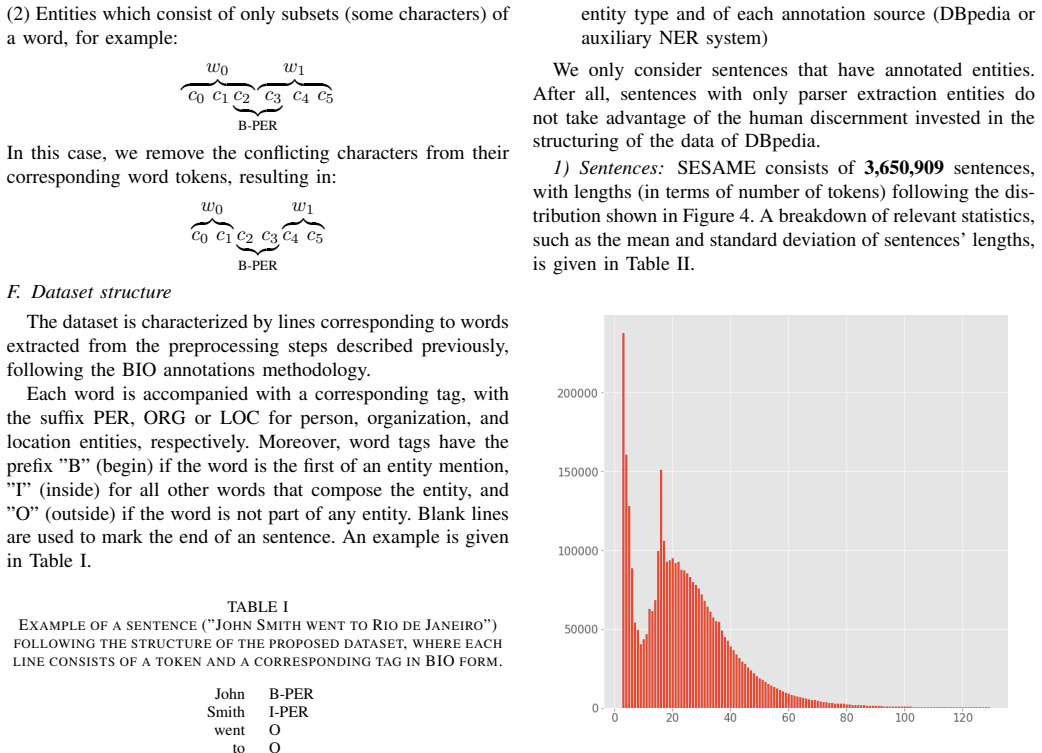
- [IV.E] The diagram for case (2), describing entities that consist of only subsets of a word, is difficult to follow because the character tokens c0...c5 are not clearly mapped to the word segments. A more explicit before-and-after example would improve readability.
Circularity Check
No significant circularity: Table VIII's F1 gain is measured on external human-annotated HAREM test data, and no prediction reduces to the dataset-generation inputs.
full rationale
The paper's central claim is that adding SESAME to HAREM2 raises F1 from 72.72 to 74.22 (Table VIII), with the test set drawn from the first HAREM corpus, a human-annotated benchmark that is external to the SESAME construction pipeline. SESAME labels are produced by exact string matching against DBpedia entity names (Section IV.C) plus Polyglot detections (Section IV.D); neither source is defined in terms of the HAREM gold labels, and the reported gain is therefore not forced by construction. The hyperparameters were selected using a 20% validation split of first HAREM (Section V.A), with the final comparison reported on the test portion, so the result is not a fitted parameter renamed as a prediction. The only self-citation is [19], cited with [18] and [20] to support the use of the First HAREM F1 metric; the metric itself is introduced by external reference [17], so this citation is not load-bearing. Section IV.G explicitly states the context-insensitive tagging limitation, which is a quality concern for the silver labels, not a circular reduction: lower label quality would only weaken the measured F1 gain, and cannot by itself produce the reported improvement. No equation in the paper reduces to its own input, and no uniqueness claim is imported from the authors' prior work. Consequently there is no significant circularity.
Assumptions & free parameters
free parameters (2)
- Balanced re-sample size of SESAME used for baseline training =
1,216,976 sentences
- Grid-searched hyperparameters of the BiLSTM-CRF baseline (Table VII) =
100-dim GloVe, 150 hidden units, learning rate 0.005
assumptions (5)
- domain assumption Exact string matching of DBpedia entity names in raw Wikipedia text is a valid detection rule for NER mentions.
- domain assumption The DBpedia ontology classes person, organization, and location are correct, sufficient, and propagated correctly from English to Portuguese.
- domain assumption Polyglot's automatically predicted labels are accurate enough to add more correct than incorrect entity mentions.
- standard math The modified First HAREM F1 metric is an appropriate evaluation for comparing NER predictors.
- domain assumption NLTK Punkt tokenization and the conflict resolution rules preserve entity spans.
Cite this review
Pith. "Pith review of Building a Massive Corpus for Named Entity Recognition using Free Open Data Sources." pith.science (2026). https://pith.science/paper/MNCP5NJH
@misc{pith2026190805758,
  author       = {Pith},
  title        = {Pith review of: Building a Massive Corpus for Named Entity Recognition using Free Open Data Sources},
  year         = {2026},
  howpublished = {\url{https://pith.science/paper/MNCP5NJH}},
  note         = {Machine review of arXiv:1908.05758}
}
read the original abstract
With the recent progress in machine learning, boosted by techniques such as deep learning, many tasks can be successfully solved once a large enough dataset is available for training. Nonetheless, human-annotated datasets are often expensive to produce, especially when labels are fine-grained, as is the case of Named Entity Recognition (NER), a task that operates with labels on a word-level. In this paper, we propose a method to automatically generate labeled datasets for NER from public data sources by exploiting links and structured data from DBpedia and Wikipedia. Due to the massive size of these data sources, the resulting dataset -- SESAME Available at https://sesame-pt.github.io -- is composed of millions of labeled sentences. We detail the method to generate the dataset, report relevant statistics, and design a baseline using a neural network, showing that our dataset helps building better NER predictors.
Figures

Figures from the paper (1 more)
Reference graph
Works this paper leans on
-
[1]
Efficient estimation of word representations in vector space,
T. Mikolov, K. Chen, G. Corrado, and J. Dean, “Efficient estimation of word representations in vector space,” arXiv preprint arXiv:1301.3781 , 2013
arXiv 2013
-
[2]
Learning multilingual named entity recognition from wikipedia,
J. Nothman, N. Ringland, W. Radford, T. Murphy, and J. R. Curran, “Learning multilingual named entity recognition from wikipedia,” Arti- ficial Intelligence, 2013
work page 2013
-
[3]
Building a corpus for named entity recognition using portuguese wikipedia and dbpedia,
C. Weber and R. Vieira, “Building a corpus for named entity recognition using portuguese wikipedia and dbpedia,” 2014
work page 2014
-
[4]
Dbpedia: A nucleus for a web of open data,
S. Auer, C. Bizer, G. Kobilarov, J. Lehmann, R. Cyganiak, and Z. G. Ives, “Dbpedia: A nucleus for a web of open data,” in ISWC/ASWC, 2007
work page 2007
- [5]
-
[6]
Named entity corpus construction using wikipedia and dbpedia ontology
Y . Hahm, J. Park, K. Lim, Y . Kim, D. Hwang, and K.-S. Choi, “Named entity corpus construction using wikipedia and dbpedia ontology.” in LREC, 2014
work page 2014
-
[7]
“Infocaixa,” https://pt.wikipedia.org/wiki/Ajuda:Infocaixa, acessed: 11/8/2018
work page 2018
-
[8]
“Dbpedia datasets,” https://wiki.dbpedia.org/services-resources/datasets/ dbpedia-datasets#h434-10, acessed: 21/7/2018
work page 2018
Show all 24 references
-
[9]
The semantic web,
T. Berners-Lee, J. Hendler, and O. Lassila, “The semantic web,” Scien- tific american, 2001
2001
-
[10]
Dbpedia datasets,
“Dbpedia datasets,” http://dbpedia.org/ontology/, acessed: 21/7/2018
2018
-
[11]
Dbpedia datasets,
“Dbpedia datasets,” https://dbpedia.org/sparql, acessed: 21/7/2018
2018
-
[12]
mwparserfromhell,
“mwparserfromhell,” https://mwparserfromhell.readthedocs.io/en/latest/, acessed: 11/8/2018
2018
-
[13]
Polyglot-ner: Massive multilingual named entity recognition,
R. Al-Rfou, V . Kulkarni, B. Perozzi, and S. Skiena, “Polyglot-ner: Massive multilingual named entity recognition,” in SDM, 2015
2015
-
[14]
Nltk: the natural language toolkit,
S. Bird and E. Loper, “Nltk: the natural language toolkit,” in ACL, 2004
2004
-
[15]
Unsupervised multilingual sentence boundary detection,
T. Kiss and J. Strunk, “Unsupervised multilingual sentence boundary detection,” Comput. Linguist., 2006
2006
-
[16]
Caminhos percorridos no mapa da portuguesificac ¸ ˜ao: A linguateca em perspectiva,
D. Santos, “Caminhos percorridos no mapa da portuguesificac ¸ ˜ao: A linguateca em perspectiva,” Linguam´atica, 2009
2009
-
[17]
HAREM: An advanced NER evaluation contest for Portuguese,
D. Santos, N. Seco, N. Cardoso, and R. Vilela, “HAREM: An advanced NER evaluation contest for Portuguese,” in LREC, 2006
2006
-
[18]
Boosting named entity recognition with neural character embeddings,
C. N. d. Santos and V . Guimaraes, “Boosting named entity recognition with neural character embeddings,” arXiv preprint arXiv:1505.05008 , 2015
2015 arXiv
-
[19]
Entropy guided transformation learning,
C. N. dos Santos and R. L. Milidi ´u, “Entropy guided transformation learning,” in Foundations of Computational Intelligence , 2009
2009
-
[20]
O cortex e a sua participac ¸ao no harem,
C. N. Aranha, “O cortex e a sua participac ¸ao no harem,”Reconhecimento de entidades mencionadas em portugu ˆes: Documentac ¸ao e actas do HAREM, a primeira avaliac ¸ao conjunta na ´area. Linguateca, 2007
2007
-
[21]
Glove: Global vectors for word representation,
J. Pennington, R. Socher, and C. Manning, “Glove: Global vectors for word representation,” in EMNLP, 2014
2014
-
[22]
Learning character-level representations for part-of-speech tagging,
C. D. Santos and B. Zadrozny, “Learning character-level representations for part-of-speech tagging,” in ICML, 2014
2014
-
[23]
Framewise phoneme classification with bidirectional lstm and other neural network architectures,
A. Graves and J. Schmidhuber, “Framewise phoneme classification with bidirectional lstm and other neural network architectures,” Neural Networks, 2005
2005
-
[24]
Second harem: Advancing the state of the art of named entity recognition in portuguese
C. Freitas, C. Mota, D. Santos, H. G. Oliveira, and P. Carvalho, “Second harem: Advancing the state of the art of named entity recognition in portuguese.” in LREC, 2010
2010
Reviewed August 14, 2026 · model on record in the stance chip above.
Discussion (0). Continue with ORCID to comment.