REVIEW 3 major objections 5 minor 2 cited by
Probing Massive Black Hole Binary Populations with LISA
T0 review · 3 major / 5 minor · reviewed 2026-08-14 · deepseek-v4-flash
Pith's one-line read This paper predicts that LISA will detect roughly 0.5 to 1 massive black hole merger per year, an order of magnitude below many earlier estimates, because the simulated seed population lacks lighter black holes.
desk verdict Worth a serious referee: the advanced extraction doubles the Illustris-based LISA rate forecast and the calculation is careful, but the 'lower limit' label does not survive the paper's own optimistic spin choice. read the letter →
The pith
A machine-rendered reading of the paper's core claim, the machinery that carries it, and where it could break.
The reading
What carries the argument
The load-bearing objects are the merger catalog and the coalescence-time prescriptions. The catalog comes from identifying every simulated pair of black hole particles that merge at kiloparsec scales, then filtering out spurious mergers caused by halo-finder mistakes by tracking whether a host galaxy has lost its central black hole; this advanced extraction retains 17,535 mergers down to the seed mass. Two sub-grid prescriptions then assign each binary a delay from formation to coalescence: DA17, a three-stage analytic model with dynamical friction, stellar hardening, and gravitational-wave emission, and K17, a numerical integration with dynamical friction, a loss-cone hardening rate, and a circumbinary gas disk. These delays, together with Monte Carlo Poisson sampling of coalescence times and waveform signal-to-noise ratios built from a phenomenological waveform model, convert the simulation's merger history into mock LISA detection catalogs.
What would settle it
Compare the predicted rate against one from any cosmological simulation with seeds of $10^3$--$10^4$ solar masses run through identical delay prescriptions; if that rate exceeds several per year, or if LISA itself detects more than about one massive black hole merger per year in its first years of operation, the lower-limit claim would be incomplete.
Extended reading notes
Core claim
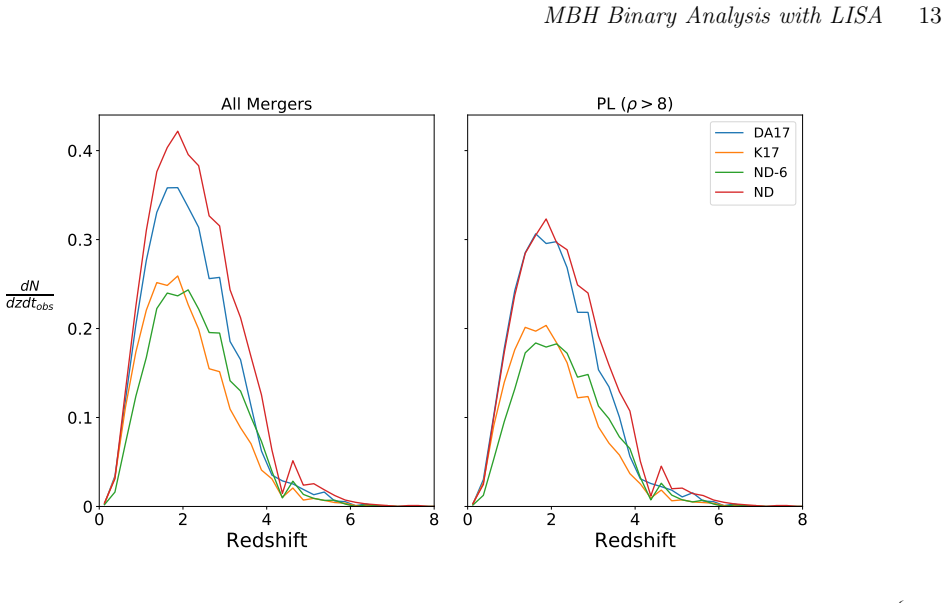
The paper claims that the no-delay baseline, in which every simulated galactic merger immediately produces a gravitational-wave source, already gives a LISA detection rate of about $0.98$ per year; adding two physically motivated delay prescriptions lowers the all-signal detection rate to $0.70$ per year (DA17) and $0.44$ per year (K17). These rates are lower than most published estimates, and the authors argue the main reason is seeding: the simulation places seeds of $1.42\times 10^5$ solar masses in massive halos, so the numerous lighter black holes that dominate LISA's accessible population are absent. A new extraction method that retains binaries down to the seed mass doubles the detection rate relative to older cuts at $10^6$ solar masses, showing that the low-mass tail is where most LISA events live. Because the sample omits masses below $10^5$ solar masses and ignores gas-driven migration and triple interactions, the quoted range is a lower limit.
Load-bearing premise
The argument assumes the simulation's seeding prescription—one black hole of $1.42\times10^5$ solar masses in every halo above $7.1\times10^{10}$ solar masses—produces a representative massive black hole population; if real seeds are smaller or form earlier, the missing low-mass binaries would raise the rate.
Editorial extensions
If this is right
- If the rate is roughly $0.5$--$1$ per year, LISA's first years would yield only a handful of massive black hole mergers, making each event statistically precious.
- Binaries with a component near $10^5$ solar masses dominate the detectable population, so LISA measurements would directly probe seed formation rather than only late-time growth.
- The two delay prescriptions differ mainly through low-mass binaries, meaning the predicted rate and the detected mass distribution are jointly shaped by binary evolution physics and seeding physics.
- Black hole spectroscopy should be possible for most detected events, giving a spectroscopy rate close to the overall detection rate.
Reading between the lines
- If real seeds are lighter or form earlier, the missing low-mass binaries would push the rate substantially above $1$ per year, possibly toward the higher semi-analytic predictions.
- The paper's own comparison to gas-rich and gas-poor constant delays suggests that adding gas-driven migration or triple-black-hole interactions would raise rates, so the quoted range is a floor under the paper's modeling choices.
- A direct testable extension is to run the same pipeline on a simulation with $10^3$--$10^4$ solar-mass seeds; the low-mass peak of the detectable population is where the models separate most clearly.
Signed reviews
Editorial analysis
A structured set of objections, weighed in public.
Referee Report
Summary. The paper uses the Illustris-1 cosmological simulation to build a catalog of massive black hole (MBH) mergers, applying a new post-processing extraction that retains binaries down to the seed mass of 1.42e5 M_sun. It evolves the merger population to coalescence under three prescriptions (no delay, ND; DA17; K17) and computes LISA detection rates using PhenomD waveforms, the LISA proposal sensitivity curve, a Galactic background model, and an SNR threshold of rho = 8, with both an integral rate calculation and Monte Carlo catalog generation. The main reported results are detection rates of about 0.75 yr^-1 (ND), 0.70 yr^-1 (DA17), and 0.44 yr^-1 (K17), summarized as ~0.5-1 yr^-1, with the claim that this should be treated as a lower limit because masses below 1e5 M_sun are missing from the sample.
Significance. If the results are robust, the paper provides an important hydrodynamic-simulation-based benchmark for LISA MBH rate predictions, roughly an order of magnitude below many semi-analytic predictions and closer to EAGLE-based estimates. The strengths are the clearly documented advanced extraction, use of two published and independent binary-evolution prescriptions, transparent Monte Carlo construction, standard waveform and sensitivity choices, and explicit comparison with prior LISA rate calculations. The central result is internally consistent. However, the 'lower limit' interpretation is not currently supported because the detectability calculation is optimistic with respect to black hole spin, and because several dominant systematics are not quantified. The significance is therefore moderate pending revision of the central claim.
major comments (3)
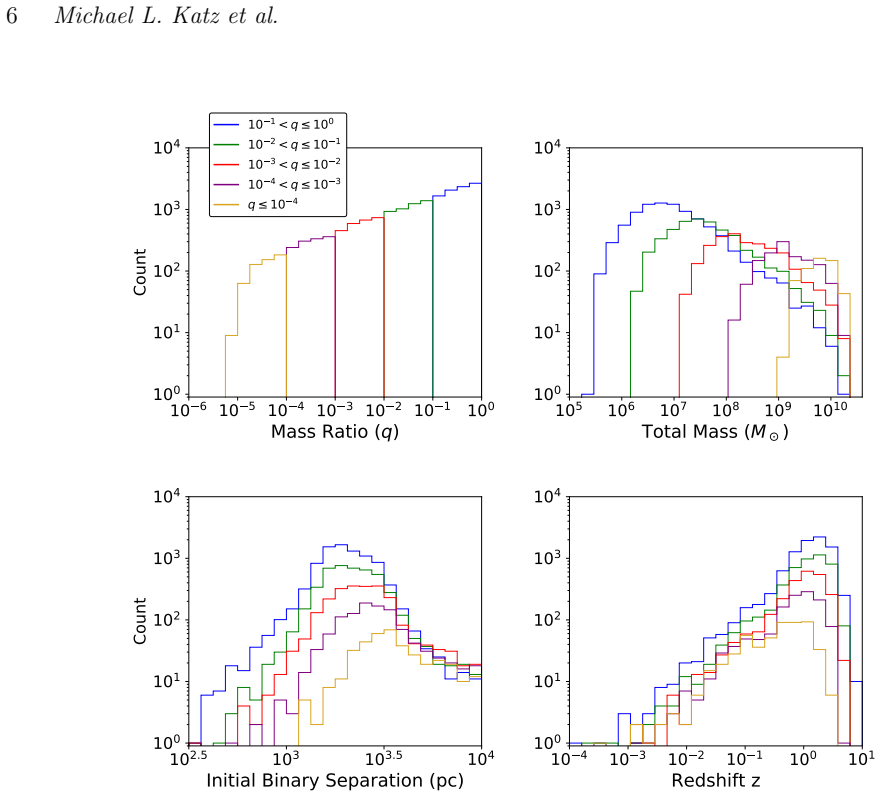
- [Section 3.2.1 and Abstract] The headline rate '~0.5-1 yr^-1' and its characterization as a lower limit are not supported by the detectability calculation as presented. The calculation fixes a1 = a2 = 0.8, aligned with the orbital angular momentum, for every binary, and the text explicitly describes this as 'the optimistic case' for unequal-mass systems, where the signal peak can change by an order of magnitude between spin-down and spin-up configurations. The detected population includes mass ratios down to q ~ 1e-2 (Figure 8), exactly the regime where spin matters most; since the SNR in Eq. (23) scales detection volume, a conservative spin choice (zero, isotropic, or anti-aligned) could push the DA17 and K17 rates below the quoted 0.5 yr^-1. The authors should either recompute rates under a conservative spin model or replace the 'lower limit' language with a statement that the rates are model-dependent estimates under an optimistic detectability assumption.
- [Sections 2, 3.3.1, and 5] The stated upward correction from missing low-mass systems is asserted but not quantified against the downward correction from optimistic spins and other modeling choices. The seeding prescription (1.42e5 M_sun seed in halos above 7.1e10 M_sun) is labeled ad hoc in Section 5, and it directly sets the completeness limit invoked by the 'lower limit' claim. Since the paper does not estimate the magnitude of the missing m < 1e5 M_sun contribution, nor combine it with the spin sensitivity, the conclusion that the true LISA rate is close to or above ~0.5-1 yr^-1 is not established. A systematic-error table or a bracketed rate range covering both upward and downward corrections would make the central claim defensible.
- [Equation (27) and Tables 1, A1] The quoted numerical errors (<0.01 in the integral calculation, ~1% in the Monte Carlo) reflect only redshift binning and Poisson sampling, not the dominant systematics: one Illustris volume, one seeding prescription, and two specific delay models. Given that the between-model spread alone is a factor of about 1.6 (0.44 vs 0.70 yr^-1), presenting the result with two-decimal precision understates the uncertainty. The manuscript should state this limitation more explicitly, even if a full Bayesian treatment is beyond the scope.
minor comments (5)
- [Section 5] The text contains the typo 'redshits' where 'redshifts' is intended.
- [Section 6] The text contains the typo 'surpression' where 'suppression' is intended.
- [Table A1 caption] The caption contains 'Similary' and 'negligble'; these should be 'Similarly' and 'negligible', and 'inpiral-only' should be 'inspiral-only'.
- [Figure A2 caption] The phrase 'can be see' should be 'can be seen'.
- [References] The Robson & Cornish (2017) reference is incomplete; an arXiv identifier or journal citation should be supplied.
Circularity Check
No circularity: the LISA detection rate is forward-modeled from Illustris merger catalogs and independent delay/waveform prescriptions; self-citations are tool/model inputs, not conclusions forced by definition.
full rationale
The derivation chain is forward: Illustris MBH merger catalog (Sections 2.1-2.2) to host-galaxy profiles, to delay models DA17 (Section 3.1.1) and K17 (Section 3.1.2), to coalescence times, to rate integrals (Equation 27), to PhenomD waveforms via gwsnrcalc, and finally to an SNR cut at rho = 8 (Equation 23). No parameter in this chain is fitted to the target LISA detection rate. The K17 and DA17 prescriptions are external published models (Kelley et al. 2017a,b; Dosopoulou & Antonini 2017) whose assumptions do not include LISA detectability, and gwsnrcalc (Katz & Larson 2019) is a published waveform/SNR tool; these self-citations are inputs with independent content, not authority-based conclusions. The Abstract's 'lower limit' statement and Section 3.2.1's optimistic spin choice (a = 0.8) are modeling assumptions and caveats: they may make the quoted rate optimistic, but they do not make the rate circular, since nothing is defined in terms of the rate itself. No equation in the paper reduces the detection-rate prediction to an input by construction, and no uniqueness theorem from the authors is invoked to forbid alternative models.
Assumptions & free parameters
free parameters (6)
- MBH spin magnitude =
0.8 for both black holes
- K17 Coulomb logarithm =
ln Lambda_c = 15
- DA17 triaxial parameters =
phi = 0.4, psi = 0.3
- LISA SNR detection threshold =
rho > 8
- Monte Carlo draw duration =
100 yr
- Host galaxy resolution and profile cuts =
>=80 DM, >=80 gas, >=300 star; >=4 per bin; 8 bins; index 0.5 to 2.5
assumptions (7)
- domain assumption Illustris-1's massive black hole seeding and repositioning scheme produces a representative resolved merger population.
- domain assumption The DA17 and K17 sub-grid prescriptions accurately describe massive black hole binary evolution from kpc separations to coalescence.
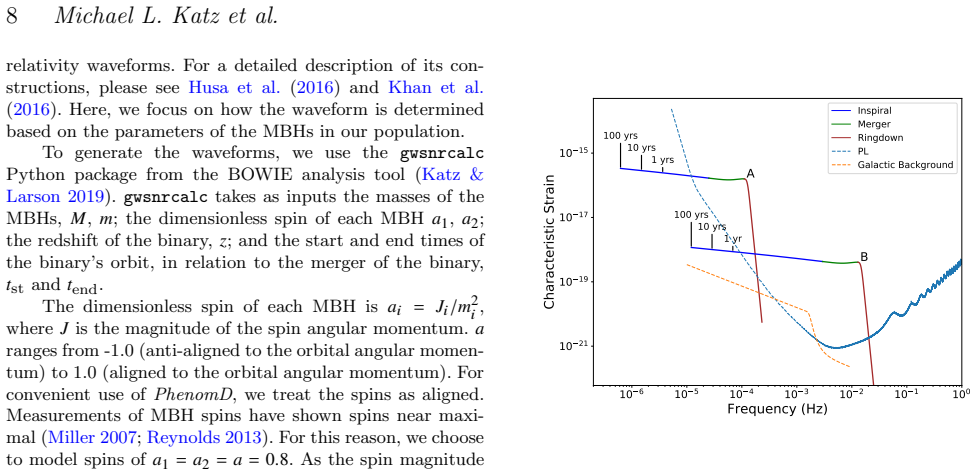
- domain assumption All binaries are circular and have aligned spins a = 0.8.
- domain assumption PhenomD waveforms and the proposed LISA PL sensitivity curve accurately represent the signals and noise for this population.
- standard math The sky-averaged SNR formula with the 3/20 averaging factor and two-channel factor is correct for LISA detectability.
- standard math Peters and Mathews gravitational-wave inspiral applies from the hardening radius onward for circular binaries.
- domain assumption Kernel density resampling with the redshift weighting of Equation 29 gives a valid Monte Carlo realization of the Illustris merger population.
Cite this review
Pith. "Pith review of Probing Massive Black Hole Binary Populations with LISA." pith.science (2026). https://pith.science/paper/SRBUNCI2
@misc{pith2026190805779,
  author       = {Pith},
  title        = {Pith review of: Probing Massive Black Hole Binary Populations with LISA},
  year         = {2026},
  howpublished = {\url{https://pith.science/paper/SRBUNCI2}},
  note         = {Machine review of arXiv:1908.05779}
}
abstract
ESA and NASA are moving forward with plans to launch LISA around 2034. With data from the Illustris cosmological simulation, we provide analysis of LISA detection rates accompanied by characterization of the merging massive black hole population. Massive black holes of total mass $\sim10^5-10^{10} M_\odot$ are the focus of this study. We evolve Illustris massive black hole mergers, which form at separations on the order of the simulation resolution ($\sim$kpc scales), through coalescence with two different treatments for the binary massive black hole evolutionary process. The coalescence times of the population, as well as physical properties of the black holes, form a statistical basis for each evolutionary treatment. From these bases, we Monte Carlo synthesize many realizations of the merging massive black hole population to build mock LISA detection catalogs. We analyze how our massive black hole binary evolutionary models affect detection rates and the associated parameter distributions measured by LISA. With our models, we find massive black hole binary detection rates with LISA of $\sim0.5-1$ yr$^{-1}$ for massive black holes with masses greater than $10^5M_\odot$. This should be treated as a lower limit primarily because our massive black hole sample does not include masses below $10^5M_\odot$, which may significantly add to the observed rate. We suggest reasons why we predict lower detection rates compared to much of the literature.
Figures

Figures from the paper (5 more)



Forward citations
Cited by 2 Pith papers
-
RABBITS IV: Stellar feedback and SMBH merging time-scales in the sub-Milky Way mass regime
Stronger stellar feedback lowers central stellar densities in low-mass merger remnants and systematically lengthens SMBH merger delays, yielding a 30–500 Myr spread in post-hardening coalescence times.
-
A Fog Over the Cosmological SGWB: Unresolved Massive Black Hole Binaries in the LISA Band
Unresolved massive black hole binaries will create a stochastic foreground in LISA that can raise the minimum detectable amplitude of a cosmological gravitational wave background by up to a factor of about 40 near a s...
Reference graph
Works this paper leans on
-
[1]
write newline
" write newline "" before.all 'output.state := FUNCTION fin.entry write newline FUNCTION new.block output.state before.all = 'skip after.block 'output.state := if FUNCTION new.sentence output.state after.block = 'skip output.state before.all = 'skip after.sentence 'output.state := if if FUNCTION not #0 #1 if FUNCTION and 'skip pop #0 if FUNCTION or pop #1...
-
[2]
P., et al., 2017, @doi [ ] 10.1038/nature24471 , 551, 85
Abbott B. P., et al., 2017, @doi [ ] 10.1038/nature24471 , 551, 85
-
[3]
Alvarez M. A., Wise J. H., Abel T., 2009, @doi [ ] 10.1088/0004-637x/701/2/l133 , 701, L133
-
[5]
Amaro-Seoane P., et al., 2017, arXiv e-prints, https://ui.adsabs.harvard.edu/abs/2017arXiv170200786A p. arXiv:1702.00786
arXiv 2017
-
[6]
Ardaneh K., Luo Y., Shlosman I., Nagamine K., Wise J. H., Begelman M. C., 2018, @doi [ ] 10.1093/mnras/sty1657 , https://ui.adsabs.harvard.edu/abs/2018MNRAS.479.2277A 479, 2277
-
[7]
G., et al., 2009, @doi [Classical and Quantum Gravity] 10.1088/0264-9381/26/9/094027 , 26, 94027
Arun K. G., et al., 2009, @doi [Classical and Quantum Gravity] 10.1088/0264-9381/26/9/094027 , 26, 94027
-
[8]
Astropy Collaboration et al., 2013, @doi [ ] 10.1051/0004-6361/201322068 , 558, A33
-
[9]
Baibhav V., Berti E., 2019, @doi [ ] 10.1103/PhysRevD.99.024005 , https://ui.adsabs.harvard.edu/abs/2019PhRvD..99b4005B 99, 024005
Show all 132 references
-
[10]
Baibhav V., Berti E., Cardoso V., Khanna G., 2018, @doi [ ] 10.1103/PhysRevD.97.044048 , 97, 44048
2018 doi
-
[11]
Farris B., Sathyaprakash B., Sesana A., 2015, J
Barausse E., Bellovary J., Berti E., Holley-Bockelmann K. Farris B., Sathyaprakash B., Sesana A., 2015, J. Phys.: Conf. Ser., 610, 12001
2015
-
[12]
C., Blandford R
Begelman M. C., Blandford R. D., Rees M. J., 1980, @doi [ ] 10.1038/287307a0 , 287, 307
1980 doi
-
[13]
C., Volonteri M., Rees M
Begelman M. C., Volonteri M., Rees M. J., 2006, @doi [ ] 10.1111/j.1365-2966.2006.10467.x , 370, 289
2006
-
[14]
M., Cleary C
Bellovary J. M., Cleary C. E., Munshi F., Tremmel M., Christensen C. R., Brooks A., Quinn T. R., 2019, @doi [ ] 10.1093/mnras/sty2842 , 482, 2913
2019 doi
-
[15]
L., Hils D., 1997, @doi [Classical and Quantum Gravity] 10.1088/0264-9381/14/6/008 , 14, 1439
Bender P. L., Hils D., 1997, @doi [Classical and Quantum Gravity] 10.1088/0264-9381/14/6/008 , 14, 1439
1997 doi
-
[16]
M., 2006, @doi [ ] 10.1103/PhysRevD.73.064030 , 73, 64030
Berti E., Cardoso V., Will C. M., 2006, @doi [ ] 10.1103/PhysRevD.73.064030 , 73, 64030
2006 doi
-
[17]
Berti E., Sesana A., Barausse E., Cardoso V., Belczynski K., 2016, @doi [Phys. Rev. Lett.] 10.1103/PhysRevLett.117.101102 , 117, 101102
2016 doi
-
[18]
Binney J., Tremaine S., 1987, Galactic dynamics
1987
-
[19]
Blanchet L., 2014, @doi [Living Reviews in Relativity] 10.12942/lrr-2014-2 , 17, 2
2014 doi
-
[20]
Blecha L., et al., 2016, @doi [ ] 10.1093/mnras/stv2646 , 456, 961
2016 doi
-
[21]
Boehle A., et al., 2016, @doi [ ] 10.3847/0004-637X/830/1/17 , 830, 17
2016 doi
-
[22]
Bogdanovi \'c T., 2015, in Gravitational Wave Astrophysics. p. 103 ( @eprint arXiv 1406.5193 ), @doi 10.1007/978-3-319-10488-1_9
2015 arXiv
-
[23]
Bonetti M., Sesana A., Haardt F., Barausse E., Colpi M., 2019, @doi [ ] 10.1093/mnras/stz903 , https://ui.adsabs.harvard.edu/abs/2019MNRAS.486.4044B 486, 4044
2019 doi
-
[24]
Burke-Spolaor S., 2013, @doi [Classical and Quantum Gravity] 10.1088/0264-9381/30/22/224013 , https://ui.adsabs.harvard.edu/abs/2013CQGra..30v4013B 30, 224013
2013 doi
-
[25]
Chandrasekhar S., 1943, @doi [ ] 10.1086/144517 , 97, 255
1943 doi
-
[26]
M., Graham M
Charisi M., Bartos I., Haiman Z., Price-Whelan A. M., Graham M. J., Bellm E. C., Laher R. R., Márka S., 2016, @doi [ ] 10.1093/mnras/stw1838 , 463, 2145–2171
2016 doi
-
[27]
B., Miller M
Davies M. B., Miller M. C., Bellovary J. M., 2011, @doi [ ] 10.1088/2041-8205/740/2/L42 , 740, L42
2011 doi
-
[28]
Devecchi B., Volonteri M., 2009, @doi [ ] 10.1088/0004-637X/694/1/302 , 694, 302
2009 doi
-
[29]
Dosopoulou F., Antonini F., 2017, @doi [ ] 10.3847/1538-4357/aa6b58 , 840, 31
2017 doi
-
[30]
Dunn G., Bellovary J., Holley-Bockelmann K., Christensen C., Quinn T., 2018, @doi [ ] 10.3847/1538-4357/aac7c2 , 861, 39
2018 doi
-
[31]
Fan X., et al., 2001a, @doi [ ] 10.1086/318033 , 121, 54
-
[32]
Fan X., et al., 2001b, @doi [ ] 10.1086/324111 , 122, 2833
-
[33]
Fan X., et al., 2006, @doi [ ] 10.1086/500296 , 131, 1203
2006 doi
-
[34]
S., Thorne K
Finn L. S., Thorne K. S., 2000, @doi [ ] 10.1103/PhysRevD.62.124021 , 62, 124021
2000 doi
-
[35]
Fontecilla C., Haiman Z., Cuadra J., 2019, @doi [ ] 10.1093/mnras/sty2972 , http://adsabs.harvard.edu/abs/2019MNRAS.482.4383F 482, 4383
2019 doi
-
[36]
J., 1976, @doi [ ] 10.1093/mnras/176.3.633 , 176, 633
Frank J., Rees M. J., 1976, @doi [ ] 10.1093/mnras/176.3.633 , 176, 633
1976 doi
-
[37]
L., Woosley S
Fryer C. L., Woosley S. E., Heger A., 2001, @doi [ ] 10.1086/319719 , 550, 372
2001 doi
-
[38]
R., Vallisneri M., Larson S
Gair J. R., Vallisneri M., Larson S. L., Baker J. G., 2013, @doi [Living Reviews in Relativity] 10.12942/lrr-2013-7 , 16, 7
2013 doi
-
[39]
Genel S., et al., 2014, @doi [ ] 10.1093/mnras/stu1654 , 445, 175
2014 doi
-
[40]
J., et al., 2015, @doi [ ] 10.1093/mnras/stv1726 , 453, 1562
Graham M. J., et al., 2015, @doi [ ] 10.1093/mnras/stv1726 , 453, 1562
2015 doi
-
[41]
Habouzit M., Volonteri M., Latif M., Dubois Y., Peirani S., 2016, @doi [ ] 10.1093/mnras/stw1924 , 463, 529
2016 doi
-
[42]
J., 2000, @doi [ ] 10.1086/308723 , 534, 11
Haiman Z., Abel T., Rees M. J., 2000, @doi [ ] 10.1086/308723 , 534, 11
2000 doi
-
[43]
Haiman Z., Kocsis B., Menou K., 2009, @doi [ ] 10.1088/0004-637X/700/2/1952 , 700, 1952
2009 doi
-
[44]
L., Woosley S
Heger A., Fryer C. L., Woosley S. E., Langer N., Hartmann D. H., 2003, @doi [ ] 10.1086/375341 , 591, 288
2003 doi
-
[45]
Hinshaw G., et al., 2013, @doi [ ] 10.1088/0067-0049/208/2/19 , 208, 19
2013 doi
-
[46]
A., Larson S
Hiscock W. A., Larson S. L., Routzahn J. R., Kulick B., 2000, @doi [ ] 10.1086/312867 , 540, L5
2000 doi
- [47]
-
[48]
D., 2007, @doi [Computing In Science & Engineering] 10.1109/MCSE.2007.55 , 9, 90
Hunter J. D., 2007, @doi [Computing In Science & Engineering] 10.1109/MCSE.2007.55 , 9, 90
2007 doi
-
[49]
J., Boh \' e A., 2016, @doi [ ] 10.1103/PhysRevD.93.044006 , 93, 44006
Husa S., Khan S., Hannam M., P \" u rrer M., Ohme F., Forteza X. J., Boh \' e A., 2016, @doi [ ] 10.1103/PhysRevD.93.044006 , 93, 44006
2016 doi
-
[50]
Jones E., Oliphant T., Peterson P., et al., 2001, SciPy : Open source scientific tools for Python , http://www.scipy.org/
2001
- [51]
-
[52]
G., 2015, @doi [ ] 10.1093/mnras/stv1048 , 451, 2352
Katz H., Sijacki D., Haehnelt M. G., 2015, @doi [ ] 10.1093/mnras/stv1048 , 451, 2352
2015 doi
-
[53]
Z., Blecha L., Hernquist L., 2017a, @doi [ ] 10.1093/mnras/stw2452 , 464, 3131
Kelley L. Z., Blecha L., Hernquist L., 2017a, @doi [ ] 10.1093/mnras/stw2452 , 464, 3131
-
[54]
Z., Blecha L., Hernquist L., Sesana A., Taylor S
Kelley L. Z., Blecha L., Hernquist L., Sesana A., Taylor S. R., 2017b, @doi [ ] 10.1093/mnras/stx1638 , 471, 4508
-
[55]
Z., Blecha L., Hernquist L., Sesana A., Taylor S
Kelley L. Z., Blecha L., Hernquist L., Sesana A., Taylor S. R., 2018, @doi [ ] 10.1093/mnras/sty689 , https://ui.adsabs.harvard.edu/abs/2018MNRAS.477..964K 477, 964
2018 doi
-
[56]
M., Just A., Merritt D., 2011, @doi [ ] 10.1088/0004-637X/732/2/89 , 732, 89
Khan F. M., Just A., Merritt D., 2011, @doi [ ] 10.1088/0004-637X/732/2/89 , 732, 89
2011 doi
-
[57]
J., Boh \' e A., 2016, @doi [ ] 10.1103/PhysRevD.93.044007 , 93, 44007
Khan S., Husa S., Hannam M., Ohme F., P \" u rrer M., Forteza X. J., Boh \' e A., 2016, @doi [ ] 10.1103/PhysRevD.93.044007 , 93, 44007
2016 doi
-
[58]
Klein A., et al., 2016, @doi [ ] 10.1103/PhysRevD.93.024003 , 93, 24003
2016 doi
-
[59]
Kormendy J., Richstone D., 1995, @doi [ ] 10.1146/annurev.aa.33.090195.003053 , 33, 581
1995
-
[60]
L., Hiscock W
Larson S. L., Hiscock W. A., Hellings R. W., 2000, @doi [ ] 10.1103/PhysRevD.62.062001 , 62, 62001
2000 doi
-
[61]
A., Schleicher D
Latif M. A., Schleicher D. R. G., Schmidt W., Niemeyer J. C., 2013, @doi [ ] 10.1093/mnras/stt1786 , 436, 2989
2013 doi
-
[62]
R., Tremaine S., Richstone D., Faber S
Lauer T. R., Tremaine S., Richstone D., Faber S. M., 2007, @doi [ ] 10.1086/522083 , 670, 249
2007 doi
-
[63]
M., Reines A
Lemons S. M., Reines A. E., Plotkin R. M., Gallo E., Greene J. E., 2015, @doi [ ] 10.1088/0004-637X/805/1/12 , 805, 12
2015 doi
- [64]
-
[65]
Lin D., et al., 2018, @doi [Nature Astronomy] 10.1038/s41550-018-0493-1 , 2, 656
2018 doi
-
[66]
Liu T., et al., 2016, @doi [ ] 10.3847/0004-637x/833/1/6 , 833, 6
2016 doi
-
[67]
A., 1994, @doi [ ] 10.1086/174548 , 432, 52
Loeb A., Rasio F. A., 1994, @doi [ ] 10.1086/174548 , 432, 52
1994 doi
-
[68]
Magorrian J., et al., 1998, @doi [ ] 10.1086/300353 , 115, 2285
1998 doi
-
[69]
McAlpine S., et al., 2016, @doi [Astronomy and Computing] 10.1016/j.ascom.2016.02.004 , 15, 72
2016 doi
-
[70]
J., Ma C.-P., 2013, @doi [ ] 10.1088/0004-637X/764/2/184 , 764, 184
McConnell N. J., Ma C.-P., 2013, @doi [ ] 10.1088/0004-637X/764/2/184 , 764, 184
2013 doi
-
[71]
Merritt D., 2013, Dynamics and Evolution of Galactic Nuclei
2013
-
[72]
Merritt D., Ferrarese L., 2001, @doi [ ] 10.1046/j.1365-8711.2001.04165.x , 320, L30
2001
-
[73]
Merritt D., Milosavljevi \' c M., 2005, @doi [Living Reviews in Relativity] 10.12942/lrr-2005-8 , 8, 8
2005 doi
-
[74]
D., Komossa S., 2009, @doi [ ] 10.1088/0004-637X/699/2/1690 , 699, 1690
Merritt D., Schnittman J. D., Komossa S., 2009, @doi [ ] 10.1088/0004-637X/699/2/1690 , 699, 1690
2009 doi
-
[75]
M., 2007, @doi [ ] 10.1146/annurev.astro.45.051806.110555 , 45, 441
Miller J. M., 2007, @doi [ ] 10.1146/annurev.astro.45.051806.110555 , 45, 441
2007 arXiv
-
[76]
A., Tahir A., Khan F
Mirza M. A., Tahir A., Khan F. M., Holley-Bockelmann H., Baig A. M., Berczik P., Chishtie F., 2017, @doi [ ] 10.1093/mnras/stx1248 , 470, 940
2017 doi
-
[77]
Moody M. S. L., Shi J.-M., Stone J. M., 2019, @doi [ ] 10.3847/1538-4357/ab09ee , 875, 66
2019 doi
-
[78]
J., Cole R
Moore C. J., Cole R. H., Berry C. P. L., 2015, Classical and Quantum Gravity, 32, 15014
2015
-
[79]
C., Shahinyan K., Sugarman H
Moran E. C., Shahinyan K., Sugarman H. R., V \' e lez D. O., Eracleous M., 2014, @doi [ ] 10.1088/0004-6256/148/6/136 , 148, 136
2014 doi
-
[80]
J., et al., 2011, @doi [ ] 10.1038/nature10159 , 474, 616
Mortlock D. J., et al., 2011, @doi [ ] 10.1038/nature10159 , 474, 616
2011 doi
-
[81]
J., Miranda R., Lai D., 2019, @doi [ ] 10.3847/1538-4357/aaf867 , https://ui.adsabs.harvard.edu/abs/2019ApJ...871...84M 871, 84
Mu \ n oz D. J., Miranda R., Lai D., 2019, @doi [ ] 10.3847/1538-4357/aaf867 , https://ui.adsabs.harvard.edu/abs/2019ApJ...871...84M 871, 84
2019 doi
-
[82]
Nelson D., et al., 2015, @doi [Astronomy and Computing] 10.1016/j.ascom.2015.09.003 , 13, 12
2015 doi
-
[83]
D., et al., 2018, @doi [ ] 10.3847/1538-4357/aabe28 , https://ui.adsabs.harvard.edu/abs/2018ApJ...858..118N 858, 118
Nguyen D. D., et al., 2018, @doi [ ] 10.3847/1538-4357/aabe28 , https://ui.adsabs.harvard.edu/abs/2018ApJ...858..118N 858, 118
2018 doi
-
[84]
D., et al., 2019, @doi [ ] 10.3847/1538-4357/aafe7a , https://ui.adsabs.harvard.edu/abs/2019ApJ...872..104N 872, 104
Nguyen D. D., et al., 2019, @doi [ ] 10.3847/1538-4357/aafe7a , https://ui.adsabs.harvard.edu/abs/2019ApJ...872..104N 872, 104
2019 doi
-
[85]
Omukai K., Schneider R., Haiman Z., 2008, @doi [ ] 10.1086/591636 , 686, 801
2008 doi
-
[86]
Pardo K., et al., 2016, @doi [ ] 10.3847/0004-637X/831/2/203 , 831, 203
2016 doi
-
[87]
C., Mathews J., 1963, @doi [Physical Review] 10.1103/PhysRev.131.435 , 131, 435
Peters P. C., Mathews J., 1963, @doi [Physical Review] 10.1103/PhysRev.131.435 , 131, 435
1963 doi
-
[88]
Petiteau A., Babak S., Sesana A., 2011, @doi [ ] 10.1088/0004-637X/732/2/82 , 732, 82
2011 doi
-
[91]
K., Sesana A., 2010, arXiv e-prints, https://ui.adsabs.harvard.edu/abs/2010arXiv1005.5296P p
Porter E. K., Sesana A., 2010, arXiv e-prints, https://ui.adsabs.harvard.edu/abs/2010arXiv1005.5296P p. arXiv:1005.5296
2010 arXiv
-
[92]
D., 1996, @doi [ ] 10.1016/S1384-1076(96)00018-8 , 1, 255
Quinlan G. D., 1996, @doi [ ] 10.1016/S1384-1076(96)00018-8 , 1, 255
1996 doi
-
[93]
D., Hernquist L., 1997, @doi [ ] 10.1016/S1384-1076(97)00039-0 , 2, 533
Quinlan G. D., Hernquist L., 1997, @doi [ ] 10.1016/S1384-1076(97)00039-0 , 2, 533
1997 doi
-
[94]
Rasskazov A., Merritt D., 2017, @doi [ ] 10.3847/1538-4357/aa6188 , 837, 135
2017 doi
-
[95]
E., Greene J
Reines A. E., Greene J. E., Geha M., 2013, @doi [ ] 10.1088/0004-637X/775/2/116 , 775, 116
2013 doi
-
[96]
S., 2013, @doi [Classical and Quantum Gravity] 10.1088/0264-9381/30/24/244004 , 30, 244004
Reynolds C. S., 2013, @doi [Classical and Quantum Gravity] 10.1088/0264-9381/30/24/244004 , 30, 244004
2013 doi
-
[97]
Robson T., Cornish N., 2017, preprint
2017
-
[98]
J., Liu C., 2019, @doi [Classical and Quantum Gravity] 10.1088/1361-6382/ab1101 , https://ui.adsabs.harvard.edu/abs/2019CQGra..36j5011R 36, 105011
Robson T., Cornish N. J., Liu C., 2019, @doi [Classical and Quantum Gravity] 10.1088/1361-6382/ab1101 , https://ui.adsabs.harvard.edu/abs/2019CQGra..36j5011R 36, 105011
2019 doi
-
[99]
Rodriguez-Gomez V., et al., 2015, @doi [ ] 10.1093/mnras/stv264 , 449, 49
2015 doi
-
[100]
Roedig C., Dotti M., Sesana A., Cuadra J., Colpi M., 2011, @doi [ ] 10.1111/j.1365-2966.2011.18927.x , 415, 3033
2011
-
[101]
G., Theuns T., McAlpine S., Schaller M., Crain R
Salcido J., Bower R. G., Theuns T., McAlpine S., Schaller M., Crain R. A., Schaye J., Regan J., 2016, @doi [ ] 10.1093/mnras/stw2048 , 463, 870
2016 doi
-
[102]
F., Schawinski K., Treister E., Trakhtenbrot B., Koss M., Shirazi M., Oh K., 2015, @doi [ ] 10.1093/mnras/stv2238 , 454, 3722
Sartori L. F., Schawinski K., Treister E., Trakhtenbrot B., Koss M., Shirazi M., Oh K., 2015, @doi [ ] 10.1093/mnras/stv2238 , 454, 3722
2015 doi
-
[103]
J., McAlpine W., Ellison S
Satyapal S., Secrest N. J., McAlpine W., Ellison S. L., Fischer J., Rosenberg J. L., 2014, @doi [ ] 10.1088/0004-637x/784/2/113 , 784, 113
2014 doi
-
[104]
Schulze A., Wisotzki L., 2011, @doi [ ] 10.1051/0004-6361/201117564 , https://ui.adsabs.harvard.edu/abs/2011A&A...535A..87S 535, A87
2011 doi
-
[105]
F., 1986, @doi [ ] 10.1038/323310a0 , 323, 310
Schutz B. F., 1986, @doi [ ] 10.1038/323310a0 , 323, 310
1986 doi
-
[106]
Sesana A., 2010, @doi [ ] 10.1088/0004-637X/719/1/851 , 719, 851
2010 doi
-
[107]
Sesana A., Haardt F., Madau P., Volonteri M., 2004, @doi [ ] 10.1086/422185 , 611, 623
2004 doi
-
[108]
Sesana A., Haardt F., Madau P., Volonteri M., 2005, @doi [ ] 10.1086/428492 , https://ui.adsabs.harvard.edu/abs/2005ApJ...623...23S 623, 23
2005 doi
-
[109]
Sesana A., Haardt F., Madau P., 2006, @doi [ ] 10.1086/507596 , 651, 392
2006 doi
-
[110]
Sesana A., Gair J., Berti E., Volonteri M., 2011, @doi [ ] 10.1103/PhysRevD.83.044036 , 83, 44036
2011 doi
-
[111]
I., Sunyaev R
Shakura N. I., Sunyaev R. A., 1973, , 500, 33
1973
-
[112]
Shankar F., et al., 2016, @doi [ ] 10.1093/mnras/stw678 , 460, 3119
2016 doi
-
[113]
L., Teukolsky S
Shapiro S. L., Teukolsky S. A., 1986, Black Holes, White Dwarfs and Neutron Stars: The Physics of Compact Objects
1986
-
[114]
E., Strauss M
Shen Y., Greene J. E., Strauss M. A., Richards G. T., Schneider D. P., 2008, @doi [ ] 10.1086/587475 , 680, 169
2008 doi
-
[115]
F., Nelson D., Hernquist L., 2015, @doi [ ] 10.1093/mnras/stv1340 , 452, 575
Sijacki D., Vogelsberger M., Genel S., Springel V., Torrey P., Snyder G. F., Nelson D., Hernquist L., 2015, @doi [ ] 10.1093/mnras/stv1340 , 452, 575
2015 doi
-
[116]
Soltan A., 1982, @doi [ ] 10.1093/mnras/200.1.115 , 200, 115
1982 doi
-
[117]
Springel V., 2010, @doi [ ] 10.1111/j.1365-2966.2009.15715.x , 401, 791
2010
-
[118]
Tanaka T., Haiman Z., 2009, @doi [ ] 10.1088/0004-637X/696/2/1798 , 696, 1798
2009 doi
-
[119]
Tang Y., MacFadyen A., Haiman Z., 2017, @doi [ ] 10.1093/mnras/stx1130 , http://adsabs.harvard.edu/abs/2017MNRAS.469.4258T 469, 4258
2017 doi
-
[120]
Torrey P., Vogelsberger M., Genel S., Sijacki D., Springel V., Hernquist L., 2014, @doi [ ] 10.1093/mnras/stt2295 , 438, 1985
2014 doi
-
[121]
R., Pontzen A., 2018, @doi [ ] 10.1093/mnras/sty139 , 475, 4967
Tremmel M., Governato F., Volonteri M., Quinn T. R., Pontzen A., 2018, @doi [ ] 10.1093/mnras/sty139 , 475, 4967
2018 doi
-
[122]
Vasiliev E., Merritt D., 2013, @doi [ ] 10.1088/0004-637X/774/1/87 , 774, 87
2013 doi
-
[123]
Vasiliev E., Antonini F., Merritt D., 2014, @doi [ ] 10.1088/0004-637X/785/2/163 , 785, 163
2014 doi
-
[124]
Vasiliev E., Antonini F., Merritt D., 2015, @doi [ ] 10.1088/0004-637X/810/1/49 , 810, 49
2015 doi
-
[125]
Vogelsberger M., Genel S., Sijacki D., Torrey P., Springel V., Hernquist L., 2013, @doi [ ] 10.1093/mnras/stt1789 , 436, 3031
2013 doi
-
[126]
Vogelsberger M., et al., 2014a, MNRAS, 444, 1518
-
[127]
Vogelsberger M., et al., 2014b, @doi [ ] 10.1038/nature13316 , 509, 177
-
[128]
Volonteri M., Madau P., Haardt F., 2003, @doi [ ] 10.1086/376722 , 593, 661
2003 doi
-
[129]
Volonteri M., Lodato G., Natarajan P., 2008, @doi [ ] 10.1111/j.1365-2966.2007.12589.x , https://ui.adsabs.harvard.edu/abs/2008MNRAS.383.1079V 383, 1079
2008
-
[130]
Walt S. v. d., Colbert S. C., Varoquaux G., 2011, @doi [Computing in Science and Engg.] 10.1109/MCSE.2011.37 , 13, 22
2011 doi
-
[131]
Wang H.-T., et al., 2019, @doi [ ] 10.1103/PhysRevD.100.043003 , https://ui.adsabs.harvard.edu/abs/2019PhRvD.100d3003W 100, 043003
2019 doi
-
[132]
White S. D. M., Frenk C. S., 1991, @doi [ ] 10.1086/170483 , 379, 52
1991 doi
-
[133]
Yu Q., 2002, @doi [ ] 10.1046/j.1365-8711.2002.05242.x , 331, 935
2002
- [134]
-
[135]
G., Gair J
van Wassenhove S., Volonteri M., Walker M. G., Gair J. R., 2010, @doi [ ] 10.1111/j.1365-2966.2010.17189.x , https://ui.adsabs.harvard.edu/abs/2010MNRAS.408.1139V 408, 1139
2010
Reviewed August 14, 2026 · model on record in the stance chip above.
Discussion (0). Continue with ORCID to comment.