REVIEW 3 major objections 5 minor 47 references
A deep-learning-based surrogate model for data assimilation in dynamic subsurface flow problems
T0 review · 3 major / 5 minor · reviewed 2026-08-14 · deepseek-v4-flash
Pith's one-line read This paper shows a recurrent R-U-Net surrogate predicts pressure, saturation, and well rates on unseen channelized models at 1.2-6.4% error, and that surrogate-based history matching cuts compute while preserving posterior forecasts.
desk verdict A credible deep-learning surrogate paper whose history-matching section never checks the matched data against the high-fidelity simulator; referees should send it back for that check. read the letter →
The pith
A machine-rendered reading of the paper's core claim, the machinery that carries it, and where it could break.
The reading
What carries the argument
The central object is the recurrent R-U-Net: a residual U-Net encoder-decoder in which the most compressed feature map $F_5(m)$ is passed through a chain of convolutional LSTM cells, producing a sequence of latent feature maps that the shared decoder turns into pressure or saturation maps at each time step. The convLSTM gates (forget, input, output, and candidate cell) carry the temporal memory, while extra weighting on well-block states in the loss function makes the predicted well rates usable for history matching. A detrended, time-step-wise min-max normalization of pressure data is also load-bearing, because it converts dynamic pressure maps into near-zero-centered inputs that the network can predict accurately.
What would settle it
Take a set of true models generated directly from the original geostatistical training image rather than through CNN-PCA, retrain the surrogate on CNN-PCA realizations as in the paper, and run the history-matching loop; if the surrogate's saturation relative error exceeds roughly 5% or the posterior P10-P90 bands miss the true forecast in more than the expected fraction of cases, the central generalization claim fails. A cheaper check is to compare the 500-test-sample errors against an ensemble of non-CNN-PCA channelized models instead of CNN-PCA-only models.
Extended reading notes
Core claim
The central discovery is that the temporal dynamics of two-phase flow in channelized reservoirs can be learned end-to-end from permeability maps, including under pressure control, without solving the partial differential equations at query time. The surrogate treats the permeability map as an image, extracts multiscale features with a residual U-Net, propagates the coarsest feature map through a convolutional LSTM over ten time steps, and decodes a separate state map at each step; well rates are recovered from predicted well-block states through the standard well-index formula. Trained on 1500 simulated realizations, the network produces dynamic saturation and pressure fields for new realizations with ensemble-averaged relative errors of 2.8% and 1.2%, and the P10/P50/P90 statistics of well rates closely track the simulator. When the same surrogate is placed inside randomized maximum likelihood history matching with the CNN-PCA parameterization, the posterior P10-P90 forecast bands narrow substantially and, when the posterior geomodels are re-simulated with the high-fidelity simulator, the posterior forecasts are in essential agreement with the surrogate predictions.
Load-bearing premise
The CNN-PCA parameterization used both to generate training realizations and to define the prior is assumed to faithfully span the same family of channelized models as the geostatistically generated true model, so the surrogate only ever needs to see CNN-PCA inputs even when the true field comes from another generator.
Editorial extensions
If this is right
- History matching that would take about 1.3 CPU-years with the full simulator takes about 11 hours with the surrogate, making randomized maximum likelihood sampling practical for problems previously out of reach.
- The posterior P10-P90 ranges in the 100-model ensemble are much narrower than the prior ranges, and the narrowing is visible in forecast periods and even for wells that have not yet broken through to water by the end of the history match.
- When the posterior geomodels are run through the high-fidelity simulator, their P50 flow forecasts agree closely with the surrogate's P50 forecasts, indicating the surrogate is not merely fitting history data in an unphysical way.
- Because the surrogate predicts full pressure and saturation maps rather than only well responses, the same framework can assimilate global data such as time-lapse saturation estimates without architectural changes, an extension the paper notes as future work.
Reading between the lines
- The accuracy numbers are tied to the CNN-PCA training-and-prior distribution; a stress test outside this paper would fix a true model from the original geostatistical generator and retrain the surrogate on a different parameterization, where the reported 1.2-6.4% errors would not be expected to survive unchanged.
- The surrogate is trained and evaluated under fixed bottom-hole pressure controls; if the convLSTM latent representation encodes flow physics rather than a control-specific schedule, it should partially transfer to new controls and well locations, a testable extension the paper lists only as future work.
- Because the surrogate's own error is not propagated into the data-assimilation objective, the posterior ensemble may be somewhat overconfident; checking calibration against the true model over many synthetic histories would quantify this.
Editorial analysis
A structured set of objections, weighed in public.
Referee Report
Summary. The paper introduces a recurrent R-U-Net surrogate model for dynamic two-phase subsurface flow in channelized geomodels. The model combines a residual U-Net with a convolutional LSTM operating on the most compressed feature map, and is trained on 1500 AD-GPRS simulations of CNN-PCA channelized realizations. The surrogate is evaluated on 500 held-out CNN-PCA geomodels, with reported relative errors of 2.8% for saturation, 1.2% for pressure, and 3.5-6.4% for well rates. The surrogate is then embedded in a randomized maximum likelihood (RML) history-matching procedure with CNN-PCA parameterization. Posterior predictions show large uncertainty reduction, and posterior forecasts generated by the surrogate are compared with high-fidelity AD-GPRS simulations, showing essential agreement. The paper's central claims are (i) the recurrent R-U-Net is an accurate and fast surrogate for dynamic flow prediction and (ii) surrogate-based history matching yields posterior models with substantially reduced prediction uncertainty.
Significance. The surrogate architecture and its empirical validation on 500 out-of-sample realizations are genuinely useful contributions to data-driven subsurface flow surrogates. The design choice to evolve only the compressed feature map through a ConvLSTM and share the decoder is interesting and appears to control the number of parameters while capturing temporal dynamics. The paper also ships a concrete, falsifiable history-matching experiment with a prescribed observation noise level. If the data-assimilation claim is fully verified, the result would be a practically relevant demonstration that a deep-learning surrogate can replace a simulator in RML/MADS history matching, with a dramatic speedup. The main weakness is that the validation of the history-matching step is incomplete: the paper reports agreement between surrogate and simulator for posterior forecasts, but does not report whether the posterior models, when evaluated with the high-fidelity simulator, actually reproduce the observed history data.
major comments (3)
- [Section 4.3, Eq. (20), Fig. 16] The central data-assimilation claim is not supported by a high-fidelity check of the history data misfit. The RML objective in Eq. (20) is minimized using surrogate predictions f-hat, but the only high-fidelity validation shown (Fig. 16) compares surrogate and AD-GPRS posterior P10/P50/P90 forecasts; it does not check whether the posterior geomodels simulated with AD-GPRS reproduce the 215 observed measurements within the assumed 5% noise. Because the surrogate well-rate relative errors (5.8-6.4%, Section 3.5) are comparable to or larger than the observation noise, RML optima may systematically exploit regions where the surrogate is biased. The authors should report the AD-GPRS-computed normalized misfit for the posterior ensemble against the observed data, and ideally show the observed data overlaid on the high-fidelity posterior intervals, to verify that the posterior models are consistent with the data under the true simulator.
- [Sections 3.2 and 4.1] The surrogate and the RML prior are both built on CNN-PCA realizations, while the true model used in history matching is an SGeMS realization. The paper relies on prior work to justify that CNN-PCA reproduces SGeMS flow behavior, but the coverage of the CNN-PCA parameterization (n_xi = 100) for the specific training image is not quantified here. If the SGeMS true model falls outside the CNN-PCA support, the RML posterior cannot contain the truth, and the optimizer may instead exploit surrogate error to match the data. The authors should quantify this risk, for example by projecting the SGeMS true model onto the CNN-PCA latent space, simulating the projected model with AD-GPRS, and comparing its flow responses with those of the original true model. This is load-bearing because the validity of the posterior models depends on the adequacy of the CNN-PCA prior.
- [Section 4.2, Fig. 15] The uncertainty-reduction claim is based on surrogate predicted posterior intervals, and no quantitative measure of the posterior's ability to match the observed history data is provided. The paper states 'the posterior P10-P90 interval generally captures the observed (and true) data' from visual inspection, but does not report, for example, the fraction of observed data points that lie within the posterior P10-P90 interval computed from the high-fidelity posterior ensemble, or the posterior mean misfit normalized by the data error standard deviation. Such a metric is needed to tie the claimed uncertainty reduction to actual data fit rather than to surrogate behavior.
minor comments (5)
- [Section 3.1] The sentence 'All wells are specified to operate are under bottom-hole pressure (BHP) control' contains a duplicated 'are'.
- [Section 4.2] The term 'subspace RML procedure' is used but never defined; please clarify what 'subspace' refers to in the RML implementation.
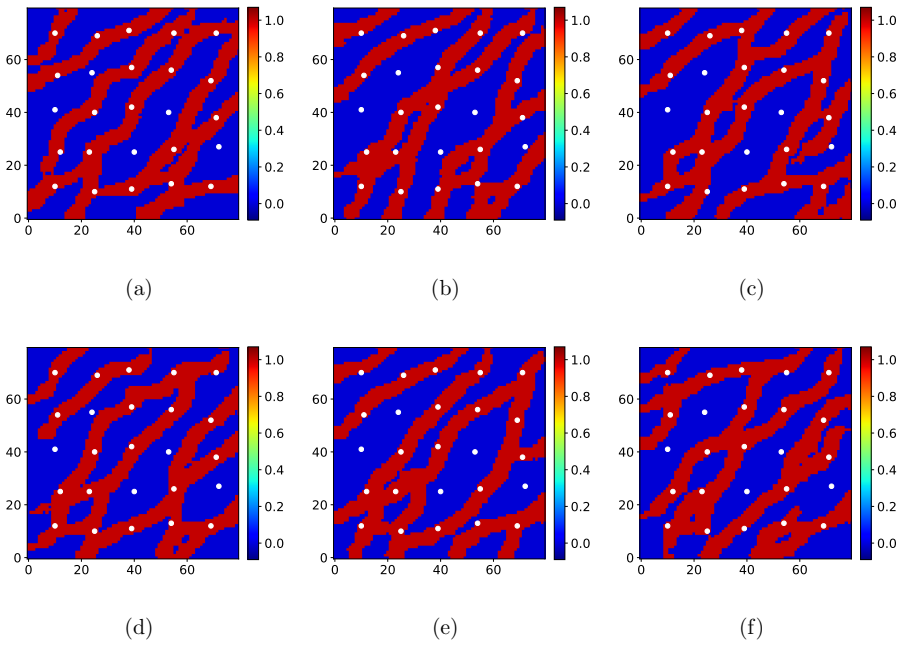
- [Section 4.2] The paper states that 100 posterior models are generated, but only three prior models and three corresponding posterior models are shown in Fig. 14; please specify how the 100 RML runs relate to the initial guesses and whether each initial guess is used multiple times.
- [Section 3.3] The training setup lists the initial learning rate, batch size, and loss weight lambda, but the number of epochs (or the stopping criterion) and any learning-rate schedule are not stated; reporting these would improve reproducibility.
- [Section 3.5, Eq. (19)] The relative well-rate error in Eq. (19) uses a fixed epsilon of 1 m^3/day in the denominator, which can disproportionately inflate relative errors for low-rate wells; consider also reporting a field-averaged absolute error or a time-averaged relative error with a more robust normalization.
Circularity Check
No circularity: surrogate predictions are validated against AD-GPRS on held-out models; history-match forecasts are re-simulated with the high-fidelity simulator.
full rationale
The central accuracy claim is self-contained: the recurrent R-U-Net is trained on AD-GPRS simulations and evaluated on 500 held-out CNN-PCA geomodels not used in training, with errors reported in Eqs. 17-19 against simulator outputs. Well rates are computed from predicted pressure and saturation via Eq. 2, not from fitted rate data. The history-matching posterior models are obtained by minimizing the surrogate-based RML objective in Eq. 20, but the resulting posterior P10/P50/P90 forecasts are independently re-simulated with AD-GPRS in Fig. 16, so the posterior forecast agreement is not merely the objective function restated. The CNN-PCA parameterization comes from prior work by the same group [39,40], and the paper relies on the cited result that CNN-PCA flow responses match SGeMS responses; this is a self-citation, but it is not circular because it is an externally published, falsifiable result and does not define the surrogate accuracy or the history-match forecasts. The genuine weakness is a validation gap rather than circularity: Section 4.3 never reports the AD-GPRS misfit of the posterior models against the 215 observed measurements, showing only surrogate-based data matches in Fig. 15 and high-fidelity comparisons of forecast curves in Fig. 16. With surrogate well-rate errors of 3.5-6.4% comparable to the 5% observation noise, the optimizer could in principle exploit surrogate bias. This missing check is a correctness risk, not an in-paper reduction of a prediction to a fitted input, so the circularity score remains 0.
Assumptions & free parameters
free parameters (7)
- lambda (well-state weight) =
1000
- initial learning rate =
0.003
- batch size =
8
- training sample size =
1500
- CNN-PCA latent dimension =
100
- network width (filters per layer) =
16-128
- loss norms for pressure and saturation =
L1 for pressure, L2 for saturation
assumptions (5)
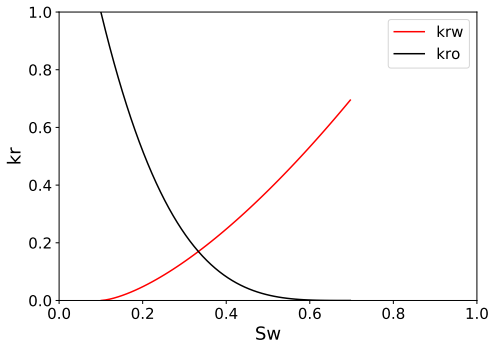
- domain assumption Two-phase immiscible flow is governed by Darcy's law and mass conservation as discretized in Eq. 1.
- domain assumption Peaceman well model (Eq. 2) relates well-block states to well rates.
- domain assumption CNN-PCA parameterization reproduces the geostatistics of SGeMS channelized models.
- ad hoc to paper Temporal dynamics can be captured by evolving only the most compressed feature map F5(m) through a ConvLSTM, with a decoding net shared across time steps.
- domain assumption RML with MADS provides approximate samples from the posterior distribution.
Cite this review
Pith. "Pith review of A deep-learning-based surrogate model for data assimilation in dynamic subsurface flow problems." pith.science (2026). https://pith.science/paper/H7JTG3LN
@misc{pith2026190805823,
  author       = {Pith},
  title        = {Pith review of: A deep-learning-based surrogate model for data assimilation in dynamic subsurface flow problems},
  year         = {2026},
  howpublished = {\url{https://pith.science/paper/H7JTG3LN}},
  note         = {Machine review of arXiv:1908.05823}
}
read the original abstract
A deep-learning-based surrogate model is developed and applied for predicting dynamic subsurface flow in channelized geological models. The surrogate model is based on deep convolutional and recurrent neural network architectures, specifically a residual U-Net and a convolutional long short term memory recurrent network. Training samples entail global pressure and saturation maps, at a series of time steps, generated by simulating oil-water flow in many (1500 in our case) realizations of a 2D channelized system. After training, the `recurrent R-U-Net' surrogate model is shown to be capable of accurately predicting dynamic pressure and saturation maps and well rates (e.g., time-varying oil and water rates at production wells) for new geological realizations. Assessments demonstrating high surrogate-model accuracy are presented for an individual geological realization and for an ensemble of 500 test geomodels. The surrogate model is then used for the challenging problem of data assimilation (history matching) in a channelized system. For this study, posterior reservoir models are generated using the randomized maximum likelihood method, with the permeability field represented using the recently developed CNN-PCA parameterization. The flow responses required during the data assimilation procedure are provided by the recurrent R-U-Net. The overall approach is shown to lead to substantial reduction in prediction uncertainty. High-fidelity numerical simulation results for the posterior geomodels (generated by the surrogate-based data assimilation procedure) are shown to be in essential agreement with the recurrent R-U-Net predictions. The accuracy and dramatic speedup provided by the surrogate model suggest that it may eventually enable the application of more formal posterior sampling methods in realistic problems.
Figures


Figures from the paper (13 more)




Reference graph
Works this paper leans on
-
[1]
J. F. Van Doren, R. Markovinovi´ c, J.-D. Jansen, Reduced-order optimal control of water flooding using proper orthogonal decomposition, Computational Geosciences 10 (1) (2006) 137–158
work page 2006
-
[2]
M. A. Cardoso, L. J. Durlofsky, P. Sarma, Development and application of reduced-order modeling procedures for subsurface flow simulation, International Journal for Numerical Methods in Engineering 77 (9) (2009) 1322–1350
work page 2009
-
[3]
J. He, L. J. Durlofsky, Reduced-order modeling for compositional simulation by use of trajectory piecewise linearization, SPE Journal 19 (05) (2014) 858–872
work page 2014
-
[4]
Y. Yang, M. Ghasemi, E. Gildin, Y. Efendiev, V. Calo, Fast multiscale reservoir simulations with POD-DEIM model reduction, SPE Journal 21 (06) (2016) 2–141
work page 2016
-
[5]
Z. L. Jin, L. J. Durlofsky, Reduced-order modeling of CO 2 storage operations, International Journal of Greenhouse Gas Control 68 (2018) 49–67
work page 2018
-
[6]
J. He, P. Sarma, L. J. Durlofsky, Reduced-order flow modeling and geological parameterization for ensemble-based data assimilation, Computers & Geosciences 55 (2013) 54–69
work page 2013
-
[7]
C. Xiao, O. Leeuwenburgh, H. X. Lin, A. Heemink, Non-intrusive subdomain POD-TPWL for reservoir history matching, Computational Geosciences 23 (03) (2019) 537–565
work page 2019
- [8]
Show all 47 references
-
[9]
Bazargan, M
H. Bazargan, M. Christie, A. H. Elsheikh, M. Ahmadi, Surrogate accelerated sampling of reservoir models with complex structures using sparse polynomial chaos expansion, Advances in Water Resources 86 (2015) 385–399
2015
-
[10]
L. A. N. Costa, C. Maschio, D. J. Schiozer, Application of artificial neural networks in a history matching process, Journal of Petroleum Science and Engineering 123 (2014) 30–45
2014
-
[11]
Baltrusaitis, P
T. Baltrusaitis, P. Robinson, L.-P. Morency, Constrained local neural fields for robust facial landmark detection in the wild, in: Proceedings of the IEEE International Conference on Computer Vision Workshops, 354–361, 2013
2013
-
[12]
F. Liu, C. Shen, G. Lin, Deep convolutional neural fields for depth estimation from a single image, in: Proceedings of the IEEE Conference on Computer Vision and Pattern Recognition, 5162–5170, 2015
2015
-
[13]
Isola, J.-Y
P. Isola, J.-Y. Zhu, T. Zhou, A. A. Efros, Image-to-image translation with conditional adversarial networks, in: Proceedings of the IEEE Conference on Computer Vision and Pattern Recognition, 1125–1134, 2017. 44
2017
-
[14]
Y. Wu, M. Schuster, Z. Chen, Q. V. Le, M. Norouzi, W. Macherey, M. Krikun, Y. Cao, Q. Gao, K. Macherey, J. Klingner, A. Shah, M. Johnson, X. Liu, . Kaiser, S. Gouws, Y. Kato, T. Kudo, H. Kazawa, K. Stevens, G. Kurian, N. Patil, W. Wang, C. Young, J. Smith, J. Riesa, A. Rudnick...
-
[15]
Devlin, M.-W
J. Devlin, M.-W. Chang, K. Lee, K. Toutanova, Bert: Pre-training of deep bidirectional transformers for language understanding, arXiv:1810.04805
-
[16]
G. K. Dziugaite, D. M. Roy, Computing nonvacuous generalization bounds for deep (stochastic) neural networks with many more parameters than training data, arXiv:1703.11008
-
[17]
Arora, R
S. Arora, R. Ge, B. Neyshabur, Y. Zhang, Stronger generalization bounds for deep nets via a compres- sion approach, arXiv:1802.05296
-
[18]
Y. Zhu, N. Zabaras, Bayesian deep convolutional encoder–decoder networks for surrogate modeling and uncertainty quantification, Journal of Computational Physics 366 (2018) 415–447
2018
-
[19]
S. Mo, Y. Zhu, N. Zabaras, X. Shi, J. Wu, Deep convolutional encoder-decoder networks for uncertainty quantification of dynamic multiphase flow in heterogeneous media, arXiv:1807.00882
-
[20]
S. Mo, N. Zabaras, X. Shi, J. Wu, Deep autoregressive neural networks for high-dimensional inverse problems in groundwater contaminant source identification, arXiv:1812.09444v1
-
[21]
Z. L. Jin, Y. Liu, L. J. Durlofsky, Deep-learning-based reduced-order modeling for subsurface flow simulation, arXiv preprint arXiv:1906.03729
1906 arXiv
-
[22]
Ronneberger, P
O. Ronneberger, P. Fischer, T. Brox, U-net: Convolutional networks for biomedical image segmenta- tion, in: International Conference on Medical Image Computing and Computer-assisted Intervention, Springer, 234–241, 2015
2015
-
[23]
Hochreiter, J
S. Hochreiter, J. Schmidhuber, Long short-term memory, Neural Computation 9 (8) (1997) 1735–1780
1997
-
[24]
Xingjian, Z
S. Xingjian, Z. Chen, H. Wang, D.-Y. Yeung, W.-K. Wong, W.-C. Woo, Convolutional LSTM net- work: A machine learning approach for precipitation nowcasting, in: Advances in Neural Information Processing Systems, 802–810, 2015
2015
-
[25]
D. W. Peaceman, Interpretation of well-block pressures in numerical reservoir simulation with nonsquare grid blocks and anisotropic permeability, SPE Journal 23 (03) (1983) 531–543
1983
-
[26]
M. D. Zeiler, R. Fergus, Visualizing and understanding convolutional networks, in: European Confer- ence on Computer Vision, Springer, 818–833, 2014
2014
-
[27]
Dumoulin, F
V. Dumoulin, F. Visin, A guide to convolution arithmetic for deep learning, arXiv:1603.07285 . 45
-
[28]
J. Long, E. Shelhamer, T. Darrell, Fully convolutional networks for semantic segmentation, in: Pro- ceedings of the IEEE Conference on Computer Vision and Pattern Recognition, 3431–3440, 2015
2015
-
[29]
K. He, X. Zhang, S. Ren, J. Sun, Deep residual learning for image recognition, in: Proceedings of the IEEE Conference on Computer Vision and Pattern Recognition, 770–778, 2016
2016
-
[30]
Mikolov, M
T. Mikolov, M. Karafi´ at, L. Burget, J. ˇCernock` y, S. Khudanpur, Recurrent neural network based lan- guage model, in: Eleventh Annual Conference of the International Speech Communication Association, 2010
2010
-
[31]
Bengio, P
Y. Bengio, P. Simard, P. Frasconi, Learning long-term dependencies with gradient descent is difficult, IEEE Transactions on Neural Networks 5 (2) (1994) 157–166
1994
-
[32]
G. Zhu, L. Zhang, P. Shen, J. Song, Multimodal gesture recognition using 3-D convolution and convo- lutional LSTM, IEEE Access 5 (2017) 4517–4524
2017
-
[33]
R. P. Poudel, P. Lamata, G. Montana, Recurrent fully convolutional neural networks for multi-slice MRI cardiac segmentation, in: Reconstruction, Segmentation, and Analysis of Medical Images, Springer, 83– 94, 2016
2016
-
[34]
Hecht-Nielsen, Theory of the backpropagation neural network, in: Neural Networks for Perception, Elsevier, 65–93, 1992
R. Hecht-Nielsen, Theory of the backpropagation neural network, in: Neural Networks for Perception, Elsevier, 65–93, 1992
1992
-
[35]
D. P. Kingma, J. Ba, Adam: A method for stochastic optimization, arXiv:1412.6980
-
[36]
C. Li, H. Farkhoor, R. Liu, J. Yosinski, Measuring the intrinsic dimension of objective landscapes, arXiv:1804.08838
-
[37]
Frankle, M
J. Frankle, M. Carbin, The lottery ticket hypothesis: finding sparse, trainable neural networks, arXiv:1803.03635
-
[38]
N. Remy, A. Boucher, J. Wu, Applied geostatistics with SGeMS: a user’s guide, Cambridge University Press, 2009
2009
-
[39]
Y. Liu, W. Sun, L. J. Durlofsky, A deep-learning-based geological parameterization for history matching complex models, Mathematical Geosciences 51 (6) (2019) 725–766
2019
-
[40]
Y. Liu, L. J. Durlofsky, Multilevel strategies and geological parameterizations for history matching complex reservoir models, in: SPE Reservoir Simulation Conference, 2019
2019
-
[41]
Zhou, Parallel general-purpose reservoir simulation with coupled reservoir models and multisegment wells, Ph.D
Y. Zhou, Parallel general-purpose reservoir simulation with coupled reservoir models and multisegment wells, Ph.D. thesis, Stanford University, 2012
2012
-
[42]
Bergstra, Y
J. Bergstra, Y. Bengio, Random search for hyper-parameter optimization, Journal of Machine Learning Research 13 (Feb) (2012) 281–305. 46
2012
-
[43]
P. K. Kitanidis, Quasi-linear geostatistical theory for inversing, Water Resources Research 31 (10) (1995) 2411–2419
1995
-
[44]
D. S. Oliver, Multiple realizations of the permeability field from well test data, SPE Journal 1 (02) (1996) 145–154
1996
-
[45]
G. Gao, M. Zafari, A. C. Reynolds, Quantifying uncertainty for the PUNQ-S3 problem in a Bayesian setting with RML and EnKF, in: SPE Reservoir Simulation Symposium, 2005
2005
-
[46]
H. X. Vo, L. J. Durlofsky, Data assimilation and uncertainty assessment for complex geological models using a new PCA-based parameterization, Computational Geosciences 19 (4) (2015) 747–767
2015
-
[47]
Audet, J
C. Audet, J. E. Dennis Jr, Mesh adaptive direct search algorithms for constrained optimization, SIAM Journal on Optimization 17 (1) (2006) 188–217. 47
2006
Reviewed August 14, 2026 · model on record in the stance chip above.
Discussion (0). Continue with ORCID to comment.