REVIEW 3 major objections 4 minor 48 references
See Clearer at Night: Towards Robust Nighttime Semantic Segmentation through Day-Night Image Conversion
T0 review · 3 major / 4 minor · reviewed 2026-08-14 · deepseek-v4-flash
Pith's one-line read Training on synthetic nighttime images raises night segmentation by 10.4 mIoU points.
desk verdict A modest, honest ratio-sweep study of CycleGAN day-to-night augmentation for nighttime segmentation; the load-bearing assumption of label preservation is never tested, and the closest baseline is omitted. read the letter →
The pith
A machine-rendered reading of the paper's core claim, the machinery that carries it, and where it could break.
The reading
What carries the argument
The load-bearing mechanism is CycleGAN, an unpaired image-to-image translator trained with cycle-consistency losses, used to bridge daytime and nighttime domains. It converts labeled daytime BDD10K images into synthetic nighttime images at training time, so the existing day labels are reused without manual night annotation. The same CycleGAN is also applied in reverse to translate nighttime test images to the day domain for the inference-time method.
What would settle it
Measure label preservation directly by running a day-trained ERF-PSPNet on a set of day images and on their CycleGAN night translations and comparing the predicted semantic maps. If the agreement is low, or if human raters cannot identify the same objects in the synthetic night images, the training labels are corrupted and the measured nighttime gains would need to be attributed to something other than the proposed synthetic supervision.
Extended reading notes
Core claim
The central claim is that the day-to-night direction of an unpaired CycleGAN trained on BDD100K produces synthetic nighttime images whose day labels remain usable enough to improve real-nighttime segmentation. With 2,000 synthetic night images mixed into 5,000 real day images, ERF-PSPNet reaches 43.14% mean IoU on BDD night validation and 45.09% on the Nighttime Driving test set; the latter is about 3.5 points higher than the DarkModelAdaptation baseline of 41.60%. The paper also finds that mixing too many synthetic night images degrades performance, with full conversion dropping below 30% IoU, and that the night-to-day inference-time conversion method underperforms the baseline at 29.94% and 32.74%.
Load-bearing premise
The argument relies on the assumption that the CycleGAN-generated nighttime images keep the same semantic content as their daytime sources, so the original day labels remain correct for the synthetic night images; the authors do not verify this and even note that the GAN can turn far-away buildings into trees.
Editorial extensions
If this is right
- Nighttime semantic segmentation can be improved without new manual night labels by translating existing daytime datasets with a GAN.
- The best training mix is about 2,000 synthetic night images with 5,000 real day images; larger fractions reduce nighttime IoU and hurt daytime robustness.
- Inference-time night-to-day conversion is not a reliable route for real-time use because it adds about one second per image and yields lower mean IoU than no conversion.
- The method transfers to a held-out Swiss nighttime dataset despite being trained on BDD images, indicating that the synthetic night style generalizes across cities.
Reading between the lines
- A direct test of whether CycleGAN preserves semantic labels is missing: the paper admits the GAN can convert far-away buildings into trees, so the reported gains may partly come from the network learning to tolerate light shifts rather than from exact label preservation.
- The same recipe could be applied to fog, rain, or snow without new labels, but the optimal synthetic-to-real ratio would likely need to be re-estimated for each condition.
- Because the synthetic images are generated at 480x270 and then upsampled, the measured gains may understate what a higher-resolution translator could achieve, while upsampling artifacts may also inflate apparent robustness.
Signed reviews
Editorial analysis
A structured set of objections, weighed in public.
Referee Report
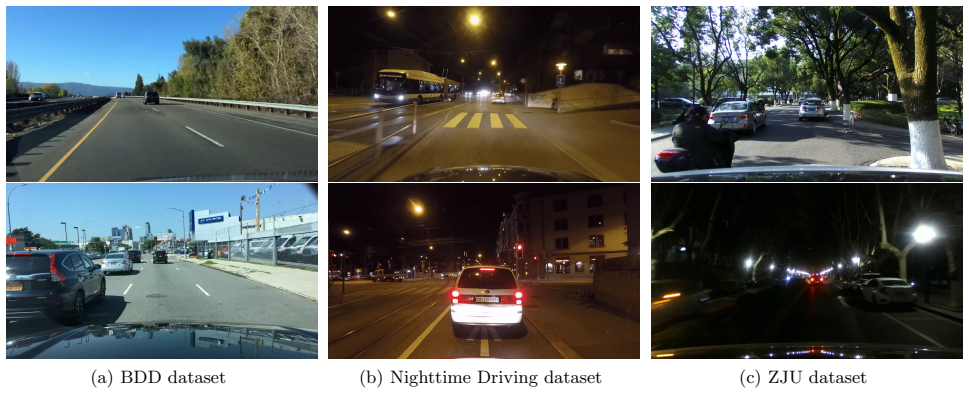
Summary. The paper addresses nighttime semantic segmentation by training a CycleGAN to translate between daytime and nighttime driving images, and proposes two methods: (1) converting nighttime test images to synthetic daytime before inference with a daytime-trained ERF-PSPNet, and (2) converting a fraction of the labeled daytime training images to synthetic nighttime images and training ERF-PSPNet on the mixture. The authors evaluate on BDD10K (32 labeled nighttime validation images), the Nighttime Driving test set (50 images), and their own collected ZJU dataset. The central empirical claim is that training with 2,000 synthetic nighttime plus 5,000 real daytime BDD images raises nighttime mean IoU from 32.72% to 43.14% on BDD night validation and from 36.73% to 45.09% on the Nighttime Driving test set, exceeding the DarkModelAdaptation baseline of 41.60% on the latter.
Significance. If the claimed result is reliable, the paper demonstrates a practical direction for nighttime semantic segmentation that avoids manual annotation of nighttime images: synthetic day-to-night transfer can act as a data-augmentation strategy. The paper contributes a publicly released ZJU day/night dataset, evaluates on an external nighttime benchmark, and provides qualitative evidence of improved sky and traffic-sign labeling. However, the central claim rests on the unverified assumption that the CycleGAN day-to-night translations preserve the semantic content of the original daytime labels, and the quantitative evaluation is based on a small test set without error bars. These issues do not invalidate the idea, but they do need to be addressed before the results can be fully trusted.
major comments (3)
- [Section 3.3, Section 3.2] The central claim that the day-to-night converted images can be used 'with their labels' is unsupported because the paper never verifies label preservation in the day-to-night direction. Section 3.2 explicitly admits that the same two-way GAN can turn far-away buildings into trees, and Section 3.3 provides no evidence that the day-to-night mapping is semantically safer. Given that the synthetic night domain alone yields below 30% mIoU (Section 4.3, Figure 7 discussion), the measured gains from the 2,000/5,000 mixture could partly stem from a generic perturbation effect rather than from learning valid nighttime appearance. The authors should add a label-consistency measurement, for example by comparing a strong segmentation model's predictions on original day images versus their synthetic night counterparts, and quantify the class-flip rate.
- [Section 4.3, Table 2] The quantitative evaluation is based on only 32 BDD nighttime validation images and 50 Nighttime Driving test images, with a single training run and no error bars or significance tests. The 2,000-image ratio was selected from the same small validation set used to report the main improvement, which risks overfitting to that particular set. The authors should report mean and standard deviation over multiple training runs and, ideally, separate a tuning set from the final evaluation set.
- [Section 4.3, Figure 7] The explanation for the non-monotonic behavior in Figure 7 is not supported by data. The claim that 5,000 is a 'symmetrical number' to 2,000 is not a mechanistic explanation, and the curve is described only qualitatively. Since the choice of the 2,000 ratio is load-bearing for the main result, the authors should provide the actual IoU values for all tested ratios, the number of runs, and some measure of variability.
minor comments (4)
- [Abstract] There are grammatical issues, for example 'there are considerable amount of segmentation datasets' should be 'a considerable number of segmentation datasets are available.'
- [Section 3.1] The sentence 'we have trained both the mapping G and F simultaneously' should be rephrased for clarity, for example 'we train the two generators G and F simultaneously.'
- [Table 1] The numbers in Table 1 (7691 day and 309 night for BDD10K) are not clearly reconciled with the text in Section 4.1, which says BDD10K contains only 32 nighttime images with pixel-wise labels; please clarify the count of labeled nighttime images used for training versus validation.
- [Figure 7] The figure caption and axis labels are missing from the manuscript text; the authors should ensure the submitted PDF includes legible axis labels and a legend.
Circularity Check
No significant circularity: the central nighttime mIoU gain is an empirical result measured on held-out night images, with no fitted parameter or self-citation chain doing the work.
full rationale
The paper's strongest claim is an empirical result: training ERF-PSPNet on BDD10K augmented with 2000 CycleGAN-generated nighttime images raises nighttime mean IoU on the held-out BDD night validation set and the Nighttime Driving test set. The evaluation uses external test images that were not used to fit any parameter whose value is then reported as a prediction. The synthetic-night ratio (2000/5000) is a hyperparameter explored by experiment, not a constant fitted inside the evaluation. The CycleGAN method is cited to external work [45], and the baseline comparison [32] is also external. Self-citations appear for the authors' prior segmentation architecture (ERF-PSPNet, refs. 1, 11) and for their own ZJU dataset and sensor (refs. 15, 19), but these are contextual and not load-bearing for the measured improvement: no uniqueness theorem, ansatz, or fitted quantity from the authors' prior work is invoked to force the result. The admitted limitations, such as the GAN potentially converting buildings to trees (Section 3.2) and the upsampling from 480x270 to 1280x720 (Section 3.3), are correctness risks about label preservation and image quality, not circularity: they do not make the reported IoU equal to an input by construction. Likewise, the observation that fully converted nighttime training sets drop below 30% mIoU is an experimental finding, not a definitional equivalance. No step in the derivation reduces, by the paper's own equations or by self-citation, to its own inputs. Therefore no circularity is identified.
Assumptions & free parameters
free parameters (1)
- synthetic nighttime image count in training mix =
2,000 synthetic night + 5,000 real day (out of 7,000)
assumptions (3)
- domain assumption CycleGAN's day-to-night translation preserves semantic labels well enough for augmented training.
- domain assumption The 32 BDD nighttime validation images and 50 Nighttime Driving test images are representative of nighttime driving conditions and their ground-truth labels are accurate.
- domain assumption The DarkModelAdaptation baseline number [32] is directly comparable to the authors' number.
Cite this review
Pith. "Pith review of See Clearer at Night: Towards Robust Nighttime Semantic Segmentation through Day-Night Image Conversion." pith.science (2026). https://pith.science/paper/FBUM23AF
@misc{pith2026190805868,
  author       = {Pith},
  title        = {Pith review of: See Clearer at Night: Towards Robust Nighttime Semantic Segmentation through Day-Night Image Conversion},
  year         = {2026},
  howpublished = {\url{https://pith.science/paper/FBUM23AF}},
  note         = {Machine review of arXiv:1908.05868}
}
read the original abstract
Currently, semantic segmentation shows remarkable efficiency and reliability in standard scenarios such as daytime scenes with favorable illumination conditions. However, in face of adverse conditions such as the nighttime, semantic segmentation loses its accuracy significantly. One of the main causes of the problem is the lack of sufficient annotated segmentation datasets of nighttime scenes. In this paper, we propose a framework to alleviate the accuracy decline when semantic segmentation is taken to adverse conditions by using Generative Adversarial Networks (GANs). To bridge the daytime and nighttime image domains, we made key observation that compared to datasets in adverse conditions, there are considerable amount of segmentation datasets in standard conditions such as BDD and our collected ZJU datasets. Our GAN-based nighttime semantic segmentation framework includes two methods. In the first method, GANs were used to translate nighttime images to the daytime, thus semantic segmentation can be performed using robust models already trained on daytime datasets. In another method, we use GANs to translate different ratio of daytime images in the dataset to the nighttime but still with their labels. In this sense, synthetic nighttime segmentation datasets can be generated to yield models prepared to operate at nighttime conditions robustly. In our experiment, the later method significantly boosts the performance at the nighttime evidenced by quantitative results using Intersection over Union (IoU) and Pixel Accuracy (Acc). We show that the performance varies with respect to the proportion of synthetic nighttime images in the dataset, where the sweet spot corresponds to most robust performance across the day and night.
Figures


Figures from the paper (4 more)


Reference graph
Works this paper leans on
-
[15]
Bridging the day and night domain gap for semantic segmentation,
Romera, E., Bergasa, L. M., Yang, K., Alvarez, J. M., and Barea, R., “Bridging the day and night domain gap for semantic segmentation,” in [ 2019 IEEE Intelligent Vehicles Symposium (IV) ], 1184–1190, IEEE (June 2019)
work page 2019
-
[33]
Sakaridis, C., Dai, D., and Van Gool, L., “Semantic nighttime image segmentation with synthetic stylized data, gradual adaptation and uncertainty-aware evaluation,” arXiv preprint arXiv:1901.05946 (2019)
work page Pith review arXiv 2019
-
[32]
Dark model adaptation: Semantic image segmentation from daytime to night- time,
Dai, D. and Van Gool, L., “Dark model adaptation: Semantic image segmentation from daytime to night- time,” in [ 2018 21st International Conference on Intelligent Transportation Systems (ITSC) ], 3819–3824, IEEE (2018)
work page 2018
-
[1]
Unifying terrain awareness through real-time semantic segmentation,
Yang, K., Bergasa, L. M., Romera, E., Cheng, R., Chen, T., and Wang, K., “Unifying terrain awareness through real-time semantic segmentation,” in [2018 IEEE Intelligent Vehicles Symposium (IV) ], 1033–1038, IEEE (June 2018)
2018
-
[2]
Unifying terrain awareness for the visually impaired through real-time semantic segmentation,
Yang, K., Wang, K., Bergasa, L. M., Romera, E., Hu, W., Sun, D., Sun, J., Cheng, R., Chen, T., and L´ opez, E., “Unifying terrain awareness for the visually impaired through real-time semantic segmentation,” Sensors 18(5), 1506 (2018)
work page 2018
-
[3]
Yang, K., Cheng, R., Bergasa, L. M., Romera, E., Wang, K., and Long, N., “Intersection perception through real-time semantic segmentation to assist navigation of visually impaired pedestrians,” in [ 2018 IEEE International Conference on Robotics and Biomimetics (ROBIO)], 1034–1039, IEEE (December 2018)
work page 2018
-
[4]
Long, N., Wang, K., Cheng, R., Yang, K., and Bai, J., “Fusion of millimeter wave radar and rgb-depth sensors for assisted navigation of the visually impaired,” in [ Millimetre Wave and Terahertz Sensors and Technology XI], 10800, 1080006, International Society for Optics and Photonics (2018)
work page 2018
-
[5]
Robust Semantic Segmentation in Adverse Weather Conditions by means of Sensor Data Fusion
Pfeuffer, A. and Dietmayer, K., “Robust semantic segmentation in adverse weather conditions by means of sensor data fusion,” arXiv preprint arXiv:1905.10117 (2019)
work page Pith review arXiv 2019
Show all 48 references
-
[6]
Expanding the detection of traversable area with realsense for the visually impaired,
Yang, K., Wang, K., Hu, W., and Bai, J., “Expanding the detection of traversable area with realsense for the visually impaired,” Sensors 16(11), 1954 (2016)
2016
-
[7]
Pyramid scene parsing network,
Zhao, H., Shi, J., Qi, X., Wang, X., and Jia, J., “Pyramid scene parsing network,” in [2017 IEEE Conference on Computer Vision and Pattern Recognition (CVPR) ], 6230–6239, IEEE (2017)
2017
-
[8]
Refinenet: Multi-path refinement networks for high-resolution semantic segmentation,
Lin, G., Milan, A., Shen, C., and Reid, I., “Refinenet: Multi-path refinement networks for high-resolution semantic segmentation,” in [2017 IEEE Conference on Computer Vision and Pattern Recognition (CVPR) ], 5168–5177, IEEE (2017)
2017
-
[9]
Deeplab: Semantic image segmentation with deep convolutional nets, atrous convolution, and fully connected crfs,
Chen, L.-C., Papandreou, G., Kokkinos, I., Murphy, K., and Yuille, A. L., “Deeplab: Semantic image segmentation with deep convolutional nets, atrous convolution, and fully connected crfs,”IEEE transactions on pattern analysis and machine intelligence 40(4), 834–848 (2017)
2017
-
[10]
Acnet: Attention based network to exploit complementary features for rgbd semantic segmentation,
Hu, X., Yang, K., Fei, L., and Wang, K., “Acnet: Attention based network to exploit complementary features for rgbd semantic segmentation,” arXiv preprint arXiv:1905.10089 (2019)
2019 arXiv
-
[11]
Can we pass beyond the field of view? panoramic annular semantic segmentation for real-world surrounding perception,
Yang, K., Hu, X., Bergasa, L. M., Romera, E., Huang, X., Sun, D., and Wang, K., “Can we pass beyond the field of view? panoramic annular semantic segmentation for real-world surrounding perception,” in [ 2019 IEEE Intelligent Vehicles Symposium (IV). IEEE ], 374–381 (June 2019)
2019
-
[12]
Robustifying semantic cognition of traversability across wearable rgb-depth cameras,
Yang, K., Bergasa, L. M., Romera, E., and Wang, K., “Robustifying semantic cognition of traversability across wearable rgb-depth cameras,” Applied optics 58(12), 3141–3155 (2019)
2019
-
[13]
The cityscapes dataset for semantic urban scene understanding,
Cordts, M., Omran, M., Ramos, S., Rehfeld, T., Enzweiler, M., Benenson, R., Franke, U., Roth, S., and Schiele, B., “The cityscapes dataset for semantic urban scene understanding,” in [ 2016 IEEE Conference on Computer Vision and Pattern Recognition (CVPR) ], 3213–3223, IEEE (2016)
2016
-
[14]
The mapillary vistas dataset for semantic understanding of street scenes,
Neuhold, G., Ollmann, T., Bul` o, S. R., and Kontschieder, P., “The mapillary vistas dataset for semantic understanding of street scenes,” in [ 2017 IEEE International Conference on Computer Vision (ICCV) ], 5000–5009, IEEE (2017)
2017
-
[16]
Segmenting objects in day and night: Edge-conditioned cnn for thermal image semantic segmentation,
Li, C., Xia, W., Yan, Y., Luo, B., and Tang, J., “Segmenting objects in day and night: Edge-conditioned cnn for thermal image semantic segmentation,” arXiv preprint arXiv:1907.10303 (2019)
2019 arXiv
-
[17]
Generative adversarial nets,
Goodfellow, I., Pouget-Abadie, J., Mirza, M., Xu, B., Warde-Farley, D., Ozair, S., Courville, A., and Bengio, Y., “Generative adversarial nets,” in [Advances in neural information processing systems], 2672–2680 (2014)
2014
-
[18]
Bdd100k: A diverse driving video database with scalable annotation tooling,
Yu, F., Xian, W., Chen, Y., Liu, F., Liao, M., Madhavan, V., and Darrell, T., “Bdd100k: A diverse driving video database with scalable annotation tooling,” arXiv preprint arXiv:1805.04687 (2018)
2018 arXiv
-
[19]
A multimodal vision sensor for autonomous driving,
Sun, D., Huang, X., and Yang, K., “A multimodal vision sensor for autonomous driving,” in [ Artificial Intelligence and Machine Learning in Defense Applications ], International Society for Optics and Photonics (2019)
2019
-
[20]
Importance-aware semantic segmentation with efficient pyramidal context network for navigational assistant systems,
Xiang, K., Wang, K., and Yang, K., “Importance-aware semantic segmentation with efficient pyramidal context network for navigational assistant systems,” arXiv preprint arXiv:1907.11066 (2019)
2019 arXiv
-
[21]
A comparative study of high-recall real-time semantic segmentation based on swift factorized network,
Xiang, K., Wang, K., and Yang, K., “A comparative study of high-recall real-time semantic segmentation based on swift factorized network,” arXiv preprint arXiv:1907.11394 (2019)
2019 arXiv
-
[22]
Fully convolutional networks for semantic segmentation,
Shelhamer, E., Long, J., and Darrell, T., “Fully convolutional networks for semantic segmentation,” IEEE Transactions on Pattern Analysis and Machine Intelligence 39(4), 640–651 (2016)
2016
-
[23]
Segnet: A deep convolutional encoder-decoder archi- tecture for image segmentation,
Badrinarayanan, V., Kendall, A., and Cipolla, R., “Segnet: A deep convolutional encoder-decoder archi- tecture for image segmentation,” IEEE transactions on pattern analysis and machine intelligence 39(12), 2481–2495 (2017)
2017
-
[24]
Semantic image segmentation with deep convolutional nets and fully connected crfs,
Chen, L.-C., Papandreou, G., Kokkinos, I., Murphy, K., and Yuille, A. L., “Semantic image segmentation with deep convolutional nets and fully connected crfs,” arXiv preprint arXiv:1412.7062 (2014)
2014 arXiv
-
[25]
Rethinking atrous convolution for semantic image segmentation,
Chen, L.-C., Papandreou, G., Schroff, F., and Adam, H., “Rethinking atrous convolution for semantic image segmentation,” arXiv preprint arXiv:1706.05587 (2017)
2017 arXiv
-
[26]
Encoder-decoder with atrous separable convolution for semantic image segmentation,
Chen, L.-C., Zhu, Y., Papandreou, G., Schroff, F., and Adam, H., “Encoder-decoder with atrous separable convolution for semantic image segmentation,” in [ Proceedings of the European conference on computer vision (ECCV) ], 801–818 (2018)
2018
-
[27]
Enet: A deep neural network architecture for real-time semantic segmentation,
Paszke, A., Chaurasia, A., Kim, S., and Culurciello, E., “Enet: A deep neural network architecture for real-time semantic segmentation,” arXiv preprint arXiv:1606.02147 (2016)
2016 arXiv
-
[28]
Erfnet: Efficient residual factorized convnet for real-time semantic segmentation,
Romera, E., Alvarez, J. M., Bergasa, L. M., and Arroyo, R., “Erfnet: Efficient residual factorized convnet for real-time semantic segmentation,” IEEE Transactions on Intelligent Transportation Systems 19(1), 263–272 (2017)
2017
-
[29]
Effective use of synthetic data for urban scene semantic segmentation,
Sadat Saleh, F., Sadegh Aliakbarian, M., Salzmann, M., Petersson, L., and Alvarez, J. M., “Effective use of synthetic data for urban scene semantic segmentation,” in [ Proceedings of the European Conference on Computer Vision (ECCV) ], 84–100 (2018)
2018
-
[30]
Semantic segmentation of panoramic images using a synthetic dataset,
Xu, Y., Wang, K., Yang, K., Sun, D., and Fu, J., “Semantic segmentation of panoramic images using a synthetic dataset,” in [ Artificial Intelligence and Machine Learning in Defense Applications ], International Society for Optics and Photonics (2019)
2019
-
[31]
Learning from synthetic data: Addressing domain shift for semantic segmentation,
Sankaranarayanan, S., Balaji, Y., Jain, A., Lim, S. N., and Chellappa, R., “Learning from synthetic data: Addressing domain shift for semantic segmentation,” in [ 2018 IEEE/CVF Conference on Computer Vision and Pattern Recognition], 3752–3761, IEEE (2018)
2018
-
[34]
Model adaptation with synthetic and real data for semantic dense foggy scene understanding,
Sakaridis, C., Dai, D., Hecker, S., and Van Gool, L., “Model adaptation with synthetic and real data for semantic dense foggy scene understanding,” in [Proceedings of the European Conference on Computer Vision (ECCV)], 687–704 (2018)
2018
-
[35]
Curriculum model adaptation with synthetic and real data for semantic foggy scene understanding,
Dai, D., Sakaridis, C., Hecker, S., and Van Gool, L., “Curriculum model adaptation with synthetic and real data for semantic foggy scene understanding,” International Journal of Computer Vision , 1–23 (2019)
2019
-
[36]
I can see clearly now: Image restoration via de-raining,
Porav, H., Bruls, T., and Newman, P., “I can see clearly now: Image restoration via de-raining,” arXiv preprint arXiv:1901.00893 (2019)
2019 arXiv
-
[37]
Depth-attentional features for single-image rain removal,
Hu, X., Fu, C.-W., Zhu, L., and Heng, P.-A., “Depth-attentional features for single-image rain removal,” in [Proceedings of the IEEE Conference on Computer Vision and Pattern Recognition ], 8022–8031 (2019)
2019
-
[38]
Don’t worry about the weather: Unsupervised condition-dependent domain adaptation,
Porav, H., Bruls, T., and Newman, P., “Don’t worry about the weather: Unsupervised condition-dependent domain adaptation,” arXiv preprint arXiv:1907.11004 (2019)
2019 arXiv
-
[39]
A cross-season correspondence dataset for robust semantic segmentation,
Larsson, M., Stenborg, E., Hammarstrand, L., Pollefeys, M., Sattler, T., and Kahl, F., “A cross-season correspondence dataset for robust semantic segmentation,” in [ Proceedings of the IEEE Conference on Computer Vision and Pattern Recognition ], 9532–9542 (2019)
2019
-
[40]
Visual localizer: Outdoor localization based on convnet descriptor and global optimization for visually impaired pedestrians,
Lin, S., Cheng, R., Wang, K., and Yang, K., “Visual localizer: Outdoor localization based on convnet descriptor and global optimization for visually impaired pedestrians,” Sensors 18(8), 2476 (2018)
2018
-
[41]
Panoramic annular localizer: Tackling the variation challenges of outdoor localization using panoramic annular images and active deep descriptors,
Cheng, R., Wang, K., Lin, S., Hu, W., Yang, K., Huang, X., Li, H., Sun, D., and Bai, J., “Panoramic annular localizer: Tackling the variation challenges of outdoor localization using panoramic annular images and active deep descriptors,” arXiv preprint arXiv:1905.05425 (2019)
2019 arXiv
-
[42]
Distilling the knowledge in a neural network,
Hinton, G., Vinyals, O., and Dean, J., “Distilling the knowledge in a neural network,” arXiv preprint arXiv:1503.02531 (2015)
2015 arXiv
-
[43]
Cross modal distillation for supervision transfer,
Gupta, S., Hoffman, J., and Malik, J., “Cross modal distillation for supervision transfer,” in [ Proceedings of the IEEE conference on computer vision and pattern recognition ], 2827–2836 (2016)
2016
-
[44]
Image-to-image translation with conditional adversarial networks,
Isola, P., Zhu, J.-Y., Zhou, T., and Efros, A. A., “Image-to-image translation with conditional adversarial networks,” in [2017 IEEE Conference on Computer Vision and Pattern Recognition (CVPR) ], 5967–5976, IEEE (2017)
2017
-
[45]
Unpaired image-to-image translation using cycle-consistent adversarial networks,
Zhu, J.-Y., Park, T., Isola, P., and Efros, A. A., “Unpaired image-to-image translation using cycle-consistent adversarial networks,” in [ 2017 IEEE International Conference on Computer Vision (ICCV) ], 2242–2251, IEEE (2017)
2017
-
[46]
Focal loss for dense object detection,
Lin, T.-Y., Goyal, P., Girshick, R., He, K., and Doll´ ar, P., “Focal loss for dense object detection,” in [ 2017 IEEE International Conference on Computer Vision (ICCV) ], 2999–3007, IEEE (2017)
2017
-
[47]
Predicting polarization beyond se- mantics for wearable robotics,
Yang, K., Bergasa, L. M., Romera, E., Huang, X., and Wang, K., “Predicting polarization beyond se- mantics for wearable robotics,” in [ 2018 IEEE-RAS 18th International Conference on Humanoid Robots (Humanoids)], 96–103, IEEE (2018)
2018
-
[48]
Imagenet large scale visual recognition challenge,
Russakovsky, O., Deng, J., Su, H., Krause, J., Satheesh, S., Ma, S., Huang, Z., Karpathy, A., Khosla, A., Bernstein, M., et al., “Imagenet large scale visual recognition challenge,” International journal of computer vision 115(3), 211–252 (2015)
2015
Reviewed August 14, 2026 · model on record in the stance chip above.
Discussion (0). Continue with ORCID to comment.