REVIEW 4 minor 14 references
Iterated ${\phi}^4$ Kinks
T0 review · 0 major / 4 minor · reviewed 2026-08-14 · deepseek-v4-flash
Pith's one-line read This paper builds explicit multi-kink and bump solutions in φ^4 theory by an iterative first-order scheme, each step adding a modulus, and proposes the resulting moduli spaces for kink-antikink dynamics.
desk verdict A clean exact iteration construction for phi4 kink/antikink/bump configurations; the math is solid, but the dynamical moduli-space proposal is still a conjecture pending metric and potential. read the letter →
The pith
A machine-rendered reading of the paper's core claim, the machinery that carries it, and where it could break.
The reading
What carries the argument
The load-bearing object is the iterated first-order ODE system $d\phi_n/dx=-(1-\phi_n^2)\phi_{n-1}$, with $\phi_0=-1$, in which the previous solution acts as an impurity for the next. Because each equation is first order, each integration constant is a modulus, so $\phi_n$ has $n$ moduli. The explicit solutions run through a deformed spatial coordinate $y_n(x)=x-\int_{-\infty}^{x}(1+\phi_{n-1}(x'))dx'$, in terms of which odd iterates are $\tanh(y_n-x_n)$ and even iterates may also be $\coth(y_n-x_n)$; the folds of $y_n$ relative to $x$ determine where kinks and antikinks appear. The fixed point of the iteration, $\phi_n=\phi_{n-1}$, reduces the system to the $\phi^6$ kink equation, and a two-cycle reduces to coupled first-order equations solved by $\phi(x)=-(1+a/\cosh^2 x)^{-1/2}$ and $\psi(x)=\mathrm{sign}(x)(1+(a+1)/\sinh^2 x)^{-1/2}$.
What would settle it
Integrate the fourth iterate using the explicit $\phi_3$ from equations (3.10) and (3.11) and scan the constants $x_3$ and $c$: if for any allowed value the $\coth$-type $\phi_4$ develops a pole or reaches $\pm1$ at finite $x$, the fourth modulus is not genuine and the $n$-moduli statement fails at $n=4$.
Extended reading notes
Core claim
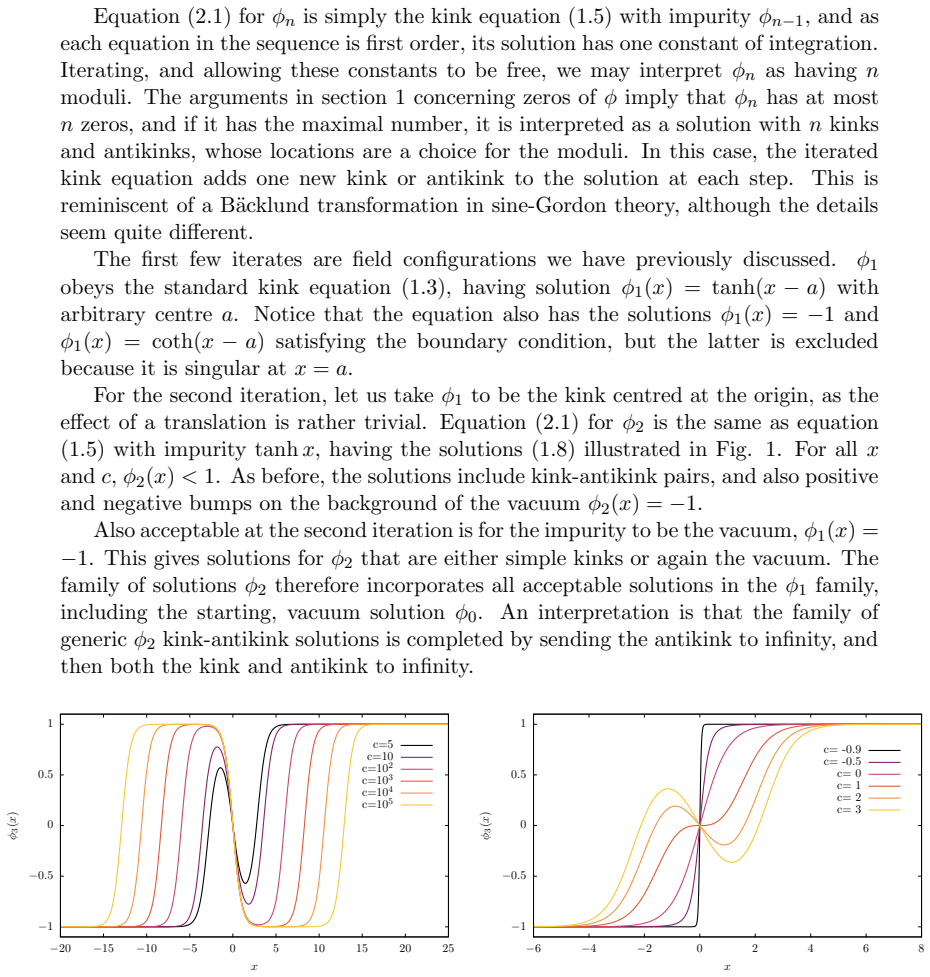
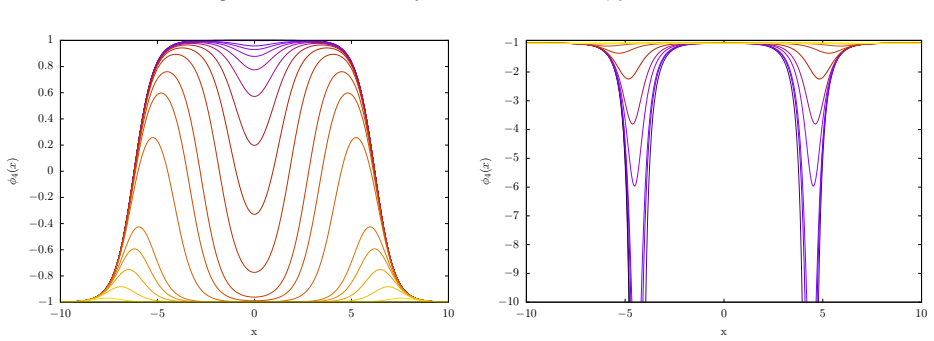
The central discovery is that the iterated first-order system $\phi_n' = -(1-\phi_n^2)\phi_{n-1}$, with $\phi_0=-1$, generates exact static solutions of $\phi^4$-type field theory with an increasing number of kinks, antikinks, and bump-like deformations, each step contributing one integration constant or modulus. The second iterate with a tanh impurity is already instructive: depending on the constant $c$, it is a kink-antikink pair or a positive/negative bump around the $-1$ vacuum. The third iterate yields either a kink deformed by a shape-mode-like distortion or a kink-antikink-kink configuration. The authors propose to use the resulting $n$-dimensional moduli spaces as collective-coordinate models for the dynamics of $n$ kinks and antikinks, in place of the gradient-flow moduli space, which ends at the vacuum and misses post-annihilation configurations. They further find that the iteration has a fixed point described by the $\phi^6$ kink equation $d\phi/dx=-(1-\phi^2)\phi$, and a two-cycle whose members are $\phi^6$-type kink configurations.
Load-bearing premise
The nth-iterate-has-n-moduli claim assumes that for every n the generic solution of $d\phi_n/dx=-(1-\phi_n^2)\phi_{n-1}$ with $\phi_n\to -1$ as $x\to-\infty$ exists for all real $x$ without singularities; this is verified explicitly only for $n=1,2,3$, while $n=4$ is only illustrated numerically.
Editorial extensions
If this is right
- For $n=2$ and $3$, explicit solutions interpolate from well-separated kink-antikink pairs through the vacuum to negative bumps, covering configurations that the gradient-flow moduli space misses.
- If the iteration is nonsingular at all orders, the $n$th iterate supplies a finite-dimensional configuration space for $n$ kinks and antikinks, with a metric computed from the $\phi^4$ Lagrangian.
- The third-iterate family includes a shape-mode-like deformation of a single kink, giving a collective-coordinate description of the shape oscillations that govern kink collisions.
- The fixed-point and two-cycle results connect the $\phi^4$ and $\phi^6$ sectors, since the iteration naturally produces $\phi^6$ kink configurations.
- For even $n$, tanh- and coth-type branches let the same moduli space represent both kink-antikink pairs and large negative bumps, as needed for annihilation events.
Reading between the lines
- A direct numerical test not performed in the paper is whether fourth and fifth iterates stay nonsingular for all allowed constants; if a coth-type solution develops a pole, the $n$-moduli claim is only a low-order observation.
- The iteration resembles a Bäcklund transformation because each step adds one zero of the field, but no integrability structure is shown; finding a closed-form all-$n$ solution would elevate the scheme to a discrete integrable hierarchy.
- A natural next step implicit in the paper is to compute the moduli-space metric and potential for the two- and three-modulus cases and compare the resulting geodesics with full field-theory simulations of kink-antikink collisions.
- The two-cycle suggests that alternating two different first-order equations can also generate useful configuration spaces; longer cycles or a continuum version could extend the construction further.
Signed reviews
Editorial analysis
A structured set of objections, weighed in public.
Referee Report
Summary. The paper defines an iterative first-order ODE scheme, Eq. (2.1), in which the impurity in a static phi^4 kink equation is taken to be the previous iterate, starting from phi_0 = -1. It derives explicit solutions for the first three iterations, including the standard kink, the kink-antikink and bump families of Eq. (1.8), and the kink-antikink-kink and deformed-kink families of Eqs. (3.10)-(3.11). It then studies the fixed point of the iteration (a phi^6 kink) and a 2-cycle with explicit solutions (4.8)-(4.9), and constructs an energy functional whose stationary points include the iterated solutions. The paper proposes that the resulting n-parameter solution families could serve as moduli spaces for modelling kink-antikink dynamics.
Significance. If the construction is correct, the paper provides an explicit, analytically tractable family of static multi-soliton configurations associated with phi^4 theory, with a clean parameter count and a geometric deformed-coordinate interpretation. The main derivations are sound: Eq. (1.8) solves Eq. (1.5) by direct differentiation, and Eqs. (3.10)-(3.11) follow from the integral in Eq. (3.8). The fixed-point and 2-cycle analysis is elegant and correctly identifies phi^6 kinks as fixed points. A particular strength is that the moduli count is not merely asserted for low orders: the tanh-branch construction of Eq. (3.7) gives a non-singular global solution at every iteration whenever the previous iterate is a bounded trapped solution, so the n-modulus statement is supported inductively, although the paper does not spell this out fully. The principal limitation is that the proposed dynamical modelling remains a conjecture: the metric and potential on the moduli space have not been computed, and the paper explicitly states this in Section 6.
minor comments (4)
- [Sec. 2, around Eq. (2.1)] The statement that the iteration can go on indefinitely with one new modulus at each step would be more convincing if it explicitly referred to the general tanh-branch solution of Eq. (3.7) as the inductive construction that guarantees a globally non-singular solution for every n, rather than leaving the reader to infer this from the low-order examples and plots.
- [Sec. 3, Eqs. (3.10)-(3.11)] At c = 0 both formulas contain the indeterminate expression 0/0; the limiting solution phi_3(x) = tanh(x - x_3) should be stated separately so that the c >= 0 and -1 < c <= 0 ranges are unambiguous.
- [Sec. 5, Eq. (5.4)] The variational claim that E is stationary when the iterated equations hold is only formal as written: the admissible class of field variations must be specified, in particular how the condition dphi_n/dx = 0 at zeros of phi_{n-1} is preserved under variations with respect to phi_{n-1}, and the boundary terms from the integration by parts should be discussed.
- [Sec. 4, Eqs. (4.8)-(4.9)] In Eq. (4.9) the factor sign(x) coincides with sign(sinh x); stating this explicitly would help the reader verify the matching with psi = phi Omega and the behaviour near x = 0.
Circularity Check
No significant circularity: iterated-kink solutions, the φ6 fixed point, and the 2-cycle are derived directly from the defining first-order equations rather than assumed.
full rationale
The derivation is self-contained. Equation (2.1) defines the iteration, and the explicit solution formula (3.7), φn(x)=tanh(x−xn−∫−∞x(1+φn−1(x′))dx′), is obtained by direct integration of that same equation, so the claim that each iterate introduces one new modulus follows from the first-order ODE structure and the displayed quadrature, not from a fitted parameter or a prior unstated assumption. The φ6 fixed point is derived by substituting φn=φn−1 into (2.1) to get dφ/dx=−(1−φ2)φ, and the 2-cycle is reduced to quadratures in equations (4.5)–(4.9); both are consequences of the defining equations. The energy functional (5.4) is explicitly constructed so that its stationary points satisfy the iterated equations; this is a consistency check, not a circular derivation of the solutions themselves. The paper cites prior work with overlapping authorship, in particular [8], for motivation and for the metric on the one-modulus impurity moduli space, but the integration method used here is rederived in Section 3, and the cited metric is not used as evidence for any of the paper's iterated-kink predictions. The dynamical moduli-space proposal is acknowledged in Section 6 to require future calculation of the metric and potential energy on these moduli spaces, which is an incompleteness or conjecture, not a circularity. No fitted input is relabeled as a prediction, and no uniqueness theorem is imported from self-citations to force a choice of ansatz. The paper's central claims either reduce to explicit first integrals of its own equations or are openly proposed as topics for future work.
Assumptions & free parameters
assumptions (3)
- domain assumption The impurity integrals (1.6) and (1.7) converge for every impurity appearing in the iteration.
- domain assumption For every n, the solution of eq. (2.1) selected by the boundary condition phi_n(x) to -1 as x to -infinity is global and non-singular.
- standard math Rolle's theorem and standard ODE existence and uniqueness apply to the continuously differentiable solutions.
Cite this review
Pith. "Pith review of Iterated ${\phi}^4$ Kinks." pith.science (2026). https://pith.science/paper/A3O7WE6E
@misc{pith2026190805893,
  author       = {Pith},
  title        = {Pith review of: Iterated $\phi^4$ Kinks},
  year         = {2026},
  howpublished = {\url{https://pith.science/paper/A3O7WE6E}},
  note         = {Machine review of arXiv:1908.05893}
}
abstract
A first order equation for a static ${\phi}^4$ kink in the presence of an impurity is extended into an iterative scheme. At the first iteration, the solution is the standard kink, but at the second iteration the kink impurity generates a kink-antikink solution or a bump solution, depending on a constant of integration. The third iterate can be a kink-antikink-kink solution or a single kink modified by a variant of the kink's shape mode. All equations are first order ODEs, so the nth iterate has n moduli, and it is proposed that the moduli space could be used to model the dynamics of n kinks and antikinks. Curiously, fixed points of the iteration are ${\phi}^6$ kinks.
Figures


Figures from the paper (2 more)

Reference graph
Works this paper leans on
-
[8]
C. Adam, K. Oles, J. Queiruga, T. Romanczukiewicz and A. Wereszczynski, Solv- able self-dual impurity models, JHEP 1907 (2019) 150
work page 2019
-
[1]
N. Manton and P. Sutcliffe, Topological Solitons, Cambridge University Press, 2004
work page 2004
-
[2]
Y. M. Shnir, Topological and Non-Topological Solitons in Scalar Field Theories , Cambridge University Press, 2018. 14
work page 2018
-
[3]
Sugiyama, Kink-antikink collisions in the two-dimensional φ4 model, Prog
T. Sugiyama, Kink-antikink collisions in the two-dimensional φ4 model, Prog. Theor. Phys. 61 (1979) 1550
work page 1979
-
[4]
Moshir, Soliton-antisoliton scattering and capture in λφ4 theory, Nucl
M. Moshir, Soliton-antisoliton scattering and capture in λφ4 theory, Nucl. Phys. B185 (1981) 318
work page 1981
-
[5]
D. K. Campbell, J. F. Schonfeld and C. A. Wingate, Resonance structure in kink- antikink interactions in φ4 theory, Physica D9 (1983) 1
work page 1983
-
[6]
H. Weigel, Collective coordinate methods and their applicability to φ4 models, in: A Dynamical Perspective on the φ4 Model (Nonlinear Systems and Complexity, vol. 26) , P. G. Kevrekidis and J. Cuevas-Maraver (eds.), Springer Nature, Cham, 2019
work page 2019
-
[7]
N. S. Manton, Unstable manifolds and soliton dynamics, Phys. Rev. Lett. 60 (1988) 1916
work page 1988
Show all 14 references
-
[9]
Adam and A
C. Adam and A. Wereszczynski, The BPS property and its breaking in 1+1 di- mensions, Phys. Rev. D98 (2018) 116001
2018
-
[10]
C. Adam, J. Queiruga and A. Wereszczynski, BPS soliton-impurity models and supersymmetry, JHEP 1907 (2019) 164
2019
-
[11]
C. Adam, T. Romanczukiewicz and A. Wereszczynski, The φ4 model with the BPS preserving defect, JHEP 1903 (2019) 131
2019
-
[12]
Rajaraman, Solitons and Instantons , Elsevier Science, Amsterdam, 1982
R. Rajaraman, Solitons and Instantons , Elsevier Science, Amsterdam, 1982
1982
-
[13]
Takyi and H
I. Takyi and H. Weigel, Collective coordinates in one-dimensional soliton models revisited, Phys. Rev. D94 (2016) 085008
2016
-
[14]
N. S. Manton and H. Merabet,φ4 kinks – gradient flow and dynamics,Nonlinearity 10 (1997) 3. 15
1997
Reviewed August 14, 2026 · model on record in the stance chip above.
Discussion (0). Continue with ORCID to comment.