REVIEW 2 major objections 4 minor 55 references
An sp-hybridized molecular carbon allotrope, cyclo[18]carbon
T0 review · 2 major / 4 minor · reviewed 2026-08-14 · deepseek-v4-flash
Pith's one-line read By removing six carbon monoxide groups from a C24O6 precursor with the tip of a scanning probe microscope, the authors produced cyclo[18]carbon on a cold salt surface and show with atomic force microscopy that it is polyynic: a ninefold…
desk verdict First structural characterization of a cyclocarbon—C18 is polyynic on NaCl; the result is real, with a minor computational caveat. read the letter →
The pith
A machine-rendered reading of the paper's core claim, the machinery that carries it, and where it could break.
The reading
What carries the argument
The load-bearing mechanism is the combination of atom manipulation and bond-order-sensitive AFM contrast. Voltage pulses delivered by the tip remove CO groups from C24O6 in pairs, and a CO-functionalized tip operated at constant height images the resulting ring; bright lobes at moderate tip height and nonagon corners at close approach are assigned to triple bonds because their high electron density shifts the tip's CO group in the probe-particle simulation. The simulation uses gas-phase density-functional geometries as input, and the assignment hinges on the contrast difference between a ninefold polyynic geometry (obtained with a hybrid functional using 80% exact exchange) and an eighteenfold cumulenic geometry (obtained with a semilocal functional), whose simulated image is featureless.
What would settle it
Measure the carbon-carbon bond lengths of an isolated C18 molecule by a technique independent of AFM contrast, such as gas-phase electron diffraction or rotational spectroscopy: alternating bonds near 1.20 Å and 1.34 Å would confirm the polyynic assignment, while eighteen equal bonds near 1.28 Å would falsify it.
Extended reading notes
Core claim
The central discovery is that cyclo[18]carbon on bilayer NaCl/Cu(111), viewed with a CO-functionalized tip, displays a ninefold-symmetric pattern: at moderate tip height nine bright lobes mark the triple bonds, and at closer tip height the molecule appears as a nonagon whose corners sit at those same positions. Simulated AFM images built from a polyynic gas-phase geometry reproduce the experimental contrast, while simulations built from a cumulenic geometry give only a featureless ring. The authors therefore assign the neutral molecule a polyynic D9h structure with alternating short and long carbon-carbon bonds, and show that the negatively charged molecule distorts into a less symmetric, less planar geometry that can be switched back to the neutral form by changing the sample bias.
Load-bearing premise
The conclusion rests on the assumption that the bright lobes and nonagon corners in the AFM images sit exactly above triple bonds, so that the images directly map bond order; this mapping is supported by simulations, but the simulations themselves assume one particular density-functional geometry.
Editorial extensions
If this is right
- If the assignment is correct, neutral cyclo[18]carbon on NaCl is the first structurally characterized cyclocarbon, and its alternating bond lengths show that electron correlation, not the 4n+2 aromaticity rule, fixes the ground-state geometry.
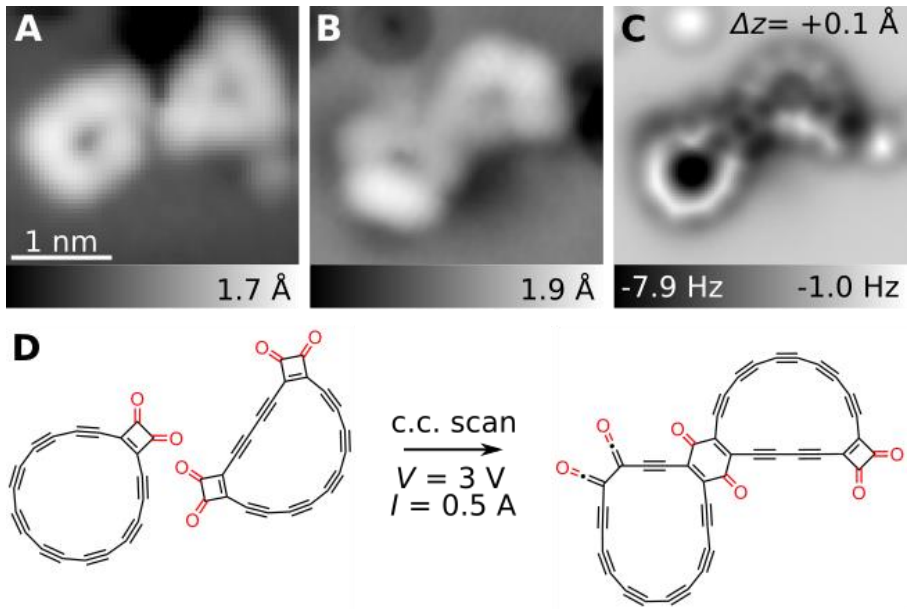
- The tip-induced decarbonylation is a practical on-surface synthesis: C18 forms from C24O6 with 13% yield across the counted manipulation events, and the same tool can fuse nearby cyclocarbon oxides into larger covalently bonded carbon-rich structures.
- The reversible charge-state switching between a ninefold neutral geometry and a distorted anionic geometry makes individual C18 molecules addressable single-molecule switches on this surface.
- The close match between the measured AFM contrast and the polyynic geometry, together with the failure of the cumulenic simulation, provides a direct experimental test that favors high-level correlated theoretical predictions over conventional density-functional results for this molecule.
Reading between the lines
- The same bright-lobe-to-triple-bond mapping should work for other strained sp-carbon scaffolds, so AFM with a CO tip could become a routine way to locate triple bonds in molecules that cannot be crystallized.
- Because the hybrid-functional geometry was computed with a hand-set 80% exact-exchange fraction, systematically varying that fraction and re-simulating the AFM images would show how much of the conclusion rests on that parameter choice.
- The experiment characterizes the molecule on a weakly interacting insulating film at 5 K; whether gas-phase cyclo[18]carbon is also polyynic, or whether the surface slightly biases the structure, is left open and could be tested by gas-phase spectroscopy or substrate-free calculations.
- The demonstrated fusion of cyclocarbon oxides suggests that atom manipulation on insulating films could build larger all-carbon rings and networks one molecule at a time, a bottom-up route that does not rely on gas-phase coalescence.
Signed reviews
Editorial analysis
A structured set of objections, weighed in public.
Referee Report
Summary. The manuscript reports the on-surface generation of cyclo[18]carbon (C18) from a C24O6 precursor on bilayer NaCl/Cu(111) by tip-induced decarbonylation, and its structural characterization using CO-functionalized atomic force microscopy (AFM). The AFM images show a ninefold symmetric pattern of bright lobes at moderate tip height and a nonagon with corners at the corresponding positions at smaller tip height. The authors interpret these images as direct evidence for a polyynic D9h structure with alternating triple and single bonds, and they support this assignment with probe-particle AFM simulations based on DFT geometries. The manuscript also demonstrates covalent fusion of cyclocarbon oxide intermediates by atom manipulation and reports charge bistability of the neutral and negatively charged molecule. The central claim is that cyclo[18]carbon on bilayer NaCl adopts a polyynic structure, resolving the long-standing polyynic versus cumulenic debate for this molecule.
Significance. If the central claim holds, this is the first structural characterization of a cyclocarbon and a landmark result in molecular carbon allotrope chemistry. The ninefold AFM pattern is a direct observation that distinguishes D9h from D18h symmetry, and the interpretation is supported by the evolution of contrast with tip height and by probe-particle simulations, including a falsifiable negative control in which the cumulenic PBE-based simulation yields a featureless ring. The paper also establishes a new on-surface synthetic route to cyclocarbons and demonstrates the reactivity of strained polyynic moieties, opening avenues for synthesizing other carbon-rich materials. The strength of the evidence is high, and the work is likely to become a reference for experimental cyclocarbon chemistry; however, the supporting simulations rely on a nonstandard DFT exact-exchange mixing parameter that requires scrutiny and justification.
major comments (2)
- [SM1, 'Density functional theory calculations'] The HSE exact-exchange mixing parameter is set to 0.8, with no justification in the manuscript. Standard HSE uses a mixing parameter of 0.25, and the choice of 0.8 is the only tested functional setting that yields a polyynic geometry for C18; PBE converges to a cumulenic structure with equal bond lengths. Because the AFM simulations that reproduce the experimental ninefold pattern are generated exclusively from the HSE(0.8) geometries, this hand-set parameter is load-bearing for the bond-order-to-contrast assignment. Please provide a rationale for α=0.8, for example by benchmarking against coupled-cluster calculations or experimental data, or show with a sensitivity study that the simulated AFM contrast is robust over a range of α values.
- [Main text, Fig. 3 and SM1, fig. S15] The AFM simulations are performed for flat gas-phase geometries, whereas the experimental molecule is tilted by about 1–2 degrees with intramolecular height differences of 0.1–0.3 Å, as stated in SM1. The authors correctly note that the simulations do not reproduce brightness asymmetries, but the possibility that a surface-distorted cumulenic structure could also give rise to a ninefold lobe pattern is not explicitly ruled out by simulation. A short statement explaining why the fourfold-symmetric NaCl surface cannot generate a ninefold pattern from an 18-fold-symmetric cumulenic molecule, or a test simulation of a slightly distorted cumulenic ring, would close this gap and strengthen the assignment.
minor comments (4)
- [Fig. 3 caption] The labels 'sim. far' and 'sim. close' in the caption are not defined; please specify the corresponding Δz values or state that they are the simulated analogues of the experimental 'AFM far' and 'AFM close' images.
- [SM1, fig. S15] The Δz values in the simulated AFM images are described as 'increase in tip-sample distance,' but the reference point (setpoint) is not given; please clarify the definition for consistency with the main text.
- [Main text, 'On-surface synthesis' statistics] The reported 13% yield for generating C18 from C24O6 is based on 90 atom-manipulation events, but no statistical uncertainty is provided; please state the number of successful C18 formations or the standard error.
- [Abstract and Introduction] The term 'molecular carbon allotrope' may be unfamiliar to some readers; a brief definition or explanatory phrase would improve accessibility, since 'allotrope' is often associated with bulk phases.
Circularity Check
Low-level circularity in the supporting AFM simulations: the simulated nine-lobed image is generated from the same HSE DFT geometry that already encodes the polyynic structure; the experimental ninefold image remains independent, so the central claim is not circular.
-
other
[Supplementary Text, 'AFM image simulations' (pp. 27–29) and fig. S15; main text p. 5]
"As input for the AFM simulation, we used the atomic coordinates from the DFT gas-phase structure optimization as well as the corresponding DFT Hartree potential. ... The simulated HSE-based AFM images for the final product cyclo[18]carbon ... show nine lobes ... which form a ring and can be associated with the nine triple bonds of the polyynic structure. ... Thus, the AFM simulations confirm our interpretation of the experimental data that cyclo[18]carbon adopts the polyynic structure on NaCl."
The simulated nine-lobed image is generated from a DFT geometry in which the nine alternating bond positions are already present (HSE with exact-exchange mixing set to 0.8). The probe-particle forward model then simply maps those pre-existing triple-bond positions into the nine lobes of the simulated AFM image. Therefore the agreement between the HSE-based simulation and the experimental ninefold pattern is a consistency check on the image model, not an independent confirmation of the polyynic assignment: the simulated output is entailed by its input. The PBE-based cumulenic simulation is a genuine negative control, and the raw experimental AFM images remain independent evidence of a ninefold pattern, so the central claim does not reduce entirely to the simulation input.
full rationale
The paper's central inference—that the constant-height AFM images of the decarbonylated product show a ninefold pattern identifying cyclo[18]carbon as polyynic on bilayer NaCl—is grounded in direct experimental images and in an AFM contrast mechanism established in earlier, independent work (refs 18, 22, 25, 27). The self-citations to Gross, Pavliček, and co-workers are not load-bearing in a circular way: they concern independently established CO-tip contrast and polyyne imaging behavior, not this molecule's structure. The only notable circularity-adjacent step is the supporting AFM simulation (fig. S15 and the SM section 'AFM image simulations'). That simulation takes the HSE DFT polyynic geometry and its Hartree potential as input and then reproduces the nine-lobed experimental contrast; in this sense the simulation's output is implied by its input and cannot independently validate the HSE-derived bond-length alternation. The PBE-based cumulenic simulation provides a meaningful negative control, and the nonstandard HSE exact-exchange mixing parameter (0.8) is presented as a modeling choice rather than as a parameter fitted to the AFM images. Since the experimental ninefold pattern and the external contrast-calibration literature carry the central conclusion, the paper is not significantly circular. Score 2 reflects a minor, non-load-bearing circularity in the supporting simulation chain, with the central claim retaining independent experimental content.
Assumptions & free parameters
free parameters (3)
- HSE exact-exchange mixing parameter =
0.8
- CO tip lateral spring constant =
0.2 N/m
- Electrostatic monopole on CO oxygen =
-0.05 e
assumptions (3)
- domain assumption The probe-particle model with a flexible CO tip accurately reproduces the AFM contrast of molecules on NaCl.
- domain assumption Gas-phase DFT geometries are adequate inputs for simulating AFM images of adsorbed molecules.
- domain assumption The bright features in AFM at moderate tip height correspond to triple bonds based on bond-order contrast from earlier work.
Cite this review
Pith. "Pith review of An sp-hybridized molecular carbon allotrope, cyclo[18]carbon." pith.science (2026). https://pith.science/paper/B4KUTYHG
@misc{pith2026190805904,
  author       = {Pith},
  title        = {Pith review of: An sp-hybridized molecular carbon allotrope, cyclo[18]carbon},
  year         = {2026},
  howpublished = {\url{https://pith.science/paper/B4KUTYHG}},
  note         = {Machine review of arXiv:1908.05904}
}
read the original abstract
Carbon allotropes built from rings of two-coordinate atoms, known as cyclo[n]carbons, have fascinated chemists for many years, but until now they could not be isolated or structurally characterized, due to their high reactivity. We generated cyclo[18]carbon (C18) using atom manipulation on bilayer NaCl on Cu(111) at 5 Kelvin by eliminating carbon monoxide from a cyclocarbon oxide molecule C24O6. Characterization of cyclo[18]carbon by high-resolution atomic force microscopy revealed a polyynic structure with defined positions of alternating triple and single bonds. The high reactivity of cyclocarbon and cyclocarbon oxides allows covalent coupling between molecules to be induced by atom manipulation, opening an avenue for the synthesis of other carbon allotropes and carbon-rich materials from the coalescence of cyclocarbon molecules.
Figures

Reference graph
Works this paper leans on
- [18]
-
[1]
H. W. Kroto, J. R. Heath, S. C. O’Brien, R. F. Curl, R. E. Smalley, C60: Buckminsterfullerene, Nature 318, 162–163 (1985)
work page 1985
- [2]
-
[3]
K. S. Novoselov, A. K. Geim, S. V. Morozov, D. Jiang, Y. Zhang, S. V. Dubonos, I. V. Grigorieva, A. A. Firsov, Electric field effect in atomically thin carbon films, Science 306, 666–669 (2004)
work page 2004
-
[4]
F. Diederich, Y. Rubin, C. B. Knobler, R. L. Whetten, K. E. Schriver, K. N. Houk, Y. Li, All-carbon molecules: Evidence for the generation of cyclo[18]carbon from a stable organic precursor, Science 245, 1088–1090 (1989)
work page 1989
-
[5]
F. Diederich, M. Kivala, All-carbon scaffolds by rational design, Adv. Mater. 22, 803–812 (2010)
work page 2010
-
[6]
R. Hoffmann, Extended Hückel theory—v: Cumulenes, polyenes, polyacetylenes and Cn, Tetrahedron 22, 521–538 (1966)
work page 1966
-
[7]
S. W. McElvany, M. M. Ross, N. S. Goroff, F. Diederich, Cyclocarbon coalescence: Mechanisms for tailor-made fullerene formation, Science 259, 1594–1596 (1993)
work page 1993
Show all 55 references
-
[8]
von Helden, N
G. von Helden, N. G. Gotts, M. T. Bowers, Experimental evidence for the formation of fullerenes by collisional heating of carbon rings in the gas phase, Nature 363, 60–63 (1993)
1993
-
[9]
Parasuk, J
V. Parasuk, J. Almlof, M. W. Feyereisen, The [18] all-carbon molecule: Cumulene or polyacetylene?, J. Am. Chem. Soc. 113, 1049–1050 (1991)
1991
-
[10]
Neiss, E
C. Neiss, E. Trushin, A. Görling, The nature of one-dimensional carbon: Polyynic versus cumulenic, ChemPhysChem 15, 2497–2502 (2014)
2014
-
[11]
Torelli, L
T. Torelli, L. Mitas, Electron correlation in C4N+ 2 carbon rings: Aromatic versus dimerized structures, Phys. Rev. Lett. 85, 1702–1705 (2000)
2000
-
[12]
Arulmozhiraja, T
S. Arulmozhiraja, T. Ohno, CCSD calculations on C14, C18, and C22 carbon clusters, J. Chem. Phys. 128, 114301 (2008)
2008
-
[13]
P. W. Fowler, N. Mizoguchi, D. E. Bean, R. W. A. Havenith, Double aromaticity and ring currents in all-carbon rings, Chem. Eur. J. 15, 6964–6972 (2009)
2009
-
[14]
Rubin, C
Y. Rubin, C. B. Knobler, F. Diederich, Synthesis and crystal structure of a stable hexacobalt complex of cyclo[18]carbon, J. Am. Chem. Soc. 112, 4966–4968 (1990)
1990
-
[15]
Rubin, M
Y. Rubin, M. Kahr, C. B. Knobler, F. Diederich, C. L. Wilkins, The higher oxides of carbon C8nO2n (n = 3–5): synthesis, characterization, and X-ray crystal structure. Formation of cyclo[n]carbon ions Cn+ (n = 18, 24), Cn– (n = 18, 24, 30), and higher carbon ions including C60+...
1991
-
[16]
Y. Tobe, H. Matsumoto, K. Naemura, Y. Achiba, T. Wakabayashi, Generation of cyclocarbons with 4n carbon atoms (C12, C16, and C20) by [2 + 2] cycloreversion of propellane-annelated dehydroannulenes, Angew. Chem. Int. Ed. 35, 1800–1802 (1996)
1996
-
[17]
A. E. Boguslavskiy, H. Ding, J. P. Maier, Gas-phase electronic spectra of C18 and C22 rings, J. Chem. Phys. 123, 034305 (2005)
2005
-
[19]
Pavliček, L
N. Pavliček, L. Gross, Generation, manipulation and characterization of molecules by atomic force microscopy, Nat. Rev. Chem. 1, 0005 (2017)
2017
-
[20]
S.-W. Hla, L. Bartels, G. Meyer, K.-H. Rieder, Inducing all steps of a chemical reaction with the scanning tunneling microscope tip: Towards single molecule engineering, Phys. Rev. Lett. 85, 2777– 2780 (2000)
2000
-
[21]
J. Repp, G. Meyer, S. Paavilainen, F. E. Olsson, M. Persson, Imaging Bond Formation Between a Gold Atom and Pentacene on an Insulating Surface, Science 312, 1196–1199 (2006)
2006
-
[22]
Pavliček, P
N. Pavliček, P. Gawel, D. R. Kohn, Z. Majzik, Y. Xiong, G. Meyer, H. L. Anderson, L. Gross, Polyyne formation via skeletal rearrangement induced by atomic manipulation, Nat. Chem. 10, 853– 858 (2018)
2018
-
[23]
F. J. Giessibl, High-speed force sensor for force microscopy and profilometry utilizing a quartz tuning fork, Appl. Phys. Lett. 73, 3956–3958 (1998)
1998
-
[24]
T. R. Albrecht, P. Grütter, D. Horne, D. Rugar, Frequency modulation detection using high-Q cantilevers for enhanced force microscope sensitivity, J. Appl. Phys. 69, 668–673 (1991)
1991
-
[25]
Hapala, G
P. Hapala, G. Kichin, C. Wagner, F. S. Tautz, R. Temirov, P. Jelínek, Mechanism of high-resolution STM/AFM imaging with functionalized tips, Phys. Rev. B 90, 085421 (2014)
2014
-
[26]
Schuler, W
B. Schuler, W. Liu, A. Tkatchenko, N. Moll, G. Meyer, A. Mistry, D. Fox, L. Gross, Adsorption geometry determination of single molecules by atomic force microscopy, Phys. Rev. Lett. 111, 106103 (2013)
2013
-
[27]
Gross, F
L. Gross, F. Mohn, N. Moll, B. Schuler, A. Criado, E. Guitián, D. Peña, A. Gourdon, G. Meyer, Bond-order discrimination by atomic force microscopy, Science 337, 1326–1329 (2012)
2012
-
[28]
D. G. de Oteyza, P. Gorman, Y.-C. Chen, S. Wickenburg, A. Riss, D. J. Mowbray, G. Etkin, Z. Pedramrazi, H.-Z. Tsai, A. Rubio, M. F. Crommie, F. R. Fischer, Direct imaging of covalent bond structure in single-molecule chemical reactions, Science 340, 1434–1437 (2013)
2013
-
[29]
A. Riss, S. Wickenburg, P. Gorman, L. Z. Tan, H.-Z. Tsai, D. G. de Oteyza, Y.-C. Chen, A. J. Bradley, M. M. Ugeda, G. Etkin, S. G. Louie, F. R. Fischer, M. F. Crommie, Local electronic and chemical structure of oligo-acetylene derivatives formed through radical cyclizations at...
2014
-
[30]
Pavliček, B
N. Pavliček, B. Fleury, M. Neu, J. Niedenführ, C. Herranz-Lancho, M. Ruben, J. Repp, Atomic force microscopy reveals bistable configurations of dibenzo[a,h]thianthrene and their interconversion pathway, Phys. Rev. Lett. 108, 086101 (2012)
2012
-
[31]
S. K. Hämäläinen, N. van der Heijden, J. van der Lit, S. den Hartog, P. Liljeroth, I. Swart, Intermolecular contrast in atomic force microscopy images without intermolecular bonds, Phys. Rev. Lett. 113, 186102 (2014)
2014
-
[44]
Schendel, B
V. Schendel, B. Borca, I. Pentegov, T. Michnowicz, U. Kraft, H. Klauk, P. Wahl, U. Schlickum, K. Kern, Remotely controlled isomer selective molecular switching, Nano Lett. 16, 93–97 (2016). 9
2016
-
[46]
Pavliček, Z
N. Pavliček, Z. Majzik, S. Collazos, G. Meyer, D. Pérez, E. Guitian, D. Peña, L. Gross, Generation and characterization of a meta-aryne on Cu and NaCl surfaces, ACS Nano 11, 10768–10773 (2017)
2017
-
[51]
van der Lit, F
J. van der Lit, F. Di Cicco, P. Hapala, P. Jelinek, I. Swart, Submolecular resolution imaging of molecules by atomic force microscopy: The influence of the electrostatic force, Phys. Rev. Lett. 116, 096102 (2016). Acknowledgments: We thank Nikolaj Moll and Rolf Allenspach for ...
2016
-
[52]
sim. far
for support. P.G. acknowledges the receipt of a Postdoc.Mobility fellowship from the Swiss National Science Foundation (P300P2-177829). Author contributions: L.M.S., P.G. and H.L.A. synthesized the precursors; K.K., F.S., L.M.S. and L.G. performed the AFM experiments; F.S., P....
-
[53]
Swart, T
I. Swart, T. Sonnleitner, J. Repp, Charge state control of molecules reveals modification of the tunneling barrier with intramolecular contrast, Nano Lett. 11, 1580–1584 (2011)
2011
-
[54]
Bennewitz, V
R. Bennewitz, V. Barwich, M. Bammerlin, C. Loppacher, M. Guggisberg, A. Baratoff, E. Meyer, H.-J. Güntherodt, Ultrathin films of NaCl on Cu(111): A LEED and dynamic force microscopy study, Surf. Sci. 438, 289–296 (1999)
1999
-
[55]
Bartels, G
L. Bartels, G. Meyer, K.-H. Rieder, Controlled vertical manipulation of single CO molecules with the scanning tunneling microscope: A route to chemical contrast, Appl. Phys. Lett. 71, 213–215 (1997)
1997
-
[56]
Schuler, G
B. Schuler, G. Meyer, D. Peña, O. C. Mullins, L. Gross, Unraveling the molecular structures of asphaltenes by atomic force microscopy, J. Am. Chem. Soc. 137, 9870–9876 (2015)
2015
-
[57]
Rubin, T
Y. Rubin, T. C. Parker, S. J. Pastor, S. Jalisatgi, C. Boulle, C. L. Wilkins, Acetylenic cyclophanes as fullerene precursors: formation of C60H6 and C60 by laser desorption mass spectrometry of C60H6(CO)12, Angew. Chem. Int. Ed. 37, 1226–1229 (1998)
1998
-
[58]
Keller, H
R. Keller, H. Wycoff, L. E. Marchi, Copper(I) Chloride, Inorg. Synth. 2, 1–4 (1946)
1946
-
[59]
A. J. Weymouth, T. Hofmann, F. J. Giessibl, Quantifying molecular stiffness and interaction with lateral force microscopy, Science 343, 1120–1122 (2014)
2014
-
[60]
Ellner, N
M. Ellner, N. Pavliček, P. Pou, B. Schuler, N. Moll, G. Meyer, L. Gross, R. Peréz, The electric field of CO tips and its relevance for atomic force microscopy, Nano Lett. 16, 1974–1980 (2016)
2016
-
[61]
Leoni, O
T. Leoni, O. Guillermet, H. Walch, V. Langlais, A. Scheuermann, J. Bonvoisin, S. Gauthier, Controlling the charge state of a single redox molecular switch, Phys. Rev. Lett. 106, 216103 (2011)
2011
-
[62]
J. Repp, G. Meyer, F. E. Olsson, M. Persson, Controlling the charge state of individual gold adatoms, Science 305, 493–495 (2004)
2004
-
[63]
J. Repp, G. Meyer, S. Paavilainen, F. E. Olsson, M. Persson, Scanning Tunneling Spectroscopy of Cl Vacancies in NaCl Films: Strong Electron-Phonon Coupling in Double-Barrier Tunneling Junctions, Phys. Rev. Lett. 95, 225503 (2005)
2005
-
[64]
J. Repp, G. Meyer, K.-H. Rieder, Snell’s law for surface electrons: Refraction of an electron gas imaged in real space, Phys. Rev. Lett. 92, 036803 (2004)
2004
-
[65]
Schendel, B
V. Schendel, B. Borca, I. Pentegov, T. Michnowicz, U. Kraft, H. Klauk, P. Wahl, U. Schlickum, K. Kern, Remotely controlled isomer selective molecular switching, Nano Lett. 16, 93–97 (2016)
2016
-
[66]
J. N. Ladenthin, L. Grill, S. Gawinkowski, S. Liu, J. Waluk, T. Kumagai, Hot carrier-induced tautomerization within a single porphycene molecule on Cu (111), ACS Nano 9, 7287–7295 (2015)
2015
-
[67]
Pavliček, Z
N. Pavliček, Z. Majzik, S. Collazos, G. Meyer, D. Pérez, E. Guitian, D. Peña, L. Gross, Generation and characterization of a meta-aryne on Cu and NaCl surfaces, ACS Nano 11, 10768–10773 (2017). 52
2017
-
[68]
V. Blum, R. Gehrke, F. Hanke, P. Havu, V. Havu, X. Ren, K. Reuter, M. Scheffler, Ab initio molecular simulations with numeric atom-centered orbitals, Comput. Phys. Commun. 180, 2175– 2196 (2009)
2009
-
[69]
J. P. Perdew, K. Burke, M. Ernzerhof, Generalized gradient approximation made simple, Phys. Rev. Lett. 77, 3865–3868 (1996)
1996
-
[70]
J. Heyd, G. E. Scuseria, M. Ernzerhof, Hybrid functionals based on a screened coulomb potential, J. Chem. Phys. 118, 8207–8215 (2003)
2003
-
[71]
Tkatchenko, M
A. Tkatchenko, M. Scheffler, Accurate molecular van der Waals interactions from groundstate electron density and free-atom reference data, Phys. Rev. Lett. 102, 073005 (2009)
2009
-
[72]
van der Lit, F
J. van der Lit, F. Di Cicco, P. Hapala, P. Jelinek, I. Swart, Submolecular resolution imaging of molecules by atomic force microscopy: The influence of the electrostatic force, Phys. Rev. Lett. 116, 096102 (2016)
2016
Reviewed August 14, 2026 · model on record in the stance chip above.
Discussion (0). Continue with ORCID to comment.