REVIEW 3 major objections 5 minor 28 references
Design and experimental demonstration of a laser modulation system for future gravitational-wave detectors
T0 review · 3 major / 5 minor · reviewed 2026-08-14 · deepseek-v4-flash
Pith's one-line read A two-interferometer laser modulator can cancel detuned signal-recycling noise.
desk verdict A genuinely new two-MZI modulator for DRSE with an honest but load-bearing gap: the displacement-noise requirement was computed for a PM-only configuration, and the REFL/AS intercorrelation at the AM-cancellation operating point is unstudied. read the letter →
The pith
A machine-rendered reading of the paper's core claim, the machinery that carries it, and where it could break.
The reading
What carries the argument
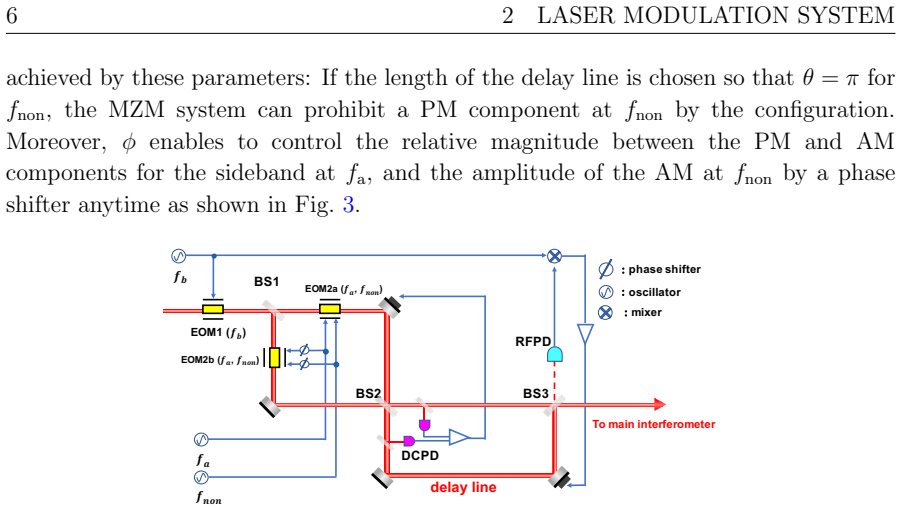
The load-bearing object is the Mach-Zehnder Modulator: a first symmetrically operated Mach-Zehnder interferometer with an electro-optic modulator in each arm, followed by a second asymmetric Mach-Zehnder interferometer whose arm-length difference acts as a delay line. The first interferometer is locked at mid-fringe so the two modulators combine to produce both phase-modulated and amplitude-modulated sidebands; the relative phase $\varphi$ between the two modulators controls the AM/PM ratio. The second interferometer is locked at dark fringe so the light lost from the first interferometer is recycled, and its asymmetry $\theta$ is what makes a pure AM sideband possible; choosing the delay-line length so $\theta=\pi$ at the non-resonant frequency kills the unwanted PM component there. The paper's noise analysis is carried by explicit formulas for the upper and lower sideband amplitudes as functions of mirror displacement $\delta\ell$, which show that displacement noise creates upper/lower sidebands of equal magnitude and opposite sign—a property used to compute the coupling into the readout.
What would settle it
Measure the transfer function from MZM mirror displacement to the gravitational-wave readout port (the antisymmetric port) while the MZM's amplitude-modulation cancellation is active at the reflection port; if the measured coupling exceeds the independent-port projection at any frequency in the observation band, the derived displacement-noise requirement is too optimistic.
Extended reading notes
Core claim
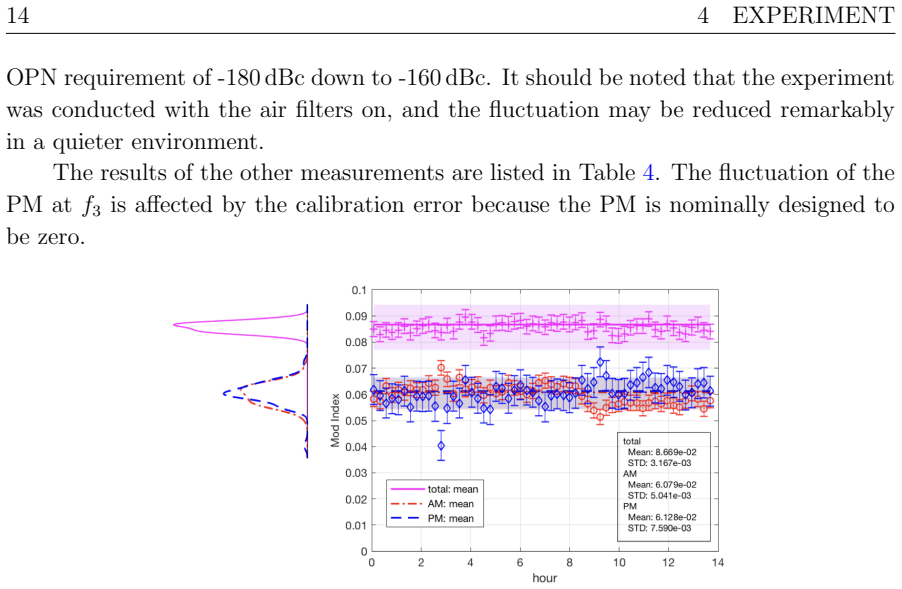
The central claim is that a two-MZI Mach-Zehnder Modulator produces the modulation field required for detuned signal recycling: a power-efficient amplitude-modulated component at frequency $f_a$ that cancels the unwanted AM generated by the detuned signal-recycling cavity, plus a non-resonant AM sideband at $f_\mathrm{non}$ that provides stable lock-acquisition error signals, with both amplitudes and phases controllable in operation. The paper derives the transfer from MZI mirror displacement to the gravitational-wave readout, uses it to set a displacement-noise requirement, and shows by simulation that the requirement lies above the shot-noise-limited detection floor for a kilometer-scale detector. The proof-of-principle experiment confirms that sweeping the phase difference between the two EOMs tunes the AM/PM ratio as predicted, and that the delay-line asymmetry suppresses the unwanted PM at $f_\mathrm{non}$. The measured displacement noise is above the requirement in the tens-to-hundreds of Hz band, and the dominant sources are identified as mechanical resonances and air/table vibrations.
Load-bearing premise
The feasibility conclusion assumes that tuning the MZM to cancel noise at the reflection port does not increase the displacement-noise coupling at the gravitational-wave readout port; the paper notes this correlation was not studied.
Editorial extensions
If this is right
- If the MZM performs as claimed, detuned signal-recycling operation becomes practical without requiring oscillator phase stability of $-180\,\mathrm{dBc}$, because the unwanted AM is cancelled at the reflection port.
- The non-resonant AM sideband gives lock-acquisition error signals that are decoupled from the arm cavities in principle, simplifying the control scheme.
- Because the second MZI reuses the light rejected by the first, the scheme avoids the carrier-power loss of conventional amplitude modulation, preserving shot-noise performance.
- The measured noise budget implies that vacuum enclosures, rigid mounts, and a shorter delay line should bring the displacement noise below the requirement, provided those upgrades suppress the identified mechanical and air-fluctuation peaks.
- The amplitude and phase tunability demonstrated in the experiment means the cancellation can be adjusted during detector operation, compensating slow drifts of the modulation indices.
Reading between the lines
- If the REFL/AS intercorrelation left unstudied in the paper turns out favorable, the same MZM hardware could also relax the oscillator-noise requirements of other dual-recycled detectors, not just the kilometer-scale design simulated here.
- The delay-line length scales inversely with the non-resonant frequency $f_\mathrm{non}$, so raising that frequency would shrink the second MZI and reduce its vibration sensitivity—a design lever the paper mentions as a future option but does not quantify.
- A tabletop test with a small detuned cavity could measure the AS-port coupling while the REFL-port cancellation is active, giving an early check of the independence assumption before a full-scale implementation.
- The common-mode rejection seen for the first MZI suggests that rigidly mounting both MZIs on a common optical base could make displacement noise largely self-cancelling, which would extend the approach to higher frequencies.
Signed reviews
Editorial analysis
A structured set of objections, weighed in public.
Referee Report
Summary. The paper proposes a two-Mach-Zehnder-interferometer laser modulation system (MZM) for future gravitational-wave detectors operating in the detuned signal-recycling (DRSE) configuration. The authors derive an analytic expression for the output modulation field, including the tunable AM/PM components needed to cancel the excess AM noise caused by the detuned signal-recycling cavity, and derive a displacement-noise requirement for the MZM optics using the Optickle simulation with KAGRA design parameters. They report a proof-of-principle experiment that demonstrates tunability of the AM and PM modulation indices as a function of the phase difference between the two EOMs, a 14-hour long-term stability measurement, and a calibrated displacement-noise measurement that currently exceeds the derived requirement. The paper concludes that the derived requirement shows feasibility of the MZM concept for KAGRA, while acknowledging that the measured displacement noise needs to be reduced through future upgrades.
Significance. If the MZM concept is validated, it would address a key technical obstacle to DRSE operation in kilometer-scale detectors, namely the excess amplitude-modulation noise induced by the detuned signal-recycling cavity. The analytic model in Eqs. (4) and (5) is transparent and the experimental demonstration in Fig. 8 shows that the measured modulation indices follow the model within the stated Monte-Carlo uncertainties. The displacement-noise requirement derivation and the noise budget in Fig. 11 are useful engineering contributions. The paper is honest about its limitations, but the central feasibility claim is not yet fully demonstrated because the simulation used a pure-PM operating point, the measured displacement noise does not currently meet the requirement, and the long-term AM stability is marginal for the stated physics goal.
major comments (3)
- [Section 3.2, Table 6, Section 5] The displacement-noise requirement in Eq. (9) and Fig. 6 is computed using a MZM configuration with only PM components at f1 (modulation index 0.1683i) and zero modulation at f3 (Table 6), whereas the intended DRSE operating point requires an AM component at f1 tuned to satisfy the cancellation condition of Eq. (3). The authors explicitly state in Section 5 that the intercorrelation between the REFL and AS ports was not studied and that the requirement could be tougher if the REFL-optimized parameters are the worst case for the AS port. Since the AS-port coupling of the displacement noise depends on the relative AM/PM content through Eqs. (7) and (8), the feasibility conclusion drawn in Section 6 is not yet established. A quantitative simulation at the actual DRSE operating point, or an analytic bound on the change in the transfer function TMZM, is needed to support the feasibility claim.
- [Section 4.3.3, Fig. 10, Section 6] The measured displacement noise of both MZIs exceeds the derived requirement over a wide frequency band. The feasibility statement in Section 6 ('The derived requirement showed the feasibility of this system in KAGRA') therefore rests on future upgrades (vacuum enclosures, rigid mounts, shorter delay line) whose noise-reduction performance has not been demonstrated. The paper should either present a quantitative projection of the achievable displacement noise after these upgrades or soften the feasibility claim to indicate that the current prototype does not yet meet the requirement. As written, the conclusion may be misread as experimental validation of the requirement.
- [Section 4.3.2, Fig. 9] The long-term stability measurement shows that the AM modulation index at f1 fluctuates by about 10% during 14 hours, which the authors correctly note degrades the oscillator-phase-noise requirement from -180 dBc to -160 dBc. Because the AM cancellation is the central function of the MZM system for DRSE, this stability level is a load-bearing limitation that needs to be addressed. The paper should quantify the impact of this fluctuation on the achievable DRSE sensitivity or explicitly state what additional stabilization (e.g., quieter environment, active control) would be required.
minor comments (5)
- [Fig. 7 caption] The word 'Megenta' in the figure caption should be 'Magenta'.
- [Section 5, first paragraph] The phrase 'It is good to have more profound understandings' should be rephrased to 'A more profound understanding is needed' for clarity.
- [Eqs. (11) and (12)] The formatting around Eqs. (11) and (12) is confusing: Eq. (12) appears to be an incomplete equation or a stray line. The authors should clarify the presentation.
- [Section 3.2, text after Fig. 6] The sentence 'The detection limit set by shot noise is smaller than the displacement noise requirement.' is unclear; it should be rephrased to specify which curve corresponds to the shot-noise-limited sensitivity and how it relates to the requirement.
- [Section 4.3.1, Fig. 8] The Monte-Carlo uncertainty calculation is only described by a list of assumed parameter fluctuations. A brief description of how these fluctuations were propagated to the shaded areas in Fig. 8 would help reproducibility.
Circularity Check
No circularity found: the MZM output field, cancellation condition, and displacement-noise requirement are derived from stated interferometric geometry and independent KAGRA parameters; the measured phase-variability curves use independently measured EOM indices, not fitted values.
full rationale
The derivation chain is self-contained. Equation (4) and Equation (5) are obtained from the optical interference of two series Mach-Zehnder interferometers with stated lock points, phases, and an asymmetry parameter; they are not defined in terms of the quantities they are used to predict. Equation (3) is the algebraic cancellation condition following from the complex reflectivity of the detuned signal-recycling cavity, and is therefore a design constraint rather than a restatement of a result. The displacement-noise requirement in Equation (9) is an explicit definition: allowed displacement equals a 10% safety factor divided by the DARM and MZM transfer functions times the strain sensitivity, evaluated with the fixed KAGRA design parameters in Tables 5 and 6. It is not fitted to the measured displacement noise, and the measured noise in Fig. 10 is compared with it as an external benchmark. The theoretical curves in Fig. 8 are computed from Equation (5) using independently measured EOM modulation indices and delay-line length; the shaded uncertainty bands are propagated from assumed parameter uncertainties, not from a regression to the data. The paper itself flags in Section 5 that the Section 3.2 simulation used only PM components at f1 and f2 and that the intercorrelation between the REFL-port cancellation condition and the AS-port displacement-noise coupling was not modeled; if the REFL-optimized parameters were the worst case for the AS port, the requirement could tighten. This is an acknowledged modeling gap and a correctness risk for the feasibility claim, not circularity: it does not make the derived output equivalent to an assumed input, and no fitted parameter is relabeled as a prediction. No load-bearing self-citation chain or imported uniqueness theorem is used; the cited OPN requirement from [21] supplies an external motivation, not the content of the MZM derivation. Therefore no circular step meeting the required evidence threshold is present.
Assumptions & free parameters
free parameters (2)
- Safety factor for displacement requirement =
0.1 (Eq. 9; Table 6 lists 'Safety factor 10')
- MZI control servo shaping for displacement-noise requirement =
low-pass filter, 1 Hz pole (Table 6), described as 10 kHz unity-gain frequency in Fig. 6 caption
assumptions (6)
- domain assumption KAGRA main-interferometer design parameters in Tables 5 and 6 are correct for the target detector.
- domain assumption Optickle correctly simulates the sideband fields and the coupling from MZM mirror displacement to AS-port DCPD power.
- domain assumption MZM displacement noise couples independently to the AS port; intercorrelation with REFL-port AM cancellation is neglected.
- standard math First-order sideband approximation in Eq. (1) is sufficient.
- domain assumption The Monte-Carlo uncertainty ranges used for Fig. 8 represent the actual experimental uncertainties.
- ad hoc to paper Future upgrades such as vacuum enclosures, rigid mounts, and a shorter second MZI can reduce displacement noise enough to meet the requirement without introducing new noise couplings.
Cite this review
Pith. "Pith review of Design and experimental demonstration of a laser modulation system for future gravitational-wave detectors." pith.science (2026). https://pith.science/paper/QOHH7SQT
@misc{pith2026190805914,
  author       = {Pith},
  title        = {Pith review of: Design and experimental demonstration of a laser modulation system for future gravitational-wave detectors},
  year         = {2026},
  howpublished = {\url{https://pith.science/paper/QOHH7SQT}},
  note         = {Machine review of arXiv:1908.05914}
}
read the original abstract
Detuning the signal-recycling cavity length from a cavity resonance significantly improves the quantum noise beyond the standard quantum limit, while there is no km-scale gravitational-wave detector successfully implemented the technique. The detuning technique is known to introduce great excess noise, and such noise can be reduced by a laser modulation system with two Mach-Zehnder interferometers in series. This modulation system, termed Mach-Zehnder Modulator (MZM), also makes the control of the gravitational-wave detector more robust by introducing the third modulation field which is non-resonant in any part of the main interferometer. On the other hand, mirror displacements of the Mach-Zehnder interferometers arise a new kind of noise source coupled to the gravitational-wave signal port. In this paper, the displacement noise requirement of the MZM is derived, and also results of our proof-of-principle experiment is reported.
Figures


Figures from the paper (9 more)




Reference graph
Works this paper leans on
-
[1]
B. P. Abbott et al , Observation of Gravitational Waves from a Binary Black Hole Merger, Phys. Rev. Lett. 116, 061102 (2016)
work page 2016
-
[2]
B. P. Abbott et al , GW151226: Observation of Gravitational Waves from a 22-Solar-Mass Binary Black Hole Coalescence, Phys. Rev. Lett. 116, 241103 (2016)
work page 2016
-
[3]
B. P. Abbott et al , GW150914: First results from the search for binary black hole coalescence with Advanced LIGO, Phys. Ref. D 93, 122003 (2016)
work page 2016
-
[4]
B. P. Abbott et al , Binary Black Hole Mergers in the first Advanced LIGO Observing Run, Phys. Rev. X 6, 041015 (2016)
work page 2016
-
[5]
B. P. Abbott et al , GW170104: Observation of a 50-Solar-Mass Binary Black Hole Coalescence at Redshift 0.2, Phys. Rev. Lett. 118, 221101 (2017)
work page 2017
-
[6]
B. P. Abbott et al , GW170814: A three-detector observation of gravitational waves from a binary black hole coalescence, Phys. Rev. Lett. 119, 141101 (2017)
work page 2017
-
[7]
B. P. Abbott et al , GW170608: Observation of a 19-solar-mass Binary Black Hole Coalescence, Astrophys. J. 851, L35 (2017)
work page 2017
-
[8]
B. P. Abbott et al , GW170817: Observation of gravitational waves from a binary neutron star inspiral, Phys. Rev. Lett. 119, 161101 (2017)
work page 2017
Show all 28 references
-
[9]
Aasi et al , Advanced LIGO, Class
J. Aasi et al , Advanced LIGO, Class. Quant. Grav. 32, 074001 (2015)
2015
-
[10]
Acernese et al , Advanced Virgo: a second-generation interferometric gravitational wave detector, Class
F. Acernese et al , Advanced Virgo: a second-generation interferometric gravitational wave detector, Class. Quant. Grav. 32, 024001 (2015)
2015
-
[11]
Aso et al , Interferometer design of the KAGRA gravitational wave detector, Phys
Y. Aso et al , Interferometer design of the KAGRA gravitational wave detector, Phys. Rev. D 88, 043007 (2013)
2013
-
[12]
R. W. P. Drever, in Gravitaional Radiation, edited by N. Deruelle and T. Piran (North-Holland, Amsterdam, 1983), pp.321-338; in The Detection of Gravitational Waves , edited by D. G. Blair (Cambridge University Press, Cambridge, England, 1991)
1983
-
[13]
J. Y. Vinet et al , Optimization of long-baseline optical interferometers for gravitational-wave detection, Phys. Rev. D 38. 433 (1998)
1998
-
[14]
B. J. Meers, Recycling in laser-interferometric gravitational-wave detectors, Phys. Rev. D 38, 2317 (1998)
1998
-
[15]
R. W. P. Drever et al , Laser phase and frequency stabilization using an optical resonator, Appl. Phys. B 31, 97 (1983)
1983
-
[16]
Mizuno et al , Resonant sideband extraction: a new configuration for interferometric gravitational wave detectors,Phys
J. Mizuno et al , Resonant sideband extraction: a new configuration for interferometric gravitational wave detectors,Phys. Lett. A 175, 273 (1993)
1993
-
[17]
Mizuno, Ph.D
J. Mizuno, Ph.D. thesis, Max-Planck-Institut f¨ ur Quantenoptik, Garching (1995)
1995
-
[18]
Heinzel, Ph.D
G. Heinzel, Ph.D. thesis, Max-Planck-Institut f¨ ur Quantenoptik, Garching (1999)
1999
-
[19]
Buonanno and Y
A. Buonanno and Y. Chen, Quantum Noise in second generation, signal-recycled laser interferometric gravitational-wave detectors, Phys. Rev. D 64, 042006 (2001)
2001
-
[20]
Buonanno and Y
A. Buonanno and Y. Chen, Signal recycled laser-interferometer gravitational-wave detectors as optical springs, Phys. Rev D 65, 042001 (2001)
2001
-
[21]
Ueda et al , Method to reduce excess noise of a detuned cavity for application in KAGRA, Class
S. Ueda et al , Method to reduce excess noise of a detuned cavity for application in KAGRA, Class. Quant. Grav. 31, 095003 (2014)
2014
-
[22]
B. J. Cusack et al , Electro-Optic Modulator Capable of Generating Simultaneous Amplitude and Phase Modulators. Appl. Opt Vol. 43, pp. 5079 - 5091 (2004)
2004
-
[23]
Pradeep R and Vijayakumar N, Performance Analysis of Mach-Zehnder Modulator In Radio Over Fiber Systems, International Journal of Advanced Research in Engineering and Technology, 7(5), 2016, pp 45-52
2016
-
[24]
S. W. Ballmer, Ph.D. thesis, Department of Physics, Massachusetts Institute of Technology, (2006)
2006
-
[25]
Aasi et al , Advanced LIGO, Class
J. Aasi et al , Advanced LIGO, Class. Quant. Grav. 32, 1 (2015)
2015
-
[26]
Izumi and D
K. Izumi and D. Sigg, Advanced LIGO: length sensing and control in a dual recycled interferometric gravitational wave antenna, Class. Quant. Grav. 34, 1 (2016) 21 6 CONCLUSION
2016
-
[27]
Aso et al , Interferometer design of the KAGRA gravitational wave detector, Phys
Y. Aso et al , Interferometer design of the KAGRA gravitational wave detector, Phys. Rev D 88, 043007 (2013)
2013
-
[28]
Evans, Optickle, https://dcc.ligo.org/public/0027/T070260/001/Optickle.pdf
M. Evans, Optickle, https://dcc.ligo.org/public/0027/T070260/001/Optickle.pdf
Reviewed August 14, 2026 · model on record in the stance chip above.
Discussion (0). Continue with ORCID to comment.