REVIEW 2 major objections 3 minor 21 references
Joule-Thomson Cooling in Graphene
T0 review · 2 major / 3 minor · reviewed 2026-08-14 · deepseek-v4-flash
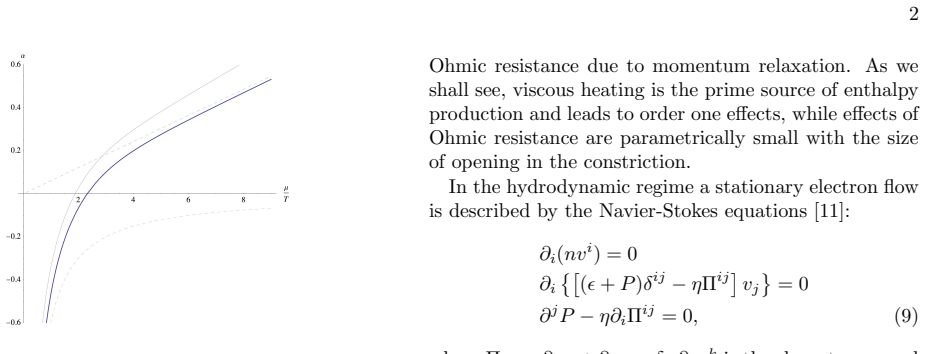
Pith's one-line read A current forced through a constriction can cool the electron fluid in graphene whenever the chemical potential is larger than about 3.32 times the temperature.
desk verdict New idea, clearly written, but a sign error in Eq. (5) inverts the main conclusion: with the corrected algebra the JT coefficient is negative in the Fermi liquid regime and positive in the Dirac regime, opposite to the abstract. read the letter →
The pith
A machine-rendered reading of the paper's core claim, the machinery that carries it, and where it could break.
The reading
What carries the argument
The load-bearing object is the Joule-Thomson coefficient $\alpha=\delta T/\delta\mu$, computed from entropy production along the flow rather than from bare enthalpy conservation. The calculation uses the exact low-Reynolds Stokes solution for flow through a slit of width $a$ with no-slip walls to obtain the pressure drop $\delta P=8\eta u/a$ and the viscous entropy production $-\delta\hat{s}=16\eta u/(3anT)$; combining these with $dP=n\,d\mu+s\,dT$ reproduces the ideal thermodynamic formula with $A=1$ replaced by $A=2/3$. The sign of $\alpha$ is then fixed entirely by $\mu/T$ through the polylogarithm $F(\xi)$, a special function encoding the thermodynamics of a two-dimensional gas with linear dispersion, while flow speed, viscosity, and geometry cancel in the leading answer. Momentum relaxation enters through a length scale $\lambda$ and contributes only a small, log-enhanced correction suppressed by $(a/\lambda)^2$.
What would settle it
Measure the electron temperature on the downstream side of a biased graphene constriction as a function of gate voltage at fixed bath temperature; the claim is refuted if no temperature shift linear in bias appears at $\mu\gg T$, or if cooling persists at $\mu\ll T$ where the prediction is heating.
Extended reading notes
Core claim
The central claim is that hydrodynamic electron flow through a constriction obeys the same enthalpy-conservation logic as a throttled gas, with viscous entropy production modifying the ideal result. Combining the thermodynamic relation $dP=n\,d\mu+s\,dT$ with entropy production along a no-slip Stokes flow gives $\delta T=\alpha\,\delta\mu$, where $\alpha$ is expressed through the polylogarithm function $F(\xi)=\operatorname{Li}_3(-e^\xi)+\operatorname{Li}_3(-e^{-\xi})$, $\xi=\mu/T$. In the Fermi-liquid limit $\mu\gg T$, $\alpha\simeq 3A\mu/[2(1+A)\pi^2 T]$ is positive for $A>0$ and describes cooling; in the Dirac limit $\mu\ll T$, $\alpha\simeq -T/[(1+A)\mu]$ describes heating. Viscosity reduces the ideal thermodynamic value from $A=1$ to $A=2/3$ without changing the sign structure, and the temperature change is linear in the applied voltage rather than quadratic as in ordinary Joule heating.
Load-bearing premise
The calculation assumes the two electron reservoirs are thermally isolated and that the no-slip Stokes flow through the constriction fixes the entropy production; if the reservoirs exchange heat or the flow follows no-stress boundary conditions, the predicted coefficient changes.
Editorial extensions
If this is right
- In a clean, suitably doped graphene sample, forcing current through a constriction should measurably cool the electron fluid, with $\delta T$ proportional to the applied voltage rather than its square.
- The same device should heat the electron fluid when $\mu$ is below $\mu_{\rm inv}\simeq 3.32\,T$, so the geometry acts as a switchable cooler and heater.
- The leading magnitude of the effect depends only on $\mu/T$; constriction width, flow speed, and shear viscosity drop out of the leading coefficient.
- Momentum relaxation alters the coefficient only by a factor suppressed by $(a/\lambda)^2\ln(L/\lambda)$ for a narrow constriction, so the effect survives in realistic samples.
Reading between the lines
- A testable extension is to measure the electron temperature downstream of a biased graphene constriction while sweeping gate voltage: the model predicts the sign of the linear-in-bias temperature shift to flip at a fixed $\mu/T$.
- The same entropy-production logic should apply to other hydrodynamic two-dimensional conductors, but the exact sign and inversion point are tied to graphene's linear dispersion through $F(\xi)$; a parabolic-band fluid would require a different thermodynamic function.
- Near charge neutrality the two-species electron-hole description becomes necessary, and a full two-fluid treatment might replace the divergent $\alpha$ at $\mu=0$ with a large but finite coefficient.
Editorial analysis
A structured set of objections, weighed in public.
Referee Report
Summary. The manuscript studies electric current through a narrow constriction in graphene in the hydrodynamic regime and argues, through a Joule-Thomson analysis, that the electron fluid cools in the Fermi-liquid regime (μ ≫ T) and heats in the Dirac regime (μ ≪ T). The author derives a thermodynamic expression for the dimensionless cooling coefficient α (Eq. (3)), evaluates it for the 2D Dirac gas (Eq. (5)), and incorporates viscous and momentum-relaxation effects, which are absorbed into a parameter A that takes the value A = 2/3 for the Stokes flow considered (Eq. (28)). The paper is self-contained and analytic, and the main quantitative claims are Eq. (7) (cooling in the Fermi-liquid regime) and Eq. (8) (heating in the Dirac regime), with an inversion point at μ/T = 3.32.
Significance. If the derivation were correct, the identification of a parameter-free, geometry-independent Joule-Thomson cooling effect in a hydrodynamic electron system would be conceptually interesting and potentially observable. The paper has genuine strengths: it is self-contained, uses standard thermodynamics and an exact Stokes solution, and produces concrete falsifiable predictions such as the inversion point and the sign change between regimes. However, the central formula contains an algebraic error that reverses the sign of the effect in the Fermi-liquid regime, so the headline prediction of cooling is not supported by the manuscript's own formalism. The significance of the paper as a claim of JT cooling therefore fails; the corrected calculation points to heating in the Fermi-liquid regime.
major comments (2)
- [Eq. (5) and surrounding derivation] Eq. (5) is algebraically incorrect, and the error reverses the central claim. From Eq. (4) one obtains \hat s = s/n = (3F - ξF')/F', with ξ = μ/T, so \partial_ξ \hat s = 2 - 3 F F''/(F')^2. Substituting into Eq. (3) and using T\partial_μ \hat s = \partial_ξ\hat s and T\partial_T\hat s|_μ = -ξ\partial_ξ\hat s gives 1/α = ξ - 3A F/F' / (A+2 - 3F F''/(F')^2). The printed Eq. (5), 1/α = 3A F/F' [A+2 - 3F F''/(F')^2] - ξ, is not equivalent to this expression; the ξ term has the wrong sign and the viscous bracket is in the wrong position. Evaluating the correct expression for ξ ≫ 1 using F = -(ξ^3 + π^2 ξ)/6 + ... yields F/F' = ξ/3 + 2π^2/(9ξ) and F F''/(F')^2 = 2/3 + 2π^2/(9ξ^2), so 1/α = -[2π^2(A+1)/(3A)]/ξ and hence α ≃ -3A μ/[2(A+1)π^2 T]. This is the negative of Eq. (7): the Fermi-liquid regime corresponds to heating, not cooling. Since the abstract and the conclusion rely on the same sign convention, the paper's main result is reversed.
- [Eq. (7), Fig. 2, and A = 2/3] The paper's own displayed asymptotics are internally inconsistent with Eq. (5) for the value A = 2/3 used in Fig. 2. For ξ ≫ 1, Eq. (5) as printed gives 1/α ≃ (A^2 - 1)ξ, which is negative for A = 2/3 and would imply α < 0, i.e. heating, in the Fermi-liquid regime. Nevertheless Eq. (7) states α > 0 for any A > 0 and Fig. 2 shows a positive curve in this regime. Thus the plot and the asymptotic formula cannot both be consequences of the printed Eq. (5); they appear to have been produced from a different expression. This reinforces that the sign error is not a typo confined to one line but affects the consistency of the central quantitative claim.
minor comments (3)
- [Eq. (2)] The enthalpy-conservation condition is written ambiguously as "δϵ + P / n = 0"; it should be δ[(ϵ + P)/n] = 0, which is the form used in the subsequent derivation.
- [Eqs. (22)-(23)] The matching of the near-zone and far-zone solutions in the momentum-relaxation calculation is described but not shown; a brief verification of the matching conditions would improve readability.
- [Boundary conditions discussion] The paper correctly notes that no-stress boundary conditions may be more realistic at low temperatures, but it does not quantify how the value of A would change. Since the sign of the corrected JT coefficient is independent of A for any positive A, this caveat does not affect the main conclusion, but it would be useful to state this explicitly.
Circularity Check
No circularity: the JT coefficient is derived from thermodynamics and an explicit Stokes-flow entropy integral, with no fitted input or self-citation chain.
full rationale
The derivation is self-contained. The JT coefficient is obtained from enthalpy conservation δ((ε+P)/n)=0 combined with the thermodynamic identity dP=n dμ+s dT and the graphene pressure integral Eq. (4); this is a direct calculation, not a restatement of the desired cooling/heating conclusion. The parameter A is introduced as an algebraic placeholder in Eq. (3) and later fixed to A=2/3 by integrating the explicit entropy production rate (16) for the Stokes solution (13); it is not fitted to data and the cooling claim is not used as an input. The Stokes solution and finite-λ generalization are cited from prior work, but they are external standard results and the paper even checks the matching between the near and far zones. The paper explicitly flags limitations near the neutrality point and notes that Joule-heating effects were not checked, but those are correctness caveats, not circular dependencies. Even the reported sign inconsistency between Eq. (5) and the asymptotic Eq. (7), if present, would be an evaluation error within the derived formula, not an equivalence of input and output. No load-bearing step reduces to its own input by definition, so the circularity score is 0.
Assumptions & free parameters
assumptions (5)
- domain assumption Electrons and holes are in local thermodynamic equilibrium with each other everywhere except near charge neutrality.
- domain assumption The electron flow is stationary and has velocity much smaller than the Fermi velocity (v << v_F).
- domain assumption The flow is incompressible and the bulk viscosity vanishes due to conformal invariance.
- domain assumption The shear viscosity eta is constant and the flow obeys no-slip boundary conditions on the constriction walls.
- standard math The standard thermodynamic relation delta P = n delta mu + s delta T applies to the difference between the two reservoirs.
Cite this review
Pith. "Pith review of Joule-Thomson Cooling in Graphene." pith.science (2026). https://pith.science/paper/EV7KYKOV
@misc{pith2026190805934,
  author       = {Pith},
  title        = {Pith review of: Joule-Thomson Cooling in Graphene},
  year         = {2026},
  howpublished = {\url{https://pith.science/paper/EV7KYKOV}},
  note         = {Machine review of arXiv:1908.05934}
}
read the original abstract
Electrons in graphene exhibit hydrodynamic behavior in a certain range of temperatures. We indicate that electric current in this regime can result in cooling of electron fluid due to the Joule-Thomson effect. Cooling occurs in the Fermi liquid regime, while for the Dirac fluid the effect results in heating.
Figures

Reference graph
Works this paper leans on
- [1]
-
[2]
Non-local transport and the hydrodynamic shear viscosity in graphene
I. Torre, A. Tomadin, A. K. Geim and M. Polini, Phys. Rev. B 92, 165433 (2015) , 1508.00363
work page Pith review arXiv 2015
-
[3]
Electron Viscosity, Current Vortices and Negative Nonlocal Resistance in Graphene
L. Levitov and G. Falkovich, Nat. Phys. 12, 672 (2016) , 1508.00836
work page Pith review arXiv 2016
-
[4]
D. A. Bandurin, I. Torre, R. K. Kumar, M. Ben Shalom, A. Tomadin, A. Principi, G. H. Auton, E. Khestanova, K. S. Novoselov, I. V. Grigorieva, L. A. Ponomarenko, A. K. Geim and M. Polini, Science 351, 1055 (2016) , 1509.04165
work page Pith review arXiv 2016
-
[5]
J. Crossno, J. K. Shi, K. Wang, X. Liu, A. Harzheim, A. Lucas, S. Sachdev, P. Kim, T. Taniguchi, K. Watanabe, T. A. Ohki and K. C. Fong, Science 351, 1058 (2016) , 1509.04713
arXiv 2016
-
[6]
Superballistic flow of viscous electron fluid through graphene constrictions
R. Krishna Kumar, D. A. Bandurin, F. M. D. Pellegrino, 5 Y. Cao, A. Principi, H. Guo, G. H. Auton, M. Ben Shalom, L. A. Ponomarenko, G. Falkovich, K. Watanabe, T. Taniguchi, I. V. Grigorieva, L. S. Levitov, M. Polini and A. K. Geim, Nat. Phys. 13, 1182 (2017) , 1703.06672
work page Pith review arXiv 2017
-
[7]
D. A. Bandurin, A. V. Shytov, L. S. Levitov, R. K. Kumar, A. I. Berdyugin, M. Ben Shalom, I. V. Grigorieva, A. K. Geim and G. Falkovich, Nat. Commun. 9, 4533 (2018) , 1806.03231
work page Pith review arXiv 2018
-
[8]
P. J. W. Moll, P. Kushwaha, N. Nandi, B. Schmidt and A. P. Mackenzie, Science 351, 1061 (2016) , 1509.05691
work page Pith review arXiv 2016
Show all 21 references
-
[9]
Gooth, F
J. Gooth, F. Menges, N. Kumar, V. S¨ u, C. Shekhar, Y. Sun, U. Drechsler, R. Zierold, C. Felser and B. Gotsmann, Nat. Commun. 9, 4093 (2018) , 1706.05925
2018 arXiv
-
[10]
H. Guo, E. Ilseven, G. Falkovich and L. S. Levitov, Proc. Natl. Acad. Sci. USA 114, 3068 (2017) , 1607.07269
2017 arXiv
-
[11]
Lucas, J
A. Lucas, J. Crossno, K. C. Fong, P. Kim and S. Sachdev, Phys. Rev. B 93, 075426 (2016) , 1510.01738
2016 arXiv
-
[12]
Lucas, R
A. Lucas, R. A. Davison and S. Sachdev, Proc. Natl. Acad. Sci. USA 113, 9463 (2016) , 1604.08598
2016 arXiv
-
[13]
Lucas and K
A. Lucas and K. Chung Fong, J. Phys. Condens. Matter 30, 053001 (2018) , 1710.08425
2018 arXiv
-
[14]
B. N. Narozhny, I. V. Gornyi, A. D. Mirlin and J. Schmalian, Ann. der Phys. 529, 1700043 (2017) , 1704.03494
2017 arXiv
-
[15]
B. N. Narozhny, Ann. Phys. 411, 167979 (2019) , 1905.09686
2019 arXiv
-
[16]
Thomson and J
W. Thomson and J. P. Joule, Philos. Trans. R. Soc. London 143, 357 (1853)
-
[17]
Vischi, M
F. Vischi, M. Carrega, A. Braggio, F. Paolucci, F. Bianco, S. Roddaro and F. Giazotto, 1906.10988
1906 arXiv
-
[18]
M. S. Foster and I. L. Aleiner, Phys. Rev. B 79, 085415 (2009) , 0810.4342
2009 arXiv
-
[19]
E. I. Kiselev and J. Schmalian, Phys. Rev. B 99, 035430 (2019) , 1806.03933
2019 arXiv
-
[20]
Falkovich and L
G. Falkovich and L. Levitov, Phys. Rev. Lett. 119, 066601 (2017) , 1607.00986
2017 arXiv
-
[21]
Erdmenger, I
J. Erdmenger, I. Matthaiakakis, R. Meyer and D. Rodr´ ıguez Fern´ andez,Phys. Rev. B98, 195143 (2018) , 1806.10635
2018 arXiv
Reviewed August 14, 2026 · model on record in the stance chip above.
Discussion (0). Continue with ORCID to comment.