REVIEW 3 major objections 6 minor 24 references
Multiparticle Dynamics on the Triangular Lattice in Interacting Media
T0 review · 3 major / 6 minor · reviewed 2026-08-14 · deepseek-v4-flash
Pith's one-line read Multiparticle indirect interactions can confine particles to periodic orbits of arbitrarily large size and period.
desk verdict Genuinely new multiparticle periodic-orbit claims in a clean lattice-gas model, but the proofs of the two main theorems are too sketchy to cite as rigorous; the paper deserves a serious referee but needs major revision. read the letter →
The pith
A machine-rendered reading of the paper's core claim, the machinery that carries it, and where it could break.
The reading
What carries the argument
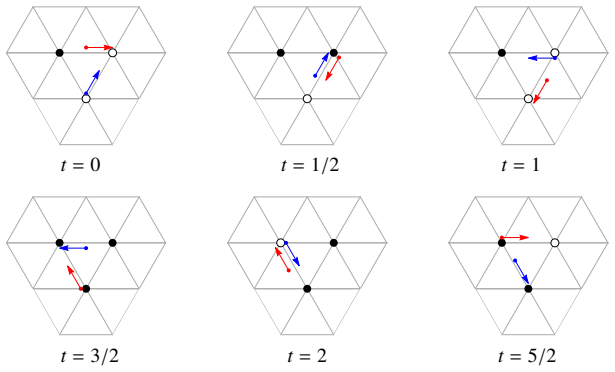
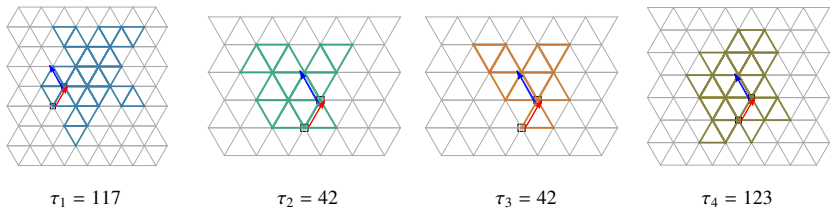
The carrying object is the flipping rotator field: each lattice site carries a left or right orientation, rotates an incoming velocity by $\pm 2\pi/3$, and reverses orientation after each scattering. Particles never collide directly; one particle interacts with another only when, between its own visits to a site, the other particle has flipped that site's rotator an odd number of times. The single-particle blocking mechanism from [1]—a trajectory segment during which the particle is pushed one lattice site away from its starting point in 2 to 7 time steps—is the unit used to prove both ballistic propagation and the speed-ratio escape threshold. For the aperiodic results, the key mechanism is exact time reversibility of the equations of motion, which turns boundedness into periodicity and transfers an unbounded past to some particle's unbounded future. Periodic orbits are classified by two invariant velocity parity sets, $V_1$ and $V_2$, which determine whether a regular or irregular orbit can form.
What would settle it
Exhibit a two-particle configuration on the triangular lattice with speed ratio at least 30 in which the particles do not both escape, or exhibit a single-particle trajectory in a two-particle setting that takes more than 6 steps between consecutive visits to the same lattice site; either would refute the load-bearing bounds behind Theorem 4.
Extended reading notes
Core claim
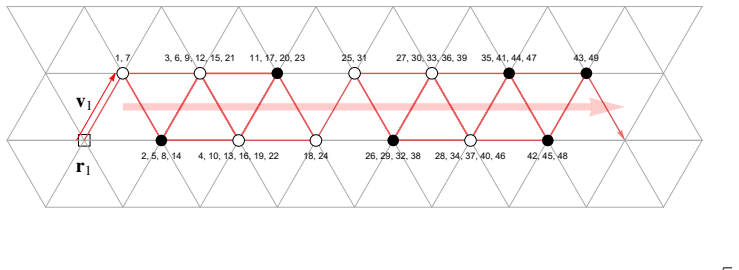
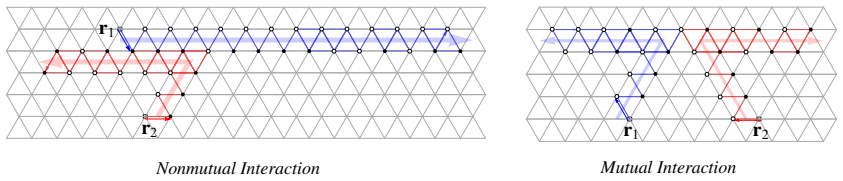
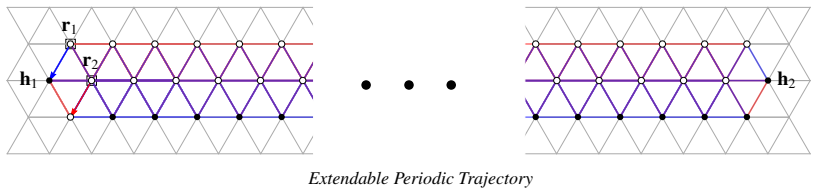
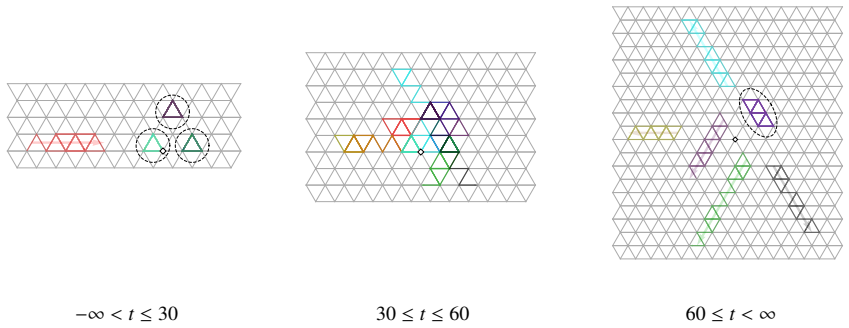
In the multiparticle model on the triangular lattice, the paper's central discovery is that indirect interaction through flipping rotators is sufficient to produce periodic and entangled trajectories of unbounded size and period, despite a lone particle always propagating ballistically in a one-site-wide strip. Theorem 2 constructs a two-particle periodic orbit whose size is $3d+1$ and whose period is $4+4(d-1)$, where $d$ is the distance between two lattice sites, so both quantities can be made arbitrarily large; for $N > 2$, the remaining particles can be placed on noninteracting parallel strips. The paper classifies two-particle periodic orbits as regular when the particles have matching velocity parity, which forbids corners, and irregular when the parity differs, which can produce corners. Time reversibility of the equations of motion yields the equivalence of bounded trajectories and periodic trajectories, and from this follows Theorem 3: if a particle has an unbounded past, some particle in the system has an unbounded future. For unequal speeds, a rational speed ratio is necessary for two particles to share a periodic orbit, and for two particles Theorem 4 asserts that a speed ratio of at least 30 prevents periodic confinement and forces both particles to escape to infinity.
Load-bearing premise
The 30:1 escape proof leans on two unproved bounds imported from the single-particle setting: a unit-speed particle returns to any previously visited site within at most 6 steps, and the blocking-mechanism durations and speed bounds still hold for a particle that has already interacted with another particle; if either bound fails, the claim that a 30:1 speed ratio always sends both particles to infinity is not established.
Editorial extensions
If this is right
- For every number of particles $N \geq 2$ there exist initial conditions with periodic trajectories, and these orbits can have arbitrarily large size and period, with the explicit size formula $3d+1$ and period $4+4(d-1)$.
- If any particle has an unbounded past, then at least one particle, possibly a different one, has an unbounded future; the argument transfers to any time-reversible multiparticle lattice gas.
- Bounded trajectories cannot be merely eventually periodic: in a time-reversible system, boundedness forces exact periodicity of the whole finite part of the model.
- Two particles with rationally independent speeds cannot share a periodic orbit; if all speed ratios are irrational, every trajectory is unbounded and aperiodic.
- Two particles with a speed ratio of at least 30 cannot form a periodic orbit and both escape to infinity.
Reading between the lines
- The 30:1 threshold is probably not sharp; a numerical search for the largest speed ratio that still admits a periodic two-particle orbit could map the true confinement-to-escape boundary.
- Because the regular-orbit size and period depend linearly on the site distance $d$, there may be an integer invariant, such as a winding number of the rotator field, that organizes all regular orbits into a single one-parameter family.
- The time-reversibility argument behind 'unbounded past implies unbounded future' should transfer to multiparticle models on square and hexagonal lattices, so numerical checks there would directly test the generality of Theorem 3.
Signed reviews
Editorial analysis
A structured set of objections, weighed in public.
Referee Report
Summary. The paper studies an N-particle Lorentz lattice gas on the triangular lattice in which every site carries a flipping left/right rotator. For a single particle, prior work [1] established ballistic propagation in a strip. The authors introduce indirect interactions and particle entanglement, and they claim: (i) for every N >= 2 there exist periodic trajectories of arbitrarily large size and period (Theorem 2); (ii) regular two-particle periodic orbits cannot have corners while irregular ones can (Proposition 3.2); (iii) in this reversible model, boundedness of all particle trajectories is equivalent to periodicity, and an unbounded past for one particle forces an unbounded future for some particle (Proposition 4.2 and Theorem 3); (iv) irrational speed ratios preclude two particles from sharing a periodic orbit (Proposition 5.1); and (v) in the two-particle model, a speed ratio of at least 30 forces both particles to escape to infinity (Theorem 4). The paper also presents numerical examples, including a speed-2 periodic orbit and several irregular periodic orbits.
Significance. If the main results are established, the paper would be a useful rigorous contribution to multiparticle Lorentz lattice gases, a setting in which rigorous results are scarce. The contrast between the single-particle ballistic propagation and multiparticle periodic entanglement is conceptually interesting, and Theorem 3 is a clean consequence of time reversibility that extends to other reversible lattice systems. The paper's strengths include its elementary model, the use of the established single-particle propagation theorem as an external input, and the clear identification of a general unbounded-past/unbounded-future mechanism. However, the proofs of the two headline results, Theorems 2 and 4, are currently too incomplete to certify the claims, and one consequence in Proposition 5.1 is not justified. The paper therefore needs substantial revision rather than acceptance in its present form.
major comments (3)
- [Section 3, Theorem 2] The proof of Theorem 2 for N = 2 is figure-based and under-specified: the lattice sites h1 and h2 in the formula d = ||h1 - h2|| are never defined, the scatterer configuration and initial positions/velocities that realize the displayed orbit for a given d are not given, and no argument shows that the pattern in Figure 5 can be reproduced for a sequence d tending to infinity. Because 'arbitrarily large size and period' is the theorem's main content, the proof must contain an explicit construction or an induction that verifies periodicity for unbounded d; the formulas s(d) = 3d + 1 and tau(d) = 4 + 4(d - 1) alone do not establish the theorem. The N > 2 paragraph should also clarify whether the theorem asserts that some particles have periodic trajectories or that the entire N-particle system is periodic; the construction with N - 2 noninteracting strip particles gives unbounded trajectories for those particles, so it establishes at most the former reading.
- [Section 5, Theorem 4] The proof of Theorem 4 relies on two unproved and nontrivial assertions: (a) 'the largest number of steps it takes for a particle traveling at unit speed to return to a previously visited lattice site is 6,' and (b) the blocking-mechanism duration and displacement bounds from [1], derived for a single unit-speed particle, apply also to a particle moving at speed 1/30 after it has already interacted with another particle, which changes the scatterer configuration. Neither assertion is derived in the paper nor tied to a specific statement or lemma in [1]. The timing calculation '30 - 6 = 24' is unclear: if the slow particle requires 30 time units to traverse one bond and reaches the interaction site at t* <= 6, the time at which it reaches an adjacent site is t* + 30, not 24. The assertion that p2 is 'on a single lattice bond adjacent to h' between t* = 0 and t2 = 24 also requires a precise definition of t* and t2. The conclusion that p1 cannot revisit r2(t2) and that p2 can never subsequently interact with p1 needs a rigorous argument rather than the informal comparison of blocking-mechanism speeds. Please supply a complete proof or replace the argument with a precise lemma.
- [Section 5, Proposition 5.1] The final implication in Proposition 5.1 is not supported by the preceding argument. The proof only shows that two particles with irrational speed ratio cannot belong to a common periodic orbit. It does not show that each individual particle trajectory is unbounded: the paper itself leaves open, in Section 4, the possibility of a single particle having a bounded but aperiodic trajectory that is influenced by an unbounded particle over increasingly long time intervals. To justify the statement 'each particle has an (unbounded) aperiodic trajectory,' the authors must supply an additional argument ruling out bounded aperiodic trajectories, or the statement should be weakened accordingly.
minor comments (6)
- [Section 2] The symbol H is used for the set of lattice sites without being defined; the paper elsewhere uses T for the triangular lattice and its sites, so please introduce H explicitly or use T consistently.
- [Throughout] There are numerous typographical errors, including 'triangluar', 'effect' in place of 'effect', 'Propogation' in the reference list, 'Lorenzt' in several references, and 'periodic obits' in the caption of Figure 5; these should be corrected.
- [Proof of Proposition 4.1] The sentence 'A proof of proposition 4.2 is the following' mislabels the proposition; it should refer to Proposition 4.1.
- [Figure 6] The Mathematica output label 'Out[928]=' appears in the figure caption and should be removed.
- [Section 5, before Theorem 4] The sentence 'if one particle is moving much faster than the other it, is not possible for the two to form a periodic orbit' contains a grammatical error and should be reworded.
- [References] Since Theorems 2 and 4 depend on blocking mechanisms from [1], the authors should cite the specific propositions or lemmas in [1] that are being used, rather than referring to [1] as a whole.
Circularity Check
No circularity found; the multiparticle results are derived from the model's equations and the external single-particle theorem, with only a non-load-bearing self-citation.
full rationale
The paper's central claims are derived from the defining equations of motion (1)-(3), time-reversibility arguments, and finite-state reasoning, rather than from the conclusions themselves. Theorem 2 constructs periodic trajectories by referring to explicit orbits in Figure 5, and while the proof is terse and arguably incomplete regarding the dependence on d, this is a gap in verification, not a circular reduction. The size and period formulas s(d)=3d+1 and tau(d)=4+4(d-1) are not themselves assumed as inputs; they are asserted as properties of a displayed configuration. The N>2 extension uses noninteracting strip trajectories whose existence is cited from [1], an external source. The self-citation [22] (Webb and Cohen) appears only in background statements about single-particle displacement scaling and about initial-configuration sensitivity; it is not used to prove any multiparticle theorem. Theorem 4's proof relies on unproved bounds about blocking mechanisms and return times, but these are external lemmas from the single-particle analysis, not the theorem's conclusion; their unverification is a correctness risk, not circularity. No parameter is fitted to target data, no uniqueness theorem from the authors is invoked to force a choice, and no known result is renamed as a new prediction. Therefore the derivation chain is not circular.
Assumptions & free parameters
assumptions (5)
- domain assumption Theorem 1 of [1]: a single particle on the triangular lattice with flipping rotators propagates in one direction through a strip for any initial configuration.
- domain assumption Blocking-mechanism properties from [1]: a unit-speed particle's trajectory partitions into blocking mechanisms of duration 2 to 7 steps, the first complete mechanism occurs within 10 steps, and the largest return time to a previously visited site is 6 steps.
- standard math The time-reversed equations (6)-(8) correctly invert the forward dynamics (1)-(3).
- standard math A finite deterministic state space with invertible dynamics implies periodic, not merely eventually periodic, motion.
- domain assumption The displacements Delta t_i are all distinct, so no two particles arrive at the same site at the same time.
Cite this review
Pith. "Pith review of Multiparticle Dynamics on the Triangular Lattice in Interacting Media." pith.science (2026). https://pith.science/paper/WS6KRKGX
@misc{pith2026190806019,
  author       = {Pith},
  title        = {Pith review of: Multiparticle Dynamics on the Triangular Lattice in Interacting Media},
  year         = {2026},
  howpublished = {\url{https://pith.science/paper/WS6KRKGX}},
  note         = {Machine review of arXiv:1908.06019}
}
abstract
We study the motion of $N$ particles moving on a two-dimensional triangular lattice, whose sites are occupied by either left or right rotators. These rotators deterministically scatter the particles to the left (right), changing orientation from left to right (right to left) after scattering a particle. This interplay between the scatterers and the particle's motion causes a single particle to propagate in one direction away from its initial position. For multiple particles we show that the particles' dynamics can be vastly different. Specifically, we show that a particle can become entangled with another particle potentially causing the particle's trajectory to become periodic and that this can happen when the particles have the same or differing speeds. We describe two classes of periodic orbits based on the particles' initial velocities. We also describe how a particle with an unbounded past trajectory implies that some, possibly other, particle(s) has an unbounded future trajectory in this and other related multiparticle models.
Figures

Figures from the paper (5 more)

Reference graph
Works this paper leans on
-
[22]
B. Webb and E. G. D. Cohen, Self-Avoiding Modes of Motion in a Deterministic Lorentz Lattice Gas J. Phys. A 47, 2014, 315202
work page 2014
-
[1]
P. Grosfils, J. Boon, E. G. D. Cohen, and L. A. Bunimovich, Propogation and organization in lattice random media, J. Stat. Phys. 97 (1999) 575-608
work page 1999
-
[2]
T. W. Ruijgrok and E. G. D. Cohen, Deterministic lattice gas models Phys. Lett. A 133 (1988) 415-418
work page 1988
-
[3]
F. Wang and E. G. D. Cohen, New results for di ffusion in Lorenzt lattice gas cellular automata, J. Stat. Phys. 81 (1995) 445-466
work page 1995
-
[4]
F. Wang and E. G. D. Cohen, Diffusion in Lorenzt lattice gas cellular automata: The honeycomb lattice and Quasi-lattices compared with the square and triangular lattices, J. Stat. Phys. 81 (1995) 467-465
work page 1995
-
[5]
F. Wang and E. G. D. Cohen, Novel phenomena in Lorentz lattice gases, Physica A 219 (1995) 56-87
work page 1995
-
[6]
X. P. Kong and E. G. D. Cohen, Lorentz lattice gases, abnormal diffusion, and polymer statistics J. Stat. Phys. 62 (1990) 1153-1171
work page 1990
-
[7]
X. P. Kong and E. G. D. Cohen, Di ffusion and Propagation in triangular Lorentz lattice gas cellular automata J. Stat. Phys. 62 (1990) 737-757
work page 1990
Show all 24 references
-
[8]
Meng and E
H. Meng and E. G. D. Cohen, Growth, self-randomization, and propoagation in a Lorentz lattice gas Phys. Rev. E 50 (1994) 2482-2487
1994
-
[9]
L. A. Bunimovich and S. E. Troubetzkoy, Rotators, periodicity, and absence of diffusion in cyclic cellular automata, J. Stat. Phys. 74 (1993) 1-10
1993
-
[10]
Cao and E
M. Cao and E. G. D. Cohen, Scaling of particle trajectories on a latticeJ. Stat. Phys.87 (1998) 147-178
1998
-
[11]
Wang and E
F. Wang and E. G. D. Cohen, Diffusion on random lattices, J. Stat. Phys. 84 (1995) 233-261
1995
-
[12]
X. P. Kong and E. G. D. Cohen, Anomolous di ffusion in a lattice-gas wind tree model Phys. Rev. B 40 (1989) 4838-4845
1989
-
[13]
L. A. Bunimovich and S. E. Troubetzkoy, Recurrence properties in Lorentz lattice gas cellular au- tomata, J. Stat. Phys. 67 (1991) 289-302
1991
-
[14]
R. Zi ff, X. P. Kong, and E. G. D. Cohen, Lorentz lattice-gas and kinetic-walk model, Phys. Rev. A 44, (1991) 24102428
1991
-
[15]
H. J. Herrmann, The mole’s labyrinth: a growth model, J. Phys. A 16, (1983) L611-L616. 16
1983
-
[16]
L. A. Bunimovich and M. Khalbystova, Lorentz Lattice Gases and Many-Dimensional Turing Ma- chines, Collision-Based Computing (ed. by. A. A. Adamatzky), Springer, London (2002) 443-467
2002
-
[17]
Turcotte, Self-organized criticality, Rep
D. Turcotte, Self-organized criticality, Rep. Prog. Phys. 62 (1999) 1377
1999
-
[18]
G. A. van Velzen, Deterministic lattice Lorentz gas: II. Mirror model, J. Phys. A: Math. Gen 24 (1991) 807-825
1991
-
[19]
H. A. Lorentz, The motion of electronsin metallic bodies, in KNAW, Proceedings,volume 7, 438453 (Amsterdam, 1905)
1905
-
[20]
R. H. Chisholm, B. D. Hughes, and K. A. Landman, Erosion by a one-dimensional random walk,Phys. Rev. E 90, 0220140 (2014)
2014
-
[21]
C. M. Baker, B. D. Hughes, and K. A. Landman, Random walks in nonuniform environments with local dynamic interactions, Phys. Rev. E 88, 042113 (2013)
2013
-
[23]
L. A. Bunimovich, Deterministic walks in random environments, Physica D 187 (2004) 20-29
2004
-
[24]
Brin and G
M. Brin and G. Stuck, Introduction to Dynamical Sytems, Cambridge University Press, Oct 14, (2002). 17
2002
Reviewed August 14, 2026 · model on record in the stance chip above.
Discussion (0). Continue with ORCID to comment.