REVIEW 2 major objections 4 minor 38 references
SCARLET-NAS: Bridging the Gap between Stability and Scalability in Weight-sharing Neural Architecture Search
T0 review · 2 major / 4 minor · reviewed 2026-08-14 · deepseek-v4-flash
Pith's one-line read This paper identifies skip connections as the destabilizing element in one-shot weight-sharing supernets and shows that replacing them during training with a removable learned 1x1 convolution restores ranking and yields a 76.9% ImageNet…
desk verdict A simple, effective stabilizer for skip connections in one-shot NAS, with a mathematical equivalence claim that is stronger than the proof supports. read the letter →
The pith
A machine-rendered reading of the paper's core claim, the machinery that carries it, and where it could break.
The reading
What carries the argument
The load-bearing object is the Equivariant Learnable Stabilizer (ELS), a learned $1\times1$ convolution with no batch-normalization and no activation, placed where the search space would put an identity skip. Its defining equivalence is Eq. (3): for the input $x^{c_l}_l$ to layer $l$ and every operation $o$ in layer $l+1$, $f^{l+1}_o(x^{c_l}_l)=f^{l+1}_o(f^l_{ELS}(x^{c_l}_l))$. The $1\times1$ map satisfies this because linear convolution commutes with composition: its weights can be folded into the following convolution's weight tensor, so the stabilizer changes no representational capacity. ELS therefore gives the search a homogeneous-feature training signal while leaving the final architecture free of the extra layer.
What would settle it
A direct check is to take a layer where the skip's output has $c_l$ channels while the other operations produce $c_{l+1}\neq c_l$ channels, feed one batch of random inputs through both the raw skip and the ELS into every next-layer operation, and compare $f^{l+1}_o(x^{c_l}_l)$ with $f^{l+1}_o(f^l_{ELS}(x^{c_l}_l))$; a difference above numerical precision at any mismatched layer would show that Lemma 1 does not cover the actual search space. Alternatively, one can compare the supernet's rank correlation on benchmark models when ELS is used only at matched-channel layers versus everywhere; a drop in the all-layers case would show the mismatch is load-bearing.
Extended reading notes
Core claim
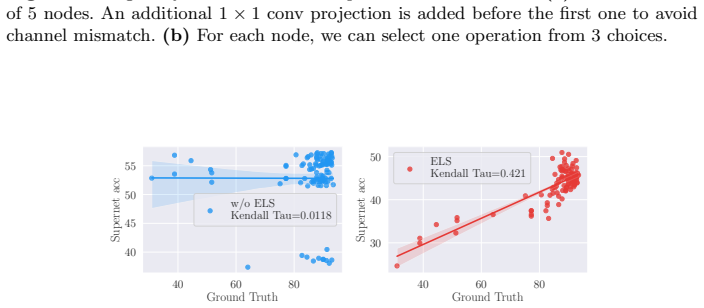
On its own terms, the paper's discovery is that the obstacle to one-shot search over variable depths is not skip connections as such but the feature heterogeneity they introduce. In a layer whose choices are inverted-bottleneck blocks and an identity skip, the skip's feature maps have dramatically lower cosine similarity with the other blocks' outputs; when the next layer samples one path, it receives inputs with different statistics depending on the previous choice, and the disturbance accumulates. Replacing the skip during supernet training with an equivariant learnable stabilizer removes the heterogeneity while preserving exactly the same representational capacity, because a $1\times1$ convolution composed with any following convolution can be absorbed into that convolution's weights (Lemma 1). The paper reports that the stabilized supernet is a far better evaluator: on a benchmark with known ground-truth labels, rank correlation rises from near zero to about 0.42 with ELS. Searching this supernet evolutionarily produces SCARLET-A, which reaches 76.9% ImageNet top-1 at 365M multiply-adds, and the paper shows transfer results on CIFAR-10 and object detection.
Load-bearing premise
The load-bearing premise is that Eq. (3) holds at every layer of the supernet, including layers where the skip carries a different number of output channels into the next block than the other choices do; the paper's proof covers only a $1\times1$ convolution followed by a $k\times k$ convolution with matching input channels, so a channel mismatch would leave the trained supernet evaluating a different architecture class than the final models.
Editorial extensions
If this is right
- Skip connections can be included in one-shot search spaces without destabilizing supernet training, so searched models can differ in depth rather than only in per-cell choices.
- Because ELS is removed after training, final architectures carry no extra parameter cost from the stabilizer, so the accuracy gain is not bought with added runtime.
- Better supernet ranking makes the evolutionary search stage more reliable; the paper's ablation puts the gain from ELS in ranking, not in the search algorithm.
- The reported result implies that competitive mobile-scale architectures can be found without proxy tasks at modest compute: SCARLET-A's 76.9% top-1 exceeds a 390M-FLOPs strong baseline using 365M FLOPs.
- Non-equivariant stabilizers (e.g., adding ReLU) overestimate subnetworks, so the equivalence condition is not a formality but an experimentally visible requirement.
Reading between the lines
- Extension: the same linear-absorption argument should transfer to any search space where a candidate operation's input features can be homogenized by a linear map; one could, for example, use a learned $1\times1$ stabilizer for variable-width choices rather than only variable-depth ones.
- Extension: measuring cross-choice feature similarity early in supernet training could serve as a cheap diagnostic for whether a given search space will rank well; the paper's cosine-similarity curves make that a testable preprocessing step rather than a post hoc explanation.
- Extension: the channel-mismatch worry in Eq. (3) suggests a targeted experiment: restrict ELS to layers whose channel counts match and compare final search quality; if quality does not drop, the shortcut is harmless in practice, and if it does, the proof needs a refined statement.
- Extension: the ranking improvement from near zero to about 0.42 implies that weight-sharing evaluations can be made informative with a much smaller fix than retraining every subnetwork, which may make one-shot search competitive as a cheap ranking oracle for broader model-selection tasks.
Editorial analysis
A structured set of objections, weighed in public.
Referee Report
Summary. The paper addresses weight-sharing one-shot NAS in search spaces with variable depth, where skip connections are added to the usual MobileNetV2-style blocks. The authors observe that a vanilla scalable supernet suffers from training instability and poor subnetwork ranking, and they attribute this to feature inconsistency between the skip connection and the other choice blocks. They propose replacing the skip with a learnable 1x1 convolution, the Equivariant Learnable Stabilizer (ELS), during supernet training. They claim (Lemma 1, Eq. 3) that this stabilizer does not change the representational capacity of any subnetwork, so it can be removed after training. Experiments show lower variance in training curves, improved Kendall Tau on NAS-Bench-101 (from 0.0118 to 0.421), and a family of SCARLET models with competitive ImageNet accuracies, the best of which (SCARLET-A) reaches 76.9% top-1 accuracy. The final models are trained from scratch after the search, so the headline accuracies do not depend on the supernet proxy.
Significance. If the equivalence claim holds, the paper contributes a practical fix for a real failure mode in one-shot NAS with variable depth: the ELS mechanism is simple, cost-free during search, and demonstrably improves ranking on an external benchmark. The empirical backbone is generally solid: the NAS-Bench-101 ranking experiment uses ground-truth accuracies; the final ImageNet models are re-trained from scratch; and the ablations (training curves, feature similarity, constrained optimization) directly support the main narrative. The central risk is the gap between the proof of Lemma 1 and the actual search spaces, which contain layers where the skip output channel count differs from the other choices. Since the entire ranking guarantee rests on Eq. (3), this gap is load-bearing and must be closed or the search space clarified before the claims can be accepted.
major comments (2)
- [Section 4.1 and Appendix A, Eq. (3)] Lemma 1's proof covers only a 1x1 convolution followed by a kxk convolution with matching input channels. In the search spaces S1/S2, at channel-changing layers the skip output has c_l channels while every other choice block outputs c_{l+1} channels; the Fig. 11 caption explicitly states 'the channel size of feature map after Choice 6 ... is half of others'. For these layers the right-hand side of Eq. (3), f^o_{l+1}(x^{c_l}_l), is not a well-defined input to a shared next block whose first convolution is shaped for c_{l+1} channels, and the 'iteratively apply' argument cannot pass through the MB nonlinearities (expansion, depthwise, SE) because folding ELS into the next block would require changing that block's weights to a tensor different from the shared one. Since SCARLET-B and -C are reported to contain identity operations, including at late stages where channel counts change, the supernet may have ranked architectures that are not the same as those later trained from scratch. The only direct ranking benchmark in Section 6.2 deliberately adds a 1x1 projection to avoid channel mismatch, which sidesteps exactly this case. Please either extend the equivalence proof to mismatched layers, or state that skip connections are only allowed when c_l = c_{l+1} and rerun or justify the affected experiments.
- [Section 3.1 and Appendix C.1] The text repeatedly calls the skip connection 'parameter-free', yet the vignette in Fig. 11 and the search-space description imply that a bare identity can be selected at layers where c_l differs from c_{l+1}. A bare identity cannot be followed by a next-layer block whose first convolution expects c_{l+1} input channels; the resulting computational graph is ill-defined. This makes it unclear how the vanilla scalable supernets in Fig. 3 were trained at all. Please specify the exact skip implementation (for example, a 1x1 projection at downsampling layers, or a restriction of skip choices to channel-matched layers) and confirm that the training curves and ranking experiments use that implementation. Without this clarification, the observed 'instability' could be an artifact of an invalid architecture rather than a genuine feature-inconsistency effect.
minor comments (4)
- [Abstract and Introduction] There are several small wording issues, such as 'we are mainly concerned about finding models' (Introduction) and 'it creates a large range of perturbation' (Abstract); these should be polished.
- [Section 4.1, Eq. (3)] The notation f^o_{l+1} is used for the next-layer operation on both sides of Eq. (3), but if f^o_{l+1} is a shared block that expects c_{l+1} input channels, the expression on the right side is ambiguous at mismatched layers; the paper should define the input channel dimension of f^o_{l+1} explicitly.
- [Section 6.2, Fig. 7] The NAS-Bench-101 experiment samples 100 models for the Kendall Tau comparison; it would be helpful to report the variance across multiple seeds or at least the number of supernet training runs, since a single run at tau=0.421 could be optimistic.
- [Appendix C.2, Table 7] Several hyperparameters in Table 7 (prm, pre, ppr, pM, pK-M) are not defined in the text or pseudocode; please add a brief description of the mutation/crossover probabilities.
Circularity Check
No load-bearing circularity; the only FairNAS self-citation is motivational, and the ELS/ranking claims are independently checked against external benchmarks.
full rationale
The derivation chain is not circular. The load-bearing equivalence in Eq. 3 is not assumed from the target result: Lemma 1 states that a 1x1 convolution can act as an equivariant stabilizer, and Appendix A proves the factorization by explicitly constructing the weight tensor w3_{u,c,q,q} = sum_p w2_{p,c,q,q} w1_{u,p,1,1} (Eq. 8); for the non-skip operations this is a direct algebraic identity, not a re-statement of the claim. The ranking contribution is validated against the external NAS-Bench-101 benchmark (Section 6.2, Kendall tau 0.421 with ELS vs 0.0118 without), and the final SCARLET-A, -B, -C numbers in Table 2 are standalone models trained from scratch after ELS is removed, so no headline accuracy is a supernet score recycled as a prediction. The only author self-citation is FairNAS [6], used as motivation ('feature similarity is critical for single-path training') and as a training/search baseline; that premise does not force the ELS result, so it is not load-bearing. A real weakness exists but is a correctness or proof-gap issue, not circularity: Appendix A proves the factorization for a convolution whose direct input has c_l channels and then says the skip case follows by 'iteratively apply[ing]' the proof, whereas Fig. 11 and its caption explicitly show the skip output can be half the width of the other choice blocks (16 vs 32). Under-argument of a lemma is not the same as the claim reducing to its own input, so the circularity score remains low.
Assumptions & free parameters
free parameters (2)
- Objective weights (w_acc, w_madds, w_params) =
0.4, 0.4, 0.2
- Search constraints (acc_min, madds_max) =
0.4, 500M
assumptions (3)
- standard math A 1x1 convolution followed by a kxk convolution can be reparameterized as a single kxk convolution (Appendix A).
- domain assumption The skip connection at a channel-mismatched layer is implementable in the supernet (e.g., via zero-padding or projection) and its capacity is comparable to ELS.
- domain assumption Inherited-weights evaluation of sampled subnetworks is a valid proxy for their stand-alone quality (the one-shot assumption).
Cite this review
Pith. "Pith review of SCARLET-NAS: Bridging the Gap between Stability and Scalability in Weight-sharing Neural Architecture Search." pith.science (2026). https://pith.science/paper/MXHJ74FT
@misc{pith2026190806022,
  author       = {Pith},
  title        = {Pith review of: SCARLET-NAS: Bridging the Gap between Stability and Scalability in Weight-sharing Neural Architecture Search},
  year         = {2026},
  howpublished = {\url{https://pith.science/paper/MXHJ74FT}},
  note         = {Machine review of arXiv:1908.06022}
}
read the original abstract
To discover powerful yet compact models is an important goal of neural architecture search. Previous two-stage one-shot approaches are limited by search space with a fixed depth. It seems handy to include an additional skip connection in the search space to make depths variable. However, it creates a large range of perturbation during supernet training and it has difficulty giving a confident ranking for subnetworks. In this paper, we discover that skip connections bring about significant feature inconsistency compared with other operations, which potentially degrades the supernet performance. Based on this observation, we tackle the problem by imposing an equivariant learnable stabilizer to homogenize such disparities. Experiments show that our proposed stabilizer helps to improve the supernet's convergence as well as ranking performance. With an evolutionary search backend that incorporates the stabilized supernet as an evaluator, we derive a family of state-of-the-art architectures, the SCARLET series of several depths, especially SCARLET-A obtains 76.9% top-1 accuracy on ImageNet. Code is available at https://github.com/xiaomi-automl/ScarletNAS.
Figures


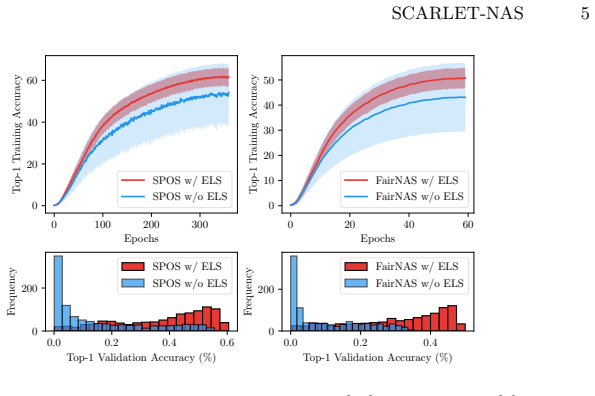
Figures from the paper (9 more)




Reference graph
Works this paper leans on
- [1]
-
[2]
Cai, H., Zhu, L., Han, S.: ProxylessNAS: Direct Neural Architecture Search on Target Task and Hardware. In: ICLR (2019)
work page 2019
-
[3]
Chen, X., Xie, L., Wu, J., Tian, Q.: Progressive Differentiable Architecture Search: Bridging the Depth Gap between Search and Evaluation. In: ICCV (2019)
work page 2019
- [4]
-
[5]
Chu, X., Zhang, B., Xu, R.: MoGA: Searching Beyond MobileNetV3. In: ICASSP (2020)
work page 2020
-
[6]
Chu, X., Zhang, B., Xu, R., Li, J.: FairNAS: Rethinking Evaluation Fairness of Weight Sharing Neural Architecture Search. arXiv preprint. arXiv:1907.01845 (2019)
arXiv 2019
-
[7]
Cubuk, E.D., Zoph, B., Mane, D., Vasudevan, V., Le, Q.V.: AutoAugment: Learn- ing Augmentation Policies from Data. In: CVPR (2019)
work page 2019
-
[8]
IEEE Transactions on Evolutionary Computation 6(2), 182–197 (2002)
Deb, K., Pratap, A., Agarwal, S., Meyarivan, T.: A Fast and Elitist Multiobjective Genetic Algorithm: NSGA-II. IEEE Transactions on Evolutionary Computation 6(2), 182–197 (2002)
work page 2002
Show all 38 references
-
[9]
In: CVPR
Deng, J., Dong, W., Socher, R., Li, L.J., Li, K., Fei-Fei, L.: ImageNet: A Large- Scale Hierarchical Image Database. In: CVPR. pp. 248–255. Ieee (2009)
2009
-
[10]
In: CVPR
Dong, X., Yang, Y.: Searching for a Robust Neural Architecture in Four GPU Hours. In: CVPR. pp. 1761–1770 (2019)
2019
-
[11]
In: AJCAI
Friedrich, T., Kroeger, T., Neumann, F.: Weighted Preferences in Evolutionary Multi-Objective Optimization. In: AJCAI. pp. 291–300. Springer (2011)
2011
-
[12]
arXiv preprint
Guo, Z., Zhang, X., Mu, H., Heng, W., Liu, Z., Wei, Y., Sun, J.: Single Path One-Shot Neural Architecture Search with Uniform Sampling. arXiv preprint. arXiv:1904.00420 (2019)
2019 arXiv
-
[13]
In: CVPR
He, K., Zhang, X., Ren, S., Sun, J.: Deep Residual Learning for Image Recognition. In: CVPR. pp. 770–778 (2016)
2016
-
[14]
In: ICCV (2019)
Howard, A., Sandler, M., Chu, G., Chen, L.C., Chen, B., Tan, M., Wang, W., Zhu, Y., Pang, R., Vasudevan, V., et al.: Searching for MobileNetV3. In: ICCV (2019)
2019
-
[15]
In: CVPR
Hu, J., Shen, L., Sun, G.: Squeeze-and-Excitation Networks. In: CVPR. pp. 7132– 7141 (2018)
2018
-
[16]
In: CVPR
Huang, G., Liu, Z., Van Der Maaten, L., Weinberger, K.Q.: Densely Connected Convolutional Networks. In: CVPR. pp. 4700–4708 (2017)
2017
-
[17]
Biometrika 30(1/2), 81–93 (1938)
Kendall, M.G.: A New Measure of Rank Correlation. Biometrika 30(1/2), 81–93 (1938)
1938
-
[18]
Kornblith, S., Shlens, J., Le, Q.V.: Do Better Imagenet Models Transfer Better? In: CVPR. pp. 2661–2671 (2019)
2019
-
[19]
Krizhevsky, A., Hinton, G., et al.: Learning Multiple Layers of Features from Tiny Images. Tech. rep., Citeseer (2009)
2009
-
[20]
In: ICCV (2017)
Lin, T.Y., Goyal, P., Girshick, R., He, K., Doll´ ar, P.: Focal Loss for Dense Object Detection. In: ICCV (2017)
2017
-
[21]
In: ECCV
Lin, T.Y., Maire, M., Belongie, S., Hays, J., Perona, P., Ramanan, D., Doll´ ar, P., Zitnick, C.L.: Microsoft COCO: Common Objects in Context. In: ECCV. pp. 740–755. Springer (2014)
2014
-
[22]
In: ICLR (2019) 16 Chu et al
Liu, H., Simonyan, K., Yang, Y.: DARTS: Differentiable Architecture Search. In: ICLR (2019) 16 Chu et al
2019
-
[23]
In: ICML (2018)
Pham, H., Guan, M.Y., Zoph, B., Le, Q.V., Dean, J.: Efficient Neural Architecture Search via Parameter Sharing. In: ICML (2018)
2018
-
[24]
In: CVPR
Sandler, M., Howard, A., Zhu, M., Zhmoginov, A., Chen, L.C.: MobileNetV2: In- verted Residuals and Linear Bottlenecks. In: CVPR. pp. 4510–4520 (2018)
2018
-
[25]
Overfitting
Srivastava, N., Hinton, G., Krizhevsky, A., Sutskever, I., Salakhutdinov, R.: Dropout: A Simple Way to Prevent Neural Networks from. Overfitting. JMLR 15(1), 1929–1958 (2014)
2014
-
[26]
In: ECMLPKDD (2019)
Stamoulis, D., Ding, R., Wang, D., Lymberopoulos, D., Priyantha, B., Liu, J., Marculescu, D.: Single-Path NAS: Designing Hardware-Efficient ConvNets in less than 4 Hours. In: ECMLPKDD (2019)
2019
-
[27]
In: AAAI (2017)
Szegedy, C., Ioffe, S., Vanhoucke, V., Alemi, A.A.: Inception-v4, Inception-ResNet and the Impact of Residual Connections on Learning. In: AAAI (2017)
2017
-
[28]
In: CVPR (2019)
Tan, M., Chen, B., Pang, R., Vasudevan, V., Le, Q.V.: Mnasnet: Platform-Aware Neural Architecture Search for Mobile. In: CVPR (2019)
2019
-
[29]
In: ICML (2019)
Tan, M., Le, Q.V.: EfficientNet: Rethinking Model Scaling for Convolutional Neural Networks. In: ICML (2019)
2019
-
[30]
BMVC (2019)
Tan, M., Le., Q.V.: MixConv: Mixed Depthwise Convolutional Kernels. BMVC (2019)
2019
-
[31]
CVPR (2019)
Wu, B., Dai, X., Zhang, P., Wang, Y., Sun, F., Wu, Y., Tian, Y., Vajda, P., Jia, Y., Keutzer, K.: FBNet: Hardware-Aware Efficient ConvNet Design via Differentiable Neural Architecture Search. CVPR (2019)
2019
-
[32]
In: CVPR
Xie, S., Girshick, R., Doll´ ar, P., Tu, Z., He, K.: Aggregated Residual Transforma- tions for Deep Neural Networks. In: CVPR. pp. 1492–1500 (2017)
2017
-
[33]
In: ICML
Ying, C., Klein, A., Christiansen, E., Real, E., Murphy, K., Hutter, F.: Nas-bench- 101: Towards reproducible neural architecture search. In: ICML. pp. 7105–7114 (2019)
2019
-
[34]
In: ICLR (2020)
Zela, A., Elsken, T., Saikia, T., Marrakchi, Y., Brox, T., Hutter, F.: Understanding and Robustifying Differentiable Architecture Search. In: ICLR (2020)
2020
-
[35]
In: CVPR (June 2018)
Zhang, X., Zhou, X., Lin, M., Sun, J.: ShuffleNet: An Extremely Efficient Convo- lutional Neural Network for Mobile Devices. In: CVPR (June 2018)
2018
-
[36]
In: CVPR
Zhang, X., Li, Z., Change Loy, C., Lin, D.: PolyNet: A Pursuit of Structural Di- versity in Very Deep Networks. In: CVPR. pp. 718–726 (2017)
2017
-
[37]
In: CVPR
Zoph, B., Vasudevan, V., Shlens, J., Le, Q.V.: Learning Transferable Architectures for Scalable Image Recognition. In: CVPR. pp. 8697–8710 (2018) SCARLET-NAS 17 A Proof Proof. First, we prove that Equation 3 (main text) holds for∀o∈{ 0, 1,...,n−2}. In this case, it’s sufficient ...
2018
-
[38]
In particular, S1 is represented as a block-level supernet with L = 19 layers of N = 7 choices each
is adopted as its backbone. In particular, S1 is represented as a block-level supernet with L = 19 layers of N = 7 choices each. Its total size is 7 19. The choices are, – MobileNetV2’s inverted bottleneck blocks [24] of two expansion rates ( x) in (3,6), three kernel sizes (y...
Reviewed August 14, 2026 · model on record in the stance chip above.
Discussion (0). Continue with ORCID to comment.