REVIEW 3 major objections 5 minor 1 cited by
Slicing conditions for axisymmetric gravitational collapse of Brill waves
T0 review · 3 major / 5 minor · reviewed 2026-08-14 · deepseek-v4-flash
Pith's one-line read Adding a maximal-slicing source term to the 1+log lapse cures the slicing blowups that stop near-critical Brill wave collapse evolutions.
desk verdict Quasi-maximal slicing is a plausible new cure for Brill-wave gauge failures; the A=5 evidence is thinner than the abstract suggests, but the claim likely holds and deserves review. read the letter →
The pith
A machine-rendered reading of the paper's core claim, the machinery that carries it, and where it could break.
The reading
What carries the argument
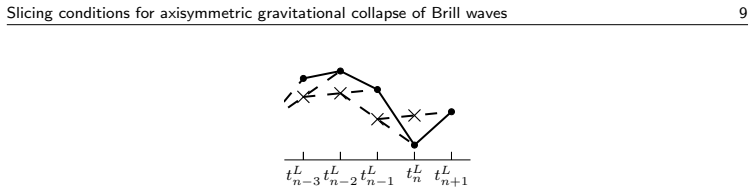
The load-bearing object is the quasi-maximal slicing condition (22), $$(\partial_t-\mathcal{L}_\$\beta$)\$\alpha$=-2\$\alpha$ K+\kappa W_a,$$ which appends to the 1+log slicing law a source term $W_a$ constructed as an approximate solution of the elliptic equation (21), derived by differentiating the maximal slicing condition in time. In practice $W_a$ is computed by a pseudo-spectral elliptic solver run once per coarse time step, linearly extrapolated and interpolated between solves, and multiplied by a low-pass filter (25) that damps basis functions once they are no longer resolved by the finite-difference grid. Because the auxiliary equation has trivial principal part $\Delta W=0$, the added term does not change the principal part of the evolution system linearized around flat space, so hyperbolicity is inherited from 1+log slicing while the source term pushes $K$ toward zero.
What would settle it
Run the $A=5$ Brill wave with the low-pass filter removed and the pseudo-spectral solver for $W_a$ made substantially more accurate; if the resolution-dependent kink in the normal derivative of $\bar\rho^2$ reappears before $t\approx10$, the cure is an artifact of the approximate solver rather than a property of quasi-maximal slicing.
Extended reading notes
Core claim
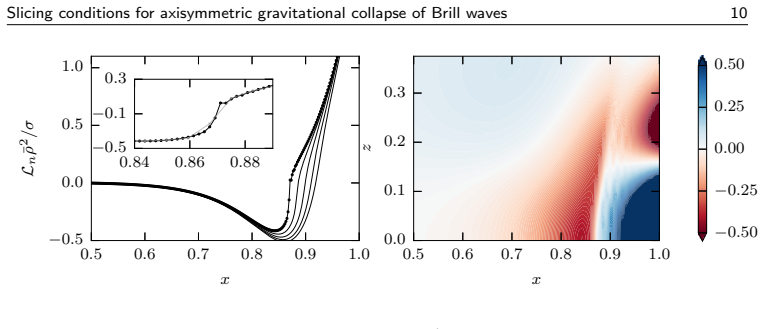
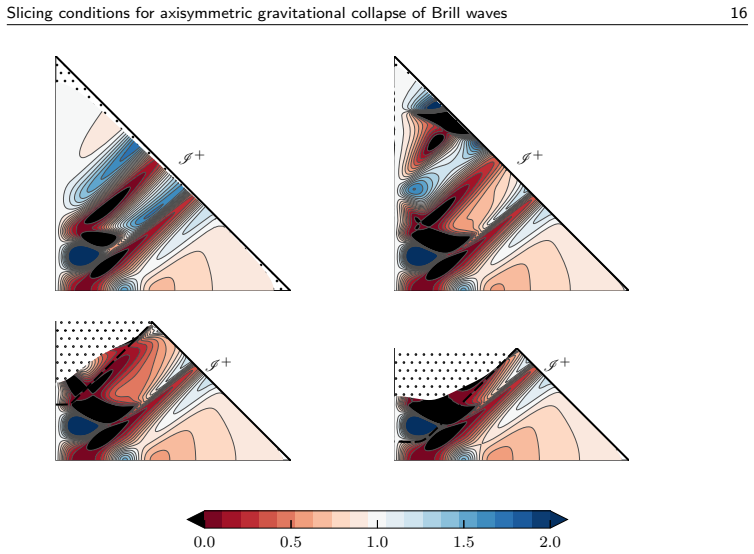
Brill wave data with amplitude $A=5$ evolve under the moving puncture gauge for only about $t\approx4.9$ before the constant-time slices develop a cusp-like nonsmooth feature, visible as a resolution-dependent kink in the normal derivative of the circumferential radius $\bar\rho^2$; the simulation then fails. The central discovery is that replacing the 1+log slicing law $(\partial_t-\mathcal{L}_\beta)\alpha=-2\alpha K$ with the quasi-maximal condition $(\partial_t-\mathcal{L}_\beta)\alpha=-2\alpha K+\kappa W_a$, where $W_a$ is a rough, low-pass-filtered, time-interpolated solution of the elliptic equation (21), removes this pathology. With zero shift the $A=5$ run passes $t=10$, an apparent horizon of mass $M_{\mathrm{AH}}\approx0.56$ appears, and the spacetime can be described by gauge-invariant quantities; for $A=5.5$ the $\Gamma$-driver shift works and mass estimates converge to the apparent horizon mass as the hole settles to Schwarzschild.
Load-bearing premise
The cure relies on the assumption that a rough, low-pass-filtered, time-interpolated solution $W_a$ of the auxiliary elliptic equation stays close enough to true maximal slicing to suppress the singularity at the near-critical amplitude where 1+log fails, a behaviour checked numerically at low amplitude but not proven generally.
Editorial extensions
If this is right
- Near-critical Brill wave data can be evolved with BSSN finite-difference moving-puncture codes far enough to form and track an apparent horizon, which 1+log slicing alone does not allow.
- Quasi-maximal slicing with fixed solver parameters converges at fourth order in the time integrator to the same invariant spacetime, so the approximate source term does not alter the physics being simulated.
- For supercritical amplitude $A=5.5$, late-time gauge-invariant mass estimates approach the final apparent horizon mass, showing the collapsed object settles to a Schwarzschild black hole.
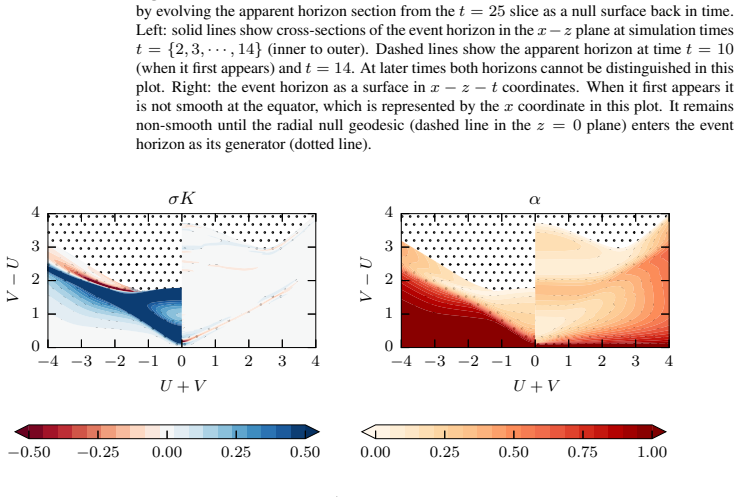
- Even away from criticality the gauge allows compactified conformal diagrams of the collapse, and reveals an early event horizon that is disk-like with a non-smooth rim, and transiently toroidal for $A=4.8$.
Reading between the lines
- The same 'quasi-' construction should extend to other elliptic gauge conditions, for example deriving a source term from harmonic or minimal-distortion conditions, to stabilize hyperbolic gauges in other strong-field regimes; the paper does not test this.
- Because a low-pass filter confining $W_a$ to the central region suffices to cure the failure, the 1+log singularity appears to originate in lapse dynamics inside the strong-field core rather than in outer-boundary gauge behavior.
- The shift shock seen at $A=5$ suggests the remaining obstacle to full moving-puncture capability for near-critical data sits in the shift condition, so an analogous quasi-maximal driver for the shift is the natural next step.
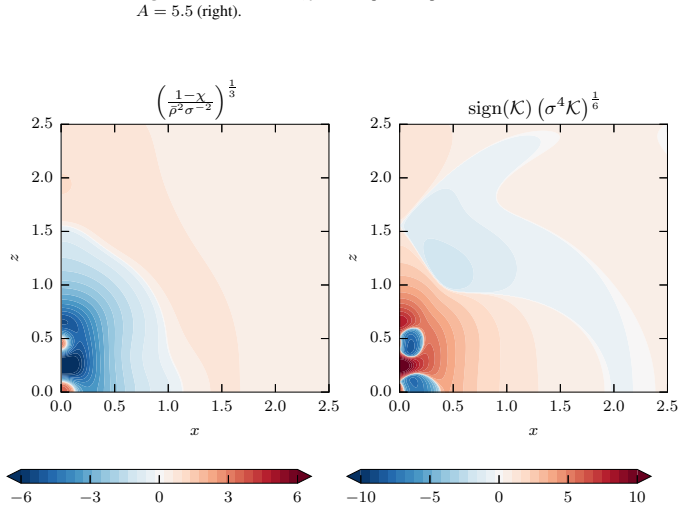
- The dimensionless invariant $\chi$, whose first negative region at Brill waves points 'the wrong way' relative to Schwarzschild, could be monitored over successive echo periods in a future critical-collapse search, since a discretely self-similar spacetime should repeat its range of values; the paper notes the possibility but does not pursue it.
Signed reviews
Editorial analysis
A structured set of objections, weighed in public.
Referee Report
Summary. The paper proposes a new 'quasi-maximal' slicing condition (Eq. 22), obtained by adding a source term W_a--an approximate solution of the elliptic equation (21)--to the 1+log slicing condition, in order to cure coordinate singularities that appear in moving-puncture evolutions of near-critical Brill wave data. The authors implement this in a BSSN code with the analytic Cartoon method, computing W_a with a pseudospectral elliptic solver, time extrapolation/interpolation, and a low-pass filter (25), and switching back to 1+log at an empirically chosen time t0 (26). They reproduce the known failure of 1+log slicing at A=5, show that max|K| tends to zero with the time step for A=0.1, that K is reduced at A=1, and that gauge-invariant quantities converge to fourth order under grid refinement at A=1. Their main result is a single A=5 run with zero shift that reaches t≈25, forms an apparent horizon, and allows construction of an event horizon and conformal diagrams; they also report long runs at A=4.6, 4.65, 4.8, 5.0, and 5.5. The paper acknowledges that with the Γ-driver the A=5 shift develops a shock and that the A=5 success is therefore limited to zero shift.
Significance. If the central claim is correct, the quasi-maximal slicing condition is a practically valuable and computationally cheap modification of 1+log slicing that enables long-term simulations of Brill wave collapse in a finite-difference moving-puncture code, and the gauge-invariant diagnostics (Kretschmann mass, circumferential radius, chi, conformal diagrams) are useful tools for studying the approach to critical collapse. The paper's strengths include a clearly motivated construction (W_a's origin in maximal slicing is stated explicitly, so the derivation is not circular), several nontrivial checks--Δt-convergence of K at A=0.1, reduced K at A=1, fourth-order convergence of invariants at A=1, and reproduction of the known A=5 failure--and the release of the simulation code. However, the headline A=5 claim rests on a single zero-shift run with no resolution or filter-sensitivity study at that amplitude, and the well-posedness of the modified gauge is justified only by linearization around flat space. The significance is therefore conditional on additional evidence at the amplitude where the claim is made.
major comments (3)
- [Section 5, 'Near-critical case: A=5'] The central claim that quasi-maximal slicing cures the A=5 singularities is supported by a single run. The convergence evidence in Sec. 4.2 and Figs. 3-4 is for A=0.1 and A=1 only; no resolution study is reported for A=5. Because W_a is, in the authors' words, a 'very approximate' solution of (21), and because the low-pass filter (25) with J=36, d=6 and the switch time t0 in (26) are empirically chosen, the run's survival could be an artifact of dissipation, of the time extrapolation, or of the switching schedule rather than of the intended maximal-slicing driver. A resolution study at A=5 (grid spacing, CFL factor, filter parameters J and d, and t0) is required to tie the observed stability to the quasi-maximal source term.
- [Section 3, after Eq. (22)] The well-posedness argument is insufficient for the strong-field regime. The statement that the source term 'does not modify the principal part of the PDEs linearized around flat space' only addresses perturbations of Minkowski spacetime; near-critical A=5 Brill waves develop large K and strong lapse dynamics, and the actual W_a is time-interpolated and low-pass filtered. No argument is given that the nonlinear system with this approximate, time-dependent driver remains well-posed. At minimum, the A=5 run should be accompanied by a report of Hamiltonian and momentum constraint violations under resolution, or another diagnostic demonstrating that the modified gauge does not introduce an instability.
- [Section 5, 'Near-critical case: A=5'] The demonstration is limited to zero shift. The authors state that with the Γ-driver the shift develops a shock profile around t≈10, so they set the shift to zero; the moving-puncture failure reported in [11] concerns the full gauge, including the Γ-driver. Thus the paper does not establish that quasi-maximal slicing cures the moving-puncture failure for A=5; it establishes that the modified slicing improves the lapse sector in a zero-shift run. This limitation should be stated explicitly, and if the claim is intended for the full moving-puncture gauge, further work on the shift sector is needed.
minor comments (5)
- [Section 4.1, Quasi-maximal slicing] In the last paragraph, 'rougly' should be 'roughly'.
- [Section 2.3] The symbol K is used both for the trace of the extrinsic curvature (7b) and for the Kretschmann scalar (12); the same symbol in adjacent sections is confusing, and the Kretschmann invariant should be denoted differently (e.g., \mathcal{K}).
- [Figure 2] The y-axis label 'Ln \bar\rho^2/\sigma' in the left panel is likely meant to denote the normal derivative L_n \bar\rho^2, but it reads like a natural logarithm; the subscript should be typeset clearly.
- [Section 4.1, Quasi-maximal slicing] The description of the elliptic solver reuse (S=1024) does not state whether the LU decomposition is refreshed during the S solves; since the metric changes with time, the preconditioner quality will degrade, and a sentence on this would help reproducibility.
- [Eq. (24a)] The basis uses \arccot without specifying the branch or range; for a spectral basis this convention matters and should be stated.
Circularity Check
No circularity found: the quasi-maximal slicing construction is a designed gauge modification validated by independent numerical benchmarks, not a prediction derived from its inputs.
full rationale
I walked the paper's derivation chain and found no step in which a claimed prediction or first-principles result reduces to its own inputs by construction. The quasi-maximal slicing condition (22) is explicitly constructed by adding a source term Wa derived from the maximal slicing condition (9) to the 1+log slicing (10). The paper openly states the design motivation: if Wa were an exact solution of (21), the system would reproduce maximal slicing. This is a design statement, not a hidden prediction; no scientific claim is disguised as an output of the construction. The central claim, that quasi-maximal slicing cures the singularities seen with 1+log slicing for A = 5 Brill waves, is an empirical numerical result supported by running the modified system and comparing it with independently reported behavior: the paper reproduces the 1+log slicing failure from [11] and compares horizon masses with [13], both by different author groups. The approximate elements of the numerical implementation, such as time extrapolation of spectral coefficients, the low-pass filter (25) with empirically chosen J = 36 and d = 6, and the empirically timed switch back to 1+log via (26), are presented as numerical techniques rather than as consequences of the gauge condition. The validation section checks convergence of the elliptic solver toward ∂ttK = 0 at A = 0.1 and convergence of spacetime invariants at A = 1; while these checks do not fully cover the near-critical A = 5 regime, that is a limitation or correctness risk, not circularity. The paper also explicitly acknowledges that it cannot yet evolve the A = 5 data indefinitely and that shift pathologies remain, which further indicates the claim is based on observed numerical behavior rather than on a self-referential argument. There is no load-bearing self-citation: the cited failure case and comparison masses come from other authors, and the paper does not invoke a uniqueness theorem or prior result of its own authors to force its choice of gauge. I therefore conclude that the derivation is self-contained and the finding is no significant circularity.
Assumptions & free parameters
free parameters (5)
- Switch time t0 in (26) =
Determined per simulation, roughly when apparent horizon forms or when largest peak in K forms/dissolves
- Filter power d in (25) =
6
- Filter amplitude J in (25) =
36
- Compactification scale L for initial data =
3 (in units of sigma)
- Elliptic solver reuse period S =
1024
assumptions (5)
- standard math BSSN evolution equations (8) with constraints (6) are a valid strongly hyperbolic formulation of Einstein's equations.
- standard math Maximal slicing, with K=0 enforced, is well-posed (following [18]), and the derivation of (21) from the time derivative of (9) is valid.
- domain assumption The modified slicing (22) remains well-posed because the added source term does not change the principal part linearized around flat space.
- domain assumption The low-pass filtering (25) and the time interpolation/extrapolation of Wa do not change the physical spacetime, and any difference is a gauge effect that converges away.
- domain assumption The apparent horizon (MOTS) tracking and event horizon tracing backwards provide an accurate approximation of the true event horizon.
Cite this review
Pith. "Pith review of Slicing conditions for axisymmetric gravitational collapse of Brill waves." pith.science (2026). https://pith.science/paper/BB27AD5O
@misc{pith2026190806034,
  author       = {Pith},
  title        = {Pith review of: Slicing conditions for axisymmetric gravitational collapse of Brill waves},
  year         = {2026},
  howpublished = {\url{https://pith.science/paper/BB27AD5O}},
  note         = {Machine review of arXiv:1908.06034}
}
read the original abstract
In numerical relativity, spacetimes involving compact strongly gravitating objects are constructed as numerical solutions of Einstein's equations. Success of such a process strongly depends on the availability of appropriate coordinates, which are typically constructed dynamically. A very robust coordinate choice is a so-called moving puncture gauge, commonly used for numerical simulations of black hole spacetimes. Nevertheless it is known to fail for evolving near-critical Brill wave data. We construct a new `quasi-maximal' slicing condition and demonstrate that it exhibits better behavior for such data. This condition is based on the 1+log slicing with an additional source term derived from maximal slicing. It is relatively simple to implement in existing moving puncture codes and computationally inexpensive. We also illustrate the properties of constructed spacetimes based on gauge-independent quantities in compactified spacetime diagrams. These invariants are also used to show how created black holes settle down to a Schwarzschild black hole.
Figures

Figures from the paper (7 more)




Forward citations
Cited by 1 Pith paper
-
Comparing twist-free axisymmetric gravitational waves near the black hole threshold
Independent codes (bamps, prague, sphGR) agree on near-threshold vacuum wave collapse, confirming family-dependent scaling and quasi-universal strong-field features.
Reference graph
Works this paper leans on
-
[11]
Hilditch D, Baumgarte T W, Weyhausen A, Dietrich T, Br ¨ugmann B, Montero P J and M¨uller E 2013 Collapse of nonlinear gravitational waves in moving-puncture coordinates Phys. Rev. D 88 103009
work page 2013
-
[13]
Hilditch D, Weyhausen A and Br ¨ugmann B 2017 Evolutions of centered brill waves with a pseudospectral method Phys. Rev. D 96 104051
work page 2017
-
[1]
Eppley K 1977 Evolution of time-symmetric gravitational waves: Initial data and apparent horizons Phys. Rev. D 16 1609–1614
work page 1977
-
[2]
Brill D R 1959 On the positive definite mass of the bondi-weber-wheeler time-symmetric gravitational waves Annals of Physics 7(4) 466– 483
work page 1959
-
[3]
Abrahams A M and Evans C R 1993 Critical behavior and scaling in vacuum axisymmetric gravitational collapse Phys. Rev. Lett. 70 2980–2983
work page 1993
-
[4]
Teukolsky S A 1982 Linearized quadrupole waves in general relativity and the motion of test particles Phys. Rev. D 26 745–750
work page 1982
-
[5]
Choptuik M W 1993 Universality and scaling in gravitational collapse of a massless scalar field Phys. Rev. Lett. 70 9–12
work page 1993
-
[6]
Gundlach C and Mart ´ın-Garc´ıa J M 2007 Critical phenomena in gravitational collapse Living Reviews in Relativity 10(1) 5
work page 2007
Show all 34 references
-
[7]
Alcubierre M, Allen G, Br ¨ugmann B, Lanfermann G, Seidel E, Suen W M and Tobias M 2000 Gravitational collapse of gravitational waves in 3d numerical relativity Phys. Rev. D 61 041501
2000
-
[8]
Garfinkle D and Duncan G C 2001 Numerical evolution of brill waves Phys. Rev. D 63 044011 Slicing conditions for axisymmetric gravitational collapse of Brill waves 18
2001
-
[9]
Bona C, Mass ´o J, Seidel E and Stela J 1995 New formalism for numerical relativityPhys. Rev. Lett.75 600–603
1995
-
[10]
Alcubierre M, Br ¨ugmann B, Diener P, Koppitz M, Pollney D, Seidel E and Takahashi R 2003 Gauge conditions for long-term numerical black hole evolutions without excision Phys. Rev. D 67 084023
2003
-
[12]
Hilditch D, Weyhausen A and Br ¨ugmann B 2016 Pseudospectral method for gravitational wave collapse Phys. Rev. D 93 063006
2016
-
[14]
Rinne O 2008 Constrained evolution in axisymmetry and the gravitational collapse of prolate brill waves Classical and Quantum Gravity 25(13) 135009
2008
-
[15]
Shibata M and Nakamura T 1995 Evolution of three-dimensional gravitational waves: Harmonic slicing case Phys. Rev. D 52 5428–5444
1995
-
[16]
Baumgarte T W and Shapiro S L 1999 On the numerical integration of einstein’s field equations Phys. Rev. D 59 024007
1999
-
[17]
Alcubierre M 2008 Introduction to 3+1 Numerical Relativity (Oxford University Press, UK) ISBN 978-0-19- 920567-7
2008
-
[18]
Gundlach C and Mart ´ın-Garc´ıa J M 2006 Well-posedness of formulations of the einstein equations with dynamical lapse and shift conditions Phys. Rev. D 74 024016
2006
-
[19]
van Meter J R, Baker J G, Koppitz M and Choi D I 2006 How to move a black hole without excision: Gauge conditions for the numerical evolution of a moving puncture Phys. Rev. D 73 124011
2006
-
[20]
Boyd J P 1987 Spectral methods using rational basis functions on an infinite interval Journal of Computational Physics 69 112–142
1987
-
[21]
Boyd J P 2001 Chebyshev and Fourier Spectral Methods(Dover Publications Inc., New York)
2001
-
[22]
ISBN 0-89871-447-8 (paperback)
Anderson E, Bai Z, Bischof C, Blackford S, Demmel J, Dongarra J, Du Croz J, Greenbaum A, Hammarling S, McKenney A and Sorensen D 1999 LAPACK Users’ Guide(Philadelphia, PA: Society for Industrial and Applied Mathematics) third edn. ISBN 0-89871-447-8 (paperback)
1999
-
[23]
Einstein Toolkit: Open software for relativistic astrophysics ( http://einsteintoolkit.org/)
-
[24]
Quantum Grav
L ¨offler F, Faber J, Bentivegna E, Bode T, Diener P, Haas R, Hinder I, Mundim B C, Ott C D, Schnetter E, Allen G, Campanelli M and Laguna P 2012 The Einstein Toolkit: A Community Computational Infrastructure for Relativistic Astrophysics Class. Quantum Grav. 29(11) 115001
2012
-
[25]
Cactus Computational Toolkit ( http://www.cactuscode.org/)
-
[26]
Goodale T, Allen G, Lanfermann G, Mass ´o J, Radke T, Seidel E and Shalf J 2003 The Cactus framework and toolkit: Design and applications Vector and Parallel Processing – VECPAR’2002, 5th International Conference, Lecture Notes in Computer Science (Berlin: Springer) (http://ed...
2003
-
[27]
Quantum Grav
Schnetter E, Hawley S H and Hawke I 2004 Evolutions in 3-D numerical relativity using fixed mesh refinement Class. Quantum Grav. 21 1465–1488
2004
-
[28]
Berger M J and Oliger J 1984 Adaptive Mesh Refinement for Hyperbolic Partial Differential Equations J. Comput. Phys. 53 484
1984
-
[29]
McLachlan, a public BSSN code ( http://www.cct.lsu.edu/~eschnett/McLachlan/)
-
[30]
Kranc: Kranc assembles numerical code ( http://kranccode.org/)
-
[31]
Brown J D, Diener P, Sarbach O, Schnetter E and Tiglio M 2009 Turduckening black holes: an analytical and computational study Phys. Rev. D 79 044023
2009
-
[32]
Alcubierre M, Brandt S, Br ¨ugmann B, Holz D, Seidel E, Takahashi R and Thornburg J 2001 Symmetry without symmetry: Numerical simulation of axisymmetric systems using Cartesian grids Int. J. Mod. Phys. D10 273–290
2001
-
[33]
van der V orst H A 1992 Bi-cgstab: A fast and smoothly converging variant of bi-cg for the solution of nonsymmetric linear systems SIAM Journal on Scientific and Statistical Computing 13(2) 631–644
1992
-
[34]
Szil ´agyi B, Lindblom L and Scheel M A 2009 Simulations of binary black hole mergers using spectral methods Phys. Rev. D 80 124010
2009
Reviewed August 14, 2026 · model on record in the stance chip above.
Discussion (0). Continue with ORCID to comment.