REVIEW 2 major objections 4 minor 69 references
Three independent codes agree: vacuum gravitational-wave collapse near the black-hole threshold has no unique critical solution at present fine-tuning.
Reviewed by Pith at T0; open to challenge. T0 means a machine referee read the full paper against a public rubric. the ladder, T0–T4 →
T0 review · grok-4.5
2026-07-14 08:50 UTC pith:6X52ADTR
load-bearing objection Solid multi-code confirmation that vacuum critical collapse is non-universal at current tuning; the new runs and null-coordinate comparisons are the real addition. the 2 major comments →
Comparing twist-free axisymmetric gravitational waves near the black hole threshold
The pith
A machine-rendered reading of the paper's core claim, the machinery that carries it, and where it could break.
Core claim
At the present level of fine-tuning, independent numerical evolutions of twist-free axisymmetric vacuum gravitational waves show no unique critical solution: different one-parameter families produce distinct scaling exponents and periods for curvature maxima, yet the three codes agree quantitatively on those family-dependent features, on geometric invariants along the axis, and on the location and mass of the first apparent horizons.
What carries the argument
Cross-code comparison of near-threshold spacetimes re-expressed in common single-null or double-null coordinates built from proper time and affine parameter along the symmetry axis, together with two independent apparent-horizon finders (shooting and flow).
Load-bearing premise
The assumption that seven decimal places of parameter tuning is already enough to tell genuine non-universality from transient or gauge-dependent behaviour that would disappear with deeper fine-tuning.
What would settle it
A single family of vacuum initial data evolved by two of the codes to at least two further decimal places of fine-tuning that yields a common scaling exponent and period matching those of a second, previously distinct family.
Editorial analysis
A structured set of objections, weighed in public.
Referee Report
Summary. The paper reports a multi-code comparison of near-threshold evolutions of twist-free axisymmetric vacuum gravitational waves using the independent bamps, prague and sphGR codes. Building on prior Brill-wave results, it adds off-center Brill data and, for the first time in bamps, time-asymmetric Teukolsky-based initial data. It documents quantitative agreement in subcritical curvature scaling (power-law exponents and approximate periods), geometric invariants along geodesics, single- and double-null reconstructions of strong-field regions, and (far from threshold) apparent-horizon masses, while cataloguing gauge, mesh-refinement and horizon-finder limitations that currently restrict fine-tuning to at most seven decimal places. The authors conclude that, at the attainable level of tuning, there is no unique critical solution.
Significance. If the reported multi-code agreement is robust, the work supplies the strongest available numerical evidence that vacuum critical collapse in axisymmetry is non-universal, with family-dependent scaling exponents and periods, thereby resolving earlier contradictory claims in the literature. The explicit construction of gauge-invariant reference coordinates, the side-by-side comparison of two independent apparent-horizon finders, and the open discussion of coordinate singularities and classification failures constitute concrete methodological advances that will guide future higher-resolution studies. The results are falsifiable by further fine-tuning and are already cross-validated across three independent formulations and gauges.
major comments (2)
- [Sec. III B, Table II] Sec. III B and Table II: The non-universality claim rests on the distinct fitted values of γ and Δ obtained for the Brill and time-asymmetric families. While the paper repeatedly qualifies all conclusions by the phrase “at the current level of fine-tuning,” the text does not quantify how much additional tuning would be required to distinguish a genuine family-dependent attractor from a late-time approach to a common universal solution. A short estimate (or an explicit statement that no such estimate is possible with present data) would make the central physical interpretation more precise.
- [Table III, Sec. III B] Table III and the accompanying discussion of apparent horizons: Horizon masses obtained with the two codes differ by factors of a few even for identical amplitudes, and the first detection times are likewise foliation-dependent. The paper correctly attributes this to gauge choice, yet still presents the masses as supporting evidence of a trend toward vanishing MAH. Because the supercritical comparison is already limited by the inability to evolve past the first horizon formation, the table should either be restricted to qualitative statements or accompanied by a clearer disclaimer that no quantitative scaling of MAH can be extracted.
minor comments (4)
- [Fig. 4, Table II] Fig. 4 caption and Table II: The distinction between single-variable (“s”) and double (“d”) fits is clear in the table but only partially reflected in the figure legend; adding the corresponding symbols or a short note would improve readability.
- [Sec. III B, Eq. (7)] Eq. (7) and the surrounding paragraph: The two gauge choices G1 and G2 are introduced with specific parameter values, yet the precise functional form of the free functions p, ηL, ηS is left implicit. A one-sentence clarification would help readers reproduce the runs.
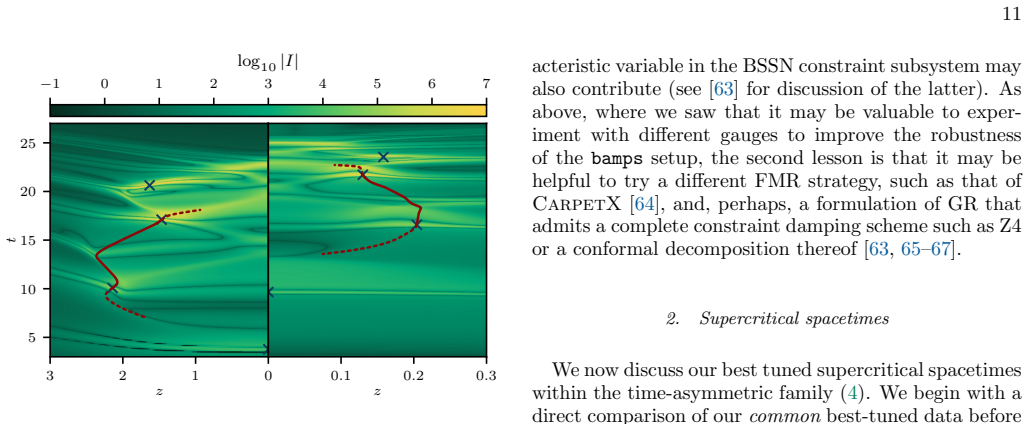
- [Fig. 11] Fig. 11: The positions of the unclassified intermediate amplitudes are shown only as discrete markers; a short statement of the coordinate times at which those maxima were recorded would make the figure self-contained.
- [Introduction] References: The recent review arXiv:2507.07636 is cited as [3]; given its comprehensive coverage of the same topic, a brief forward pointer in the introduction would be useful for non-specialist readers.
Circularity Check
Empirical multi-code numerical comparison of vacuum Einstein solutions; no fitted quantities re-labeled as predictions and no load-bearing self-citation reductions.
full rationale
The paper's central claims (quantitative agreement of bamps/prague/sphGR on curvature scaling, single/double-null profiles, and AH masses across Brill and time-asymmetric families; consequent support for non-universality at current fine-tuning) are obtained by direct numerical evolution of the vacuum Einstein equations under independent formulations/gauges/grids, followed by post-processing comparisons. Power-law/period fits (Table II, Eq. 8, Fig. 4) are descriptive characterizations of the produced data for each family separately; they are not used to 'predict' any closely related quantity that is forced by construction. Reference coordinates (single-null, double-null) are constructed from the numerical metrics themselves and merely re-express the same data for visual comparison; agreement is empirical, not definitional. Prior self-citations ([6–9], [18]) supply methods and earlier families but are not load-bearing uniqueness theorems or ansatze that force the present results; the new evolutions (time-asymmetric data in bamps, off-center Brill in prague/sphGR) and cross-code checks stand independently. No self-definitional loop, fitted-input-as-prediction, or renaming of a known result appears. The fine-tuning caveat is openly stated by the authors and does not constitute circularity.
Axiom & Free-Parameter Ledger
free parameters (3)
- initial-data amplitude A (and critical estimate A*)
- gauge parameters (p, η_L, η_S) in bamps
- mesh-refinement and resolution parameters
axioms (3)
- domain assumption Vacuum Einstein equations Gab=0 hold and the spacetime is twist-free axisymmetric
- domain assumption Apparent horizons (outermost MOTS) are a reliable quasilocal proxy for black-hole formation
- ad hoc to paper Power-law plus periodic wiggle form (Eq. 8) is an adequate phenomenological fit for curvature maxima
read the original abstract
The threshold of black hole formation in axisymmetric vacuum gravity is proving to be more complicated than had been anticipated but, following recent advances, a consensus between independent codes and methods is emerging. Building on earlier work we provide further details of a comparison between three independent numerical codes (the bamps, prague, and sphGR codes), paying special attention to the relative strengths and weaknesses of each and examining various features of near-threshold collapse of vacuum gravitational waves for the first time. In particular, we observe quasi-universal strong-field features appearing in curvature scalars. Focusing on geometric features on the symmetry axis, we construct reference coordinates to aid the comparison of strong-field data. We evolve, for the first time, time-asymmetric wave initial data within the bamps code. To the extent possible with current methods we compare apparent horizons and attempt to determine what causes difficulties in the classification of these strong-field and highly dynamical spacetimes. In all cases the results from the three codes agree very well.
Figures





Reference graph
Works this paper leans on
-
[1]
These were unveiled by plotting geometric scalars along geodesics connecting neighboring peaks in the curvature
Subcritical spacetimes The most important discovery of [6] was the presence of quasi-universal features in twist-free spacetimes close to the threshold. These were unveiled by plotting geometric scalars along geodesics connecting neighboring peaks in the curvature. In axisymmetry, the scalar ζ= 1− ∇ aρ∇aρ ρ2 ,(9) withρthe circumferential radius, is a geom...
-
[2]
We begin with a direct comparison of ourcommonbest-tuned data before giving an overview of thebampsdata beyond which our current bisection breaks down
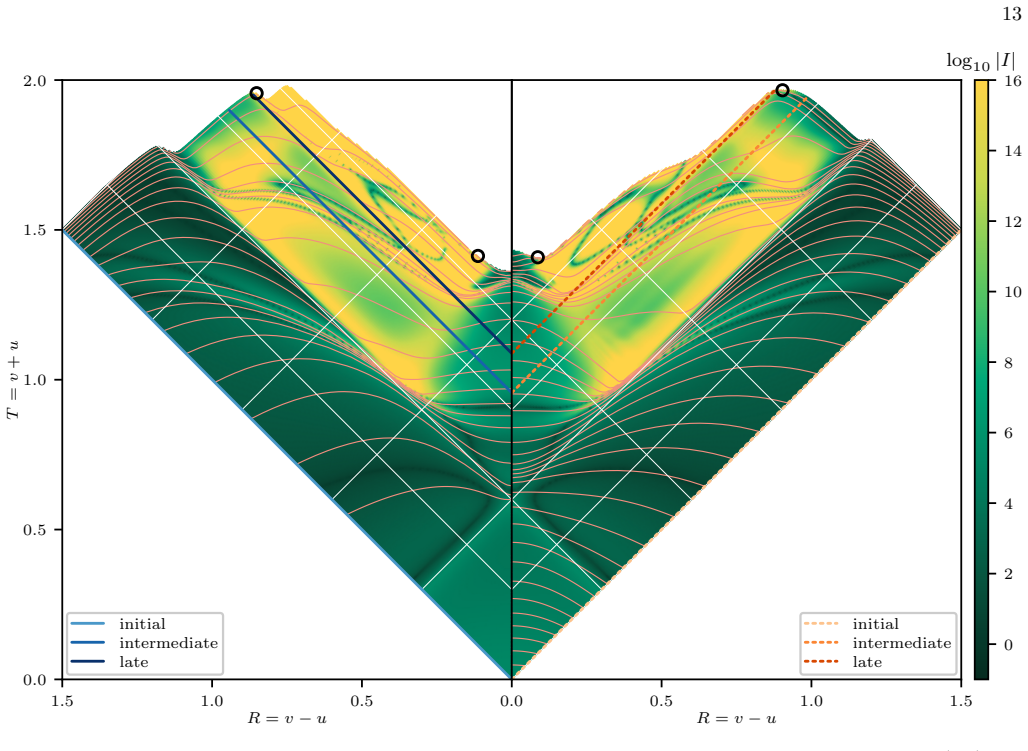
Supercritical spacetimes We now discuss our best tuned supercritical spacetimes within the time-asymmetric family (4). We begin with a direct comparison of ourcommonbest-tuned data before giving an overview of thebampsdata beyond which our current bisection breaks down. Comparing best tuned common supercritical spacetimes We use double-null coordinates to...
2022
-
[3]
This work was partially supported by FCT (Portugal) through grant Numbers UID/00099/2025, UID/PRR/00099/2025 and 2023.12549.PEX. Numerical simulations were performed at the Leibniz Supercomputing Centre (LRZ) [sup- ported by projects pn34vo and pn36je], the Deucalion supercomputer at the Minho Ad- vanced Computing Center (MACC) [with FCT/FCCN projects 202...
arXiv 2025
-
[4]
M. W. Choptuik, Universality and scaling in gravita- tional collapse of a massless scalar field, Phys. Rev. Lett. 70, 9 (1993)
1993
-
[5]
C. Gundlach and J. M. Mart´ ın-Garc´ ıa, Critical Phenom- ena in Gravitational Collapse, Living Reviews in Rela- tivity10, 5 (2007), arXiv:0711.4620 [gr-qc]
Pith/arXiv arXiv 2007
-
[6]
C. Gundlach, D. Hilditch, and J. M. Mart´ ın-Garc´ ıa, Crit- ical Phenomena in Gravitational Collapse, arXiv e-prints (2025), arXiv:2507.07636 [gr-qc]
Pith/arXiv arXiv 2025
-
[7]
A. M. Abrahams and C. R. Evans, Critical behavior and scaling in vacuum axisymmetric gravitational collapse, Phys. Rev. Lett.70, 2980 (1993)
1993
-
[8]
A. M. Abrahams and C. R. Evans, Universality in ax- isymmetric vacuum collapse, Phys. Rev. D49, 3998 (1994)
1994
-
[9]
T. Ledvinka and A. Khirnov, Universality of Curvature Invariants in Critical Vacuum Gravitational Collapse, Phys. Rev. Lett.127, 011104 (2021), arXiv:2102.09579 [gr-qc]
Pith/arXiv arXiv 2021
-
[10]
I. Su´ arez Fern´ andez, S. Renkhoff, D. Cors Agull´ o, B. Br¨ ugmann, and D. Hilditch, Evolution of Brill waves with an adaptive pseudospectral method, Phys. Rev. D 106, 024036 (2022), arXiv:2205.04379 [gr-qc]
Pith/arXiv arXiv 2022
-
[11]
T. W. Baumgarte, C. Gundlach, and D. Hilditch, Critical phenomena in the collapse of quadrupolar and hexade- capolar gravitational waves, Phys. Rev. D107, 084012 (2023), arXiv:2303.05530 [gr-qc]
Pith/arXiv arXiv 2023
-
[12]
T. W. Baumgarte, B. Br¨ ugmann, D. Cors, C. Gund- lach, D. Hilditch, A. Khirnov, T. Ledvinka, S. Renkhoff, and I. S. Fern´ andez, Critical Phenomena in the Collapse of Gravitational Waves, Phys. Rev. Lett.131, 181401 (2023), arXiv:2305.17171 [gr-qc]
Pith/arXiv arXiv 2023
-
[13]
Eppley, Pure gravitational waves, inWorkshop on Sources of Gravitational Radiation(1979) pp
K. Eppley, Pure gravitational waves, inWorkshop on Sources of Gravitational Radiation(1979) pp. 275–291
1979
-
[14]
S. M. Miyama, Time Evolution of Pure Gravitational Waves, Prog. Theor. Phys.65, 894 (1981)
1981
-
[15]
M. Alcubierre, G. Allen, B. Br¨ ugmann, G. Lanfermann, E. Seidel, W.-M. Suen, and M. Tobias, Gravitational col- lapse of gravitational waves in 3D numerical relativity, Phys. Rev. D61, 041501 (2000), arXiv:gr-qc/9904013 [gr-qc]
Pith/arXiv arXiv 2000
-
[16]
D. Garfinkle and G. C. Duncan, Numerical evolution of Brill waves, Phys. Rev. D63, 044011 (2001), arXiv:gr- qc/0006073 [gr-qc]
arXiv 2001
-
[17]
O. Rinne, Constrained evolution in axisymmetry and the gravitational collapse of prolate Brill waves, Classical and Quantum Gravity25, 135009 (2008), arXiv:0802.3791 [gr-qc]
Pith/arXiv arXiv 2008
-
[18]
Sorkin, On critical collapse of gravitational waves, Class
E. Sorkin, On critical collapse of gravitational waves, Class. Quant. Grav.28, 025011 (2011), arXiv:1008.3319 [gr-qc]
Pith/arXiv arXiv 2011
-
[19]
D. Hilditch, T. W. Baumgarte, A. Weyhausen, T. Di- etrich, B. Br¨ ugmann, P. J. Montero, and E. M¨ uller, Collapse of nonlinear gravitational waves in moving- puncture coordinates, Phys. Rev. D88, 103009 (2013), arXiv:1309.5008 [gr-qc]
Pith/arXiv arXiv 2013
-
[20]
D. Hilditch, A. Weyhausen, and B. Br¨ ugmann, Evo- lutions of centered Brill waves with a pseudospec- tral method, Phys. Rev. D96, 104051 (2017), arXiv:1706.01829 [gr-qc]
Pith/arXiv arXiv 2017
-
[21]
Khirnov,Representation of dynamical black hole spacetimes in numerical simulations, Ph.D
A. Khirnov,Representation of dynamical black hole spacetimes in numerical simulations, Ph.D. thesis, Charles University, Prague (2021)
2021
-
[22]
T. W. Baumgarte, C. Gundlach, and D. Hilditch, Critical 16 collapse of vacuum spacetimes: Nakamura wave initial data, arXiv e-prints (2026), arXiv:2606.27431 [gr-qc]
Pith/arXiv arXiv 2026
-
[23]
D. R. Brill, On the positive definite mass of the Bondi- Weber-Wheeler time-symmetric gravitational waves, An- nals of Physics7, 466 (1959)
1959
-
[24]
D. Hilditch, A. Weyhausen, and B. Br¨ ugmann, Pseu- dospectral method for gravitational wave collapse, Phys. Rev. D93, 063006 (2016), arXiv:1504.04732 [gr-qc]
Pith/arXiv arXiv 2016
-
[25]
A. Khirnov and T. Ledvinka, Slicing conditions for axisymmetric gravitational collapse of Brill waves, Classical and Quantum Gravity35, 215003 (2018), arXiv:1908.06034 [gr-qc]
Pith/arXiv arXiv 2018
-
[26]
S. A. Teukolsky, Linearized quadrupole waves in general relativity and the motion of test particles, Phys. Rev. D 26, 745 (1982)
1982
-
[27]
Rinne, Explicit solution of the linearized Einstein equations in TT gauge for all multipoles, Class
O. Rinne, Explicit solution of the linearized Einstein equations in TT gauge for all multipoles, Class. Quan- tum Grav.26, 048003 (2009), arXiv:0809.1761 [gr-qc]
Pith/arXiv arXiv 2009
-
[28]
T. Nakamura, General Solutions to the Linearized Ein- stein Equations and Initial Data for Three Dimensional Time Evolution of Pure Gravitational Waves, Progress of Theoretical Physics72, 746 (1984)
1984
-
[29]
Shibata and T
M. Shibata and T. Nakamura, Evolution of three- dimensional gravitational waves: Harmonic slicing case, Phys. Rev. D52, 5428 (1995)
1995
-
[30]
Rostworowski, Vacuum axisymmetric gravitational collapse revisited: Preliminary investigation, Phys
A. Rostworowski, Vacuum axisymmetric gravitational collapse revisited: Preliminary investigation, Phys. Rev. D111, 104067 (2025), arXiv:2503.17549 [gr-qc]
Pith/arXiv arXiv 2025
-
[31]
Br¨ ugmann, A pseudospectral matrix method for time- dependent tensor fields on a spherical shell, J
B. Br¨ ugmann, A pseudospectral matrix method for time- dependent tensor fields on a spherical shell, J. Comput. Phys.235, 216 (2013”), arXiv:1104.3408 [physics.comp- ph]
Pith/arXiv arXiv 2013
-
[32]
S. Renkhoff, D. Cors, D. Hilditch, and B. Br¨ ugmann, Adaptive hp refinement for spectral elements in nu- merical relativity, Phys. Rev. D107, 104043 (2023), arXiv:2302.00575 [gr-qc]
Pith/arXiv arXiv 2023
-
[33]
D. Cors, S. Renkhoff, H. R. R¨ uter, D. Hilditch, and B. Br¨ ugmann, Formulation improvements for critical col- lapse simulations, Phys. Rev. D108, 124021 (2023), arXiv:2308.01812 [gr-qc]
Pith/arXiv arXiv 2023
-
[34]
Pretorius, Numerical relativity using a generalized harmonic decomposition, Class
F. Pretorius, Numerical relativity using a generalized harmonic decomposition, Class. Quant. Grav.22, 425 (2005), arXiv:gr-qc/0407110
Pith/arXiv arXiv 2005
-
[35]
L. Lindblom, M. A. Scheel, L. E. Kidder, R. Owen, and O. Rinne, A new generalized harmonic evolution sys- tem, Classical and Quantum Gravity23, S447 (2006), arXiv:gr-qc/0512093 [gr-qc]
Pith/arXiv arXiv 2006
-
[36]
Cactus Computational Toolkit home page
-
[37]
F. L¨ offler, J. Faber, E. Bentivegna, T. Bode, P. Diener, R. Haas, I. Hinder, B. C. Mundim, C. D. Ott, E. Schnet- ter, G. Allen, M. Campanelli, and P. Laguna, The Ein- stein Toolkit: a community computational infrastruc- ture for relativistic astrophysics, Classical and Quantum Gravity29, 115001 (2012), arXiv:1111.3344 [gr-qc]
Pith/arXiv arXiv 2012
-
[38]
M. Zilh˜ ao and F. L¨ offler, An Introduction to the Ein- stein Toolkit, Int. J. Mod. Phys. A28, 1340014 (2013), arXiv:1305.5299 [gr-qc]
Pith/arXiv arXiv 2013
-
[39]
Nakamura, K
T. Nakamura, K. Oohara, and Y. Kojima, General Rela- tivistic Collapse to Black Holes and Gravitational Waves from Black Holes, Progress of Theoretical Physics Sup- plement90, 1 (1987)
1987
-
[40]
T. W. Baumgarte and S. L. Shapiro, Numerical inte- gration of Einstein’s field equations, Phys. Rev. D59, 024007 (1998), arXiv:gr-qc/9810065 [gr-qc]
Pith/arXiv arXiv 1998
-
[41]
T. W. Baumgarte, P. J. Montero, I. Cordero-Carri´ on, and E. M¨ uller, Numerical relativity in spherical polar co- ordinates: Evolution calculations with the BSSN formu- lation, Phys. Rev. D87, 044026 (2013), arXiv:1211.6632 [gr-qc]
Pith/arXiv arXiv 2013
-
[42]
T. W. Baumgarte, P. J. Montero, and E. M¨ uller, Nu- merical Relativity in Spherical Polar Coordinates: Off- center Simulations, Phys. Rev. D91, 064035 (2015), arXiv:1501.05259 [gr-qc]
Pith/arXiv arXiv 2015
-
[43]
Alcubierre, Appearance of coordinate shocks in hy- perbolic formalisms of general relativity, Phys
M. Alcubierre, Appearance of coordinate shocks in hy- perbolic formalisms of general relativity, Phys. Rev. D 55, 5981 (1997), arXiv:gr-qc/9609015 [gr-qc]
Pith/arXiv arXiv 1997
-
[44]
Alcubierre, Hyperbolic slicings of spacetime: singular- ity avoidance and gauge shocks, Class
M. Alcubierre, Hyperbolic slicings of spacetime: singular- ity avoidance and gauge shocks, Class. Quantum Grav. 20, 607 (2003), gr-qc/0210050
Pith/arXiv arXiv 2003
-
[45]
T. W. Baumgarte and D. Hilditch, Shock-avoiding slicing conditions: Tests and calibrations, Phys. Rev. D106, 044014 (2022), arXiv:2207.06376 [gr-qc]
Pith/arXiv arXiv 2022
-
[46]
R. Beig, P. T. Chru´ sciel, and W. Cong, Who’s afraid of a negative lapse?, arXiv e-prints (2025), arXiv:2505.03516 [gr-qc]
arXiv 2025
-
[47]
C. Bona, J. Mass´ o, E. Seidel, and J. Stela, New Formal- ism for Numerical Relativity, Phys. Rev. Lett.75, 600 (1995), gr-qc/9412071
Pith/arXiv arXiv 1995
-
[48]
Alcubierre,Introduction to 3+1 Numerical Relativity (Oxford University Press, Oxford, 2008)
M. Alcubierre,Introduction to 3+1 Numerical Relativity (Oxford University Press, Oxford, 2008)
2008
-
[49]
T. W. Baumgarte and S. L. Shapiro,Numerical Relativ- ity: Solving Einstein’s Equations on the Computer(Cam- bridge University Press, Cambridge, 2010)
2010
-
[50]
Thornburg, Event and apparent horizon finders for 3+1 numerical relativity, Living Rev
J. Thornburg, Event and apparent horizon finders for 3+1 numerical relativity, Living Rev. Rel.10, 3 (2007), arXiv:gr-qc/0512169
Pith/arXiv arXiv 2007
-
[51]
D. Pook-Kolb, O. Birnholtz, B. Krishnan, and E. Schnet- ter, Existence and stability of marginally trapped sur- faces in black-hole spacetimes, Phys. Rev. D99, 064005 (2019), arXiv:1811.10405 [gr-qc]
Pith/arXiv arXiv 2019
-
[52]
D. Garfinkle and G. C. Duncan, Scaling of curvature in subcritical gravitational collapse, Phys. Rev. D58, 064024 (1998), arXiv:gr-qc/9802061 [gr-qc]
Pith/arXiv arXiv 1998
-
[53]
Gundlach, Understanding critical collapse of a scalar field, Phys
C. Gundlach, Understanding critical collapse of a scalar field, Phys. Rev. D , 695 (1997), arXiv:gr-qc/9604019 [gr- qc]
Pith/arXiv arXiv 1997
- [54]
-
[55]
M. W. Choptuik, E. W. Hirschmann, S. L. Liebling, and F. Pretorius, Critical collapse of the massless scalar field in axisymmetry, Phys. Rev. D68, 044007 (2003), arXiv:gr-qc/0305003 [gr-qc]
Pith/arXiv arXiv 2003
-
[56]
T. W. Baumgarte, Aspherical deformations of the Choptuik spacetime, Phys. Rev. D98, 084012 (2018), arXiv:1807.10342 [gr-qc]
Pith/arXiv arXiv 2018
-
[57]
K. Marouda, D. Cors, H. R. R¨ uter, F. Atteneder, and D. Hilditch, Twist-free axisymmetric critical collapse of a complex scalar field, Phys. Rev. D109, 124042 (2024), arXiv:2402.06724 [gr-qc]
Pith/arXiv arXiv 2024
-
[58]
C. Gundlach, T. W. Baumgarte, and D. Hilditch, Sim- ulations of gravitational collapse in null coordinates. II. Critical collapse of an axisymmetric scalar field, Phys. Rev. D110, 024019 (2024), arXiv:2404.15839 [gr-qc]
Pith/arXiv arXiv 2024
-
[59]
M. W. Choptuik, E. W. Hirschmann, S. L. Liebling, and F. Pretorius, Critical collapse of a complex scalar field with angular momentum, Phys. Rev. Lett.93, 131101 17 (2004), arXiv:gr-qc/0405101
Pith/arXiv arXiv 2004
-
[60]
K. Marouda, D. Cors, H. R. R¨ uter, A. Va˜ no-Vi˜ nuales, and D. Hilditch, Twist and higher modes of a complex scalar field at the threshold of collapse, Phys. Rev. D 113, 024062 (2026), arXiv:2511.04649 [gr-qc]
arXiv 2026
-
[61]
T. W. Baumgarte, C. Gundlach, and D. Hilditch, Criti- cal Phenomena in the Gravitational Collapse of Electro- magnetic Waves, Phys. Rev. Lett.123, 171103 (2019), arXiv:1909.00850 [gr-qc]
Pith/arXiv arXiv 2019
-
[62]
M. F. Perez Mendoza and T. W. Baumgarte, Critical phenomena in the gravitational collapse of electromag- netic dipole and quadrupole waves, Phys. Rev. D103, 124048 (2021), arXiv:2104.03980 [gr-qc]
Pith/arXiv arXiv 2021
-
[63]
G. D. Reid and M. W. Choptuik, Universality in the crit- ical collapse of the Einstein-Maxwell system, Phys. Rev. D108, 104021 (2023), arXiv:2308.03943 [gr-qc]
Pith/arXiv arXiv 2023
-
[64]
L. Lindblom and B. Szilagyi, An Improved Gauge Driver for the GH Einstein System, Phys. Rev. D80, 084019 (2009), arXiv:0904.4873 [gr-qc]
Pith/arXiv arXiv 2009
-
[65]
S. Bernuzzi and D. Hilditch, Constraint violation in free evolution schemes: comparing BSSNOK with a con- formal decomposition of Z4, Phys. Rev. D81, 084003 (2010), arXiv:0912.2920 [gr-qc]
Pith/arXiv arXiv 2010
-
[66]
S. Shankar, P. M¨ osta, S. R. Brandt, R. Haas, E. Schnet- ter, and Y. de Graaf, GRaM-X: a new GPU-accelerated dynamical spacetime GRMHD code for Exascale com- puting with the Einstein Toolkit, Class. Quant. Grav. 40, 205009 (2023), arXiv:2210.17509 [astro-ph.IM]
arXiv 2023
-
[67]
C. Bona, T. Ledvinka, C. Palenzuela, and M. ˇZ´ aˇ cek, General-covariant evolution formalism for numerical rel- ativity, Phys. Rev. D67, 104005 (2003), gr-qc/0302083
Pith/arXiv arXiv 2003
-
[68]
C. Gundlach, J. M. Martin-Garcia, G. Calabrese, and I. Hinder, Constraint damping in the Z4 formulation and harmonic gauge, Class. Quantum Grav.22, 3767 (2005), gr-qc/0504114
Pith/arXiv arXiv 2005
-
[69]
A. Weyhausen, S. Bernuzzi, and D. Hilditch, Constraint damping for the Z4c formulation of general relativity, Phys. Rev. D85, 024038 (2012), arXiv:1107.5539 [gr-qc]
Pith/arXiv arXiv 2012
discussion (0)
Sign in with ORCID, Apple, or X to comment. Anyone can read and Pith papers without signing in.