REVIEW 2 major objections 5 minor 47 references
Needles in Haystacks: On Classifying Tiny Objects in Large Images
T0 review · 2 major / 5 minor · reviewed 2026-08-14 · deepseek-v4-flash
Pith's one-line read The paper claims that image-level CNN classifiers have a minimum object size for a given training budget, and that the training data needed rises steeply as the object-to-image ratio shrinks.
desk verdict Useful testbed and a lot of honest empiricism, but the headline O2I scaling law is confounded by clutter count in nMNIST. read the letter →
The pith
A machine-rendered reading of the paper's core claim, the machinery that carries it, and where it could break.
The reading
What carries the argument
The central object is the object-to-image (O2I) ratio, defined as the area of the class-relevant object divided by the area of the image. The argument is carried by two controlled datasets: a synthetic cluttered-digit set the paper calls nMNIST, which places a fixed 28-by-28 digit on canvases from 64-by-64 to 1024-by-1024 pixels while scaling the number of distractor digits from 2 to 400 to keep clutter density roughly constant, and a histopathology crop set the paper calls nCAMELYON, derived from pixel-level lesion annotations. Around this testbed the paper varies three network properties independently: receptive field size, model capacity, and the global pooling operation, using a convolutional backbone that permits explicit receptive-field control.
What would settle it
Re-run the 1024-by-1024 digit experiment with the same 0.075% object-to-image ratio but with, say, 10 clutter digits instead of 400; if the network then classifies above chance, the O2I limit is really a clutter-count limit, and the paper's headline scaling would not transfer to constant-clutter settings.
Extended reading notes
Core claim
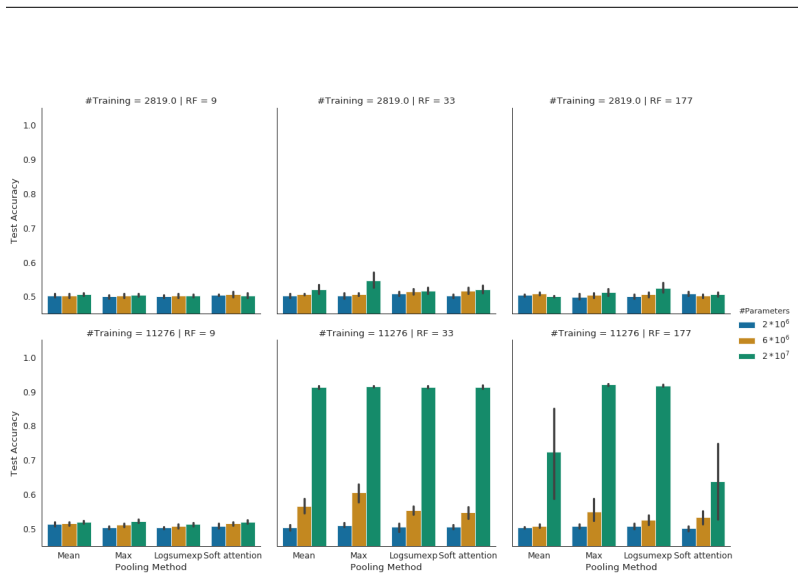
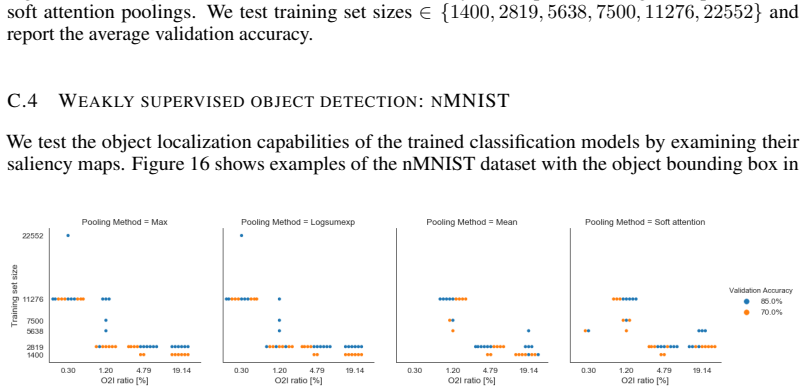
On its own terms, the paper's central claim is that there is a minimum object-to-image ratio for a given CNN training budget, and that below this ratio image-level classifiers do not beat random guessing on held-out data. More data lowers the floor, but only at a steep cost: the number of training examples needed to reach a fixed validation accuracy rises quickly as the object-to-image ratio drops, so the gains from simply collecting more data diminish sharply. The paper also reports that at small object-to-image ratios higher-capacity models generalize better, that a receptive field matched to or larger than the object helps when the object size is known, and that global max pooling is the most reliable choice for very small signals, while pooling choice matters little at larger ratios.
Load-bearing premise
The load-bearing premise is that the failure threshold is controlled by the object's share of the image, but the main testbed changes the number of distractor digits together with the canvas size, so the claimed scaling could be driven by crowding rather than by object size.
Editorial extensions
If this is right
- At any fixed training-set size there is a smallest object size for which an image-level CNN can classify better than chance, so practitioners working with very small targets should expect random performance unless they can grow the dataset.
- Dataset collection effort must grow much faster than the reduction in object size: a small further decrease in the object-to-image ratio demands a large increase in training examples to hold accuracy.
- Raising model capacity improves low-signal generalization, but the benefit shrinks when the training set is small, so capacity alone is not a substitute for data.
- If an approximate object size is known, setting the receptive field to cover it is a useful inductive bias; the wrong pooling choice can hurt optimization mainly in the very low signal-to-noise regime.
Reading between the lines
- Because the digit testbed raises canvas size and clutter count together, the inverse-O2I scaling may actually measure how well the network can ignore many distractor objects rather than how small the target is; decoupling object size from clutter density would settle which variable drives the floor.
- If the floor is largely a crowding effect, then a detection module that first proposes candidate locations could push the O2I limit lower without additional data, since the classifier would no longer need to aggregate over thousands of irrelevant patches.
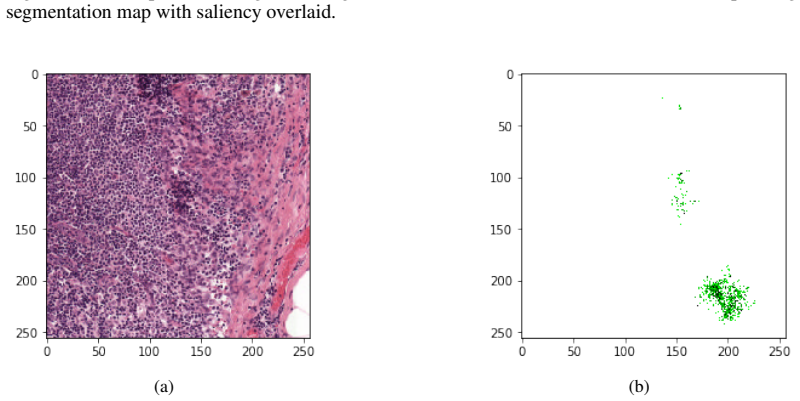
- The saliency results already show localization quality degrades faster than classification at small O2I, suggesting that the limit may be even lower for weakly supervised detection than for classification; that gap deserves its own scaling curve.
- For pathology, the scaling result implies that weakly supervised whole-slide classification at clinically realistic O2I levels would need tens of thousands of slides, so the practical bottleneck is data-efficient inductive biases rather than raw dataset collection.
Signed reviews
Editorial analysis
A structured set of objections, weighed in public.
Referee Report
Summary. The paper introduces two synthetic 'needle-in-a-haystack' testbeds, nMNIST and nCAMELYON, to study image-level binary classification when the object of interest occupies a very small fraction of the image (low object-to-image, O2I, ratio). Using a BagNet-style backbone with controlled receptive fields, capacities, and four global pooling operations, the authors report four empirical observations: (1) there is an O2I limit below which CNNs fail to generalize, and the amount of training data needed for generalization scales rapidly with the inverse of O2I; (2) higher-capacity models generalize better; (3) matching the receptive field to the object size is beneficial on nMNIST but not on nCAMELYON; and (4) global pooling choice affects optimization at the smallest O2I values. The main evidence for the headline scaling law comes from Fig. 6b, which is computed from nMNIST experiments over six training-set sizes and six seeds per configuration.
Significance. The paper addresses a practically important and understudied regime, and the testbed itself is a useful resource: nMNIST provides controlled O2I variation, and the experiments are unusually extensive for a study of this type, with 48 architectures, six seeds per run, and more than 750 reported experiments. If the scaling claim holds, it quantifies a real bottleneck for image-level CNN classifiers on tiny-object tasks. The code-release statement, if honored, would make the testbed reproducible. However, the central quantitative claim about inverse-O2I scaling is currently entangled with a second, uncontrolled factor, distractor count, and the nCAMELYON dataset is too small and too coarsely controlled to provide independent confirmation. The paper's usefulness as a testbed is therefore stronger than the evidence for its headline law.
major comments (2)
- [Section 2.1 and Section 3.1 (Fig. 6b)] The nMNIST generator does not vary O2I independently of clutter count. To maintain approximately constant clutter density, the canvas sizes 64, 128, 256, 512, and 1024 pixels are paired with 2, 5, 25, 100, and 400 clutter digits, respectively. Every low-O2I condition is therefore also a high-distractor condition, and the positive decision at 0.075% O2I is 'find one 3 among 401 digits' rather than 'find a 28x28 object in a 1024x1024 image'. The abstract's claim that required training-set size scales rapidly with inverse O2I is read directly from Fig. 6b, which uses only this confounded sweep; no dataset-size sweep is run on nCAMELYON. Please add control experiments that vary O2I at a fixed clutter count (e.g., keep 25 distractors while enlarging the canvas), or vary clutter count at fixed O2I, and report whether the scaling law still holds when the two factors are separated.
- [Section 3.1 (Figs. 6, 7, 8)] The reported validation and test accuracies in Figs. 6a, 7, and 8 condition on optimization success: Fig. 6a averages only pipeline configurations that surpassed 70% training accuracy, and Figs. 7 and 8 report only runs that fit the training data, replacing non-fitting runs with random accuracy and a textured bar. This conditioning is stated in the captions, but it means the heatmaps and bar heights reflect generalization conditional on successful training, not the unconditional behavior of the architectures. Please report the fraction of runs that satisfy the conditioning, and show at least one unconditional accuracy result (or state explicitly whether the qualitative conclusions change when all runs are included).
minor comments (5)
- [Section 3.1 (Inductive bias paragraph)] The abbreviation 'nMINIST' appears instead of 'nMNIST'; please fix this typo.
- [Section 2.1] The sentence 'We maintain approximately constant clutter density over different O2I ratios' would be easier to verify if the actual densities (clutter count multiplied by digit area divided by canvas area) were listed for each O2I value, since the chosen counts give only approximate constancy.
- [Figure 6b] Please add explicit axis labels and a description of how 'minimum required training set size' is obtained from the six tested sizes; currently the reader must infer whether the values are interpolated or chosen among the grid points.
- [Section 2.1 (nCAMELYON)] The center-wise train/validation/test split is described only in the supplementary material; it should be stated in the main text because it is important for interpreting the nCAMELYON results.
- [Tables 1 and 2] There are small typographical issues, e.g., 'differen O2I ratios' in Table 1 and inconsistent use of 'O2IR' versus 'O2I ratio' in the supplementary text; please standardize.
Circularity Check
No circularity: the scaling claims are direct empirical testbed measurements, and the O2I/clutter co-variation is an external-validity confound, not a circular reduction.
full rationale
The paper makes no fitted-parameter-then-predict move and no first-principles derivation that could reduce to its own inputs. The central claim that required training set size grows rapidly as O2I shrinks (Section 3.1, Figures 5a, 6a-b) is an empirical reading of validation and test accuracy over datasets the authors constructed; the O2I levels are realized by canvas resolution and the training-size thresholds are measured, not derived from the definition of O2I. The generation procedure in Section 2.1 does vary clutter count together with canvas size (2, 5, 25, 100, 400 distractors for O2I 19.1% down to 0.075%) to keep clutter density approximately constant; this is a real confound for transferring the headline law to settings where clutter count is fixed, but it is an experimental-design limitation, not a circularity, because neither O2I nor the threshold is defined in terms of the other. Self-citations such as Arpit et al. 2017 and Jastrzebski et al. 2017, which include one of the present authors, appear only as related-work context and are not load-bearing for the O2I claims. The authors themselves flag the main limitation: 'due to the lack of large scale datasets that allow for explicit control of the input signal-to-noise ratios, we were forced to use the synthetically built nMNIST dataset for most of our analysis.' That statement, together with the small nCAMELYON lesion counts, supports treating the paper's results as controlled testbed observations rather than as a derivation whose conclusion is presupposed. No circular step can be exhibited with a specific equation or renamed fitted quantity; therefore the appropriate finding is no significant circularity.
Assumptions & free parameters
assumptions (4)
- domain assumption Object-to-image area ratio is an adequate proxy for classification signal-to-noise, with the annotated object as the label-relevant signal.
- domain assumption Keeping clutter density constant across O2I levels isolates the effect of object size rather than introducing a confound.
- domain assumption Positive and negative nCAMELYON crops differ only in the presence of the lesion, not in crop position, tissue composition, or acquisition site.
- domain assumption The chosen pipeline, a BagNet backbone with InstanceNorm, RMSProp, fixed schedule, and global pooling, is representative enough to support conclusions about CNNs generally.
Cite this review
Pith. "Pith review of Needles in Haystacks: On Classifying Tiny Objects in Large Images." pith.science (2026). https://pith.science/paper/RQJ6Y3OP
@misc{pith2026190806037,
  author       = {Pith},
  title        = {Pith review of: Needles in Haystacks: On Classifying Tiny Objects in Large Images},
  year         = {2026},
  howpublished = {\url{https://pith.science/paper/RQJ6Y3OP}},
  note         = {Machine review of arXiv:1908.06037}
}
read the original abstract
In some important computer vision domains, such as medical or hyperspectral imaging, we care about the classification of tiny objects in large images. However, most Convolutional Neural Networks (CNNs) for image classification were developed using biased datasets that contain large objects, in mostly central image positions. To assess whether classical CNN architectures work well for tiny object classification we build a comprehensive testbed containing two datasets: one derived from MNIST digits and one from histopathology images. This testbed allows controlled experiments to stress-test CNN architectures with a broad spectrum of signal-to-noise ratios. Our observations indicate that: (1) There exists a limit to signal-to-noise below which CNNs fail to generalize and that this limit is affected by dataset size - more data leading to better performances; however, the amount of training data required for the model to generalize scales rapidly with the inverse of the object-to-image ratio (2) in general, higher capacity models exhibit better generalization; (3) when knowing the approximate object sizes, adapting receptive field is beneficial; and (4) for very small signal-to-noise ratio the choice of global pooling operation affects optimization, whereas for relatively large signal-to-noise values, all tested global pooling operations exhibit similar performance.
Figures


Figures from the paper (15 more)





Reference graph
Works this paper leans on
-
[1]
write newline
" write newline "" before.all 'output.state := FUNCTION n.dashify 't := "" t empty not t #1 #1 substring "-" = t #1 #2 substring "--" = not "--" * t #2 global.max substring 't := t #1 #1 substring "-" = "-" * t #2 global.max substring 't := while if t #1 #1 substring * t #2 global.max substring 't := if while FUNCTION format.date year duplicate empty "emp...
-
[2]
Amjad Almahairi, Nicolas Ballas, Tim Cooijmans, Yin Zheng, Hugo Larochelle, and Aaron Courville. Dynamic capacity networks. In International Conference on Machine Learning, pp.\ 2549--2558, 2016
work page 2016
-
[3]
BACH: Grand Challenge on Breast Cancer Histology Images
Guilherme Aresta, Teresa Ara \' u jo, Scotty Kwok, Sai Saketh Chennamsetty, Mohammed Safwan K. P., Alex Varghese, Bahram Marami, Marcel Prastawa, Monica Chan, Michael J. Donovan, Gerardo Fernandez, Jack Zeineh, Matthias Kohl, Christoph Walz, Florian Ludwig, Stefan Braunewell, Maximilian Baust, Quoc Dang Vu, Minh Nguyen Nhat To, Eal Kim, Jin Tae Kwak, Same...
work page Pith review arXiv 2018
-
[4]
Jastrzebski, Nicolas Ballas, David Krueger, Emmanuel Bengio, Maxinder S
Devansh Arpit, Stanislaw K. Jastrzebski, Nicolas Ballas, David Krueger, Emmanuel Bengio, Maxinder S. Kanwal, Tegan Maharaj, Asja Fischer, Aaron C. Courville, Yoshua Bengio, and Simon Lacoste - Julien. A closer look at memorization in deep networks. In Proceedings of the 34th International Conference on Machine Learning, ICML 2017, Sydney, NSW, Australia, ...
work page 2017
-
[5]
Multiple object recognition with visual attention
Jimmy Ba, Volodymyr Mnih, and Koray Kavukcuoglu. Multiple object recognition with visual attention. In ICLR , 2015
work page 2015
-
[6]
Benchmarking of image registration methods for differently stained histological slides
Jiri Borovec, Arrate Munoz-Barrutia, and Jan Kybic. Benchmarking of image registration methods for differently stained histological slides. 10 2018. doi:10.1109/icip.2018.8451040
arXiv 2018
-
[7]
Approximating CNN s with bag-of-local-features models works surprisingly well on imagenet
Wieland Brendel and Matthias Bethge. Approximating CNN s with bag-of-local-features models works surprisingly well on imagenet. In International Conference on Learning Representations, 2019. URL https://openreview.net/forum?id=SkfMWhAqYQ
work page 2019
-
[8]
P. Bándi , O. Geessink , Q. Manson , M. Van Dijk , M. Balkenhol , M. Hermsen , B. Ehteshami Bejnordi , B. Lee , K. Paeng , A. Zhong , Q. Li , F. G. Zanjani , S. Zinger , K. Fukuta , D. Komura , V. Ovtcharov , S. Cheng , S. Zeng , J. Thagaard , A. B. Dahl , H. Lin , H. Chen , L. Jacobsson , M. Hedlund , M. Çetin , E. Halıcı , H. Jackson , R. Chen , F. Both...
arXiv 2019
Show all 47 references
-
[9]
J. Deng, W. Dong, R. Socher, L.-J. Li, K. Li, and L. Fei-Fei. ImageNet: A Large-Scale Hierarchical Image Database . In CVPR09, 2009
2009
-
[10]
Babak Ehteshami Bejnordi, Mitko Veta, Paul Johannes van Diest, Bram van Ginneken, Nico Karssemeijer, Geert Litjens, Jeroen A. W. M. van der Laak, , and the CAMELYON16 Consortium. Diagnostic Assessment of Deep Learning Algorithms for Detection of Lymph Node Metastases in Women ...
2017
-
[11]
Deep Learning
Ian Goodfellow, Yoshua Bengio, and Aaron Courville. Deep Learning. MIT Press, 2016. http://www.deeplearningbook.org
2016
-
[12]
Co-teaching: Robust training of deep neural networks with extremely noisy labels
Bo Han, Quanming Yao, Xingrui Yu, Gang Niu, Miao Xu, Weihua Hu, Ivor Tsang, and Masashi Sugiyama. Co-teaching: Robust training of deep neural networks with extremely noisy labels. In Advances in Neural Information Processing Systems, pp.\ 8527--8537, 2018
2018
-
[13]
Where's Wally? Walker, 1987
Martin Handford. Where's Wally? Walker, 1987
1987
-
[14]
Deep residual learning for image recognition
Kaiming He, Xiangyu Zhang, Shaoqing Ren, and Jian Sun. Deep residual learning for image recognition. CoRR, abs/1512.03385, 2015. URL http://arxiv.org/abs/1512.03385
2015 arXiv
-
[15]
Identity mappings in deep residual networks
Kaiming He, Xiangyu Zhang, Shaoqing Ren, and Jian Sun. Identity mappings in deep residual networks. In European conference on computer vision, pp.\ 630--645. Springer, 2016
2016
-
[16]
Densely connected convolutional networks
Gao Huang, Zhuang Liu, Laurens Van Der Maaten, and Kilian Q Weinberger. Densely connected convolutional networks. In Proceedings of the IEEE conference on computer vision and pattern recognition, pp.\ 4700--4708, 2017
2017
-
[17]
Attention-based deep multiple instance learning
Maximilian Ilse, Jakub M Tomczak, and Max Welling. Attention-based deep multiple instance learning. arXiv preprint arXiv:1802.04712, 2018
2018 arXiv
-
[18]
Batch normalization: Accelerating deep network training by reducing internal covariate shift
Sergey Ioffe and Christian Szegedy. Batch normalization: Accelerating deep network training by reducing internal covariate shift. In Proceedings of the 32Nd International Conference on International Conference on Machine Learning - Volume 37, ICML'15, pp.\ 448--456. JMLR.org, ...
2015
-
[19]
Three factors influencing minima in sgd
Stanis aw Jastrz e bski, Zachary Kenton, Devansh Arpit, Nicolas Ballas, Asja Fischer, Yoshua Bengio, and Amos Storkey. Three factors influencing minima in sgd. arXiv preprint arXiv:1711.04623, 2017
2017 arXiv
-
[20]
Mentornet: Learning data-driven curriculum for very deep neural networks on corrupted labels
Lu Jiang, Zhengyuan Zhou, Thomas Leung, Li-Jia Li, and Li Fei-Fei. Mentornet: Learning data-driven curriculum for very deep neural networks on corrupted labels. arXiv preprint arXiv:1712.05055, 2017
2017 arXiv
-
[21]
Processing megapixel images with deep attention-sampling models
Angelos Katharopoulos and Fran c ois Fleuret. Processing megapixel images with deep attention-sampling models. arXiv preprint arXiv:1905.03711, 2019
1905 arXiv
-
[22]
Learning multiple layers of features from tiny images
Alex Krizhevsky. Learning multiple layers of features from tiny images. Technical report, 2009
2009
-
[23]
Imagenet classification with deep convolutional neural networks
Alex Krizhevsky, Ilya Sutskever, and Geoffrey E Hinton. Imagenet classification with deep convolutional neural networks. In F. Pereira, C. J. C. Burges, L. Bottou, and K. Q. Weinberger (eds.), Advances in Neural Information Processing Systems 25, pp.\ 1097--1105. Curran Associ...
2012
-
[24]
The handbook of brain theory and neural networks
Yann LeCun and Yoshua Bengio. The handbook of brain theory and neural networks. chapter Convolutional Networks for Images, Speech, and Time Series, pp.\ 255--258. MIT Press, Cambridge, MA, USA, 1998. ISBN 0-262-51102-9. URL http://dl.acm.org/citation.cfm?id=303568.303704
1998
-
[25]
Gradient-based learning applied to document recognition
Yann Lecun, Léon Bottou, Yoshua Bengio, and Patrick Haffner. Gradient-based learning applied to document recognition. In Proceedings of the IEEE, pp.\ 2278--2324, 1998
1998
-
[26]
A robust and effective approach towards accurate metastasis detection and pn-stage classification in breast cancer
Byungjae Lee and Kyunghyun Paeng. A robust and effective approach towards accurate metastasis detection and pn-stage classification in breast cancer. CoRR, abs/1805.12067, 2018. URL http://arxiv.org/abs/1805.12067
2018 arXiv
-
[27]
Microsoft COCO: Common objects in context
Tsung-Yi Lin, Michael Maire, Serge Belongie, James Hays, Pietro Perona, Deva Ramanan, Piotr Doll \'a r, and C Lawrence Zitnick. Microsoft COCO: Common objects in context . In European conference on computer vision, pp.\ 740--755. Springer, 2014
2014
-
[28]
Exploring the limits of weakly supervised pretraining
Dhruv Mahajan, Ross Girshick, Vignesh Ramanathan, Kaiming He, Manohar Paluri, Yixuan Li, Ashwin Bharambe, and Laurens van der Maaten. Exploring the limits of weakly supervised pretraining. In Proceedings of the European Conference on Computer Vision (ECCV), pp.\ 181--196, 2018
2018
-
[29]
Recurrent models of visual attention
Volodymyr Mnih, Nicolas Heess, Alex Graves, et al. Recurrent models of visual attention. In Advances in neural information processing systems, pp.\ 2204--2212, 2014
2014
-
[30]
Abolafia, Jeffrey Pennington, and Jascha Sohl-Dickstein
Roman Novak, Yasaman Bahri, Daniel A. Abolafia, Jeffrey Pennington, and Jascha Sohl-Dickstein. Sensitivity and generalization in neural networks: an empirical study. In International Conference on Learning Representations, 2018. URL https://openreview.net/forum?id=HJC2SzZCW
2018
-
[31]
Is object localization for free?-weakly-supervised learning with convolutional neural networks
Maxime Oquab, L \'e on Bottou, Ivan Laptev, and Josef Sivic. Is object localization for free?-weakly-supervised learning with convolutional neural networks . In Proceedings of the IEEE Conference on Computer Vision and Pattern Recognition, pp.\ 685--694, 2015
2015
-
[32]
R ^ 2 -cnn: Fast tiny object detection in large-scale remote sensing images
Jiangmiao Pang, Cong Li, Jianping Shi, Zhihai Xu, and Huajun Feng. R ^ 2 -cnn: Fast tiny object detection in large-scale remote sensing images. arXiv preprint arXiv:1902.06042, 2019
1902 arXiv
-
[33]
Resta , N
S. Resta , N. Acito , M. Diani , G. Corsini , T. Opsahl , and T. V. Haavardsholm . Detection of small changes in airborne hyperspectral imagery: Experimental results over urban areas. In 2011 6th International Workshop on the Analysis of Multi-temporal Remote Sensing Images (M...
2011
-
[34]
Berens, Cas van den Bogaard, Piergiorgio Cerello, Hao Chen, Qi Dou, Maria Evelina Fantacci, Bram Geurts, Robbert van der Gugten, Pheng Ann Heng, Bart Jansen, Michael M.J
Arnaud Arindra Adiyoso Setio, Alberto Traverso, Thomas de Bel, Moira S.N. Berens, Cas van den Bogaard, Piergiorgio Cerello, Hao Chen, Qi Dou, Maria Evelina Fantacci, Bram Geurts, Robbert van der Gugten, Pheng Ann Heng, Bart Jansen, Michael M.J. de Kaste, Valentin Kotov, Jack Y...
2017
-
[35]
Simonyan and A
K. Simonyan and A. Zisserman. Very deep convolutional networks for large-scale image recognition. CoRR, abs/1409.1556, 2014
2014 arXiv
-
[36]
The mammographic image analysis society digital mammogram database''exerpta medica
John Suckling. The mammographic image analysis society digital mammogram database''exerpta medica. Exerpta Medica International Congress Series, 1069, 01 1994
1994
-
[37]
3d multirater rcnn for multimodal multiclass detection and characterisation of extremely small objects
Carole H Sudre, Beatriz Gomez Anson, Silvia Ingala, Chris D Lane, Daniel Jimenez, Lukas Haider, Thomas Varsavsky, Lorna Smith, H Rolf J \"a ger, and M Jorge Cardoso. 3d multirater rcnn for multimodal multiclass detection and characterisation of extremely small objects. arXiv p...
2018 arXiv
-
[38]
Revisiting unreasonable effectiveness of data in deep learning era
Chen Sun, Abhinav Shrivastava, Saurabh Singh, and Abhinav Gupta. Revisiting unreasonable effectiveness of data in deep learning era. In Proceedings of the IEEE international conference on computer vision, pp.\ 843--852, 2017
2017
-
[39]
Tieleman and G
T. Tieleman and G. Hinton. Lecture 6.5---RmsProp: Divide the gradient by a running average of its recent magnitude . COURSERA: Neural Networks for Machine Learning, 2012
2012
-
[40]
Finding a needle in the haystack: Attention-based classification of high resolution microscopy images
Naofumi Tomita, Behnaz Abdollahi, Jason Wei, Bing Ren, Arief Suriawinata, and Saeed Hassanpour. Finding a needle in the haystack: Attention-based classification of high resolution microscopy images. arXiv preprint arXiv:1811.08513, 2018
2018 arXiv
-
[41]
Lempitsky
Dmitry Ulyanov, Andrea Vedaldi, and Victor S. Lempitsky. Instance normalization: The missing ingredient for fast stylization. CoRR, abs/1607.08022, 2016
2016 arXiv
-
[42]
Wei, Laura J
Jason W. Wei, Laura J. Tafe, Yevgeniy A. Linnik, Louis J. Vaickus, Naofumi Tomita, and Saeed Hassanpour. Pathologist-level classification of histologic patterns on resected lung adenocarcinoma slides with deep neural networks. CoRR, abs/1901.11489, 2019. URL http://arxiv.org/a...
1901 arXiv
-
[43]
Dota: A large-scale dataset for object detection in aerial images
Gui-Song Xia, Xiang Bai, Jian Ding, Zhen Zhu, Serge Belongie, Jiebo Luo, Mihai Datcu, Marcello Pelillo, and Liangpei Zhang. Dota: A large-scale dataset for object detection in aerial images. In The IEEE Conference on Computer Vision and Pattern Recognition (CVPR), June 2018
2018
-
[44]
Understanding deep learning requires rethinking generalization
Chiyuan Zhang, Samy Bengio, Moritz Hardt, Benjamin Recht, and Oriol Vinyals. Understanding deep learning requires rethinking generalization. 2017. URL https://arxiv.org/abs/1611.03530
2017 arXiv
-
[45]
@esa (Ref
\@ifxundefined[1] #1\@undefined \@firstoftwo \@secondoftwo \@ifnum[1] #1 \@firstoftwo \@secondoftwo \@ifx[1] #1 \@firstoftwo \@secondoftwo [2] @ #1 \@temptokena #2 #1 @ \@temptokena \@ifclassloaded agu2001 natbib The agu2001 class already includes natbib coding, so you should ...
-
[46]
\@lbibitem[] @bibitem@first@sw\@secondoftwo \@lbibitem[#1]#2 \@extra@b@citeb \@ifundefined br@#2\@extra@b@citeb \@namedef br@#2 \@nameuse br@#2\@extra@b@citeb \@ifundefined b@#2\@extra@b@citeb @num @parse #2 @tmp #1 NAT@b@open@#2 NAT@b@shut@#2 \@ifnum @merge>\@ne @bibitem@firs...
-
[47]
@open @close @open @close and [1] URL: #1 \@ifundefined chapter * \@mkboth \@ifxundefined @sectionbib * \@mkboth * \@mkboth\@gobbletwo \@ifclassloaded amsart * \@ifclassloaded amsbook * \@ifxundefined @heading @heading NAT@ctr thebibliography [1] @ \@biblabel @NAT@ctr \@bibset...
1993
Reviewed August 14, 2026 · model on record in the stance chip above.
Discussion (0). Continue with ORCID to comment.