REVIEW 5 major objections 5 minor 26 references
Shallow Domain Adaptive Embeddings for Sentiment Analysis
T0 review · 5 major / 5 minor · reviewed 2026-08-14 · deepseek-v4-flash
Pith's one-line read A shallow adaptation layer that mixes generic and domain-specific word embeddings improves sentiment classification by 2–8% and outperforms BERT, LR-Bi-LSTM, and self-attention on the tested small-data tasks.
desk verdict Nice hypergeometric validation and a plausible shallow adaptation idea, but the headline 2–8% gain is not isolated from transductive use of the full target corpus. read the letter →
The pith
A machine-rendered reading of the paper's core claim, the machinery that carries it, and where it could break.
The reading
What carries the argument
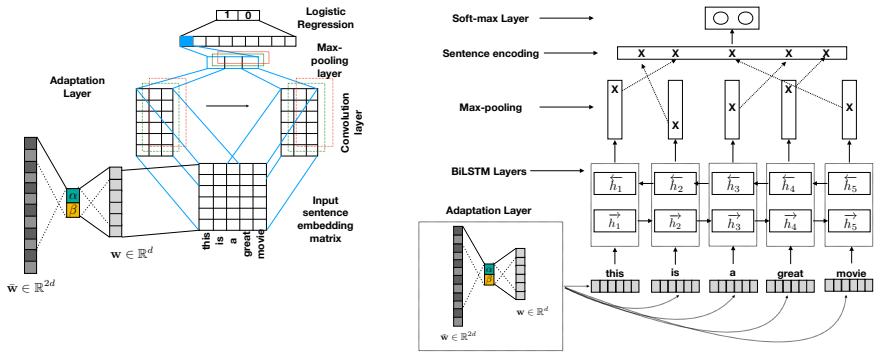
The carrying mechanism is the shallow adaptation layer: a single $2\times1$ convolution that turns the concatenated pair $[\bar{w}_{i,G}; \bar{w}_{i,DS}]$ of generic and domain-specific KCCA-aligned embeddings into a domain-adapted embedding $\bar{w}_{i,DA} = \alpha\bar{w}_{i,G} + \beta\bar{w}_{i,DS}$. Only $\alpha$ and $\beta$ plus the final softmax classifier are trained; the sentence encoder (CNN or BiLSTM with max-pooling) stays fixed. This makes adaptation an inexpensive re-weighting of existing embeddings rather than a retrained network. The second supporting mechanism is KCCA (kernel canonical correlation analysis), which projects the LSA-based domain-specific vectors and the GloVe vectors into a common space so that the two can be meaningfully averaged.
What would settle it
Rebuild the domain-specific embeddings using only the training portion of each corpus, retrain the adaptation layer on that split, and compare test accuracies against the same vanilla baselines; if the 2–8% advantage disappears or reverses, the improvement depends on transductive access to test documents rather than on the adaptation mechanism itself.
Extended reading notes
Core claim
The central claim is that domain semantics stored in word embeddings are enough to improve downstream sentiment classification, and that a deliberately shallow layer can supply them. Concretely, the paper's domain-adapted embedding is $\bar{w}_{i,DA} = \alpha \bar{w}_{i,G} + \beta \bar{w}_{i,DS}$, where $\bar{w}_{i,G}$ is a GloVe projection and $\bar{w}_{i,DS}$ is an LSA-based domain-specific embedding aligned with it by KCCA. The two weights are learned by a single $2\times1$ convolution kernel, and only those weights plus the final classifier are trained; the sentence encoder (a CNN or BiLSTM with max-pooling) is kept fixed. On LibCon, MR, SST, and balanced and imbalanced Beauty, Book, and Music data, adapted encoders improve on vanilla encoders by roughly 2–8%, and the adapted BiLSTM edges out BERT, LR-Bi-LSTM, and self-attention by 1–2% on the tested data sets. The paper also presents a hypergeometric calculation showing that the words whose adapted embeddings shift most between Liberal and Conservative tweets overlap with a gold-standard list far more than chance would predict ($p \approx 0.0005$).
Load-bearing premise
The adaptation layer's advantage depends on the domain-specific embeddings being built from the full target corpus, including test documents, while the vanilla baselines never see that corpus; if this hidden access is what produces the gains, the comparison is not fair.
Editorial extensions
If this is right
- The layer is encoder-agnostic: any frozen pretrained CNN or BiLSTM encoder can be adapted by training only $\alpha$, $\beta$, and the classifier, keeping the added parameter count small.
- On modest data sets the adapted encoders can beat fine-tuned BERT; at 1000- and 2500-point training subsamples, BERT overfits so severely that the paper does not list its numbers.
- The 2–8% improvement holds for binary and multi-class, balanced and imbalanced sentiment data, with micro-F scores also improving on imbalanced sets.
- No hand-built domain lexicon is required: the domain-specific side of the adaptation comes from LSA embeddings of the target corpus, and the gold-standard word list is used only for evaluation.
Reading between the lines
- Because the domain-specific embeddings are fitted on the full target corpus, the headline accuracies should be read as a transductive result; holding out the test documents when building those embeddings and re-running the experiments is the cleanest way to see whether the gains survive a fully supervised comparison.
- The two-weight blend is a generic operation on paired word vectors, so the same adaptation layer could be reused with other generic embeddings or a small in-domain corpus and other frozen encoders, learning new weights for each pairing.
- The Euclidean-distance shift $\psi$ could be reused as a diagnostic for domain adaptation before training any classifier, since the paper shows it flags polarizing vocabulary at a significance level ($p \approx 0.0005$) that chance does not explain.
Signed reviews
Editorial analysis
A structured set of objections, weighed in public.
Referee Report
Summary. The paper proposes a shallow domain-adaptation layer that learns two scalar weights, alpha and beta, to combine a generic word embedding (GloVe) with a KCCA-projected domain-specific (DS) embedding, producing domain-adapted (DA) embeddings that are fed into standard CNN or BiLSTM sentence encoders for sentiment classification. The authors validate the KCCA embeddings with a shift analysis on a Liberal/Conservative Twitter dataset, using a hypergeometric model to show that the most shifted words overlap with a gold-standard list more than chance. They then report accuracy gains of 2–8% over vanilla GloVe-based baselines and claim 1–2% improvements over BERT, LR-Bi-LSTM, and Self-attention on LibCon, MR, SST, and Beauty/Book/Music review datasets.
Significance. If the reported gains are real and the method is properly isolated, the proposal is a simple, lightweight way to inject domain knowledge into small-data sentiment classification, which is a practically useful direction. The paper has several strengths: it explicitly models the chance baseline for the shift analysis, it evaluates on a variety of binary and multiclass datasets, and it compares against strong baselines including BERT and DAS. However, the empirical case is currently weakened by protocol asymmetries (transductive use of target-corpus statistics, an unmatched DAS setting, and no variance reporting), so the central quantitative claim is not yet established at the level claimed.
major comments (5)
- [Section 3 and Section 4.3] The domain-specific embeddings and KCCA projections are constructed from the full target-domain corpus, as described in Section 3 and used throughout Section 4, but the paper never states that test documents are excluded. Since the adapted models thereby have access to unlabeled statistics of the test corpus while the vanilla GloVe baselines do not, the reported 2–8% improvements in Tables 2–4 are confounded by this transductive information. Please state explicitly whether the DS embeddings and KCCA projections are built using only the training split; if not, rerun the experiments with DS embeddings computed from the training portion only, or provide the vanilla baselines with an equivalent unlabeled target-corpus embedding.
- [Section 4.4, Tables 2–4] The headline claim that the learned alpha and beta weights improve accuracy is not isolated by the current experiments. The only fixed-combination condition is BoW with alpha = beta = 0.5, and it is not run with the CNN/BiLSTM encoders used for the main claims. Thus the observed differences could arise from the learned weights, from the KCCA-projected DS embeddings themselves, or from the transductive target-corpus access described above. Please add an ablation that uses the CNN and BiLSTM encoders with fixed alpha = beta = 0.5 (or with the DA embeddings obtained from the same KCCA procedure but without learning the combination weights), so that the contribution of the learned adaptation layer can be separated.
- [Section 4.2, DAS baseline] The comparison with DAS is not apples-to-apples. As stated, DAS trains on source domains such as book, music, and electronics and is tested on a target domain such as beauty, whereas the proposed method uses only the target-domain Beauty reviews to learn the DS embeddings. The adapted model therefore receives target-domain unlabeled data that DAS does not, and the claim of outperforming DAS is not supported by a matched experimental protocol. Please either give the proposed method the same source-only training setup, or give DAS access to the same unlabeled target-domain data, and report both settings.
- [Section 4.4, Tables 2 and 3] No error bars, standard deviations, or significance tests are reported for any of the classification results, which makes it impossible to judge whether the 1–2% and 2–8% differences are reliable, especially on the small LibCon and SST test sets. Additionally, Table 3 shows BERT at 51.5 on SST, which is higher than the Adapted BiLSTM at 51.2, contradicting the abstract's claim that the proposed architectures outperform BERT by 1–2%. Please report multiple runs with variance and significance tests, and qualify or correct the BERT comparison.
- [Section 4.1 and Section 4.3] The description of the SST evaluation is inconsistent: Section 4.1 says the experiments use a pre-determined test set of 5000 points, while Section 4.3 says the pre-defined test set has 2210 data points. This discrepancy affects the comparability of the SST results, and the paper should state the exact train/dev/test sizes and the source of the split used for the reported numbers.
minor comments (5)
- [Section 3.2, Table 1] The text says that words in bold are those that shift the most, but the table as rendered does not clearly show bold formatting; please ensure the table visually distinguishes the shifted words or lists them separately.
- [Section 4.4, Table 2] In the Vanilla CNN row for Music (I), the F-score entry appears as '74,5', which looks like a typo for 74.5; please correct the formatting.
- [Abstract and Section 4.4] The abstract and introduction state that the DA architectures outperform BERT, LR-Bi-LSTM, and Self-attention by 1–2%, but the SST results in Table 3 show BERT outperforming the adapted BiLSTM; the claims should be stated with the dataset-specific exceptions.
- [Section 3.3] The hypergeometric analysis would be clearer if the paper stated explicitly that the top-200 words were selected from the full common vocabulary Vcommon after computing the shift for all common words, and if the observed count of 20 gold-standard words in that top-200 set were reported in the same section.
- [Section 4.3] The supplement is referenced for hyperparameters and additional results, but no supplement is attached to the arXiv submission; please include the supplement or state where it will be available.
Circularity Check
No circular derivation: the adaptation weights are trained by backpropagation from classification labels, and the domain-semantics validation uses an external gold-standard list; the main concern is transductive data use, which is a leakage issue rather than a circularity.
full rationale
The paper's derivation chain is self-contained and does not reduce any prediction to its inputs. The adapted embedding is defined as w̄_i,DA = α w̄_i,G + β w̄_i,DS, with α and β learned by a single CNN layer whose error is backpropagated from the classification objective; accuracy is measured on held-out labels, so no fitted parameter is renamed as a prediction. The KCCA projection step is imported from the authors' prior work, but the paper independently validates that the projected embeddings capture domain semantics by comparing the most shifted words against an external gold-standard list (Li et al., 2017) and by showing a hypergeometric p-value of 0.000524 against a random baseline. That is an externally falsifiable check, not a circular self-citation. The BoW fixed-combination point α=β=0.5 is not run with the CNN/BiLSTM encoders used for the headline results, so the learned α/β are not fully isolated by the reported tables; however, this is an incompleteness in ablation design, not a circularity, because the learned weights are still trained on labels rather than defined from the outcome. The more serious concern is that the DS embeddings are built from the full target corpus, including test documents, which gives the adapted models transductive access to unlabeled test-word statistics; this is a benchmark-leakage and fairness-of-comparison issue, not a derivation-level circularity, and therefore does not raise the circularity score under the stated rubric. No equation in the paper defines the claimed improvement as equal to an input by construction, and no load-bearing argument rests solely on an unverified self-citation.
Assumptions & free parameters
free parameters (2)
- alpha and beta combination weights =
alpha=0.7145, beta=0.3994 on Book reviews (example)
- Top-k threshold in shift analysis =
200
assumptions (5)
- domain assumption KCCA projections of generic and domain-specific embeddings produce useful domain-adapted representations.
- domain assumption LSA-based domain-specific embeddings capture domain-specific word semantics.
- standard math The hypergeometric distribution correctly models the null hypothesis for the top-k shifted words.
- domain assumption The gold standard list of 136 political concepts from Li et al. 2017 is a valid ground truth for contentious language.
- domain assumption Using the full target-domain corpus (including test documents) to build word embeddings does not leak label information.
Cite this review
Pith. "Pith review of Shallow Domain Adaptive Embeddings for Sentiment Analysis." pith.science (2026). https://pith.science/paper/N6OCRXTQ
@misc{pith2026190806082,
  author       = {Pith},
  title        = {Pith review of: Shallow Domain Adaptive Embeddings for Sentiment Analysis},
  year         = {2026},
  howpublished = {\url{https://pith.science/paper/N6OCRXTQ}},
  note         = {Machine review of arXiv:1908.06082}
}
read the original abstract
This paper proposes a way to improve the performance of existing algorithms for text classification in domains with strong language semantics. We propose a domain adaptation layer learns weights to combine a generic and a domain specific (DS) word embedding into a domain adapted (DA) embedding. The DA word embeddings are then used as inputs to a generic encoder + classifier framework to perform a downstream task such as classification. This adaptation layer is particularly suited to datasets that are modest in size, and which are, therefore, not ideal candidates for (re)training a deep neural network architecture. Results on binary and multi-class classification tasks using popular encoder architectures, including current state-of-the-art methods (with and without the shallow adaptation layer) show the effectiveness of the proposed approach.
Figures

Reference graph
Works this paper leans on
-
[1]
URL: " 'urlintro :=
ENTRY address author booktitle chapter edition editor howpublished institution journal key month note number organization pages publisher school series title type volume year eprint doi pubmed url lastchecked label extra.label sort.label short.list INTEGERS output.state before.all mid.sentence after.sentence after.block STRINGS urlintro eprinturl eprintpr...
-
[2]
write newline
" write newline "" before.all 'output.state := FUNCTION n.dashify 't := "" t empty not t #1 #1 substring "-" = t #1 #2 substring "--" = not "--" * t #2 global.max substring 't := t #1 #1 substring "-" = "-" * t #2 global.max substring 't := while if t #1 #1 substring * t #2 global.max substring 't := if while FUNCTION word.in bbl.in capitalize " " * FUNCT...
-
[3]
Jisun An, Haewoon Kwak, and Yong-Yeol Ahn. 2018. http://aclweb.org/anthology/P18-1228 Semaxis: A lightweight framework to characterize domain-specific word semantics beyond sentiment . In Proceedings of the 56th Annual Meeting of the Association for Computational Linguistics (Volume 1: Long Papers), pages 2450--2461. Association for Computational Linguistics
work page 2018
-
[4]
Alexis Conneau, Douwe Kiela, Holger Schwenk, Lo\" i c Barrault, and Antoine Bordes. 2017. https://www.aclweb.org/anthology/D17-1070 Supervised learning of universal sentence representations from natural language inference data . In Proceedings of the 2017 Conference on Empirical Methods in Natural Language Processing, pages 670--680, Copenhagen, Denmark. ...
2017
-
[5]
Scott Deerwester, Susan T Dumais, George W Furnas, Thomas K Landauer, and Richard Harshman. 1990. Indexing by latent semantic analysis. Journal of the American society for information science, 41(6):391--407
1990
-
[6]
Jacob Devlin, Ming-Wei Chang, Kenton Lee, and Kristina Toutanova. 2018. Bert: Pre-training of deep bidirectional transformers for language understanding. arXiv preprint arXiv:1810.04805
arXiv 2018
-
[7]
Wells Friedland, Wagner Shah, and Abhishek. 2017. The civic state under threat: How social, political and media changes eroded wisconsin's civic culture
work page 2017
-
[8]
Hamilton, Kevin Clark, Jure Leskovec, and Dan Jurafsky
William L. Hamilton, Kevin Clark, Jure Leskovec, and Dan Jurafsky. 2016. https://aclweb.org/anthology/D16-1057 Inducing domain-specific sentiment lexicons from unlabeled corpora . In Proceedings of the 2016 Conference on Empirical Methods in Natural Language Processing, pages 595--605, Austin, Texas. Association for Computational Linguistics
work page 2016
Show all 26 references
-
[9]
Viktor Hangya, Fabienne Braune, Alexander Fraser, and Hinrich Sch \"u tze. 2018. http://aclweb.org/anthology/P18-1075 Two methods for domain adaptation of bilingual tasks: Delightfully simple and broadly applicable . In Proceedings of the 56th Annual Meeting of the Association...
2018
-
[10]
Ruidan He, Wee Sun Lee, Hwee Tou Ng, and Daniel Dahlmeier. 2018. http://aclweb.org/anthology/D18-1383 Adaptive semi-supervised learning for cross-domain sentiment classification . In Proceedings of the 2018 Conference on Empirical Methods in Natural Language Processing, pages ...
2018
-
[11]
Prathusha K Sarma, Yingyu Liang, and William Sethares. 2018. http://aclweb.org/anthology/P18-2007 Domain adapted word embeddings for improved sentiment classification . In Proceedings of the 56th Annual Meeting of the Association for Computational Linguistics (Volume 2: Short ...
2018
-
[12]
Yoon Kim. 2014. http://www.aclweb.org/anthology/D14-1181 Convolutional neural networks for sentence classification . In Proceedings of the 2014 Conference on Empirical Methods in Natural Language Processing (EMNLP), pages 1746--1751, Doha, Qatar. Association for Computational ...
2014
-
[13]
languages
Ping Li, Benjamin Schloss, and D Jake Follmer. 2017. Speaking two “languages” in america: A semantic space analysis of how presidential candidates and their supporters represent abstract political concepts differently. Behavior research methods, 49(5):1668--1685
2017
-
[14]
Zhouhan Lin, Minwei Feng, Cicero Nogueira dos Santos, Mo Yu, Bing Xiang, Bowen Zhou, and Yoshua Bengio. 2017. A structured self-attentive sentence embedding. arXiv preprint arXiv:1703.03130
2017 arXiv
-
[15]
Pengfei Liu, Xipeng Qiu, and Xuanjing Huang. 2016. Recurrent neural network for text classification with multi-task learning. arXiv preprint arXiv:1605.05101
2016 arXiv
-
[16]
Qi Liu, Yue Zhang, and Jiangming Liu. 2018. https://doi.org/10.18653/v1/N18-1050 Learning domain representation for multi-domain sentiment classification . In Proceedings of the 2018 Conference of the North American Chapter of the Association for Computational Linguistics: Hum...
2018 doi
-
[17]
Julian McAuley, Christopher Targett, Qinfeng Shi, and Anton Van Den Hengel. 2015. Image-based recommendations on styles and substitutes. In Proceedings of the 38th International ACM SIGIR Conference on Research and Development in Information Retrieval, pages 43--52. ACM
2015
-
[18]
Tomas Mikolov, Quoc V Le, and Ilya Sutskever. 2013 a . Exploiting similarities among languages for machine translation. arXiv preprint arXiv:1309.4168
2013 arXiv
-
[19]
Tomas Mikolov, Ilya Sutskever, Kai Chen, Greg S Corrado, and Jeff Dean. 2013 b . Distributed representations of words and phrases and their compositionality. In Advances in neural information processing systems, pages 3111--3119
2013
-
[20]
Hyeonseob Nam and Bohyung Han. 2016. Learning multi-domain convolutional neural networks for visual tracking. In Proceedings of the IEEE Conference on Computer Vision and Pattern Recognition, pages 4293--4302
2016
-
[21]
Bo Pang and Lillian Lee. 2005. Seeing stars: Exploiting class relationships for sentiment categorization with respect to rating scales. In Proceedings of the 43rd annual meeting on association for computational linguistics, pages 115--124. Association for Computational Linguistics
2005
-
[22]
Jeffrey Pennington, Richard Socher, and Christopher Manning. 2014. http://www.aclweb.org/anthology/D14-1162 Glove: Global vectors for word representation . In Proceedings of the 2014 Conference on Empirical Methods in Natural Language Processing (EMNLP), pages 1532--1543, Doha...
2014
-
[23]
Matthew Peters, Mark Neumann, Mohit Iyyer, Matt Gardner, Christopher Clark, Kenton Lee, and Luke Zettlemoyer. 2018. https://doi.org/10.18653/v1/N18-1202 Deep contextualized word representations . In Proceedings of the 2018 Conference of the North American Chapter of the Associ...
2018 doi
-
[24]
Qiao Qian, Minlie Huang, Jinhao Lei, and Xiaoyan Zhu. 2017. https://doi.org/10.18653/v1/P17-1154 Linguistically regularized lstm for sentiment classification . In Proceedings of the 55th Annual Meeting of the Association for Computational Linguistics (Volume 1: Long Papers), p...
2017 doi
-
[25]
Jingbo Shang, Liyuan Liu, Xiaotao Gu, Xiang Ren, Teng Ren, and Jiawei Han. 2018. http://aclweb.org/anthology/D18-1230 Learning named entity tagger using domain-specific dictionary . In Proceedings of the 2018 Conference on Empirical Methods in Natural Language Processing, page...
2018
-
[26]
Jiali Zeng, Jinsong Su, Huating Wen, Yang Liu, Jun Xie, Yongjing Yin, and Jianqiang Zhao. 2018. http://aclweb.org/anthology/D18-1041 Multi-domain neural machine translation with word-level domain context discrimination . In Proceedings of the 2018 Conference on Empirical Metho...
2018
Reviewed August 14, 2026 · model on record in the stance chip above.
Discussion (0). Continue with ORCID to comment.