REVIEW 3 major objections 5 minor 1 cited by
Superradiant instability of charged scalar fields in higher-dimensional Reissner-Nordstr\"om-de Sitter black holes
T0 review · 3 major / 5 minor · reviewed 2026-08-14 · deepseek-v4-flash
Pith's one-line read Charged scalar fields superradiantly destabilize Reissner-Nordström-de Sitter black holes in four to six dimensions, with higher dimensions amplifying the growth and widening the unstable parameter region.
desk verdict A plausible and cleanly derived extension of the 4D charged-scalar superradiant instability to d=5,6, but the quantitative claim rests on a spectral solver with no shown convergence data. read the letter →
The pith
A machine-rendered reading of the paper's core claim, the machinery that carries it, and where it could break.
The reading
What carries the argument
The load-bearing object is the 'BH de Sitter' family of quasinormal modes: modes of asymptotically de Sitter black holes whose frequencies are well approximated by the pure de Sitter spectrum $\omega/\kappa_c^{\mathrm{dS}} = -i(\ell+2n)$ and $\omega/\kappa_c^{\mathrm{dS}} = -i(\ell+2n+d-1)$. For $\ell=0$ this family contains a zero-mode, and turning on the scalar field charge $qQ$ deforms it into a growing mode. The mechanism that allows the growth is the effective potential $V(r)$ in the radial master equation: for $\ell=0$ it develops a potential well between the photon sphere and the cosmological horizon, trapping waves where the superradiant amplification condition $\Phi(r_c)<\omega<\Phi(r_+)$ can act; higher dimensions make this well deeper.
What would settle it
Run an independent time-domain integration of the charged Klein-Gordon equation on a fixed $d=5$ RNdS background with $M=1$, $Q=0.5$, $\Lambda=0.25$, $qQ=1$, $\mu=0$: the reported dominant mode has $\omega \approx 0.01656 + 0.00073 i$, so the field must grow. If it instead decays, or if a second independent frequency-domain method does not reproduce the unstable branch under grid refinement, the central claim fails.
Extended reading notes
Core claim
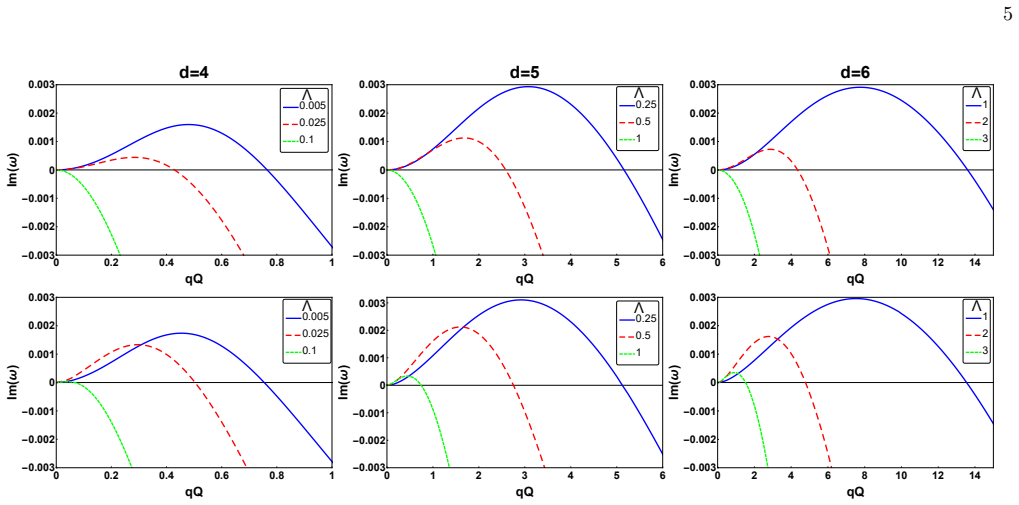
The central discovery is that in $d=4,5,6$ non-extremal RNdS spacetimes, the $\ell=0$ charged scalar mode — the one that becomes the zero-mode $\omega=0$ of pure de Sitter space when the charge coupling vanishes — turns into a complex quasinormal frequency with $\mathrm{Im}(\omega)>0$ as soon as $qQ$ is switched on. Its real part grows monotonically with $qQ$; its imaginary part first rises, peaks, then falls below zero, so stability is restored for sufficiently large charge coupling or scalar mass. Every unstable mode found lies inside the superradiant window $\Phi(r_c)<\omega<\Phi(r_+)$, but so do many stable modes, which the paper reads as proof that superradiance is necessary but not sufficient. As the spacetime dimension increases, the effective potential well deepens, making the instability stronger and extending it across a wider region of parameter space.
Load-bearing premise
The load-bearing premise is that the numerical frequency-domain solver returns accurate quasinormal frequencies for the chosen parameter ranges; the paper reports no convergence study or error bounds, so a spurious mode misidentified as the dominant $\ell=0$ branch would invalidate the instability claim.
Editorial extensions
If this is right
- For $d=4,5,6$ Reissner-Nordström-de Sitter black holes, $\ell=0$ charged scalar perturbations grow exponentially for intermediate values of the charge coupling $qQ$, extracting electromagnetic energy from the black hole.
- The growth rate peaks at a finite $qQ$ and then falls; increasing the scalar mass $\mu$ lowers $\mathrm{Im}(\omega)$, so a finite critical mass exists beyond which the instability disappears.
- Because the instability rides on the de Sitter zero-mode rather than the photon-sphere family, any asymptotically de Sitter black hole supporting a zero-mode is a candidate for the same superradiant instability.
- Higher spacetime dimensions amplify the effect: as $d$ goes from 4 to 6, the unstable region of the $(qQ,\Lambda)$ parameter space widens and the peak growth rate grows.
- The superradiant condition $\Phi(r_c)<\omega<\Phi(r_+)$ is necessary but not sufficient, so detecting a mode inside this window does not by itself prove instability.
Reading between the lines
- If the de Sitter zero-mode is the seed, the same mechanism should operate for charged fermion or vector perturbations on RNdS, and possibly for rotating de Sitter black holes whenever a de Sitter mode lies inside the superradiant frequency window; this is a testable extension, not a claim of the paper.
- The dimension dependence visible in the tables suggests a scaling law for the peak growth rate and the critical couplings in terms of horizon radii or the cosmological surface gravity; extracting it would give an analytic estimate beyond the three dimensions computed here.
- Because the instability strengthens with dimension, nonlinear evolutions in $d=5$ or $d=6$, where the growth timescale is shorter, may be the practical route to determine whether the endpoint is a scalarized black hole or evacuation of the field — a question the paper leaves open.
Editorial analysis
A structured set of objections, weighed in public.
Referee Report
Summary. The manuscript studies charged scalar-field perturbations on higher-dimensional Reissner-Nordström–de Sitter (RNdS) black holes, specializing to spacetime dimensions d=4,5,6. It derives a radial master equation, obtains a Wronskian-based criterion for superradiance, and computes quasinormal mode (QNM) frequencies with a frequency-domain spectral package. The central claims are that l=0 charged scalar perturbations become superradiantly unstable in a finite region of the charge-coupling parameter space, that this instability is tied to the pure de Sitter 'zero-mode' family of QNMs, that adding a scalar-field mass stabilizes the system, and that increasing the spacetime dimension amplifies the instability and enlarges the unstable region. The paper reports unstable and stable modes in Tables I and II and illustrates the behavior in Figures 1–5.
Significance. If the numerical results are reliable, the paper is a useful extension of the known four-dimensional superradiant instability to higher-dimensional RNdS spacetimes, and the connection to the pure de Sitter QNM family provides a physically interesting interpretation. The derivation of the master equation and the Wronskian superradiance condition is clean and appears correct, and the explicit tables give concrete frequencies that can be checked by other methods. The paper also makes the falsifiable prediction that all unstable modes satisfy the superradiant condition, while some stable modes satisfy it as well. The main weakness is that the central quantitative claims rest on a spectral solver with no reported convergence study, error bounds, or shown cross-checks, which is especially concerning because the unstable imaginary parts are small and could be affected by numerical error.
major comments (3)
- [Sec. V, Tables I–II, Figs. 3–5] The central instability claim is not yet quantitatively verified because no convergence study or error estimates are reported for the spectral solver. The unstable modes have imaginary parts of order 10^-4 to 10^-3, so even modest numerical error could change the sign of Im(ω) and alter the stability conclusion. The manuscript states that the results were checked with WKB and a matrix method, and the acknowledgments mention time-evolution data, but none of these checks are shown quantitatively for the parameter points used. Since the unstable branch is obtained by tracking the l=0 pure de Sitter zero-mode as qQ increases, the possibility of branch jumping or a spurious numerical mode is not excluded. Please provide a convergence test (e.g., frequencies versus grid size/order), show direct comparisons with at least one independent method for representative rows of Tables I and II, and report error bars or an equivalent accuracy estimate.
- [Table II, d=6 block] The same mass value μ=4×10^-1 is listed twice in the d=6 block with two different frequencies, ω=0.04496−0.02141i and ω=0.03005−0.10116i. This internal inconsistency suggests that the numerical output was not fully vetted and makes the table unreliable as a reference. Please correct the typo or explain which mass value was actually used, and re-check the corresponding entries.
- [Abstract, Sec. V, Figs. 3 and 5] The claim that 'the increment of dimensions amplifies the growth rate and enlarges the region of the parameter space' is not established by the data as presented. The d=4, 5, and 6 panels in Figures 3 and 5 use different cosmological constants (Λ=0.005, 0.25, 1) and different qQ ranges, so the larger qQ range at higher d may simply reflect the larger available parameter space rather than a dynamical amplification. The peak imaginary parts in Table I are not monotonic in d under the chosen parameter sets (d=4: ~0.0016 at qQ=0.5; d=5: ~0.0007 at qQ=1; d=6: ~0.0025 at qQ=10). To support the dimension-dependence claim, the comparison should be made at a controlled physical scale, for example fixed dimensionless quantities such as ΛM^2 or fixed horizon-radius ratios, with equivalent resolution in all dimensions.
minor comments (5)
- [Sec. II, Eq. (8)] The notation qQ is used as a dimensionless coupling, but the relation between the scalar-field charge q, the black-hole charge parameter q0, and the physical charge Q is only implicit; a short definition of the dimensionless combination would improve clarity.
- [Fig. 3 caption and Sec. V] The quantity Qmax appearing in the caption is never defined; please define it explicitly, for example via the extremal charge for the given M and Λ.
- [Sec. IV, Fig. 2] The potential-well argument is used as evidence for instability, but the existence of a potential well is only heuristic and does not by itself prove the QNM spectral property; the text should state more clearly that the instability is established by the frequency-domain calculation rather than by the shape of V(r).
- [Introduction and Acknowledgments] Several typos should be corrected, including 'in expense of' (should be 'at the expense of'), 'Quiet strikingly' (should be 'Quite strikingly'), and 'a d-dimensional' (should be 'a d-dimensional' with the article adjusted).
- [Sec. V, Table I] The table footnote says all modes satisfy the superradiant condition, which is a useful check, but it would help to also list the values of ω−Φ(rc) and Φ(r+)−ω explicitly so the reader can verify the inequalities without recomputation.
Circularity Check
No circularity: the unstable QNM frequencies are obtained by direct numerical solution of the master equation with standard boundary conditions, and the pure de Sitter mode formula is used only as an interpretive benchmark.
full rationale
The paper's central claim is that charged scalar perturbations on d=4,5,6 Reissner-Nordström-de Sitter black holes exhibit a superradiant instability and that the growth rate increases with dimension. The derivation chain is self-contained: the Klein-Gordon equation (5) is reduced to the master equation (7) with the effective potential (9), and the QNM frequencies are found by imposing the boundary conditions (10) and solving the resulting boundary-value problem numerically with the Mathematica package of Ref. [54]. No parameter is fitted to the unstable modes, and no quantity that is 'predicted' is used as an input to define the calculation. The superradiant condition (13) is derived from a conserved Wronskian and is checked as a consistency condition after the modes are computed, not imposed to select them. The pure-de Sitter formula (14) is used to interpret the zero mode and the BH-dS family, but the unstable modes are not constructed from that formula; the formula is an approximation for comparison, as stated. Self-citations to Refs. [55-58] establish the previously identified BH-dS family and the numerical solver is cited from Ref. [54], but none of these citations carries the load of the instability result itself. Concerns about numerical convergence and the apparent duplicate row in Table II are correctness or presentation issues, not circularity. Therefore no circular step reduces the derivation to its inputs.
Assumptions & free parameters
assumptions (5)
- domain assumption The test field approximation is valid: the scalar field does not backreact on the spacetime metric.
- domain assumption The spacetime is subextremal with three distinct horizons r- < r+ < rc.
- domain assumption Quasinormal modes are defined by the boundary conditions (10) at the event and cosmological horizons.
- standard math The Wronskian conservation argument leading to the superradiant condition (13) is valid.
- domain assumption The numerical spectral method converges to the true QNM spectrum.
Cite this review
Pith. "Pith review of Superradiant instability of charged scalar fields in higher-dimensional Reissner-Nordstr\"om-de Sitter black holes." pith.science (2026). https://pith.science/paper/GZPYZB7W
@misc{pith2026190806117,
  author       = {Pith},
  title        = {Pith review of: Superradiant instability of charged scalar fields in higher-dimensional Reissner-Nordstr\"om-de Sitter black holes},
  year         = {2026},
  howpublished = {\url{https://pith.science/paper/GZPYZB7W}},
  note         = {Machine review of arXiv:1908.06117}
}
abstract
Black holes possess trapping regions which lead to intriguing dynamical effects. By properly scattering test fields off a black hole, one can extract energy from it, leading to the growth of the amplitude of the test field in expense of the black hole's energy. Such a dynamical phenomenon is called superradiance. Here, we study charged-scalar-field instabilities of Reissner-Nordstr\"{o}m black holes immersed in a $d-$dimensional de Sitter Universe. By performing a thorough frequency-domain analysis we compute the unstable quasinormal resonances and link their presence with a novel family of quasinormal modes associated with the existence and timescale of the cosmological horizon of pure de Sitter spacetime. Our results indicate that such an instability is caused by superradiance, while the increment of dimensions amplifies the growth rate and enlarges the region of the parameter space where, both massless and massive, test fields are unstable.
Figures


Figures from the paper (2 more)


Forward citations
Cited by 1 Pith paper
-
Strong Cosmic Censorship in Horndeski Theory
For scalar fields with non-minimal derivative coupling on Reissner-Nordström-de Sitter black holes, strong cosmic censorship is violated only when the ratio β exceeds 3/2 instead of 1/2, and small near-extremal black ...
Reference graph
Works this paper leans on
-
[1]
Regge and J
T. Regge and J. A. Wheeler, Phys. Rev.108, 1063 (1957)
1957
-
[2]
Barack et al., (2018), arXiv:1806.05195 [gr-qc]
L. Barack et al., (2018), arXiv:1806.05195 [gr-qc]
arXiv 2018
-
[3]
P. Pani, Proceedings, Spring School on Numerical Rel- ativity and High Energy Physics (NR/HEP2): Lisbon, Portugal, March 11-14, 2013 , Int. J. Mod. Phys. A28, 1340018 (2013), arXiv:1305.6759 [gr-qc]
arXiv 2013
-
[4]
K. D. Kokkotas and B. G. Schmidt, Living Rev. Rel. 2, 2 (1999), arXiv:gr-qc/9909058 [gr-qc]
arXiv 1999
- [5]
-
[6]
R. A. Konoplya and A. Zhidenko, Rev. Mod. Phys. 83, 793 (2011), arXiv:1102.4014 [gr-qc]
arXiv 2011
-
[7]
Penrose and R
R. Penrose and R. M. Floyd, Nature 229, 177 (1971)
1971
-
[8]
J. D. Bekenstein, Phys. Rev. D7, 949 (1973)
work page 1973
Show all 75 references
-
[9]
Brito, V
R. Brito, V. Cardoso, and P. Pani, Lect. Notes Phys. 906, pp.1 (2015), arXiv:1501.06570 [gr-qc]
2015 arXiv
-
[10]
Detweiler, Phys
S. Detweiler, Phys. Rev. D 22, 2323 (1980)
1980
-
[11]
Cardoso and S
V. Cardoso and S. Yoshida, JHEP 07, 009 (2005), arXiv:hep-th/0502206 [hep-th]
2005 arXiv
-
[12]
S. R. Dolan, Phys. Rev. D76, 084001 (2007), arXiv:0705.2880 [gr-qc]
2007 arXiv
-
[13]
Cardoso, O
V. Cardoso, O. J. C. Dias, J. P. S. Lemos, and S. Yoshida, Phys. Rev. D70, 044039 (2004), 7 d= 4 Λ = 0.005 qQ ω Φ(rc) Φ(r+) 0.005 0.00023 + 3.7×10⁻⁷i 0.00021 0.00266 0.05 0.00229 + 0.00004 i0.00213 0.02663 0.5 0.02577 + 0.00159 i0.02134 0.26625 1 0.05322 - 0.00271 i0.04268 0.5...
2004
-
[14]
Witek, V
H. Witek, V. Cardoso, A. Ishibashi, and U. Sperhake, Phys. Rev. D87, 043513 (2013), arXiv:1212.0551 [gr-qc]
2013 arXiv
-
[15]
Brito, V
R. Brito, V. Cardoso, and P. Pani, Phys. Rev. D88, 023514 (2013), arXiv:1304.6725 [gr-qc]
2013 arXiv
-
[16]
Ishibashi, P
A. Ishibashi, P. Pani, L. Gualtieri, and V. Cardoso, JHEP 09, 209 (2015), arXiv:1507.07079 [hep-th]
2015 arXiv
-
[17]
Wang and C
M. Wang and C. Herdeiro, Phys. Rev. D93, 064066 (2016), arXiv:1512.02262 [gr-qc]
2016 arXiv
-
[18]
W. E. East and F. Pretorius, Phys. Rev. Lett. 119, 041101 (2017), arXiv:1704.04791 [gr-qc]
2017 arXiv
-
[19]
H. R. C. Ferreira and C. A. R. Herdeiro, Phys. Rev.D97, 084003 (2018), arXiv:1712.03398 [gr-qc]
2018 arXiv
-
[20]
J. C. Degollado, C. A. R. Herdeiro, and E. Radu, Phys. Lett. B781, 651 (2018), arXiv:1802.07266 [gr-qc]
2018 arXiv
-
[21]
Kolyvaris, M
T. Kolyvaris, M. Koukouvaou, A. Machattou, and E. Papantonopoulos, Phys. Rev. D98, 024045 (2018), arXiv:1806.11110 [gr-qc]
2018 arXiv
-
[22]
L. D. Menza and J.-P. Nicolas, Class. Quant. Grav. 32, 145013 (2015), arXiv:1411.3988 [math-ph]
2015 arXiv
-
[23]
C. L. Benone and L. C. B. Crispino, Phys. Rev. D93, 024028 (2016), arXiv:1511.02634 [gr-qc]
2016 arXiv
-
[24]
Huang, D.-J
Y. Huang, D.-J. Liu, and X.-Z. Li, Int. J. Mod. Phys. D26, 1750141 (2017), arXiv:1606.00100 [gr-qc]
2017 arXiv
-
[25]
P. A. Gonz´ alez, E. Papantonopoulos, J. Saavedra, and Y. V´ asquez, Phys. Rev. D95, 064046 (2017), arXiv:1702.00439 [gr-qc]
2017 arXiv
- [26]
-
[27]
Huang, D.-J
Y. Huang, D.-J. Liu, X.-h. Zhai, and X.-z. Li, Phys. Rev. D98, 025021 (2018), arXiv:1807.06263 [gr-qc]
2018 arXiv
-
[28]
C. L. Benone and L. C. B. Crispino, Phys. Rev. D99, 044009 (2019), arXiv:1901.05592 [gr-qc]
2019 arXiv
-
[29]
Vicente, V
R. Vicente, V. Cardoso, and J. C. Lopes, Phys. Rev. D97, 084032 (2018), arXiv:1803.08060 [gr-qc]
2018 arXiv
-
[30]
Cardoso, R
V. Cardoso, R. Brito, and J. L. Rosa, Phys. Rev. D91, 124026 (2015), arXiv:1505.05509 [gr-qc]
2015 arXiv
-
[31]
Cardoso, P
V. Cardoso, P. Pani, and T.-T. Yu, Phys. Rev. D95, 124056 (2017), arXiv:1704.06151 [gr-qc]
2017 arXiv
-
[32]
Maggio, V
E. Maggio, V. Cardoso, S. R. Dolan, and P. Pani, Phys. Rev. D99, 064007 (2019), arXiv:1807.08840 [gr-qc]
2019 arXiv
-
[33]
Chandrasekhar and S
S. Chandrasekhar and S. L. Detweiler, Proc. Roy. Soc. Lond. A344, 441 (1975)
1975
-
[34]
Ferrari and B
V. Ferrari and B. Mashhoon, Phys. Rev. Lett. 52, 1361 (1984)
1984
-
[35]
Furuhashi and Y
H. Furuhashi and Y. Nambu, Prog. Theor. Phys. 112, 983 (2004), arXiv:gr-qc/0402037 [gr-qc]
2004 arXiv
-
[36]
R. A. Konoplya and A. Zhidenko, Phys. Rev. Lett. 103, 161101 (2009), arXiv:0809.2822 [hep-th]
2009 arXiv
-
[37]
S. R. Dolan, Phys. Rev. D87, 124026 (2013), arXiv:1212.1477 [gr-qc]
2013 arXiv
-
[38]
Destounis, G
K. Destounis, G. Panotopoulos, and n. Rinc´ on, Eur. Phys. J. C78, 139 (2018), arXiv:1801.08955 [gr-qc]
2018 arXiv
-
[39]
Zhu, S.-J
Z. Zhu, S.-J. Zhang, C. E. Pellicer, B. Wang, and E. Ab- dalla, Phys. Rev. D90, 044042 (2014), [Addendum: Phys. Rev.D90,no.4,049904(2014)], arXiv:1405.4931 [hep-th]
2014 arXiv
-
[40]
R. A. Konoplya and A. Zhidenko, Phys. Rev. D90, 064048 (2014), arXiv:1406.0019 [hep-th]
2014 arXiv
-
[41]
O. J. C. Dias, P. Figueras, R. Monteiro, H. S. Reall, and J. E. Santos, JHEP 05, 076 (2010), arXiv:1001.4527 [hep-th]
2010 arXiv
-
[42]
Cardoso, M
V. Cardoso, M. Lemos, and M. Marques, Phys. Rev. D80, 127502 (2009), arXiv:1001.0019 [gr-qc]. 8
2009 arXiv
-
[43]
R. A. Konoplya and A. Zhidenko, Phys. Rev. D89, 024011 (2014), arXiv:1309.7667 [hep-th]
2014 arXiv
-
[44]
C. A. R. Herdeiro, J. C. Degollado, and H. F. R´ unarsson, Phys. Rev. D88, 063003 (2013), arXiv:1305.5513 [gr-qc]
2013 arXiv
-
[45]
J. C. Degollado and C. A. R. Herdeiro, Phys. Rev. D89, 063005 (2014), arXiv:1312.4579 [gr-qc]
2014 arXiv
-
[46]
Sanchis-Gual, J
N. Sanchis-Gual, J. C. Degollado, P. J. Montero, J. A. Font, and C. Herdeiro, Phys. Rev. Lett. 116, 141101 (2016), arXiv:1512.05358 [gr-qc]
2016 arXiv
-
[47]
R. Li, Eur. Phys. J. C73, 2274 (2013), arXiv:1207.1984 [hep-th]
2013 arXiv
- [48]
- [49]
-
[50]
Li, J.-K
R. Li, J.-K. Zhao, and Y.-M. Zhang, Commun. Theor. Phys. 63, 569 (2015), arXiv:1404.6309 [gr-qc]
2015 arXiv
- [51]
-
[52]
R. Li, Y. Tian, H.-b. Zhang, and J. Zhao, Phys. Lett. B750, 520 (2015), arXiv:1506.04267 [gr-qc]
2015 arXiv
-
[53]
Tanabe, Class
K. Tanabe, Class. Quant. Grav. 33, 125016 (2016), arXiv:1511.06059 [hep-th]
2016 arXiv
- [54]
-
[55]
Cardoso, J
V. Cardoso, J. L. Costa, K. Destounis, P. Hintz, and A. Jansen, Phys. Rev. Lett. 120, 031103 (2018), arXiv:1711.10502 [gr-qc]
2018 arXiv
-
[56]
Cardoso, J
V. Cardoso, J. L. Costa, K. Destounis, P. Hintz, and A. Jansen, Phys. Rev. D 98, 104007 (2018)
2018
-
[57]
H. Liu, Z. Tang, K. Destounis, B. Wang, E. Pa- pantonopoulos, and H. Zhang, JHEP 03, 187 (2019), arXiv:1902.01865 [gr-qc]
2019 arXiv
- [58]
-
[59]
Iyer and C
S. Iyer and C. M. Will, Phys. Rev. D35, 3621 (1987)
1987
- [60]
-
[61]
Kodama, R
H. Kodama, R. A. Konoplya, and A. Zhidenko, Phys. Rev. D79, 044003 (2009), arXiv:0812.0445 [hep-th]
2009 arXiv
-
[62]
Wang and C
M. Wang and C. Herdeiro, Phys. Rev. D89, 084062 (2014), arXiv:1403.5160 [gr-qc]
2014 arXiv
-
[63]
Cardoso, A
V. Cardoso, A. S. Miranda, E. Berti, H. Witek, and V. T. Zanchin, Phys. Rev. D79, 064016 (2009), arXiv:0812.1806 [hep-th]
2009 arXiv
-
[64]
R. A. Konoplya and Z. Stuchl´ ık, Phys. Lett. B771, 597 (2017), arXiv:1705.05928 [gr-qc]
2017 arXiv
- [65]
- [66]
-
[67]
Cardoso and J
V. Cardoso and J. P. S. Lemos, Phys. Rev. D67, 084020 (2003), arXiv:gr-qc/0301078 [gr-qc]
2003 arXiv
-
[68]
D. R. Brill and S. A. Hayward, Class. Quant. Grav. 11, 359 (1994), arXiv:gr-qc/9304007 [gr-qc]
1994 arXiv
-
[69]
A. D. Rendall, Annales Henri Poincare 5, 1041 (2004), arXiv:gr-qc/0312020 [gr-qc]
2004 arXiv
-
[70]
Lopez-Ortega, Gen
A. Lopez-Ortega, Gen. Rel. Grav. 38, 1565 (2006), arXiv:gr-qc/0605027 [gr-qc]
2006 arXiv
-
[71]
Vasy, Advances in Mathematics 223, 49 (2010)
A. Vasy, Advances in Mathematics 223, 49 (2010)
2010
-
[72]
P. R. Brady, C. M. Chambers, W. Krivan, and P. La- guna, Phys. Rev. D55, 7538 (1997), arXiv:gr-qc/9611056 [gr-qc]
1997 arXiv
-
[73]
P. R. Brady, C. M. Chambers, W. G. Laarakkers, and E. Poisson, Phys. Rev. D60, 064003 (1999), arXiv:gr- qc/9902010 [gr-qc]
1999
- [74]
-
[75]
R. Luna, M. Zilh˜ ao, V. Cardoso, J. L. Costa, and J. Nat´ ario, Phys. Rev. D99, 064014 (2019), arXiv:1810.00886 [gr-qc]
2019 arXiv
Reviewed August 14, 2026 · model on record in the stance chip above.
Discussion (0). Continue with ORCID to comment.