REVIEW 6 major objections 6 minor 10 references
Conv2Warp: An unsupervised deformable image registration with continuous convolution and warping
T0 review · 6 major / 6 minor · reviewed 2026-08-14 · deepseek-v4-flash
Pith's one-line read Conv2Warp learns continuous warp fields for deformable registration with deformable convolutions and a learnable Catmull-Rom spline, matching SimpleElastix's Dice while running 141× faster.
desk verdict A fast unsupervised DIR pipeline with real speed gains, but the printed loss function is not NCC and the evaluation misses the key deep learning baseline. read the letter →
The pith
A machine-rendered reading of the paper's core claim, the machinery that carries it, and where it could break.
The reading
What carries the argument
The network has three linked components. LD-ConvNet alternates five linear and three deformable convolution layers (with batch norm and ELU) to predict a raw deformation vector field; deformable convolution adds learnable spatial offsets to the sampling grid, relaxing the uniform-pixel sampling of standard filters. NL-DVF-R resamples that field with a learnable bicubic Catmull-Rom spline—a cubic interpolant that passes through its control points and is C1 continuous—rather than with linear interpolation, which is the paper's mechanism for smoother fields and smaller interpolation error. CWS applies the field at multiple pyramid levels, warping each coarser source level and summing the per-level data terms. The data term D(Is,It) is written as a 'derived SSD' from standardized intensities (with absolute values) that the paper says guarantees maximization of normalized cross-correlation, and an L2 regularizer (clamped to [0,0.25]) penalizes deviation between the final DVF and the upsampled previous-level DVF to keep the field smooth.
What would settle it
Train Conv2Warp on a fixed pair set with the proposed D loss, and in parallel train the same architecture with a standard negative NCC or SSD loss. If the paper's equivalence claim is correct, the proposed loss should track NCC (lower D should correspond to higher NCC) and produce comparable or better Dice; if the D-trained model underperforms the NCC-trained one, or if NCC does not improve as D decreases, the loss-equivalence premise fails. A second check: on POPI, which has landmark point pairs, compare the point-wise target registration error of Conv2Warp against SimpleElastix; Dice gains without corresponding TRE gains would indicate that accuracy is not truly in the deformation fields.
Extended reading notes
Core claim
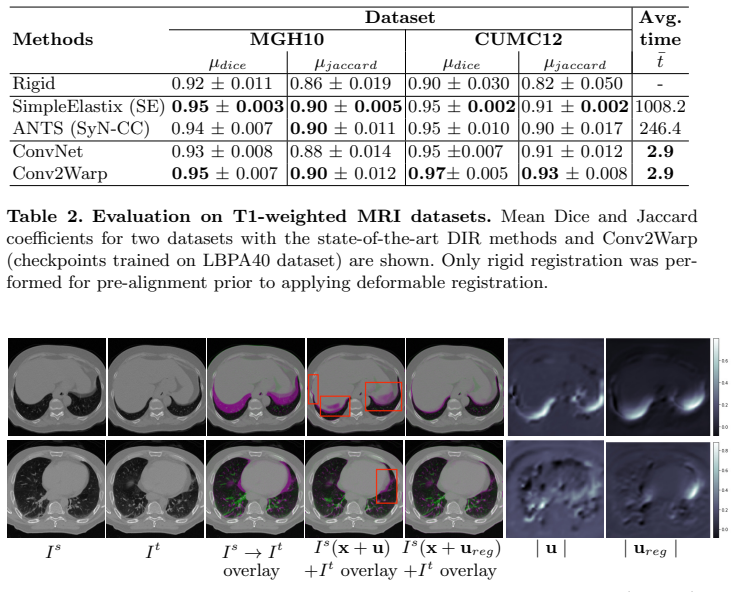
The central claim is that a registration network built from linear plus deformable convolutions and a learnable Catmull-Rom spline resampler can learn smooth deformation fields that handle large non-linear deformations better than networks restricted to linear convolutions and linear resampling. Deformable convolutions relax the uniform spatial sampling of standard filters, the Catmull-Rom spline provides C1-continuous, locally supported interpolation that passes through control points, and a multi-scale continuous warping stage aggregates deformations across pyramid levels. On the POPI lung 4D-CT dataset the method reaches mean Dice 0.90, equalling SimpleElastix; on the MGH10 and CUMC12 brain MRI datasets it reaches mean Dice 0.95 and 0.97, matching or exceeding SimpleElastix and beating ANTS, while running in about 2.94 s on CPU and under 1 s GPU. The authors argue these results show that large non-linear deformations can be captured without ground-truth deformation fields and with drastically lower computation than iterative methods.
Load-bearing premise
The training loss is stated to be a 'derived SSD' that guarantees maximization of normalized cross-correlation, but the derivation is not shown and the absolute-value standardized terms do not match the standard NCC form; if the loss does not truly optimize correlation, the reported accuracy rests on an unverified objective.
Editorial extensions
If this is right
- Pair-wise registration of a 256×256 2D image takes about 2.94 s on CPU and under 1 s on GPU, so the method could fit into clinical workflows that currently use minutes-long optimization.
- Training is unsupervised: no ground-truth deformation fields are needed, only image pairs, which removes the bottleneck of generating synthetic DVFs for training.
- The multi-scale continuous warping component is modular and could be combined with other data terms or regularizers without changing the architecture.
- On the tested benchmarks, the model matches or exceeds SimpleElastix Dice while being roughly 141 times faster, suggesting the accuracy/speed trade-off of learning-based DIR can be resolved in favor of speed without sacrificing accuracy.
Reading between the lines
- A caveat that follows from the paper's own comparison: Dice is computed on segmentation masks, not on the deformation fields themselves; mask overlap can improve even when the underlying voxel correspondence does not, so the claim of 'accurate DVFs' would be better tested against point-wise target registration error on datasets like POPI that provide landmarks.
- The loss's equivalence to NCC is asserted without derivation, and the absolute-value standardization is not the standard z-score; if this loss does not actually behave as a correlation objective, a model trained on a conventional NCC or SSD loss might perform differently, so a direct ablation would strengthen the argument.
- Catmull-Rom splines pass through their control points whereas B-splines do not; this may be why the paper observes lower training loss, but the comparison is on losses only, and final registration quality could be compared on DVF error metrics instead.
Signed reviews
Editorial analysis
A structured set of objections, weighed in public.
Referee Report
Summary. This manuscript proposes Conv2Warp, an unsupervised deformable image registration network that concatenates linear and deformable convolutional layers with a Catmull-Rom spline resampler and a multi-scale continuous warping scheme. The training loss combines a normalized intensity-difference data term with a clamped L2 regularizer on the deformation field. The method is evaluated on lung CT (POPI) and brain MRI (MGH10, CUMC12) benchmarks, reporting Dice and Jaccard overlaps and CPU runtime against SimpleElastix, ANTS-SyN, and a linear-convolution-only ablation. The authors claim improved accuracy over classical methods and a 141x runtime speedup relative to SimpleElastix.
Significance. The idea of a differentiable continuous resampler and pyramid warping for unsupervised deep registration is timely, and the proposed architecture is lightweight and evaluated on public datasets. The internal ablation comparing the full model with a linear-convolution baseline is a useful control, and the speed advantage over classical tools is a genuine practical contribution. However, the mathematical justification of the loss is questionable, the experimental comparison omits the most relevant deep-learning baselines, and the evaluation relies solely on segmentation overlap without landmark-based error or statistical tests. If the loss issue is clarified and the comparisons are completed, the paper could make a useful contribution to fast deformable registration.
major comments (6)
- [Section 2, Loss function] The data term D(Is,It) = 1/(2N) Σ ( |Is−μs|/√(σs²+ε²) − |It−μt|/√(σt²+ε²) )² is stated to 'guarantee maximization of NCC metric [4]', but for the standard definition of normalized cross-correlation this is not correct. Since E[(|zs|−|zt|)²] = 2 − 2 E[|zs zt|], the loss maximizes the expected product of absolute normalized deviations, not E[zs zt]. For example, with zs = [1,−1] and zt = [−1,1], the loss is 0 while NCC is −1, so the objective rewards contrast inversion. If the absolute values are intentional, the loss is not a valid reformulation of NCC and the theoretical justification is unsupported; if they are a typographical error, the equation must be corrected and the experiments rerun. Because every reported accuracy result depends on this loss, the issue is load-bearing.
- [Tables 1 and 2] The experimental comparison omits the most relevant deep-learning baselines for this task, namely VoxelMorph (ref. [1]) and the unsupervised framework of de Vos et al. (ref. [10]), even though both are cited in the introduction. Without these comparisons, the claim that Conv2Warp advances the state of the art in deep deformable registration is not established. Please add these baselines or explicitly restrict the claims to the classical methods that were actually compared.
- [Table 1] The text in Section 3.2 states that Conv2Warp 'outperforms all other state-of-the-art methods and ConvNet for almost all considered pairs', but Table 1 reports the same mean Dice for SimpleElastix and Conv2Warp (0.90) and a slightly lower mean Jaccard for Conv2Warp (0.84 vs 0.85). This statement overstates the numerical results and should be corrected.
- [Tables 1 and 2] No statistical significance tests or confidence intervals are provided, and the sample sizes are small (7 lung pairs, 9 and 11 brain pairs). For example, in Table 2 the MGH10 mean Dice values for SimpleElastix and Conv2Warp are both 0.95 with overlapping standard deviations, so the claimed advantage is not substantiated. In addition, no target registration error (TRE) is reported for POPI, which has publicly available landmark annotations; segmentation Dice alone is an indirect accuracy measure and may be insensitive to clinically relevant misalignments. Paired significance tests and a landmark-based evaluation are needed.
- [Section 2, NL-DVF-R] The phrase 'learnable bicubic Catmull-Rom spline resampler' is ambiguous because Catmull-Rom interpolation coefficients are fixed by the interpolation conditions. The only learnable component appears to be a convolutional filter applied after resampling. Please specify exactly which parameters are learned in this block and how; otherwise the contribution of the resampler cannot be reproduced.
- [Section 2, Continuous Warping Stage] The multi-scale warping scheme is described only briefly. In particular, it is not stated how the image pyramid and the deformation fields are downsampled and upsampled between levels, which interpolation is used for the upsampled DVF, or how the concatenated input images are handled at each pyramid level. These details are necessary for reproducibility.
minor comments (6)
- [Table 1] The 'Pre-align.' column is not defined; please state what transformation is applied to obtain these Dice values.
- [Section 2, Loss function] The regularization weight λ=0.001 and the clamp [0, 0.25] are presented without a sensitivity analysis; a small ablation would help justify these choices.
- [Section 3.1] The description of the lung training data is confusing: 'only breathing cycles 00-50, 10-80 and 30-90 were considered from 10 different sets (a total of 120 volumes)' needs clarification on how the 120 volumes are formed.
- [References to supplementary material] The paper refers to supplementary figures (e.g., Fig. 2 and Fig. 3 in the supplement) that are not included in the submission; the supplementary material should be provided.
- [Section 3.2] The runtime comparison should report the CPU model, the number of threads, and whether the classical methods are run single-threaded; the 141x speedup factor depends on these details.
- [General] The loss is described as 'multi-modal NCC', but all experiments are mono-modal; please clarify whether the method is intended for multi-modal registration and whether the loss supports it.
Circularity Check
No significant circularity: Conv2Warp is trained on one set of public images and evaluated on separate benchmarks, and the questionable NCC-SSD equivalence is a mathematical accuracy issue rather than a self-referential reduction.
full rationale
The paper's central derivation chain is not circular. Conv2Warp is trained on DIR-LAB and LBPA40 data and evaluated on held-out public benchmarks (POPI, MGH10, CUMC12), so the reported Dice/Jaccard results are external comparisons rather than reconstructions of the training inputs. The choice of Catmull-Rom resampling is justified by observed training-loss curves, which is standard model selection and does not make the evaluation self-validating. There are no load-bearing self-citations: the cited work on deformable convolutions, NCC-correlation transforms, VoxelMorph, and benchmark datasets is external to the present authors' argument and does not smuggle in the paper's conclusions. The one genuinely questionable mathematical step is the claim in Section 2 that the absolute-value SSD, D(Is,It) = 1/2N sum((|Is−μs|/sqrt(σs^2+ε^2) − |It−μt|/sqrt(σt^2+ε^2))^2), 'guarantees maximization of NCC metric'; this equivalence is not derived and is not obviously true because the absolute value discards the sign of normalized deviations. However, that is a correctness or reproducibility concern about an external mathematical identity, not a circular reduction: the paper does not define NCC in terms of this loss, nor does it fit the loss to the evaluation targets. Since no prediction is forced by construction and no argument reduces to its own inputs, the appropriate circularity score is 0.
Assumptions & free parameters
free parameters (4)
- lambda (regularization weight) =
0.001
- Regularization clamp upper bound =
0.25
- epsilon (numerical stability) =
1e-3
- Pyramid levels l =
4 for 2D, 2 for 3D
assumptions (4)
- domain assumption Catmull-Rom spline is C1 continuous and differentiable, making it smoother than linear interpolation and suitable as a resampler in a neural network.
- domain assumption Deformable convolutional layers can capture complex non-linear deformations better than linear convolutions.
- ad hoc to paper The proposed SSD loss with absolute normalized deviations maximizes the normalized cross-correlation (NCC) metric.
- domain assumption Dice/Jaccard overlap on organ segmentations is a sufficient proxy for registration quality in the evaluation.
Cite this review
Pith. "Pith review of Conv2Warp: An unsupervised deformable image registration with continuous convolution and warping." pith.science (2026). https://pith.science/paper/ETSZNVHS
@misc{pith2026190806194,
  author       = {Pith},
  title        = {Pith review of: Conv2Warp: An unsupervised deformable image registration with continuous convolution and warping},
  year         = {2026},
  howpublished = {\url{https://pith.science/paper/ETSZNVHS}},
  note         = {Machine review of arXiv:1908.06194}
}
read the original abstract
Recent successes in deep learning based deformable image registration (DIR) methods have demonstrated that complex deformation can be learnt directly from data while reducing computation time when compared to traditional methods. However, the reliance on fully linear convolutional layers imposes a uniform sampling of pixel/voxel locations which ultimately limits their performance. To address this problem, we propose a novel approach of learning a continuous warp of the source image. Here, the required deformation vector fields are obtained from a concatenated linear and non-linear convolution layers and a learnable bicubic Catmull-Rom spline resampler. This allows to compute smooth deformation field and more accurate alignment compared to using only linear convolutions and linear resampling. In addition, the continuous warping technique penalizes disagreements that are due to topological changes. Our experiments demonstrate that this approach manages to capture large non-linear deformations and minimizes the propagation of interpolation errors. While improving accuracy the method is computationally efficient. We present comparative results on a range of public 4D CT lung (POPI) and brain datasets (CUMC12, MGH10).
Figures


Figures from the paper (1 more)

Reference graph
Works this paper leans on
-
[4]
Drulea, M., Nedevschi, S.: Motion Estimation Using the Correlation Transform. IEEE Trans. on Image Processing 22(8), 3260–3270 (2013)
work page 2013
-
[1]
IEEE Transac- tions on Medical Imaging 38(8), 1788–1800 (Aug 2019)
Balakrishnan, G., Zhao, A., Sabuncu, M.R., Guttag, J., Dalca, A.V.: Voxelmorph: A learning framework for deformable medical image registration. IEEE Transac- tions on Medical Imaging 38(8), 1788–1800 (Aug 2019)
work page 2019
-
[10]
Medical Image Analysis 52, 128–143 (2019)
de Vos, B.D., Berendsen, F.F., Viergever, M.A., Sokooti, H., Staring, M., Isgum, I.: A deep learning framework for unsupervised affine and deformable image regis- tration. Medical Image Analysis 52, 128–143 (2019)
work page 2019
-
[2]
Castillo, R., Castillo, E., Guerra, R., Johnson, V., McPhail, T., Garg, A., Guerrero, T.: Physics in Medicine and Biology 54(7), 1849–1870 (2009)
work page 2009
-
[3]
In: 2017 IEEE International Conference on Computer Vision (ICCV)
Dai, J., Qi, H., Xiong, Y., Li, Y., Zhang, G., Hu, H., Wei, Y.: Deformable con- volutional networks. In: 2017 IEEE International Conference on Computer Vision (ICCV). pp. 764–773 (2017)
work page 2017
-
[5]
NeuroImage 46(3), 786 – 802 (2009)
Klein, A., Andersson, J., Ardekan, B.A., et al.: Evaluation of 14 nonlinear defor- mation algorithms applied to human brain MRI registration. NeuroImage 46(3), 786 – 802 (2009)
work page 2009
-
[6]
In: Medical Image Computing and Computer Assisted Intervention(MICCAI)
Krebs, J., Mansi, T., Delingette, H., Zhang, L., Ghesu, F.C., Miao, S., Maier, A.K., Ayache, N., Liao, R., Kamen, A.: Robust non-rigid registration through agent-based action learning. In: Medical Image Computing and Computer Assisted Intervention(MICCAI). pp. 344–352. Springer (2017)
work page 2017
-
[7]
In: 2018 IEEE 15th International Sympo- sium on Biomedical Imaging (ISBI 2018)
Li, H., Fan, Y.: Non-rigid image registration using self-supervised fully convolu- tional networks without training data. In: 2018 IEEE 15th International Sympo- sium on Biomedical Imaging (ISBI 2018). pp. 1075–1078 (2018)
work page 2018
Show all 10 references
-
[8]
NeuroImage 39(3), 1064 – 1080 (2008)
Shattuck, D.W., Mirza, M., Adisetiyo, V., Hojatkashani, C., Salamon, G., Narr, K.L., Poldrack, R.A., Bilder, R.M., Toga, A.W.: Construction of a 3d probabilistic atlas of human cortical structures. NeuroImage 39(3), 1064 – 1080 (2008)
2008
-
[9]
Med Phys 38(1), 166–178 (2011)
Vandemeulebroucke, J., Rit, S., Kybic, J., Clarysse, P., Sarrut, D.: Spatiotemporal motion estimation for respiratory-correlated imaging of the lungs. Med Phys 38(1), 166–178 (2011)
2011
Reviewed August 14, 2026 · model on record in the stance chip above.
Discussion (0). Continue with ORCID to comment.