REVIEW 4 major objections 5 minor 60 references
Machine Learning the Physical Non-Local Exchange-Correlation Functional of Density-Functional Theory
T0 review · 4 major / 5 minor · reviewed 2026-08-14 · deepseek-v4-flash
Pith's one-line read This paper claims that a neural network can learn the exchange-correlation functional of DFT, with the energy and potential reproduced consistently, and demonstrates it in one-dimensional two-electron systems.
desk verdict A genuinely consistent ML xc functional enforced by automatic differentiation, with solid 1D self-consistent results whose main weakness is the unquantified inverse-KS label noise. read the letter →
The pith
A machine-rendered reading of the paper's core claim, the machinery that carries it, and where it could break.
The reading
What carries the argument
The central object is a kernel-based neural-network functional: a fully connected network that receives a block of $\kappa$ density values centered on a grid point and outputs a local exchange-correlation energy, with the total energy obtained by summing over all grid points; $\kappa$ controls the degree of non-locality, from 1 (an ML-LDA) to 180. The load-bearing relation is the exact identity $v_{\rm xc}(r)=\delta E_{\rm xc}/\delta n(r)$, imposed by automatic differentiation of the network energy rather than by fitting the potential separately. The training loss combines mean-squared errors for the energy, the potential, the spatial derivative of the potential, and the consistency of the energy with $\int v_{\rm xc}(r)n(r)\,dr$. This combination is what allows the model to be highly non-local and still enter standard self-consistent Kohn-Sham iterations.
What would settle it
Run the same network and loss on a fresh set of one-dimensional two-electron systems, but with training potentials computed by an independent exact method such as full configuration interaction; if the self-consistent energies are not systematically closer to exact than LDA on the original test set, the claim of a consistent and accurate learned functional fails.
Extended reading notes
Core claim
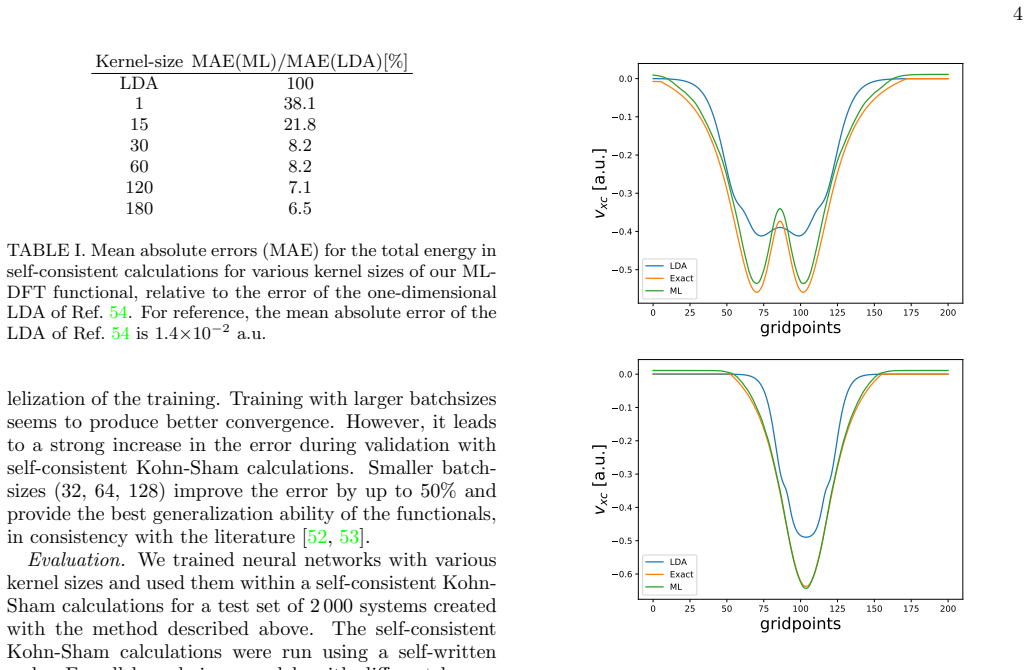
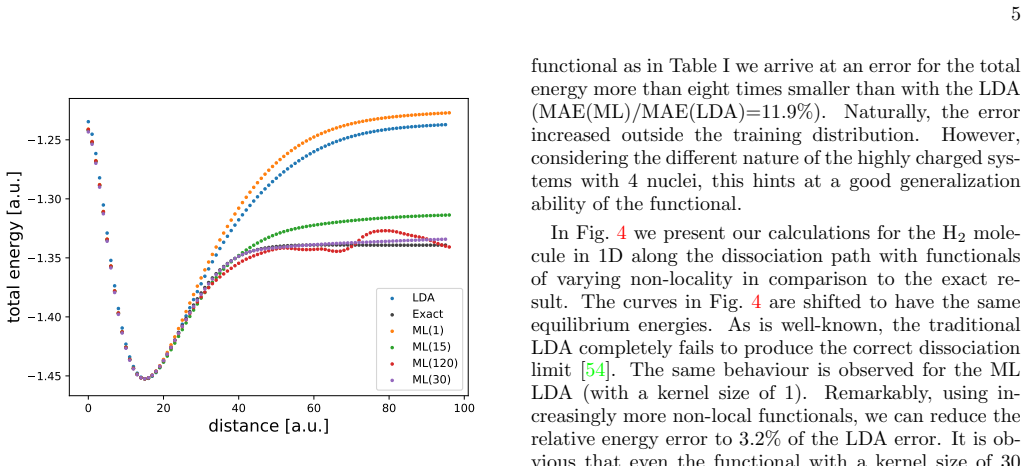
The central claim is that imposing the exact mathematical link between energy and potential during training, by obtaining the potential as the automatic derivative of the network's energy, makes a machine-learned exchange-correlation functional usable in self-consistent Kohn-Sham calculations. On a test set of 2,000 one-dimensional two-electron systems outside the training set, the error in the total energy drops to as low as 6.5% of the LDA error as the kernel size is increased, and a network trained only on the energy fails badly on the potential while joint training recovers potentials close to the exact ones. The same functionals reproduce the 1D H2 dissociation curve far better than LDA, even beyond the non-locality range of the kernel. These results are offered as evidence that a consistent, non-local ML functional is feasible and can address errors such as static correlation without abandoning Kohn-Sham efficiency.
Load-bearing premise
The trained functional inherits whatever errors are in the exchange-correlation potentials used as training labels, which are obtained by numerically inverting the Kohn-Sham equations and then filtering out cases flagged as unstable; if that inversion is biased in ways that survive the filtering, the entire functional is biased.
Editorial extensions
If this is right
- The same training strategy can be taken to three dimensions using coupled-cluster, full configuration-interaction, or quantum Monte Carlo data, the route the paper names for creating a universal functional.
- Because the potential is the functional derivative by construction, trained functionals cannot suffer from the energy-potential inconsistency of 'stray' potentials; remaining failures must come from the training data, the architecture, or the kernel range.
- Non-locality over a few atomic units is enough to cure the qualitative failure of LDA for dissociation in the tested model, suggesting that many static-correlation errors do not require infinite-range memory.
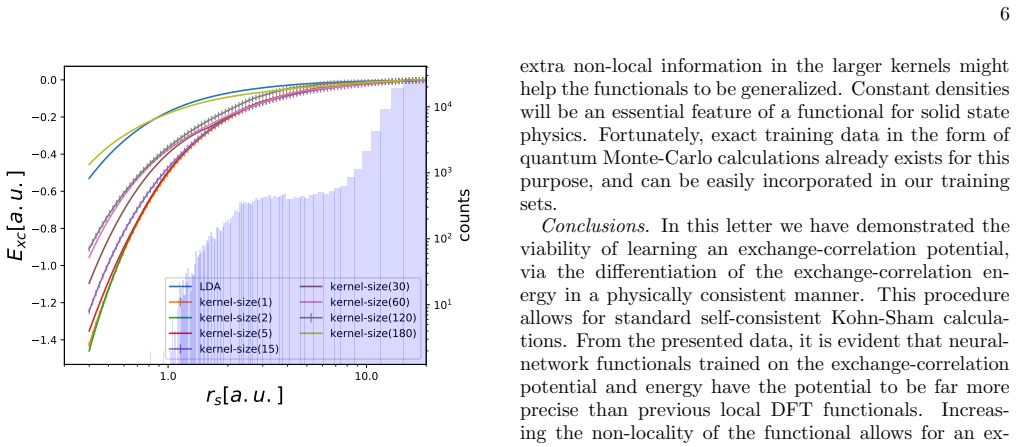
- Functionals trained on inhomogeneous systems can generalize to the homogeneous electron gas when the training set includes the relevant density range, which matters for use in solids.
Reading between the lines
- An immediate testable extension is to use the same consistency loss as a filter for any proposed ML functional: compute the derivative of the network's energy and reject models whose implicit potential disagrees with any separately fitted potential before running self-consistent calculations.
- The kernel-size study can be read as a diagnostic of how much non-locality each physical effect actually needs; measuring the required $\kappa$ per system type could guide data generation in three dimensions.
- Since the paper finds larger kernels sometimes produce unphysical dissociation curves, a natural next step is to enforce exact constraints, such as the correct constant-density limit, as soft or hard terms in the loss, which the results here suggest may be necessary for large kernels rather than merely helpful.
Signed reviews
Editorial analysis
A structured set of objections, weighed in public.
Referee Report
Summary. The manuscript trains neural-network exchange-correlation (xc) functionals for one-dimensional two-electron systems, using exact ground-state densities and energies obtained by solving the two-particle Schrödinger equation and then solving the inverse Kohn-Sham problem to obtain xc energies and potentials. The functional is a scanning sum of local network outputs over density neighborhoods (kernel size κ), with the xc potential obtained by automatic differentiation, so the energy-potential relation of Eq. (2) is satisfied by construction. The authors train with a weighted loss on energy, potential, potential derivative, and the energy-potential integral, and they test the functionals in self-consistent Kohn-Sham calculations on held-out systems, on four-nucleus systems, on H2 dissociation, and on the homogeneous electron gas. They report that increasing kernel size reduces total-energy errors relative to a 1D LDA, that the dissociation curve improves with non-locality, and that the approach is a feasible route toward non-local xc functionals with local-scaling cost.
Significance. If the reported results are robust, the paper makes a useful conceptual contribution: it shows that a machine-learned xc functional can be trained simultaneously on energies and potentials, that automatic differentiation enforces the exact functional-derivative relation, and that the resulting functional can be used in self-consistent Kohn-Sham calculations while improving on LDA in a model system where LDA is known to fail. The out-of-distribution tests (four nuclei, H2 dissociation, homogeneous electron gas) are a commendable part of the evaluation, and the explicit use of a held-out test set is a strength. The central limitation is that the training labels come from a numerically unstable inverse Kohn-Sham inversion, and the paper does not yet demonstrate that the label-cleaning procedure is unbiased. Because the label-quality issue bears directly on the validity of the learned functional, the manuscript needs additional evidence before the 'universal functional' claim can be accepted.
major comments (4)
- [Data section, p. 2-3] The training labels for both Exc and vxc are obtained by solving the inverse Kohn-Sham problem in octopus, and the paper states that 'the inversion is known to be numerically unstable [48]' and that outliers from these instabilities were removed, together with an additional cut Exc > −0.55 a.u. No quantitative information is provided about the magnitude or structure of the inversion error, no comparison of the inverted vxc against any reference is shown, and no analysis is given of which systems are removed by the cleaning procedure. If the instabilities or the Exc cut preferentially remove strongly correlated, low-density, or dissociated configurations, the training distribution is biased away from exactly the physics the functional is meant to describe. This is load-bearing because the claim that the ML functional reproduces the exact xc energy and potential rests entirely on the quality of these labels. I ask the authors to quantify inversion errors (e.g., by convergence checks with respect to grid spacing and inversion algorithm parameters), show at least a small set of representative inverted potentials against independently validated references, and characterize the discarded systems to show that the cleaning is not selecting on the target physics.
- [Table I and Evaluation section, p. 4] Table I reports mean absolute errors for the total energy relative to LDA for each kernel size, but no error bars, no seed variance, and no number of independent training runs are given. The text states that 'models with different hyperparameters were evaluated on a validation set of 250 systems' and that training was 'not completely converged at this stage,' with only the best model per kernel size continued to training and test evaluation. This makes the reported monotonic decrease of error with kernel size and the claimed optimal kernel size around 30 difficult to assess: a single favourable initialization or validation choice could drive the trend. I request repeated training runs over several random seeds for each kernel size, reporting the mean and standard deviation of the test MAE, and a statement of how many hyperparameter configurations were explored.
- [Homogeneous electron gas, Fig. 5] The HEG comparison is weakened by two issues that are acknowledged in the text but not adequately controlled. First, the machine-learned curves are shifted so that they are zero at zero density, a post-hoc adjustment that hides any bias in the network output for vanishing density. Second, the training data contains almost no samples with rs < 1 (as shown in the histogram in Fig. 5), so the behavior at high density is an extrapolation. The statement that 'functionals with larger kernel sizes still generalize on average far better' to the HEG is not supported by any error bars or by a quantitative comparison to the exact/LDA curve; moreover, the text notes that some large-kernel functionals show unphysical behavior. Please provide a quantitative error measure versus rs for each kernel size, with error bars over training runs, and discuss how the zero-density shift affects the comparison.
- [Abstract and Conclusions] The abstract calls the trained network 'the universal exchange-correlation functional of density-functional theory,' but the demonstration is limited to one-dimensional two-electron systems with a specific nuclear potential form, and the Conclusions acknowledge that scaling to three dimensions requires new representations and substantial additional data. The overstatement is consequential because the phrase 'universal functional' invites claims of general applicability that the evidence does not support. Please temper the abstract and title-level claim to 'a step toward' or 'a proof of principle for' a universal functional, and state explicitly in the abstract that the results are for 1D model systems.
minor comments (5)
- [p. 2] Typographical errors: 'fullfil' should be 'fulfill' and 'batchsizes' should be 'batch sizes' in the training paragraph on p. 4.
- [Eq. (5)] The loss function combines five terms, but the text says 'weights α, β, γ and δ' are optimized; Eq. (5) indeed has exactly four weights. Please clarify the wording to avoid implying a fifth weight.
- [Table I] Table I only gives ratios MAE(ML)/MAE(LDA). Please also report the absolute MAE for each ML functional so the reader can judge the practical magnitude of the errors, and define the LDA reference error precisely in the table caption.
- [Data section] The data-generation description does not specify the distributions of nuclear charges Zk or the minimum separation between nuclei. These details matter for judging the diversity of the training set and for reproducing the results; please add them.
- [Fig. 5 caption] The caption should state explicitly that the ML curves are shifted to zero at zero density, as mentioned in the text, so that readers do not interpret the plotted offset as raw network output.
Circularity Check
No significant circularity: the ML functional is trained on externally generated exact labels and evaluated on held-out and out-of-distribution systems.
full rationale
The paper's derivation chain is not circular. The exact exchange-correlation energy and potential labels come from solving the 1D two-electron problem exactly and then solving the inverse Kohn-Sham problem with octopus; these targets are external to the neural-network model, not defined in terms of its outputs. Equation (2), v_xc = δE_xc/δn, is imposed as an architectural constraint through automatic differentiation, and the loss function (5) fits the network to both the energy and the potential on training densities. Evaluating the trained functional on a held-out test set, on systems with four nuclei, and on the H2 dissociation curve is a genuine generalization test rather than a reconstruction of the training data. The HEG comparison is an extrapolation to constant densities and includes a clearly disclosed cosmetic shift to zero energy at zero density; this post-processing does not enter training and does not force the reported density dependence. Citations to the authors' prior work, such as the 1D LDA of Ref. 54 or octopus in Ref. 47, are used as benchmarks or computational tools and are not invoked as load-bearing uniqueness or existence arguments. The acknowledged numerical instability of the inverse Kohn-Sham inversion and the Exc > -0.55 a.u. outlier removal are data-quality limitations that could bias the learned distribution, but they do not make any predicted quantity equal to a fitted input by construction. No equation or claim in the paper reduces to its own inputs; the central results are empirical demonstrations of out-of-sample performance, so the circularity score is 0.
Assumptions & free parameters
free parameters (4)
- Loss weights α, β, γ, δ =
α≈1.0, β≈100.0, γ≈10.0, δ≈1.0 (typical)
- Kernel size κ =
1 to 180, optimal ~30
- Outlier threshold Exc > -0.55 a.u. =
-0.55 a.u.
- Neural network weights =
Learned during training (no closed form)
assumptions (4)
- domain assumption The 1D two-electron Hamiltonian with softened interaction is a valid theoretical laboratory for DFT functional development.
- domain assumption The inverse Kohn-Sham problem in octopus yields the exact xc potential for the sampled systems, and the outlier removal does not introduce bias.
- ad hoc to paper The scanning sum-of-local-network form can represent the exact xc energy functional for the systems of interest.
- standard math Automatic differentiation of the network output with respect to density inputs yields the correct functional derivative.
Cite this review
Pith. "Pith review of Machine Learning the Physical Non-Local Exchange-Correlation Functional of Density-Functional Theory." pith.science (2026). https://pith.science/paper/XZKS7ES2
@misc{pith2026190806198,
  author       = {Pith},
  title        = {Pith review of: Machine Learning the Physical Non-Local Exchange-Correlation Functional of Density-Functional Theory},
  year         = {2026},
  howpublished = {\url{https://pith.science/paper/XZKS7ES2}},
  note         = {Machine review of arXiv:1908.06198}
}
read the original abstract
We train a neural network as the universal exchange-correlation functional of density-functional theory that simultaneously reproduces both the exact exchange-correlation energy and potential. This functional is extremely non-local, but retains the computational scaling of traditional local or semi-local approximations. It therefore holds the promise of solving some of the delocalization problems that plague density-functional theory, while maintaining the computational efficiency that characterizes the Kohn-Sham equations. Furthermore, by using automatic differentiation, a capability present in modern machine-learning frameworks, we impose the exact mathematical relation between the exchange-correlation energy and the potential, leading to a fully consistent method. We demonstrate the feasibility of our approach by looking at one-dimensional systems with two strongly-correlated electrons, where density-functional methods are known to fail, and investigate the behavior and performance of our functional by varying the degree of non-locality.
Figures


Figures from the paper (2 more)
Reference graph
Works this paper leans on
-
[48]
Reference electronic structure calculations in one dimension,
L. O. Wagner, E. M. Stoudenmire, K. Burke, and S. R. White, “Reference electronic structure calculations in one dimension,” Phys. Chem. Chem. Phys. 14, 8581 (2012)
work page 2012
-
[1]
P. Hohenberg and W. Kohn, “Inhomogeneous electron gas,” Phys. Rev. 136, B864 (1964)
work page 1964
-
[2]
Self-consistent equations in- cluding exchange and correlation effects,
W. Kohn and L. J. Sham, “Self-consistent equations in- cluding exchange and correlation effects,” Phys. Rev. 140, A1133 (1965)
work page 1965
-
[3]
Qualitatively close to real 3D systems, this 1D model is known as a theoretical laboratory for studying strong correlation and developing exchange-correlation density functionals for DFT [46]. Since the ground-state problem of the Hamiltonian H(x1,x 2) can be treated as a one- particle problem in two dimensions, the problem can be solved exactly. We sampl...
-
[4]
Jacob’s ladder of density functional approximations for the exchange-correlation energy,
J. P. Perdew and K. Schmidt, “Jacob’s ladder of density functional approximations for the exchange-correlation energy,” AIP Conf. Proc. 577, 1 (2001)
work page 2001
-
[5]
Ground state of the electron gas by a stochastic method,
D. M. Ceperley and B. J. Alder, “Ground state of the electron gas by a stochastic method,” Phys. Rev. Lett. 45, 566 (1980). 7
work page 1980
-
[6]
Calculated electron affini- ties of the elements,
L. A. Cole and J. P. Perdew, “Calculated electron affini- ties of the elements,” Phys. Rev. A 25, 1265 (1982)
work page 1982
-
[7]
S. H. Vosko, L. Wilk, and M. Nusair, “Accurate spin- dependent electron liquid correlation energies for local spin density calculations: a critical analysis,” Can. J. Phys. 58, 1200 (1980)
work page 1980
Show all 60 references
-
[8]
Generalized gradient approximation made simple,
J. P. Perdew, K. Burke, and M. Ernzerhof, “Generalized gradient approximation made simple,” Phys. Rev. Lett. 77, 3865 (1996)
1996
-
[9]
Accurate and simple an- alytic representation of the electron-gas correlation en- ergy,
J. P. Perdew and Y. Wang, “Accurate and simple an- alytic representation of the electron-gas correlation en- ergy,” Phys. Rev. B 45, 13244 (1992)
1992
-
[10]
Accurate first-principles struc- tures and energies of diversely bonded systems from an efficient density functional,
J. Sun, R. C. Remsing, Y. Zhang, Z. Sun, A. Ruzsinszky, H. Peng, Z. Yang, A. Paul, U. Waghmare, X. Wu, M. L. Klein, and J. P. Perdew, “Accurate first-principles struc- tures and energies of diversely bonded systems from an efficient density functional,” Nat. Chem. 8, 831 (2016)
2016
-
[11]
Generalized gra- dient approximation for the exchange-correlation hole of a many-electron system,
J. P. Perdew, K. Burke, and Y. Wang, “Generalized gra- dient approximation for the exchange-correlation hole of a many-electron system,” Phys. Rev. B 54, 16533 (1996)
1996
-
[12]
Rationale for mixing exact exchange with density functional ap- proximations,
J. P. Perdew, M. Ernzerhof, and K. Burke, “Rationale for mixing exact exchange with density functional ap- proximations,” J. Chem. Phys. 105, 9982 (1996)
1996
-
[13]
A new mixing of Hartree–Fock and lo- cal density-functional theories,
A. D. Becke, “A new mixing of Hartree–Fock and lo- cal density-functional theories,” J. Chem. Phys. 98, 1372 (1993)
1993
-
[14]
Recent developments in libxc — A comprehensive library of functionals for density func- tional theory,
S. Lehtola, C. Steigemann, M. J. T. Oliveira, and M. A. L. Marques, “Recent developments in libxc — A comprehensive library of functionals for density func- tional theory,” SoftwareX 7, 1 (2018)
2018
-
[15]
Toward reliable density functional methods without adjustable parameters: The PBE0 model,
C. Adamo and V. Barone, “Toward reliable density functional methods without adjustable parameters: The PBE0 model,” J. Chem. Phys. 110, 6158 (1999)
1999
-
[16]
Insights into current limitations of density functional theory,
A. J. Cohen, P. Mori-S´ anchez, and W. Yang, “Insights into current limitations of density functional theory,” Sci- ence 321, 792 (2008)
2008
-
[17]
Perspective: Fifty years of density- functional theory in chemical physics,
A. D. Becke, “Perspective: Fifty years of density- functional theory in chemical physics,” J. Chem. Phys. 140, 18A301 (2014)
2014
-
[18]
Self-consistent hybrid functional for condensed systems,
J. H. Skone, M. Govoni, and G. Galli, “Self-consistent hybrid functional for condensed systems,” Phys. Rev. B 89, 195112 (2014)
2014
-
[19]
Fractional spins and static correlation error in density functional theory,
A. J. Cohen, P. Mori-S´ anchez, and W. Yang, “Fractional spins and static correlation error in density functional theory,” J. Chem. Phys. 129, 121104 (2008)
2008
-
[20]
Facial expression recognition method based on gabor wavelet features and fractional power polynomial kernel PCA,
S.-S. Liu and Y.-T. Tian, “Facial expression recognition method based on gabor wavelet features and fractional power polynomial kernel PCA,” in Advances in Neural Networks (Springer Berlin Heidelberg, 2010) pp. 144– 151
2010
-
[21]
Towards a formal definition of static and dy- namic electronic correlations,
C. L. Benavides-Riveros, N. N. Lathiotakis, and M. A. L. Marques, “Towards a formal definition of static and dy- namic electronic correlations,” Phys. Chem. Chem. Phys. 19, 12655 (2017)
2017
-
[22]
Machine learning for molecular and ma- terials science,
K. T. Butler, D. W. Davies, H. Cartwright, O. Isayev, and A. Walsh, “Machine learning for molecular and ma- terials science,” Nature 559, 547 (2018)
2018
-
[23]
Waibel and K.-F
A. Waibel and K.-F. Lee, eds., Readings in Speech Recog- nition (Morgan Kaufmann, 1990)
1990
-
[24]
Big data of materials science: Criti- cal role of the descriptor,
L. M. Ghiringhelli, J. Vybiral, S. V. Levchenko, C. Draxl, and M. Scheffler, “Big data of materials science: Criti- cal role of the descriptor,” Phys. Rev. Lett. 114, 105503 (2015)
2015
-
[25]
Recent advances and applications of machine learning in solid-state materials science,
J. Schmidt, M. R. G. Marques, S. Botti, and M. A. L. Marques, “Recent advances and applications of machine learning in solid-state materials science,” Npj Comput. Mat. 5 (2019)
2019
-
[26]
Finding density functionals with machine learning,
J. C. Snyder, M. Rupp, K. Hansen, K-R. M¨ uller, and K. Burke, “Finding density functionals with machine learning,” Phys. Rev. Lett. 108, 253002 (2012)
2012
-
[27]
Exchange-correlation potentials,
D. J. Tozer, V. E. Ingamells, and N. C. Handy, “Exchange-correlation potentials,” J. Chem. Phys. 105, 9200 (1996)
1996
-
[28]
Kinetic Energy of Hydrocar- bons as a Function of Electron Density and Convolutional Neural Networks,
K. Yao and J. Parkhill, “Kinetic Energy of Hydrocar- bons as a Function of Electron Density and Convolutional Neural Networks,” J. Chem. Theory Comput. 12, 1139 (2016)
2016
-
[29]
Orbital-free bond breaking via machine learning,
J. C. Snyder, M. Rupp, K. Hansen, L. Blooston, K.-R. M¨ uller, and K. Burke, “Orbital-free bond breaking via machine learning,” J. Chem. Phys. 139, 224104 (2013)
2013
-
[30]
rameters
in comparison to the exact and the LDA results. rameters. This reason, together with the need to rep- resent more long-range interactions that are based on different physical principles (such as van der Waals in- teraction), makes the training considerably more diffi- cult. One a...
-
[31]
Bypassing the Kohn-Sham equations with machine learning,
F. Brockherde, L. Vogt, L. Li, M. E. Tuckerman, K. Burke, and K.-R. M¨ uller, “Bypassing the Kohn-Sham equations with machine learning,” Nat. Commun. 8, 872 (2017)
2017
-
[32]
Improving the performance of long-range- corrected exchange-correlation functional with an embed- ded neural network,
Q. Liu, J. C. Wang, P. L. Du, L. H. Hu, X. Zheng, and G. Chen, “Improving the performance of long-range- corrected exchange-correlation functional with an embed- ded neural network,” J. Phys. Chem. A121, 7273 (2017)
2017
-
[33]
Neural-network Kohn-Sham exchange-correlation po- tential and its out-of-training transferability,
R. Nagal, R. Akashi, S. Sasaki, and S. Tsuneyuki, “Neural-network Kohn-Sham exchange-correlation po- tential and its out-of-training transferability,” J. Chem. Phys. 148, 241737 (2018)
2018
-
[34]
mBEEF-vdW: Robust fitting of error estimation density functionals,
K. T. Lundgaard, J. Wellendorff, J. Voss, K. W. Jacob- sen, and T. Bligaard, “mBEEF-vdW: Robust fitting of error estimation density functionals,” Phys. Rev. B 93, 235162 (2016)
2016
-
[35]
Density functionals for surface science: Exchange-correlation model development with bayesian error estimation,
J. Wellendorff, K. T. Lundgaard, A. Møgelhøj, V. Pet- zold, D. D. Landis, J. K. Nørskov, T. Bligaard, and K. W. Jacobsen, “Density functionals for surface science: Exchange-correlation model development with bayesian error estimation,” Phys. Rev. B 85, 235149 (2012)
2012
-
[36]
Pure density functional for strong correlation and the thermo- dynamic limit from machine learning,
L. Li, T. E. Baker, S. R. White, and K. Burke, “Pure density functional for strong correlation and the thermo- dynamic limit from machine learning,” Phys. Rev. B 94, 245129 (2016)
2016
-
[37]
Derivation and application of an accurate Kohn-Sham potential with in- teger discontinuity,
J. B. Krieger, Y. Li, and G. J. Iafrate, “Derivation and application of an accurate Kohn-Sham potential with in- teger discontinuity,” Phys. Lett. A 146, 256 (1990)
1990
-
[38]
A variational approach to the unipotential many-electron problem,
R. T. Sharp and G. K. Horton, “A variational approach to the unipotential many-electron problem,” Phys. Rev. 90, 317 (1953)
1953
-
[39]
Optimized effective atomic central potential,
J. D. Talman and W. F. Shadwick, “Optimized effective atomic central potential,” Phys. Rev. A 14, 36 (1976)
1976
-
[40]
Exchange-corre- lation potential with correct asymptotic behavior,
R. van Leeuwen and E. J. Baerends, “Exchange-corre- lation potential with correct asymptotic behavior,” Phys. Rev. A 49, 2421 (1994)
1994
-
[41]
A simple effective po- tential for exchange,
A. D. Becke and E. R. Johnson, “A simple effective po- tential for exchange,” J. Chem. Phys.124, 221101 (2006)
2006
-
[42]
Accurate Band Gaps of Semi- conductors and Insulators with a Semilocal Exchange- Correlation Potential,
F. Tran and P. Blaha, “Accurate Band Gaps of Semi- conductors and Insulators with a Semilocal Exchange- Correlation Potential,” Phys. Rev. Lett. 102, 226401 (2009)
2009
-
[43]
How to tell when a model Kohn–Sham potential is not a functional deriva- tive,
A. P. Gaiduk and V. N. Staroverov, “How to tell when a model Kohn–Sham potential is not a functional deriva- tive,” J. Chem. Phys. 131, 044107 (2009). 8
2009
-
[44]
Large-Scale Benchmark of Ex- change–Correlation Functionals for the Determination of Electronic Band Gaps of Solids,
P. Borlido, T. Aull, A. W. Huran, F. Tran, M. A. L. Marques, and S. Botti, “Large-Scale Benchmark of Ex- change–Correlation Functionals for the Determination of Electronic Band Gaps of Solids,” J. Chem. Theory Com- put. 15, 5069 (2019)
2019
-
[45]
Automatic differentiation in pytorch,
A. Paszke, S. Gross, S. Chintala, G. Chanan, E. Yang, Z. DeVito, Z. Lin, A. Desmaison, L. Antiga, and A. Lerer, “Automatic differentiation in pytorch,” inNIPS 2017 Autodiff Workshop: The Future of Gradient-based Machine Learning Software and Techniques (2017)
2017
-
[46]
TensorFlow: Large-scale machine learning on heterogeneous systems,
M. Abadi, A. Agarwal, P. Barham, E. Brevdo, Z. Chen, C. Citro, G. S. Corrado, A. Davis, J. Dean, M. Devin, S. Ghemawat, I. Goodfellow, A. Harp, G. Irving, M. Is- ard, Y. Jia, R. Jozefowicz, L. Kaiser, M. Kudlur, J. Levenberg, D. Man´ e, R. Monga, S. Moore, D. Mur- ray, C. Olah...
2015
-
[47]
Completing den- sity functional theory by machine-learning hidden mes- sages from molecules,
R. Nagai, R. Akashi, and O. Sugino, “Completing den- sity functional theory by machine-learning hidden mes- sages from molecules,” arXiv:1903.00238 (2019)
2019 arXiv
-
[49]
Real-space grids and the Octo- pus code as tools for the development of new simulation approaches for electronic systems,
X. Andrade, D. Strubbe, U. De Giovannini, A. H. Larsen, M. J. T. Oliveira, J. Alberdi-Rodriguez, A. Varas, I. Theophilou, N. Helbig, M. J. Verstraete, L. Stella, F. Nogueira, A. Aspuru-Guzik, A. Castro, M. A. L. Mar- ques, and A. Rubio, “Real-space grids and the Octo- pus code...
2015
-
[50]
Numerical methods for the inverse problem of density functional theory,
D. S. Jensen and A. Wasserman, “Numerical methods for the inverse problem of density functional theory,” Int. J. Quantum Chem. 118, e25425 (2018)
2018
-
[51]
Fast and accurate deep network learning by exponential linear units (elus),
D.-A. Clevert, T. Unterthiner, and S. Hochreiter, “Fast and accurate deep network learning by exponential linear units (elus),” arXiv:1511.07289 (2015)
2015 arXiv
-
[52]
“Ignite,” https://github.com/pytorch/ignite, (2018)
2018
-
[53]
Adam: A method for stochastic optimization,
D. P. Kingma and J. Ba, “Adam: A method for stochastic optimization,” arXiv:1412.6980 (2014)
2014 arXiv
-
[54]
Revisiting small batch train- ing for deep neural networks,
D. Masters and C. Luschi, “Revisiting small batch train- ing for deep neural networks,” arXiv:1804.07612 (2018)
2018 arXiv
-
[55]
Goodfellow, Y
I. Goodfellow, Y. Bengio, and A. Courville, Deep Learn- ing (MIT Press, 2016) http://www.deeplearningbook. org
2016
-
[56]
Density functional theory beyond the linear regime: Validating an adiabatic local density approximation,
N. Helbig, J. I. Fuks, M. Casula, M. J. Verstraete, M. A. L. Marques, I. V. Tokatly, and A. Rubio, “Density functional theory beyond the linear regime: Validating an adiabatic local density approximation,” Phys. Rev. A 83, 032503 (2011)
2011
-
[57]
MN15-L: A New Local Exchange-Correlation Functional for Kohn–Sham Density Functional Theory with Broad Accuracy for Atoms, Molecules, and Solids,
H. S. Yu, X. He, and D. G. Truhlar, “MN15-L: A New Local Exchange-Correlation Functional for Kohn–Sham Density Functional Theory with Broad Accuracy for Atoms, Molecules, and Solids,” J. Chem. Theory Com- put. 12, 1280 (2016)
2016
-
[58]
MN15: A Kohn–Sham global-hybrid exchange–correlation density functional with broad accuracy for multi-reference and single-reference systems and noncovalent interactions,
H. S. Yu, X. He, S. L. Li, and D. G. Truhlar, “MN15: A Kohn–Sham global-hybrid exchange–correlation density functional with broad accuracy for multi-reference and single-reference systems and noncovalent interactions,” Chem. Sci. 7, 5032 (2016)
2016
-
[59]
ωB97M-V: A combinatorially optimized, range-separated hybrid, me- ta-GGA density functional with VV10 nonlocal correla- tion,
N. Mardirossian and M. Head-Gordon, “ ωB97M-V: A combinatorially optimized, range-separated hybrid, me- ta-GGA density functional with VV10 nonlocal correla- tion,” J. Chem. Phys. 144, 214110 (2016)
2016
-
[60]
Can ex- act conditions improve machine-learned density function- als?
J. Hollingsworth, T. E. Baker, and K. Burke, “Can ex- act conditions improve machine-learned density function- als?” J. Chem. Phys. 148, 241743 (2018)
2018
Reviewed August 14, 2026 · model on record in the stance chip above.
Discussion (0). Continue with ORCID to comment.