REVIEW 4 major objections 6 minor 34 references
On the Adversarial Robustness of Subspace Learning
T0 review · 4 major / 6 minor · reviewed 2026-08-14 · deepseek-v4-flash
Pith's one-line read Closed-form formulas give the exact worst-case rotation an energy-bounded adversary can force on a learned PCA subspace, and identify the attack matrix that achieves it.
desk verdict Useful closed-form attack formulas for PCA poisoning, but the exact worst-case claim rests on an unproved sparsity theorem. read the letter →
The pith
A machine-rendered reading of the paper's core claim, the machinery that carries it, and where it could break.
The reading
What carries the argument
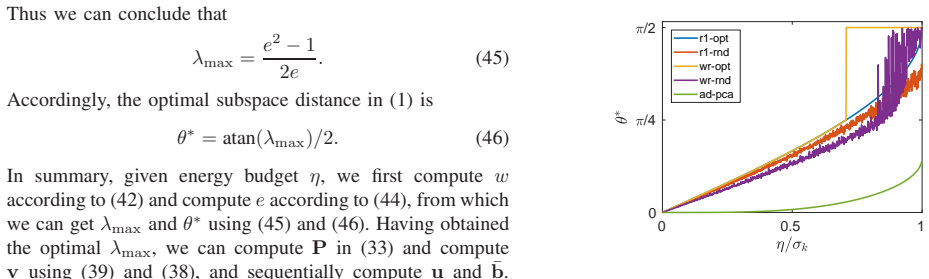
The load-bearing structure is a sparsity theorem: in the SVD coordinate system of the original data matrix, the optimal modification $B = U^\top \Delta X V$ has non-zero entries only in the $2\times 2$ block spanning rows and columns $k$ and $k+1$. This reduces the infinite-dimensional non-convex problem to maximizing the ratio of two quadratic forms in a four-dimensional vector $u$, $u^\top A_1 u / u^\top A_2 u$, subject to $\|u - \sigma\|^2 \le \eta^2$. The ratio is converted to a feasibility problem $u^\top(A_1 - \lambda A_2)u = 0$; an eigendecomposition of the $2\times 2$ matrix $Q$ and the change of variables $v = \operatorname{diag}(P^\top, P^\top)u$ turn this into $v_1^2 + v_3^2 = v_2^2 + v_4^2$. Minimizing the distance from $v$ to a $\lambda$-dependent center gives a scalar inequality, whose largest feasible $\lambda$ is $\lambda_{\max} = (e^2 - 1)/(2e)$. The rank-one analysis supports this: Theorem 2 fixes the form of the optimal rank-one attack on the same two coordinates, and Lemma 1 uses perturbation theory to ensure the top singular vector of the perturbed $2\times 2$ block is the selected principal component.
What would settle it
Take a concrete data matrix, for example $X = \operatorname{diag}(4,3,2,1)$ with $k=2$ and $\eta=0.4$, compute $\theta^* = \operatorname{atan}(\lambda_{\max})/2$ from the paper's formulas, then do an exhaustive or heavily randomized search over matrices $B$ with $\|B\|_F = \eta$ in the full $4\times 4$ space; if any $B$ whose entries extend beyond the $2\times 2$ block on rows and columns 2 and 3 yields an Asimov distance larger than $\theta^*$, the characterization is falsified. The rank-one formula $\theta^* = \arcsin(\eta/\sigma_k)$ can be checked the same way.
Extended reading notes
Core claim
The paper's central claim is that the optimal adversarial modification of a data matrix can be characterized exactly in closed form. For a rank-one attack when the selected subspace dimension equals the rank of the data matrix, the maximum Asimov distance is $\theta^* = \pi/2$ if $\eta > \sigma_k$ and $\theta^* = \arcsin(\eta/\sigma_k)$ otherwise, achieved by $\Delta X^* = ab^\top$ with $a$ placed against the $k$-th singular direction plus an orthogonal component and $b = v_k$. For the general attack with no rank constraint, the paper proves that, in the coordinate system $X = U\Sigma V^\top$, an optimal modification has non-zero entries only in the $2\times 2$ block on rows and columns $k$ and $k+1$, and the worst-case distance is $\theta^* = \operatorname{atan}(\lambda_{\max})/2$, where $\lambda_{\max} = (e^2 - 1)/(2e)$ and $e$ is computed from $\eta$, $\sigma_k$, and $\sigma_{k+1}$ through the auxiliary quantity $w$. The paper also identifies the threshold $\eta \ge (\sigma_k - \sigma_{k+1})/\sqrt{2}$ beyond which the attacker can make the learned subspace exactly orthogonal to the original one, so $\theta^* = \pi/2$.
Load-bearing premise
The load-bearing premise is the structural sparsity theorem: the optimal attack spends all its energy inside the $2\times 2$ block of the $k$-th and $(k+1)$-th singular directions, so if any modification touching other directions rotated the PCA subspace more for the same budget, the closed-form angle would understate the true worst case.
Editorial extensions
If this is right
- For any $\eta < (\sigma_k - \sigma_{k+1})/\sqrt{2}$, no modification of the data matrix with Frobenius norm at most $\eta$ can rotate the learned $k$-dimensional PCA subspace by more than $\theta^* = \operatorname{atan}(\lambda_{\max})/2$, and the paper gives the explicit $B^*$ that attains it.
- Once $\eta \ge (\sigma_k - \sigma_{k+1})/\sqrt{2}$, the attacker can drive the learned subspace to be orthogonal to the original one, so the worst-case distance jumps to $\pi/2$.
- In the rank-one low-rank case, the worst-case angle is $\arcsin(\eta/\sigma_k)$ for $\eta \le \sigma_k$, so a single rank-one perturbation already produces a large rotation when the budget is comparable to the smallest singular value.
- The optimal strategy depends only on the two adjacent singular values $\sigma_k$, $\sigma_{k+1}$ and the budget $\eta$; all other singular directions are irrelevant to the worst-case distance.
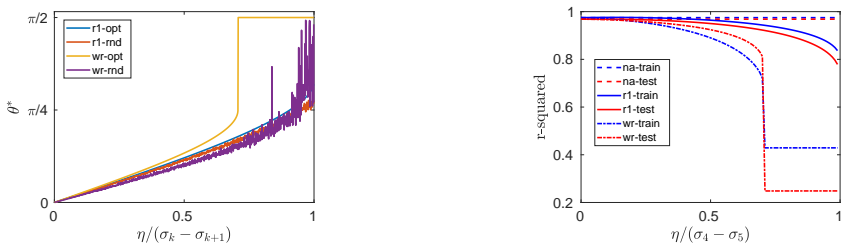
- In the paper's principal component regression experiment, the attack lowers $R^2$ steadily and then drops sharply at $\eta/(\sigma_k - \sigma_{k+1}) = 1/\sqrt{2}$, matching the predicted transition to $\theta^* = \pi/2$.
Reading between the lines
- Editorial inference: inverting $\theta^*(\eta)$ yields a certified robustness radius for PCA: the largest energy budget that keeps the learned subspace within a given angular tolerance is the $\eta$ that solves $\theta^*(\eta) = \text{tolerance}$, and it can be computed from the same closed form.
- Editorial inference: the localization of the optimal attack to two adjacent singular directions suggests analogous worst-case rotation formulas may hold for other spectral subspace methods whose objective depends on a similar eigen-gap, such as spectral clustering or canonical correlation analysis.
- Editorial inference: in streaming or online PCA, where a single new sample is incorporated at each step, the rank-one result can be read as a bound on how much one adversarially chosen sample can move the current subspace.
Signed reviews
Editorial analysis
A structured set of objections, weighed in public.
Referee Report
Summary. The manuscript studies a white-box adversary who observes a data matrix X and adds a perturbation ΔX with Frobenius norm at most η before PCA is applied. The attack objective is the Asimov distance, i.e., the largest principal angle between the k-dimensional PCA subspaces of X and of X + ΔX. For rank-one perturbations the paper derives closed-form optimal distances: θ* = arcsin(η/σ_k) in the low-rank/full-rank cases and a more complicated expression in the general case k < rank(X) (Theorem 3). For unrestricted perturbations the paper claims that the optimal modification matrix B is supported only on the 2×2 block in rows and columns (k, k+1), and derives the closed-form θ* = atan(λmax)/2 with λmax = (e² − 1)/(2e), where e depends on σ_k, σ_{k+1}, and η (Section IV, Eqs. (45)–(46)). Numerical experiments on synthetic data and a principal component regression application on gasoline spectra are presented, including a phase transition at η/(σ_k − σ_{k+1}) = 1/√2.
Significance. If the optimality claims are fully established, the paper provides a complete, closed-form characterization of the worst-case PCA subspace attack under an energy budget, and the formulas depend only on the relevant singular values and the budget. This is a useful complement to the sparse-outlier and small-noise robustness literature and goes beyond [26] by allowing dense modification of the whole data matrix. The phase transition predicted for the unconstrained attack at η/(σ_k − σ_{k+1}) = 1/√2 is a concrete falsifiable prediction, and the PCR experiment in Fig. 4 displays the predicted drop. The algebra from the reduced 2×2 problem onward is coherent, and the low-rank limit of the unconstrained formula correctly reduces to arcsin(η/σ_k). The principal weakness is not the closed-form manipulation but the structural reductions that justify reducing the original problem to a 2×2 block; these reductions are asserted through qualitative arguments in Appendices B, C, and E rather than proved. Because the central exactness claim depends on those reductions, the proofs need to be completed before the formulas can be regarded as the true worst case.
major comments (4)
- [Appendix E, Theorem 4] The proof of the row-sparsity statement in Theorem 4 is asserted rather than derived. After introducing P, Q, and T, the text states that 'by setting all the entries of B to be zero except the kth and (k+1)th rows, we can guarantee achieving the maximal subspace distance' and concludes q ∈ span{e_k, e_{k+1}} and p = e_k. This conclusion is exactly the content of the theorem, and the preceding qualitative variance arguments do not rule out perturbations with energy in rows outside {k, k+1} producing a larger principal angle, especially when σ_{k+2} is close to σ_{k+1} or when off-block entries reorder singular values. Since problem (29) is reduced to the four-variable problem (31) under this unverified assumption, the exactness of Eqs. (45)–(46) depends entirely on this step. The numerical random-attack baselines in Figs. 1–2 also do not test dense optimality; a small-scale global optimization over all B, or a rigorous proof, is needed before the unconstrained formula can be treated as the true worst case.
- [Appendix E, inequalities (60)–(62)] The column-sparsity step is also not established by the displayed inequalities. Inequalities (60)–(62) provide an upper bound on b_y and a lower bound on b_x for a given choice of b_1 and b_2, but the proof then asserts that replacing (b_1, b_2) by (0, 0) and enlarging the 2×2 entries yields another feasible solution with a larger objective value. Because both the numerator and the denominator of b_y/b_x change in this replacement, separate bounds on b_y and b_x do not imply a monotone change of the ratio; a direct comparison of the ratios is required. The equality conditions in (61)–(62) only identify when the auxiliary bounds are tight, not when the original objective is maximal.
- [Appendix C, Theorem 2] The structural proof of the rank-one result in Theorem 2 is not rigorous. The proof assumes that the intersection T = P ∩ Q has dimension k−1 and represents P = T ⊕ span(p), Q = T ⊕ span(q), so that the Asimov distance is the angle between p and q. This representation requires dim(T) = k−1, which is not automatic when d > k+1: two k-dimensional subspaces of R^d can intersect in fewer than k−1 dimensions. The argument then uses qualitative variance-dominance statements such as 'the larger variance in the direction of p is, the closer p and q will be' and 'q will be closer to a as â grows', without proving monotonicity of the actual eigenvector objective. Because Theorem 2 is the basis for the 2×2 reduction leading to Theorem 3, this gap is load-bearing for the rank-one optimal attack as well.
- [Section III-B, Lemma 1 and Appendix D] Two supporting steps are under-specified. First, Lemma 1's perturbation-theory claim that the singular values of Σ_2 satisfy ξ_2 < σ_k and ξ_1 > σ_{k+1} is stated with a reference but not derived, and the conclusion that the selected principal component is w_1 needs an explicit check that ξ_2 is also below σ_{k−1}, so that only one singular vector of the 2×2 block enters the top-k subspace. Second, the proof of Theorem 3 in Appendix D defers the boundary comparison with 'it is easy to compute the objective values at the boundary points'. Since problem (25) is a two-dimensional nonconvex problem, the stationary-point analysis alone does not establish the global optimum unless the boundary values are actually computed and compared.
minor comments (6)
- [Appendix A heading] The heading 'POOF OF THE EQUIVALENCE' should be corrected to 'PROOF OF THE EQUIVALENCE'.
- [Section V-A] The word 'Frobenious' should be 'Frobenius'.
- [Section V-B] The text 'gasaline data set' should be 'gasoline data set'.
- [Eq. (33)] The notation p_{i,j} is used immediately after Eq. (33) but is not explicitly defined; the entries of P should be listed or labeled before they are referenced in the expressions for σ̄.
- [Appendix B] The final step of Appendix B says b_k = −sign(a_k) and then 'to avoid the sign ambiguity, we set b_k = 1'. The sign convention is confusing because changing the sign of b can be absorbed into a; it should be stated precisely which gauge is fixed.
- [Figs. 1 and 2] The figure axes are not fully labeled: the y-axis is implicitly the Asimov distance but no tick labels or axis name are shown. Adding axis labels would improve readability.
Circularity Check
No circularity: the optimal-attack formulas are derived from the stated optimization problems, and the apparent gaps in Theorem 4 are proof-correctness issues, not circular reasoning.
full rationale
The paper's central claims are derived, not fitted: given the white-box threat model, the attack matrix is constructed from the SVD of X and the budget η, and the resulting Asimov distance is then evaluated from the same problem definition. Nothing is calibrated to make theory match experiments; the experiments use the same observed X to construct and evaluate the attack, which is exactly the adversarial setting being characterized. The derivation chain is self-contained: Proposition 1, Proposition 2, and Theorem 3 are obtained by solving the displayed optimization problems with explicit stationary-point and boundary analysis, and the closed-form λmax in equations (42)-(46) follows from the feasibility reformulation of problem (31). The paper cites its own conference version [1] and a related paper by one author [25], but neither is load-bearing: [1] is a prior version of the same result and [25] is contextual related work, while the proof of the rank-one structure explicitly follows the external reference [26]. The only notable weakness is that Theorem 4's proof in Appendix E asserts, rather than rigorously establishes, the key row-sparsity reduction: after the intersection argument, the text states that 'by setting all the entries of B to be zero except the kth and (k+1)th rows, we can guarantee achieving the maximal subspace distance,' which is essentially the content of the theorem. This is a potential correctness gap and would require a complete proof or numerical global-optimization verification before the exactness claim of θ* = atan(λmax)/2 is fully certified, but it is not circularity: the claim is not being defined in terms of itself, and no fitted parameter or self-citation chain forces the result. Accordingly, the circularity score is 0.
Assumptions & free parameters
assumptions (3)
- domain assumption The data matrix is preprocessed (centered and standardized) before PCA; modifying the centered data is equivalent to modifying X directly.
- domain assumption Asimov distance (largest principal angle) is the correct metric for subspace discrepancy, and it is unitarily invariant.
- standard math Perturbation theory: for a rank-one modification within the energy budget, the singular values of the affected 2x2 block satisfy ξ2 < σ_k and ξ1 > σ_{k+1}, so the selected principal component is the top singular vector of that block.
Cite this review
Pith. "Pith review of On the Adversarial Robustness of Subspace Learning." pith.science (2026). https://pith.science/paper/J76D4RZV
@misc{pith2026190806210,
  author       = {Pith},
  title        = {Pith review of: On the Adversarial Robustness of Subspace Learning},
  year         = {2026},
  howpublished = {\url{https://pith.science/paper/J76D4RZV}},
  note         = {Machine review of arXiv:1908.06210}
}
read the original abstract
In this paper, we study the adversarial robustness of subspace learning problems. Different from the assumptions made in existing work on robust subspace learning where data samples are contaminated by gross sparse outliers or small dense noises, we consider a more powerful adversary who can first observe the data matrix and then intentionally modify the whole data matrix. We first characterize the optimal rank-one attack strategy that maximizes the subspace distance between the subspace learned from the original data matrix and that learned from the modified data matrix. We then generalize the study to the scenario without the rank constraint and characterize the corresponding optimal attack strategy. Our analysis shows that the optimal strategies depend on the singular values of the original data matrix and the adversary's energy budget. Finally, we provide numerical experiments and practical applications to demonstrate the efficiency of the attack strategies.
Figures
Reference graph
Works this paper leans on
-
[26]
Adversarial principal component analysis,
D. L. Pimentel-Alarcn, A. Biswas, and C. R. Sols-Lemus, “Adversarial principal component analysis,” in Proc. IEEE International Symposium on Information Theory , Aachen, Germany, Jun. 2017, pp. 2363–2367
work page 2017
-
[1]
On the adversarial robustness o f subspace learning,
F. Li, L. Lai, and S. Cui, “On the adversarial robustness o f subspace learning,” in Proc. IEEE International Conference on Acoustics, Speech and Signal Processing , Brighton, UK, May 2019, pp. 2477–2481
work page 2019
-
[2]
Y . Li, W. Dai, J. Zou, H. Xiong, and Y . F. Zheng, “Structure d sparse representation with union of data-driven linear and multil inear subspaces model for compressive video sampling,” IEEE Transactions on Signal Processing, vol. 65, no. 19, pp. 5062–5077, Oct. 2017
work page 2017
-
[3]
Subspace-based adaptive m ethod for estimating direction-of-arrival with luenberger observe r,
J. Xin, N. Zheng, and A. Sano, “Subspace-based adaptive m ethod for estimating direction-of-arrival with luenberger observe r,” IEEE Trans- actions on Signal Processing , vol. 59, no. 1, pp. 145–159, Jan. 2011
work page 2011
-
[4]
Online categor ical subspace learning for sketching big data with misses,
Y . Shen, M. Mardani, and G. B. Giannakis, “Online categor ical subspace learning for sketching big data with misses,” IEEE Transactions on Signal Processing, vol. 65, no. 15, pp. 4004–4018, Aug. 2017
work page 2017
-
[5]
An online algorithm for se parating sparse and low-dimensional signal sequences from their sum ,
H. Guo, C. Qiu, and N. V aswani, “An online algorithm for se parating sparse and low-dimensional signal sequences from their sum ,” IEEE Transactions on Signal Processing, vol. 62, no. 16, pp. 4284–4297, Aug. 2014
work page 2014
-
[6]
R. Otazo, E. J. Cand` es, and D. K. Sodickson, “Low-rank pl us sparse matrix decomposition for accelerated dynamic MRI with sepa ration of background and dynamic components,” Magnetic Resonance in Medicine, vol. 73, no. 3, pp. 1125–1136, Apr. 2015
work page 2015
-
[7]
Matrix factorizatio n techniques for recommender systems,
Y . Koren, R. Bell, and C. V olinsky, “Matrix factorizatio n techniques for recommender systems,” Computer, vol. 42, no. 8, pp. 30–37, Aug. 2009
work page 2009
Show all 34 references
-
[8]
Dynamic anom alog- raphy: Tracking network anomalies via sparsity and low rank ,
M. Mardani, G. Mateos, and G. B. Giannakis, “Dynamic anom alog- raphy: Tracking network anomalies via sparsity and low rank ,” IEEE Journal of Selected Topics in Signal Processing , vol. 7, no. 1, pp. 50– 66, Feb. 2012
2012
-
[9]
Video denoising via online sparse and low- rank matrix decomposition,
H. Guo and N. V aswani, “Video denoising via online sparse and low- rank matrix decomposition,” in Proc. IEEE Statistical Signal Processing W orkshop, Palma de Mallorca, Spain, Jun. 2016, pp. 1–5
2016
-
[10]
Robust princi pal component analysis?
E. J. Cand` es, X. Li, Y . Ma, and J. Wright, “Robust princi pal component analysis?” Journal of the ACM , vol. 58, no. 3, pp. 11:1–11:37, Jun. 2011
2011
-
[11]
Robust matrix decomp osition with sparse corruptions,
D. Hsu, S. M. Kakade, and T. Zhang, “Robust matrix decomp osition with sparse corruptions,” IEEE Transactions on Information Theory , vol. 57, no. 11, pp. 7221–7234, Jun. 2011
2011
-
[12]
Recursive ro bust PCA or recursive sparse recovery in large but structured noi se,
C. Qiu, N. V aswani, B. Lois, and L. Hogben, “Recursive ro bust PCA or recursive sparse recovery in large but structured noi se,” IEEE Transactions on Information Theory , vol. 60, no. 8, pp. 5007–5039, Jun. 2014
2014
-
[13]
Robust ma trix completion and corrupted columns,
Y . Chen, H. Xu, C. Caramanis, and S. Sanghavi, “Robust ma trix completion and corrupted columns,” in Proc. International Conference on Machine Learning , Bellevue, Washington, Jun. 2011, pp. 873–880
2011
-
[14]
Robust physical-world at tacks on deep learning models,
K. Eykholt, I. Evtimov, E. Fernandes, B. Li, A. Rahmati, C. Xiao, A. Prakash, T. Kohno, and D. Song, “Robust physical-world at tacks on deep learning models,” arXiv preprint arXiv:1707.08945 , Jul. 2017
2017 arXiv
-
[15]
Hidden voice commands,
N. Carlini, P . Mishra, T. V aidya, Y . Zhang, M. Sherr, C. S hields, D. Wagner, and W. Zhou, “Hidden voice commands,” in Proc. USENIX Security Symposium , Austin, TX, Aug. 2016, pp. 513–530
2016
-
[16]
Adversarial attacks on medical machine learning,
S. G. Finlayson, J. D. Bowers, J. Ito, J. L. Zittrain, A. L . Beam, and I. S. Kohane, “Adversarial attacks on medical machine learning, ” Science, vol. 363, no. 6433, pp. 1287–1289, Mar. 2019
2019
-
[17]
Targeted backd oor attacks on deep learning systems using data poisoning,
X. Chen, C. Liu, B. Li, K. Lu, and D. Song, “Targeted backd oor attacks on deep learning systems using data poisoning,” arXiv preprint arXiv:1712.05526, Dec. 2017
2017 arXiv
-
[18]
G. H. Golub and C. F. V an Loan, Matrix computations . The Johns Hopkins University Press, 2013
2013
-
[19]
The geometry of algorithms with orthogonality constraints,
A. Edelman, T. A. Arias, and S. T. Smith, “The geometry of algorithms with orthogonality constraints,” SIAM journal on Matrix Analysis and Applications, vol. 20, no. 2, pp. 303–353, Apr. 1998
1998
-
[20]
Almost invariant submanifolds for comp act group ac- tions,
A. Weinstein, “Almost invariant submanifolds for comp act group ac- tions,” Journal of the European Mathematical Society , vol. 2, no. 1, pp. 53–86, Mar. 2000
2000
-
[21]
Optimal robustness in th e gap metric,
T. T. Georgiou and M. C. Smith, “Optimal robustness in th e gap metric,” IEEE Transactions on Automatic Control , vol. 35, no. 6, pp. 673–686, Jun. 1990
1990
-
[22]
Frequency domain uncertainty and the g raph topology,
G. Vinnicombe, “Frequency domain uncertainty and the g raph topology,” IEEE Transactions on Automatic Control , vol. 38, no. 9, pp. 1371–1383, Sep. 1993
1993
-
[23]
Feedback stability under simult aneous gap metric uncertainties in plant and controller,
L. Qui and E. Davison, “Feedback stability under simult aneous gap metric uncertainties in plant and controller,” Systems & Control Letters , vol. 18, no. 1, pp. 9–22, Jan. 1992
1992
-
[24]
Manipulating machine learning: Poisoning attacks and cou ntermeasures for regression learning,
M. Jagielski, A. Oprea, B. Biggio, C. Liu, C. Nita-Rotar u, and B. Li, “Manipulating machine learning: Poisoning attacks and cou ntermeasures for regression learning,” in Proc. IEEE Symposium on Security and Privacy, San Francisco, CA, May 2018, pp. 19–35
2018
-
[25]
On the adversarial robustness of multivariate robust estimation,
E. Bayraktar and L. Lai, “On the adversarial robustness of multivariate robust estimation,” arXiv preprint arXiv:1903.11220 , 2019
1903 arXiv
-
[27]
The role of princip al angles in subspace classification,
J. Huang, Q. Qiu, and R. Calderbank, “The role of princip al angles in subspace classification,” IEEE Transactions on Signal Processing , vol. 64, no. 8, pp. 1933–1945, Apr. 2015
1933
-
[28]
Robust detection with the gap metr ic,
C. He and J. M. Moura, “Robust detection with the gap metr ic,” IEEE Transactions on Signal Processing , vol. 45, no. 6, pp. 1591–1604, Jun. 1997
1997
-
[29]
On the largest prin cipal angle between random subspaces,
P . A. Absil, A. Edelman, and P . Koev, “On the largest prin cipal angle between random subspaces,” Linear Algebra and its applications , vol. 414, no. 1, pp. 288–294, Apr. 2006
2006
-
[30]
A closed-form update for orthogonal ma trix de- compositions under arbitrary rank-one modifications,
R. Zimmermann, “A closed-form update for orthogonal ma trix de- compositions under arbitrary rank-one modifications,” arXiv preprint arXiv:1711.08235, Nov. 2017
2017 arXiv
-
[31]
R. A. Horn and C. R. Johnson, Matrix analysis. Cambridge university press, 2012
2012
-
[32]
The behavior of eigenvalues and singul ar values under perturbations of restricted rank,
R. C. Thompson, “The behavior of eigenvalues and singul ar values under perturbations of restricted rank,” Linear Algebra and its Applications , vol. 13, no. 1-2, pp. 69–78, 1976
1976
-
[33]
J. E. Jackson, A user’s guide to principal components . John Wiley & Sons, 2005, vol. 587
2005
-
[34]
Two data sets of near infrared spectra,
J. H. Kalivas, “Two data sets of near infrared spectra,” Chemometrics and Intelligent Laboratory Systems , vol. 37, no. 2, pp. 255–259, Jun. 1997. 13
1997
Reviewed August 14, 2026 · model on record in the stance chip above.
Discussion (0). Continue with ORCID to comment.