REVIEW 3 major objections 4 minor 26 references
A Batched Multi-Armed Bandit Approach to News Headline Testing
T0 review · 3 major / 4 minor · reviewed 2026-08-14 · deepseek-v4-flash
Pith's one-line read This paper claims that batched Thompson Sampling gathers 3.69% more clicks than equal-allocation headline testing while converging to the optimal headline within about 30 minutes.
desk verdict Solid industrial bandit application with an honest limitations section; the headline 3.69% gain is a simulated estimate without error bars and depends on stationary CTRs that the paper's own data suggest are violated. read the letter →
The pith
A machine-rendered reading of the paper's core claim, the machinery that carries it, and where it could break.
The reading
What carries the argument
The central object is batched Thompson Sampling (bTS) on a Bernoulli bandit. Each headline is an arm with an unknown click probability $\theta_k$; the algorithm maintains a $\text{Beta}(\alpha_k,\beta_k)$ posterior for each arm, draws one sample per arm at every incoming view, displays the arm with the largest sample, and aggregates clicks and impressions over fixed five-minute intervals to update the posterior with the summation rule. The batch mechanism is what makes the method feasible for high-volume traffic while preserving Thompson Sampling's exploration-exploitation trade-off.
What would settle it
Run both bTS and test-rollout on the same set of articles while continuing to record clicks for every headline variant beyond the first hour, and compare total clicks using the recorded performance; if the measured gain falls materially below 3.69% when real post-first-hour click-through rates are used, the simulation's assumption of stationary click rates is the cause.
Extended reading notes
Core claim
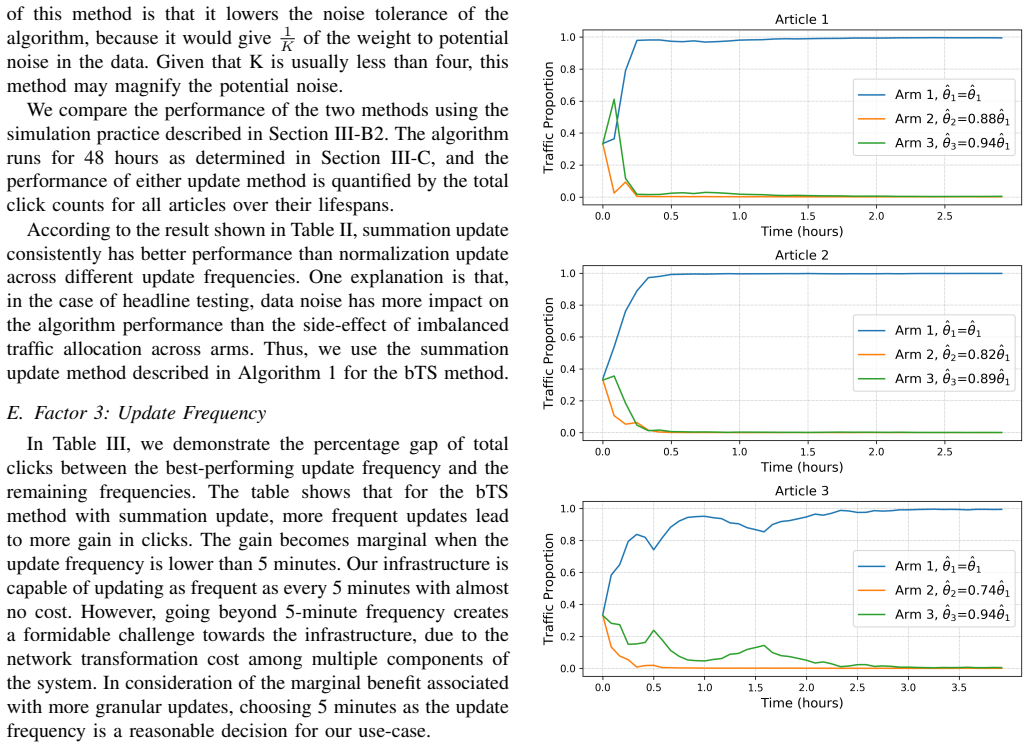
The central discovery is that a multi-armed bandit treatment of headline testing, using Thompson Sampling with batched updates, can harvest clicks during the exploration phase without sacrificing accuracy. Treating each headline variant as a Bernoulli arm with a Beta prior, the algorithm reallocates traffic toward the currently best-seeming headline while retaining enough exploration to identify the true optimum. The authors tune three factors: a 48-hour stopping point chosen from the empirical distribution of article active lifespans, a summation update rule that adds raw click and non-click counts to the Beta parameters, and a five-minute update interval that balances infrastructure cost against marginal click gain. In their simulation, which uses real impression counts and user clicks simulated from first-hour empirical click-through rates, the method outperforms the test-rollout baseline by 3.69% in total clicks, converges correctly on 99.25% of articles, and shows an 80th-percentile optimization time under 30 minutes.
Load-bearing premise
User responses in the evaluation are simulated from fixed Bernoulli distributions whose success probabilities are the click-through rates observed in the first hour, and those probabilities are assumed constant over the whole article lifespan.
Editorial extensions
If this is right
- Publishers can shift traffic toward winning headlines within minutes of publication instead of after a fixed test hour, so the early-life traffic peak is no longer spent on inferior headlines.
- Because bTS keeps testing across the article's active lifespan, it can detect and self-correct from an unfavorable initial allocation; in the stress test, 80% of articles recovered within 33 minutes.
- The observed 71.53% reduction in impressions on sub-optimal headlines implies a direct improvement in user experience, since fewer readers see headlines that perform poorly.
- The algorithm's tuned parameters (48 hours, five-minute batches, summation update) transfer to other high-volume settings where optimization and testing must happen simultaneously, such as marketing campaigns or signup funnels.
Reading between the lines
- A consequence the paper leaves implicit is that the 3.69% gain is probably a lower bound: if headline click rates drift after the first hour, bTS can reallocate while test-rollout cannot, so the real-world gap may be larger.
- A consequence the paper leaves implicit is that its baseline is intentionally lenient toward test-rollout, since it grants the baseline knowledge of the true best arm 97% of the time in the post-testing period; a baseline using only the first-hour winner would likely enlarge bTS's advantage.
- An untested extension is whether the five-minute batch interval stays optimal when traffic volume varies sharply across articles, since batch size is determined by observed impressions rather than a fixed event count.
Signed reviews
Editorial analysis
A structured set of objections, weighed in public.
Referee Report
Summary. The paper formulates headline testing at Yahoo Front Page as a Bernoulli multi-armed bandit problem and proposes batched Thompson Sampling (bTS) with three tunable factors: the algorithm stopping point, the update method, and the update frequency. Using minute-level empirical impressions and clicks from production data, the authors simulate user responses from the empirical testing-period CTR of each headline variant, and compare bTS against the existing test-rollout strategy. They report that bTS converges correctly for 99.25% of articles, reaches stable optimal-arm allocation for 80% of articles within 30 minutes, self-corrects from an adversarial initial allocation within 33 minutes for 80% of articles, and produces 3.69% more total clicks than the test-rollout baseline (13.54% in the first hour and 1.00% in the remaining hours).
Significance. If the results held, the paper would offer a practical, deployment-oriented recipe for batched Thompson Sampling in high-volume content testing, with clearly specified algorithms and a transparent baseline definition. The strengths include the use of production impression and click data, the explicit comparison of summation and normalization update rules, and the honest acknowledgment in Section V that the stationarity assumption has not been assessed. However, the central quantitative claims rest entirely on a stationary simulation whose key assumption is in tension with the paper's own reported 12% testing/post-testing CTR discrepancy, and none of the simulation statistics are accompanied by uncertainty quantification. The contribution is therefore conditional on additional non-stationary analysis and more rigorous statistical reporting, rather than being established by the current evidence.
major comments (3)
- [Section IV-D, Eqs. (1)-(4), Table IV] The headline 3.69% gain is computed under a fully stationary model: in the test-rollout baseline, Eq. (3) sets the post-testing click probability equal to the testing-period CTR of the winner, and in Section III-B2 the bTS simulation draws from Bernoulli(theta-hat_k) with theta-hat_k equal to the same fixed testing-period empirical CTRs for all 48 hours. This is in tension with the paper's own observation in Section II-B that testing-period and post-testing-period CTRs differ by 12% on average, and Section V states that the stationarity assumption remains untested. The simulation therefore cannot quantify the failure mode that motivated the paper, and the assertion in Section IV-D that 'the actual gain after implementation is likely to be larger' is not supported by the presented evidence. Please add non-stationary simulations calibrated to the reported 12% discrepancy, including drift and rank-reversal scenarios, and report click gains and convergence metrics under those scenarios alongside the stationary results.
- [Section IV, Tables II-IV and Figures 2-4] All headline statistics are point estimates from stochastic simulations with no uncertainty quantification. The paper does not state the number of simulation runs or random seeds, and no confidence intervals or standard errors are reported anywhere. For example, the 3.69% total gain and the 1.00% post-testing gain in Table IV could easily be within Monte Carlo noise given the stochastic Bernoulli process used to generate user responses. Please report multi-seed means with standard errors or confidence intervals, and specify the number of simulation runs used for every reported quantity.
- [Sections III-B2 through III-E and Section IV] The three algorithm factors (48-hour stopping point, summation update, and 5-minute update frequency) are selected using the same simulation practice and empirical data on which the final performance is then reported. Section III-B2 describes the simulation used to 'determine and tune the factors,' and Section IV uses the same simulation to report the method's click gain, with no held-out articles or separate validation phase described. This creates a risk that the reported 3.69% gain reflects in-sample selection of these factors. Please provide an out-of-sample evaluation, a sensitivity analysis around the chosen factor values, or both.
minor comments (4)
- [Section III-D, Algorithm 2] The normalization update computes S_k/(S_k+F_k), which is undefined when an arm receives zero impressions in a batch; please specify the convention for this case.
- [Section II-B] The '12% discrepancy in their CTR' is ambiguous; please state the metric (for example, mean absolute percentage difference or difference in percentage points) and report the distribution of the discrepancy across articles.
- [Section IV-A] The definition of false convergence relies on the phrase 'allocate most traffic to the optimal arm' without a threshold; please define this criterion precisely so that the 99.25% rate is reproducible.
- [Section III-B1] Please report the number of articles, the number of headline variants per article, and the range of empirical CTRs in the dataset; these quantities affect convergence speed and the magnitude of the reported gains.
Circularity Check
No significant circularity: the headline 3.69% click-gain figure is a Monte Carlo simulation outcome computed under an explicit stationary-arm model, not a fitted parameter or a self-citation chain.
full rationale
The paper's claimed derivation chain is not circular. The 3.69% gain is not algebraically forced by the inputs: Section IV-D defines the test-rollout baseline with equations (1)-(4) using Binomial samples with testing-period CTRs, and Section III-B2 says bTS user responses are simulated from Bernoulli(theta-hat_k) with the same empirical testing-period CTRs. Both algorithms face the same generative model, so the comparison is a controlled simulation evaluation rather than an identity; the click totals depend on each algorithm's stochastic allocation and are not equal to the CTR inputs by construction. There are no self-citations of the authors' own prior work, so no load-bearing self-citation chain or imported uniqueness theorem is present. The paper's tuning of update method and frequency on the same simulated data is an in-sample model-selection issue, but the differences across the frequency grid are small (Table III) and no equation reduces the reported gain to the chosen hyperparameter. The acknowledged stationarity limitation (Section V: 'The current assumption is that theta_k... is constant over time') is a correctness/validity caveat, not a circularity, because it concerns whether the simulation generalizes to real drifting CTRs, not whether the reported number is definitionally equivalent to its inputs. The claims about false convergence, speed, and self-correction are likewise empirical evaluations against the simulated ground truth, which is the standard role of a simulation. Therefore the derivation is self-contained and the appropriate score is 0.
Assumptions & free parameters
free parameters (4)
- Update frequency (batch interval) =
5 minutes
- Algorithm stopping point =
48 hours
- Update method =
summation update
- Self-correction criterion =
5 consecutive batches
assumptions (3)
- domain assumption Each headline has a fixed, unknown Bernoulli click probability theta_k that does not change over the article lifespan.
- domain assumption The one-hour testing-period empirical CTR is an unbiased estimate of theta_k and is used as the true success probability in the simulation.
- domain assumption The three-day empirical impressions and clicks dataset is representative of article traffic patterns at Yahoo Front Page.
Cite this review
Pith. "Pith review of A Batched Multi-Armed Bandit Approach to News Headline Testing." pith.science (2026). https://pith.science/paper/JCKAPWCF
@misc{pith2026190806256,
  author       = {Pith},
  title        = {Pith review of: A Batched Multi-Armed Bandit Approach to News Headline Testing},
  year         = {2026},
  howpublished = {\url{https://pith.science/paper/JCKAPWCF}},
  note         = {Machine review of arXiv:1908.06256}
}
read the original abstract
Optimizing news headlines is important for publishers and media sites. A compelling headline will increase readership, user engagement and social shares. At Yahoo Front Page, headline testing is carried out using a test-rollout strategy: we first allocate equal proportion of the traffic to each headline variation for a defined testing period, and then shift all future traffic to the best-performing variation. In this paper, we introduce a multi-armed bandit (MAB) approach with batched Thompson Sampling (bTS) to dynamically test headlines for news articles. This method is able to gradually allocate traffic towards optimal headlines while testing. We evaluate the bTS method based on empirical impressions/clicks data and simulated user responses. The result shows that the bTS method is robust, converges accurately and quickly to the optimal headline, and outperforms the test-rollout strategy by 3.69% in terms of clicks.
Figures


Figures from the paper (1 more)

Reference graph
Works this paper leans on
-
[1]
Headline testing page at optimizely
“Headline testing page at optimizely.” [Online]. Available: https: //www.optimizely.com/optimization-glossary/headline-testing/
-
[2]
Customer acquisition via display advertising using multi-armed bandit experiments,
E. M. Schwartz, E. T. Bradlow, and P. S. Fader, “Customer acquisition via display advertising using multi-armed bandit experiments,” Market- ing Science, vol. 36, no. 4, pp. 500–522, 2017
work page 2017
-
[3]
Predicting the shape and peak time of news article views,
Y . Keneshloo, S. Wang, E.-H. S. Han, and N. Ramakrishnan, “Predicting the shape and peak time of news article views,” in Big Data (Big Data), 2016 IEEE International Conference on . IEEE, 2016, pp. 2400–2409
work page 2016
-
[4]
Analysis of thompson sampling for the multi- armed bandit problem,
S. Agrawal and N. Goyal, “Analysis of thompson sampling for the multi- armed bandit problem,” in Conference on Learning Theory , 2012, pp. 39–1
2012
-
[5]
Algorithms for multi-armed bandit prob- lems,
V . Kuleshov and D. Precup, “Algorithms for multi-armed bandit prob- lems,” arXiv preprint arXiv:1402.6028 , 2014
arXiv 2014
-
[6]
Finite-time analysis of the multiarmed bandit problem,
P. Auer, N. Cesa-Bianchi, and P. Fischer, “Finite-time analysis of the multiarmed bandit problem,” Machine learning , vol. 47, no. 2-3, pp. 235–256, 2002
work page 2002
-
[7]
Exploration–exploitation tradeoff using variance estimates in multi-armed bandits,
J.-Y . Audibert, R. Munos, and C. Szepesv ´ari, “Exploration–exploitation tradeoff using variance estimates in multi-armed bandits,” Theoretical Computer Science, vol. 410, no. 19, pp. 1876–1902, 2009
work page 1902
-
[8]
Regret bounds and minimax policies under partial monitoring,
J.-Y . Audibert and S. Bubeck, “Regret bounds and minimax policies under partial monitoring,” Journal of Machine Learning Research , vol. 11, no. Oct, pp. 2785–2836, 2010
work page 2010
Show all 26 references
-
[9]
On the likelihood that one unknown probability exceeds another in view of the evidence of two samples,
W. R. Thompson, “On the likelihood that one unknown probability exceeds another in view of the evidence of two samples,” Biometrika, vol. 25, no. 3/4, pp. 285–294, 1933
1933
-
[10]
Gittins, K
J. Gittins, K. Glazebrook, and R. Weber, Multi-armed bandit allocation indices. John Wiley & Sons, 2011
2011
-
[11]
An empirical evaluation of thompson sampling,
O. Chapelle and L. Li, “An empirical evaluation of thompson sampling,” in Advances in neural information processing systems , 2011, pp. 2249– 2257
2011
-
[12]
A modern bayesian look at the multi-armed bandit,
S. L. Scott, “A modern bayesian look at the multi-armed bandit,” Applied Stochastic Models in Business and Industry, vol. 26, no. 6, pp. 639–658, 2010
2010
-
[13]
A bayesian learning automaton for solving two-armed bernoulli bandit problems,
O.-C. Granmo, “A bayesian learning automaton for solving two-armed bernoulli bandit problems,” in 2008 Seventh International Conference on Machine Learning and Applications . IEEE, 2008, pp. 23–30
2008
-
[14]
Optimistic bayesian sampling in contextual-bandit problems,
B. C. May, N. Korda, A. Lee, and D. S. Leslie, “Optimistic bayesian sampling in contextual-bandit problems,” Journal of Machine Learning Research, vol. 13, no. Jun, pp. 2069–2106, 2012
2012
-
[15]
Thompson sampling: An asymptotically optimal finite-time analysis,
E. Kaufmann, N. Korda, and R. Munos, “Thompson sampling: An asymptotically optimal finite-time analysis,” in International Conference on Algorithmic Learning Theory . Springer, 2012, pp. 199–213
2012
-
[16]
Web-scale bayesian click-through rate prediction for sponsored search advertising in microsoft’s bing search engine
T. Graepel, J. Q. Candela, T. Borchert, and R. Herbrich, “Web-scale bayesian click-through rate prediction for sponsored search advertising in microsoft’s bing search engine.” Omnipress, 2010
2010
-
[17]
Computational advertising: the linkedin way,
D. Agarwal, “Computational advertising: the linkedin way,” in Pro- ceedings of the 22nd ACM international conference on Conference on information & knowledge management . ACM, 2013, pp. 1585–1586
2013
-
[18]
Laser: A scalable response prediction platform for online advertising,
D. Agarwal, B. Long, J. Traupman, D. Xin, and L. Zhang, “Laser: A scalable response prediction platform for online advertising,” in Proceedings of the 7th ACM international conference on Web search and data mining . ACM, 2014, pp. 173–182
2014
-
[19]
Multi-armed bandit experiments in the online service economy,
S. L. Scott, “Multi-armed bandit experiments in the online service economy,”Applied Stochastic Models in Business and Industry , vol. 31, no. 1, pp. 37–45, 2015
2015
-
[20]
An efficient bandit algorithm for realtime multivariate optimization,
D. N. Hill, H. Nassif, Y . Liu, A. Iyer, and S. Vishwanathan, “An efficient bandit algorithm for realtime multivariate optimization,” in Proceedings of the 23rd ACM SIGKDD International Conference on Knowledge Discovery and Data Mining . ACM, 2017, pp. 1813–1821
2017
-
[21]
Overview of content experiments: Multi-armed bandit experiments,
S. L. Scott, “Overview of content experiments: Multi-armed bandit experiments,” 2014. [Online]. Available: https://support.google.com/ analytics/answer/2844870
2014
-
[22]
Randomized allocation with nonparametric estimation for a multi-armed bandit problem with covariates,
Y . Yang, D. Zhu et al. , “Randomized allocation with nonparametric estimation for a multi-armed bandit problem with covariates,” The Annals of Statistics , vol. 30, no. 1, pp. 100–121, 2002
2002
-
[23]
Asymptotically efficient adaptive allocation rules,
T. L. Lai and H. Robbins, “Asymptotically efficient adaptive allocation rules,” Advances in applied mathematics , vol. 6, no. 1, pp. 4–22, 1985
1985
-
[24]
Online network revenue management using thompson sampling,
K. Ferreira, D. Simchi-Levi, and H. Wang, “Online network revenue management using thompson sampling,” 2017
2017
-
[25]
Efficient thompson sampling for online matrix-factorization recommen- dation,
J. Kawale, H. H. Bui, B. Kveton, L. Tran-Thanh, and S. Chawla, “Efficient thompson sampling for online matrix-factorization recommen- dation,” in Advances in neural information processing systems, 2015, pp. 1297–1305
2015
-
[26]
Stop clickbait: Detecting and preventing clickbaits in online news media,
A. Chakraborty, B. Paranjape, S. Kakarla, and N. Ganguly, “Stop clickbait: Detecting and preventing clickbaits in online news media,” in Proceedings of the 2016 IEEE/ACM International Conference on Advances in Social Networks Analysis and Mining . IEEE Press, 2016, pp. 9–16
2016
Reviewed August 14, 2026 · model on record in the stance chip above.
Discussion (0). Continue with ORCID to comment.