REVIEW 4 major objections 5 minor 1 cited by
ShellNet: Efficient Point Cloud Convolutional Neural Networks using Concentric Shells Statistics
T0 review · 4 major / 5 minor · reviewed 2026-08-14 · deepseek-v4-flash
Pith's one-line read Point-cloud convolution can be reduced to concentric shell statistics plus a shared one-dimensional kernel, and the paper reports that this simple recipe reaches state-of-the-art accuracy with much faster training than prior methods.
desk verdict ShellNet's shell-conv operator is a genuine, simple contribution, but the paper's state-of-the-art claims are contradicted by its own tables and need fixing before acceptance. read the letter →
The pith
A machine-rendered reading of the paper's core claim, the machinery that carries it, and where it could break.
The reading
What carries the argument
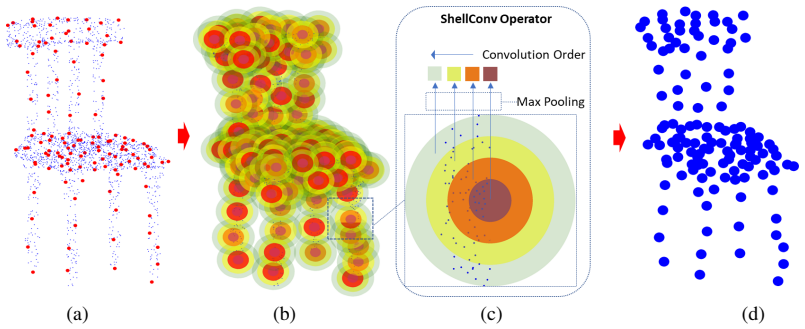
The central object is ShellConv, a convolution operator that partitions a local point set into concentric spherical shells and reduces each shell to a fixed-size feature vector by max-pooling. Shells are constructed by sorting neighbor distances and assigning a fixed number of points per shell from inner to outer; convolution then runs over the naturally ordered shell vectors. This machinery resolves point-order ambiguity twice: the radial shell order is fixed by geometry, and max-pooling makes the content of each shell order-invariant. It also controls receptive field directly through the shell count and shell size, so a single ShellConv layer can observe a larger context without stacking more layers.
What would settle it
Construct two local neighborhoods that have identical shell-wise max-pooled features but different point arrangements within a shell, and check whether a downstream task can distinguish them: if ShellNet assigns the same output while a histogram-based or attention-based shell descriptor does not, the max-pooled shell statistics are discarding information the paper's accuracy claims depend on. Concretely, train ShellNet on ModelNet40 with shell size 1 so each shell is a single point and compare with shell size 16; a large gap would confirm that pooling over fixed-size shells, not just the radial order, is carrying the reported accuracy.
Extended reading notes
Core claim
ShellConv defines convolution on an unordered point set by giving it a radial order. Around each representative point, the nearest neighbors are sorted by distance and divided into a fixed number of spherical shells, each holding a fixed number of points; each shell is reduced to its per-channel maximum; and the sequence of shell vectors is passed through a 1D convolution whose weights are shared over all positions. The paper reports that ShellNet, a three-layer encoder built from ShellConv, reaches 93.1% overall accuracy on ModelNet40, 82.8% mean part IoU on ShapeNet, 85.2% mIoU on ScanNet, and 66.8% mIoU on S3DIS, with 69.4% on Semantic3D, while using about 0.48M parameters and reaching 90% classification accuracy after roughly 15 minutes of training. The paper presents these results as evidence that a simple, statistically aggregated radial partition can match or exceed the accuracy of more complex point-cloud operators at a fraction of the training cost.
Load-bearing premise
The load-bearing premise is that sorting a fixed number of nearest neighbors by distance and pooling each resulting shell with a per-channel maximum preserves enough local shape information for classification and segmentation; if point density varies too sharply, or a shell's few points fail to represent the local surface, the fixed-size representation misses geometry that a more flexible operator would capture.
Editorial extensions
If this is right
- The learned X-transformation used by PointCNN is not needed: a fixed radial ordering plus max-pooling provides the ordering that convolution requires, eliminating a significant source of training cost.
- Receptive field size becomes a tunable property of a single layer through shell size and number of shells, so a three-layer network can match or exceed the context of deeper networks on the tested benchmarks.
- ShellConv works in both encoder and decoder roles inside a U-net-style architecture, so the same operator transfers from classification to dense part and scene segmentation.
- On the reported comparisons, ShellNet is lightweight, using 0.48M parameters and lower FLOPs than compared networks, so the accuracy results are not bought with model capacity.
Reading between the lines
- The radial ordering is independent of the choice of max-pooling: replacing max with mean, variance, or a learned attention over points in each shell would remain permutation-invariant and could recover distributional structure that max-pooling discards; this is a natural extension the paper does not test.
- The fixed-points-per-shell construction is a form of adaptive radial binning; on datasets with strongly varying density, making shell boundaries depend on local density or on a fixed radius could change robustness, which the paper's sparse-data experiment leaves open.
- Because the shell representation is a fixed-length sequence, ShellConv could be combined with sequence or attention models over shells, connecting this architecture to point-cloud transformers without changing the shell construction.
- The paper's own robustness test shows partial point clouds lose accuracy mainly at boundaries; adding shell count or density as extra features is a concrete way to test whether the loss comes from the fixed-size shell assumption.
Signed reviews
Editorial analysis
A structured set of objections, weighed in public.
Referee Report
Summary. The paper proposes ShellConv, a permutation-invariant convolution operator for point clouds that partitions each local neighborhood into concentric spherical shells, assigns a fixed number of points per shell by sorted distance, max-pools point features within each shell, and applies a 1D convolution over the shell features. The authors build a lightweight network, ShellNet, with three encoding ShellConv layers and a U-net-like decoder for segmentation, and report experiments on ModelNet40 classification, ShapeNet part segmentation, ScanNet/S3DIS/Semantic3D semantic segmentation, and efficiency comparisons. The central claims are that ShellConv resolves point-order ambiguity, enlarges receptive fields without extra layers, and that ShellNet achieves state-of-the-art accuracy and speed across all experiments.
Significance. The core operator is simple and well-defined: fixed-cardinality distance-sorted shells with max-pooling are a clean way to obtain a permutation-invariant local representation, and the resulting network is very lightweight (0.48M parameters). The paper provides a public code release and evaluates on four standard benchmarks, which is a useful contribution if the numbers are reproducible. However, the claimed 'state-of-the-art for both accuracy and speed' is not supported by the paper's own tables, and the experimental protocol is under-specified. These issues are localizable and fixable, so a careful revision could make the contribution acceptable.
major comments (4)
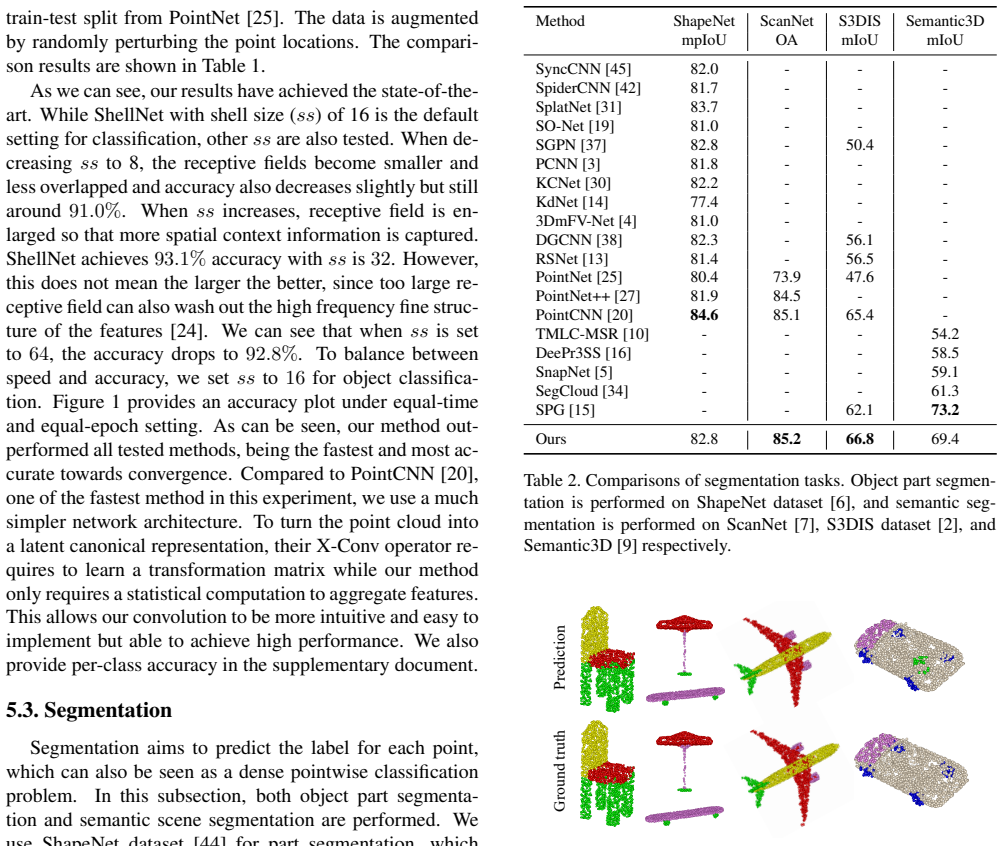
- [Abstract, Section 5 (opening), Conclusion] The claim that ShellNet achieves 'state-of-the-art performance for both accuracy and speed in all the experiments' is contradicted by the paper's own data. In Table 2, ShellNet's ShapeNet part-segmentation mpIoU is 82.8, below PointCNN's 84.6, and its Semantic3D mIoU is 69.4, below SPG's 73.2. In Table 3, PointCNN has lower training/inference time (0.031s/0.012s) than ShellNet (0.066s/0.023s). The authors must either revise these statements to a defensible form (e.g., 'competitive accuracy with fast convergence') or provide additional evidence that justifies a specific, qualified sense of state-of-the-art.
- [Section 5.4, Table 3] The sentence 'For all three metrics, ShellNet is better than existing methods' is false for the time metric, as PointCNN is faster in both training and inference per iteration. The comparison is also not apples-to-apples without specifying the exact implementation, GPU model, batch size, and whether the reported times include neighbor search and data loading. The 'small RF' row uses a non-default configuration that is not the network used in the accuracy tables. Please report the measurement protocol and, if possible, time PointCNN and ShellNet under identical conditions.
- [Section 5.1, 5.2, 5.3] The dataset preparation is under-specified: Section 5.3 states only 'We follow PointCNN' for ScanNet, S3DIS, and Semantic3D, without describing the exact train/validation/test splits, point sampling density, feature normalization, or evaluation protocol. Because representative points are randomly sampled in ShellConv, the reported single-run numbers (e.g., 85.2 vs 85.1 on ScanNet; 66.8 vs 65.4 on S3DIS) may be within run-to-run variation. Provide the number of runs, standard deviations, or a fixed random seed so the claimed margins can be assessed.
- [Section 5.3, Table 2] Even the more modest statement in the part-segmentation paragraph, 'our method outperforms most of the state-of-the-art techniques,' is difficult to reconcile with Table 2, where ShellNet's ShapeNet mpIoU (82.8) is lower than SplatNet (83.7), PointCNN (84.6), and the original table entry for SyncCNN (82.0). If the authors intend to claim competitiveness rather than superiority, the text and abstract should be revised accordingly.
minor comments (5)
- [Section 5.5] The sentence 'Our method is without limitation' is immediately followed by 'more investigations into its robustness is required,' which is internally contradictory. Please rewrite this passage to state plainly that robustness to sparse and partial data is a limitation that needs further study.
- [Algorithm 1, line 4] The line '{F (q)}←{ [Fprev(q), Flocal(q)}' has a mismatched bracket; it should be '[Fprev(q), Flocal(q)]'.
- [Section 4] In the classification description, 'Finally, we obtain a128× kcls matrix' is unclear: after the MLP module, a matrix of size N2 x kcls would be expected, and the reduction from N2 representative points to a single class prediction is not described. Please clarify the global pooling or aggregation step.
- [Table 2] The row 'SyncCNN' appears to refer to reference [45], which is titled 'SyncSpecCNN'; please use a consistent name. Also, several methods have missing entries (e.g., PointNet++ on S3DIS); consider adding a note explaining why those entries are absent.
- [Figure 1] The equal-time and equal-epoch comparisons in Figure 1 would be easier to interpret if the authors specified which methods are plotted, the exact hardware, and whether all timings were measured on the same GPU with the same batch size.
Circularity Check
No circularity found; ShellConv is a proposed architecture evaluated against external benchmarks, with no fitted parameter renamed as a prediction.
full rationale
The paper contains no claimed derivation that reduces to its own inputs. ShellConv is defined directly as a convolution over concentric spherical shells with maxpooled per-shell statistics (Eq. 2, Eq. 3, Algorithm 1), and the accuracy and speed claims are empirical comparisons on ModelNet40, ShapeNet, ScanNet, S3DIS, and Semantic3D. There are no parameters fitted to a subset of data and then reported as predictions of a related quantity; the shell size, number of shells, and channel counts are architecture choices, not fitted values. The only self-citation by the present authors is reference [12], cited in the introduction and related work as prior pointwise convolution that is "simple to implement but inaccurate," and it is not load-bearing for the proposed method. No uniqueness theorem is imported from the authors' prior work, and no ansatz is smuggled in via citation; the shell construction is explicitly described as "a simple heuristics approach" in Section 3. Whether the state-of-the-art claims are fully supported by Tables 2 and 3 is a correctness concern, not a circularity concern, and external benchmark protocols make the evaluation independently checkable. Accordingly, no circular step is present and the score is 0.
Assumptions & free parameters
free parameters (3)
- shell size ss (points per shell) =
16 for classification, 8 for segmentation
- per-layer shell counts S0, S1, S2 =
4, 2, 1
- representative point counts N0, N1, N2 =
512, 128, 32
assumptions (3)
- standard math Max pooling over points in a shell is a symmetric function, so the shell feature is invariant to point order.
- domain assumption Euclidean nearest-neighbor search in 3D coordinates defines meaningful local neighborhoods for point clouds.
- ad hoc to paper A fixed number of points per shell provides useful stratification of local point distributions.
Cite this review
Pith. "Pith review of ShellNet: Efficient Point Cloud Convolutional Neural Networks using Concentric Shells Statistics." pith.science (2026). https://pith.science/paper/3NAX3NQS
@misc{pith2026190806295,
  author       = {Pith},
  title        = {Pith review of: ShellNet: Efficient Point Cloud Convolutional Neural Networks using Concentric Shells Statistics},
  year         = {2026},
  howpublished = {\url{https://pith.science/paper/3NAX3NQS}},
  note         = {Machine review of arXiv:1908.06295}
}
read the original abstract
Deep learning with 3D data has progressed significantly since the introduction of convolutional neural networks that can handle point order ambiguity in point cloud data. While being able to achieve good accuracies in various scene understanding tasks, previous methods often have low training speed and complex network architecture. In this paper, we address these problems by proposing an efficient end-to-end permutation invariant convolution for point cloud deep learning. Our simple yet effective convolution operator named ShellConv uses statistics from concentric spherical shells to define representative features and resolve the point order ambiguity, allowing traditional convolution to perform on such features. Based on ShellConv we further build an efficient neural network named ShellNet to directly consume the point clouds with larger receptive fields while maintaining less layers. We demonstrate the efficacy of ShellNet by producing state-of-the-art results on object classification, object part segmentation, and semantic scene segmentation while keeping the network very fast to train.
Figures


Figures from the paper (4 more)


Forward citations
Cited by 1 Pith paper
-
Enhancing Human-Robot Collaboration: A Sim2Real Domain Adaptation Algorithm for Point Cloud Segmentation in Industrial Environments
A DGCNN plus residual CNN dual-stream architecture with fine-tuning reaches 97.76% accuracy on a real-world human-robot collaboration point cloud segmentation benchmark.
Reference graph
Works this paper leans on
-
[1]
Tensorflow: A system for large-scale machine learning
Mart ´ın Abadi, Paul Barham, Jianmin Chen, Zhifeng Chen, Andy Davis, Jeffrey Dean, Matthieu Devin, Sanjay Ghe- mawat, Geoffrey Irving, Michael Isard, et al. Tensorflow: A system for large-scale machine learning. In 12th{USENIX} Symposium on Operating Systems Design and Implementa- tion ({OSDI} 16), pages 265–283, 2016. 5
work page 2016
-
[2]
3d semantic parsing of large-scale indoor spaces
Iro Armeni, Ozan Sener, Amir R Zamir, Helen Jiang, Ioannis Brilakis, Martin Fischer, and Silvio Savarese. 3d semantic parsing of large-scale indoor spaces. InComputer Vision and Pattern Recognition, pages 1534–1543, 2016. 2, 6, 7
work page 2016
-
[3]
Point convolutional neural networks by extension operators
Matan Atzmon, Haggai Maron, and Yaron Lipman. Point convolutional neural networks by extension operators. ACM Transactions on Graphics, 37(4), 2018. 6
work page 2018
-
[4]
3dmfv: Three-dimensional point cloud classification in real-time using convolutional neural networks
Yizhak Ben-Shabat, Michael Lindenbaum, and Anath Fis- cher. 3dmfv: Three-dimensional point cloud classification in real-time using convolutional neural networks. IEEE Robotics and Automation Letters, 3:3145–3152, 2018. 2, 6, 8
work page 2018
-
[5]
Unstructured point cloud semantic labeling using deep seg- mentation networks
Alexandre Boulch, Bertrand Le Saux, and Nicolas Audebert. Unstructured point cloud semantic labeling using deep seg- mentation networks. In Eurographics Workshop on 3D Ob- ject Retrieval, volume 2, page 7, 2017. 6
work page 2017
-
[6]
Angel X. Chang, Thomas A. Funkhouser, Leonidas J. Guibas, Pat Hanrahan, Qi-Xing Huang, Zimo Li, Silvio Savarese, Manolis Savva, Shuran Song, Hao Su, Jianxiong Xiao, Li Yi, and Fisher Yu. Shapenet: An information-rich 3d model repository. CoRR, abs/1512.03012, 2015. 6
arXiv 2015
-
[7]
Scan- net: Richly-annotated 3d reconstructions of indoor scenes
Angela Dai, Angel X Chang, Manolis Savva, Maciej Hal- ber, Thomas Funkhouser, and Matthias Niessner. Scan- net: Richly-annotated 3d reconstructions of indoor scenes. In Computer Vision and Pattern Recognition , pages 5828– 5839, 2017. 6
work page 2017
-
[8]
A papier-m ˆach´e ap- proach to learning 3d surface generation
Thibault Groueix, Matthew Fisher, Vladimir G Kim, Bryan C Russell, and Mathieu Aubry. A papier-m ˆach´e ap- proach to learning 3d surface generation. InComputer Vision and Pattern Recognition, pages 216–224, 2018. 2
work page 2018
Show all 45 references
-
[9]
Semantic3d.net: A new large-scale point cloud classification benchmark
Timo Hackel, Nikolay Savinov, Lubor Ladicky, Jan D Weg- ner, Konrad Schindler, and Marc Pollefeys. Semantic3d.net: A new large-scale point cloud classification benchmark. In ISPRS Annals of the Photogrammetry, Remote Sensing and Spatial Information Sciences, pages 91–98, 2017. 6, 7
2017
-
[10]
Fast semantic segmentation of 3d point clouds with strongly varying density
Timo Hackel, Jan D Wegner, and Konrad Schindler. Fast semantic segmentation of 3d point clouds with strongly varying density. ISPRS annals of the photogrammetry, re- mote sensing and spatial information sciences , 3(3):177– 184, 2016. 6
2016
-
[11]
Monte carlo convolution for learning on non-uniformly sampled point clouds
Pedro Hermosilla, Tobias Ritschel, Pere-Pau V ´azquez, `Alvar Vinacua, and Timo Ropinski. Monte carlo convolution for learning on non-uniformly sampled point clouds. ACM Transactions on Graphics, 2018. 2
2018
-
[12]
Point- wise convolutional neural network
Binh-Son Hua, Minh-Khoi Tran, and Sai-Kit Yeung. Point- wise convolutional neural network. In Computer Vision and Pattern Recognition, pages 984–993, 2018. 1, 2, 5
2018
-
[13]
Re- current slice networks for 3d segmentation on point clouds
Qiangui Huang, Weiyue Wang, and Ulrich Neumann. Re- current slice networks for 3d segmentation on point clouds. In Computer Vision and Pattern Recognition , pages 2626– 2635, 2018. 2, 6
2018
-
[14]
Escape from cells: Deep kd-networks for the recognition of 3d point cloud mod- els
Roman Klokov and Victor Lempitsky. Escape from cells: Deep kd-networks for the recognition of 3d point cloud mod- els. In International Conference on Computer Vision, pages 863–872, 2017. 1, 2, 6
2017
-
[15]
Large-scale point cloud semantic segmentation with superpoint graphs
Loic Landrieu and Martin Simonovsky. Large-scale point cloud semantic segmentation with superpoint graphs. In Computer Vision and Pattern Recognition , pages 4558– 4567, 2018. 2, 6, 7
2018
-
[16]
Deep projective 3d semantic segmentation
Felix J ¨aremo Lawin, Martin Danelljan, Patrik Tosteberg, Goutam Bhat, Fahad Shahbaz Khan, and Michael Felsberg. Deep projective 3d semantic segmentation. In International Conference on Computer Analysis of Images and Patterns , pages 95–107, 2017. 6
2017
-
[17]
Pointgrid: A deep network for 3d shape understanding
Truc Le and Ye Duan. Pointgrid: A deep network for 3d shape understanding. InComputer Vision and Pattern Recog- nition, pages 9204–9214, 2018. 2
2018
-
[18]
Deep learning
Yann LeCun, Yoshua Bengio, and Geoffrey Hinton. Deep learning. Nature, 521(7553):436, 2015. 1
2015
-
[19]
So-net: Self- organizing network for point cloud analysis
Jiaxin Li, Ben M Chen, and Gim Hee Lee. So-net: Self- organizing network for point cloud analysis. In Computer Vision and Pattern Recognition, pages 9397–9406, 2018. 2, 6
2018
-
[20]
Pointcnn: Convolution on x-transformed points
Yangyan Li, Rui Bu, Mingchao Sun, Wei Wu, Xinhan Di, and Baoquan Chen. Pointcnn: Convolution on x-transformed points. In Advances in Neural Information Processing Sys- tems, pages 820–830, 2018. 1, 2, 3, 5, 6, 8
2018
-
[21]
Fpnn: Field probing neural networks for 3d data
Yangyan Li, Soeren Pirk, Hao Su, Charles R Qi, and Leonidas J Guibas. Fpnn: Field probing neural networks for 3d data. In Advances in Neural Information Processing Systems, pages 307–315, 2016. 1, 2, 5
2016
-
[22]
Point2sequence: Learning the shape representa- tion of 3d point clouds with an attention-based sequence to sequence network
Xinhai Liu, Zhizhong Han, Yu-Shen Liu, and Matthias Zwicker. Point2sequence: Learning the shape representa- tion of 3d point clouds with an attention-based sequence to sequence network. In Association for the Advancement of Artificial Intelligence, 2019. 2
2019
-
[23]
V oxnet: A 3d con- volutional neural network for real-time object recognition
Daniel Maturana and Sebastian Scherer. V oxnet: A 3d con- volutional neural network for real-time object recognition. In International Conference on Intelligent Robots and Systems, pages 922–928, 2015. 2
2015
-
[24]
Mel and Stephen M
Bartlett W. Mel and Stephen M. Omohundro. How recep- tive field parameters affect neural learning. In R. P. Lipp- mann, J. E. Moody, and D. S. Touretzky, editors, Advances in Neural Information Processing Systems , pages 757–763. Morgan-Kaufmann, 1991. 6
1991
-
[25]
Pointnet: Deep learning on point sets for 3d classification and segmentation
Charles R Qi, Hao Su, Kaichun Mo, and Leonidas J Guibas. Pointnet: Deep learning on point sets for 3d classification and segmentation. In Computer Vision and Pattern Recogni- tion, pages 652–660, 2017. 1, 2, 3, 5, 6, 8
2017
-
[26]
V olumetric and multi-view cnns for object classification on 3d data
Charles R Qi, Hao Su, Matthias Nießner, Angela Dai, Mengyuan Yan, and Leonidas J Guibas. V olumetric and multi-view cnns for object classification on 3d data. In Com- puter Vision and Pattern Recognition , pages 5648–5656,
-
[27]
Pointnet++: Deep hierarchical feature learning on point sets in a metric space
Charles Ruizhongtai Qi, Li Yi, Hao Su, and Leonidas J Guibas. Pointnet++: Deep hierarchical feature learning on point sets in a metric space. In Advances in Neural Informa- tion Processing Systems, pages 5105–5114, 2017. 1, 2, 3, 5, 6, 8
2017
-
[28]
Octnet: Learning deep 3d representations at high resolutions
Gernot Riegler, Ali Osman Ulusoy, and Andreas Geiger. Octnet: Learning deep 3d representations at high resolutions. In Computer Vision and Pattern Recognition , pages 3577– 3586, 2017. 1, 2
2017
-
[29]
U- net: Convolutional networks for biomedical image segmen- tation
Olaf Ronneberger, Philipp Fischer, and Thomas Brox. U- net: Convolutional networks for biomedical image segmen- tation. In International Conference on Medical image com- puting and computer-assisted intervention , pages 234–241. Springer, 2015. 4, 5
2015
-
[30]
Min- ing point cloud local structures by kernel correlation and graph pooling
Yiru Shen, Chen Feng, Yaoqing Yang, and Dong Tian. Min- ing point cloud local structures by kernel correlation and graph pooling. In Computer Vision and Pattern Recognition, pages 4548–4557, 2018. 2, 6
2018
-
[31]
SPLATNet: Sparse lattice networks for point cloud process- ing
Hang Su, Varun Jampani, Deqing Sun, Subhransu Maji, Evangelos Kalogerakis, Ming-Hsuan Yang, and Jan Kautz. SPLATNet: Sparse lattice networks for point cloud process- ing. In Computer Vision and Pattern Recognition , pages 2530–2539, 2018. 6
2018
-
[32]
Multi-view convolutional neural networks for 3d shape recognition
Hang Su, Subhransu Maji, Evangelos Kalogerakis, and Erik Learned-Miller. Multi-view convolutional neural networks for 3d shape recognition. In International Conference on Computer Vision, pages 945–953, 2015. 1, 2
2015
-
[33]
Tangent convolutions for dense prediction in 3d
Maxim Tatarchenko, Jaesik Park, Vladlen Koltun, and Qian- Yi Zhou. Tangent convolutions for dense prediction in 3d. In Computer Vision and Pattern Recognition , pages 3887– 3896, 2018. 2
2018
-
[34]
Segcloud: Semantic segmen- tation of 3d point clouds
Lyne Tchapmi, Christopher Choy, Iro Armeni, JunYoung Gwak, and Silvio Savarese. Segcloud: Semantic segmen- tation of 3d point clouds. In International Conference on 3D Vision, pages 537–547, 2017. 6
2017
-
[35]
O-cnn: Octree-based convolutional neu- ral networks for 3d shape analysis
Peng-Shuai Wang, Yang Liu, Yu-Xiao Guo, Chun-Yu Sun, and Xin Tong. O-cnn: Octree-based convolutional neu- ral networks for 3d shape analysis. ACM Transactions on Graphics, 36(4):72, 2017. 1, 2, 5
2017
-
[36]
Adaptive o-cnn: A patch-based deep representation of 3d shapes
Peng-Shuai Wang, Chun-Yu Sun, Yang Liu, and Xin Tong. Adaptive o-cnn: A patch-based deep representation of 3d shapes. ACM Transactions on Graphics, 2018. 2
2018
-
[37]
Sgpn: Similarity group proposal network for 3d point cloud instance segmentation
Weiyue Wang, Ronald Yu, Qiangui Huang, and Ulrich Neu- mann. Sgpn: Similarity group proposal network for 3d point cloud instance segmentation. In Computer Vision and Pat- tern Recognition, pages 2569–2578, 2018. 6
2018
-
[38]
Sarma, Michael M
Yue Wang, Yongbin Sun, Ziwei Liu, Sanjay E. Sarma, Michael M. Bronstein, and Justin M. Solomon. Dynamic graph cnn for learning on point clouds. ACM Transactions on Graphics, 2019. 2, 3, 6, 8
2019
-
[39]
3d shapenets: A deep representation for volumetric shapes
Zhirong Wu, Shuran Song, Aditya Khosla, Fisher Yu, Lin- guang Zhang, Xiaoou Tang, and Jianxiong Xiao. 3d shapenets: A deep representation for volumetric shapes. In Computer Vision and Pattern Recognition , pages 1912– 1920, 2015. 2
1912
-
[40]
3d shapenets: A deep representation for volumetric shapes
Zhirong Wu, Shuran Song, Aditya Khosla, Fisher Yu, Lin- guang Zhang, Xiaoou Tang, and Jianxiong Xiao. 3d shapenets: A deep representation for volumetric shapes. In Computer Vision and Pattern Recognition , pages 1912– 1920, 2015. 2, 5
1912
-
[41]
At- tentional shapecontextnet for point cloud recognition
Saining Xie, Sainan Liu, Zeyu Chen, and Zhuowen Tu. At- tentional shapecontextnet for point cloud recognition. In Computer Vision and Pattern Recognition , pages 4606– 4615, 2018. 2
2018
-
[42]
Spidercnn: Deep learning on point sets with parameterized convolutional filters
Yifan Xu, Tianqi Fan, Mingye Xu, Long Zeng, and Yu Qiao. Spidercnn: Deep learning on point sets with parameterized convolutional filters. In European Conference on Computer Vision, pages 87–102, 2018. 1, 2, 3, 6
2018
-
[43]
Fold- ingnet: Point cloud auto-encoder via deep grid deformation
Yaoqing Yang, Chen Feng, Yiru Shen, and Dong Tian. Fold- ingnet: Point cloud auto-encoder via deep grid deformation. In Computer Vision and Pattern Recognition , pages 206– 215, 2018. 2
2018
-
[44]
Kim, Duygu Ceylan, I-Chao Shen, Mengyan Yan, Hao Su, Cewu Lu, Qixing Huang, Alla Shef- fer, and Leonidas Guibas
Li Yi, Vladimir G. Kim, Duygu Ceylan, I-Chao Shen, Mengyan Yan, Hao Su, Cewu Lu, Qixing Huang, Alla Shef- fer, and Leonidas Guibas. A scalable active framework for region annotation in 3d shape collections.ACM Transactions on Graphics, 2016. 2, 6
2016
-
[45]
Sync- speccnn: Synchronized spectral cnn for 3d shape segmen- tation
Li Yi, Hao Su, Xingwen Guo, and Leonidas J Guibas. Sync- speccnn: Synchronized spectral cnn for 3d shape segmen- tation. In Computer Vision and Pattern Recognition, pages 2282–2290, 2017. 2, 6
2017
Reviewed August 14, 2026 · model on record in the stance chip above.
Discussion (0). Continue with ORCID to comment.