REVIEW 3 major objections 6 minor 42 references
Hybrid Deep Network for Anomaly Detection
T0 review · 3 major / 6 minor · reviewed 2026-08-14 · deepseek-v4-flash
Pith's one-line read This paper claims that adding a patch-location classification task to a convolutional autoencoder improves video anomaly detection, because an anomalous cuboid will be misplaced and poorly reconstructed.
desk verdict A honest, reimplementable study of a genuinely new auxiliary task that is undermined in two of four benchmarks by a frame-level vs pixel-level metric mismatch. read the letter →
The pith
A machine-rendered reading of the paper's core claim, the machinery that carries it, and where it could break.
The reading
What carries the argument
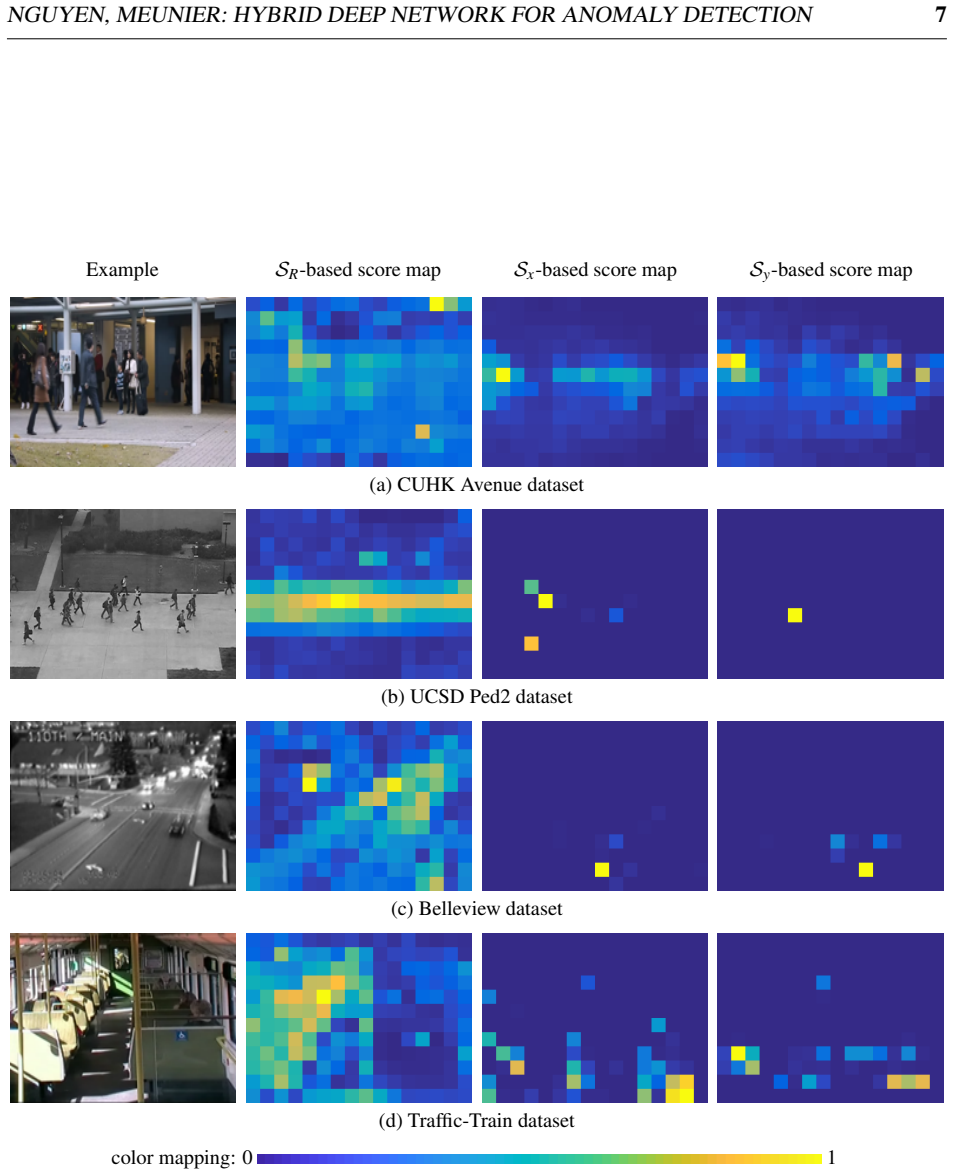
The central object is the hybrid network: a convolutional autoencoder whose bottleneck features are also fed to a two-branch classification sub-network that predicts the horizontal and vertical position of the input cuboid (28 classes in total instead of 192). The location labels come for free from the grid structure of the frame, so the supervised objective needs no anomaly annotations. The argument runs on a score-combination identity: each cuboid's reconstruction error, horizontal placement error, and vertical placement error are computed as cuboid-level scores, normalized by their average values on normal training cuboids at the same position, and fused into a weighted map whose standard deviation is the frame normality measure. This fusion lets the reconstruction branch and the location branch compensate for each other's weaknesses.
What would settle it
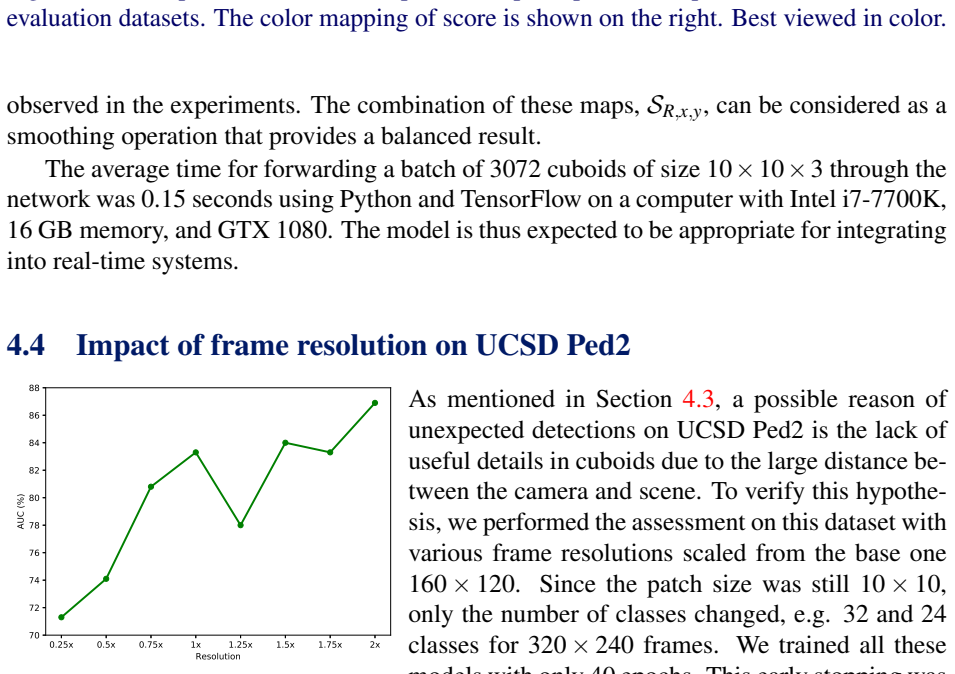
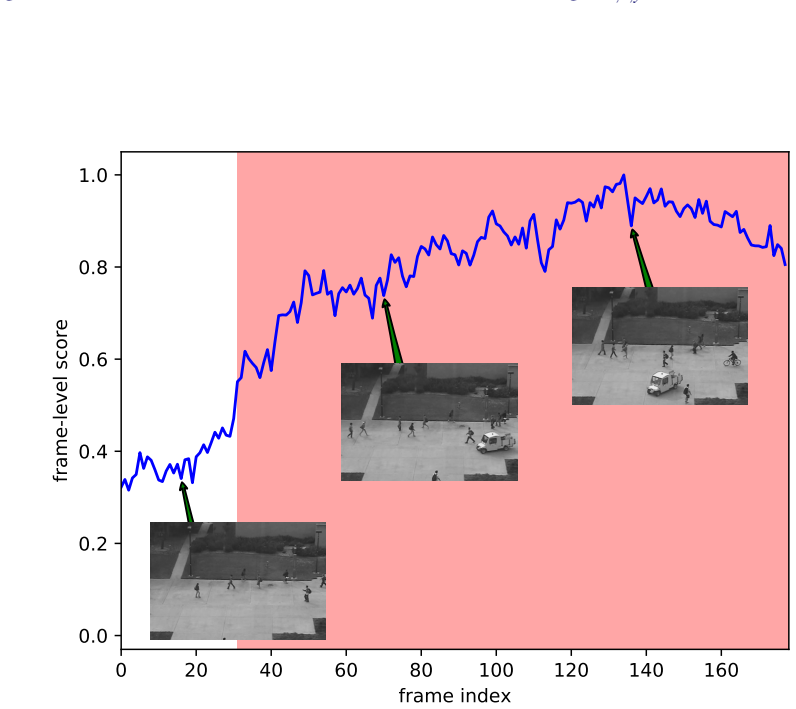
Train the same hybrid model on a dataset where the same normal object appearance occurs at many positions (for instance, repeated floor tiles or a panning camera), then measure the location sub-network's accuracy on normal versus anomalous cuboids. If the sub-network places anomalous cuboids as accurately as normal ones, the proposed mechanism—that anomalies are detectable through location misclassification—is falsified. Alternatively, the paper's own resolution sweep on UCSD Ped2 is a partial falsifier: if upscaling to 2x resolution did not raise the AUC of the combined score, the claim that missing cuboid detail explains the Ped2 gap would be wrong.
Extended reading notes
Core claim
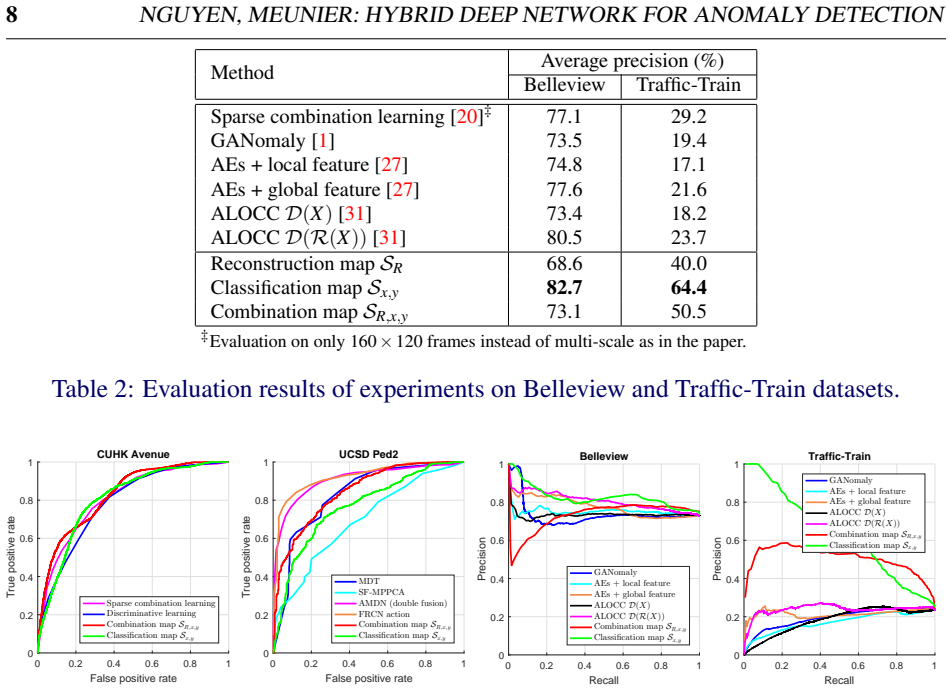
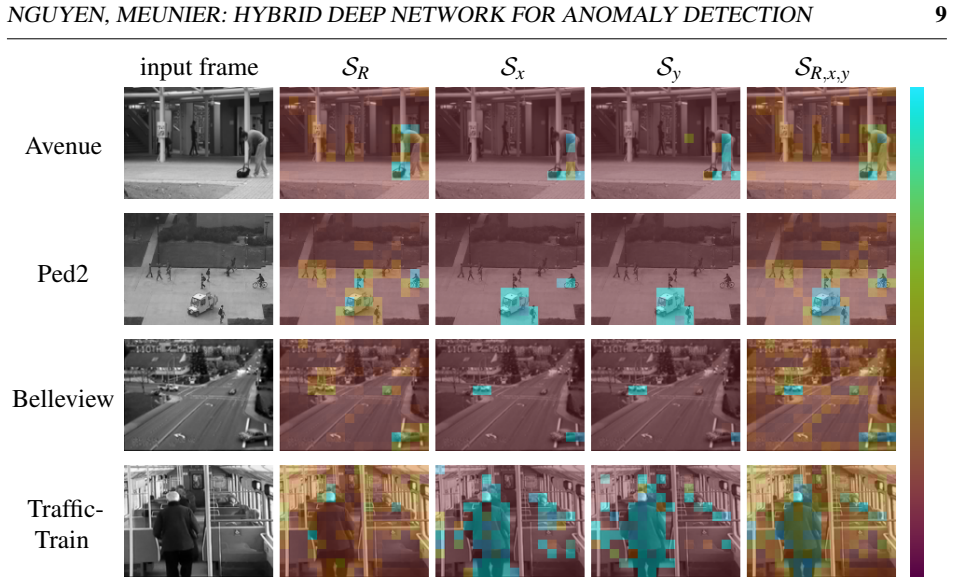
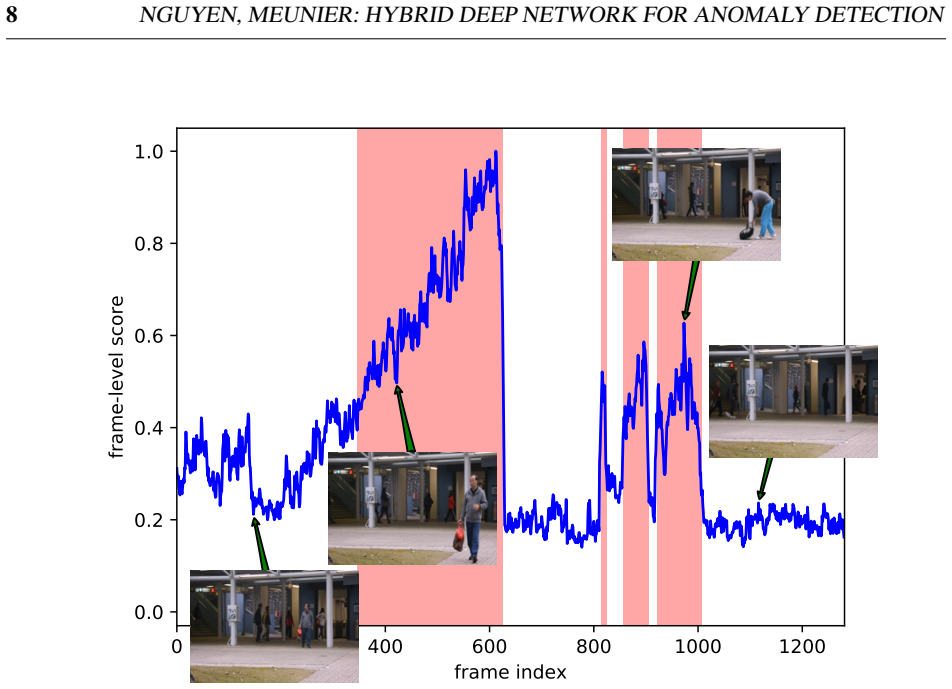
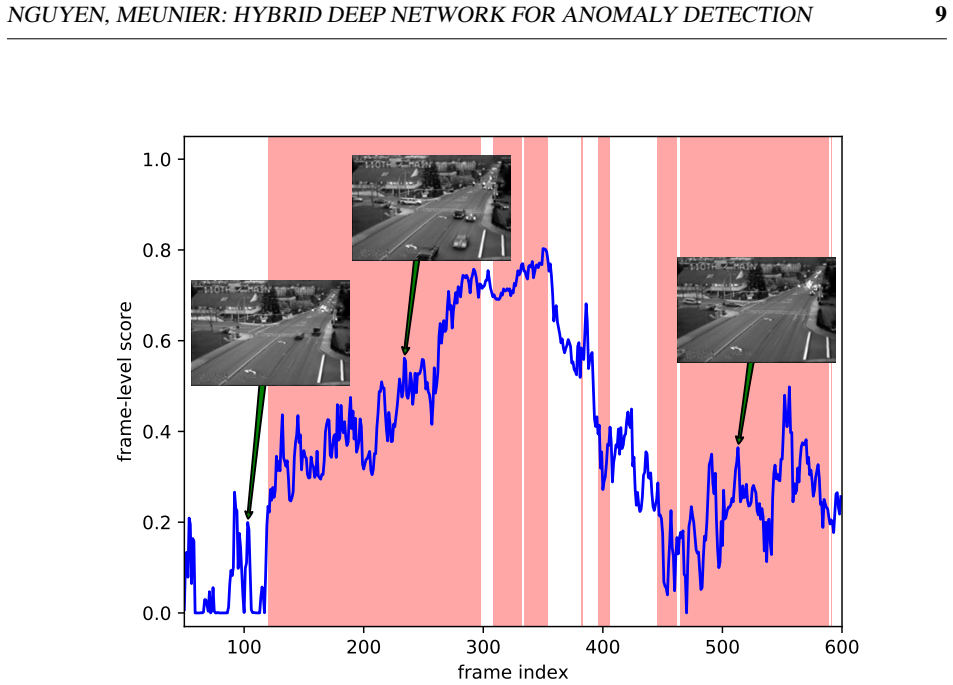
The paper's central claim is that integrating a patch-position classification task into a convolutional autoencoder improves video anomaly detection. Input frames are resized to 160x120 and split into 10x10 non-overlapping patches; three consecutive gray-scale patches form a cuboid. The encoder is trained to reconstruct the cuboid while two softmax branches predict the horizontal (16 classes) and vertical (12 classes) index of the cuboid's location, forcing shared features to encode location. At inference, each cuboid gets a reconstruction score and two classification scores measuring how confidently the network places it at its true position, all combined into a weighted normality map; the standard deviation of that map across cuboids is the frame-level score. The paper reports that this hybrid outperforms using supervised or unsupervised objectives alone on the CUHK Avenue dataset (AUC 82.8 percent for the combined map), that the classification map is the best component on the low-quality Belleview (AP 82.7) and Traffic-Train (AP 64.4) datasets, and that adversarial training of the reconstruction helps except when camera jitter makes real and reconstructed cuboids hard to distinguish.
Load-bearing premise
The load-bearing assumption is that a normal cuboid's spatial location can be predicted from its appearance and motion, so an anomalous cuboid will be misclassified by the location sub-network; the paper itself notes this breaks down when cuboids are too small or frames too low-quality.
Editorial extensions
If this is right
- A supervised location-prediction objective can serve as an auxiliary task for unsupervised normality learning, improving frame-level anomaly scores on standard benchmarks without labeled anomalies.
- Combining reconstruction and classification scores helps on datasets where both signals are informative, as on Avenue where the combined map reaches AUC 82.8, above either branch alone.
- On low-resolution or jittery videos, the classification branch is the more reliable signal; dropping the reconstruction score from the fusion yields the best results on Belleview and Traffic-Train.
- Adversarial training of the autoencoder improves detection on stable cameras but hurts on Traffic-Train, so it should be disabled when the camera is unstable.
- Upscaling input resolution tends to improve detection on UCSD Ped2, indicating that cuboid detail relative to object size is a limiting factor.
Reading between the lines
- Location prediction is effectively a self-supervised pretext task; the same architectural move could be tried with other free labels from video geometry, such as temporal order, rotation, or frame offset, to see which pretext transfers best to anomaly scoring.
- The resolution experiment on Ped2 suggests a testable extension: fix the patch size relative to object scale rather than in pixels, so that distant objects still occupy enough of the cuboid for location to be predictable.
- Because the classification branch alone drives performance on low-quality data, a practical deployment could run the classifier online and invoke the reconstruction branch only when the classifier is uncertain.
- If the location sub-network is genuinely learning normal spatial structure, its internal feature map could double as a saliency localizer for the anomalous region, even though the paper evaluates only frame-level scores.
Signed reviews
Editorial analysis
A structured set of objections, weighed in public.
Referee Report
Summary. The paper proposes a hybrid deep network for frame-level anomaly detection in surveillance video. The model is a convolutional auto-encoder trained on 10x10x3 cuboids from three consecutive gray-scale frames, with an added classification sub-network that predicts the row and column position of each cuboid from encoder features. The total loss combines l2 reconstruction with gradient regularization, cross-entropy classification, and an adversarial discriminator loss. At test time, cuboid-level reconstruction and classification scores are combined (Eq. (6)) and the standard deviation of the resulting score map is used as the frame-level normality score. Experiments are reported on CUHK Avenue, UCSD Ped2, Belleview, and Traffic-Train, with AUC for the first two and AP for the last two. The authors report competitive or superior results compared with several prior methods, and provide ablations of the adversarial term, the decoder, and input resolution.
Significance. The central idea—using patch-position prediction as an auxiliary task for normality learning—is interesting and the architecture is clearly described. The ablations in Sections 4.4-4.6 are a strength, especially the resolution experiment on Ped2 and the comparison with/without adversarial training and decoder. The method is trained from scratch on normal data only, and the combination weights in Eq. (6) are estimated on the training set, so I do not see circularity in the evaluation. If the claims on Belleview and Traffic-Train survive a fair frame-level comparison, the paper would be a reasonable contribution. However, the current evidence for superiority on two of four benchmarks rests on comparing frame-level AP with pixel-level baselines, which makes the reported margin unreliable.
major comments (3)
- [4.2 / Table 2] In §4.2 the authors state that the Belleview and Traffic-Train results in related studies were obtained at pixel level, whereas the paper evaluates at frame level. Table 2 then lists the paper's frame-level AP (e.g., 82.7 and 64.4 for Sx,y) against pixel-level AP values from Sparse combination learning, GANomaly, AEs+local/global, and ALOCC. Frame-level AP is generally a less stringent metric than pixel-level AP, because a frame is scored positive if any anomalous pixel is present. The claimed conclusion in §4.3 that the hybrid network handles lighting change and camera jitter 'better than models of similar architectures' is therefore not supported by these numbers. The authors must re-evaluate the baselines at frame-level, or restrict the comparison to methods that report frame-level results; otherwise the superiority claims on Belleview and Traffic-Train should be withdrawn.
- [4.3, Eq. (6)] The combination rule SR,x,y does not improve over Sx,y on Belleview (73.1 vs. 82.7 AP) or Traffic-Train (50.5 vs. 64.4 AP), and Table 3 shows that the benefit of adversarial training is negative on Traffic-Train. The paper acknowledges the former, but the conclusion still presents the score-combination scheme as a contribution that improves the final anomaly score. Reporting the best of Sx,y and SR,x,y after inspecting test-set results is a form of test-set selection. A principled criterion for choosing between the combination and the classification-only score (e.g., based on training-set reconstruction quality) should be provided, and the final numbers should be presented for a single pre-specified decision rule.
- [4.3–4.6] All reported results are single-run values without error bars or significance tests. Many of the differences that support qualitative claims are very small: in Table 4, the decoder contribution to Sx,y on Avenue is 80.6 vs. 80.3 AUC; in Table 3, the improvements due to adversarial training are below 1 AP point on Belleview. On Traffic-Train, removing adversarial training actually improves all scores. Without multiple seeds or confidence intervals, these differences are not distinguishable from run-to-run variation, and the claims that adversarial training and the decoder 'improve' detection are not statistically supported. Please provide results over at least 3 seeds with mean±std, or a significance test.
minor comments (6)
- [3.4] The choice of standard deviation as the frame-level pooling function is not compared with alternatives (mean, max, or percentile). Since this pooling operation directly determines the reported frame-level scores, please add a small ablation or at least a justification based on a quantitative comparison.
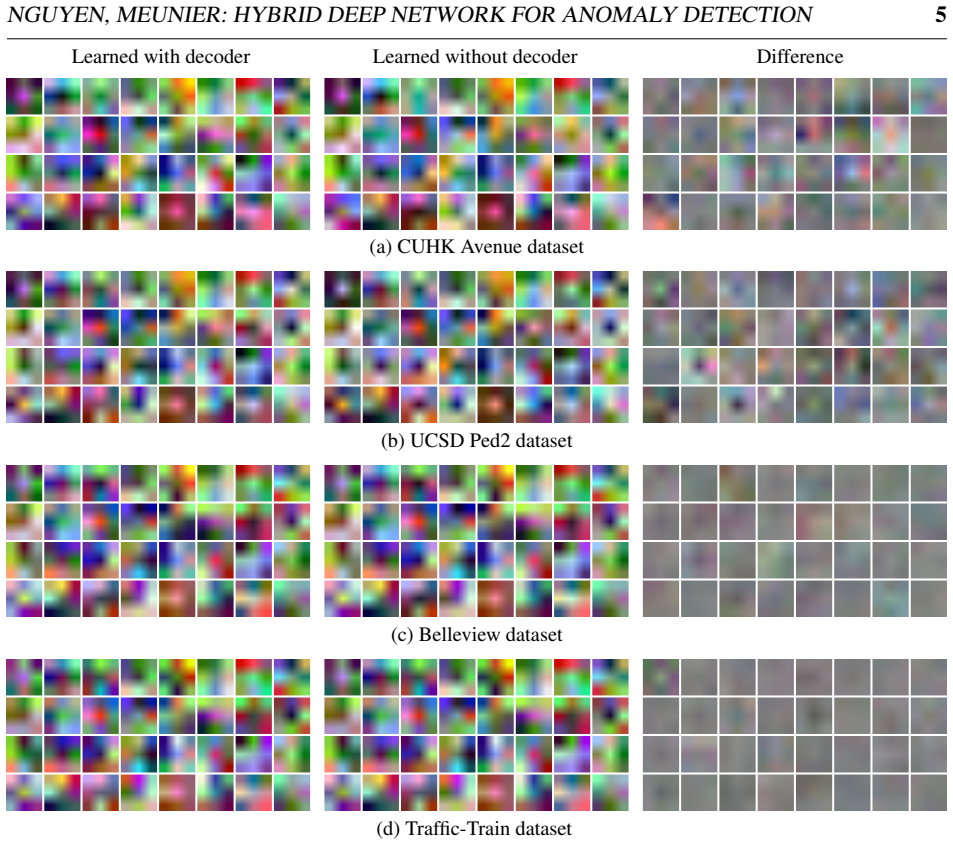
- [3.3.3 / Fig. 1(b)] The paper mentions that the discriminator is used only during training, but this fact is stated in §5.3.3 rather than when the architecture is introduced; making it explicit next to Fig. 1(b) would improve clarity.
- [4.3] The phrase 'our method is better than others when working on the Avenue dataset' should be qualified as 'better than the methods listed in Table 1', since the table does not include all state-of-the-art approaches.
- [4.4] The resolution experiment uses only 40 epochs for all resolutions, so the improvement in Fig. 4 may reflect longer effective training rather than resolution alone. Converged results or an epoch-controlled plot would be more informative.
- [Eq. (5), Section 4] Please clarify whether the input cuboid values are scaled to [0,1] or [0,255]; this affects the magnitude of reconstruction scores and hence the relative weights in Eq. (6).
- [4.3] The statement that the model is 'appropriate for integrating into real-time systems' is based on 0.15 s per 3072 cuboids, which is not a per-frame latency; please report end-to-end per-frame runtime including cuboid extraction.
Circularity Check
No circularity: trained on normal cuboids, evaluated on public test sets; no target metric or test label enters training or score combination.
full rationale
The derivation chain is self-contained and empirically grounded rather than circular. The model learns two objectives from normal-event training cuboids only: an l2/gradient reconstruction loss (Eq. 1) and a patch-location cross-entropy loss (Eq. 2); neither uses test labels or the final frame-level anomaly metric. At inference, normality scores are reconstruction error and location-classification error against the true cuboid position (Eq. 5), which is a standard auxiliary-task design, not a quantity fitted to the evaluation labels. The only fitted scalars in the pipeline are the network weights and the Eq. (6) combination weights, and the paper states these weights are 'assigned according to its efficiency on the training data' (for which Sk should be small); they are computed from normal training cuboids and are not tuned to the test-set ROC/PR curves. Reported AUC/AP numbers come from disjoint public benchmarks with fixed ground truth, so no 'prediction' reduces by construction to an input. The paper contains no load-bearing self-citations: the author list has only Nguyen and Meunier, and the cited methods are external prior work (e.g., Lu et al. [20], Liu et al. [19]); no uniqueness theorem or prior author result is invoked to force the architecture. The acknowledged limitations—the Ped2 resolution gap (Sections 4.3 and 4.4) and the frame-level versus pixel-level comparison for Belleview and Traffic-Train (Section 4.2)—weaken the strength of some empirical claims but are disclosed comparability/correctness issues, not circular derivations. Accordingly the circularity score is 0.
Assumptions & free parameters
free parameters (8)
- lambda_l2 =
1
- lambda_grad =
1/3
- lambda_G =
0.25
- lambda_R =
1
- lambda_C =
1
- alpha =
1
- beta =
2
- learning_rates =
2e-4 for G, 1e-4 for D
assumptions (4)
- domain assumption Spatial location is a useful classification target for normality learning
- domain assumption The standard deviation of cuboid-level scores in a frame is a reliable frame-level normality measure
- domain assumption Training data contain only normal events, so any deviation in reconstruction or location prediction indicates anomaly
- standard math Adam and gradient descent converge to a useful local optimum for the hybrid generator and discriminator
Cite this review
Pith. "Pith review of Hybrid Deep Network for Anomaly Detection." pith.science (2026). https://pith.science/paper/RYJCSZCQ
@misc{pith2026190806347,
  author       = {Pith},
  title        = {Pith review of: Hybrid Deep Network for Anomaly Detection},
  year         = {2026},
  howpublished = {\url{https://pith.science/paper/RYJCSZCQ}},
  note         = {Machine review of arXiv:1908.06347}
}
read the original abstract
In this paper, we propose a deep convolutional neural network (CNN) for anomaly detection in surveillance videos. The model is adapted from a typical auto-encoder working on video patches under the perspective of sparse combination learning. Our CNN focuses on (unsupervisedly) learning common characteristics of normal events with the emphasis of their spatial locations (by supervised losses). To our knowledge, this is the first work that directly adapts the patch position as the target of a classification sub-network. The model is capable to provide a score of anomaly assessment for each video frame. Our experiments were performed on 4 benchmark datasets with various anomalous events and the obtained results were competitive with state-of-the-art studies.
Figures

Figures from the paper (9 more)



Reference graph
Works this paper leans on
-
[1]
write newline
" write newline "" before.all 'output.state := FUNCTION fin.entry add.period write newline FUNCTION new.block output.state before.all = 'skip after.block 'output.state := if FUNCTION new.sentence output.state after.block = 'skip output.state before.all = 'skip after.sentence 'output.state := if if FUNCTION not #0 #1 if FUNCTION and 'skip pop #0 if FUNCTIO...
-
[2]
@esa (Ref
\@ifclassloaded agu2001 natbib The agu2001 class already includes natbib coding, so you should not add it explicitly Type <Return> for now, but then later remove the command natbib from the document \@ifclassloaded aguplus natbib The aguplus class already includes natbib coding, so you should not add it explicitly Type <Return> for now, but then later rem...
-
[3]
@stdbsttrue NAT@ctr \@lbibitem[ NAT@ctr ] \@lbibitem[#1]#2 \@extra@b@citeb \@ifundefined br@#2\@extra@b@citeb \@namedef br@#2 \@nameuse br@#2\@extra@b@citeb \@ifundefined b@#2\@extra@b@citeb @num @parse #2 [ @natanchorstart #2\@extra@b@citeb \@biblabel @num @natanchorend] @ifcmd#1(@)(@)\@nil #2 @lbibitem\@undefined @lbibitem\@lbibitem \@lbibitem[#1]#2 @lb...
-
[4]
@open @close @open @close and [1] URL: #1 \@ifundefined chapter * \@mkboth \@ifundefined NAT@sectionbib * \@mkboth * \@mkboth\@gobbletwo \@ifclassloaded amsart * \@ifclassloaded amsbook * \@ifundefined bib@heading @heading NAT@ctr thebibliography [1] @ \@biblabel NAT@ctr \@bibsetup #1 NAT@ctr 0 @openbib .11em \@plus.33em \@minus.07em 4000 4000 `\.=1000 \@...
-
[5]
Samet Akcay, Amir Atapour-Abarghouei, and Toby P. Breckon. Ganomaly: Semisupervised anomaly detection via adversarial training. In Computer Vision -- ACCV 2018, Cham, 2018. Springer International Publishing
work page 2018
-
[6]
Spatiotemporal deformable prototypes for motion anomaly detection
Robert Bensch, Thomas Brox, and Olaf Ronneberger. Spatiotemporal deformable prototypes for motion anomaly detection. In Xianghua Xie, Mark W. Jones, and Gary K. L. Tam, editors, Proceedings of the British Machine Vision Conference (BMVC), pages 189.1--189.12. BMVA Press, September 2015. ISBN 1-901725-53-7. doi:10.5244/C.29.189
-
[7]
Return of the devil in the details: Delving deep into convolutional nets
Ken Chatfield, Karen Simonyan, Andrea Vedaldi, and Andrew Zisserman. Return of the devil in the details: Delving deep into convolutional nets. In Proceedings of the British Machine Vision Conference. BMVA Press, 2014. doi:http://dx.doi.org/10.5244/C.28.6
doi:10.5244/c.28.6 2014
-
[8]
K. Cheng, Y. Chen, and W. Fang. Video anomaly detection and localization using hierarchical feature representation and gaussian process regression. In 2015 IEEE Conference on Computer Vision and Pattern Recognition (CVPR), pages 2909--2917, June 2015. doi:10.1109/CVPR.2015.7298909
arXiv 2015
Show all 42 references
-
[9]
Andrew Bagnell, and Martial Hebert
Allison Del Giorno, J. Andrew Bagnell, and Martial Hebert. A discriminative framework for anomaly detection in large videos. In Bastian Leibe, Jiri Matas, Nicu Sebe, and Max Welling, editors, Computer Vision -- ECCV 2016, pages 334--349, Cham, 2016. Springer International Publ...
2016
-
[10]
Dosovitskiy, P
A. Dosovitskiy, P. Fischer, E. Ilg, P. H\" a usser, C. Hazirbas, V. Golkov, P. v. d. Smagt, D. Cremers, and T. Brox. Flownet: Learning optical flow with convolutional networks. In 2015 IEEE International Conference on Computer Vision (ICCV), pages 2758--2766, Dec 2015. doi:10....
2015 doi
-
[11]
Generative adversarial nets
Ian Goodfellow, Jean Pouget-Abadie, Mehdi Mirza, Bing Xu, David Warde-Farley, Sherjil Ozair, Aaron Courville, and Yoshua Bengio. Generative adversarial nets. In Z. Ghahramani, M. Welling, C. Cortes, N. D. Lawrence, and K. Q. Weinberger, editors, Advances in Neural Information ...
2014
-
[12]
Hasan, J
M. Hasan, J. Choi, J. Neumann, A. K. Roy-Chowdhury, and L. S. Davis. Learning temporal regularity in video sequences. In 2016 IEEE Conference on Computer Vision and Pattern Recognition (CVPR), pages 733--742, June 2016. doi:10.1109/CVPR.2016.86
2016 doi
-
[13]
K. He, X. Zhang, S. Ren, and J. Sun. Deep residual learning for image recognition. In 2016 IEEE Conference on Computer Vision and Pattern Recognition (CVPR), pages 770--778, June 2016. doi:10.1109/CVPR.2016.90
2016 doi
-
[14]
K. He, G. Gkioxari, P. Doll\' a r, and R. Girshick. Mask r-cnn. In 2017 IEEE International Conference on Computer Vision (ICCV), pages 2980--2988, Oct 2017. doi:10.1109/ICCV.2017.322
2017 doi
-
[15]
Hinami, T
R. Hinami, T. Mei, and S. Satoh. Joint detection and recounting of abnormal events by learning deep generic knowledge. In 2017 IEEE International Conference on Computer Vision (ICCV), pages 3639--3647, Oct 2017. doi:10.1109/ICCV.2017.391
2017 doi
-
[16]
Flownet 2.0: Evolution of optical flow estimation with deep networks
Eddy Ilg, Nikolaus Mayer, Tonmoy Saikia, Margret Keuper, Alexey Dosovitskiy, and Thomas Brox. Flownet 2.0: Evolution of optical flow estimation with deep networks. In The IEEE Conference on Computer Vision and Pattern Recognition (CVPR), July 2017
2017
-
[17]
R. T. Ionescu, S. Smeureanu, B. Alexe, and M. Popescu. Unmasking the abnormal events in video. In 2017 IEEE International Conference on Computer Vision (ICCV), pages 2914--2922, Oct 2017. doi:10.1109/ICCV.2017.315
2017 doi
-
[18]
Isola, J
P. Isola, J. Zhu, T. Zhou, and A. A. Efros. Image-to-image translation with conditional adversarial networks. In 2017 IEEE Conference on Computer Vision and Pattern Recognition (CVPR), pages 5967--5976, July 2017. doi:10.1109/CVPR.2017.632
2017 doi
-
[19]
Kim and K
J. Kim and K. Grauman. Observe locally, infer globally: A space-time mrf for detecting abnormal activities with incremental updates. In 2009 IEEE Conference on Computer Vision and Pattern Recognition, pages 2921--2928, June 2009. doi:10.1109/CVPR.2009.5206569
2009
-
[20]
Adam: A method for stochastic optimization
Diederick P Kingma and Jimmy Ba. Adam: A method for stochastic optimization. In International Conference on Learning Representations (ICLR), 2015
2015
-
[21]
Imagenet classification with deep convolutional neural networks
Alex Krizhevsky, Ilya Sutskever, and Geoffrey E Hinton. Imagenet classification with deep convolutional neural networks. In F. Pereira, C. J. C. Burges, L. Bottou, and K. Q. Weinberger, editors, Advances in Neural Information Processing Systems 25, pages 1097--1105. Curran Ass...
2012
-
[22]
W. Li , V. Mahadevan , and N. Vasconcelos . Anomaly detection and localization in crowded scenes. IEEE Transactions on Pattern Analysis and Machine Intelligence, 36 0 (1): 0 18--32, Jan 2014. ISSN 0162-8828. doi:10.1109/TPAMI.2013.111
2014 doi
-
[23]
Future frame prediction for anomaly detection - a new baseline
Wen Liu, Weixin Luo, Dongze Lian, and Shenghua Gao. Future frame prediction for anomaly detection - a new baseline. In The IEEE Conference on Computer Vision and Pattern Recognition (CVPR), June 2018
2018
-
[24]
C. Lu, J. Shi, and J. Jia. Abnormal event detection at 150 fps in matlab. In 2013 IEEE International Conference on Computer Vision, pages 2720--2727, Dec 2013. doi:10.1109/ICCV.2013.338
2013 doi
-
[25]
W. Luo, W. Liu, and S. Gao. A revisit of sparse coding based anomaly detection in stacked rnn framework. In 2017 IEEE International Conference on Computer Vision (ICCV), pages 341--349, Oct 2017. doi:10.1109/ICCV.2017.45
2017 doi
-
[26]
Maas, Awni Y
Andrew L. Maas, Awni Y. Hannun, and Andrew Y. Ng. Rectifier nonlinearities improve neural network acoustic models. In in ICML Workshop on Deep Learning for Audio, Speech and Language Processing, 2013
2013
-
[27]
Mahadevan, W
V. Mahadevan, W. Li, V. Bhalodia, and N. Vasconcelos. Anomaly detection in crowded scenes. In 2010 IEEE Computer Society Conference on Computer Vision and Pattern Recognition, pages 1975--1981, June 2010. doi:10.1109/CVPR.2010.5539872
2010
-
[28]
Deep multi-scale video prediction beyond mean square error
Micha \" e l Mathieu, Camille Couprie, and Yann LeCun. Deep multi-scale video prediction beyond mean square error. CoRR, abs/1511.05440, 2015
2015 arXiv
-
[29]
Medioni, I
G. Medioni, I. Cohen, F. Bremond, S. Hongeng, and R. Nevatia. Event detection and analysis from video streams. IEEE Transactions on Pattern Analysis and Machine Intelligence, 23 0 (8): 0 873--889, Aug 2001. ISSN 0162-8828. doi:10.1109/34.946990
2001 doi
-
[30]
Vinod Nair and Geoffrey E. Hinton. Rectified linear units improve restricted boltzmann machines. In Proceedings of the 27th International Conference on International Conference on Machine Learning, ICML'10, pages 807--814, USA, 2010. Omnipress. ISBN 978-1-60558-907-7
2010
-
[31]
Narasimhan and Sowmya Kamath S
Medhini G. Narasimhan and Sowmya Kamath S. Dynamic video anomaly detection and localization using sparse denoising autoencoders. Multimedia Tools and Applications, 77 0 (11): 0 13173--13195, Jun 2018. ISSN 1573-7721. doi:10.1007/s11042-017-4940-2
2018 doi
-
[32]
Ravanbakhsh, M
M. Ravanbakhsh, M. Nabi, E. Sangineto, L. Marcenaro, C. Regazzoni, and N. Sebe. Abnormal event detection in videos using generative adversarial nets. In 2017 IEEE International Conference on Image Processing (ICIP), pages 1577--1581, Sep. 2017. doi:10.1109/ICIP.2017.8296547
2017
-
[33]
Ravanbakhsh , E
M. Ravanbakhsh , E. Sangineto , M. Nabi , and N. Sebe . Training adversarial discriminators for cross-channel abnormal event detection in crowds. In 2019 IEEE Winter Conference on Applications of Computer Vision (WACV), pages 1896--1904, Jan 2019. doi:10.1109/WACV.2019.00206
2019
-
[34]
Faster r-cnn: Towards real-time object detection with region proposal networks
Shaoqing Ren, Kaiming He, Ross Girshick, and Jian Sun. Faster r-cnn: Towards real-time object detection with region proposal networks. In C. Cortes, N. D. Lawrence, D. D. Lee, M. Sugiyama, and R. Garnett, editors, Advances in Neural Information Processing Systems 28, pages 91-...
2015
-
[35]
Adversarially learned one-class classifier for novelty detection
Mohammad Sabokrou, Mohammad Khalooei, Mahmood Fathy, and Ehsan Adeli. Adversarially learned one-class classifier for novelty detection. In The IEEE Conference on Computer Vision and Pattern Recognition (CVPR), June 2018
2018
-
[36]
Learning deep representations of appearance and motion for anomalous event detection
Dan Xu, Elisa Ricci, Yan Yan, Jingkuan Song, and Nicu Sebe. Learning deep representations of appearance and motion for anomalous event detection. In Xianghua Xie, Mark W. Jones, and Gary K. L. Tam, editors, Proceedings of the British Machine Vision Conference (BMVC), pages 8.1...
2015 doi
-
[37]
Detecting anomalous events in videos by learning deep representations of appearance and motion
Dan Xu, Yan Yan, Elisa Ricci, and Nicu Sebe. Detecting anomalous events in videos by learning deep representations of appearance and motion. Computer Vision and Image Understanding, 156: 0 117 -- 127, 2017. ISSN 1077-3142. doi:https://doi.org/10.1016/j.cviu.2016.10.010. Image ...
2017 doi
-
[38]
Anomalous behaviour detection using spatiotemporal oriented energies, subset inclusion histogram comparison and event-driven processing
Andrei Zaharescu and Richard Wildes. Anomalous behaviour detection using spatiotemporal oriented energies, subset inclusion histogram comparison and event-driven processing. In Kostas Daniilidis, Petros Maragos, and Nikos Paragios, editors, Computer Vision -- ECCV 2010, pages ...
2010
-
[39]
Zhang, H
T. Zhang, H. Lu, and S. Z. Li. Learning semantic scene models by object classification and trajectory clustering. In 2009 IEEE Conference on Computer Vision and Pattern Recognition, pages 1940--1947, June 2009. doi:10.1109/CVPR.2009.5206809
2009
-
[40]
Video anomaly detection based on locality sensitive hashing filters
Ying Zhang, Huchuan Lu, Lihe Zhang, Xiang Ruan, and Shun Sakai. Video anomaly detection based on locality sensitive hashing filters. Pattern Recognition, 59: 0 302 -- 311, 2016. ISSN 0031-3203. doi:https://doi.org/10.1016/j.patcog.2015.11.018. Compositional Models and Structur...
2016 doi
-
[41]
B. Zhao, L. Fei-Fei, and E. P. Xing. Online detection of unusual events in videos via dynamic sparse coding. In CVPR 2011, pages 3313--3320, June 2011. doi:10.1109/CVPR.2011.5995524
2011
-
[42]
Batch normalization: Accelerating deep network training by reducing internal covariate shift
Sergey Ioffe and Christian Szegedy. Batch normalization: Accelerating deep network training by reducing internal covariate shift. In Francis Bach and David Blei, editors, Proceedings of the 32nd International Conference on Machine Learning, volume 37 of Proceedings of Machine ...
2015
Reviewed August 14, 2026 · model on record in the stance chip above.
Discussion (0). Continue with ORCID to comment.