REVIEW 4 major objections 4 minor 57 references
Anomaly Detection in Video Sequence with Appearance-Motion Correspondence
T0 review · 4 major / 4 minor · reviewed 2026-08-14 · deepseek-v4-flash
Pith's one-line read A shared-encoder CNN that learns appearance-motion correspondence detects anomalous frames in surveillance video, outperforming prior methods on Avenue and Ped2.
desk verdict A genuine architectural combination with unusually honest failure analysis, but the headline SOTA claim rests on single-run margins that are within noise; deserves review, but not blind citation. read the letter →
The pith
A machine-rendered reading of the paper's core claim, the machinery that carries it, and where it could break.
The reading
What carries the argument
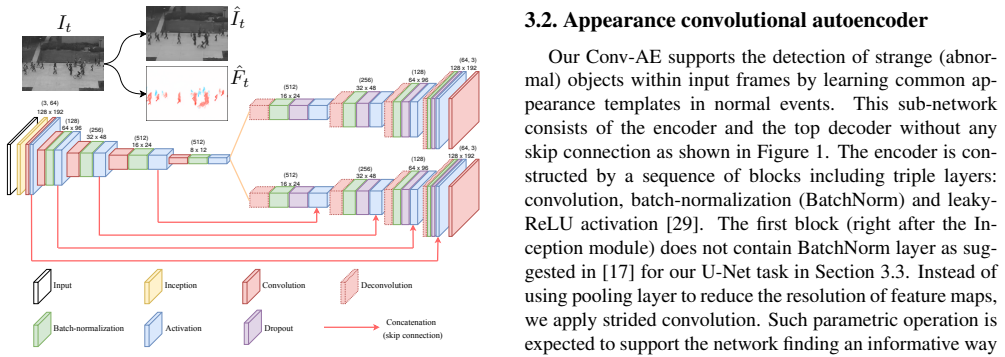
The load-bearing object is the shared-encoder two-stream network: an Inception module ($1\times1$, $3\times3$, $5\times5$, $7\times7$ factorized convolutions) right after the input lets the network choose low-level filter scales; the common encoder feeds two decoders, with the appearance decoder a plain Conv-AE (no skip connections, $\ell^2$ intensity plus gradient loss) and the motion decoder a U-Net with skip connections predicting optical flow ($\ell^1$ loss against FlowNet2 output, with a cGAN discriminator on concatenated frame and flow). The scoring mechanism is the other key piece: instead of averaging errors over the whole frame, it slides a $16\times16$ patch, picks the patch with the largest motion-prediction error $\tilde{P}$, and forms $S = \log[w_F S_F(\tilde{P})] + \lambda_S \log[w_I S_I(\tilde{P})]$ with inverse-average weights from training data. This patch selection concentrates the score on the most anomalous region and suppresses diffuse noise.
What would settle it
Run the same pipeline on UCSD Ped1, which the authors excluded because FlowNet2 handles very small and thin pedestrians poorly; if the appearance-motion correspondence is the real driver, frame-level AUC should drop markedly below the Ped2 value of 0.962, whereas an appearance-only or scale-robust flow variant should suffer less.
Extended reading notes
Core claim
The central claim is that a single shared encoder can learn the correspondence between an object's appearance and its typical motion, and that breaking this correspondence is a reliable signal of anomaly. The appearance decoder reconstructs the frame with intensity and gradient losses; the motion decoder predicts a three-channel optical flow from the same latent code using skip connections and an $\ell^1$ loss against FlowNet2 ground truth, plus a conditional GAN loss on the flow distribution. Anomaly scores are computed per frame from $16\times16$ patches, taking the patch with the highest motion error and combining it with the appearance reconstruction error at that patch using weights calibrated on training data. On the two datasets with frame-level ground truth the method reports the best AUC among the compared methods, and on event-level and PR-based benchmarks it is competitive; the authors also show that replacing the score with SSIM on the appearance stream helps on jittery, poorly-estimated-flow datasets.
Load-bearing premise
The paper treats FlowNet2's optical flow as reliable ground-truth motion; if that estimator is noisy or wrong for a scene, the learned appearance-motion correspondence and the anomaly scores built on it degrade.
Editorial extensions
If this is right
- A single video frame is enough to score normality: the motion stream predicts the flow to the next frame from appearance alone, so no temporal window of inputs is required.
- The shared encoder means the model learns joint appearance-motion patterns rather than separate detectors, which is what allows unusual objects (bicycles, trucks) and unusual motions (running, wrong direction) to be flagged by the same score.
- Because scoring uses the maximum-error patch, the model can detect anomalies occupying small image regions that whole-frame averaging would miss.
- The method does not need anomalous training examples or explicit event definitions, only normal footage and an optical-flow estimator to generate motion ground truth.
- On datasets with camera jitter or poor flow, using SSIM between the input and its reconstruction improves results, showing the appearance stream alone carries useful signal.
Reading between the lines
- If the correspondence view is right, optical-flow prediction from a single frame is a strong self-supervised pretext task for surveillance representation learning; the same shared-encoder design could be extended to other dense prediction targets such as depth or segmentation.
- The dependence on FlowNet2 suggests a testable extension: replacing the fixed flow estimator with a fine-tuned or uncertainty-aware flow network should improve performance exactly on scenes like Ped1 or Traffic-Train where flow quality is the known bottleneck.
- The patch-based max-error scoring is a generic mechanism: it could be grafted onto other reconstruction or prediction anomaly detectors to sharpen frame-level and localization performance without retraining.
- On scenes where appearance and motion are weakly correlated (for example, static cameras with many parked vehicles), the shared-encoder correspondence assumption would probably be less informative, and appearance-only scoring should catch up.
Signed reviews
Editorial analysis
A structured set of objections, weighed in public.
Referee Report
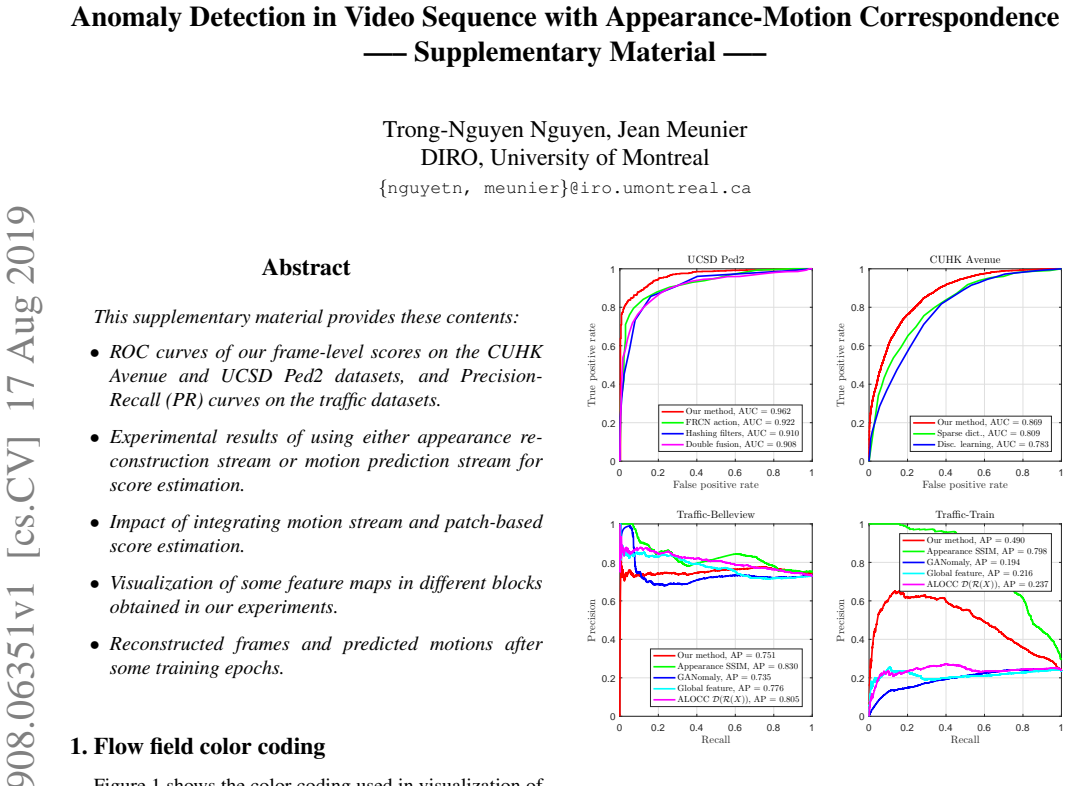
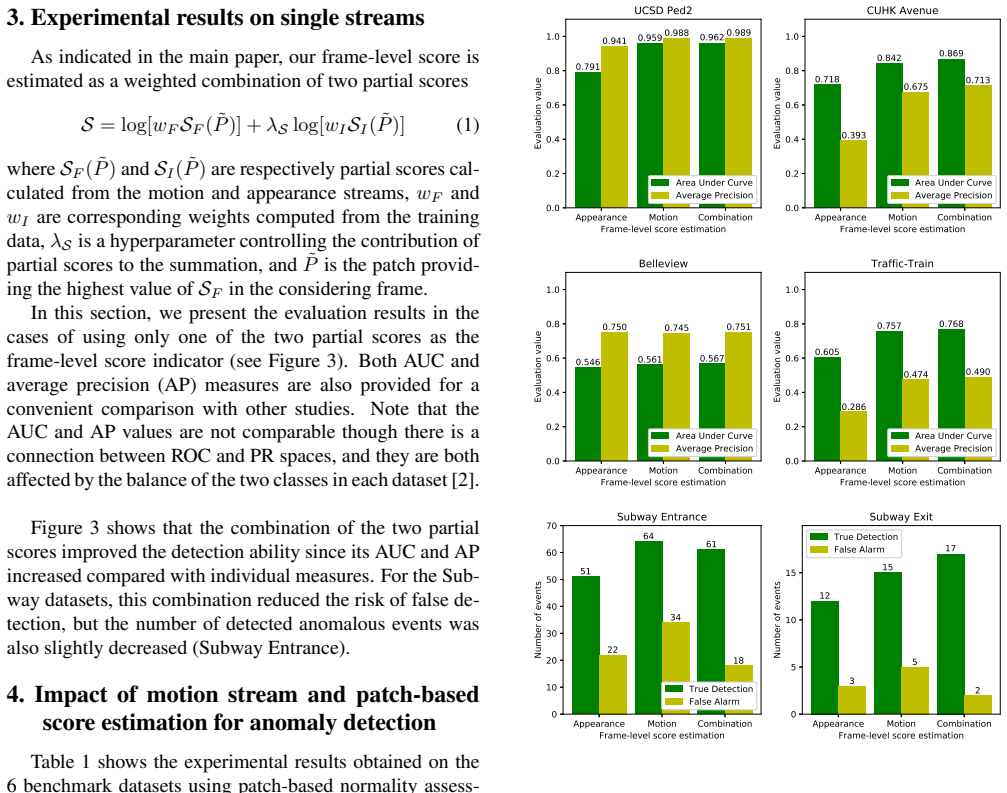
Summary. The paper proposes a two-stream deep network for frame-level anomaly detection in surveillance video. A shared encoder feeds an appearance reconstruction stream (Conv-AE with intensity and gradient losses) and a motion prediction stream (U-Net with an l1 optical-flow loss and a conditional GAN loss). The anomaly score is a log-weighted combination of patch-level reconstruction errors from the two streams, with inverse-average normalization weights estimated on training data. Experiments are reported on six benchmark datasets: CUHK Avenue, UCSD Ped2, Subway Entrance/Exit, Traffic-Belleview, and Traffic-Train. The central claim, stated in Section 4.1, is that the proposed model outperforms all recent methods, supported by AUC values of 0.869 (Avenue) and 0.962 (Ped2) in Table 1. On the Subway datasets, the method detects most events but with more false alarms than competing approaches; on the Traffic datasets, the combined score obtains AP 0.751 and 0.490, while an appearance-stream SSIM variant obtains 0.830 and 0.798, respectively.
Significance. The shared-encoder design that couples appearance reconstruction with motion prediction is a reasonable and well-motivated idea, and the patch-based scoring scheme is a practical contribution that the supplementary material shows can improve over per-pixel scores. The paper is honest in reporting failure cases and discusses dataset-specific limitations, which is valuable for practitioners. If the reported gains were accompanied by proper statistical validation, the method would be a solid improvement over the 2017-2018 baselines on Avenue and Ped2. However, as presented, the comparative claim rests on single-run point estimates with margins smaller than typical seed variance, and the motion stream demonstrably degrades performance on the Traffic datasets relative to a simpler appearance-only SSIM score. The paper also does not provide code or artifacts, limiting reproducibility. These issues make the significance conditional on additional evidence rather than established by the manuscript as written.
major comments (4)
- [Section 4.1, Table 1] The load-bearing claim that 'our model outperforms all other recent methods' is supported only by single-run AUC point estimates. On Avenue the margin over Future frame prediction [25] is 0.018 and on Ped2 it is 0.008. Because the model is trained with a GAN (Section 3.4) and dropout (Section 3.2), run-to-run variability of this magnitude is plausible. The paper provides no error bars, no multiple seeds, and no significance tests. Please provide a distribution over runs (e.g., mean ± std over at least three seeds) or a paired statistical test, or explicitly qualify the claim as 'competitive with' rather than 'outperforms all other recent methods.'
- [Section 4.3, Table 3] The proposed combined score is not competitive on the Traffic datasets: on Traffic-Train it achieves AP 0.490, while the appearance-stream SSIM variant reported in the same table achieves 0.798; on Traffic-Belleview the combined score (0.751) is below ALOCCD(R(X)) (0.805). The supplementary material (Figure 3) also shows that the motion stream alone performs poorly on Traffic-Train (AP 0.474 vs. 0.286 for appearance). This contradicts the paper's over-arching claim that the appearance-motion correspondence is beneficial across datasets. The authors should report the proposed method's performance per dataset with a clear designation of which score is the official one, and discuss why adding the motion stream hurts on these scenes despite helping on Avenue and Ped2.
- [Section 3.5 and Supplementary Table 2] The anomaly score in Eq. (8) depends on hyperparameters that appear to be tuned without a held-out validation protocol: λ_S is 'empirically set to 0.2', the patch size P is fixed at 16×16, and the number of training epochs is selected per dataset (Supplementary Table 2) with no statement about whether test labels were consulted. Since the reported margins over prior work are small, the possibility of implicit test-set selection is a serious risk. Please provide a sensitivity analysis for λ_S and patch size, or a validation-based selection procedure, to rule out that the reported numbers are the result of post-hoc tuning.
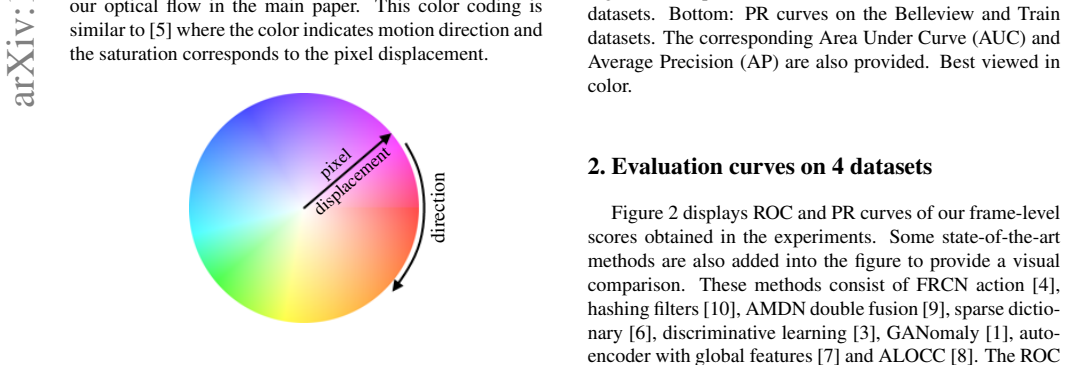
- [Section 4.3, Figure 6] The paper attributes the degradation on Traffic-Belleview and the exclusion of UCSD Ped1 to FlowNet2's unreliable optical flow on small or low-quality objects. Because FlowNet2 provides the ground-truth motion signal for the entire motion stream, this is a core dependency rather than a peripheral implementation detail. The current evidence is qualitative (Figure 6c). Please quantify the accuracy of FlowNet2 on the datasets used (e.g., by comparing FlowNet2 flow against a second estimator on a sample of frames) or show a sensitivity analysis with an alternative flow estimator to establish that the motion stream's limitations come from the estimator rather than the proposed architecture.
minor comments (4)
- [Throughout] The notation 'l2' and 'l1' should be formatted as ℓ2 and ℓ1 for consistency with standard usage.
- [Section 3.5] The definition of the score in Eq. (8) is not fully explained: the logarithm of a weighted sum is not a standard normalization, and the reason for taking the log of each term separately rather than the log of the weighted sum should be clarified.
- [Section 4.2, Table 2] The statement that 'our model detected most anomalous events but also generated more false alarm than other recent studies' is accurate, but the discussion of the false alarms in Figure 5 would be strengthened by reporting the precision/recall trade-off numerically rather than only through examples.
- [Supplementary Material, Table 2] The description of epoch selection as 'according to the number of training images in each dataset and the memory capacity of our hardware' is vague; please specify the actual criterion (e.g., early stopping on a validation metric) or state that the choice was made on the test set.
Circularity Check
No significant circularity; the anomaly score is evaluated against external benchmarks and no load-bearing self-citation or fitted-input-as-prediction step was found.
full rationale
The paper's derivation chain is self-contained with respect to the claimed contribution: the model learns a shared-encoder appearance reconstruction (Conv-AE) and motion prediction (U-Net) on normal training videos, and the frame-level anomaly score in Eq. (8) combines per-patch reconstruction and optical-flow errors. The normalization weights wF and wI in Eq. (10) are computed from training-set error statistics, not from test labels, and lambda_S is a fixed empirical hyperparameter; these are not 'predictions' that reduce to fitted quantities. The ground-truth optical flow is produced by a pretrained external estimator (FlowNet2), and the paper explicitly states that the model signal does not propagate through it, so the motion stream is not circularly defined in terms of its own output. The central comparative claim ('our model outperforms all other recent methods', Section 4.1) is supported by AUC point estimates on the external CUHK Avenue and UCSD Ped2 benchmarks; the absence of error bars or multiple seeds is a statistical robustness concern, not a circularity of derivation. No self-citations by the authors appear in the reference list, so there is no self-citation chain carrying a load-bearing premise. Accordingly, no specific circular step can be quoted and exhibited, and the appropriate score is 0.
Assumptions & free parameters
free parameters (5)
- lambda_S =
0.2
- lambda_G, lambda_a, lambda_f =
0.25, 1, 2
- patch size P =
16x16
- wF, wI =
Inverse average training scores
- Initial learning rates =
2e-4 (G), 2e-5 (D)
assumptions (3)
- domain assumption FlowNet2 pretrained on FlyingThing3D and ChairsSDHom produces optical flow that is an adequate ground-truth motion signal for normal events in surveillance videos.
- domain assumption Training on normal-event frames only is sufficient for the model to learn a normality distribution that generalizes to test frames.
- domain assumption The benchmark datasets' frame-level and event-level ground truth annotations are correct.
Cite this review
Pith. "Pith review of Anomaly Detection in Video Sequence with Appearance-Motion Correspondence." pith.science (2026). https://pith.science/paper/FMZ5JZ6T
@misc{pith2026190806351,
  author       = {Pith},
  title        = {Pith review of: Anomaly Detection in Video Sequence with Appearance-Motion Correspondence},
  year         = {2026},
  howpublished = {\url{https://pith.science/paper/FMZ5JZ6T}},
  note         = {Machine review of arXiv:1908.06351}
}
read the original abstract
Anomaly detection in surveillance videos is currently a challenge because of the diversity of possible events. We propose a deep convolutional neural network (CNN) that addresses this problem by learning a correspondence between common object appearances (e.g. pedestrian, background, tree, etc.) and their associated motions. Our model is designed as a combination of a reconstruction network and an image translation model that share the same encoder. The former sub-network determines the most significant structures that appear in video frames and the latter one attempts to associate motion templates to such structures. The training stage is performed using only videos of normal events and the model is then capable to estimate frame-level scores for an unknown input. The experiments on 6 benchmark datasets demonstrate the competitive performance of the proposed approach with respect to state-of-the-art methods.
Figures


Figures from the paper (8 more)




Reference graph
Works this paper leans on
-
[25]
Future frame prediction for anomaly detection – a new baseline
Wen Liu, Weixin Luo, Dongze Lian, and Shenghua Gao. Future frame prediction for anomaly detection – a new baseline. In The IEEE Conference on Computer Vision and Pattern Recognition (CVPR) , June 2018
work page 2018
-
[1]
Robust real-time unusual event detection using multiple fixed-location monitors
Amit Adam, Ehud Rivlin, Ilan Shimshoni, and David Reinitz. Robust real-time unusual event detection using multiple fixed-location monitors. IEEE Trans. Pattern Anal. Mach. Intell. , 30(3):555--560, 2008
work page 2008
-
[2]
Samet Akcay, Amir Atapour-Abarghouei, and Toby P. Breckon. Ganomaly: Semisupervised anomaly detection via adversarial training. In Computer Vision -- ACCV 2018 , Cham, 2018. Springer International Publishing
work page 2018
-
[3]
Learning object motion patterns for anomaly detection and improved object detection
Arslan Basharat, Alexei Gritai, and Mubarak Shah. Learning object motion patterns for anomaly detection and improved object detection. In 2008 IEEE Conference on Computer Vision and Pattern Recognition , pages 1--8, June 2008
work page 2008
-
[4]
Sca-cnn: Spatial and channel-wise attention in convolutional networks for image captioning
Long Chen, Hanwang Zhang, Jun Xiao, Liqiang Nie, Jian Shao, Wei Liu, and Tat-Seng Chua. Sca-cnn: Spatial and channel-wise attention in convolutional networks for image captioning. In The IEEE Conference on Computer Vision and Pattern Recognition (CVPR) , July 2017
work page 2017
-
[5]
Kai-Wen Cheng, Yie-Tarng Chen, and Wen-Hsien Fang. Video anomaly detection and localization using hierarchical feature representation and gaussian process regression. In 2015 IEEE Conference on Computer Vision and Pattern Recognition (CVPR) , pages 2909--2917, June 2015
work page 2015
-
[6]
Sparse reconstruction cost for abnormal event detection
Yang Cong, Junsong Yuan, and Ji Liu. Sparse reconstruction cost for abnormal event detection. In CVPR 2011 , pages 3449--3456, June 2011
work page 2011
-
[7]
Andrew Bagnell, and Martial Hebert
Allison Del Giorno, J. Andrew Bagnell, and Martial Hebert. A discriminative framework for anomaly detection in large videos. In Bastian Leibe, Jiri Matas, Nicu Sebe, and Max Welling, editors, Computer Vision -- ECCV 2016 , pages 334--349, Cham, 2016. Springer International Publishing
work page 2016
Show all 57 references
-
[8]
Flownet: Learning optical flow with convolutional networks
Alexey Dosovitskiy, Philipp Fischer, Eddy Ilg, Philip H\" a usser, Caner Hazirbas, Vladimir Golkov, Patrick van der Smagt, Daniel Cremers, and Thomas Brox. Flownet: Learning optical flow with convolutional networks. In 2015 IEEE International Conference on Computer Vision (ICC...
2015
-
[9]
Sparse subspace clustering
Ehsan Elhamifar and Rene Vidal. Sparse subspace clustering. In 2009 IEEE Conference on Computer Vision and Pattern Recognition , pages 2790--2797, June 2009
2009
-
[10]
Generative adversarial nets
Ian Goodfellow, Jean Pouget-Abadie, Mehdi Mirza, Bing Xu, David Warde-Farley, Sherjil Ozair, Aaron Courville, and Yoshua Bengio. Generative adversarial nets. In Z. Ghahramani, M. Welling, C. Cortes, N. D. Lawrence, and K. Q. Weinberger, editors, Advances in Neural Information ...
2014
-
[11]
Roy-Chowdhury, and Larry S
Mahmudul Hasan, Jonghyun Choi, Jan Neumann, Amit K. Roy-Chowdhury, and Larry S. Davis. Learning temporal regularity in video sequences. In 2016 IEEE Conference on Computer Vision and Pattern Recognition (CVPR) , pages 733--742, June 2016
2016
-
[12]
Mask r-cnn
Kaiming He, Georgia Gkioxari, Piotr Doll\' a r, and Ross Girshick. Mask r-cnn. In 2017 IEEE International Conference on Computer Vision (ICCV) , pages 2980--2988, Oct 2017
2017
-
[13]
Deep residual learning for image recognition
Kaiming He, Xiangyu Zhang, Shaoqing Ren, and Jian Sun. Deep residual learning for image recognition. In 2016 IEEE Conference on Computer Vision and Pattern Recognition (CVPR) , pages 770--778, June 2016
2016
-
[14]
Joint detection and recounting of abnormal events by learning deep generic knowledge
Ryota Hinami, Tao Mei, and Shin'ichi Satoh. Joint detection and recounting of abnormal events by learning deep generic knowledge. In 2017 IEEE International Conference on Computer Vision (ICCV) , pages 3639--3647, Oct 2017
2017
-
[15]
Flownet 2.0: Evolution of optical flow estimation with deep networks
Eddy Ilg, Nikolaus Mayer, Tonmoy Saikia, Margret Keuper, Alexey Dosovitskiy, and Thomas Brox. Flownet 2.0: Evolution of optical flow estimation with deep networks. In The IEEE Conference on Computer Vision and Pattern Recognition (CVPR) , July 2017
2017
-
[16]
Unmasking the abnormal events in video
Radu Tudor Ionescu, Sorina Smeureanu, Bogdan Alexe, and Marius Popescu. Unmasking the abnormal events in video. In 2017 IEEE International Conference on Computer Vision (ICCV) , pages 2914--2922, Oct 2017
2017
-
[17]
Phillip Isola, Jun-Yan Zhu, Tinghui Zhou, and Alexei A. Efros. Image-to-image translation with conditional adversarial networks. In 2017 IEEE Conference on Computer Vision and Pattern Recognition (CVPR) , pages 5967--5976, July 2017
2017
-
[18]
Densecap: Fully convolutional localization networks for dense captioning
Justin Johnson, Andrej Karpathy, and Li Fei-Fei. Densecap: Fully convolutional localization networks for dense captioning. In 2016 IEEE Conference on Computer Vision and Pattern Recognition (CVPR) , pages 4565--4574, June 2016
2016
-
[19]
Deep visual-semantic alignments for generating image descriptions
Andrej Karpathy and Li Fei-Fei. Deep visual-semantic alignments for generating image descriptions. IEEE Transactions on Pattern Analysis and Machine Intelligence , 39(4):664--676, April 2017
2017
-
[20]
Observe locally, infer globally: A space-time mrf for detecting abnormal activities with incremental updates
Jaechul Kim and Kristen Grauman. Observe locally, infer globally: A space-time mrf for detecting abnormal activities with incremental updates. In 2009 IEEE Conference on Computer Vision and Pattern Recognition , pages 2921--2928, June 2009
2009
-
[21]
Kingma and Jimmy Ba
Diederik P. Kingma and Jimmy Ba. Adam: A method for stochastic optimization. CoRR , abs/1412.6980, 2014
2014 arXiv
-
[22]
Extracting and filtering minima and maxima of 1d functions
Yeara Kozlov and Tino Weinkauf. Extracting and filtering minima and maxima of 1d functions. https://www.csc.kth.se/ weinkauf/notes/persistence1d.html. [Accessed 15-Feb-2019]
2019
-
[23]
Imagenet classification with deep convolutional neural networks
Alex Krizhevsky, Ilya Sutskever, and Geoffrey E Hinton. Imagenet classification with deep convolutional neural networks. In F. Pereira, C. J. C. Burges, L. Bottou, and K. Q. Weinberger, editors, Advances in Neural Information Processing Systems 25 , pages 1097--1105. Curran As...
2012
-
[24]
Anomaly detection and localization in crowded scenes
Weixin Li, Vijay Mahadevan, and Nuno Vasconcelos. Anomaly detection and localization in crowded scenes. IEEE Transactions on Pattern Analysis and Machine Intelligence , 36(1):18--32, Jan 2014
2014
-
[26]
Abnormal event detection at 150 fps in matlab
Cewu Lu, Jianping Shi, and Jiaya Jia. Abnormal event detection at 150 fps in matlab. In 2013 IEEE International Conference on Computer Vision , pages 2720--2727, Dec 2013
2013
-
[27]
Remembering history with convolutional lstm for anomaly detection
Weixin Luo, Wen Liu, and Shenghua Gao. Remembering history with convolutional lstm for anomaly detection. In 2017 IEEE International Conference on Multimedia and Expo (ICME) , pages 439--444, July 2017
2017
-
[28]
A revisit of sparse coding based anomaly detection in stacked rnn framework
Weixin Luo, Wen Liu, and Shenghua Gao. A revisit of sparse coding based anomaly detection in stacked rnn framework. In 2017 IEEE International Conference on Computer Vision (ICCV) , pages 341--349, Oct 2017
2017
-
[29]
Maas, Awni Y
Andrew L. Maas, Awni Y. Hannun, and Andrew Y. Ng. Rectifier nonlinearities improve neural network acoustic models. In in ICML Workshop on Deep Learning for Audio, Speech and Language Processing , 2013
2013
-
[30]
Anomaly detection in crowded scenes
Vijay Mahadevan, Weixin Li, Viral Bhalodia, and Nuno Vasconcelos. Anomaly detection in crowded scenes. In 2010 IEEE Computer Society Conference on Computer Vision and Pattern Recognition , pages 1975--1981, June 2010
2010
-
[31]
Lau, Zhen Wang, and Stephen Paul Smolley
Xudong Mao, Qing Li, Haoran Xie, Raymond Y.K. Lau, Zhen Wang, and Stephen Paul Smolley. Least squares generative adversarial networks. In 2017 IEEE International Conference on Computer Vision (ICCV) , pages 2813--2821, Oct 2017
2017
-
[32]
Deep multi-scale video prediction beyond mean square error
Micha \" e l Mathieu, Camille Couprie, and Yann LeCun. Deep multi-scale video prediction beyond mean square error. CoRR , abs/1511.05440, 2015
2015 arXiv
-
[33]
A large dataset to train convolutional networks for disparity, optical flow, and scene flow estimation
Nikolaus Mayer, Eddy Ilg, Philip Hausser, Philipp Fischer, Daniel Cremers, Alexey Dosovitskiy, and Thomas Brox. A large dataset to train convolutional networks for disparity, optical flow, and scene flow estimation. In The IEEE Conference on Computer Vision and Pattern Recogni...
2016
-
[34]
Event detection and analysis from video streams
G\' e rard Medioni, Isaac Cohen, Fran c ois Bremond, Somboon Hongeng, and Ramakant Nevatia. Event detection and analysis from video streams. IEEE Transactions on Pattern Analysis and Machine Intelligence , 23(8):873--889, Aug 2001
2001
-
[35]
Narasimhan and Sowmya Kamath S
Medhini G. Narasimhan and Sowmya Kamath S. Dynamic video anomaly detection and localization using sparse denoising autoencoders. Multimedia Tools and Applications , 77(11):13173--13195, Jun 2018
2018
-
[36]
Trajectory-based anomalous event detection
Claudio Piciarelli, Christian Micheloni, and Gian Luca Foresti. Trajectory-based anomalous event detection. IEEE Transactions on Circuits and Systems for Video Technology , 18(11):1544--1554, Nov 2008
2008
-
[37]
Abnormal event detection in videos using generative adversarial nets
Mahdyar Ravanbakhsh, Moin Nabi, Enver Sangineto, Lucio Marcenaro, Carlo Regazzoni, and Nicu Sebe. Abnormal event detection in videos using generative adversarial nets. In 2017 IEEE International Conference on Image Processing (ICIP) , pages 1577--1581, Sep. 2017
2017
-
[38]
Faster r-cnn: Towards real-time object detection with region proposal networks
Shaoqing Ren, Kaiming He, Ross Girshick, and Jian Sun. Faster r-cnn: Towards real-time object detection with region proposal networks. In C. Cortes, N. D. Lawrence, D. D. Lee, M. Sugiyama, and R. Garnett, editors, Advances in Neural Information Processing Systems 28 , pages 91...
2015
-
[39]
U-net: Convolutional networks for biomedical image segmentation
Olaf Ronneberger, Philipp Fischer, and Thomas Brox. U-net: Convolutional networks for biomedical image segmentation. In Nassir Navab, Joachim Hornegger, William M. Wells, and Alejandro F. Frangi, editors, Medical Image Computing and Computer-Assisted Intervention -- MICCAI 201...
2015
-
[40]
Adversarially learned one-class classifier for novelty detection
Mohammad Sabokrou, Mohammad Khalooei, Mahmood Fathy, and Ehsan Adeli. Adversarially learned one-class classifier for novelty detection. In The IEEE Conference on Computer Vision and Pattern Recognition (CVPR) , June 2018
2018
-
[41]
Very deep convolutional networks for large-scale image recognition
Karen Simonyan and Andrew Zisserman. Very deep convolutional networks for large-scale image recognition. CoRR , abs/1409.1556, 2014
2014 arXiv
-
[42]
Deep appearance features for abnormal behavior detection in video
Sorina Smeureanu, Radu Tudor Ionescu, Marius Popescu, and Bogdan Alexe. Deep appearance features for abnormal behavior detection in video. In Sebastiano Battiato, Giovanni Gallo, Raimondo Schettini, and Filippo Stanco, editors, Image Analysis and Processing - ICIAP 2017 , page...
2017
-
[43]
Riedmiller
Jost Tobias Springenberg, Alexey Dosovitskiy, Thomas Brox, and Martin A. Riedmiller. Striving for simplicity: The all convolutional net. CoRR , abs/1412.6806, 2014
2014 arXiv
-
[44]
Dropout: A simple way to prevent neural networks from overfitting
Nitish Srivastava, Geoffrey Hinton, Alex Krizhevsky, Ilya Sutskever, and Ruslan Salakhutdinov. Dropout: A simple way to prevent neural networks from overfitting. Journal of Machine Learning Research , 15:1929--1958, 2014
1929
-
[45]
Real-world anomaly detection in surveillance videos
Waqas Sultani, Chen Chen, and Mubarak Shah. Real-world anomaly detection in surveillance videos. In 2018 IEEE/CVF Conference on Computer Vision and Pattern Recognition (CVPR) , pages 6479--6488, June 2018
2018
-
[46]
Online growing neural gas for anomaly detection in changing surveillance scenes
Qianru Sun, Hong Liu, and Tatsuya Harada. Online growing neural gas for anomaly detection in changing surveillance scenes. Pattern Recognition , 64:187 -- 201, 2017
2017
-
[47]
Going deeper with convolutions
Christian Szegedy, Wei Liu, Yangqing Jia, Pierre Sermanet, Scott Reed, Dragomir Anguelov, Dumitru Erhan, Vincent Vanhoucke, and Andrew Rabinovich. Going deeper with convolutions. In 2015 IEEE Conference on Computer Vision and Pattern Recognition (CVPR) , pages 1--9, June 2015
2015
-
[48]
Rethinking the inception architecture for computer vision
Christian Szegedy, Vincent Vanhoucke, Sergey Ioffe, Jon Shlens, and Zbigniew Wojna. Rethinking the inception architecture for computer vision. In 2016 IEEE Conference on Computer Vision and Pattern Recognition (CVPR) , pages 2818--2826, June 2016
2016
-
[49]
Action recognition with improved trajectories
Heng Wang and Cordelia Schmid. Action recognition with improved trajectories. In 2013 IEEE International Conference on Computer Vision , pages 3551--3558, Dec 2013
2013
-
[50]
Simoncelli
Zhou Wang, Alan Conrad Bovik, Hamid Rahim Sheikh, and Eero P. Simoncelli. Image quality assessment: from error visibility to structural similarity. IEEE Transactions on Image Processing , 13(4):600--612, April 2004
2004
-
[51]
Detecting anomalous events in videos by learning deep representations of appearance and motion
Dan Xu, Yan Yan, Elisa Ricci, and Nicu Sebe. Detecting anomalous events in videos by learning deep representations of appearance and motion. Computer Vision and Image Understanding , 156:117 -- 127, 2017. Image and Video Understanding in Big Data
2017
-
[52]
Anomalous behaviour detection using spatiotemporal oriented energies, subset inclusion histogram comparison and event-driven processing
Andrei Zaharescu and Richard Wildes. Anomalous behaviour detection using spatiotemporal oriented energies, subset inclusion histogram comparison and event-driven processing. In Kostas Daniilidis, Petros Maragos, and Nikos Paragios, editors, Computer Vision -- ECCV 2010 , pages...
2010
-
[53]
Tianzhu Zhang, Hanqing Lu, and Stan Z. Li. Learning semantic scene models by object classification and trajectory clustering. In 2009 IEEE Conference on Computer Vision and Pattern Recognition , pages 1940--1947, June 2009
2009
-
[54]
Video anomaly detection based on locality sensitive hashing filters
Ying Zhang, Huchuan Lu, Lihe Zhang, Xiang Ruan, and Shun Sakai. Video anomaly detection based on locality sensitive hashing filters. Pattern Recognition , 59:302 -- 311, 2016. Compositional Models and Structured Learning for Visual Recognition
2016
-
[55]
Bin Zhao, Li Fei-Fei, and Eric P. Xing. Online detection of unusual events in videos via dynamic sparse coding. In CVPR 2011 , pages 3313--3320, June 2011
2011
-
[56]
write newline
" write newline "" before.all 'output.state := FUNCTION fin.entry add.period write newline FUNCTION new.block output.state before.all = 'skip after.block 'output.state := if FUNCTION new.sentence output.state after.block = 'skip output.state before.all = 'skip after.sentence '...
-
[57]
The relationship between precision-recall and roc curves
Jesse Davis and Mark Goadrich. The relationship between precision-recall and roc curves. In Proceedings of the 23rd International Conference on Machine Learning , ICML '06, pages 233--240, New York, NY, USA, 2006. ACM
2006
Reviewed August 14, 2026 · model on record in the stance chip above.
Discussion (0). Continue with ORCID to comment.