REVIEW 2 major objections 4 minor 1 cited by
The Particle and Energy Cost of Entanglement of Hawking Radiation with the Final Vacuum State
T0 review · 2 major / 4 minor · reviewed 2026-08-14 · deepseek-v4-flash
Pith's one-line read Purifying Hawking radiation by entangling it with the final vacuum requires at least as many late-time inertial particles as the Hawking radiation itself, so in black hole evaporation the required final state is not energetically possible.
desk verdict Wald gives a clean, honest proof in the moving mirror model that purifying Hawking radiation via vacuum entanglement costs at least as many late-time inertial particles as Hawking particles; the black-hole extrapolation is explicitly conditional and should be read that way. read the letter →
The pith
A machine-rendered reading of the paper's core claim, the machinery that carries it, and where it could break.
The reading
What carries the argument
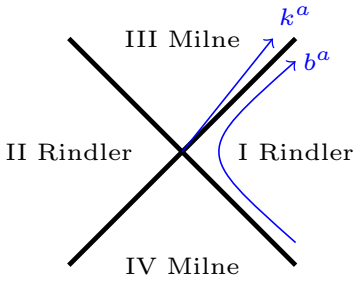
The load-bearing object is Milne quantization: the Fock-space description of a massless scalar field using positive-frequency modes defined by the dilation conformal Killing field in the future light-cone wedges of Minkowski spacetime, which in 1+1 dimensions coincide with the Rindler modes across the horizons. The identity that carries the argument is $F_1 = (f_1 + e^{-\pi\omega/\kappa} \bar{f}_2)/\sqrt{1-e^{-2\pi\omega/\kappa}}$, expressing the inertial positive-frequency purification mode as a Bogoliubov mixture of the Milne mode $f_1$ and its reflected Rindler partner $f_2$. This identity converts the statement that $f_1$ is entangled with the Hawking mode $h$ into a lower bound on inertial particle number, because the vacuum correlations that would otherwise tie $f_1$ to $f_2$ are unavailable. The companion moving-mirror energy-flux formula supplies the estimates for the energy carried by the late-time particles.
What would settle it
Compute the exact late-time state in a concrete unitary model of Planck-scale evaporation, or in a moving mirror model with overlapping modes: if the partner mode does not emerge as a Milne mode of the final Minkowski region, or if the expected inertial particle number in the purifying modes is less than the Hawking number once overlap is included, the paper's conclusion fails.
Extended reading notes
Core claim
The central claim is that vacuum entanglement does not purify Hawking radiation at zero particle cost. For the moving mirror, using a nonstandard "out" quantization whose late-time modes are Milne modes, the outgoing state is exactly $\Psi = (\sum_n e^{-n\pi\omega/\kappa} |n\rangle_h |n\rangle_{f_1}) \otimes \Psi'$, with the Hawking mode $h$ entangled with the Milne mode $f_1$. Rewriting this state in ordinary inertial out-particles gives the inequality $\langle N(F_1)\rangle > \langle N(h)\rangle$, where $F_1$ is the inertial mode that purifies the Hawking mode: the late-time purification must contain strictly more inertial particles than the Hawking mode it purifies. The reason is that in the global vacuum the Milne mode $f_1$ would have been entangled with a Rindler partner $f_2$; once $f_1$ is used to purify the Hawking radiation, that vacuum correlation is broken and $f_2$ must be populated by inertial particles. The same final state, transplanted to a (3+1)-dimensional evaporating black hole, would require as many late-time inertial particles as Hawking particles, each of Planck energy, which the paper argues is not energetically possible.
Load-bearing premise
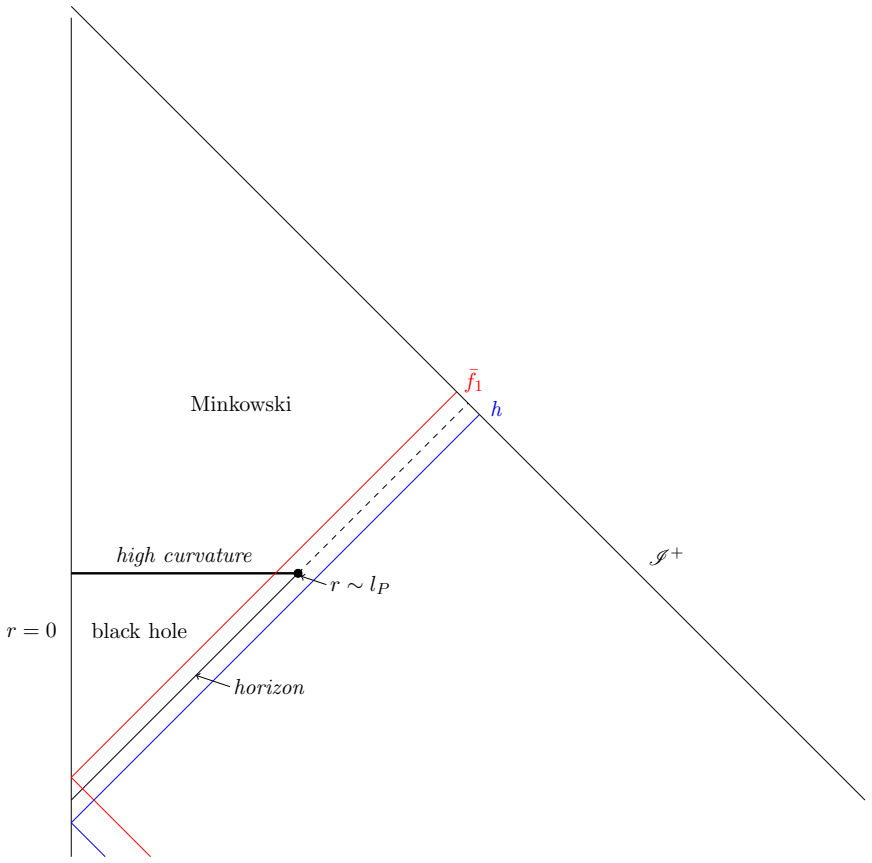
The black hole conclusion rests on the conjecture, posed as a possibility rather than derived, that the partner mode propagates through the Planck-scale high-curvature region and emerges as a Milne mode of the final Minkowski region; if high-curvature physics produces a different late-time state, the energy argument collapses, and the total-number claim also assumes the late-time modes do not overlap.
Editorial extensions
If this is right
- For every Hawking mode in the moving mirror, the expected number of inertial particles in the purifying mode strictly exceeds the expected number of Hawking particles in that mode (eq. 27), so the total late-time non-Hawking emission is at least as large as the total Hawking flux.
- If the mirror is brought back to rest at late times, the purification burst has energy of order $e^{\kappa u_1}$ times the total Hawking energy and is sharply localized near the moment the mirror becomes inertial.
- If the mirror merely stops accelerating while keeping its velocity, the late-time particles carry very little energy, but they are spread over long times and overlap with one another, so the simple energy estimate (28) is not reliable.
- In a (3+1)-dimensional evaporating black hole, an analogous final state of the form (48) would require at least as many late-time inertial particles as Hawking particles, each of Planck energy, which the paper concludes is not energetically possible.
- Vacuum entanglement therefore does not provide a viable way of avoiding information loss, contrary to the author's earlier assessment that it was potentially viable.
Reading between the lines
- Inference: The same counting argument should apply to any proposal that purifies Hawking radiation by entangling it with vacuum degrees of freedom on a future light cone, since the vacuum's entangled structure on wedges is fixed and can only be repurposed at the cost of populating the partner modes.
- Inference: The exact inequality (27) relies on the 1+1-dimensional coincidence that Rindler and Milne modes are the same; in 3+1 dimensions the Bogoliubov coefficients would differ, so a direct calculation in the future light cone of an evaporating black hole is the natural place to test the analogous bound.
- Inference: The low-energy escape in the mirror requires an external agent to supply a large boost to the final inertial state; in black hole evaporation no such agent exists, so any viable information-restoring dynamics would have to supply the energy from the Planck-scale regime itself.
Signed reviews
Editorial analysis
A structured set of objections, weighed in public.
Referee Report
Summary. This paper analyzes the Hotta-Schutzhold-Unruh moving mirror model as an analog of black hole Hawking emission. It introduces a nonstandard 'out' quantization that describes Hawking particles as entangled with 'Milne particles' in the region after the mirror becomes inertial, and then computes the inertial particle and energy content of this final state using a Bogoliubov transformation. The central technical result is a per-mode inequality (Eq. (27)): for each Hawking mode h, the expected number of late-time inertial particles in the partner mode F1 is strictly greater than the expected number of Hawking particles. The paper then estimates the associated energy cost for two mirror endpoint scenarios and applies the same reasoning to evaporating black holes, concluding that vacuum entanglement of Hawking radiation with final-state vacuum fluctuations would require as many Planck-scale inertial particles as Hawking particles and is therefore not energetically possible.
Significance. If the per-mode inequality is taken in isolation, the paper makes a rigorous and useful contribution: it quantifies, in a concrete unitary model, the sense in which purification of Hawking radiation by 'vacuum fluctuations' is not free of inertial-particle cost. The derivation of Eq. (25)–(27) is self-contained, uses only standard Bogoliubov theory, and has no fitted parameters; the comparison of the two mirror transitions in Section VI is also physically illuminating. The black hole application, however, rests on an explicitly conjectural final-state form (Eq. (48)), and the extension from per-mode to total particle and energy claims is not fully rigorous. The paper is clear about several of these caveats, which is to its credit, but the abstract and concluding statements state the black hole conclusion more strongly than the body supports.
major comments (2)
- [Section VII, Eq. (48)] The evaporating-black-hole conclusion depends entirely on the assumption that the partner mode emerges as a Milne mode in the final Minkowski region, yielding the final state (48). The paper itself says 'We do not know the physics that would apply in the high curvature regime' and describes this only as 'an interesting possibility.' If Planck-scale physics produces a different purification structure, the energy argument collapses. Since the paper's abstract and final paragraph state unconditionally that vacuum entanglement 'has the same difficulties' for evaporating black holes, the central claim for black holes is not established by the analysis; it is a conjecture. This should be stated as a conditional result throughout, or supported by an explicit physical argument that the Milne-mode form is the unique possibility consistent with known low-energy physics.
- [Section VI, Eqs. (27)–(28) and footnote 4] The per-mode inequality (27) is rigorously derived from the Bogoliubov transformation, but the step from 'true for each Hawking mode' to the total-number claim 'the total number of non-Hawking inertial particles emitted at late times must be greater than the total number of Hawking particles' assumes that the modes F1_i form an orthonormal set. Footnote 4 admits that these modes may significantly overlap, indeed 'may even overlap with the early time Hawking emission,' which means that simply summing (27) over i can double-count particles. Thus the total particle-number statement is not proven as a lower bound, and the energy estimate (28) is likewise an estimate rather than a rigorous bound. The distinction should be made explicit, especially because the low-energy turning-off scenario is precisely the case where the overlap is large.
minor comments (4)
- [Abstract and Section II] The abstract contains a typo ('blac k hole'), and Section II contains a duplicated word ('one defines defines a one-particle Hilbert space').
- [References] Reference [1] gives the year of Hawking's article as '195'; it should be 1975.
- [Section VI, Eqs. (28) and (46)] The symbol E_B is introduced in Eq. (28) as an estimate of late-time particle energy, and later in Eq. (46) as the integrated energy flux of a specific mirror trajectory. The relation between these two quantities, and the fact that Eq. (46) is a complementary check rather than a derivation of Eq. (28), should be stated more explicitly.
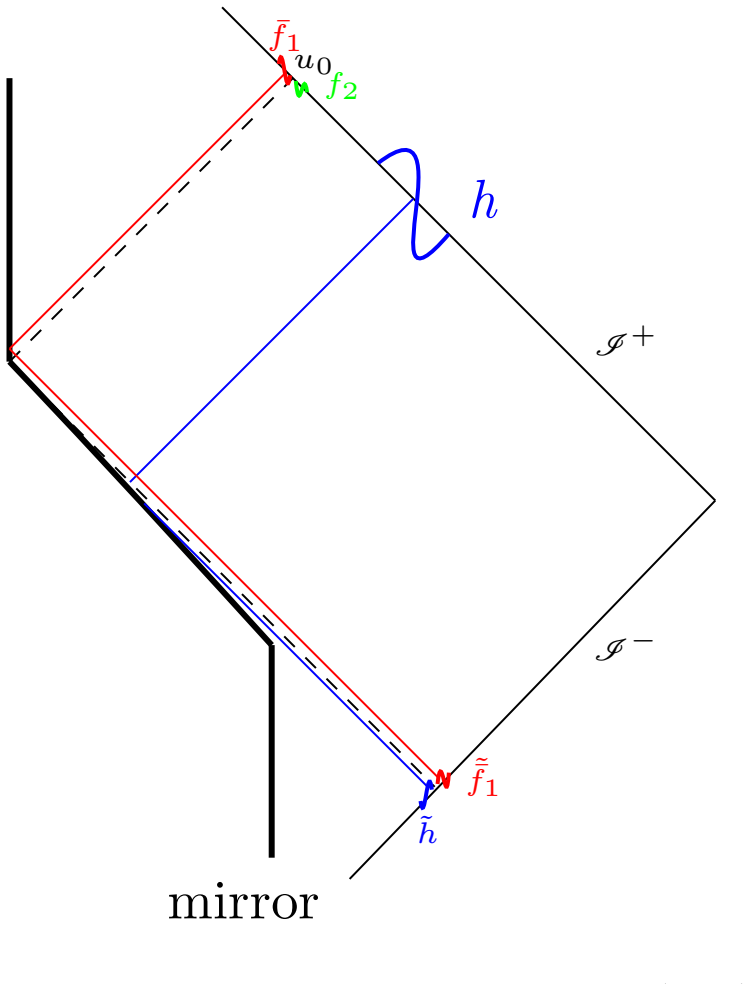
- [Figures 2 and 3] The labels in Figures 2 and 3 (e.g., 'h', '¯f1', 'f2') are terse; adding a sentence in the captions defining the modes and their colors would aid readability.
Circularity Check
No circularity: the per-mode mirror derivation is self-contained, and the black hole conclusion rests on an explicitly labeled conjecture rather than on a reduction to its own inputs.
full rationale
The per-mode mirror analysis is self-contained. Section III constructs Milne quantization from the dilation Killing field and identifies Rindler/Milne mode spaces through the horizon equality b^a = k^a, using Bisognano-Wichmann and Hislop-Longo as external theorems; the Minkowski-vacuum formulas (10), (13), and (14) are derived, not fitted. Section V defines H'_out as a choice of positive-frequency subspace and derives the out state (22) via the same Bogoliubov calculation as (8)-(9); no parameter is fitted to the target data. Section VI's inequality (27) follows algebraically from (24)-(26) and the positivity of the last term, so the claim that late-time inertial particle number exceeds Hawking particle number is a proven consequence, not an assumption. The energy estimates (32), (35), and (46) are explicit calculations, with the minimization claim in (46) flagged as unproven. Section VII's final-state formula (48) is explicitly introduced as an 'interesting possibility,' and the paper states that it does not know the high-curvature physics; this is an unproven extrapolation and a correctness risk, but it is not circular because the mirror chain does not presuppose (48). The self-citations to [3] and [7] are review/context citations and are not load-bearing. No step reduces by definition to its own input.
Assumptions & free parameters
assumptions (7)
- domain assumption The standard Fock space construction from a one-particle Hilbert space of positive frequency solutions (conditions (i)-(iii) in Section II) yields a valid notion of particles.
- domain assumption The Minkowski vacuum can be expressed as a thermal entangled state of Rindler particles (eq. 10) and of Milne particles (eq. 13), via the Unruh effect and the Hislop-Longo theorem.
- domain assumption The massless Klein-Gordon field is scale invariant, which is essential for defining Milne quantization with the dilation Killing field (Section III, paragraph after eq. 11).
- domain assumption The state of the field in the region u > u0 is the vacuum state for the final inertial mirror motion because past-directed null geodesics from that region do not interact with the non-inertial mirror (Section IV, first bullet).
- ad hoc to paper For an evaporating black hole, the final state takes the form (48), in which the partner mode emerges as a Milne mode in the final Minkowski region (Section VII, paragraph starting 'We do not know the physics...').
- ad hoc to paper Modes emerging from a Planck-scale high-curvature region have inertial frequencies of order the Planck scale (Section VII, paragraph 'By causality, the Milne modes f1...').
- domain assumption The moving-mirror energy flux formula (37) of Fulling and Davies correctly describes the energy radiated by the mirror trajectories considered.
invented entities (1)
-
Milne particles
Cite this review
Pith. "Pith review of The Particle and Energy Cost of Entanglement of Hawking Radiation with the Final Vacuum State." pith.science (2026). https://pith.science/paper/USFDEZPE
@misc{pith2026190806363,
  author       = {Pith},
  title        = {Pith review of: The Particle and Energy Cost of Entanglement of Hawking Radiation with the Final Vacuum State},
  year         = {2026},
  howpublished = {\url{https://pith.science/paper/USFDEZPE}},
  note         = {Machine review of arXiv:1908.06363}
}
abstract
A semiclassical analysis shows that in the process of black hole formation and evaporation, an initial pure state will evolve to a mixed state, i.e., information will be lost. One way of avoiding this conclusion without invoking drastic modifications of the local laws of physics in a low curvature regime would be for the information to be restored at the very end of the evaporation process. It is normally envisioned that this would require a final burst of particles entangled with the early time Hawking radiation. This would imply the emission of an extremely large number of particles from an object of Planck size and mass and would appear to be blatantly ruled out by energy considerations. However, Hotta, Schutzhold, and Unruh have analyzed a $(1+1)$-dimensional moving mirror analog of the Hawking process and have found that, in this model, information is restored via entanglement of the early time Hawking radiation with vacuum fluctuations in the spacetime region to the future of the event where the mirror returns to inertial motion. We analyze their model here and give a precise formulation of this entanglement by introducing the notion of "Milne particles." We then analyze the inertial particle and energy cost of such an entanglement of Hawking radiation with vacuum fluctuations. We show that that, in fact, the entanglement of early time Hawking radiation with vacuum fluctuations requires the emission of at least as many late time inertial particles as Hawking particles. Although the energy cost can be made small in the $(1+1)$-dimensional mirror system, this should not be the case for the $(3+1)$-dimensional evaporating black hole system. Thus, vacuum entanglement has the same difficulties as the more usual burst scenarios for attempting to avoid information loss.
Figures
Forward citations
Cited by 1 Pith paper
-
Energy Flux as an Entanglement Current in Moving-Mirror Radiation
In moving-mirror analog Hawking radiation, negative energy flux is correlated with entanglement growth between local detector modes and is interpreted as an information-return channel tied to partner-mode recovery.
Reference graph
Works this paper leans on
-
[3]
Beginning at u = u1, the mirror begins transitioning back to inertial motion, and it is assumed to have become inertial by the retarded time u = u0 at which the mirror trajectory intersects the null line v = 0. (The line v = 0 is shown in fig. 2 as the black dashed line with slope −1; the line u = u0 is shown as the black dashed line with slope +1.) In fig....
-
[1]
( 15) below), the mirror is at rest at x = 0
At early times, t< −C (with C >κ, with κ being the constant appearing in eq. ( 15) below), the mirror is at rest at x = 0
-
[2]
At u = −C, the mirror begins to accelerate to the left. After a transition per iod (shown as a sharp corner in the figure, but the actual transition is assume d to be smooth), 12 the mirror follows a trajectory given in terms of the null coordinate s v = t +x and u =t −x by v = − 1 κe−κu. (15) It follows this trajectory starting at retarded time u = 0 and ...
-
[4]
S. D. Mathur, Fortsch. Phys. 53, 793 (2005) [arXiv:hep-th/0502050]
arXiv 2005
- [5]
- [6]
-
[7]
W.G. Unruh and R.M. Wald, Rep.Prog.Phys. 80, 092002 (2017); arXiv:1703.02140
arXiv 2017
-
[8]
and ( 9) above, we find that the quantities ˜F1(v) = ˜f1(v) +e−πω/κ ¯ ˜h(v) (18) and ˜F2(v) = ˜h(v) +e−πω/κ ¯ ˜f1(v) (19) are purely positive frequency with respect to inertial time v. If we propagate the solution given by the data ˜h(v) at I − forward in time, we will, of course, get back the original wavepacket h(u) at I +. This outgoing solution lies in...
Show all 18 references
-
[9]
Almheiri, D
A. Almheiri, D. Marolf, J. Polchinski and J. Sully, JHEP 02, 062 (2013) [arXiv:1207.3123]
2013 arXiv
-
[10]
Hotta, R
M. Hotta, R. Schutzhold, and W.G. Unruh, Phys. Rev. D.91124060 (2015) [arXiv:1503.06109]
2015 arXiv
-
[11]
R. M. Wald, Quantum Field Theory in Curved Spacetime and Black Hole Thermod ynamics, University of Chicago Press, (Chicago, 1994)
1994
-
[12]
Fell, Trans
J.M. Fell, Trans. Am. Math. Soc. 94, 365 (1960)
1960
-
[13]
Bisognano and E.H
J.J. Bisognano and E.H. Wichmann, J. Math. Phys. 17, 303 (1976). 27
1976
-
[14]
Higuchi, S
A. Higuchi, S. Iso, K. Ueda, and K. Yamamoto, Phys. Rev. D96, 083531 (2017) [arXiv:1709.05757]
2017 arXiv
-
[15]
Ellis and R.M
G.F.R. Ellis and R.M. Williams, Flat and Curved Spacetimes (second edition), Oxford Uni- versity Press (Oxford, 2000)
2000
-
[16]
Hislop and R
P.D. Hislop and R. Longo, Commun. Math. Phys. 84, 71 (1982)
1982
-
[17]
Tomitsuka, K
T. Tomitsuka, K. Yamaguchi, and M. Hotta, arXiv:1906.0 5009
1906
-
[18]
Fulling and P.C.W
S.A. Fulling and P.C.W. Davies, Proc. Roy. Soc. Lond. A 348, 393 (1976). 28
1976
Reviewed August 14, 2026 · model on record in the stance chip above.
Discussion (0). Continue with ORCID to comment.