REVIEW 3 major objections 4 minor 30 references
Quantum Ornstein-Zernike Equation
T0 review · 3 major / 4 minor · reviewed 2026-08-14 · deepseek-v4-flash
Pith's one-line read This paper proposes writing the quantum commutation effect as a sum of temperature-dependent pair effective potentials, so that classical statistical mechanics—including the Ornstein-Zernike equation—applies to quantum systems.
desk verdict Genuinely new formal machinery, but the paper's own Appendix C shows the pair truncation is inconsistent and numerically fails; the central claim collapses. read the letter →
The pith
A machine-rendered reading of the paper's core claim, the machinery that carries it, and where it could break.
The reading
What carries the argument
The central object is the commutation function $\omega$, defined by $e^{-\beta H}\omega=\langle q|e^{-\beta\hat H}|p\rangle/\langle q|p\rangle$, or equivalently its logarithm $W=\ln\omega$, a temperature-dependent effective potential. The carrying mechanism is the pair ansatz $W=\sum_{j<k}w^{(2)}(p_{jk},q_{jk})$, the nonlinear PDE $\partial\tilde w/\partial\beta=-u+(i\bar h/m)p_z\tilde w_z+(\bar h^2/m)(\tilde w_{xx}+\tilde w_{zz})+(\bar h^2/m)(\tilde w_x^2+\tilde w_z^2)$, its linear Fourier solution, and the generalized Mayer-f function that folds quantum corrections into a pairwise additive classical weight. This reduces the many-body quantum problem to a two-body computation that can be pre-tabulated on a grid and fed into standard classical closures such as the Ornstein-Zernike and hypernetted-chain equations.
What would settle it
For a three-particle Lennard-Jones system with two outer particles fixed, compute the total commutation function from the pair-truncated many-body expansion and compare it with an eigenfunction-sum calculation at $\beta\bar h\omega=0.5$; the paper's Figures 1 and 2 already show quantitative disagreement and unphysical momentum dependence. A direct check is to evaluate the dropped term $\nabla_1\tilde w_{12}\cdot\nabla_1\tilde w_{13}$ and test whether it is negligible compared with $\nabla_1\tilde w_{12}\cdot\nabla_1\tilde w_{12}$.
Extended reading notes
Core claim
The proposed discovery is a transformation: define $W=\ln\omega$ as an effective potential for the commutation function $\omega$, whose departure from unity measures non-commutativity. For a homogeneous system with pairwise interactions, $W$ is approximated as a sum over pair functions $w^{(2)}(p_{jk},q_{jk})$, each satisfying a nonlinear partial differential equation in inverse temperature and spatial coordinates. When the quadratic term is dropped, the linearized equation has the explicit Fourier-space solution $\hat{\tilde w}^{(2)}_{\mathrm{lin}}(k)=-\hat u(k)[e^{\beta b(k)}-1]/b(k)$, valid at high and intermediate temperatures or at large separations. Combining the pair commutation function with the pair potential and the dimer symmetrization term produces a generalized Mayer-f function, $f^{(2)}=e^{-\beta u^{(2)}}e^{w^{(2)}}e^{\eta^{(2)}}-1$, from which the quantum Ornstein-Zernike equation follows as a direct analogue of its classical counterpart.
Load-bearing premise
The load-bearing premise is that the non-linear term in the temperature-derivative equation can be reduced to pair terms by dropping cross terms between forces from different neighbours, so that $\nabla\tilde W\cdot\nabla\tilde W$ becomes a sum over two-body terms; the paper's Appendix C states there is no reason to suppose the neglected three-body term is smaller than the retained terms, and its own numerical tests fail at that point.
Editorial extensions
If this is right
- At high and intermediate temperatures, or at large separations, the linear solution (2.18) is valid, and the paper states the pair ansatz is exact in that linear regime.
- For lower temperatures, the nonlinear PDE can be solved by stepping downward in inverse temperature from the linear starting point, using Runge-Kutta integration.
- The generalized Mayer-f function vanishes at large separations, so classical diagrammatic expansions, integral equations, and density functional methods carry over to quantum systems; the quantum Ornstein-Zernike equation is the explicit example.
- Symmetrization effects for bosons and fermions enter as dimer loop functions at terrestrial densities, making particle statistics another pairwise additive effective interaction.
- Since the pair commutation function can be precomputed on a three-dimensional grid and interpolated, Metropolis Monte Carlo simulations remain computationally tractable.
Reading between the lines
- A repair suggested by the paper's own equations would be to retain the three-body cross terms in $\nabla\tilde W\cdot\nabla\tilde W$ rather than dropping them, or to resum them into an effective pair function; the failure reported in the numerical appendix identifies exactly where that term enters.
- The linear solution predicts that $w(q)$ decays more quickly at large separations than the pair potential itself, which could be tested directly by extracting $W$ from pair correlation data in a simulated quantum fluid, independent of eigenfunction sums.
- If the effective-potential picture is correct, then solving the quantum Ornstein-Zernike equation with a hypernetted-chain closure and comparing the resulting pair structure against path-integral Monte Carlo data would provide a stringent non-perturbative cross-check that does not rely on the pair-level evaluation that the appendix finds unreliable.
Signed reviews
Editorial analysis
A structured set of objections, weighed in public.
Referee Report
Summary. The paper proposes a new formulation of quantum statistical mechanics in classical phase space. It writes the commutation function as an effective potential W = ln ω, expands W as a sum of many-body terms, and claims that the pair term is dominant. A nonlinear PDE (Eq. 2.15) is derived for the pair commutation function, a linearized solution is given explicitly in Fourier space (Eq. 2.18), and an algorithm is sketched for the full nonlinear problem. The symmetrization function is similarly expanded in loop terms, leading to a generalized pair Mayer-f function and a quantum Ornstein-Zernike equation (Eq. 2.29). The abstract claims that these developments enable classical statistical mechanics to be applied to quantum systems. However, the paper's own Appendix C reports numerical results for the pair-truncated expansion that are 'not promising', 'unphysical', and explicitly concludes that the many-body expansion 'is not viable at the pair level'. These statements directly undercut the central claim of the paper.
Significance. If the central claim were valid, the paper would provide a systematic, parameter-free route to applying classical liquid-state techniques to quantum systems, which would be a substantial contribution. The explicit linear solution of the pair PDE is a genuine mathematical step, and the paper is commendably transparent in reporting its own negative numerical results. That transparency is also the paper's undoing: the load-bearing truncation is shown, inside the manuscript, to be inconsistent with its own temperature-derivative equation and to produce unphysical phase-space weights. The significance of the positive proposal is therefore not established, and the appended limitation statements are decisive for the verdict.
major comments (3)
- [§II.C, Eq. (2.13)] The approximation that drops the k' ≠ k cross terms in ∇W·∇W is the only step that makes the pair truncation closed, leading to the pair PDE (2.15) and all downstream results including the generalized Mayer-f function (2.28) and the quantum Ornstein-Zernike equation (2.29). Appendix C, Eq. (C.3), explicitly shows that for N=3 the neglected term 2∇_2 w21·∇_2 w23 has the same structure as the retained terms, and the paper states that 'there is no reason to suppose that the neglected term is smaller in magnitude than those that are retained.' The paper further concludes that the pair-terminated expansion is 'inconsistent with its temperature derivative' and 'not viable at the pair level.' Since this truncation is load-bearing, the central claim is not supported.
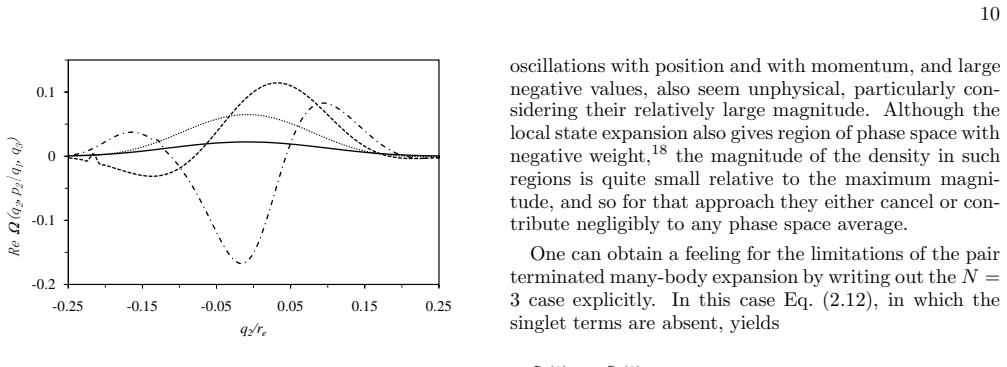
- [Appendix C, Figs. 1–2] The numerical tests presented as the only assessment of the pair-truncated many-body expansion show results that the paper itself describes as 'seem unphysical': dramatic oscillations, incorrect momentum dependence in the real part of the phase-space weight, and an 'unrealistically high average kinetic energy' in Monte Carlo simulations (not shown). These are not minor quantitative disagreements; they contradict the abstract's claim that the pair term is dominant and physically adequate. The paper's own juxtaposition with the local-state expansion, which it says agrees with benchmark results, reinforces that the proposed pair-level method fails in practice.
- [Appendix C, 'The Fourier transform methods proposed in the text do not work for the Lennard-Jones potential.'] The paper explicitly states that the Fourier transform methods proposed in the text do not work for the Lennard-Jones potential, which is the standard test system used in the numerical section. This invalidates the claimed computational algorithm for the full nonlinear problem (Eqs. 2.16–2.19) for a common and important interaction model, and further undermines the practical applicability asserted in the introduction and conclusion.
minor comments (4)
- [§II.C; §II.E] The notation for the pair commutation function is used inconsistently: w^(2)(p_jk, q_jk) sometimes denotes a function of relative momentum and separation, while in Eqs. (2.20)–(2.21) it is written with separate particle labels and momenta. Please clarify the arguments at each occurrence.
- [Eq. (2.26)] The derivation of the correction terms in the symmetrization loop product is hard to follow because of the δ̄ notation and the counting factors; a clearer step-by-step explanation or a reference to a standard derivation would help.
- [Throughout] There are several typographical and formatting errors, e.g., 'differenc' for 'difference' and inconsistent hyphenation of 'Planck's constant.' These are minor but should be corrected.
- [Eq. (2.30)] The hypernetted chain closure in Eq. (2.30) is written with complex phase-space quantities and oscillatory functions; the paper notes this but does not discuss convergence or uniqueness of solutions of the coupled OZ/HNC system. A brief comment on numerical strategy would be useful.
Circularity Check
No significant circularity; the new equations are derived from a stated PDE, and no fitted parameter is relabeled as a prediction.
full rationale
The paper's central derivation starts from the definition of the commutation function and its Kirkwood temperature derivative, Eq. (2.5), and then solves the resulting PDE under a stated pair ansatz. The linear solution, Eq. (2.18), is obtained by dropping the quadratic term in Eq. (2.17), not by fitting data; the non-linear solution is a stated numerical integration scheme. The generalized Mayer-f function and the quantum Ornstein-Zernike equation, Eqs. (2.28)-(2.29), are applications of standard classical-statistical-mechanics identities once the pair effective potential is assumed, and the paper explicitly says the OZ equation 'can just be written down' rather than being derived from the target result. Many definitions are cited to the author's prior work (e.g., the phase-space probability density and the proof of the symmetrization factor), but these are framework inputs, not predictions; the paper's new claims do not reduce to those citations by construction. The serious difficulty reported in Appendix C — that the pair-truncated expansion is 'inconsistent with its temperature derivative' and that 'there is no reason to suppose that the neglected term is smaller' — is an internal-consistency and numerical-reliability failure of the approximation, not circularity. No fitted parameter is renamed as a prediction, no uniqueness theorem is imported from the authors, and no equation is equivalent to its input by definition. Accordingly the circularity score is 0; correctness risk is a separate matter.
Assumptions & free parameters
assumptions (4)
- domain assumption The classical phase space quantum probability density, Eq (2.1), with the commutation and symmetrization functions, is taken as exact from Refs [3,4].
- ad hoc to paper The pair ansatz W = sum_{j<k} w^(2)(p_jk, q_jk) with neglect of three-body and higher terms in the many-body expansion.
- ad hoc to paper The approximation in Eq (2.13) that cross terms in ∇W·∇W average to zero, leaving only k'=k terms.
- domain assumption The symmetrization loop expansion is truncated and exponentiated, Eq (2.27), keeping leading-order independent loop products.
Cite this review
Pith. "Pith review of Quantum Ornstein-Zernike Equation." pith.science (2026). https://pith.science/paper/ROVTTMZA
@misc{pith2026190806373,
  author       = {Pith},
  title        = {Pith review of: Quantum Ornstein-Zernike Equation},
  year         = {2026},
  howpublished = {\url{https://pith.science/paper/ROVTTMZA}},
  note         = {Machine review of arXiv:1908.06373}
}
read the original abstract
The non-commutativity of the position and momentum operators is formulated as an effective potential in classical phase space and expanded as a series of successive many-body terms, with the pair term being dominant. A non-linear partial differential equation in temperature and space is given for this. The linear solution is obtained explicitly, which is valid at high and intermediate temperatures, or at low densities. An algorithm for solving the full non-linear problem is given. Symmetrization effects accounting for particle statistics are also written as a series of effective many-body potentials, of which the pair term is dominant at terrestrial densities. Casting these quantum functions as pair-wise additive, temperature-dependent, effective potentials enables the established techniques of classical statistical mechanics to be applied to quantum systems. The quantum Ornstein-Zernike equation is given as an example.
Figures

Reference graph
Works this paper leans on
-
[1]
Wigner, ``On the Quantum Correction for Thermodynamic Equilibrium'', Phys.\ Rev.\ 40 , 749 (1932)
E. Wigner, ``On the Quantum Correction for Thermodynamic Equilibrium'', Phys.\ Rev.\ 40 , 749 (1932)
work page 1932
-
[2]
J. G. Kirkwood, ``Quantum Statistics of Almost Classical Particles'', Phys.\ Rev.\ 44 , 31 (1933)
work page 1933
-
[3]
Attard, Entropy Beyond the Second Law
P. Attard, Entropy Beyond the Second Law. Thermodynamics and Statistical Mechanics for Equilibrium, Non-Equilibrium, Classical, and Quantum Systems, (IOP Publishing, Bristol, 2018)
work page 2018
-
[4]
Attard, ``Quantum Statistical Mechanics in Classical Phase Space
P. Attard, ``Quantum Statistical Mechanics in Classical Phase Space. Expressions for the Multi-Particle Density, the Average Energy, and the Virial Pressure'', arXiv:1811.00730 [quant-ph] (2018)
arXiv 2018
-
[5]
P. Attard, ``Quantum Statistical Mechanics in Classical Phase Space. Test Results for Quantum Harmonic Oscillators'', arXiv:1811.02032 (2018)
work page Pith review arXiv 2018
-
[6]
P. Attard, ``Quantum Statistical Mechanics in Classical Phase Space. III. Mean Field Approximation Benchmarked for Interacting Lennard-Jones Particles'', arXiv:1812.03635 [quant-ph] (2018)
work page Pith review arXiv 2018
-
[7]
A. Hernando and J. Van\'i cek, ``Imaginary-time nonuniform mesh method for solving the multidimensional Schr\"odinger equation: Fermionization and melting of quantum Lennard-Jones crystals'', Phys.\ Rev.\ A 88 , 062107 (2013). arXiv:1304.8015v2 [quant-ph] (2013)
work page Pith review arXiv 2013
-
[8]
P. Attard, ``Fermionic Phonons: Exact Analytic Results and Quantum Statistical Mechanics for a One Dimensional Harmonic Crystal'', arXiv:1903.06866 [quant-ph] (2019)
work page Pith review arXiv 2019
Show all 30 references
-
[9]
Messiah, Quantum Mechanics, (North-Holland, Amsterdam, Vols I and II, 1961)
A. Messiah, Quantum Mechanics, (North-Holland, Amsterdam, Vols I and II, 1961)
1961
-
[10]
[ Attard19 ] the symmetrization factor was shown correct for fermion statistics via a proof by induction that the number of even and odd permutations of N objects were equal
In Ref. [ Attard19 ] the symmetrization factor was shown correct for fermion statistics via a proof by induction that the number of even and odd permutations of N objects were equal. A much simpler proof is as follows: Suppose that \ P _ \ _ =1 ^ N! is any set of permutation o...
-
[11]
R. K. Pathria, Statistical Mechanics, (Pergamon Press, Oxford, 1972)
1972
-
[12]
Hansen and I
J.-P. Hansen and I. R. McDonald Theory of Simple Liquids, (Academic Press, London, 1986)
1986
-
[13]
Attard, Thermodynamics and Statistical Mechanics: Equilibrium by Entropy Maximisation (Academic Press, London, 2002)
P. Attard, Thermodynamics and Statistical Mechanics: Equilibrium by Entropy Maximisation (Academic Press, London, 2002)
2002
-
[14]
Morita and K Hiroike, ``A New Approach to the Theory of Classical Fluids
T. Morita and K Hiroike, ``A New Approach to the Theory of Classical Fluids. III ---General Treatment of Classical Systems---'', Progr.\ Theor.\ Phys.\ 25 , 537--578 (1961)
1961
-
[15]
Stell, ``Cluster Expansions for Classical Systems in Equilibrium'', in The Equilibrium Theory of Classical Fluids, (H
G. Stell, ``Cluster Expansions for Classical Systems in Equilibrium'', in The Equilibrium Theory of Classical Fluids, (H. L. Frisch and J. L. Lebowitz, eds, p.\ II:171--266, W. A. Benjamin, New York, 1964)
1964
-
[16]
Attard, ``Pair Hypernetted Chain Closure for Fluids with Three-body Potentials
P. Attard, ``Pair Hypernetted Chain Closure for Fluids with Three-body Potentials. Results for Argon with the Axilrod-Teller Triple Dipole Potential.'' Phys.\ Rev.\ A 45 , 3659--3669 (1992)
1992
-
[17]
Merzbacher, Quantum Mechanics, (Wiley, New York, 2nd ed., 1970)
E. Merzbacher, Quantum Mechanics, (Wiley, New York, 2nd ed., 1970)
1970
-
[18]
Attard, ``Quantum Statistical Mechanics in Classical Phase Space
P. Attard, ``Quantum Statistical Mechanics in Classical Phase Space. V. Quantum Local, Average Global'', arXiv:2005.06165 [quant-ph] (2020)
2020 arXiv
-
[19]
Attard, Quantum Statistical Mechanics: Equilibrium and Non-Equilibrium Theory from First Principles, (IOP Publishing, Bristol, 2015)
P. Attard, Quantum Statistical Mechanics: Equilibrium and Non-Equilibrium Theory from First Principles, (IOP Publishing, Bristol, 2015)
2015
-
[20]
Gasiorowicz, Quantum Physics (Wiley, New York, 1974)
S. Gasiorowicz, Quantum Physics (Wiley, New York, 1974)
1974
-
[21]
H. L. Strauss, Qunatum Mechanics: An Introduction (Prentice Hall, Englewood Cliffs, New Jersey, 1968)
1968
-
[22]
Abramowitz and I
M. Abramowitz and I. A. Stegun, Handbook of Mathermatical Functions (Dover, New York, 9th printing, 1970)
1970
-
[23]
R. G. Parr and W. Yang, Density-Functional Theory of Atoms and Molecules, (Oxford University Press, 2nd ed.\ 1994)
1994
-
[24]
Morton and D
K. Morton and D. Mayers, Numerical Solution of Partial Differential Equations, An Introduction, (Cambridge University Press, 2nd ed.\ 2005)
2005
-
[25]
Bloch, J
I. Bloch, J. Dalibard, and W. Zwerger, Rev.\ Mod.\ Phys.\ 80 , 885 (2008)
2008
-
[26]
J. M. McMahon, M. A. Morales, C. Pierleoni, and D. M. Ceperley, Rev.\ Mod.\ Phys.\ 84 , 1607 (2012)
2012
-
[27]
Pollet, Rep.\ Prog.\ Phys.\ 75 , 094501 (2012)
L. Pollet, Rep.\ Prog.\ Phys.\ 75 , 094501 (2012)
2012
-
[28]
Attard, ``Quantum Statistical Mechanics as an Exact Classical Expansion with Results for Lennard-Jones Helium'', arXiv:1609.08178v3 [quant-ph] (2016)
P. Attard, ``Quantum Statistical Mechanics as an Exact Classical Expansion with Results for Lennard-Jones Helium'', arXiv:1609.08178v3 [quant-ph] (2016)
2016 arXiv
-
[29]
Attard, ``Quantum Statistical Mechanics Results for Argon, Neon, and Helium Using Classical Monte Carlo'', arXiv:1702.00096 (2017)
P. Attard, ``Quantum Statistical Mechanics Results for Argon, Neon, and Helium Using Classical Monte Carlo'', arXiv:1702.00096 (2017)
2017 arXiv
-
[30]
S. W. van Sciver, Helium Cryogenics (Springer, New York, 2nd ed., 2012)
2012
Reviewed August 14, 2026 · model on record in the stance chip above.
Discussion (0). Continue with ORCID to comment.